Financial Reporting in Lithuania
JONAS MACKEVIČIUS
Vilnius University
Sauletekio 9, LT-10222 Vilnius
LITHUANIA
[email protected]
SVETLANA ZVEROVICH
University of the West of England – Bristol Business School
Frenchay Campus, Coldharbour Lane, BS16 1QY Bristol
UNITED KINGDOM
[email protected]
LAIMUTĖ KAZLAUSKIENĖ
Mykolas Romeris University
Ateities 20, LT-08303 Vilnius
LITHUANIA
[email protected]
Abstract: - Small-and-medium sized enterprises (SMEs) are a driving force of each economy. This chapter
deals with the current stage of financial reporting for SMEs in Lithuania. Due to the globalization of business and international harmonization of financial reporting also Lithuania experiences a shift in paradigms from historical costs accounting towards fair value measurement. Chapter provides an analysis between national accounting legislature and standard IFRS for SMEs.
Key-Words: - Financial reporting, International harmonization, Measurement, Financial statements, Small and
Medium Sized enterprises (SMEs), Lithuania.
Country Lithuania
(Lietuva) Location
Baltic country (North-Eastern Europe) Area
65,300 km2
Population
3,545,319 (2010 est.) Member of European Union
since 1st May 2004; Schengen country
Currency
litas (LTL); 3.451 LTL/EUR (as at 31.12.2010)
1 Country Introduction
Vilnius. The population of Lithuania stands at 3,349,900, of whom 83.1% are ethnic Lithuanians who speak Lithuanian, which is the official language of the country. Several sizable minorities exist such as Poles (6.0%), Russians (4.8%), Belarusians (1.1%) and Ukrainians (0.6%).
For the first time the name Lithuania was mentioned in 1009 AD in a medieval Prussian manuscript, the Quedlinburg Chronicle. In the 13th century AD, the Grand Duchy of Lithuania was created by Mindaugas who united the lands inhabited by the Lithuanians, Samogitians, Jotvingians and Couronians. In the middle ages (1392–1430), the Grand Duchy of Lithuania became the largest state in Europe. Its borders stretched from the Baltic to the Black Sea and almost to Moscow. For the next four centuries, Lithuania gradually became dominated by Poland, until 1795 when the Russian-Prussian-Hapsburg alliance made the third and final partition of Poland and Lithuania became a province of Russia. Lithuania achieved its independence only in February 1918, and between 1920 and 1923 the Republic of Lithuania had been recognized by the major countries. It remained independent until 23 August 1939, when Germany and the USSR signed the so-called Molotov-Ribbentrop Pact, in which Lithuania was the first in the sphere of influence of Germany and then, following the Soviet Agreement of 28 September 1939, fell under the rule of the USSR [1]. After the occupation by Nazi Germany, the Soviet order was re-established in Lithuania in 1944 when the Red Army forced Nazi German out of Lithuania. On 11 March 1990, Lithuania was the first of the Soviet Republics to declare its independence; it regained statehood and joined the community of nations. In October 2002, Lithuania was invited to join the European Union (EU), and in May 2004 it became a member of the EU. In 2003, before joining the European Union, Lithuania had the highest economic growth rate amongst all the candidate and member countries. Most of the trade of Lithuania is within the European Union. By the UN classification, Lithuania is a country with a high average income. The country boasts a well developed modern infrastructure of railways, airports and four-lane highways. As of October 2008, the unemployment rate is 4.7%. According to officially published figures, EU membership fueled a booming economy, increased outsourcing into the country, and boosted the tourism sector. Litas, the national currency, has been pegged to the euro since 2 February 2002 at the rate of EUR 1.00 = LTL 3.4528 and Lithuania is expecting to switch to the euro on 1 January 2014. Lithuania is part the EU single market.
Structurally, there is a gradual but consistent shift towards a knowledge-based economy with special emphasis on biotechnology (industrial and diagnostic) as well as laser equipment. Major biotechnology producers in the Baltic countries are concentrated in Lithuania. Also, mechatronics and information technology (IT) are seen as prospective knowledge-based economy directions in Lithuania. In 2009, "Barclays" bank IT centre appeared in Lithuania, and in 2010 IBM Company with the Lithuanian government decided to set up a research center there. Also, the first solar cell plant has been opened in Lithuania, and "Western Union" decided to establish a money transfer centre there in 2010. The Lithuanian government strategy is as follows: Lithuanian economy is the production of high added value products and services.
Lithuania has a flat tax rate rather than a progressive scheme. Lithuanian income levels are lower than in the older EU Member States. According to Eurostat data, Lithuanian PPS GDP per capita stood at 61 per cent of the EU average in 2008. Lower wages have been a factor that in 2004 fueled emigration to wealthier EU countries, something that has been made legally possible as a result of accession to the European Union. Prior to the global financial crisis of 2007–2010, Lithuania had one of the fastest growing economies in the European Union. Lithuania is a member of NATO, the Council of Europe, and Lithuania became a full member of the Schengen Agreement on 21 December 2007. In 2009, Vilnius was the European Capital of Culture and Lithuania celebrated the millennium of its name.
2 Legal System
Since 1990, the legal system of Lithuania has been reformed to meet the demands of the vast social and economic changes brought about by a return to democracy and a free market economic system.
power of Lithuania is exercised bythe Seimas (Parliament),the President of the Republic,the Government andthe Courts. The chief of the Republic of Lithuania is the president who is directly elected by the people and serves a five-year term. The head of the government is the premier, who is formally appointed by the president (subject to approval by the parliament).
Since Lithuania has declared its independence, there has been a large scale of complicated changes faced by the national economy in the process of changeover from a state ownership to a private one. Many new entities, especially medium and small-sized, were established and Lithuania has been continuing the growth into an economically strong country. The Republic of Lithuania Law on Small and Medium-sized Business Development defines four types of entities in Lithuania: large, medium, small and micro [3] (see Table 1).
Table 1. Classification of Enterprises by Size Based on the Republic of Lithuanian Law on Small and
Medium-Sized Business
Type
Recognition criteria
Lithuanian legislation Recommendations of the European Commission Number of
employees, people
Annual income, LTL million
Balance sheet value of assets, LTL
million
Number of employees,
people
Annual turnover and/
or balance sheet amount,
EUR million
Large 250 138 93 > 250 Turnover > 50,
balance > 43
Medium < 250 < 138 < 93 < 250 Turnover < 50,
balance < 43
Small < 50 < 24 < 17 < 50 < 10
Micro < 10 < 7 < 5 < 10 < 2
Source: [3]
According to the Department of Statistics of the Republic of Lithuania, the number of Small and Medium-sized Enterprises (SMEs) is constantly growing. By 1 January 2008, there were 63,187 active SMEs in Lithuania. This number increased by 7,362, or 13.2 percent, as compared to the number of SMEs in 2004. Also, the significance and contribution by small and medium enterprises to the national economy increase each year. In Lithuania, small and medium sized enterprises account for more than 99 percent of the total number of active enterprises. They produce about 60 percent of the gross value added, generated by all Lithuania’s enterprises, and provide jobs for more than 70 percent of all the employed [4].
Taking into account the contribution of SMEs to the national economy of Lithuania, the Government of the Republic of Lithuania has tried to create not only the best possible conditions for the establishment of new SMEs but also to encourage a further development and vitality of the already operating ones, e.g. on 19 October 2005, the Government of the Republic of Lithuania approved the Strategic Guidelines for Small and Medium-sized Business Development (Resolution No 1104). According to the Resolution, the following medium-term development trends of Small and Medium-sized Business (SMB) were defined in the Strategic Guidelines for SMB Development:
to improve the legal and economic environment for SMB;
to improve financial assistance for SMB;
to encourage entrepreneurship in regions;
to promote competitiveness of SMB entities [5].
current economic recession for the benefit of local businesses and contribute to higher investment activities of those companies [6, 13].
However, there are some challenges that this business sector faces. In 2001, the biggest business constraints for SMEs were low purchasing power, high taxes and the lack of working capital. In 2005, the businessmen of the sector pointed out that the major obstacles for the development of SMEs are high taxes and severe competition; and in 2007 one of the main problems mentioned was the lack of high-skilled specialists [7].
2.1 Business Law
The procedure for the incorporation of limited civil liability companies is governed by the Law on Companies of the Republic of Lithuania (No VIII-1835). The Law regulates the incorporation, management, activities, reorganization, transformation, split-off and liquidation of the companies having the legal form of a public or private limited liability company, the rights and duties of the shareholders, as well as establishment of branches of foreign companies and termination of their activities. When the provisions of this Law apply to a limited liability company, both public and private, the term “company” shall be used. The provisions of the Law are brought in line with the legal acts of the European Union specified in the Annex to the Law.
The authorized capital of a public company shall be not less than LTL 150,000. Its shares may be offered or traded publicly in accordance with legal acts governing the securities market.
The authorized capital of a private company shall be not less than LTL 10,000, and a company shall have not more than 250 shareholders. Shares of a private company shall not be offered or traded publicly unless the laws provide differently.
2.2 Accounting Law
Pursuant to the Law on Accounting, accounting of an entity shall be handled by the following:
an accounting service of an economic entity
a company rendering accounting services under a contract
the head of an individual enterprise. (This provision shall apply to unlimited civil liability legal persons with a sole owner, notaries, lawyers and natural persons holding patents.)
farmer and farmer’s partners
The chief accountant (accountant) and the accounting company shall be responsible for accuracy of accounting entries for the timely submission of financial reports. The responsibility of the chief accountant (accountant) shall be defined by legal acts of the Republic of Lithuania. The responsibility of the accounting company shall be defined in a written agreement concluded with the customer.
The accounting department shall be run by the chief accountant. All instructions of the chief accountant with regards to the management of accounts shall be binding upon all staff of the entity and of the accounting department in particular. The chief accountant, in concert with highly experienced accounting staff, shall
develop the organizational chart of the accounting department and the program of accounting works
define the flows of accounting information and their users, and also the system of the turnover of
documents
take care of installation and dislocation of the workstations for the accounting staff
create good microclimate and favorable working conditions
established by the head of an economic entity, ensuring safety of the documents. After the approval of a financial statement, accounting documents and registers shall be stored under the procedure established by the head of an economic entity, observing the time limits of documents storage set by the Government. When accounting documents or accounting registers disappear or are partially or wholly damaged the person who lost or damaged them shall write an explanation to the head of an economic entity. The head of an economic entity shall make a decision on the restoration of the documents under the procedure established by the Government.
As mentioned before, the chief accountant (accountant) and the accounting company shall be responsible for accuracy of accounting entries for the timely submission of financial statements. It should be noted that the responsibility for the general organization of accounting and storage of the accounting documents shall rest upon the head of the entity.
Lithuania’s chart of accounts is of two levels: specimen and individual. Pursuant to the Accounting Law, the specimen chart of accounts is developed, approved and published in “Valstybes Zinios” (Official Gazette) by the Audit and Accounting Authority. Each entity shall develop its own chart of accounts. The chart of accounts shall be approved by the head of that entity. Entities may prepare their individual chart of accounts according to their information needs, e.g. to reduce it, or supplement it introducing new more analytical accounts. Each entity, when preparing its individual chart of accounts, shall observe the general principles for the preparation of charts of accounts, i.e. the information received should satisfy the needs of both, external and internal users of information. Abridged Chart of Accounts is presented in Appendix IV.
Accounting policy shall comprise accounting principles, accounting methods and rules for handling an entity’s accounting, as well as compiling and presenting financial statements. The head of an entity must choose and implement an accounting policy taking into consideration specific business conditions, type of business, and invoking the Business Accounting Standards. Business Accounting Standards are based on principles and they are not influenced by taxation rules. All limited civil liability profit-seeking entities, which are registered in the Republic of Lithuania in accordance with the Law on Financial Statements of Entities, shall draw up annual financial reports at the end of their financial year. For taxation purposes, entities need to prepare tax declaration in accordance with the taxation rules.
2.3 Tax Law
After regaining the independence by Lithuania free market relations started coming into existence in the national economy, and the number of enterprises increased to a material extent. This naturally caused a necessity to accordingly modify the national tax administration system. Starting from 1990, significant efforts have been devoted to the development of a tax administration system that could meet the needs of the national economy. For quite an extended period of time the authorities could not reach a decision concerning which law should set the fundamentals of the taxation system and principal provisions of tax policy and the liability of tax payers. After long discussions the Law on Tax Administration was passed by the Seimas of the Republic of Lithuania on 28 June 1995.
Law of the Republic of Lithuania on Tax Administration shall establish the basic concepts and regulations, which must be observed in implementing the tax laws of the Republic of Lithuania, the basic principles of legal regulation of taxation, the list of taxes applied in the Republic of Lithuania, the functions, rights and obligations of the tax administrator, the rights and obligations of the taxpayer, the calculation and payment of taxes, the procedure of enforced recovery of taxes and related amounts as well as the procedure for the settlement of tax disputes. This Law also ensures the implementation of the EU legal acts regulating taxation. Article 13 of the Law on Tax Adminsitration defines the following taxes that shall be administered under this Law:
value added tax;
excise duty;
personal income tax;
immovable property tax;
state natural resources tax;
petroleum and gas resources tax;
tax on environmental pollution;
consular fees;
stamp duty;
inheritance tax;
compulsory health insurance contributions;
contributions to the Guarantee Fund;
state-imposed fees and charges;
lottery and gaming tax;
fees for the registration of industrial property objects;
corporate income tax;
state social insurance contributions;
excess quota tax on white sugar;
quota sugar production tax;
additional sugar production tax;
customs duties;
deductions from income under the Law of the Republic of Lithuania on
Forestry;
tax on the use of state property by the right of trust.
All of above mentioned taxes are regulated by a separate Law or other legal acts.
Starting from 2009, standard VAT tax rate has been 21%. The reduced VAT rate of 9% is applied to books
and non-periodic information publications. Personal income of individuals (except dividends and other profit distributions) is subject to personal income tax at the standard rate of 15%. Dividends and other profit distributions are taxed at the personal income tax rate of 20%. Income received by an owner of an unlimited civil liability entity from the entity's taxable profits is taxed at 15%.
3 Evolution of Accounting after 1989
Since the restoration of independence in 1990, Lithuania has been rapidly moving to the worldwide market. Its accounting system has changed considerably. In the evolution of the Lithuanian accounting after 1990 the following stages can be recognized [2]:
Accounting reorganisation necessities (1990–1991)
Adoption of regulatory acts (1992–1995)
Implementation and improvement of regulatory acts (1996–2001)
Integration in the European system of accounting (2002–2007)
Further development and improvement (2007–present)
The main challenges of the first stage were to determine how the Lithuanian accounting system should look like and what its key principles and characteristics should be in the new business environment. During this stage, the following events have taken place:
On 7 September 1990, the Lithuanian Association of Accountants and Auditors was set up and its first
congress was held on 30 November 1990. The congress adopted the appeal to the national government requesting to begin drafting the regulatory acts for the management of accounting.
In November 1990, the seminar-conference of the leading accounting specialists of the Baltic States
was organised to develop the concept of accounting common for the Baltic States.
The Republic of Lithuania Law on the Principles of Accounting was devoted only to the principles of accounting and it did not consider the accounting framework as a whole.
On 27 January 1993, the Government adopted the Resolution No 804 on Accounting and Annual Financial Statements of Legal Persons with Limited Liabilities. The Resolution approved a new procedure for the preparation of the financial statements and for the recognition of income and costs. Based on this Resolution, the Ministry of Finance of the Republic of Lithuania approved a new standard Chart of Accounts and drafted the forms of financial statements and explanations for the explanatory notes and the Chart of Accounts.
The third stage can be designated as a stage of new actions and expectations. The Order issued by the Ministry of Finance on 29 June 1995 on the Establishment of the Institute of Audit and Accounting might be considered as a start of this stage. On 21 December 1998, the Institute was renamed to the Institute of Audit, Accounting and Property Valuation of the Republic of Lithuania (Ministry of Finance Order No 297), and subsequently to the Institute of Accounting. On the initiative of this Institute and the Accounting Department of Vilnius University in 1997, a campaign was launched aimed at reorganization of the accounting system of Lithuania and development of the concept of its further improvement. The following works have been proposed:
drafting a new accounting law
improving the existing Chart of Accounts
preparing the professional accountants training programme
updating the applicable forms of financial reporting
developing the national accounting standards etc.
In 1997, when the International Accounting Standards (IAS) were translated into Lithuanian by the Institute of Accounting of the Republic of Lithuania, an active campaign regarding the preparation of national accounting standards based on the international ones was launched. On 6 November 2001, the Seimas (Parliament) of the Republic of Lithuania passed three Laws regulating the accounting system: the Republic of Lithuania Accounting Law, the Republic of Lithuania Law on Financial Statements of Entities and the Republic of Lithuania Law on Consolidated Financial Statements [9, 10, 11]. These Laws have been harmonized with the Fourth (78/660) and Seventh (83/349) EEC Council Directives.
The fourth stage started from year 2002. The year 2002 is considered as the start of the integration in the European system of accounting when the Institute of Accounting of the Republic of Lithuania commenced intensive and consistent development of the Lithuanian Business Accounting Standards (BAS). On 18 December 2002, the Board of the Institute of Accounting of the Republic of Lithuania approved the first 17
Business Accounting Standards. Overall, since 2002 thirty seven Business Accounting standards have been
developed; twenty nine of them are based on IFRS. From September 2008, the Accounting Institute was renamed to the Audit and Accounting Authority.
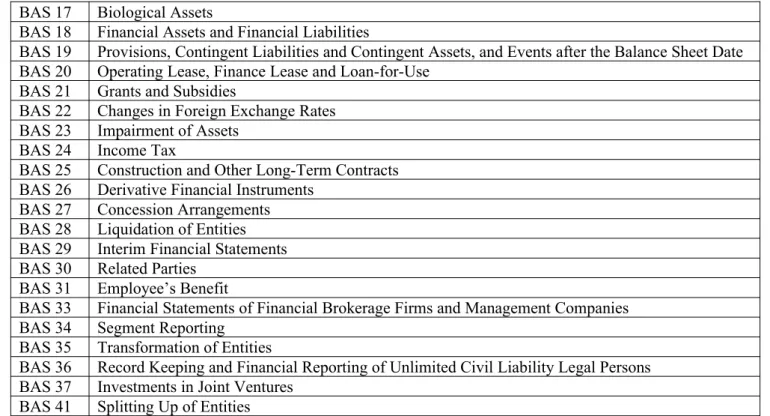
Table 2. List of Business Accounting Standards
BAS 1 Financial Statements
BAS 2 Balance Sheet
BAS 3 Income Statement
BAS 4 Statement of Changes in Equity
BAS 5 Cash Flow Statement
BAS 6 Explanatory Notes
BAS 7 Changes in Accounting Policies, Accounting Estimates and Correction of Errors
BAS 8 Equity
BAS 9 Inventories
BAS 10 Income
BAS 11 Expenses
BAS 12 Non-Current Tangible Assets
BAS 13 Intangible Assets
BAS 14 Business Combinations
BAS 15 Investments in Associates
BAS 17 Biological Assets
BAS 18 Financial Assets and Financial Liabilities
BAS 19 Provisions, Contingent Liabilities and Contingent Assets, and Events after the Balance Sheet Date
BAS 20 Operating Lease, Finance Lease and Loan-for-Use
BAS 21 Grants and Subsidies
BAS 22 Changes in Foreign Exchange Rates
BAS 23 Impairment of Assets
BAS 24 Income Tax
BAS 25 Construction and Other Long-Term Contracts
BAS 26 Derivative Financial Instruments
BAS 27 Concession Arrangements
BAS 28 Liquidation of Entities
BAS 29 Interim Financial Statements
BAS 30 Related Parties
BAS 31 Employee’s Benefit
BAS 33 Financial Statements of Financial Brokerage Firms and Management Companies
BAS 34 Segment Reporting
BAS 35 Transformation of Entities
BAS 36 Record Keeping and Financial Reporting of Unlimited Civil Liability Legal Persons
BAS 37 Investments in Joint Ventures
BAS 41 Splitting Up of Entities
According to the Republic of Lithuania Accounting Law (Article 4), from 1 January 2004, limited liability
profit-seeking entities are required to comply with the BAS . On 7 June 2007, the Parliament of Lithuania
passed amendments to the Law on Financial Statements of Entities (No 1179), the Accounting Law (No X-1178) and the Law on Consolidated Accounts of Entities (No X-1180). According to these amended laws, limited civil liability profit-seeking entities, whose securities are not traded on regulated markets, are allowed to choose either the BAS or IFRS for keeping accounts and preparing financial statements for the financial year starting 1 July 2007 and later. The structure of these laws is presented in Table 3.
Table 3. The structure of the laws
The Republic of Lithuania Accounting Law The Republic of Lithuania
Law on Financial Statements of Entities
The Republic of Lithuania Law on Consolidated Accounts of Groups of Undertakings Chapter I.
General provisions
Chapter I.
General provisions
Chapter I.
General provisions Chapter II.
Organizations of accounting
Chapter II.
Generally accepted accounting principles
Chapter II. Drawing up of consolidated accounts Chapter III.
Accounting documents and registers. Correction of errors
Chapter III.
Requirements for the drawing up financial statements
Chapter III.
Consolidated Annual Report
Chapter IV.
Storage of accounting documents and registers
Chapter IV.
Components of financial statements and description of reports
Chapter IV.
Chapter V.
Responsibility for arrangement of accounting, preservation of accounting documents. Commercial secrets
Chapter V. Valuation rules
Chapter V.
Storage of consolidated financial reports and the consolidated annual report, responsibility for their drawing up and submission to the legal entities register
Chapter VI. Final provisions
Chapter VI.
Storage of financial statements Chapter VII.
Liability for the drawing up of financial statements
Chapter VIII. Final provisions
The adoption of the International Financial Reporting Standards in the European Union has considerably influenced Lithuanian accounting legislation and practice. The Republic of Lithuania Accounting Law prescribes that entities, whose securities are traded on an EU regulated market from 1 January 2005, have to prepare their financial statements in accordance with IAS/IFRS (Republic of Lithuania Accounting Law, Article 3).
4 Reporting Issues
The BAS are in the first instance being developed in observance of the provisions of the Fourth (78/660/EEC) and Seventh (83/349/EEC) Council Directives. If certain aspects of accounting are not described in these Directives, or there are no restrictions for the application of other provisions, the provisions of the IFRS shall apply for the purpose of the BAS.
According to BAS 1 (Article 16), the elements of financial statements can be measured by using a number of different measurement bases:
Historical cost
Fair value
Net realizable value
Net realization value
Present value
Value in use
Amortized cost
In financial statements, the majority of elements are carried by entities at historical costs, unless the BAS establish otherwise. The entities are free to select the measurement bases of the elements of financial statements on their own discretion if such methods are not established by the BAS.
Fair value in most cases is applied for the measurement of financial assets.
There are two possible methods to establish the fair value of a financial asset or financial liability:
according to the price quoted on the active securities market
by using fair value establishing methods referring to the active market information
have not changed significantly. Where an enterprise does not have any comparable assets or liabilities, for the purpose of establishing fair values it may refer to average market prices.
Where there is no market for a financial asset, although there is one for a comparable financial market, the fair value shall be established on the basis of the price of the comparable asset.
Where the market for a financial asset or financial liabilities is not active, in order to establish a reliable fair value the quoted prices may need to be adjusted. Where the market is not properly established, the quoted market price may not necessarily correspond to the fair value of the asset. In certain circumstances, where the volume of trading is relatively limited, the value of the asset may be established by an independent property evaluator. In other cases (also in the cases where a quoted market price is not available), other valuation methods providing sufficiently reliable fair values may be employed.
The valuation methods established in financial markets are based on the market value of essentially identical asset or liability, discounter cash flow analysis and the option pricing model. In applying discounted cash flow analysis, an entity uses one or more discount rates equal to the prevailing rates of return for a financial asset having substantially the same terms and characteristics including the contractual interest rate, the remaining term to repayment, and the currency in which the settlement is to be effected.
The fair value of a financial asset or financial liability may be established using valuation methods applied in financial markets. The chosen valuation method shall refer upon the inputs used by market participants for the purpose of calculation of fair values, including the prepayment rates, or estimated interest or discount rates. Where the average market indicators or prices are not available entities shall calculate the average indicators and average market prices by reference to the information published by banks or financial brokers.
The fair value cannot be the amount that an entity would receive or pay in a forced transaction, i.e., in an involuntary liquidation or distress sale.
4.1 Intangible Assets
According to BAS 13 “Intangible Assets”, an intangible asset is an “identifiable non-monetary asset without physical substance disposed by the enterprise expecting to obtain direct and indirect economic benefits from
the use of such asset”. Intangible assets should be recognized if they satisfy the definition of intangible assets
and the following three recognition criteria:
The enterprise can reasonably expect to obtain future economic benefits from the assets;
The historical (production) cost of the assets can be reliably measured and distinguished from the value of other assets;
The enterprise can dispose such assets, control them or limit the others’ right to use such assets.
Intangible assets are carried at the acquisition (production) cost [12].
Overall, BAS 13 is consistent with IAS 38 ‘Intangible Assets’ but the difference between them is that intangible assets cannot be revaluated under BAS 13. There are no intangible assets with unlimited useful life.
4.2 Tangible Assets
BAS 12 identifies non-current tangible assets as “tangible assets which rendering economic benefits to the enterprise for a period exceeding one year and the acquisition (production) costs of which are not lower than
the minimum value of non-current tangible assets estimated by the enterprise”. Although main provisions of
the standard are very similar to those of IAS 16 ‘Property, Plant and Equipment’ and IAS 40 ‘Investment Property’, there are some differences. For example, BAS 12 defines an additional criterion for recognition of non-current tangible assets: the acquisition (production) cost of the asset should be not lower than the minimum cost of a non-current tangible asset estimated by an enterprise per each group of assets. The next difference is that interest is not included in the asset acquisition (production) cost. It is recorded under expenses of corresponding periods. There is no separate standard for non-current tangible assets held for sale, so BAS 12 includes principles for accounting non-current tangible assets held for sale.
4.3 Leases
except for the possibility to recognize as investment assets the sub-leased assets acquired under operating lease; however, such a possibility is not provided. But there are some differences. According to IAS 17, the lease term covers the major part of the economic life of the asset even if the title is not transferred, while according to BAS 20 the lease term covers the major part of the economic life of the asset, in any case for at least 75 percent of the economic life of the asset.
According to IAS 17, at the inception of the lease the present value of the minimum lease payments amounts to at least substantially all of the fair value of the leased asset, while according to BAS 20 the present value of the lease payments is equal to the fair value of the leased asset or accounts for at least 90 percent thereof. According to IAS 17, the initial direct costs of the lessor are recorded as assets and are distributed through the entire lease term, while according to BAS 20 such costs are attributed to the costs of the period at the time of the conclusion of the lease contract.
Also, BAS 20 contains the chapter on principles of accounting for assets transferred or acquired under loan-for-use, which is not covered in IAS 17.
4.4 Financial Assets, Financial Liabilities and Derivatives
Financial assets include cash and cash equivalents, contractual right to receive cash or other financial assets from another entity, and securities issued by another entity.
Cash and cash equivalents are cash on hand and in bank accounts, and their equivalents in various currencies. Cash equivalents include short-term (up to 3 months) liquid investments into securities, traveler’s cheques and other financial assets that meet the definition of cash equivalents. If an entity enters into a short-term crediting agreement and it is allowed to make payment transactions that exceed its bank account balance, the value of a financial asset is equal to zero, and the amount exceeding the closing balance is recognized as a financial liability.
There are no essential differences between the procedure of recognition of and accounting for derivatives set forth under BAS 26 “Derivatives” and IAS 32 “Financial Instruments: Disclosure and Presentation” and IAS 39 “Financial Instruments: Recognition and Measurement”.
Also, the principles of accounting for financial assets and financial liabilities established under BAS 18 “Financial Assets and Financial Liabilities” and IAS 39 are very similar. However, for the purpose of recognition and measurement, BAS 18 classifies financial assets into the following three groups:
Intended-for-sale
Held-to-maturity
Originated loans and receivables
Whereas, according to IAS 39, financial assets are classified in one of the following categories:
Financial assets at fair value through profit or loss (this category has two subcategories: designated and held for trading)
Available-for-sale financial assets
Loans and receivables
Held-to-maturity investments
Thus, BAS 18 does not include the group Available-for-sale financial assets and all financial assets that are not attributed to the categories of Held-to-maturity; Originated loans and receivables and treated as Intended-for-sale, and changes in their value are recognized as profit or loss in Income Statement.
4.5 Inventories
The main difference between BAS 9 “Inventories” and IAS 2 “Inventories” is that under BAS 9 it is possible to
apply not only the FIFO and weighted average cost methods but also LIFO in some cases. For example, “when
the items of inventory which were purchased or produced last are sold first, and consequently the items
remaining in inventory at the end of the period are those first purchased or produced” [12]. The other essential
4.6 Equity
There is separate standards BAS 8 “Equity” establishing the procedure of accounting for equity, and its provisions essentially correspond to the provisions of IAS 32 “Financial Instruments: Disclosure and Presentation” with regards to capital accounting. However, BAS 8 provides much more detail. It elaborates on accounting for reserves formed when distributing the owners’ profit. The standard describes in detail the accounting for revaluation reserve; the accounting for share premium; the accounting for the capital of state enterprises (which is not divided into shares), as well as it describes the accounting for capital corresponding to assets which may be only state-owned. There are special rules for accounting for this capital. The decrease of the capital, corresponding to the asset that statutorily may be only the state-owned property, shall be recorded in the accounting only when the asset that according to laws may be owned only by the State is depreciated, provided such an asset is not directly used to generate the entity's revenues. Also, the difference concerns the fact that the proportion of convertible value of bonds issued by the entity may not be shown in the equity part.
4.7 Provisions
There are no essential differences between BAS 19 “Provision, Contingent Liabilities and Contingent Assets, and Events Occurring after the Balance Sheet Date” and the corresponding IAS 10 “Events After the Balance Sheet Date” and IAS 37 “Provisions, Contingent Liabilities and Contingent Assets”. Also, the provisions of BAS 22 “Changes in Foreign Exchange Rates” correspond to the provisions of IAS 21 “The Effects of Changes in Foreign Exchange Rates”; and essential differences between BAS 23 “Impairment of Assets” and IAS 36 “Impairment of Assets” do not exist.
5 Official Forms of Financial Statements
The purpose of financial statements shall be to satisfy the needs of information users with regards to receiving correct information about financial position, performance and cash flows of an entity. Financial statements shall provide disclosures on:
assets
equity
liabilities
income and expenses
cash flows
The Republic of Lithuania Law on Financial Statements of Entities (RL LFSE) sets up the following financial statements: Balance Sheet; Income Statement; Cash Flow Statement; Statement of Changes in Equity; and Explanatory Notes. The RL LFSE also establishes the main requirements for the compilation of financial statements [10].
According to the RL LFSE, there are the following requirements for the compilation of financial statements:
At the beginning of financial reports, the following particulars must be given:
o Name, code and address of the registered office of an entity;
o Date of financial statements;
o The level of precision used in the presentation of figures (indicators) in financial statements (it shall be specified whether the indicators are expressed in litas, thousands of litas, etc).
The financial statements of an entity must preserve headings of the items given in sample reports,
numbering and ordering thereof.
Entities shall draw up annual financial statements at the end of their financial year.
Financial statements shall be drawn up using the monetary unit of the Republic of Lithuania (the litas).
Financial statements shall be drawn up in the Lithuanian language and, where necessary, in a foreign
language.
All economic operations and economic events of an entity must be accounted prior to the drawing up of financial statements.
Accounting data shall be based on the data of the stocktaking of assets and liabilities. The procedure for stocktaking shall be set forth by the Government or an institution authorized by it.
The financial year of an entity shall last 12 months. Entities shall select the financial year by taking account of the nature of their activities. The financial year may be changed due to a change of the nature of activities of an entity (not more than once per five years) or due to consolidation of financial statements (in this case, a subsidiary undertaking shall be allowed to change the financial year and to agree it with the financial year of a parent undertaking) [10].
The Framework for the preparation and presentation of financial statements in Lithuania is BAS 1 “Financial Statements”. It is very similar to the IASB Framework for the preparation and presentation of financial statements. It prescribes the basic concepts by which financial statements are prepared, and provides definitions, short descriptions of the financial statements, evaluation methods of the elements of statements and references to other standards, where accounting requirements for the above financial statements are determined. According to BAS 1, “the purpose of financial statements shall be to satisfy the needs of information users with
regards to receiving correct information about the entity’s financial condition, performance and cash flows”.
However, it does not define main users of financial reporting.
5.1 Balance Sheet
Form of Complete Balance Sheet
(entity name)
(entity identification number, address, other information)
(APPROVED)
(reporting period)
ASSETS
A. NON-CURRENT ASSETS -
-I. INTANGIBLE ASSETS -
I.1. Development work I.2. Goodwill
I.3. Licences and patents I.4. Computer software I.5. Other intangible assets
II. TANGIBLE ASSETS -
II.1. Land
II.2. Buildings and construction II.3. Plant and machinery II.4. Vehicles
II.5. Equipment
II.6. Construction in progress II.7. Other tangible assets
II.8. Investment property - II.8.1. Land
II.8.2. Buildings
III. FINANCIAL ASSETS - III.1. Investments in subsidiaries and associates
III.2. Loans to subsidiaries and associates III.3. Amounts receivable after one year III.4. Other financial assets
IV. OTHER NON-CURRENT ASSETS - IV.1. Deferred tax assets
IV.2. Other non-current assets
B. CURRENT ASSETS -
-I. -
I.1. Inventories -
I.1.1. Raw materials and components I.1.2. Work in progress
I.1.3. Finished products I.1.4. Goods for resale I.2. Prepayments I.3. Contracts in progress
II. AMOUNTS RECEIVABLE WITHIN ONE YEAR - II.1. Trade debtors
II.2. Amounts receivable from subsidiaries and associates II.3. Other amounts receivable
III. OTHER CURRENT ASSETS - III.1. Current investments
III.2. Time deposits III.3. Other current assets
IV. CASH AND CASH EQUIVALENTS
TOTAL ASSETS: -
-Comment
No. Financial year
Previous financial
year
20___ y. ______________ ___ d. BALANCE SHEET
_____________________________________ No. _____ (reporting date)
INVENTORIES, PREPAYMENTS AND CONTRACTS IN PROGRESS
EQUITY AND LIABILITIES
C. EQUITY -
-I. CAPITAL -
I.1. Authorised (subscribed)
I.2. Subscribed uncalled authorised capital (-) I.3. Share premium
I.4. Own shares (-)
II. REVALUATION RESERVE (RESULTS)
III. RESERVES -
III.1. Legal reserve
III.2. Reserve for acquiring own shares III.3. Other reserves
IV. RETAINED EARNINGS (LOSSES - IV.1. Profit (loss) of the reporting year
IV.2. Profit (loss) of the previous years
D. GRANTS AND SUBSIDIES
E. AMOUNTS PAYABLE AND LIABILITIES -
-I.
I.1. Financial debts - I.1.1. Leases and similar liabilities
I.1.2. To credit institutions I.1.3. Other financial debts I.2. Trade amounts payable I.3. Received prepayments
I.4. Provisions - I.4.1. For covering liabilities and claims
I.4.2. For pensions and similar obligations I.4.3. Other provisions
I.5. Deferred tax liabilities
I.6. Other amounts payable and non-current liabilities II. CURRENT AMOUNTS PAYABLE AND LIABILITIES
II.1. Current portion of long-term debts
II.2. Financial debts - II.2.1. To credit institutions
II.2.2. Other debts
II.3. Trade amounts payable II.4. Received prepayments II.5. Income tax liabilities
II.6. Liabilities related to employment relations II.7. Provisions
II.8. Other amounts payable and current liabilities
TOTAL EQUITY AND LIABILITIES -
-__________________________ __________
(title of the head of entity administration) (signature)
_____________________________ (name, surname) Comment
No. Financial year
Previous financial
year
NON-CURRENT AMOUNTS PAYABLE AND LIABILITIES
5.2 Profit/Loss Statement
Form of Complete Income Statement
(entity name)
(entity identification number, address, other information)
(APPROVED)
__________________________ ______________________________
(reporting period)
No. Items Comme
nt No.
Financial Year Previous financial year
I. SALES REVENUE II. COST OF SALES
III. GROSS PROFIT (LOSS) - -IV. OPERATING EXPENSES -
IV.1 Selling
IV.2 General and administrative
V. OPERATING PROFIT (LOSS) - -VI. OTHER ACTIVITIES -
VI.1. Income VI.2. Expenses
VII. FINANCING AND INVESTING ACTIVITIES -
VII.1. Income VII.2. Expenses
VIII. PROFIT (LOSS) FROM ORDINARY ACTIVITIES - -IX. EXTRAORDINARY GAINS
X. EXTRAORDINARY LOSSES
XI. PROFIT (LOSS) BEFORE TAX - -XII. INCOME TAX
XIII. NET PROFIT (LOSS) -
-__________________________ _______________ _______________________ (title of the head of entity administration) (signature) (name, surname)
(Reporting currency, specify degree of accuracy)
(reporting date)
20___ y. ______________ ___ d. INCOME STATEMENT
_____________________________________ No. _____
5.3 Cash Flow Statement
Direct Method
(entity name)
(entity identification number, address, other information)
(APPROVED)
_________________________
(reporting period)
No. Items Note No.
Financial year
Previous financial
year
I. Cash flows from operating activities
I.1. Cash inflows of the reporting period (VAT included) - - I.1.1. Inflows from customers
I.1.2. Other inflows
I.2. Cash outflows of the reporting period - - I.2.1. Cash paid to suppliers of raw materials, goods and services (VAT
included)
I.2.2. Outflows related to employment relations I.2.3. Taxes paid into the budget
I.2.4. Other payments
Net cash flows from operating activities - - II. Cash flows from investing activities
II.1. Acquisition of non-current assets (excluding investments) II.2. Disposal of non-current assets (excluding investments) II.3. Acquisition of non-current investments
II.4. Disposal of non-current investments II.5. Loans granted
II.6. Loans recovered
II.7. Dividends and interest received
II.8. Other increases in cash flows from investing activities II.9. Other decreases in cash flows from investing activities
Net cash flows from investing activities - - III. Cash flows from financing activities
III.1. Cash flows related to entity owners: - - III.1.1. Issue of shares
III.1.2. Owners' contributions against losses III.1.3. Purchase of own shares
III.1.4. Dividends paid
III.2. Cash flows arising from other financing sources - - III.2.1. Increase in financial debts - - III.2.1.1. Loans received
III.2.1.2. Issue of bonds
III.2.2. Decrease in financial debts - - III.2.2.1. Loans returned
III.2.2.2. Redemption of bonds III.2.2.3. Interest paid
III.2.2.4. Payments of liabilities arising from finance leases III.2.3. Increase in other liabilities of the entity III.2.4. Decrease in other liabilities of the entity
III.2.5. Other increases in cash flows from financing activities III.2.6. Other decreases in cash flows from financing activities
Net cash flows from financing activities - - IV. Cash flows from extraordinary items - -
IV.1. Increase in cash flows from extraordinary items IV.2. Decrease in cash flows from extraordinary items
V. Effect of changes in exchange rates on the balance of cash and cash equivalents
VI. Net increase (decrease) in cash flows - - VII. Cash and cash equivalents at the beginning of the period
VIII. Cash and cash equivalents at the end of the period - -
_________________________ ______________ ________________ (title of the head of entity administration) (signature) (name, surname)
20___ y. ______________ ___ d. CASH FLOW STATEMENT
(reporting date)
_____________________________________ No. _____
(reporting currency, specify degree of accuracy)
Indirect method
(entity name)
(entity identification number, address, other information)
(APPROVED)
_________________________
No. Items
Note No.
Financial year Previous financial year
I. Cash flows from operating activities
I.1. Net profit (loss)
I.2. Depreciation and amortisation expenses
I.3. Decrease (increase) in amounts receivable after one year I.4. Decrease (increase) in inventories
I.5. Decrease (increase) in prepayments I.6. Decrease (increase) in contracts in progress I.7. Decrease (increase) in trade debtors
I.8. Decrease (increase) in amounts receivable from subsidiaries and associates
I.9. Decrease (increase) in other amounts receivable I.10. Decrease (increase) in other current assets
I.11. Increase (decrease) in non-current trade amounts payable and received prepayments
I.12. Increase (decrease) in current trade amounts payable and received prepayments
I.13. Increase (decrease) in income tax liabilities
I.14. Increase (decrease) in liabilities related to employment relations I.15. Increase (decrease) in provisions
I.16. Increase (decrease) in other amounts payable and liabilities
I.17. Elimination of results of disposals of non-current tangible and intangible assets
I.18. Elimination of results of financing and investing activities I.19. Elimination of other non-cash items
Net cash flows from operating activities - -
II. Cash flows from investing activities
II.1. Acquisition of non-current assets (excluding investments) II.2. Disposal of non-current assets (excluding investments) II.3. Acquisition of non-current investments
II.4. Disposal of non-current investments II.5. Loans granted
II.6. Loans recovered
II.7. Dividends and interest received
II.8. Other increases in cash flows from investing activities II.9. Other decreases in cash flows from investing activities
Net cash flows from investing activities - -
III. Cash flows from financing activities
III.1. Cash flows related to entity owners: - - III.1.1. Issue of shares
III.1.2. Owners' contributions against losses III.1.3. Purchase of own shares III.1.4. Dividends paid
III.2. Cash flows arising from other financing sources - - III.2.1. Increase in financial debts - - III.2.1.1. Loans received
III.2.1.2. Issue of bonds
III.2.2. Decrease in financial debts - - III.2.2.1. Loans repaid
III.2.2.2. Redemption of bonds III.2.2.3. Interest paid
III.2.2.4. Payments of liabilities arising from finance leases III.2.3. Increase in other liabilities of the entity III.2.4. Decrease in other liabilities of the entity
III.2.5. Other increases in cash flows from financial activities III.2.6. Other decreases in cash flows from financial activities
Net cash flows from financing activities - -
IV. Cash flows from extraordinary items - -
IV.1. Increase in cash flows from extraordinary items IV.2. Decrease in cash flows from extraordinary items
V. Effect of changes in exchange rates on the balance of cash and cash equivalents
VI. Net increase (decrease) in cash flows - -
VII. Cash and cash equivalents at the beginning of the period
VIII. Cash and cash equivalents at the end of the period - -
_______________________________ _________________ ___________________ (title of the head of entity administration) (signature) (name, surname)
20___ y. ______________ ___ d. CASH FLOW STATEMENT
(reporting date)
_____________________________________ No. _____
(Reporting currency, specify degree of accuracy) (reporting period)
6 Major Differences from IFRS
Following table provides a comparative analysis of Lithuanian standards with International Financial Reporting Standards:
BAS IAS/IFRS Comments
IFRS 1 First-time
Adoption of International
Financial Reporting
Standards
There is no BAS corresponding to this Standard, as there was no need to draft it. BAS were enacted since 2004, and each standard specifies what adjustments should be made by the first-time adopters of the respective standard.
IFRS 4 Insurance
Contracts
A corresponding BAS has not been adopted yet. The insurance contracts’ accounting procedure is regulated by the Rules established by the Insurance Supervisory Commission.
IFRS 6 Exploration for and Evaluation of Mineral Resources
A corresponding standard has not been adopted and the Accounting for Exploration for and Evaluation of Mineral Resources is not regulated yet. It is included in the plans to discuss whether there is a need to establish the accounting procedure on this issue.
BAS 10 Revenue
from Sales IAS 18 Revenue Essential differences do not exist.
BAS 11 Cost of
Sales and
Operating Costs
A separate IAS or IFRS corresponding to this standard does not exist. This standard establishes the principles for the recognition of the cost of sold goods and provided services as well as the principles for the recognition of operating costs.
BAS 14 Business Combinations
IFRS 3 Business
Combinations
Recognition of negative goodwill is allowed. Goodwill and negative goodwill may be amortized.
BAS 15
Investments in Associates
IAS 28 Investments in Associates
Essential differences do not exist
BAS 16
Consolidated Financial
Statements and Accounting for Investments in Subsidiaries
IAS 27 Consolidated and
Separate Financial
Statements
Investments in subsidiaries in separate financial statements of a parent undertaking may be reflected at cost or equity method.
The standard establishes specimen forms of consolidated financial statements.
BAS 17 Biological Assets
IAS 41 Agriculture Possibility is provided to use either cost or fair value less
POS expenses for the purpose of accounting for biological assets.
BAS 21 Grants and
Subsidies IAS 20 Accounting forGovernment Grants and
Disclosure of
Government Assistance
In addition to government grants, this Standard applies to the accounting for assets received gratis.
The main principles of recognition of and accounting for grants correspond to those set forth by IAS, except that the possibility is not provided to select the accounting method by deducting the grant in arriving at the carrying amount of the asset.
BAS 25
Construction and Other Long-Term Contracts
IAS 11 Construction Contracts
Essential differences do not exist.
Concession arrangements
accounting and presentation in financial statements of economic operations and economic events related to concession, public/private partnerships and other contracts of a similar type.
BAS 28
Liquidation of
entities
Provides that financial statements of an entity under liquidation shall report such entity’s assets, equity, liabilities, income, costs, cash flows and other information disclosed in the notes to the financial statements.
The standard is applied in drawing up the financial statements of entities that are under liquidation and cannot apply the going concern principle.
BAS 29 Interim Financial Reporting
IAS 34 Interim Financial Reporting
The difference is that BAS 29 does not provide for the possibility to prepare a set of condensed financial statements for interim financial reporting purposes. According to this Standard, only explanatory notes may be condensed, while forms of other financial statements (balance sheet, profit (loss)) should be the same as for annual financial statements.
For the purpose of interim reporting period information in the profit (loss) statement should be provided in the increasing order, i.e. of 3, 6 and 9 months and comparative information of the respective period of the previous financial year. Interim financial reports of 6 and 9 months separate presentation of data of Q2 and Q3 is not required. BAS 30 Related
Parties
IAS 24 Related Party Disclosures
Provisions of BAS 30 correspond to the provisions of IAS 24. The standard is binding only upon those undertakings, which prepare full financial statements.
Entities preparing condensed financial statements are required to disclose information only about payments to their managers, as specified in BAS 6.
IAS 29 Financial
Reporting in
Hyperinflationary Economies
A corresponding BAS does not exist.
31 BAS
Employee's benefit
IAS 19 Employee
Benefits
Essential differences from IAS 11 do not exist. IFRS 2 Share-based Payment
BAS 33 Financial
Statements of
Financial
Brokerage Firms and Management Companies
The Standard applies to financial broker’s and management enterprises. It establishes model forms of these financial statements and requirements for the disclosure of information in the explanatory notes. A corresponding IAS/IFRS does not exist.
BAS 34 Segment Reporting
IFRS 8 Segment
Reporting
Provisions of BAS 34 correspond to the provisions of IFRS 8. The standard is binding only upon those undertakings, which prepare full financial statements.
BAS 35
Restructuring of Entities
BAS 35 does not have its counterparty among IAS/IFRS. This standard establishes the procedure of accounting and preparation of financial reports in case of restructuring of entities from one legal form to another in the manner established by laws. For example, an unlimited civil liability company is reorganized into a limited liability company, or a public or municipal enterprise – into a private limited liability company. In the course of such restructuring, the type of entity’s operations and its owner remain the same, and all that changes is its legal form. BAS 36 Record
Keeping and
Financial Reporting of Unlimited Civil Liability Legal Persons
BAS 36 does not have its counterparty among IAS/IFRS in terms of its scope, as it is aimed at very small entities of unlimited civil liability. The standard is not mandatory, because entities of such type do not produce financial statements and they are required to provide only tax returns. They shall apply this Standard only if they have included in their founding documents the provision on the preparation of financial reports. In terms of its contents this Standard is a simplified summary of BAS. This Standard does not require to apply the asset value impairment tests to long-term assets or to assess reserves at net realizable value. Non-current assets are reflected in the balance sheet at residual value, and reserves – at historical cost. The Annex to this Standard includes model forms of financial statements (balance sheet, profit (loss) statements and statement of changes in equity).
BAS 37
Accounting for Investments in Joint Ventures
IAS 31 Interests in Joint Ventures
The difference is that according to BAS such investments in consolidated statements should be reflected at equity method and that the possibility of using pro rata consolidation is excluded. .
IAS 33 Earnings per Share
As listed entities apply IAS/IFRS, there is no need to prepare such standard.
39 BAS
Accounting of
collective investment
undertakings and pension funds
It partly corresponds to 26 IAS, but is much more detailed.
41 BAS Splitting up of entities
It sets accounting principles when the assets and liabilities of the split-up entities are distributed to other entities that continue to operate, and the split–up entity terminates its operation.
split-up entity. The assets and liabilities of split (divided) entity are divided between the new incorporated entities, while the split-up entity terminates its operations.
In this case, part of the company continuing its operations shall be split-up and one or several entities incorporated on the basis of that part of assets or liabilities.
7 Sample Case
ACCOUNTANT Ltd started its business in Lithuania in November 2010. The core business of the company is sale of goods as well as professional consulting.
The formula for derecognition of the goods is FIFO; company applies linear accounting depreciation as well as linear tax depreciation (based on local Income Tax Act or other act specifying the tax depreciation). From the differences between accounting and tax depreciation will be calculated deferred tax. Company is a VAT payer (basic rate, i.e. 21 %).
For the simplicity of postings there will be used “MU” (monetary unit).
At the very beginning there were paid the incorporation expenses 5 000 MU and there was deposited 145 000 MU on the bank account. Incorporation expenses were paid by one of the owners of Accountant Ltd against which he provided a short-term loan payable in June 2011.
Initial Balance Sheet
Balance Sheet as at 1st November 2010
Bank account 145,000 Registered capital 145,000
Loss
(5000)Short-term loans 5,000
ASSETS 145,000 EQUITY+LIABILITIES 145,000
Tangible Assets
On 12th November 2010 has been purchased computer for 2 000 MU (due date is 12th January 2011).
Financial Leases
Company has decided to purchase the car in the form of 5-years financial lease. Financial lease was negotiated from 1st December 2010 with the monthly based rental payments 350 MU (all payable at the end of each month). Incremental interest rate of lessee is 10 %; fair value of the car is 17 500 MU.
Inventories
Throughout the period of November and December 2010 there were made following purchases and sales of goods:
1 Purchase of 6 500 pieces of goods @ 7.50 MU
2 Purchase of 4 200 pieces of goods @ 8.00 MU
3 Sale of 5 000 pieces @ 12 MU (payable on February 2011)
4 Purchase of 3 300 pieces of goods @ 9.00 MU
5 Sale of 3 600 pieces @ 12 MU (payable on March 2011)
6 Sale of 2 400 pieces @ 12 MU (payable on March 2011)
All purchases have been paid directly from company’s bank account. Fair value of goods as at 31st December 2010 is 22 500 MU.
In November 2010 was negotiated long-term (3Y) contract for consulting services. The total amount of contract 180 000 MU is payable at the end of the contract, i.e. 30th November 2013.
Company has one employee, Miss Anna. Her gross monthly salary is 800 MU. Salary is payable on 10th day of the next month.
Other Costs and Expenses
rental payments – 1 200 MU/monthly (payable on 20th for the next month),
tax consulting – 200 MU/monthly (payable on 25th of the next month),
telecommunication services – 1 000 MU/monthly (payable on 15th of the next month),
road tax – 100 MU (payable on 15th December 2010)
interests received – 920 MU
bank charges – 5 300 MU
Solution of the study
Fixed Assets and Financial Leases
Accounting depreciation of computer:
monthly depreciation=2,000
36 =55.56≡56
Tax depreciation for computer will be at the same as the same rate may be used for taxation purpose.
Op. Transaction Amount Account
1 Purchase of computer 2,000
420 2,420 Dr Dr Cr Equipment VAT Trade payables
2 Depreciation of computer (1 month)
Depreciation is calculated from next month after purchase
56 56
Dr Cr
Expense ( Depreciation) Equipment (Ac. depreciation)
3. Financial lease (present value) 16473
16473 Dr
Cr
Fixed assets (car)
Finance lease liabilities (long term)
4 Lease payment 213
137 74 424 Dr Dr Cr
Finance lease liabilities Interest expense
VAT
Bank account 5 Registered current portion of long term
finance lease liabilities
2696 2696
Dr Cr
Long term lease liabilities
Current portion of long term finance lease liabilities
Inventories
Op. Transaction Amount Account
1 Purchase of goods (6,500 @ 7.50 MU) 48,750
10,238 58,988 Dr Dr Cr Goods VAT Bank account
2 Purchase of goods (4,200 @ 8.00 MU) 33,600
7,056 40,656 Dr Dr Cr Goods VAT Bank account
3 Sale of goods (5,000 @ 12.00 MU) 60,000
12,600 72,600 Dr
Cr Cr
Revenue ( Sold goods) VAT
Cost of goods sold using LIFO 39,600 39,600
Dr Cr
Cost of sold goods Inventory
4 Purchase of goods (3,300 @ 9.00 MU) 29,700
6.237 35,937
Dr Dr
Cr
Goods VAT
Bank account
5 Sale of goods (3,600 @ 12.00 MU) 43,200
9,072 51,840 Dr
Cr Cr
Revenue ( Sold goods) VAT
Trade receivables
Cost of goods sold using LIFO 31,950
31,950 Dr
Cr
Cost of sold goods Inventory
6 Sale of goods (2,400 @ 12.00 MU) 28,800
6,048 34,848 Dr
Cr
Cr Revenue (Sold goods)VAT Trade receivables
Cost of goods sold using LIFO 18,000
18,000 Dr
Cr
Cost of sold goods Inventory
Ending inventories
Op. pieces Cost MU
+ - + -
1 6,500 6,500 7.50 48,750 48,750
2 4,200 10,700 8.00 33,600 82,350
3 5,000 5700 39,600 42,750
4 3,300 9,000 9.00 29,700 72,450
5 3,600 5,400 31,950 40,500
6 2,400 3,000 18,000 22,500
For taxation purpose FIFO method has to be used Calculation of deferred tax
Year Inventory LIFO
Inventory FIFO
Difference Tax rate Deferred tax assets
2010 22,500 27,000 (4500) 15% 675
Receivables and payables
Op. Text Amount Account
1 Long-term contract (12/2010) 5,000
5,000 Dr
Cr
Deferred income* Services revenue
*According to the requirements of BAS should discounted, but in the sample case there was no information for interest rate
Calculation of salaries expense
Gross salary 800
Social security from employer (31%) 248
Total expense 1 048
Calculation of tax payable from employee
Gross salary 800
Social insurance and health security from employee (9%) 72
Income tax 120
Op. Transaction Amount Account
Nov Gross salary 800
800 Dr Cr Salary expensePayroll
Nov Social and health insurance (employer) 248
248 Dr
Cr
Social insurance expense SHI payables
Nov Income tax 120
120 Dr
Cr
Payroll
Income tax payables
Nov Social and health insurance (employee) 72
72 Dr
Cr
Payroll SHI payables
Nov Pay-off 608
608 Dr
Cr
Payroll Bank account
Nov Payment of insurance 368
368 Dr
Cr
SHI payables Bank account
Nov Payment of income tax 120
120 Dr
Cr
Income tax payables Bank account
Dec Gross salary 800
800 Dr
Cr
Salary expense Payroll
Dec Social and health insurance (employer) 248
248 Dr
Cr
Social insurance expense SHI payables
Dec Income tax 120
120 Dr
Cr
Payroll
Income tax payables
Dec Social and health insurance (employee) 72
72 Dr Cr PayrollSHI payables
Other costs and expenses
Op. Text Amount Account
1 Rental payment (for November 2010) 1,200
252 1,452 Dr Dr Cr Services expense VAT Bank account
1A Rental payment (for December 2010) 1,200
252 1,452 Dr Dr Cr Services expense VAT Bank account
1B Rental payment (for January 2011) 1,200
252 1,452 Dr Dr Cr Deferred expenses VAT Bank account
2 Tax advisory (November 2010) 200
42 242
Dr Dr
Cr
Services expense VAT
Bank account
2A Tax advisory (December 2010) 200
200 Dr
Cr
Services expense Accrued expense*
3 Telecommunication services (November
2010) 1,000 210 1,210 Dr Dr Cr Services expense VAT Bank account
3A Telecommunication services (December
2010) 1,000 1,000 Dr Cr Services expense Accrued expense*
5 Interests received 920
920 Dr
Cr
Bank account Interests revenue
6 Bank charges 5,300
5,300 Dr
Cr