Productivity and Proximity
Don J. Webber
1and Paul White
21 Department of Economics, Auckland University of Technology, New Zealand 2 Department of Statistics, University of the West of England, Bristol, UK
Labour productivity is known to be higher in the presence of agglomeration economies. This paper presents an analysis of the shape of the relationship between labour productivity and the distance between the firm and the region’s central business district. Based on plant-level data across England our empirical estimates indicate that this relationship is non-linear.
Keywords: Labour productivity; Distance; CBD.
JEL classifications: C21; R32
1. Introduction
Empirical analyses of within country spatial labour productivity variations
typically focus on either agglomeration economies present within and
between conurbations, or the variation in and evolution of average labour
productivity at an aggregate geographical level, such as the county, state or
prefecture. This may be due to a chosen focus on administrative regions or
restrictive availability of data at a more disaggregated level.
Both of these approaches avoid the explicit calibration of the
trade-off between labour productivity and distance from the core of the market,
and the importance of this relationship has been alluded to in the theoretical
contributions of Hoover (1937), Smithies (1941), Anderson et al (1989), Hsu (2006) and many others who emphasise the important of location.
Evidence of such a trade-off, essentially linking productivity to proximity,
has repercussions for economic theory (Bivand, 2008). For instance,
theories of monopolistic competition often cite space as an insulating factor
that allows spatially segregated firms to charge higher prices. The
between forecourts mean drivers often pay higher petrol/gas prices in rural
areas rather than paying the additional cost of travelling to a cheaper
forecourt. As such spatially segregated firms typically produce low
quantities but charge high prices it may appear that their marginal
productivity is high. This points to the possibility of a U-shaped relationship
between productivity and proximity. Nevertheless the ability of a range of
firms to compete on price in a region’s core city’s central business district
(CBD) reduces with greater transportation costs, which suggests the
presence of a negative relationship as value added per worker would be
squeezed to compensate for transportation costs. These relationships could
have changed over time (Glaeser and Kohlhase, 2004) but the death of the
importance of distance may well be premature (Reitveld and Vickerman,
2004).
Although area based studies, such as Harris (1954), Clarke et al. (1969), Keeble et al. (1982) and Overman et al. (2003), often examine market-potential by weighting purchasing-power by transportation costs,
few studies consider the microeconomic foundations of productivity for
evidence supporting the presence of a productivity-proximity trade-off at
the plant-level. This paper fills this gap in the literature by presenting an
empirical investigation into the influence of distance on labour productivity.
We employ data for 16,410 plants within England which we match at the
district level to data relating to the distance between the district and the
region’s core city’s CBD.
2. Model
Plant-level data for labour productivity is modelled below using OLS
regression. Potential explanatory variables include the number of workers,
capital stock per worker, distance to the CBD and a dummy variable to
indicate plant status. Here ‘plant status’ refers to whether there is more than
one plant within an establishment (firm). For instance, plants can be
location-specific outlets for identical goods produced by the establishment
(e.g. different outlets of a supermarket chain) or plants could specialise in a
different stage of the production process within an establishment (e.g.
manufacture occurs in another plant). If the plant status is equal to 0, then
there is only one plant within the establishment; if the plant status is equal
to 1, then there is more than one plant within the establishment and this
could be associated with either scale or diseconomies of scale, which again
would depend on the nature of the establishment.
The modelling strategy is to extend the regression model by
including a quadratic term for the distance to the region’s CBD, and to
further extend it by including a cubic term for the distance to the region’s
CBD. The inclusion of the quadratic and cubic terms has the potential to
induce a high degree of undesirable correlation between explanatory
variables. For this reason we isolate the unique quadratic and cubic effects
using an orthogonal quadratic and orthogonal cubic term using the
Gram-Schmidt orthogonalisation process (see Draper and Smith, 1981).
The model is further extended through the inclusion of interaction
terms between the multi-plant dummy variable and all other explanatory
variables so as to ascertain whether the rate of change of labour productivity
3. Data
Analyzing business performance at the plant-level overcomes the
shortcomings of working with aggregate data, in particular by providing an
unambiguous association between output and the workforce responsible for
generating it. In this analysis we use data held by the UK’s Office for
National Statistics in their Annual Respondents Database (ARD2) (ONS,
2002), which includes data on the number of employees, gross value added
and the amount of capital stock which relates to individual business units.
Data on firm-specific capital stock is obtainable from the ONS and is
matched with plant-specific data within the ARD2.
Factors affecting labour productivity ultimately act by influencing
the operational performance of firms. Our sample is comprised of all firms
across all industrial sectors of England, and is therefore of interest to policy
makers associated with infrastructure and local economic development.1
The district in which the plant is located is identifiable from the
ARD2. For simplicity, UK districts are sub-divisions of counties, and
1 An analysis that disaggregates by sector could be carried out if the policy maker
counties are subdivisions of regions – the UK has 9 administrative regions.
We calculate the distance between each plant’s district location and the
region’s core city’s CBD. Distance data is sourced separately from the AA
website (www.theAA.com). Essentially this distance reflects the level of
past infrastructural investments and is responsive to long term policy
initiatives to improve transport infrastructure. The longer the period of time
it takes to move goods to the location of consumption or intermediate
productive use then the greater will be the incurred transportation costs and
the less competitive the firm will be in the region’s core market place.
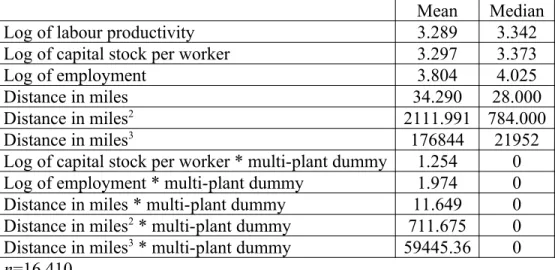
Table 1 provides mean and median values for labour productivity
and for all potential explanatory variables. The average distance from a
plant’s district to a region’s core city’s CBD is 34 miles, but this distance
varies from zero (where the plant is located in the region’s core city’s CBD)
to 195 (where the plant is located in the Isles of Scilly).
4. Results
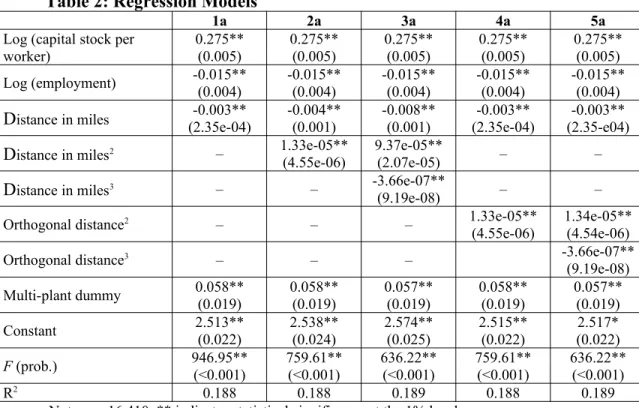
Table 2 summarises the regression models without consideration of
interaction terms involving plant status. In Model 1a there is a statistically
significant average increase in (the logarithm of) labour productivity with
labour productivity increasing by a factor of 1.06 for multi-plant
organisations compared with single-plant organisations (p<0.001). In
regression Model 1a a doubling of capital stock per worker is associated
with labour productivity increasing by a factor of 1.2 (p<0.001). Also note
that there is evidence of decreasing returns to scale from the employment
variable. These effects are essentially constant irrespective of whether
quadratic or cubic terms for the Euclidean distance to the CBD are included
in the model (see Model 1a to 5a, Table 2).
{Table 2 about here}
In the fitted model (Model 1a, Table 2) there is a statistically
productivity (p<0.001), with a ten mile decrease in distance being
associated with labour productivity increasing by a factor of 1.03. The
square of distance produces an additional statistically significant unique
effect (see Model 2a and Model 4a, Table 2) and the same can be seen for
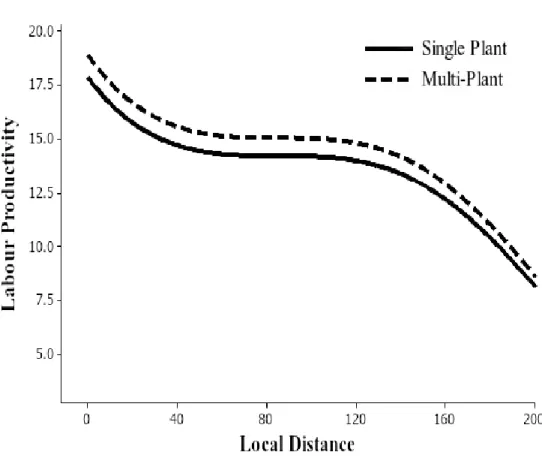
the cube of distance (see Model 3a and Model 5a, Table 2). A graphical
summary of the cubic model (for single- and multi-plant firms) is given in
Figure 1, where this graphic is based on the logarithm of capital stock per
worker and the logarithm of employment held at mean values. The graph
illustrates that there is neither a simple linear nor a simple quadratic
relationship between labour productivity and distance; instead it appears
that there is a combination of these two effects suggesting that the
relationship between distance and labour productivity is complex. Further it
indicates that a simple one-size-fits-all model may be systematically biased
and it questions whether scale economies are uniform across locations, as
the gap between single- and multi-plants become very small in very
peripheral locations.
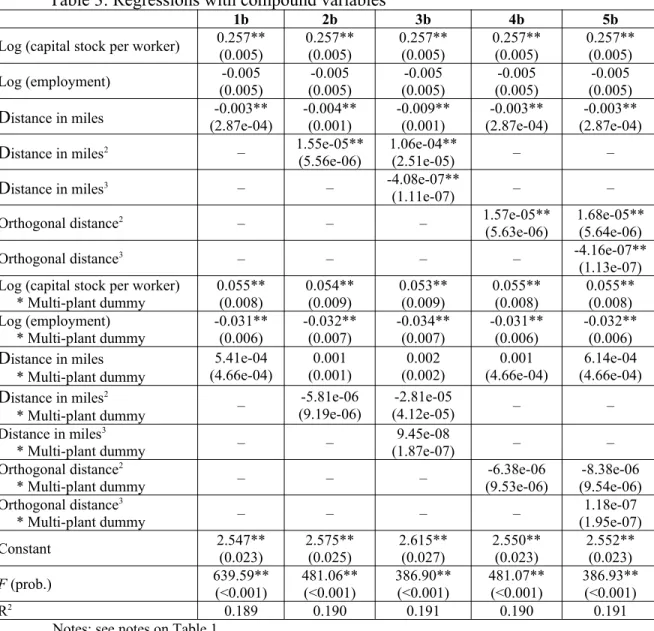
Table 3 summarises the regression models which include interaction
effects with plant status and all other explanatory variables. All models in
Table 3 capture a statistically significant interaction between plant status
and capital stock per worker on labour productivity with a doubling of
capital stock per worker being associated with labour productivity
increasing by a factor of 1.19 for single-plant firms and increasing by a
factor of 1.24 for multi-plant firms; this difference in effects is statistically
significant (p<0.001). Interestingly there is evidence from the interaction
between plant status and logarithm of employment that single-plant firms
do not suffer from diseconomies of scale and that this is a characteristics of
multi-plant firms in general. Nevertheless in all models in Table 3 there is
no differential effect between linear (p=0.245), quadratic (p=0.527) and
cubic (p=0.614) distance with productivity and plant status.
{Table 3 about here}
A repercussion of these results is that technological improvements
eradication of the spatial labour productivity divide across English regions,
and therefore are in line with Reitveld and Vickerman (2004).
5. Conclusion
Accessibility to the core of the market is known to affect pricing decisions
and is embedded in much of the literature on location theory. However most
empirical analyses that address spatial variations in labour productivity
typically focus on either agglomeration economies or the variation in and
evolution of average labour productivity at an aggregate geographical level.
This paper presents an empirical investigation which sought to
identify the shape of the relationship between labour productivity and the
distance to the core of a region’s central business district using plant-level
data across England. The results from our regression analyses suggest that a
plant’s labour productivity is negatively and non-linearly related to its
References
Anderson, S. P., de Palma, A. and Thisse, J.-F. 1989. Spatial price policies reconsidered.
Journal of Industrial Economics 38(1), 1-18
Bivand, R. 2008. Implementing representations of space in economic geography. Journal of Regional Science 48, 1-27
Clarke, C., Wilson, F. And Bradley, J. (1969) “Industrial location and economic potential in Western Europe”, Regional Studies 3, 197-212
Draper, N. and Smith, H. 1981. Applied regression analysis, John Wiley and Sons, New York
Glaeser, E. L. and Kohlhase, J. E. 2004. Cities, regions and the decline of transport costs.
Papers in Regional Science 83, 197-228
Harris, C. (1954) “The market as a factor in the localisation of industry in the United States”, Annals of the Association of American Geographers 64, 315-48
Hoover, E. M. 1937. Spatial price discrimination. Review of Economic Studies 4(3), 182-191
Hsu, S.-K. 2006. Simple monopoly price theory in a spatial market. Annals of Regional Science 40, 531-544
Keeble, D., Owens, P. L. And Thompson, C. (1982) “Regional accessibility and economic potential in the European Community”, Regional Studies 16, 416-432
Overman, H. G., Redding, S. And Venables, A. J. (2003) “The economic geography of trade, production and income: A survey of empirics” in Handbook of International Trade (eds.) Kwan-Choi, E. And Harrigan, J. Basil Blackwell, Oxford, pp. 353-387 Reitveld, P. and Vickerman, R. 2004. Transport in regional science: The “death of
distance” is premature. Papers in Regional Science 83, 229-248
Smithies, A. 1941. Optimal location in spatial competition. Journal of Political Economy
Table 1: Descriptive statistics
Mean Median
Log of labour productivity 3.289 3.342
Log of capital stock per worker 3.297 3.373
Log of employment 3.804 4.025
Distance in miles 34.290 28.000
Distance in miles2 2111.991 784.000
Distance in miles3 176844 21952
Log of capital stock per worker * multi-plant dummy 1.254 0 Log of employment * multi-plant dummy 1.974 0 Distance in miles * multi-plant dummy 11.649 0 Distance in miles2 * multi-plant dummy 711.675 0
Distance in miles3 * multi-plant dummy 59445.36 0
Table 2: Regression Models
1a 2a 3a 4a 5a
Log (capital stock per
worker) 0.275**(0.005) 0.275**(0.005) 0.275**(0.005) 0.275**(0.005) 0.275**(0.005) Log (employment) -0.015**(0.004) -0.015**(0.004) -0.015**(0.004) -0.015**(0.004) -0.015**(0.004)
Distance in miles (2.35e-04)-0.003** -0.004**(0.001) -0.008**(0.001) (2.35e-04)-0.003** (2.35-e04)-0.003**
Distance in miles2 – 1.33e-05**
(4.55e-06) 9.37e-05**(2.07e-05) – –
Distance in miles3 – – -3.66e-07**
(9.19e-08) – –
Orthogonal distance2 – – – 1.33e-05**
(4.55e-06) 1.34e-05**(4.54e-06)
Orthogonal distance3 – – – -3.66e-07**
(9.19e-08) Multi-plant dummy 0.058**(0.019) 0.058**(0.019) 0.057**(0.019) 0.058**(0.019) 0.057**(0.019)
Constant 2.513**(0.022) 2.538**(0.024) 2.574**(0.025) 2.515**(0.022) (0.022)2.517*
F (prob.) 946.95**(<0.001) 759.61**(<0.001) 636.22**(<0.001) 759.61**(<0.001) 636.22**(<0.001)
R2 0.188 0.188 0.189 0.188 0.189
Table 3: Regressions with compound variables
1b 2b 3b 4b 5b
Log (capital stock per worker) 0.257**(0.005) 0.257**(0.005) 0.257**(0.005) 0.257**(0.005) 0.257**(0.005)
Log (employment) (0.005)-0.005 (0.005)-0.005 (0.005)-0.005 (0.005)-0.005 (0.005)-0.005
Distance in miles (2.87e-04)-0.003** -0.004**(0.001) -0.009**(0.001) (2.87e-04)-0.003** (2.87e-04)-0.003**
Distance in miles2 – 1.55e-05**
(5.56e-06) 1.06e-04**(2.51e-05) – –
Distance in miles3 – – -4.08e-07**
(1.11e-07) – –
Orthogonal distance2 – – – 1.57e-05**
(5.63e-06) 1.68e-05**(5.64e-06)
Orthogonal distance3 – – – – -4.16e-07**
(1.13e-07) Log (capital stock per worker)
* Multi-plant dummy 0.055**(0.008) 0.054**(0.009) 0.053**(0.009) 0.055**(0.008) 0.055**(0.008) Log (employment)
* Multi-plant dummy -0.031**(0.006) -0.032**(0.007) -0.034**(0.007) -0.031**(0.006) -0.032**(0.006)
Distance in miles * Multi-plant dummy
5.41e-04
(4.66e-04) (0.001)0.001 (0.002)0.002 (4.66e-04)0.001 (4.66e-04)6.14e-04
Distance in miles2
* Multi-plant dummy –
-5.81e-06
(9.19e-06) (4.12e-05)-2.81e-05 – – Distance in miles3
* Multi-plant dummy – – (1.87e-07)9.45e-08 – – Orthogonal distance2
* Multi-plant dummy – – –
-6.38e-06 (9.53e-06)
-8.38e-06 (9.54e-06) Orthogonal distance3
* Multi-plant dummy – – – – (1.95e-07)1.18e-07 Constant 2.547**(0.023) 2.575**(0.025) 2.615**(0.027) 2.550**(0.023) 2.552**(0.023)
F (prob.) 639.59**(<0.001) 481.06**(<0.001) 386.90**(<0.001) 481.07**(<0.001) 386.93**(<0.001)
R2 0.189 0.190 0.191 0.190 0.191