An Alternative Test to Check the Validity of
Convergence Results
Don J. Webber
1and Paul White
21 School of Economics, University of the West of England, Bristol, UK, Policy Research Institute, Leeds Metropolitan University, Leeds, UK
2 Faculty of Computing, Engineering and Mathematical Sciences, University of the West of England, Bristol, UK
Abstract
This paper presents a simple method for identifying distributional dynamic properties of economies using the ideas of concordance and discordance. It can be employed to examine the strength and validity of the results of other methods. The method has the advantage of comparing distributions at two points without relying on intermediary data between the two time points. We present results that suggest there is more ‘strong-divergence’ than ‘strong-convergence’ in GDP between countries over the time period 1960-2000 although the distribution exhibits both convergent and divergent characteristics.
JEL Classification: C14; F19
Keywords: Convergence; Concordance; Income per capita.
An Alternative Test to Check the Validity of
Convergence Results
Abstract
This paper presents a new method for identifying distributional dynamic properties of economies using the ideas of concordance and discordance. It can be employed to examine the strength and validity of the results of other methods. The method has the advantage of comparing distributions at two points without relying on intermediary data between the two time points. We present results that suggest there is more ‘strong-divergence’ than ‘strong-convergence’ in GDP between countries over the time period 1960-2000 although the distribution exhibits both convergent and divergent characteristics.
JEL Classification: C14; F19
1. Introduction
Neoclassical growth theory suggests an inverse relationship between the capital-labour
ratio and the productivity of capital. The Solow-Swan model of economic growth
suggests that income per capita will converge due to differences in the rates of return on
capital and capital will move from economies with lower rates of return to those with
higher rates of return, with convergence driven by movements in the wage rates (see
Solow, 1956; Swan, 1956; or Barro and Sala-i-Martin, 1995, for a review of the
literature). This leads to the proposition that poor economies should grow faster than
rich economies and that output per capita should converge across economies.
Five distinct empirical tests on long-term convergence in economic conditions
can be identified. First, σ-convergence is where there is a reduction of the dispersion of
the variable concerned over time. Second, β-convergence is the most common form of
estimation which relates long-term growth with initial levels of income and follows on
from Mankiw et al. (1992). Here, the variables are assumed to be in transition towards
their limiting distributions and will ultimately converge to a position in the distribution
conditional on some other variable. Third, the Durlauf and Quah (1999) approach tests
for the presence of deterministic or stochastic trend components. This focuses on the
equalisation of variables to a steady state level, with sample means taken to be good
proxies of asymptotic means, and variables assumed to be near their limiting
distributions. A fourth approach, suggested by Quah (1996), proposes a non-parametric
method of estimation of the shape of the cross-economy distribution of transition
probabilities of this distribution among different long-term stochastic basins of
attraction. The fifth, and most recent proposed method, examines convergence empirics
using the ideas of concordance and discordance (Webber and White, 2003; Webber et
However, most analyses of the dynamics of distributions of economic variables
do not find that cross-sectional distributions collapse through time even though growth
miracles do exist. Some of the empirical literature, such as Quah (1997), identify that
convergence is not necessarily the dominant force for a distribution of economies and
highlight that other distributional dynamic properties are also evident.
Although there have been important developments in this field, the results
generated through such methods should stand up to external scrutiny. To increase
confidence in the results of these methods, such results should be validated either by
each other or by an alternative and easy to use method. Each method has its own
strengths and weaknesses and a robust method is needed that can be easily employed to
help assist in validating such results.
This paper presents a new method for identifying distributional dynamic
properties of economies using the ideas of concordance and discordance which is both
theoretically and empirically simply and it can be employed as a quick check of
empirical results generated by other methods. The method has the advantage of
comparing distributions at two points in time without relying on intermediary data
between the two time points. We illustrate the use of this method by performing an
empirical investigation on real GDP per capita figures for 97 countries between 1960
and 2000, which has been carried out by numerous empirical economists. The analysis
suggests that there is more ‘strong-divergence’ than ‘strong-convergence’ between
countries although the distribution exhibits both convergent and divergent
2. Data and Model
Convergence can be understood to mean several different things. Let be a metric
for output of country i at time t. For instance, convergence could be inferred to be the
gradual reduction in the magnitude of the difference between a richer economy (i) and a
poorer economy (j) between two periods of time and i.e. without loss of
generality assume . Under this condition, if
then this could be taken as “convergence without switching”. Convergence using this
reduction in ‘the difference’ necessarily requires a slower rate of growth for i than for j.
Other definitions of convergence without switching could be based on the ratio of
rewards. Again assume without loss of generality that . Under this condition,
if then this could be taken as “convergence without
switching”. If considering convergence irrespective of whether switching has taken
place then similar definitions may be proposed based on the ‘absolute difference’
or based on the maximum ratio of rewards i.e.
. The data in empirical investigations of
convergence could be either in ‘ratios’ (based on the original data) or in ‘differences’
possibly with the original data being transformed using a new baseline value to reduce
the bias due to natural growth.
For development purposes consider two economies indexed by i and j and
i.e. for
If:
then countries i and j exhibit divergence in ratio without switching
then countries i and j exhibit convergence in ratio without switching
then there cannot be any further convergence: the economies have converged
then countries i and j exhibit convergence in ratio with switching
then countries i and j exhibit divergence in ratio with switching
Similarly let denote a normalising transformation of (e.g.
where is the sample mean at time t) and define . If:
then countries i and j exhibit divergence in difference without switching
then countries i and j exhibit convergence in difference without switching
then countries i and j exhibit convergence in difference with switching
then countries i and j exhibit divergence in difference with switching
The calculation of all possible pairwise combinations of ( ) may then
be summarised by counting instances of convergence and divergence with and without
switching in a matrix as shown in Table 1. This method can be employed irrespective of
denote infeasible combinations in that they involve the ratio but not the difference
switching, or vice versa.
{Insert Table 1 about here}
3. Empirical Results
The data used in the following exploratory analysis is country level real GDP per capita
(in 1995 constant $US) obtained from the World Bank. Countries were included in the
sample if and only if data for their GDP per capita was available for ten-year intervals
between 1960 and 2000. The countries included in the data set maximise both the time
period (1960-2000) and the number of countries (97) subject to the constraint that there
are observations for each country at each point in time.
The variables were estimated using GDP per capita ( ) and the
variables were estimated using . Enumeration of and
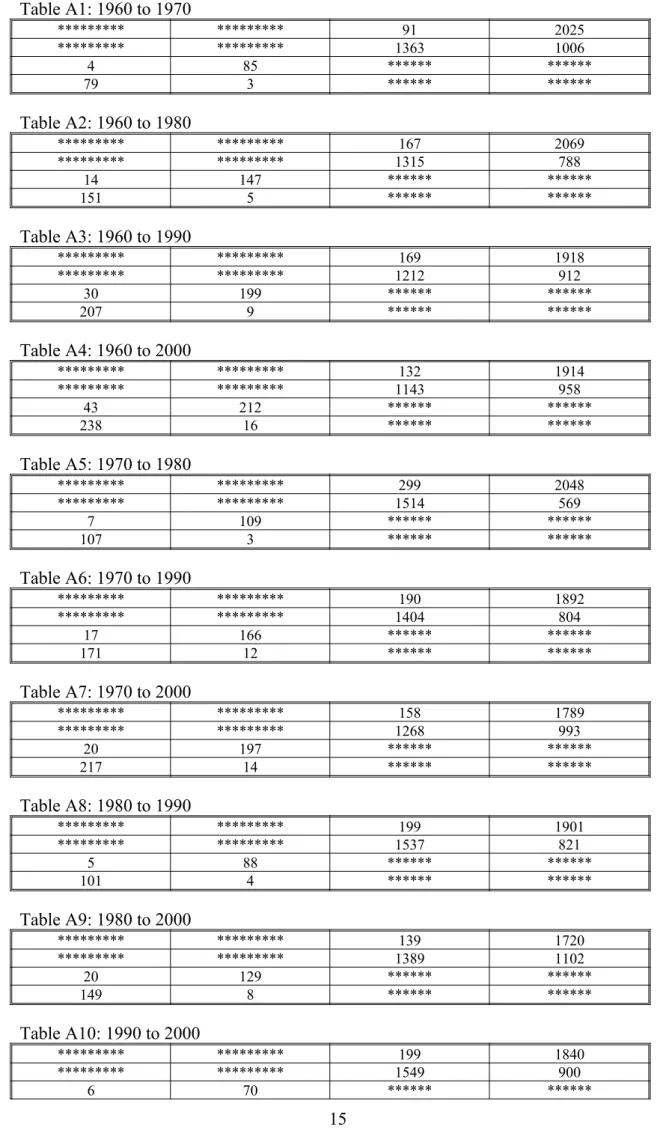
for all pairs of countries is summarised in matrix form given in the appendix.
Tables A1 – A4 present the results relative to 1960, while Tables A5 – A7, A8 – A9,
and A10 present the results relative to 1970, 1980 and 1990 respectively. The numbers
representing switching are in the bottom left quadrant of the tables.
Several patterns can be identified from the tables. First, the longer the period of
time under examination then the greater the number of pairs of economies that have
switched their position. This suggests that the growth path of a national economy is
neither uniform nor smooth across the sample: some countries grow faster than others
and an economy can overtake another.
Second, there is more evidence of divergence than there is of convergence. The
number of pairs of economies that have strongly diverged (irrespective of whether or
that have strongly converged (irrespective of whether or not they have switched) are
summarised in Table 3.
{Insert Table 2 about here}
{Insert Table 3 about here}
As the total possible number of converging pairs for a sample of 97 economies
is equal to 4656, the evidence does not support the proposition that there was strong
convergence throughout the period. When the frequencies are converted into
percentages, it is easily identifiable that the maximum number of ‘strongly converging’
pairs is only 34.9% of the entire sample whereas the minimum number of ‘strongly
diverging’ pairs is 40.1%.
The above analysis has been repeated replacing country i and country j with the
i-th and j-th percentile of the distributions i.e. working directly with the properties of the
empirical distribution rather than the countries which make up the empirical
distribution. The analysis based on percentiles leads to the same broad conclusions (e.g.
when comparing 1960 with 2000 there are 2783 pairs of percentiles for which
and , 1300 pairs of percentile for which and
, 543 pairs of percentiles for which and ,
and 30 pairs of percentiles for which and . The evidence
provided in these analyses does not support the proposition that the sample is
strongly-converging over time and questions the realism of the traditional Solow-Swan
4. Conclusion
This paper has presented a new method for identifying the convergence and divergence
empirics of a sample that permits the researcher to identify switching simultaneously.
When these methods are employed to identify some convergent properties of 97
countries’ real GDP per capita between 1960 and 2000, the results suggest that
divergence is the dominant property, but there is evidence of convergence and switching
in the sample also. The results question empirically the traditional theoretical approach
to growth, which suggest that economies should converge to the long-run steady-state.
Moreover, it questions empirically the role of capital mobility in equalising income
levels and reinforces the need to find other explanations to understand cross-economies
patterns of growth.
Acknowledgements: The authors would like to thank David Allen and Sam
Bibliography
Barro, R. J. and Sala-i-Martin, X. (1995) Economic Growth, McGraw Hill, London Durlauf, S. N. and Quah, D. T. (1999) “The New Empirics of Economic Growth”, in
Taylor, J. B. and Woodford, M. Handbook of Macroeconomics, Vol. 1A, Elsevier, Oxford
Mankiw, N. G., Romer, D. and Weil, D. N. (1992) “A Contribution to the Empirics of Economic Growth”, Quarterly Journal of Economics107, 407-437
Quah, D. T. (1996) “Empirics of Economic Growth and Convergence”, European Economic Review40(6), 1353-1375
Quah, D. T. (1997) “Empirics for Growth and Distribution: Polarisation, Stratification and Convergence Clubs”, Journal of Economic Growth2(1), 27-59
Solow R. M. (1956) “A Contribution to the Theory of Economic Growth”, Quarterly Journal of Economics, 70, 65-94.
Swan, T. W. (1956) “Economic Growth and Capital Accumulation”, Economic Record,
32, 334-61
Webber, D. J., White, P. and Allen, D. O. (2005) “Income Convergence across US States: An Analysis using Measures of Concordance and Discordance” Journal of Regional Science45(3), 565-589
Webber, D. J. and White, P. (2003) “Regional Factor Price Convergence across Four Major European Countries”, Regional Studies37(8), 773-782
Appendix:
The countries in the sample are: Algeria, Argentina, Australia, Austria, The Bahamas,
Bangladesh, Barbados, Belgium, Belize, Benin, Bolivia, Botswana, Brazil, Burkina
Faso, Burundi, Cameroon, Central African Republic, Chad, Chile, China, Colombia,
Rep. of Congo, Costa Rica, Cote d'Ivoire, Denmark, Dominican Republic, Ecuador,
Arab Rep. of Egypt, El Salvador, Fiji, Finland, France, Gabon, Ghana, Greece,
Guatemala, Guyana, Haiti, Honduras, Hong Kong, China, Hungary, Iceland, India,
Indonesia, Ireland, Israel, Italy, Jamaica, Japan, Kenya, Rep. of Korea, Lesotho,
Luxembourg, Madagascar, Malawi, Malaysia, Malta, Mauritania, Mauritius, Mexico,
Morocco, Nepal, Netherlands, New Zealand, Nicaragua, Niger, Nigeria, Norway,
Pakistan, Panama, Papua New Guinea, Paraguay, Peru, Philippines, Portugal, Rwanda,
Saudi Arabia, Senegal, Seychelles, Sierra Leone, Singapore, South Africa, Spain, Sri
Lanka, Sudan, Sweden, Switzerland, Syrian Arab Republic, Thailand, Togo, Trinidad
and Tobago, United Kingdom, United States, Uruguay, Venezuela, Zambia and
Table 2: Number of Strongly Diverging Pairs of Economies
1970 1980 1990 2000
1960 2104 (45.2%) 2220 (47.7%) 2125 (45.6%) 2152 (46.2%)
1970 - 2155 (46.3%) 2063 (44.3%) 2006 (43.1%)
1980 - - 2002 (43.0%) 1869 (40.1%)
Table 3: Number of Strong Converging Pairs of Economies
1970 1980 1990 2000
1960 1446 (31.1%) 1462 (31.4%) 1411 (30.3%) 1355 (29.1%)
1970 - 1623 (34.9%) 1570 (33.7%) 1465 (31.5%)
1980 - - 1625 (34.9%) 1518 (32.6%)
Table A1: 1960 to 1970
********* ********* 91 2025
********* ********* 1363 1006
4 85 ****** ******
79 3 ****** ******
Table A2: 1960 to 1980
********* ********* 167 2069
********* ********* 1315 788
14 147 ****** ******
151 5 ****** ******
Table A3: 1960 to 1990
********* ********* 169 1918
********* ********* 1212 912
30 199 ****** ******
207 9 ****** ******
Table A4: 1960 to 2000
********* ********* 132 1914
********* ********* 1143 958
43 212 ****** ******
238 16 ****** ******
Table A5: 1970 to 1980
********* ********* 299 2048
********* ********* 1514 569
7 109 ****** ******
107 3 ****** ******
Table A6: 1970 to 1990
********* ********* 190 1892
********* ********* 1404 804
17 166 ****** ******
171 12 ****** ******
Table A7: 1970 to 2000
********* ********* 158 1789
********* ********* 1268 993
20 197 ****** ******
217 14 ****** ******
Table A8: 1980 to 1990
********* ********* 199 1901
********* ********* 1537 821
5 88 ****** ******
101 4 ****** ******
Table A9: 1980 to 2000
********* ********* 139 1720
********* ********* 1389 1102
20 129 ****** ******
149 8 ****** ******
Table A10: 1990 to 2000
********* ********* 199 1840