REINVESTMENT PROJECT FINAL REPORT
Developing podcasts to facilitate learning in biological sciences in
health care education
Helen Godfrey
July 2010
Acknowledgements
The project team are grateful to all the technical staff who supported the project especially Ian Parsons, Tracey Penberthy and Adam Christopher. The project team also wish to thank the students who contributed to the
Contents
1. Executive Summary 5
2. Background 9
3. Project aims and scope 10
4. Project activity 11
5. Project outcomes and key findings 18
6. Outcomes and outputs 33
7. Recommendations and next steps 33
1 Executive Summary
1.1 Podcasts may be used as part of a blended-learning approach (Evans, 2008) and
are a creative way for students to receive information and for students to express their learning (Cook, 2008). The use of podcasts in higher education and their value in
learning is yet to be established (Evans, 2008). This project set out to develop a number of podcasts and to investigate how podcasting and podcasts can be used to facilitate student learning in biological sciences in healthcare education.
1.2 An initial exploration of existing pedagogical podcasts and literature concerning the use of podcasts for learning in the HE sector was carried out. This scoping aspect of the project revealed few existing podcasts which could supplement learning in this
discipline. Some useful literature about podcasts was retrieved including a framework for creating podcasts (Edirisingha et al, 2008), this 10-factor design model was used to guide the development of podcasts within the project.
1.3 The development of two prototype podcasts enabled the project team to become familiar with podcasting technology. The prototype audio podcast is a round table question and answer style discussion which explores the basis of multifactorial
inheritance with a particular emphasis on type 2 diabetes. The video podcast includes discussions, mini lectures and animations which describe the blood supply to the brain and introduces the causes and consequences of a lack of cerebral blood flow.
scripting, recording, filming, editing and publishing) and to critically reflect on the podcasts produced so that the subsequent ones could be refined.
1.5 Student views were collected using a self-report questionnaire designed to collect data about students’ perceptions of podcasts used to supplement more traditional forms of module delivery. The preliminary findings indicate that students are overwhelmingly positive in their response to using podcasts for learning. Most students reported that podcasts had contributed to their learning and were a good use of their time. The majority of students reported no preference for either audio or video podcasts, whilst 32% preferred audio podcasts and 23% preferred video podcasts.
1.6 Staff views about the development of podcasts and their role in learning were collected via a focus group, this enabled staff to discuss their views and experience of developing podcasts and the pedagogical role of podcasts. Thematic analysis revealed the following themes: Uses of podcasts; Benefits to students; Educational limitations; Challenges in creating podcasts; Aspirations at the start and Guidance for others.
1.7 Podcasts were seen as enhancing teaching and learning and were considered to be a way of delivering material in an innovative and novel fashion. Podcasts offered
students the flexibility of when and where they were used and were able to support lectures by providing important material in a shorter and different format. There were some limitations in using podcasts for learning including no opportunity for instant feedback, potential loss of novelty value if overused and the difficulty in audio podcasts of discussing concepts without any images to illustrate.
1.8 Lack of familiarity with technical equipment initially was a challenge and staff found it difficult to create an informal style within the podcasts initially. The creation of podcasts demanded a lot of time and this may have contributed to some of the frustration
at the start of the podcasting project so that technical support and help with the pedagogical aspects of podcasting was available.
1.9 Reflecting on the process of creating podcasts for learning, a number of key interlocking elements seem to be integral to producing a quality podcast: a well developed concept, pedagogical rationale, accurate and contemporary material, creativity, appropriate technology, and an engaging style.
1.10 Summary of outcomes and outputs
Ten exemplar podcasts have been created to support teaching and learning in biological sciences for health care students. Project team members have acquired podcasting skills and have increased the capacity to develop pedagogical podcasts within the faculty.
Two members of the project team have joined the ‘Best Practice Models for e-Learning community’ (Staffordshire University)http://learning.staffs.ac.uk/bestpracticemodels/; this network aims to identify and model good practice in facilitating e Learning in order to enhance learner-centred, flexible learning. One member of the project team took part in the ‘Ask the experts: Podcasting Forum’. This event included a selection of case studies from lecturers using podcasting with students, a podcast model to explore and a live forum to discuss the cases and the model with the presenters.
Staff and student experiences of using podcasts for learning collected during the project indicate that podcasts are perceived as beneficial to learning. The project findings support the further development of podcasts across a greater number of modules.
Repository where the podcasts can be accessed and downloaded
http://learntech.uwe.ac.uk/podcasts/
1.11 Key recommendations include:
Podcasts should be integrated more widely into modules so that more students have the opportunity to gain potential benefits for learning.
The podcasters need to manage the tension between creativity, pedagogical rationale, a well developed concept, appropriate technology, accurate and contemporary material and an engaging style when creating podcasts.
There should be a list of resources and a database of podcasting expertise within the Faculty to support staff new to podcasting.
Technical staff should be an integral part of any future podcasting development at the outset, so that they can explain what is available and help novice podcasters to understand the technical steps involved.
Funding for staff time in creating and updating podcasts needs to reflect the time and expertise involved in creating pedagogical podcasts.
There is a need for staff training on the technical and pedagogical aspects of podcasting.
2. Background
2.1 A podcast is a digital media file (audio or audio with vision), which is made available
from a website and then downloaded onto a computer or mobile device (Corbeil and Valdes-Corbeil, 2005; Salmon et al, 2008). The portability of podcasting technology offers the potential for students to access learning materials from many locations and whilst travelling (Salmon et al, 2008) and on as many occasions as they choose (Evans, 2008). Podcasts have the potential for a variety of learning opportunities and are
compatible with more flexible modes of learning (Rainsbury and McDonnell, 2006). The use of portable devices (e.g. iPods, MP3 players) enables students more choice about “when, where and how they study” (Evans, 2008, p 492).
2.3 The use of podcasts in higher education and their value in learning is yet to be established (Evans, 2008). Studies which have investigated the effectiveness of podcasting lectures suggest that students appreciate their flexibility (Malan, 2007) and that students using podcast lectures can improve their achievement (Kurtz et al, 2007). 2.4 However, it is argued that lecture podcasts are not the most appropriate use of podcasting and that short podcasts with a narrow focus provide greater learning
opportunities for students (University of Wisconsin-Madison, 2006). In a study in which short, audio-only podcasts were uploaded onto a virtual learning environment for postgraduate students, short podcasts had the potential to support student learning (Clark et al, 2007).
2.5 Whilst there is evidence of a growing capacity within the Faculty of developing quality on-line materials within the blended learning model of CPD delivery for example and an active E-Learning Development Unit within the University, currently there
appears to be little experience of using podcasts for learning within the Faculty.
3. Project aims and scope
3.1 The main aims of the project are to develop a number of podcasts and to investigate
how podcasting and podcasts can be used to facilitate student learning in biological sciences in healthcare education. The objectives are to:
Create two prototype podcasts during the pilot phase, (an audio podcast and a video podcast) which support teaching and learning in biological sciences for health care students.
Using skills and knowledge developed during the pilot phase’ create a number of exemplar podcasts with different educational purposes, which have the potential to enhance students learning in biological sciences.
Evaluate staff and students’ experiences of using podcasts for learning.
Disseminate guidance about creating podcasts for learning to faculty and beyond.
Project team: Helen Godfrey (Project leader)
Geoffrey Abbott, Daryl Edgar, Sabita Menon, Sarah Mitchard Polly Wilson
Technical support: Adam Christopher Ian Parsons
Tracey Penberthy
Project dates: May 2009 - July 2010
4. Project Activity
4.1 The major activities within the project include:
Scoping activity
Creating prototype podcasts
Producing exemplar podcasts
Exploring staff perceptions of podcasts
Scoping activity
4.2 The project team began the project with little knowledge of podcasts, had limited familiarity with their use in learning and lacked know-how about how to develop
podcasts for learning. An initial exploration of literature concerning the use of podcasts for learning in the HE sector was carried out. Most of the literature available on podcasts deals with how to create podcasts. There are few research studies which investigate the educational use of podcasts (Evans, 2008). Some studies evaluate the actual quality of the podcasts using a range of criteria. Studies have indicated the various benefits of podcasts on learners including better learner engagement (Belanger, 2005), reduction in isolation in distance learners (Chan and Lee, 2005), improved performance in
assessments and improved motivation (Hargis and Wilson, 2005).
4.3 A research project, IMPALA – Informal Mobile Podcasting and Learning Adaptation, (http://www.le.ac.uk/impala/) has been reported in ‘Podcasting for Learning in
Universities’ (Salmon and Edirisingha, 2008), this was a useful guide to podcasting for learning in HE. A framework for creating podcasts, a 10-factor design model (Edirisingha et al, 2008) was used to guide the development of podcasts within the project:
1. decide educational purpose
2. select the medium (audio or video)
3. decide how podcast will integrate with other learning 4. choose contributors and content
5. decide structure of podcasting 6. decide on reusability of podcast 7. choose length
9. decide framework 10. select access system
4.4 A review of existing podcasts was performed to prevent any possible duplication of effort and to gather useful ideas. Two ‘podcasts’ provided from the School of Life
Sciences were PowerPoint presentations which had been animated and narrated. These had been converted into a movie format using the PointeCast Publisher / Helius
Presenter. These were interactive powerpoint presentations rather than podcasts. A number of podcasts from external sites were critically appraised and a consensus around the essential attributes of the prototype podcasts began to emerge. The E-Learning Development Unit (UWE) was a useful source of help in the initial stages of the project in becoming familiar with the available tools to support e-learning approaches including podcasting.
4.5 A small selection of websites where podcasts were accessed to gain ideas on style and structure:
http://podcast.open.ac.uk/oulearn/health-and-social-care http://podcast.open.ac.uk/oulearn/science
http://www.ox.ac.uk/media/news_stories/2009/090527.html http://www.nature.com/podcast/index.html
http://www.biology.ed.ac.uk/public/podcasts.php
4.6 Discussions also took place with staff from Learning Educational Technologies and Learning Technologies Technical Unit in the early stages of the project to explore what support and resources were available. Initially, it proved difficult to seek help and
guidance without firm ideas and it was difficult to have a vision when it was unclear what was actually possible to achieve in a podcast for learning.
4.7 The development of two prototype podcasts enabled the project team to become familiar with podcasting technology including audio recording and editing, shooting video and editing, creating animations and publishing podcasts.
4.8 The process of developing a prototype audio podcast began with a decision to create a podcast which would help students understand a complex concept. The choice of topic, ‘multifactorial inheritance’ reflected a desire to create a podcast which had significance for a wide range of healthcare students and which also supported the drive to facilitate the integration of genetics into health professional education which stemmed from the Department of Health white paper ‘Our inheritance, our future- realizing the potential of genetics in the NHS’ (DH, 2003) and the creation of the National Genetics Education and Development Centre http://www.geneticseducation.nhs.uk/. This site only provided a limited introduction to multifactorial inheritance despite this being significant in the common, multifactorial chronic diseases such as cardiovascular disease, diabetes, and breast, colon and prostate cancer.
4.9 The aim in developing the prototype video podcast ‘Blood flow to the brain’ was to create a re-usable podcast with broad applicability for health care students to gain understanding of the cerebral blood flow so that they can understand how stroke occurs and the damage it can cause. Additionally it provided a vehicle to develop some
expertise in generating visual elements and exposed the project team to some of the challenges of video podcasting.
4.10 Creating the 20 minute video podcast involved many hours of lecturer and technical staff time. This supports Edirisingha et al (2008) who report that a two minute video podcast involved four hours each of academic and technician time.
Producing exemplar podcasts
has enabled the team to further develop their podcasting skills and to critically reflect on the podcasts produced so that the latter ones could be refined.
4.12 The project team agreed at the outset that the educational purpose of the podcasts was to create podcasts as supplementary learning activities to support more traditional modes of teaching and learning. The podcasts produced are not intended to replace lectures but to engage students in developing knowledge and understanding of complex concepts before, during or after a session as a supplementary activity. The topics chosen reflect contemporary issues in health and include explorations in physiology, pharmacology and pathophysiology.
4.13 A mixture of audio and video podcasts were produced; as beginner podcasters, audio podcasts were favoured in the majority of cases. Three topics were chosen for video podcasts where visual elements were thought to be particularly necessary.
4.14 The podcasts produced are reusable and will be used in a range of modules. They will be integrated with other learning and teaching provision. The students will be
directed to access the podcasts at appropriate stages in the module delivery.
4.15 In the first audio podcast, ‘Multifactorial inheritance’, five members of the project team were involved, but subsequent podcasts have tended to have fewer contributors. For each podcast, once the topic was chosen, the content and structure were written into a script. The podcasts have a tendency to be longer than originally proposed; this possibly reflects the project members being novice podcasters. 10 minutes is reported to be about the right length that students are willing to listen to (Edirisingha et al, 2008). The podcasts produced in this project vary from 5-20 minutes.
contributors tended to read from a script rather than feeling confident enough to just use notes.
4.17 The framework for each podcast was kept similar, a short piece of music was used to signal the start and then the end of each podcast, the sequence of topics was framed by an introduction and reiteration of key points in a conclusion.
4.18 Editing of podcasts was mainly done by technical staff with some input from the project leader. One member of the team recorded and edited a podcast using Audacity, a free, relatively easy-to-use audio editor and recorder. Having become familiar with this software, the process of recording and editing could be condensed.
4.19 Once the podcasts were completed, the access system had to be considered, this proved more complicated than anticipated. Podcasts can be delivered via the internet using technology such as 'Really Simple Syndication' (RSS), but since our podcasts were designed to support teaching and to be integrated with other learning activities in modules the virtual learning environment (VLE) ‘Blackboard’ was the preferred platform. In the first instance the prototype audio podcast was made available to students via the module delivery on Blackboard, however in this format students were able to access the podcast via a PC but unable to download the podcast to a mobile device, this seemed to defeat the objective of developing flexible modes of learning. The solution after much debate with the technology team supporting the project was to create a space on the learning repository on the HSC student net http://learntech.uwe.ac.uk/. Module leaders are able make an announcement via Blackboard to direct students to access the podcasts and provide a link to the ‘HSC podcasts’. Students can then if they wish
download the podcast. A transcript with some suggested further reading is also provided with each podcast.
4.20 Approval was gained from the Health and Social Care Research Ethics Committee (UWE) for the research study embedded within the podcast project ‘Evaluation of staff and students’ experiences of using podcasts for learning’.
4. 21 The use of podcasts in higher education and their value in learning is yet to be established (Evans, 2008). One of the study aims was therefore to explore student perceptions and engagement with a number of podcasts developed by the biological sciences’ lecturers to supplement more traditional approaches to learning and teaching.
4.22 Delays in the development of the prototype podcasts and their accessibility to students compromised the planned recruitment of students to this evaluation study since several of the student cohorts had finished their modules within which we were to trial the use of podcasts to support learning. Students were recruited from BSc (Hons) Midwifery, DipHE Adult Nursing, DipHE Mental Health Nursing and FdSc in Paramedic Science and the sample included year 1 and year 2 students. Only 23 students
participated in the evaluation and the student views highlighted in this report can only be considered preliminary findings.
4.23 Student views on podcasts were collected using a self-report questionnaire (Appendix 1) designed to collect data about students’ perceptions of podcasts. The questionnaire included Likert–like statements and a five point scale together with open questions capturing quasi-qualitative data encouraging respondents to focus on their experiences in more depth and in their own words.
Exploring staff perceptions of podcasts
collaborative activities with the technical staff and staff views on using podcasts as learning tools integrated within other module learning approaches. The focus group discussion was electronically recorded and transcribed verbatim.
4.25 The quantitative data from questionnaires was analysed using SPSS. The focus group transcript was thematically analysed.
5. Project outcomes and key findings
Creation of exemplar podcasts
5.1 Ten podcasts in total have been produced during the project to be used as
supplementary learning activities to support more traditional modes of teaching and learning.
Podcast Medium Content, style and educational purpose
Multifactorial inheritance
Audio Presented by five people in a round table question and answer style discussion. This podcast explores the basis of multifactorial inheritance means and identifies some of the diseases that are accepted as multifactorial in origin with a particular emphasis on type 2 diabetes.
Length: 17¾ minutes Blood flow to the
brain Video Four people are involved in presenting different sections including, discussions, mini lecture format and animations. The podcast describes the blood supply to the brain and introduces some of the causes and consequences of a lack of cerebral blood flow.
Length: 20 minutes Why are there
no aspirin in the jungle?
Audio Presented by two people, this podcast explains the uses of aspirin and proposes a mechanism of action. Length: 7½ minutes
Alcohol's effects on liver structure and function
Length: 16 minutes The immune
response to TB
Video One presenter uses images and animations to explain the non-specific and specific immune responses employed to deal with TB infection. Different scenarios are used to illustrate what happens when a droplet containing mycobacterium tuberculosis is inhaled.
Length: 17 minutes
HPV testing Audio Presented by one person, this podcast discusses HPV testing and news reports which suggest that the HPV test can cut cervical cancer deaths and that it has greater benefits than the smear test. Explores concepts in viral infection and carcinogenesis.
Length: 13 minutes How diuretic
drugs work
Audio This podcast, presented by one person, describes the role of the kidneys in fluid balance and explores the actions of different types of diuretic drugs.
Length: 12½ minutes All you wanted
to know about constipation but were too polite to ask
Audio A presentation by one person of the role of the gut in elimination and the prevention, causes and
management of constipation.
Length: 8 minutes
Pivotal role of the CD4 cell
Audio One presenter discusses the role of T-helper cells in the integration of the two components of the immune response: innate and adaptive immunity.
Length: 7 minutes What makes
blood red? Video An animation which introduces the key features of thehaemoglobin molecule, its role in carrying oxygen around the body and some of its different forms such as sickle cell haemoglobin.
Length: 4½ minutes
investigated and the experience of one project team member using ‘‘Audacity’ software was successful. Podcasters developing expertise in editing would also put less pressure on technical staff.
Student experience of learning with podcasts
5.3 Preliminary findings about student views of the podcasts developed in the project are based on 22 completed student questionnaires. 23 students complete
questionnaires although one was not included in the analysis because the student hadn’t actually used the podcasts, but was commenting on podcasts in general.
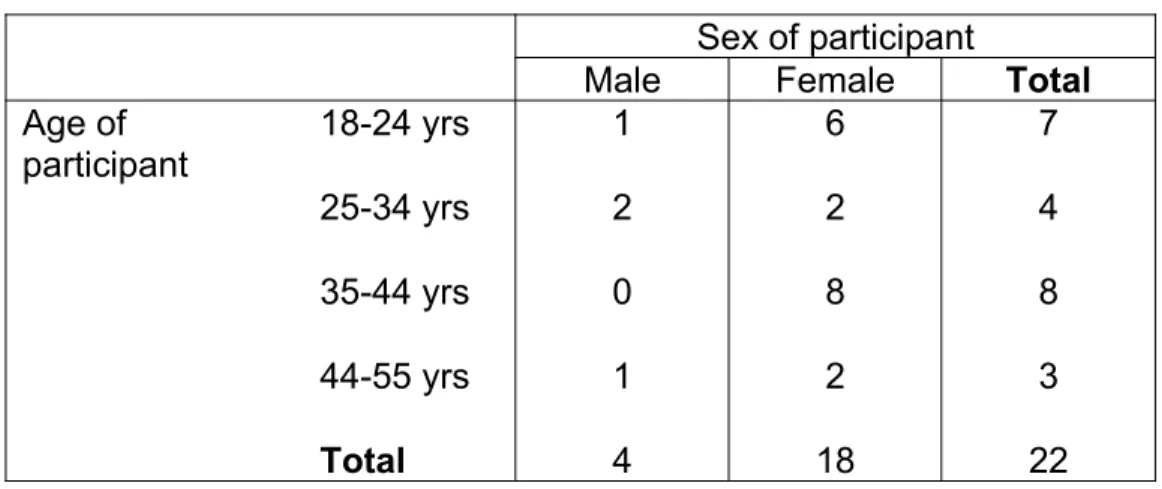
5.4 The characteristics of the participants are shown in Table 1, this highlights that whilst the ages of students were varied, few male students participated in the evaluation.
Table 1 Demographics
Sex of participant
Male Female Total
Age of participant
18-24 yrs 1 6 7
25-34 yrs 2 2 4
35-44 yrs 0 8 8
44-55 yrs 1 2 3
5.5 Students from four programmes took part in the evaluation BSc (Hons) Midwifery (10 students), DipHE Adult Nursing (4 students), DipHE Mental Health Nursing (1 student) and FdSc Paramedic Science (7 students).
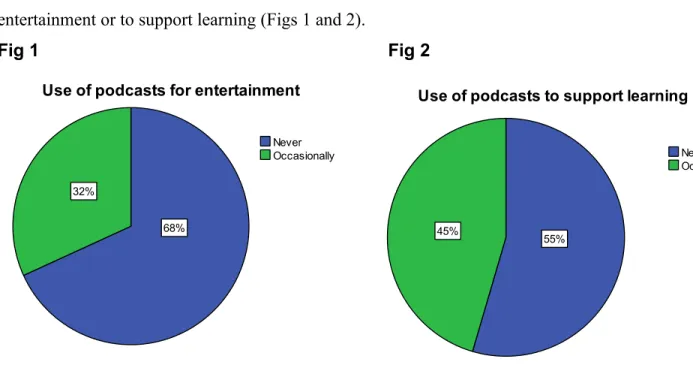
5.6 The responses to the questionnaire revealed that many students never used podcasts for entertainment or to support learning (Figs 1 and 2).
Fig 1 Fig 2
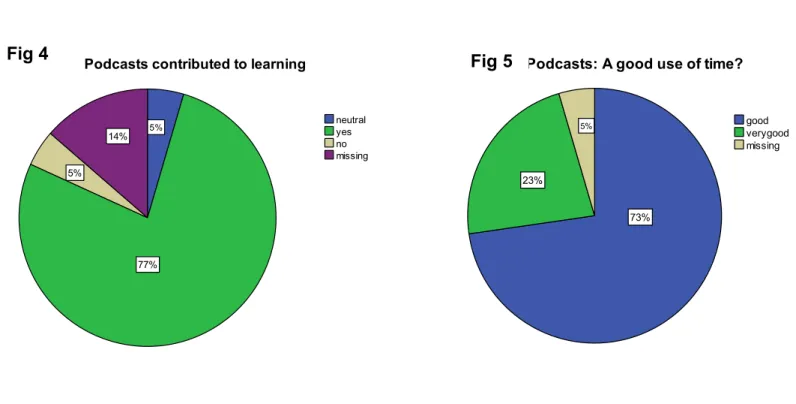
5.8 Of those students who commented on how they had used the podcasts, 10 indicated they had accessed a podcast before the lecture. The majority of students reported that podcasts had contributed to their learning (Fig 4) and that they were a good use of their time (Fig 5).
Fig 3
5.9 Students varied in whether they felt the podcasts integrated with other teaching and learning approaches in the module (Fig 6).
5.10 All students reported they found the podcasts easy to use, 86% of students strongly agreed or agreed that they had learnt new information from the podcasts. The majority of students strongly agreed or agreed that the podcasts made learning more enjoyable (Fig 7).
5.11 Interestingly despite many of the podcasts exceeding 10 minutes, 86% of students strongly agreed or agreed that the podcasts were about the right length (Fig 8).
5.12 Most students indicated they would prefer podcasts to supplement the lectures rather than replace them (Fig 9) and 95% of students strongly agreed or agreed that they would like podcasts to be used more widely across modules. When asked whether they had a preference for audio or video podcasts, most students reported no
preference for either medium, whilst 32% preferred audio podcasts (Fig 10).
Fig 7
Fig 9
Fig 8
5.13 Student comments revealed perceived benefits in using podcasts:
‘Really nice to have a new medium.’
‘I found this particular podcast really useful as I made notes at the same time- could also stop and start when necessary- can’t do that in class!’
‘I used it after but it would have been beneficial to listen before, however it was great to listen to after to reinforce the lecture.’
‘Very clear and concise. Don’t get led off at a tangent as can happen with internet searching.’
‘It was better than reading an article as pre-reading for a lecture.’
‘It was really good. I felt in charge of my own learning as it was at my own pace.’
‘I can listen to them in car/cooking dinner etc.’
5.14 They also highlighted some areas for improvement:
‘…however it could be heard that it was being read from a script at times, not very relaxed.’
‘More banter between the lecturers.’
‘No real human contact to ask questions.’
5.16 The clarity of the podcasts depended on the device being used although some students ascribed the poor sound quality to the podcasts:
‘Sound was not great but could be machine.’
5.17 The preliminary findings from the student questionnaire indicate that students are overwhelmingly positive in their response to using podcasts.
Staff experience of developing podcasts and their perspectives on role of podcasts in learning
5.18 Four lecturers from the project team shared their thoughts, feelings, attitudes and ideas on podcasting. Thematic analysis of the verbatim transcript revealed the following themes:
Uses of podcasts
Benefits to students
Educational limitations
Challenges in creating podcasts
Aspirations at the start
Guidance for others
Uses of podcasts
‘...you could get people who are doing work in other fields that are relevant to us but don’t want to invite them in for a whole hour lecture but they could do a 5 minute or 10 minute (podcast), answer a few questions that we put to them, that would be great actually.’
‘Students could be involved in developing podcasts as a method of learning either as part of a taught session or as a form of assessment.’
‘Actually spend some time doing an audio podcast, which could then be used by other students. They’d actually have to research and find out; I think there is some mileage in that.’
5.18 Finally the podcasts could be a way of delivering material in an innovative and novel fashion.
‘I think that could be quite fun, more like the media use them sort of topical interest.’
Benefits to students
5.19 Podcasts offered students the flexibility of when and where they were used.
Students had some control over their learning and could replay them as often as they liked.
The spoken word could be reassuring to them rather than text based distance learning material. They could become comfortable with the technology.
‘I’ve done online learning and distance learning and it can be very lonely. Whereas if you’ve got a voice with someone speaking to you; you’re a little less isolated.’
‘It’s also, I think, a good way of getting students to be comfortable with technology.’
The material could support lectures by providing important material in a shorter and different format.
‘I think I can use it to really support my lectures.’
‘Five minutes worth of important things and to be able to put it into a very short piece.’
Educational limitations
5.20 There were concerns about how to portray anatomy and physiology in audio format alone, the video podcasts could help here, but a lack of visual supporting material could be a problem, and video podcasts were more challenging to create.
‘I had to do something in our audio podcasts on structure in anatomy and physiology and that’s really difficult to do in an audio podcast.’
‘There's no feedback, there’s no opportunity for them to stop and say I don’t understand that so there’s no checking out.’
5.22 The students may need prior knowledge to understand the biology presented within the podcasts. There was a tension between trying to reach a wide audience and
creating podcasts for particular programmes.
‘...that limited our topic choice. We didn’t make it profession specific.’
5.23 The podcasts have a shelf life and could be out of date if not updated, there could be a tendency to produce too many, leading to overload and loss of novelty value. There was also no easy way of providing references to back up statements within the podcast.
‘...if we over use them, they’ll lose their shine, their usefulness in remaining innovative.’
‘It’s like anything with teaching though, if you do too much of one thing.’
‘...we’ve said things but haven’t really explained where we got that information from.’
Challenges in creating podcasts
5.24 The ability to use the equipment was clearly identified many times as a challenge, with a lack of sufficient technical skill, familiarity with equipment, differences in devices and lack of technical support highlighted.
‘..that idea of just getting familiar with it and confident with the
‘...limited by our expertise in terms of technical aspects.’
‘...when I realised I hadn’t recorded any of it and had to do it for a 3rd
time!’
5.25 Staff reported a lack of confidence in two key areas: the sound and quality of their voices when reviewing the material and a fear of working without a script. The ability to present complex issues in a new format was raised as being difficult in terms of maintaining a high quality of presentation that flowed naturally.
‘I’d go over it and think it’s reading from a script, its not coming naturally like a lecture so I had to redo it in a way that sounded interesting.’
‘If we were a bit more confident, we would just ‘oh that sounds a bit too formal’ we’ll go back and have another go at it.’
‘My voice isn’t that much to listen to.’
‘I was like ‘oh my god, is that me, I hate it!’’
‘We want it to be natural but it’s not.’
‘... that’s what we’re doing in the audio podcasts, we’re actually… we’re writing it out in a written form that we’re going to speak so it’s a bit different.’
‘But we’ve got to come up with all the elements of it, if you see what I mean which is very time consuming.’
5.27 The ability to prepare short podcasts involving one presenter was raised due to the difficulties coordinating multiple presenters which had led to some podcasts being perceived by staff as too long.
‘...but they are tending to be a bit longer than we hoped.’
5.28 There was frustration expressed about not being able to produce podcasts which reflected creative aspirations. Some ideas were given up due to lack of technical know-how, support and time. At the start of the project there was a lack of awareness about what was possible leading to a trial and error approach which took up time and led to further frustration. There were some resources such as the autocue which weren’t known about in the initial stages of the project.
‘I tried to make it more creative and fun but the pull between making it with good accurate information and interesting, I found sometimes those two pulling against each other.’
‘I think we were a little naïve at the start because we didn’t know the problems, we envisaged that it would be easier than it turned out to be.’
Aspirations at the start
5.27 This theme relates to the outcomes and expectations that the team had at the beginning of the project. The approach to creating the podcasts was to choose topics which were relevant to many disciplines and students and to use accurate and
5.28 We wanted to make sure what we were putting out was correct and accurate and up to date.
5.29 It was felt that podcasts should be short, no longer than 10 minutes, innovative, interesting and involve more than one presenter.
‘We did set out to try and make quite short, snappy podcasts.’
‘...there should be more than one person involved in presenting.’
‘...it would offer a more innovative and interesting way of engaging students to make them feel more enthused and motivated because it’s a bit different.’
Guidance for others
5.30 This included getting advice at the outset from those who have been through the process of creating podcasts. Ensure there is adequate time, funding and technical support. Explore what is technically possible and what is already available. Make use of the existing infrastructure of technology and resources. Practice before recording and get advice on broadcasting skills and filming to avoid making mistakes. Get experts to edit the material.
‘You need someone to advise; a technical assistant, someone who knows all the tools and will tell you all the sort of things you could use if you’re contemplating doing this.’
‘I think directing and broadcasting skills.’
5.31 Reflecting on the process of creating podcasts for learning, a number of key interlocking elements seem to be integral to producing a quality podcast (Fig 11):
Fig 11: Attributes of a good podcast
6. Outcomes and outputs
6.1 Ten exemplar podcasts have been created to support teaching and learning in biological sciences for health care students. Project team members have acquired podcasting skills and have increased the capacity to develop pedagogical podcasts within the faculty.
6.2 Two members of the project team have joined the ‘Best Practice Models for e-Learning community’ (Staffordshire University)
http://learning.staffs.ac.uk/bestpracticemodels/; this network aims to identify and model good practice in facilitating e Learning in order to enhance learner-centred, flexible learning. One member of the project team took part in the ‘Ask the experts: Podcasting Forum’. This event included a selection of case studies from lecturers using podcasting with students, a podcast model to explore and a live forum to discuss the cases and the model with the presenters.
6.3 Staff and student experiences of using podcasts for learning collected during the project indicate that podcasts are perceived as beneficial to learning. The project findings support the further development of podcasts across a greater number of modules.
6.4 An ‘easy guide to creating podcasts for learning’ (appendix 1) has been developed for wider dissemination and this with the ten exemplar podcasts is available on a CD for colleagues who are outside the faculty and unable to access the HSC Learning
Repository where the podcasts can be accessed and downloaded
http://learntech.uwe.ac.uk/podcasts/
7. Recommendations and next steps
7.2 Podcasters should manage the tension between creativity, pedagogical rationale, a well developed concept, appropriate technology, accurate and contemporary material and an engaging style when creating podcasts.
7.3 Choice of topics for podcasts should encompass those with a profession-specific focus as well as those with a broad applicability; student input should also be sought in the choices made.
7.4 Podcasts should be integrated with other teaching and learning activities in modules.
7.5 Meticulous editing of podcast material is necessary to ensure podcasts are not too long.
7.6 Funding for staff time in creating and updating podcasts needs to reflect the time and expertise involved in creating pedagogical podcasts.
7.7 The invisible labour that goes into making a podcast should be quantified so that resource implications of podcasting are properly acknowledged.
7.8 There is a need for staff training on the technical and pedagogical aspects of podcasting. This could include a staff workshop on creating podcasts for learning.
7.9 There should be a greater coherence around the way in which innovations in e-learning are developed so that the processes and services can be streamlined and made more responsive.
7.11There is a need to create a database of podcasting expertise and other e-learning approaches within the Faculty to enable staff to benefit from the experience and
knowledge of others.
7.12 Technical staff should be an integral part of any future podcasting development at the outset, so that they can explain what is available and help novice podcasters to understand the technical steps involved and talk through what is possible.
7.13 Students’ expectations regarding sound and visual quality needs to be managed so that they are aware that the device used to access the podcasts (eg MP3 player,
speakers on a PC) may hamper the overall quality.
References
Austria J (2007) Developing Evaluation Criteria for Podcasts Libri 57:179–207
Belanger,Y. (2005) Duke University iPod first year experience final evaluation report. Duke University. http://cit.duke.edu/pdf/reports/ipod_initiative_04_05.pdf [Accessed 28th December 2009]
Chan A and Lee M J W (2005) An MP3 a day keeps the worries away: Exploring the use of podcasting to address preconceptions and alleviate pre-class anxiety amongst undergraduate information technology students In: Dirk HR Spennemann & Leslie Burr (eds), Good Practice in Practice. Proceedings of the Student Experience Conference 5-7th September ’05. Wagga Wagga, NSW: Charles Sturt University. Pp. 59–71.
http://www.csu.edu.au/division/studserv/sec/papers/chan.pdf [Accessed 28th December 2009]
Clark S, Taylor L and Westcott M (2007) Using short podcasts to reinforce lectures. In Proceedings of the Assessment in Science Teaching and Learning Symposium (pp 22-26). http://science.uniserve.edu.au/pubs/procs/2007/08.pdf [Accessed 28th December 2009]
Cook K (2008) Learning on the go Nursing Standard 23 (12): 61
Corbeil JR and Valdes-Corbeil ME (2007) Are you ready for Mobile Learning Educause Quarterly 2: 51-58
DH (2003) Our inheritance, our future: realising the potential of genetics in the NHS. Department of Health.
Edirisingha P, Salmon G abs Nie M (2008) Developing pedagogical podcasts In: Salmon G and Edirisingha P, eds. Podcasting for Learning in Universities Maidenhead: Open University Press 2008, pp. 153-168
Evans C (2008) The effectiveness of m-learning in the form of podcast revision lectures in higher education. Computers and Education 50: 491-498
Hargis, J. and Wilson. D. (2005) Fishing for Learning with a Podcast Net. [online]
University of North Florida. Available from: Dale (2007) Strategies for Using Podcasting to Support Student LearningJournal of Hospitality, Leisure, Sport and Tourism Education 6(1), 49-57. 57 http://www.unf.edu/dept/cirt/tech/podcast/HargisPodcastArticle.pdf
[Accessed 28th December 2009].
Kurtz BL, Fenwick JB and Ellsworth CC (2007) Using podcasts and tablet PCs in computer science ACMSE Proceedings of the 45th annual southeast regional conference (pp 484 – 489) Winston-Salem, North Carolina
Lane C (2006) Podcasting at the UW: An evaluation of Current Use
http://www.washington.edu/lst/research_development/papers/2006/ podcasting_report.pdf [Accessed 28th December 2009].
Malan DJ (2007)Podcasting computer science E-1 ACM SIGCSE Bulletin 39(1): 389 -393
Kennedy G, Judd T, Churchward A, Gray K. and Krause K. (2008) First year students' experiences with technology: Are they really digital natives? Australasian Journal of Educational Technology, 24(1): 108-122
Rainsbury J W and McDonnell SN (2006) Podcasts: an educational revolution in the making? Journal of the Royal Society of Medicine 99: 481-2
Salmon G, Mobbs R, Edirisingha P and Dennett C (2008) Podcasting Technology. In: Salmon G and Edirisingha P, eds. Podcasting for Learning in Universities Maidenhead: Open University Press 2008, pp. 20-32
Salmon G and Edirisingha P (2008) eds. Podcasting for Learning in Universities Maidenhead: Open University Press 2008
Tynan, B., & Colbran, S. (2006). Podcasting, student learning and expectations. In L. Markauskaite, P. Goodyear & P. Reimann (Eds.), Who's Learning? Whose
Technology? Proceedings of the Australasian Society for Computers in Learning in Tertiary Education (ASCILITE) Conference (pp. 825-832). Sydney Australia, Dec 3-6. [Online] Available at
http://www.ascilite.org.au/conferences/sydney06/proceeding/pdf_papers/p132.pdf
[Accessed 20th November,2009]
University of Wisconsin-Madison ( 2006) Teaching and Learning with Podcasting http:// engage.wisc.edu/podcasting/teaching/index.html[Accessed 28th December 2009].
Williams J and Fardon M (2007) Perpetual connectivity: Lecture recordings and
portable media players. In ICT: Providing choices for learners and learning. Proceedings ascilite Singapore 2007.
8. Appendix
Appendix 1
Easy guide to creating podcasts for learning
July 2010
Helen Godfrey
The ‘three little bacilli’ in ‘The immune response to TB’ video podcast
Planning the podcast
In creating podcasts to be integrated with other teaching and learning activities, it is important to consider the style and substance of the podcasts. A 10-factor design model (Edirisingha et al, 2008) outlines the key steps which guide the development of podcasts:
1. decide educational
purpose
2. select the medium (audio
or video)
39 | P a g e This easy guide to creating podcasts for learning is based on the experience gained during a funded project ‘Developing podcasts to facilitate learning in biological sciences in health care education’, conducted within Health and Life Sciences Faculty, UWE. The podcasts developed during the project may be viewed at http://learntech.uwe.ac.uk/podcasts/ and since they comprise a range of styles they may offer a guide as to which style and format you may prefer.
The easy guide covers the planning and creation of podcasts for learning under the following themes:
Planning the podcast Equipment for podcasting
Recording and editing
Converting the podcast
Publishing the podcast Aim for a podcast of about 10 minutes since this is
considered to be about the right length Begin
3. decide how podcast will integrate with other learning
4. choose contributors and
content
5. decide structure of
podcasting
6. decide on reusability of
podcast
7. choose length
8. select formality/style
9. decide framework
10. select access system
An interactive guide to this 10 step model is available at: http://www.atimod.com/podcasting/PDModel.html
Following the steps in this model will yield ideas which may then be developed into a script. The script can be in note form or a more detailed account of what each contributor will say, rather like a radio play. As you become more experienced in creating
podcasts you may prefer to make notes to create a more informal style.
Our experience suggests that the following elements also need to be considered in the planning of
pedagogical podcasts:
Aim for a podcast of about 10 minutes since this is
considered to be about the right length (Edirisingha et al, 2008).
The balance of these different elements seems to be crucial although as novice podcasters it may be difficult to achieve this balance at first since there tends to be an emphasis on becoming familiar with the technology and a heavy reliance on scripts.
Equipment for
podcasting
Creating audio podcasts requires a recording device, this could be a microphone connected to a computer, a digital recording device or a specialist sound booth. If you are going to have the audio podcast edited for you, the simplest approach is to record the content on a digital recording device. The mp3 sound file created can then be edited using appropriate editing software by technical staff.
Alternatively you can use free open source software such as Audacity which is an ‘easy-to-use audio editor and recorder’ available at
http://audacity.sourceforge.net/
The equipment necessary for video podcasting is more complex, a video camera to record film and
41 | P a g e Start simple: use a digital voice recorder to record your audio podcast.
sound. Alternatively, the sound can be recorded separately using a voice recorder or in a sound booth. Technical help is required to edit a video podcast and specialist video editing software such as Avid is used.
Other images may be incorporated into the video podcast such as Powerpoint presentations,
animations, still images and specialist equipment can be used to integrate these into the video podcast.
Recording and editing
Recording the sound for an audio podcast can be done on a digital recorder or by using a programme such as Audacity. This software allows you to record, edit and combine other sounds such as a music jingle which can be used to frame the start and end of the podcast. Play back the recording and re-record until you are happy with the results. Detailed information about recording and editing podcasts using Audacity is available (Mobbs et al, 2008).
Converting the
podcast
The podcast has to be converted into a form that is easy to share; the audio file has to be compressed so that the file is smaller in size.
Create interest by having more than one voice!
An autocue may be used and this allows you to talk in a more relaxed style without having to think about what to say.
Publishing the
podcast
Once the podcast is in the right format it has to be made available to students, there are different ways of doing this. The podcasts need to be stored
somewhere on line, so that links can be made via the virtual learning environment (VLE) in which students access their on-line materials.
Provide a transcript to accompany the podcast on the web site so that students can read and/or print out. Consider enhancing audio podcasts by providing a series of images on the website which students have the option of looking at whilst listening to the podcast.
This guide to podcasting sets out the basics, creating a pedagogical podcast which students will enjoy and find useful is more of a challenge.
References
Edirisingha P, Salmon G and Nie M (2008) Developing pedagogical podcasts In: Salmon G and Edirisingha P, eds. Podcasting for Learning in Universities Maidenhead: Open University Press 2008, pp. 153-168
Mobbs M, Salmon G and Edirisingha P (2008) Appendix: How to create podcasts – practitioner’s guide In: Salmon G and Edirisingha P, eds. Podcasting for Learning in Universities Maidenhead: Open University Press 2008, pp. 188-204
Appendix 2
Evaluation of staff and students’ experiences of using podcasts for learning
Student Questionnaire
This is an anonymous questionnaire. Please ensure that you do not write your name, or any other comments that will make you identifiable, on the attached questionnaire. By completing the questionnaire you are consenting to take part in this research. You are advised to first read the participant information sheet as it explains fully the intention of this study. Your participation in this study is entirely voluntary.
Please complete the following:
Female Male (optional)
Age (optional) 18-24yrs 25-34yrs 35-44yrs 44-55yrs
Module
Programme
Cohort
Please read the following questions and give as much detail as possible. Some of the questions specifically relate to the podcasts you have used in your studies. Other questions are about your views and experiences of podcasts in general.
1. Do you ever use podcasts for entertainment? (Please tick one box)
Never
Occasionally Regularly
Never
Occasionally Regularly
3. Please indicate which of the following podcasts you have used in support of your learning during this module: (Please tick as many boxes as appropriate)
Multifactorial inheritance audio podcast
Blood flow to the brain video podcast
Effects of alcohol on liver structure and function audio podcast
Why are there no aspirin in the jungle? audio podcast
The immune response to TB video podcast
How diuretics work audio podcast
Other(s)- please name
4. How did you access the podcasts you used? (Please tick as many boxes as appropriate) On my MP3
On my personal computer at home On my laptop
On a computer at placement On a computer at UWE
5. Please describe how you used the podcast(s) to support your learning. For example, did you use the podcast before or after a linked lecture, did you make notes or just
6. Please state whether you consider the podcast(s) contributed to your learning, and if so please explain the ways in which the podcast helped you learn.
7. Please comment on whether you felt using the podcast(s) was a good use of your time.
8. Please explain whether the podcast(s) integrated with other teaching and learning approaches in the module.
Please read the following questions carefully and rate them on a scale of 1-5 by ticking one box for each question:
S tr o n g ly A g re e A g re e N eu tr a l D is a g re e S tr o n g ly D is a g re e
podcast(s)
11. The information was not new but the podcast(s) were interesting
12. Podcast(s) made my learning more
enjoyable
13. The podcast(s) I used were about the right length
14. The podcast(s) I used were too long
15. I found the podcast(s) more useful than other multi-media resources such
as the internet and videos
16.
If lectures were available as podcasts I would use them in preference to
attending lectures
17.
I would prefer to use podcasts to supplement the lectures rather than
replace them
18. I would like all lectures to be made
available as podcasts
19. I would like podcasts to be used more widely across modules
20. Please explain how effective the podcast(s) were in helping you understand the topics introduced in the podcast.
22. Please comment on the advantages of the podcast(s) for you compared to other learning approaches.
23. Please describe how useful the podcast(s) were overall in your learning.
24. Please comment on how these podcast(s) compare to other podcasts that you may have used in the past. (If you have not previously used podcasts then please leave this box blank and move onto Question 25).
26. Please comment on whether you would wish to have access to more podcasts and explain why.
27. Please comment on whether you would prefer podcasts to introduce ‘essential content’ for a module or to introduce a topic which is relevant to healthcare, but less directly related to the module content.
28. Please comment on whether you have a preference for audio or video podcasts.
29. Please explain how you think podcasts could be used more effectively.
Appendix 3
Topics for focus group discussion:
Pedagogical aspects
What opportunities do podcasts offer for teaching and learning?
What is the purpose of podcasts in the support of teaching and learning?
What are the gaps that podcasts can fill, which other teaching and learning approaches cannot?
What are the benefits of podcasts for student learning?
What are the weaknesses of podcasts for student learning?
Developing podcasts
Learning issues
What are the necessary elements in podcasts designed to support teaching and learning?
What are the key features in a podcast which are necessary to engage the learner?
What aspects of the podcasts are crucial in developing deep learning experiences?
Technical issues
What were the issues encountered during the creation of the podcasts?
Scripting
Filming and recording
Editing
Publishing
What skills have you developed during the creation of podcasts? In hindsight, what skills do you need to create podcasts designed to support teaching and learning?
What were the issues with the technical support available in the creation of the podcasts?
Appendix 3
Easy guide to creating podcasts for learning
July 2010
Helen Godfrey
The ‘three little bacilli’ in ‘The immune response to TB’ video podcast
Planning the podcast
In creating podcasts to be integrated with other teaching and learning activities, it is important to consider the style and substance of the podcasts. A 10-factor design model (Edirisingha et al, 2008) outlines the key steps which guide the development of podcasts:
11. decide educational
purpose
12. select the medium (audio
or video)
13. decide how podcast will
integrate with other learning
54 | P a g e This easy guide to creating podcasts for learning is based on the experience gained during a funded project ‘Developing podcasts to facilitate learning in biological sciences in health care education’, conducted within Health and Life Sciences Faculty, UWE. The podcasts developed during the project may be viewed at http://learntech.uwe.ac.uk/podcasts/ and since they comprise a range of styles they may offer a guide as to which style and format you may prefer.
The easy guide covers the planning and creation of podcasts for learning under the following themes:
Planning the podcast Equipment for podcasting
Recording and editing
Converting the podcast
Publishing the podcast Aim for a podcast of about 10 minutes since this is
considered to be about the right length (Edirisingha Begin
14. choose contributors and content
15. decide structure of
podcasting
16. decide on reusability of
podcast
17. choose length
18. select formality/style
19. decide framework
20. select access system
An interactive guide to this 10 step model is available at: http://www.atimod.com/podcasting/PDModel.html
Following the steps in this model will yield ideas which may then be developed into a script. The script can be in note form or a more detailed account of what each contributor will say, rather like a radio play. As you become more experienced in creating
podcasts you may prefer to make notes to create a more informal style.
Our experience suggests that the following elements also need to be considered in the planning of
pedagogical podcasts:
Aim for a podcast of about 10 minutes since this is
considered to be about the right length (Edirisingha et al, 2008).
The balance of these different elements seems to be crucial although as novice podcasters it may be difficult to achieve this balance at first since there tends to be an emphasis on becoming familiar with the technology and a heavy reliance on scripts.
Equipment for
podcasting
Creating audio podcasts requires a recording device, this could be a microphone connected to a computer, a digital recording device or a specialist sound booth. If you are going to have the audio podcast edited for you, the simplest approach is to record the content on a digital recording device. The mp3 sound file created can then be edited using appropriate editing software by technical staff.
Alternatively you can use free open source software such as Audacity which is an ‘easy-to-use audio editor and recorder’ available at
http://audacity.sourceforge.net/
The equipment necessary for video podcasting is more complex, a video camera to record film and
56 | P a g e Start simple: use a digital voice recorder to record your audio podcast.
sound. Alternatively, the sound can be recorded separately using a voice recorder or in a sound booth. Technical help is required to edit a video podcast and specialist video editing software such as Avid is used.
Other images may be incorporated into the video podcast such as Powerpoint presentations,
animations, still images and specialist equipment can be used to integrate these into the video podcast.
Recording and editing
Recording the sound for an audio podcast can be done on a digital recorder or by using a programme such as Audacity. This software allows you to record, edit and combine other sounds such as a music jingle which can be used to frame the start and end of the podcast. Play back the recording and re-record until you are happy with the results. Detailed information about recording and editing podcasts using Audacity is available (Mobbs et al, 2008).
Converting the
podcast
The podcast has to be converted into a form that is easy to share; the audio file has to be compressed so that the file is smaller in size.
Create interest by having more than one voice!
An autocue may be used and this allows you to talk in a more relaxed style without having to think about what to say.
Publishing the
podcast
Once the podcast is in the right format it has to be made available to students, there are different ways of doing this. The podcasts need to be stored
somewhere on line, so that links can be made via the virtual learning environment (VLE) in which students access their on-line materials.
Provide a transcript to accompany the podcast on the web site so that students can read and/or print out. Consider enhancing audio podcasts by providing a series of images on the website which students have the option of looking at whilst listening to the podcast.
This guide to podcasting sets out the basics, creating a pedagogical podcast which students will enjoy and find useful is more of a challenge.
References
Edirisingha P, Salmon G and Nie M (2008) Developing pedagogical podcasts In: Salmon G and Edirisingha P, eds. Podcasting for Learning in Universities Maidenhead: Open University Press 2008, pp. 153-168
Mobbs M, Salmon G and Edirisingha P (2008) Appendix: How to create podcasts – practitioner’s guide In: Salmon G and Edirisingha P, eds. Podcasting for Learning in Universities Maidenhead: Open University Press 2008, pp. 188-204