Phylogenetic host specificity and understanding parasite sharing in primates
Natalie Cooper1,2,3* Randi Griffin1,4, Mathias Franz5, Moshood Omotayo6, and Charles L. Nunn7
1Department of Human Evolutionary Biology, Harvard University, Cambridge, MA 02138, USA.
2School of Natural Sciences, Trinity College Dublin, College Green, Dublin, Ireland.
3Trinity Centre for Biodiversity Research, Trinity College Dublin, Dublin, Ireland. [email protected]
5Courant Research Center Evolution of Social Behavior, Georg-August-Universität Göttingen, Kellnerweg 6, 37077, Göttingen, Germany. [email protected]
6Harvard School of Public Health, 677 Huntington Avenue, Boston, MA, 02115, USA. [email protected]
*Author for correspondence: Email: [email protected]; address: Zoology Building, School of
Natural Sciences, Trinity College Dublin, College Green, Dublin 2, Ireland. Tel: (+353) 1
8961000, Fax: (+353) 1 6778094.
Short running title: Phylogenetic host specificity in primate parasites 1
2
3
4
5
6
7
8
9
10
11
12
13
14
15
16
17
18
Keywords (10 max): specialist; generalist; protozoa; helminth; virus; vector; intermediate host; phylogenetic comparative methods.
Type of article: Letter
Number of words in the abstract: 144
Number of words in the main text (excluding abstract, acknowledgements, references, table and figure legends): 4997
Number of references: 49
Number of figures and tables: 5 (3 figures and 2 tables)
Statement of authorship: NC designed the study, performed the analyses, and wrote and revised the manuscript. RG contributed to the study design and performed analyses. MF contributed to the study design. MO collected the geoferencing data. CLN designed the study and revised the manuscript.
20
21
22
23
24
25
26
27
28
29
30
31
32
Abstract
Understanding how parasites are transmitted to new species is of great importance for human health, agriculture and conservation. However, it is still unclear why some parasites are shared by many species, while others have only one host. Using a new measure of “phylogenetic host specificity”, we find that most primate parasites with more than one host are phylogenetic generalists, infecting less closely related primates than expected. Evolutionary models suggest that phylogenetic host generalism is driven by mixture of host-parasite cospeciation and lower rates of parasite extinction. We also show that phylogenetic relatedness is important in most analyses but fails to fully explain patterns of parasite sharing among primates. Host ecology and geographical distribution emerged as key additional factors that influence contacts among hosts to facilitate sharing. Greater understanding of these factors is therefore crucial to improve our ability to predict future infectious disease risks.
34
35
36
37
38
39
40
41
42
43
44
45
Introduction
Emerging infectious diseases (EIDs) present a major challenge to the health of humans and our domesticated animals and crops (Morens et al. 2004; Woolhouse et al. 2005). EIDs also affect wild animals and plants, and can be major drivers of wildlife population declines (e.g., amphibians and Tasmanian devils; McCallum & Jones 2006; Kilpatrick et al. 2010). The source of EIDs is often other species; for example, many recent human pandemics originated in wildlife, including HIV and SARS, and parasite introduction via introduced species is a major driver of plant EID emergence (Anderson et al. 2004; Wolfe et al. 2005; Wolfe et al. 2007; Jones et al.
2008). If we understand the factors that increase the likelihood of parasites switching from one host species to another, we can identify problematic parasites before they are transmitted to new hosts. This would be advantageous for public health reasons, and for agriculture and the
conservation of biodiversity.
The most reliable way to determine whether a parasite – here defined as any infectious organism – can switch from one species to another is to experimentally infect the new host in the laboratory. However, this is expensive, time consuming and raises ethical concerns for some host taxa. Another solution is to take a comparative approach that considers how parasites are shared among host species in nature. Patterns of present-day parasite sharing will reflect (among other things) historical transfers of parasites from one host to another. Thus, we can use the degree of parasite sharing among hosts to make inferences about the host and parasite characteristics that promote host switching. To do this, we must first consider the steps involved in a host shift. Initially the new host must make contact with the parasite, the likelihood of which will depend on factors that include: whether the host and parasite have overlapping geographic ranges; the parasite’s transmission mode (e.g., sexually transmitted diseases are less likely to be encountered 47
48
49
50
51
52
53
54
55
56
57
58
59
60
61
62
63
64
65
66
67
68
by new hosts than environmentally transmitted diseases); the parasite’s abundance in the original host; and similarities in the ecology and behavior of the hosts. Once a new host is exposed, the probability that the parasite can replicate and spread to other individuals depends on the host’s immune defenses and the parasite’s ability to circumvent these defenses (Woolhouse et al. 2005; Parrish et al. 2008).
Previous authors have suggested that each stage of the host-shifting process is more likely if the original host and the new host are closely-related, because closely-related species are likely to be similar in ecological, behavioral, physiological and distributional traits that increase the likelihood of exposure to a parasite and the ability of the parasite to circumvent the host’s immune defenses (Woolhouse et al. 2005; Engelstädter & Hurst 2006; Wolfe et al. 2007; Davies & Pedersen 2008). Indeed, in a range of host-parasite systems, parasites are more commonly shared among close relatives than among more distant relatives (e.g., Davies & Pedersen 2008; Krasnov et al. 2010; Poulin 2010; Streicker et al. 2010; Longdon et al. 2011). However, processes other than host switching also influence patterns of parasite sharing (summarized in Fig. S1; see Appendix S1 in Supporting Information). Close relatives also inherit parasites from their last common ancestor, and thus should share more parasites through common descent (this is referred to as cospeciation; Engelstädter & Hurst 2006). In addition, parasites may be missing from some species simply because the host has been studied insufficiently to detect the parasite, or because the parasite has gone extinct.
Here, we use phylogenetic comparative methods to identify factors that influence parasite sharing among primate hosts. We use primates because they are well-studied and also our closest relatives, allowing us to make inferences about parasite sharing among primates and humans. Using a measure of “phylogenetic host specificity” (or “phylospecificity”; Poulin et al. 2011), 70
71
72
73
74
75
76
77
78
79
80
81
82
83
84
85
86
87
88
89
90
91
we first investigate whether parasites infect more closely-related hosts than expected by chance. Our measure differs from standard measures of host specificity because it takes into account the relatedness of the hosts, rather than relying on taxonomic or other categories (e.g., Pedersen et al.
2005). With this measure, a parasite that infects distantly-related hosts is a phylogenetic host generalist, whereas a parasite that infects closely-related hosts is a phylogenetic host specialist. We predict that viruses will be phylogenetic host generalists because the fast rates of viral evolution should allow them to easily adapt to new hosts (Woolhouse & Gowtage-Sequeria 2005; Parrish et al. 2008; Elena & Froissart 2010). Conversely, we predict that helminths will be phylogenetic host specialists, due to their often complex lifecycles that may constrain their ability to adapt to new hosts (Woolhouse et al. 2005; Parrish et al. 2008). We also use evolutionary models to investigate whether patterns of sharing are driven by host shifts, host-parasite cospeciation, host-parasite extinction, or biases in sampling effort (summarized in Fig. S1).
Next, we investigate patterns of parasite sharing among primates in relation to primate phylogeny, ecology and geography, and parasite phylogenetic host specificity. We predict that parasite sharing will be highest among closely-related, ecologically similar primates that live in close proximity, as these factors should favor parasite transmission. We also expect that the relationship between parasite sharing and host phylogeny will be stronger in phylogenetically host specialized parasites. Finally, we use phylogenetic models to investigate levels of parasite sharing among primates and humans.
93
94
95
96
97
98
99
100
101
102
103
104
105
106
107
108
109
110
111
Materials and Methods
Host-parasite data
We obtained 2867 host-parasite combinations, representing 128 primate species and 437 parasite species (60 viruses, 247 helminths, 91 protozoa, 35 bacteria and four fungi), from the
Global Mammal Parasite Database (GMPD, accessed 25th July 2011; Nunn & Altizer 2005). We took our list of endemic human parasites from Taylor et al. (2001).
Primate data
For each species, we collated data on adult body mass (g) and social group size from various sources (de Magalhaes & Costa 2009; Jones et al. 2009, Nowak 1999 plus references in Appendix S2). We also defined each species as terrestrial (> 90% of time on ground), semi-terrestrial (< 90% but > 50% of time on ground), semi-arboreal (< 90% but > 50% of time in trees) or arboreal (> 90% of time in trees).
We downloaded geographic range maps from the IUCN (2010) and used these to estimate the geographic range size of each species (km2). For each pair of primates we then determined their geographic range overlap (km2) and the geodesic distance between their geographic range centroids (km). We obtained mean annual temperature (0.1°C) and
precipitation (mm) data from WorldClim (Hijmans et al. 2005) and extracted mean temperature and precipitation values for each primate’s geographic range. We used the R packages maptools (Lewin-Koh & Bivand 2011), PBSmapping (Schnute et al. 2010), raster (Hijmans & van Etten 2011), rgdal (Keitt et al. 2011) and sp (Pebesma & Bivand 2005) for all geographic data manipulation.
113
114
115
116
117
118
119
120
121
122
123
124
125
126
127
128
129
130
131
132
133
As a measure of sampling effort we collected citation counts for each primate species, i.e., the number of references retrieved from the ISI Web of Knowledge (http://wokinfo.com/; accessed 5th July 2012), where the Latin binomial of the species appeared in either the title or topic fields, and either “parasite”, “disease” or “pathogen” also appeared in the topic field. Where the species binomial had changed between 1993 and 2005 (Wilson & Reeder 1993, 2005) we summed the number of citations for the species names from both taxonomies. We used the dated consensus phylogeny from 10kTrees version 3 (Arnold et al. 2010) and the taxonomy of Wilson & Reeder (2005) for all analyses.
Parasite data
We defined each parasite’s geographic range as the union of the geographic ranges of its hosts (GR1). However, it is unlikely that a parasite will be found across the whole geographic range of a host, especially where hosts have large ranges. Therefore we derived a second parasite geographic range (GR2). GR2 was equal to the area encompassed by the minimum convex polygon created using the host-parasite latitude and longitude locality records for a given parasite, plus a five degree buffer. To estimate GR2, we obtained latitude and longitude
coordinates for each host-parasite combination from the GMPD. We excluded localities that we were unable to unambiguously georeference, and localities with an extent greater than
10,000km2. We then extracted geographic ranges for our parasites using the R packages cited above plus rgeos (Bivand & Rundel 2011) and wild1 (Sargeant 2011). Parasite geographic ranges are probably highly dynamic and vary seasonally; thus, we lack information on which of these ranges best represents the true geographic range of the parasite. Therefore, we performed 135
136
137
138
139
140
141
142
143
144
145
146
147
148
149
150
151
152
153
154
155
analyses using both GR1 and GR2. We report only results using GR2; however, our GR1 results are qualitatively similar.
Sampling biases
Host-parasite data are sensitive to sampling effort: hosts which have been thoroughly sampled for parasites may appear to have more parasites than those which have been less well-sampled (Gregory et al. 1996). To deal with this issue, we focused on well-sampled primates, defined as species with at least 10 different parasites and evidence for saturation in their parasite accumulation curves (Fig. S2). This left 35 primate species, 2144 host-parasite combinations, and 346 parasite species (52 viruses, 180 helminths, 78 protozoa, 33 bacteria and three fungi). We report results using the 35 well-sampled primate species; however our results were
qualitatively similar when we used all primate species. All data are available in Appendix S3.
ANALYSES
Phylogenetic host specificity
We first investigated whether primate parasites infect more closely-related hosts than expected by chance by using the net relatedness index (NRI) to investigate the “phylogenetic host specificity” (or “phylospecificity”; Poulin et al. 2011) of each parasite (Webb et al. 2002). NRI is based on the mean phylogenetic distance (MPD) between all possible pairs of hosts infected by a parasite (MPDobs), where phylogenetic distance is defined as the sum of all
intervening branch lengths between two hosts. To allow comparisons among multiple parasites, we standardized these MPD values by (i) subtracting the mean MPD expected for n hosts drawn at random from the host phylogeny across 999 iterations (MPDn) and then (ii) dividing by the 157
158
159
160
161
162
163
164
165
166
167
168
169
170
171
172
173
174
175
176
177
178
standard deviation of the MPD from these 999 randomly drawn n hosts (s(MPDn)). Finally we multiplied these values by -1 so that positive values of NRI reflect phylogenetic host
specialization. Thus, NRI is calculated as follows:
NRI = -1*((MPDobs - MPDn) / s(MPDn)) (1) To test for statistical significance in phylogenetic host specificity, we compared MPDobs values with those from the 999 randomly generated MPD values. A parasite was considered
significantly phylogenetically host specific if less than 5% of these random MPD values were larger than MPDobs (p < 0.05).
We estimated NRI values for each parasite that infected at least two of our 35 primate hosts (N = 141) using the R package picante (Kembel et al. 2010). We used χ2 tests to determine whether different groups of parasites (virus, protozoa or helminth), or parasites transmitted by vectors or intermediate hosts rather than by more direct means, had significantly different proportions of phylogenetic host specialist parasites. We also ran simulations to investigate whether sampling effort affected our power to detect significant phylogenetic host specificity (Appendix S4).
Evolutionary models
Patterns of phylogenetic host specificity are the result of multiple processes including host shifts, parasite extinctions and host-parasite cospeciation (summarized in Fig. S1). To better understand these mechanisms we used maximum likelihood methods to compare three
evolutionary models: (i) shifts and parasite extinctions occur at different rates, (ii) host-shifts and parasite extinctions occur at equal rates, and (iii) only parasite extinctions occur. We computed the maximum likelihood for each model using the MultiState option in BayesTraits 180
181
182
183
184
185
186
187
188
189
190
191
192
193
194
195
196
197
198
199
200
201
(Pagel et al. 2004). This fits a continuous-time Markov model to discrete character data distributed on the tips of a phylogenetic tree by traversing the phylogeny and estimating rate parameters associated with transitions among character states (Pagel et al. 2004). We then used AIC to select the best model for each parasite, defining models with greater than 2 units
difference in AIC as different. We also compared estimated rates of host shifts (host gain) and parasite extinction (host loss) taken from model (i) to determine which process occurred at a higher rate.
Parasite sharing among primates
We estimated the similarity of parasite communities among pairs of primate hosts using either Jaccard’s index (Jaccard 1922):
Parasite similarity= a/(a+b+c) (2)
or a modified version of Jaccard’s index, calculated as follows:
Parasite similarity= ((a+e)/γ)/((a+b+c+e)/γ) (3) where a is the number of parasites shared by host species B and C, b is the number of parasites unique to species B, c is the number of parasites unique to species C,and e is the number of parasites present in the shared parasite species pool (γ) but missing from species B and C. We defined the shared parasite species pool, γ, as all the parasites with geographic ranges that overlap with the geographic ranges of both species B and C. We divide by γ so that parasite similarity values range from 0 to 1, where 0 indicates that species B and C have no shared parasites nor any shared absences of parasites, to 1 where species B and C share all their
parasites and/or absences of parasites. We include this modified version because Jaccard’s index does not include information on shared absences of species (Anderson et al. 2011), and in terms 203
204
205
206
207
208
209
210
211
212
213
214
215
216
217
218
219
220
221
222
223
224
of parasite transmission likelihoods, whether two species both lack a parasite may be informative (e.g., it may indicate that the parasite lacks the ability to circumvent the immune system of both species). Because parasite similarity values are bounded between 0 and 1 and thus produce non-normal error distributions, we logit transformed our similarity indices, after first adding the minimum non-zero value of parasite similarity to each value (because zeros cannot be log transformed; Warton & Hui 2011). Note that where we report predicted values and intercepts we subtract this value from our estimates.
After calculating parasite similarity for all primate pairs, we fit linear models of each similarity index against the time since the species’ most recent common ancestor, i.e., divergence time (Davies & Pedersen 2008). Previous studies have shown that divergence time does not fully explain variation in parasite sharing (e.g., Davies & Pedersen 2008), which could be the result of differences in the ecology or distribution of host pairs. We therefore fit linear models of parasite similarity against divergence time with all possible combinations of the following variables: the difference between each species pair in adult body mass, social group size, terrestriality (as a ranked ordinal variable), mean annual temperature and precipitation, the geographic range overlap of each pair of species and the distance between their geographic range centroids. All predictor variables except terrestriality were natural-log transformed prior to analysis. We then used model averaging with the R package MuMIn (Barton 2011) to summarize the 95%
confidence set of models for explaining variation in parasite similarity with divergence time as a fixed variable in all models. We repeated all analyses using subsets of the data restricted to phylogenetic host specialist or generalist parasites, viruses, protozoa and helminths separately.
To determine whether sampling effort could bias our results and account for the
relationship between parasite similarity and divergence time, we fit models of parasite similarity 226
227
228
229
230
231
232
233
234
235
236
237
238
239
240
241
242
243
244
245
246
247
against the sum of citation counts from species B and C, and the difference in citation counts from species B and C. Both predictors were natural-log transformed prior to the analysis. We also note that because each species appears multiple times in our pairwise measures of parasite similarity, our models contain pseudoreplication. However, each pair of primates produces an independent value of parasite similarity and, since we are using these values in the models rather than species values, we feel this is not a major issue. A more important issue is pseudoreplication in divergence times, i.e., each New World monkey versus Old World monkey comparison has the same divergence time, leading to many points with the same value. To determine whether this influenced our results we repeated the analyses 1000 times, randomly selecting only one species pair for each divergence time on each iteration, fitting the models and then averaging the results across all 1000 iterations. Our results are qualitatively similar (Table S1).
Human-primate parasite sharing predictions
We used the parasite sharing models described above to predict levels of parasite sharing among primates and humans. We used only human parasites which also occurred in our primate dataset so we could classify parasites as phylogenetic host specialists or generalists. We assumed that humans could potentially contract any parasite due to our cosmopolitan distribution.
Results
Phylogenetic host specificity
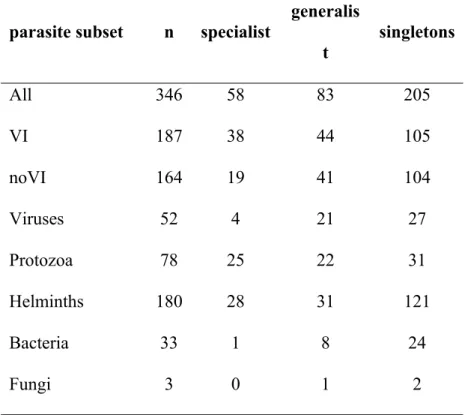
58 of 141 parasites were identified as phylogenetic host specialists, i.e., they infect more closely-related primate species than expected by chance (Table 1; Fig. 1; Appendix S3). As predicted, viruses had lower phylogenetic host specificity than protozoa or helminths (χ2 = 9.745, 249
250
251
252
253
254
255
256
257
258
259
260
261
262
263
264
265
266
267
268
269
270
df = 2, p = 0.008; Table 1), but there were no significant differences among transmission modes (χ2 = 1.554, df = 1, p = 0.213; Table 1). When parasites with a single host were included as specialists, helminths had much higher phylogenetic host specificity than protozoa or viruses (χ2 = 11.57, df = 2, p = 0.003; Table 1), but differences among transmission modes remained non-significant (χ2 = 0.004, df = 1, p = 0.9496; Table 1). Simulations revealed that our method had very high power to detect significant phylogenetic host specificity even under heterogeneous host sampling (Appendix S4). Our results were qualitatively similar when we used only well-sampled parasites (i.e., those with > 4 hosts from our subset of 35 well-well-sampled primates).
Evolutionary models
Evolutionary model (i), where hosts were gained and lost at different rates, was the best fitting model for 89 of our 141 parasites, suggesting that their transmission history included a mixture of host shifts, host-parasite cospeciation and parasite extinction (Appendix S3). The remaining 52 parasites showed support for more than one model, although model (i) was always one of the equally supported models. Rates of host gain in these models were much lower than rates of host loss, suggesting that the patterns are driven mainly by host-parasite cospeciation and parasite extinction, rather than extensive host switching (Appendix S3). These results did not differ when phylogenetic host generalist and specialist parasites were considered separately. We also found no significant differences in the host gain to host loss rate ratio between phylogenetic host generalist and specialist parasites (ANOVA: F1,140 = 0.133, p = 0.716), or among parasite types (ANOVA: F4,136 = 1.868, p = 0.119).
Parasite sharing among primates
272
273
274
275
276
277
278
279
280
281
282
283
284
285
286
287
288
289
290
291
292
293
As predicted, we found a significant negative relationship between divergence time and parasite similarity (r2 = 0.331), and this relationship held across all transmission modes and parasite types (Fig. 2; Fig. S3; Table S2) using either of the Jaccard’s indices (Table S5). This relationship is strongest in phylogenetic host specialist parasites (r2 = 0.411; phylogenetic host generalists: r2 = 0.161), with the greatest scatter about the regression line in viruses (r2 = 0.116), but with little difference between transmission modes (Table S2 and Table S5).
The estimated intercept of the relationship between divergence time and parasite similarity for all parasites was 0.793±0.022, whereas theoretically it should be one (i.e., when divergence time is zero parasite communities should be identical, although this will be true only when all parasites in a host are recorded without sampling error). The lower than expected intercept suggests that parasite sharing among primates is not simply the result of phylogenetic relationships. When phylogenetic host specialist parasites alone were considered, the intercept was 0.903±0.018, which is much closer to one, versus 0.449±0.033 in phylogenetic host generalist parasites suggesting that phylogenetic relatedness is more important for parasite sharing in phylogenetic host specialists than in phylogenetic host generalists.
Statistical models including ecology and geography explained substantially more of the variation in parasite sharing than models including only divergence time (“best” model, all parasites, r2 = 0.613; Table 2; Table S3 and Table S6). Other than divergence time, the most important predictors in our models were the distance between host geographic range centroids, the body mass difference between hosts, and the difference in mean annual temperature across the species’ ranges. As predicted, parasite sharing increased as differences decreased, indicating that greater geographic and ecological similarity increases parasite similarity (Table 2; Table S3). The relative importance of these factors varied with subsets of the data; only the distance 295
296
297
298
299
300
301
302
303
304
305
306
307
308
309
310
311
312
313
314
315
316
between host geographic range centroids was consistently found in all of our 95% confidence sets of models. Thus, greater distances resulted in lower parasite similarity, consistent with opportunity for contact and/or habitat similarity as predictors of parasite sharing.
Although we found significant relationships among parasite similarity and host sampling effort, these associations were weak (mean r2 < 0.05), suggesting that our results are not an artifact of differences in sampling effort (Table S4).
Human-primate parasite sharing predictions
As predicted by the parasite sharing models, we share most parasites with our closest relatives, chimpanzees and gorillas (Fig. 3). However, overall parasite sharing did not decrease predictably with phylogenetic distance: on average, humans share more parasites with Old World monkeys and lemurs than with orangutans. This appears to be because humans share far fewer phylogenetic host specialist parasites with chimpanzees, gorillas and orangutans than predicted by our models (Fig. 3). When considering phylogenetic host generalists, however, parasite sharing among humans and primates decreased more consistently with phylogenetic distance (Fig. 3).
Discussion
Over 60% of human emerging infectious diseases are shared with animals (Jones et al.
2008). Thus, it is vitally important to understand the drivers of parasite sharing among species so we can predict which parasites may emerge in humans in the future. Previous authors found that close relatives should share more parasites than distant relatives (e.g., Davies & Pedersen 2008; Krasnov et al. 2010; Longdon et al. 2011). We also show that closely related primates 318
319
320
321
322
323
324
325
326
327
328
329
330
331
332
333
334
335
336
337
338
339
share more parasites than more distantly related primates. Importantly, however, phylogenetic distance did not fully explain variation in parasite sharing; ecological and distributional
differences among primates were also relevant predictors, particularly the distance between the species’ geographic ranges. Davies and Pedersen (2008) also found that geographic range overlap was important for parasite sharing in primates, and Krasnov et al. (2010) found that environmental differences were important in ectoparasite sharing among rodents, particularly for ectoparasites that sometimes live independently of their hosts. Conversely, Longdon et al. (2011) found that phylogenetic distances among hosts explained almost all variation in the ability of viruses to infect new Drosophila species. However, they avoided any effects of host ecology and distribution by artificially infecting the hosts.
Taken together, these results suggest that host ecological and distributional differences are important through their affects on the rate and intensity of initial host-parasite contacts, while phylogeny is important for parasite sharing only after host-parasite contact has occurred. Other factors are also important for understanding parasite sharing. Using a measure of phylogenetic host specificity, for example, we found more variance in parasite sharing was explained by phylogeny for host specialist parasites.
Most of our parasites were phylogenetic host generalists, infecting more distantly related primates than expected. Evolutionary models suggest these patterns are driven primarily by parasite extinction and host-parasite coevolution rather than host switching (although our method may not detect recent host switching among many close relatives, e.g., SIV; Charleston & Robertson 2002). This was true for phylogenetic host generalist and specialist parasites, although we expected to see higher rates of host switching in phylogenetic host generalists. These results suggest that phylogenetic host generalists infect many hosts by resisting extinction (rather than 341
342
343
344
345
346
347
348
349
350
351
352
353
354
355
356
357
358
359
360
361
362
by regularly switching hosts). Parasite extinctions could occur through the evolution of host immune defenses, changes in host ecology or distribution that make the host unsuitable (e.g., dispersal to an area without an appropriate vector), competitive exclusion by other parasites, or simply by chance (e.g., “missing the boat” at speciation; Krasnov et al. 2010). Phylogenetic host generalists may avoid extinction by quickly evolving adaptations to circumvent such host
changes.
Most viruses in our dataset are phylogenetic host generalists. Interestingly, Longdon et al. (2011) found the opposite result in Drosophila sigma viruses, although this may reflect that the hosts were infected artificially. Contrary to expectations, evolutionary models did not show that viruses had higher rates of host switching than other groups of parasites. This suggests that viruses are particularly good at resisting extinction, perhaps owing to higher rates of evolution (Woolhouse & Gowtage-Sequeria 2005; Woolhouse et al. 2005; Parrish et al. 2008; Elena & Froissart 2010). Bacteria were also predominantly phylogenetic host generalists, although we have little data on these parasites (Table 1). Protozoa and helminths, in contrast, have fairly equal numbers of phylogenetic host specialists and generalists. However, this changes if we consider parasites with just one host. Around 50% of viruses, 70% of bacteria, 40% of protozoa and 70% of helminths in our dataset infect only a single primate species, suggesting that we are
underestimating phylogenetic host specificity. One explanation for this pattern involves constraints imposed by the parasite’s lifecycle. For example, helminths often have complex lifecycles, which may reduce their ability to adapt to new hosts because they must retain
adaptations to their intermediate hosts (Woolhouse et al. 2005; Parrish et al. 2008). In addition, vector borne or intermediate host parasites are also constrained by availability of sufficient competent vectors or susceptible intermediate hosts, even in areas where susceptible hosts are 364
365
366
367
368
369
370
371
372
373
374
375
376
377
378
379
380
381
382
383
384
385
abundant (Randolph & Rogers 2010; Kilpatrick 2011). However, we failed to find any
differences in phylogenetic host specificity in relation to transmission mode. Parasites may also appear to infect only one host due to low sampling effort (see below).
Our parasite sharing models predicted that humans should share most parasites with our closest primate relatives. However, parasite sharing did not decrease with phylogenetic distance as strongly as expected; humans share more host-specific parasites with Old World monkeys and lemurs than with our closer relative the orangutan. This departure from expectations may reflect the greater research effort aimed at documenting parasites in Old World monkeys (see Fig. S2), especially as many macaque species are used in medical research, and because of greater contact between humans and these lineages of primates. For example, humans are likely to have more contact with Old World monkeys than orangutans because orangutans are rare and primarily arboreal, whereas Old World monkey species are more terrestrial and are often commensal with humans (Smuts et al. 1987). In addition, many human diseases appear to originate from human-wildlife contact during bushmeat hunting or butchering, including Old World monkeys (Wolfe et al. 2005; Betsem et al. 2011). Hence, these findings also suggest that the rate and intensity of parasite contacts is a better predictor of parasite sharing among species than phylogeny alone, which may explain why more parasites of humans are shared with rodents and domestic animals than with wild primates (Woolhouse & Gowtage-Sequeria 2005; Engelstädter & Hurst 2006; Wolfe et al. 2007; Parrish et al. 2008). We omitted ecological differences in analyses involving humans because human ecological attributes are difficult to quantify. It would be useful to formalize ecological overlap between humans and other mammals more formally in future extensions of this research.
387
388
389
390
391
392
393
394
395
396
397
398
399
400
401
402
403
404
405
406
407
Sampling effort is a major issue in comparative analyses of parasites because poorly-studied hosts will appear to have fewer parasites than well-known hosts (Gregory et al. 1996). We dealt with this issue by focusing on the 35 best-studied primates (out of 376 species in the Order Primates; Wilson & Reeder 2005) and find that our analyses still had high power to detect significant phylogenetic host specificity even under heterogeneous parasite sampling. However, we also find that even in these well-studied primates, more effort is needed to sample the full complement of parasites found in most primates, as indicated by only slight saturation in the parasite accumulation curves (Fig. S2). In addition, 205 parasites are found only in one primate species. In some cases the lack of saturation reflects a truly specialized parasite; in others it likely reflects under-sampling of the parasite. This under-sampling is also uneven across parasite groups: bacterial parasites are rarely reported, possibly due to lower severity of bacterial diseases compared to viral diseases (e.g., Ebola). Given the past and future implications of emerging parasites contracted from human-wildlife contacts, further research into wildlife parasites is crucial to fill these research gaps.
Several other methodological issues deserve mention. First, many parasite “species” consist of multiple cryptic species that infect different hosts. Treating these cryptic species as one species could artificially inflate the phylogenetic host specificity of the parasite; however, if a cryptic species complex is phylogenetically host specific, it is likely that its constituent species will be, too. In addition, species definitions differ across types of parasite, which make it difficult to compare phylogenetic host specificity across parasite types. Second, our measure of
phylogenetic host specificity only captures one aspect of host specificity in parasites. Poulin et al. (2011) discuss other important factors, including structural (i.e., how the parasite prevalence and abundance vary among hosts) and geographical (i.e., how host use varies geographically) 409
410
411
412
413
414
415
416
417
418
419
420
421
422
423
424
425
426
427
428
429
430
specificity. Third, the mechanisms leading to a pair of hosts sharing two closely related parasites or two distantly related parasites probably differ; however our methods do not distinguish between these scenarios. If parasite relatedness was considered, we would expect parasite sharing of closely-related parasites to be more strongly governed by host phylogeny. We did not consider parasite relatedness due to a lack of suitable parasite phylogenies; however, this should be considered in the future as more comprehensive parasite phylogenies are published (Poulin et al. 2011).
In conclusion, understanding the drivers of parasite sharing among species is vital to understanding which parasites will be more likely to emerge in humans, domesticated animals, crops, or endangered wildlife. Our results confirm that more closely related hosts are more likely to share parasites, but also highlight the importance of host ecology and geographical
distribution, and of the phylogenetic host specificity of the parasites involved. We also highlight major gaps in our knowledge of wildlife parasites. Greater understanding of these gaps is
essential to improve our ability to predict future infectious disease risks.
Acknowledgements
We thank the Nunn lab and three anonymous referees for helpful comments. Funding was provided by Harvard University and the NSF (BCS-0923791).
432
433
434
435
436
437
438
439
440
441
442
443
444
445
446
447
448
449
450
References 1.
Anderson M.J., Crist T.O., Chase J.M., Vellend M., Inouye B.D., Freestone A.L., et al. (2011). Navigating the multiple meanings of diversity: a roadmap for the practicing ecologist.
Ecol Lett, 14, 19-28. 2.
Anderson P.K., Cunningham A.A., Patel N.G., Morales F.J., Epstein P.R. & Daszak P. (2004). Emerging infectious diseases of plants: pathogen pollution, climate change and
agrotechnology drivers. Trends Ecol Evol, 19, 535-544. 3.
Arnold C., Matthews L.J. & Nunn C.L. (2010). The 10kTrees website: A new online resource for primate phylogeny. Evol Anthr, 19, 114-118.
4.
Barton K. (2011). MuMIn: Multi-model inference. R package version 1.6.0. 5.
Betsem E., Rua R., Tortevoye P., Froment A. & Gessain A. (2011). Frequent and recent human acquisition of Simian Foamy Viruses through apes' bites in Central Africa. PLoS Pathog, 7, e1002306.
6.
Bivand R. & Rundel C. (2011). rgeos: Interface to Geometry Engine - Open Source (GEOS). R package version 0.1-8.
452
453
454
455
456
457
458
459
460
461
462
463
464
465
466
467
468
469
470
471
7.
Charleston M.A. & Robertson D.L. (2002). Preferential host switching by primate Lentiviruses can account for phylogenetic similarity with the primate phylogeny. Syst Biol, 51, 528-535.
8.
Davies T.J. & Pedersen A.B. (2008). Phylogeny and geography predict pathogen community similarity in wild primates and humans. Proc R Soc Lond B Biol Sci, 275, 1695-1701. 9.
de Magalhaes J.P. & Costa J. (2009). A database of vertebrate longevity records and their relation to other life-history traits. J Evol Biol, 22, 1770-1774.
10.
Elena S.F. & Froissart R. (2010). New experimental and theoretical approaches towards the understanding of the emergence of viral infections. Phil Trans R Soc Lond B Biol Sci, 365, 1867-1869.
11.
Engelstädter J. & Hurst G.D.D. (2006). The dynamics of parasite incidence across host species.
Evol Ecol, 20, 603-616. 12.
Gregory R.D., Keymer A.E. & Harvey P.H. (1996). Helminth parasite richness among vertebrates. Biodiversity Conserv, 5, 985-997.
13. 473
474
475
476
477
478
479
480
481
482
483
484
485
486
487
488
489
490
491
492
Hijmans R.J., Cameron S.E., Parra J.L., Jones P.G. & Jarvis A. (2005). Very high resolution interpolated climate surfaces for global land areas. Int J Climatol, 25, 1965-1978. 14.
Hijmans R.J. & van Etten J. (2011). raster: Geographic analysis and modeling with raster data. R package version 1.8-39.
15.
IUCN (2010). IUCN Red List of Threatened Species. Version 2010.4. Available at:
http://www.iucnredlist.org Last accessed 25th July 2011. 16.
Jaccard P. (1922). La chrologie sélective et sa signification pour la sociologie végétale. Mem Soc Vaud Sci Nature, 2.
17.
Jones K.E., Bielby J., Cardillo M., Fritz S.A., O'Dell J., Orme C.D.L., et al. (2009).
PanTHERIA: A species-level database of life-history, ecology and geography of extant and recently extinct mammals. Ecology, 90, 2648.
18.
Jones K.E., Patel N.G., Levy M.A., Storeygard A., Balk D., Gittleman J.L., et al. (2008). Global trends in emerging infectious diseases. Nature, 451, 990-993.
19.
Keitt T.H., Bivand R., Pebesma E.J. & Rowlingson B. (2011). rgdal: bindings for the geospatial data abstraction library. R package version 0.7-1.
494
495
496
497
498
499
500
501
502
503
504
505
506
507
508
509
510
511
512
513
20.
Kembel S.W., Cowan P.D., Helmus M.R., Cornwell W.K., Morlon H., Ackerly D.D., et al.
(2010). Picante: R tools for integrating phylogenies and ecology. Bioinformatics, 26, 1463-1464.
21.
Kilpatrick A.M. (2011). Globalization, land use, and the invasion of West Nile virus. Science, 334, 323-327.
22.
Kilpatrick A.M., Briggs C.J. & Daszak P. (2010). The ecology and impact of chytridiomycosis: an emerging disease of amphibians. Trends Ecol Evol, 25, 109-118.
23.
Krasnov B.R., Mouillot D., Shenbrot G.I., Khokhlova I.S., Vinarski M.V., Korallo-Vinarskaya N.P., et al. (2010). Similarity in ectoparasite faunas of Palaearctic rodents as a function of host phylogenetic, geographic or environmental distances: Which matters the most? Int J Parasit, 40, 807-817.
24.
Lewin-Koh N.J. & Bivand R. (2011). maptools: Tools for reading and handling spatial objects. R package version 0.8-9.
25.
Longdon B., Hadfield J.D., Webster C.L., Obbard D.J. & Jiggins F.M. (2011). Host phylogeny determines viral persistence and replication in novel hosts. PLoS Pathog, 7, e1002260. 515
516
517
518
519
520
521
522
523
524
525
526
527
528
529
530
531
532
533
534
26.
McCallum H. & Jones M. (2006). To lose both would look like carelessness: Tasmanian devil facial tumour disease. PLoS Biol, 4, 1671-1674.
27.
Morens D.M., Folkers G.K. & Fauci A.S. (2004). The challenge of emerging and re-emerging infectious diseases. Nature, 430, 242-249.
28.
Nowak R.M. (1999). Walker's mammals of the world. The Johns Hopkins University Press, Baltimore.
29.
Nunn C.L. & Altizer S. (2005). The Global Mammal Parasite Database: an online resource for infectious disease records in wild primates. Evol Anthr, 14, 1-2.
30.
Pagel M., Meade A. & Barker D. (2004). Bayesian estimation of ancestral character states on phylogenies. Syst Biol, 53, 673-684.
31.
Parrish C.R., Holmes E.C., Morens D.M., Park E.-C., Burke D.S., Calisher C.H., et al. (2008). Cross-species virus transmission and the emergence of new epidemic diseases. Microbiol Mol Biol Rev, 72, 457-470.
32.
Pebesma E.J. & Bivand R.S. (2005). sp: classes and methods for spatial data in R. In: R News. 536
537
538
539
540
541
542
543
544
545
546
547
548
549
550
551
552
553
554
555
33.
Pedersen A.B., Altizer S., Poss M., Cunningham A.A. & Nunn C.L. (2005). Patterns of host specificity and transmission among parasites of wild primates. Int J Parasit, 35, 647-657. 34.
Poulin R. (2010). Decay of similarity with host phylogenetic distance in parasite faunas.
Parasitology, 137, 733-741. 35.
Poulin R., Krasnov B.R. & Mouillot D. (2011). Host specificity in phylogenetic and geographic space. Trends Parasit, 27, 355-361.
36.
Randolph S.E. & Rogers D.J. (2010). The arrival, establishment and spread of exotic diseases: patterns and predictions. Nat Rev Micro, 8, 361-371.
37.
Sargeant G.A. (2011). wild1: R tools for wildlife research and management. R package version 1.09.
38.
Schnute J.T., Boers N., Haigh R. & Couture-Beil A. (2010). PBSmapping: Mapping Fisheries Data and Spatial Analysis Tools. R package version 2.61.9.
39.
Smuts B.B., Cheney D.L., Seyfarth R.M., Wrangham R.W. & Struhsaker T.T. (1987). Primate Societies Chicago University Press, Chicago.
557
558
559
560
561
562
563
564
565
566
567
568
569
570
571
572
573
574
575
576
40.
Streicker D.G., Turmelle A.S., Vonhof M.J., Kuzmin I.V., McCracken G.F. & Rupprecht C.E. (2010). Host phylogeny constrains cross-species emergence and establishment of Rabies virus in bats. Science, 329, 676-679.
41.
Taylor L.H., Latham S.M. & Woolhouse M.E.J. (2001). Risk factors for human disease emergence. Phil Trans R Soc Lond B Biol Sci, 356, 983-989.
42.
Warton D.I. & Hui F.K.C. (2011). The arcsine is asinine: the analysis of proportions in ecology.
Ecology, 92, 3-10. 43.
Webb C.O., Ackerly D.D., McPeek M.A. & Donoghue M.J. (2002). Phylogenies and community ecology. Ann Rev Ecol Syst, 33, 475-505.
44.
Wilson D.E. & Reeder D.A.M. (1993). Mammal species of the world: a taxonomic and geographic reference. 2nd edn. Smithsonian Institution Press, Washington D.C. 45.
Wilson D.E. & Reeder D.A.M. (2005). Mammal species of the world: a taxonomic and geographic reference. 3rd edn. Smithsonian Institution Press, Washington D.C. 46.
578
579
580
581
582
583
584
585
586
587
588
589
590
591
592
593
594
595
596
Wolfe N.D., Dunavan C.P. & Diamond J. (2007). Origins of major human infectious diseases.
Nature, 447, 279-283. 47.
Wolfe N.D., Peter D., Marm K.A. & S. B.D. (2005). Bushmeat hunting, deforestation, and prediction of zoonoses emergence. Emerg Infect Dis, 11, 1822-1827.
48.
Woolhouse M.E.J. & Gowtage-Sequeria S. (2005). Host range and emerging and reemerging pathogens. Emerg Infect Dis, 11, 1842-1847.
49.
Woolhouse M.E.J., Haydon D.T. & Antia R. (2005). Emerging pathogens: the epidemiology and evolution of species jumps. Trends Ecol Evol, 20, 238-244.
SUPPORTING INFORMATION
Additional Supporting Information may be downloaded via the online version of this article at Wiley Online Library (www.ecologyletters.com).
As a service to our authors and readers, this journal provides supporting information supplied by the authors. Such materials are peer-reviewed and may be re-organized for online delivery, but are not copy-edited or typeset. Technical support issues arising from supporting information (other than missing files) should be addressed to the authors.
598
599
600
601
602
603
604
605
606
607
608
609
610
611 612
613 614 615 616
Tables
Table 1: The distribution of phylogenetic host specialist and generalist parasites across different types of parasite. Singletons are parasites with only one host. VI = parasites transmitted by vectors or intermediate hosts; noVI = parasites transmitted sexually, vertically or by close or non close contact.
parasite subset n specialist generalis t
singletons
All 346 58 83 205
VI 187 38 44 105
noVI 164 19 41 104
Viruses 52 4 21 27
Protozoa 78 25 22 31
Helminths 180 28 31 121
Bacteria 33 1 8 24
Fungi 3 0 1 2
618
619
620
621
622
623
Table 2: Model averaging results from multiple regressions of parasite similarity against various predictors, for pairs of primates. N = 595 primate species pairs. Coefficients are model averages from the 95% confidence set of models. SE = standard error; CI = confidence interval;
importance = the relative importance of each variable.
variable slope adjusted SE lower CI upper CI importance
Divergence time -0.355 0.044 -0.441 -0.269 1.000
Body mass difference -0.086 0.017 -0.120 -0.052 1.000 Group size difference -0.036 0.028 -0.091 0.020 0.447 Terrestriality difference 0.038 0.033 -0.026 0.102 0.410 Temperature difference -0.063 0.024 -0.110 -0.017 0.982 Precipitation difference 0.037 0.023 -0.009 0.082 0.558 Geographic range overlap 0.003 0.008 -0.013 0.019 0.274 Geographic range distance -0.535 0.033 -0.600 -0.469 1.000 625
626
627
628
629
Figure legends
Figure 1: Phylogenetic distribution of the primate hosts for the most common parasites in our study. The primate phylogeny is on the left, primate species are on the right and parasites are under the plot. Black dots indicate parasite presence.
Figure 2: Scatter plots showing the relationship between parasite similarity and divergence time (millions of years) among pairs of primates for all parasites and for phylogenetic host specialist and generalist parasites separately. Results have been subdivided into five million year
divergence time bins. Points are the mean values within these bins and error bars represent standard errors.
Figure 3: Average parasite similarity among humans and various species/clades of primates. White bars represent overall parasite similarity, light grey bars represent parasite similarity for phylogenetic host generalist parasites only, and dark grey bars represent parasite similarity for phylogenetic host specialist parasites only. Crosses represent predicted values from parasite sharing models. Pan = Pan troglodytes; Gorilla = Gorilla gorilla; Pongo = Pongo pygmaeus; OW = Old World monkeys (Cercopithecidae); NW = New World monkeys (Platyrrhini); Lemur = Strepsirrhini.
631
632
633
634
635
636
637
638
639
640
641
642
643
644
645
646
647
648
649
Figures
Figure 1 651
652
653
654