Language Identification: The Long and the Short of the Matter
Timothy Baldwin and Marco Lui
Dept of Computer Science and Software Engineering University of Melbourne, VIC 3010 Australia
[email protected],[email protected]
Abstract
Language identification is the task of identify-ing the language a given document is written in. This paper describes a detailed examina-tion of what models perform best under dif-ferent conditions, based on experiments across three separate datasets and a range of tokeni-sation strategies. We demonstrate that the task becomes increasingly difficult as we increase the number of languages, reduce the amount of training data and reduce the length of docu-ments. We also show that it is possible to per-form language identification without having to perform explicit character encoding detection.
1 Introduction
With the growth of the worldwide web, ever-increasing numbers of documents have become available, in more and more languages. This growth has been a double-edged sword, however, in that content in a given language has become more preva-lent but increasingly hard to find, due to the web’s sheer size and diversity of content. While the ma-jority of (X)HTML documents declare their charac-ter encoding, only a tiny minority specify what guage they are written in, despite support for lan-guage declaration existing in the various (X)HTML standards.1 Additionally, a single encoding can
gen-erally be used to render a large number of languages such that the document encoding at best filters out a subset of languages which are incompatible with the given encoding, rather than disambiguates the source language. Given this, the need for automatic means to determine the source language of web
doc-1http://dev.opera.com/articles/view/
mama-head-structure/
uments is crucial for web aggregators of various types.
There is widespread misconception of language identification being a “solved task”, generally as a result of isolated experiments over homogeneous datasets with small numbers of languages (Hughes et al., 2006; Xia et al., 2009). Part of the motivation for this paper is to draw attention to the fact that, as a field, we are still a long way off perfect language identification of web documents, as evaluated under realistic conditions.
In this paper we describe experiments on lan-guage identification of web documents, focusing on the broad question of what combination of tokenisa-tion strategy and classificatokenisa-tion model achieves the best overall performance. We additionally evalu-ate the impact of the volume of training data and the test document length on the accuracy of lan-guage identification, and investigate the interaction between character encoding detection and language identification.
One assumption we make in this research, follow-ing standard assumptions made in the field, is that all documents are monolingual. This is clearly an un-realistic assumption when dealing with general web documents (Hughes et al., 2006), and we plan to re-turn to investigate language identification over mul-tilingual documents in future work.
Our contributions in this paper are: the demon-stration that language identification is: (a) trivial over datasets with smaller numbers of languages and approximately even amounts of training data per language, but (b) considerably harder over datasets with larger numbers of languages with more skew in the amount of training data per language; byte-based tokenisation without character encoding de-tection is superior to codepoint-based tokenisation
with character encoding detection; and simple co-sine similarity-based nearest neighbour classifica-tion is equal to or better than models including sup-port vector machines and naive Bayes over the lan-guage identification task. We also develop datasets to facilitate standardised evaluation of language identification.
2 Background Research
Language identification was arguably established as a task by Gold (1967), who construed it as a closed class problem: given data in each of a predefined set of possible languages, human subjects were asked to classify the language of a given test document. It wasn’t until the 1990s, however, that the task was popularised as a text categorisation task.
The text categorisation approach to language identification applies a standard supervised classi-fication framework to the task. Perhaps the best-known such model is that of Cavnar and Tren-kle (1994), as popularised in the textcat tool.2 The method uses a per-language character frequency model, and classifies documents via their relative “out of place” distance from each language (see Section 5.1). Variants on this basic method in-clude Bayesian models for character sequence pre-diction (Dunning, 1994), dot products of word fre-quency vectors (Darnashek, 1995) and information-theoretic measures of document similarity (Aslam and Frost, 2003; Martins and Silva, 2005). More recently, support vector machines (SVMs) and ker-nel methods have been applied to the task of lan-guage identification task with success (Teytaud and Jalam, 2001; Lodhi et al., 2002; Kruengkrai et al., 2005), and Markov logic has been used for joint in-ferencing in contexts where there are multiple evi-dence sources (Xia et al., 2009).
Language identification has also been carried out via linguistically motivated models. Johnson (1993) used a list of stop words from different languages to identify the language of a given document, choos-ing the language with the highest stop word over-lap with the document. Grefenstette (1995) used word and part of speech (POS) correlation to de-termine if two text samples were from the same or different languages. Giguet (1995) developed a
2http://www.let.rug.nl/vannoord/TextCat/
cross-language tokenisation model and used it to identify the language of a given document based on its tokenisation similarity with training data. Dueire Lins and Gonc¸alves (2004) considered the use of syntactically-derived closed grammatical-class models, matching syntactic structure rather than words or character sequences.
The observant reader will have noticed that some of the above approaches make use of notions such as “word”, typically based on the naive assumption that the language uses white space to delimit words. These approaches are appropriate in contexts where there is a guarantee of a document being in one of a select set of languages where words are space-delimited, or where manual segmentation has been performed (e.g. interlinear glossed text). However, we are interested in language identification of web documents, which can be in any language, includ-ing languages that do not overtly mark word bound-aries, such as Japanese, Chinese and Thai; while relatively few languages fall into this categories, they are among the most populous web languages and therefore an important consideration. There-fore, approaches that assume a language is space-delimited are clearly not suitable for our purposes. Equally, approaches which make assumptions about the availability of particular resources for each lan-guage to be identified (e.g. POS taggers, or the ex-istence of precompiled stop word lists) cannot be used.
Language identification has been applied in a number of contexts, the most immediate applica-tion being in multilingual text retrieval, where re-trieval results are generally superior if the language of the query is known, and the search is restricted to only those documents predicted to be in that lan-guage (McNamee and Mayfield, 2004). It can also be used to “word spot” foreign language terms in multilingual documents, e.g. to improve parsing per-formance (Alex et al., 2007), or for linguistic corpus creation purposes (Baldwin et al., 2006; Xia et al., 2009; Xia and Lewis, 2009).
3 Datasets
Corpus Documents Languages Encodings Document Length (bytes) EUROGOV 1500 10 1 17460.5±39353.4
TCL 3174 60 12 2623.2±3751.9
[image:3.612.99.263.156.289.2]WIKIPEDIA 4963 67 1 1480.8±4063.9
Table 1: Summary of the three language identification datasets
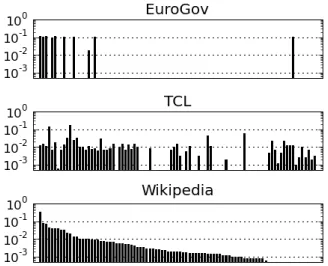
Figure 1: Distribution of languages in the three datasets (vector of languages vs. the proportion of documents in that language)
EUROGOV: longer documents, all in a single en-coding, spread evenly across a relatively small num-ber (10) of Western European languages; this dataset is comparable to the datasets conventionally used in language identification research. As the name would suggest, the documents were sourced from the Euro-GOV document collection, as used in the 2005 Web-CLEF task.
TCL: a larger number of languages (60) across a wider range of language families, with shorter docu-ments and a range of character encodings (12). The collection was manually sourced by the Thai Com-putational Linguistics Laboratory (TCL) in 2005 from online news sources.
WIKIPEDIA: a slightly larger number of lan-guages again (67), a single encoding, and shorter documents; the distribution of languages is intended to approximate that of the actual web. This col-lection was automatically constructed by taking the dumps of all versions of Wikipedia with 1000 or more documents in non-constructed languages, and randomly selecting documents from them in a bias-preserving manner (i.e. bias-preserving the document distribution in the full collection); this is intended to represent the document language bias observed on
the web. All three corpora are available on request. We outline the characteristics of the three datasets in Table 1. We further detail the language distri-bution in Figure 1, using a constant vector of lan-guages for all three datasets, based on the order of languages in the WIKIPEDIAdataset (in descending order of documents per language). Of note are the contrasting language distributions between the three datasets, in terms of both the languages represented and the relative skew of documents per language. In the following sections, we provide details of the cor-pus compilation and document sampling method for each dataset.
4 Document Representation
As we are interested in performing language iden-tification over arbitrary web documents, we re-quire a language-neutral document representation which does not make artificial assumptions about the source language of the document. Separately, there is the question of whether it is necessary to deter-mine the character encoding of the document in or-der to extract out character sequences, or whether the raw byte stream is sufficient. To explore this question, we experiment with two document repre-sentations: (1) byten-grams, and (2) codepointn -grams. In both cases, a document is represented as a feature vector of token counts.
Byte n-grams can be extracted directly without explicit encoding detection. Codepointn-grams, on the other hand, require that we know the character encoding of the document in order to perform to-kenisation. Additionally, they should be based on a common encoding to prevent: (a) over-fragmenting the feature space (e.g. ending up with discrete fea-ture spaces for euc-jp, s-jis and utf-8 in the case of Japanese); and (b) spurious matches be-tween encodings (e.g. Japanese hiragana and Ko-rean hangul mapping onto the same codepoint in
uni-code as the common encoding for all documents. In practice, character encoding detection is an is-sue only for TCL, as the other two datasets are in a single encoding. Where a character encoding was provided for a document in TCL and it was possi-ble to transcode the document to unicode based on that encoding, we used the encoding information. In cases where a unique encoding was not provided, we used an encoding detection library based on the Mozilla browser.3 Having disambiguated the encod-ing for each document, we transcoded it into uni-code.
5 Models
In our experiments we use a number of different language identification models, as outlined below. We first describe the neighbour and nearest-prototype models, and a selection of distance and similarity metrics combined with each. We then present three standalone text categorisation models.
5.1 Nearest-Neighbour and Nearest-Prototype Models
The 1-nearest-neighbour (1NN) model is a common classification technique, whereby a test document D is classified based on the language of the clos-est training documentDi (with languagel(Di)), as
determined by a given distance or similarity metric. In nearest-neighbour models, each training doc-ument is represented as a single instance, mean-ing that the computational cost of classifymean-ing a test document is proportional to the number of training documents. A related model which aims to reduce this cost is nearest-prototype (AM), where each lan-guage is represented as a single instance, by merging all of the training instances for that language into a single centroid via the arithmetic mean.
For both nearest-neighbour and nearest-prototype methods, we experimented with three similarity and distance measures in this research:
Cosine similarity (COS): the cosine of the angle between two feature vectors, as measured by the dot product of the two vectors, normalised to unit length.
Skew divergence (SKEW): a variant of Kullback-Leibler divergence, whereby the second distribution
3http://chardet.feedparser.org/
(y) is smoothed by linear interpolation with the first (x) using a smoothing factorα(Lee, 2001):
sα(x, y) =D(x||αy+ (1−α)x)
where:
D(x||y) =X
i
xi(log2xi−log2yi)
In all our experiments, we setαto 0.99.
Out-of-place (OOP): a ranklist-based distance metric, where the distance between two documents is calculated as (Cavnar and Trenkle, 1994):
oop(Dx, Dy) =
X
t∈Dx∨Dy
abs(RDx(t)−RDy(t))
RD(t) is the rank of termtin document D, based
on the descending order of frequency in document D; terms not occurring in documentDare conven-tionally given the rank1 + maxiRD(ti).
5.2 Naive Bayes (NB)
Naive Bayes is a popular text classification model, due to it being lightweight, robust and easy to up-date. The language of test documentDis predicted by:
ˆ
l(D) = arg max
li∈L P(li)
|V| Y
j=1
P(tj|li)ND,tj
ND,tj!
whereLis the set of languages in the training data, ND,tjis the frequency of thejth term inD,V is the
set of all terms, and:
P(t|li) =
1 +P|kD=1| Nk,tP(li|Dk)
|V|+P|V|
j=1
P|D|
k=1Nk,tjP(li|Dk)
In this research, we use the rainbow imple-mentation of multinominal naive Bayes (McCallum, 1996).
5.3 Support Vector Machines (SVM)
margin between training instances and the calculated decision boundary based on structural risk minimi-sation (Vapnik, 1995).
In this work, we have made use of bsvm,4 an implementation of SVMs with multiclass classifica-tion support (Hsu et al., 2008). We only report re-sults for multi-class bound-constrained support vec-tor machines with linear kernels, as they were found to perform best over our data.
6 Experimental Methodology
We carry out experiments over the cross-product of the following options, as described above:
model (×7): nearest-neighbour (COS1NN,
SKEW1NN, OOP1NN), nearest-prototype (COSAM, SKEWAM),5NB, SVM
tokenisation (×2): byte, codepoint
n-gram (×3): 1-gram, 2-gram, 3-gram
for a total of 42 distinct classifiers. Each classi-fier is run across the 3 datasets (EUROGOV, TCL
and WIKIPEDIA) based on 10-fold stratified cross-validation.
We evaluate the models using micro-averaged precision (Pµ), recall (Rµ) and F-score (Fµ), as well
as macro-averaged precision (PM), recall (RM) and
F-score (FM). The micro-averaged scores indicate
the average performance per document; as we al-ways make a unique prediction per document, the micro-averaged precision, recall and F-score are al-ways identical (as is the classification accuracy). The macro-averaged scores, on the other hand, indi-cate the average performanceper language. In each case, we average the precision, recall and F-score across the 10 folds of cross validation.6
As a baseline, we use a majority class, or ZeroR, classifier (ZEROR), which assigns the language with highest prior in the training data to each of the test documents.
4http://www.csie.ntu.edu.tw/˜cjlin/bsvm/ 5
We do not include the results for nearest-prototype classi-fiers with the OOP distance metric as the results were consid-erably lower than the other methods.
6Note that this means that the averagedF
M is not necessar-ily the harmonic mean of the averagedPM andRM.
Model Token PM RM FM Pµ/Rµ/Fµ
ZEROR — .020 .084 .032 .100 COS1NN byte .975 .978 .976 .975 COS1NN codepoint .968 .973 .970 .971 COSAM byte .922 .938 .926 .937 COSAM codepoint .908 .930 .913 .931 SKEW1NN byte .979 .979 .979 .977 SKEW1NN codepoint .978 .978 .978 .976 SKEWAM byte .974 .972 .972 .969 SKEWAM codepoint .974 .972 .973 .970 OOP1NN byte .953 .952 .953 .949
OOP1NN codepoint .961 .960 .960 .957
NB byte .975 .973 .974 .971 NB codepoint .975 .973 .974 .971 SVM byte .989 .985 .987 .987
[image:5.612.315.541.59.255.2]SVM codepoint .988 .985 .986 .987
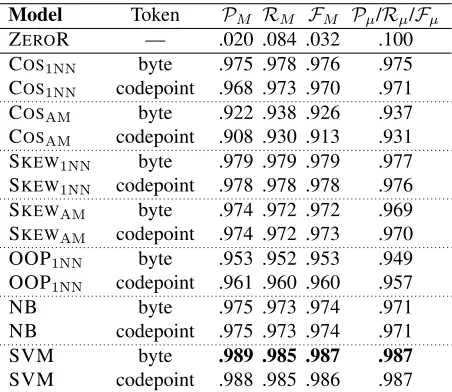
Table 2: Results for byte vs. codepoint (bigram) tokeni-sation over EUROGOV
7 Results
In our experiments, we first compare the different models for fixedn-gram order, then come back to vary the n-gram order. Subsequently, we examine the relative performance of the different models on test documents of differing lengths, and finally look into the impact of the amount of training data for a given language on the performance for that lan-guage.
7.1 Results for the Different Models and Tokenisation Strategies
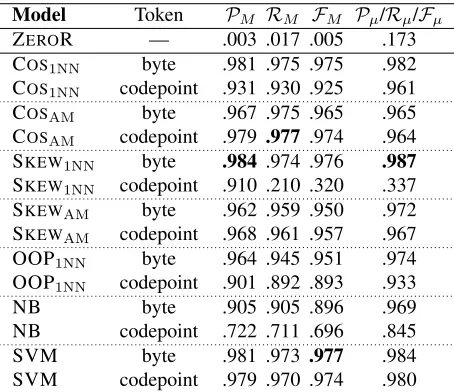
First, we present the results for each of the classifiers in Tables 2–4, based on byte or codepoint tokenisa-tion and bigrams. In each case, we present the best result in each column inbold.
The relative performance over EUROGOV and TCL is roughly comparable for all methods barring SKEW1NN, with near-perfect scores over all 6
eval-uation metrics. SKEW1NN is near-perfect over EU
-ROGOV and TCL, but drops to baseline levels over WIKIPEDIA; we return to discuss this effect in
Sec-tion 7.2.
Model Token PM RM FM Pµ/Rµ/Fµ
ZEROR — .003 .017 .005 .173 COS1NN byte .981 .975 .975 .982 COS1NN codepoint .931 .930 .925 .961 COSAM byte .967 .975 .965 .965 COSAM codepoint .979 .977 .974 .964 SKEW1NN byte .984 .974 .976 .987
SKEW1NN codepoint .910 .210 .320 .337 SKEWAM byte .962 .959 .950 .972 SKEWAM codepoint .968 .961 .957 .967 OOP1NN byte .964 .945 .951 .974
OOP1NN codepoint .901 .892 .893 .933
NB byte .905 .905 .896 .969 NB codepoint .722 .711 .696 .845 SVM byte .981 .973 .977 .984 SVM codepoint .979 .970 .974 .980
Table 3: Results for byte vs. codepoint (bigram) tokeni-sation over TCL
the larger number of languages, smaller documents, and skew in the amounts of training data per lan-guage. All models are roughly balanced in the rel-ative scores they attain for PM, RM andFM (i.e.
there are no models that have notably higherPM
rel-ative toRM, for example).
The nearest-neighbour models outperform the corresponding nearest-prototype models to varying degrees, with the one exception of SKEW1NN over WIKIPEDIA. The nearest-prototype classifiers were certainly faster than the nearest-neighbour classi-fiers, by roughly an order of 10, but this is more than outweighed by the drop in classification per-formance. With the exception of SKEW1NN over
WIKIPEDIA, all methods were well above the base-lines for all three datasets.
The two methods which perform consistently well at this point are COS1NN and SVM, with COS1NN
holding up particularly well under micro-averaged F-score while NB drops away over WIKIPEDIA, the most skewed dataset; this is due to the biasing effect of the prior in NB.
Looking to the impact of byte- vs. codepoint-tokenisation on classifier performance over the three datasets, we find that overall, bytes outperform codepoints. This is most notable for TCL and WIKIPEDIA, and the SKEW1NN and NB models. Given this result, we present only results for byte-based tokenisation in the remainder of this paper.
Model Token PM RM FM Pµ/Rµ/Fµ
ZEROR — .004 .013 .007 .328 COS1NN byte .740 .646 .671 .869
COS1NN codepoint .685 .604 .625 .835 COSAM byte .587 .634 .573 .776 COSAM codepoint .486 .556 .483 .725 SKEW1NN byte .005 .013 .008 .304 SKEW1NN codepoint .006 .013 .007 .241 SKEWAM byte .605 .617 .588 .844 SKEWAM codepoint .552 .575 .532 .807 OOP1NN byte .619 .518 .548 .831
OOP1NN codepoint .598 .486 .520 .807
[image:6.612.72.299.59.255.2]NB byte .496 .454 .442 .851 NB codepoint .426 .349 .360 .798 SVM byte .667 .545 .577 .845 SVM codepoint .634 .494 .536 .818
Table 4: Results for byte vs. codepoint (bigram) tokeni-sation over WIKIPEDIA
The results for byte tokenisation of TCL are par-ticularly noteworthy. The transcoding into unicode and use of codepoints, if anything, hurts perfor-mance, suggesting that implicit character encoding detection based on byte tokenisation is the best ap-proach: it is both more accurate and simplifies the system, in removing the need to perform encoding detection prior to language identification.
7.2 Results for Differingn-gram Sizes
We present results with byte unigrams, bigrams and trigrams in Table 5 for WIKIPEDIA.7 We omit
re-sults for the other two datasets, as the overall trend is the same as for WIKIPEDIA, with lessened relative differences betweenn-gram orders due to the rela-tive simplicity of the respecrela-tive classification tasks.
SKEW1NNis markedly different to the other meth-ods in achieving the best performance with uni-grams, moving from the worst-performing method by far to one of the best-performing methods. This is the result of the interaction between data sparse-ness and heavy-handed smoothing with the α con-stant. Rather than using a constantα value for all n-gram orders, it may be better to parameterise it using an exponential scale such asα = 1−βn(with
7
Model n-gram PM RM FM Pµ/Rµ/Fµ
ZEROR — .004 .013 .007 .328 COS1NN 1 .644 .579 .599 .816 COS1NN 2 .740 .646 .671 .869
COS1NN 3 .744 .656 .680 .862 COSAM 1 .526 .543 .487 .654 COSAM 2 .587 .634 .573 .776 COSAM 3 .553 .632 .545 .761 SKEW1NN 1 .691 .598 .625 .848 SKEW1NN 2 .005 .013 .008 .304 SKEW1NN 3 .005 .013 .004 .100 SKEWAM 1 .552 .569 .532 .740 SKEWAM 2 .605 .617 .588 .844 SKEWAM 3 .551 .631 .554 .825 OOP1NN 1 .519 .446 .468 .747
[image:7.612.75.295.58.328.2]OOP1NN 2 .619 .518 .548 .831 NB 1 .576 .578 .555 .778 NB 2 .496 .454 .442 .851 NB 3 .493 .435 .432 .863 SVM 1 .585 .505 .523 .812 SVM 2 .667 .545 .577 .845 SVM 3 .717 .547 .594 .840
Table 5: Results for different n-gram orders over WIKIPEDIA
β = 0.01, e.g.), based on the n-gram order. We leave this for future research.
For most methods, bigrams and trigrams are bet-ter than unigrams, with the one notable exception of SKEW1NN. In general, there is little separating
bigrams and trigrams, although the best result for is achieved slightly more often for bigrams than for tri-grams.
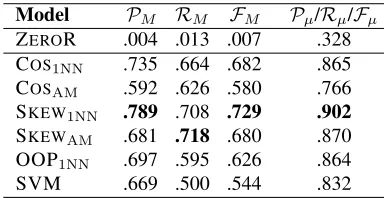
[image:7.612.327.519.59.158.2]For direct comparability with Cavnar and Tren-kle (1994), we additionally carried out a preliminary experiment with hybrid byten-grams (all of 1- to 5-grams), combined with simple frequency-based fea-ture selection of the top-1000 feafea-tures for each n -gram order. The significance of this setting is that it is the strategy adopted bytextcat, based on the original paper of Cavnar and Trenkle (1994) (with the one exception that we use 1000 features rather than 300, as all methods other than OOP1NN bene-fitted from more features). The results are shown in Table 6.
Compared to the results in Table 5, SKEW1NNand SKEWAMboth increase markedly to achieve the best overall results. OOP1NN, on the other hand, rises slightly, while the remaining three methods actually
Model PM RM FM Pµ/Rµ/Fµ
ZEROR .004 .013 .007 .328 COS1NN .735 .664 .682 .865 COSAM .592 .626 .580 .766 SKEW1NN .789 .708 .729 .902
SKEWAM .681 .718 .680 .870 OOP1NN .697 .595 .626 .864
SVM .669 .500 .544 .832
Table 6: Results for mixedn-grams (1–5) and feature se-lection over WIKIPEDIA(a l´a Cavnar and Trenkle (1994))
drop back slightly. Clearly, there is considerably more experimentation to be done here with mixed n-gram models and different feature selection meth-ods, but the results indicate that some methods cer-tainly benefit fromn-gram hybridisation and feature selection, and also that we have been able to sur-pass the results of Cavnar and Trenkle (1994) with SKEW1NNin an otherwise identical framework.
7.3 Breakdown Across Test Document Length
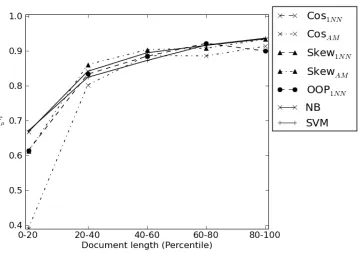
To better understand the impact of test document size on classification accuracy, we divided the test documents into 5 equal-size bins according to their length, measured by the number of tokens. We then computedFµindividually for each bin across the 10
folds of cross validation. We present the breakdown of results for WIKIPEDIAin Figure 2.
WIKIPEDIA shows a pseudo-logarithmic growth
in Fµ (= Pµ = Rµ) as the test document size
in-creases. This fits with our intuition, as the model has progressively more evidence to base the classi-fication on. It also suggests that performance over shorter documents appears to be the dominating fac-tor in the overall ranking of the different methods. In particular, COS1NNand SVM appear to be able to classify shorter documents most reliably, leading to the overall result of them being the best-performing methods.
While we do not show the graph for reasons of space, the equivalent graph for EUROGOV displays
a curious effect:Fµdrops off as the test documents
assump-Figure 2: Breakdown of Fµ over WIKIPEDIA for test
[image:8.612.98.279.60.187.2]documents of increasing length
Figure 3: Per-languageFM for COS1NN, relative to the
training data size (in MB) for that language
tion of strict monolingualism is broken, or when the document is dominated by extra-linguistic data. Clearly, this underlines our assumption of monolin-gual documents, and suggests multilinmonolin-gual language identification is a fertile research area even in terms of optimising performance over our “monolingual” datasets.
7.4 Performance Relative to Training Data Size
As a final data point in our analysis, we calculated theFM for each language relative to the amount of
training data available for that language, and present the results in the form of a combined scatter plot for the three datasets in Figure 3. The differing distri-butions of the three datasets are self-evident, with
most languages in EUROGOV (the squares) both having reasonably large amounts of training data and achieving highFM values, but the majority of
lan-guages in WIKIPEDIA(the crosses) having very lit-tle data (including a number of languages with no training data, as there is a singleton document in that language in the dataset). As an overall trend, we can observe that the greater the volume of training data, the higher theFM across all three datasets, but there
is considerable variation between the languages in terms of theirFM for a given training data size (the
column of crosses for WIKIPEDIAto the left of the graph is particularly striking).
8 Conclusions
We have carried out a thorough (re)examination of the task of language identification, that is predict-ing the language that a given document is written in, focusing on monolingual documents at present. We experimented with a total of 7 models, and tested each over two tokenisation strategies (bigrams vs. codepoints) and three tokenn-gram orders (un-igrams, bigrams and trigrams). At the same time as reproducing results from earlier research on how easy the task can be over small numbers of lan-guages with longer documents, we demonstrated that the task becomes much harder for larger num-bers of languages, shorter documents and greater class skew. We also found that explicit character encoding detection is not necessary in language de-tection, and that the most consistent model overall is either a simple 1-NN model with cosine similar-ity, or an SVM with a linear kernel, using a byte bigram or trigram document representation. We also confirmed that longer documents tend to be easier to classify, but also that multilingual documents cause problems for the standard model of language identi-fication.
Acknowledgements
This research was supported by a Google Research Award.
References
[image:8.612.69.296.253.442.2]on Empirical Methods in Natural Language Process-ing and Computational Natural Language LearnProcess-ing 2007 (EMNLP-CoNLL 2007), pages 151–160, Prague, Czech Republic.
Javed A. Aslam and Meredith Frost. 2003. An information-theoretic measure for document similar-ity. InProceedings of 26th International ACM-SIGIR Conference on Research and Development in Informa-tion Retrieval (SIGIR 2003), pages 449–450, Toronto, Canada.
Timothy Baldwin, Steven Bird, and Baden Hughes. 2006. Collecting low-density language materials on the web. InProceedings of the 12th Australasian Web Conference (AusWeb06). http://www.ausweb. scu.edu.au/ausweb06/edited/hughes/. William B. Cavnar and John M. Trenkle. 1994.
N-gram-based text categorization. InProceedings of the Third Symposium on Document Analysis and Informa-tion Retrieval, Las Vegas, USA.
Marc Darnashek. 1995. Gauging similarity with n -grams: Language-independent categorization of text. Science, 267:843–848.
Rafael Dueire Lins and Paulo Gonc¸alves. 2004. Au-tomatic language identification of written texts. In Proceedings of the 2004 ACM Symposium on Applied Computing (SAC 2004), pages 1128–1133, Nicosia, Cyprus.
Ted Dunning. 1994. Statistical identification of lan-guage. Technical Report MCCS 940-273, Computing Research Laboratory, New Mexico State University. Emmanuel Giguet. 1995. Categorization according to
language: A step toward combining linguistic knowl-edge and statistic learning. In Proceedings of the 4th International Workshop on Parsing Technologies (IWPT-1995), Prague, Czech Republic.
E. Mark Gold. 1967. Language identification in the limit. Information and Control, 5:447–474.
Gregory Grefenstette. 1995. Comparing two language identification schemes. InProceedings of Analisi Sta-tistica dei Dati Testuali (JADT), pages 263–268. Chih-Wei Hsu, Chih-Chung Chang, and Chih-Jen Lin.
2008. A practical guide to support vector classifica-tion. Technical report, Department of Computer Sci-ence National Taiwan University.
Baden Hughes, Timothy Baldwin, Steven Bird, Jeremy Nicholson, and Andrew MacKinlay. 2006. Recon-sidering language identification for written language resources. In Proceedings of the 5th International Conference on Language Resources and Evaluation (LREC 2006), pages 485–488, Genoa, Italy.
Thorsten Joachims. 1998. Text categorization with sup-port vector machines: learning with many relevant fea-tures. In Proceedings of the 10th European
Confer-ence on Machine Learning, pages 137–142, Chemnitz, Germany.
Stephen Johnson. 1993. Solving the problem of lan-guage recognition. Technical report, School of Com-puter Studies, University of Leeds.
Canasai Kruengkrai, Prapass Srichaivattana, Virach Sornlertlamvanich, and Hitoshi Isahara. 2005. Lan-guage identification based on string kernels. In Pro-ceedings of the 5th International Symposium on Com-munications and Information Technologies (ISCIT-2005), pages 896–899, Beijing, China.
Lillian Lee. 2001. On the effectiveness of the skew diver-gence for statistical language analysis. InProceedings of Artificial Intelligence and Statistics 2001 (AISTATS 2001), pages 65–72, Key West, USA.
Huma Lodhi, Craig Saunders, John Shawe-Taylor, Nello Cristianini, and Chris Watkins. 2002. Text classifica-tion using string kernels. Journal of Machine Learning Research, 2:419–444.
Christopher D. Manning, Prabhakar Raghavan, and Hin-rich Sch¨utze. 2008. Introduction to Information Re-trieval. Cambridge University Press, Cambridge, UK. Bruno Martins and M´ario J. Silva. 2005. Language iden-tification in web pages. In Proceedings of the 2005 ACM symposium on Applied computing, pages 764– 768, Santa Fe, USA.
Andrew Kachites McCallum. 1996. Bow: A toolkit for statistical language modeling, text retrieval, classifica-tion and clustering. http://www.cs.cmu.edu/ ˜mccallum/bow.
Paul McNamee and James Mayfield. 2004. CharacterN -gram Tokenization for European Language Text Re-trieval. Information Retrieval, 7(1–2):73–97.
Olivier Teytaud and Radwan Jalam. 2001. Kernel-based text categorization. In Proceedings of the International Joint Conference on Neural Networks (IJCNN’2001), Washington DC, USA.
Vladimir N. Vapnik. 1995. The Nature of Statistical Learning Theory. Springer-Verlag, Berlin, Germany. Fei Xia and William Lewis. 2009. Applying NLP
tech-nologies to the collection and enrichment of language data on the web to aid linguistic research. In Pro-ceedings of the EACL 2009 Workshop on Language Technology and Resources for Cultural Heritage, So-cial Sciences, Humanities, and Education (LaTeCH – SHELT&R 2009), pages 51–59, Athens, Greece. Fei Xia, William Lewis, and Hoifung Poon. 2009.