Exploring word order in learner
corpora: The WOSLAC Project
http://www.uam.es/woslac
Corpus Research Seminar
Department of Linguistics & English Language Lancaster University
20/11/2006
Amaya Mendikoetxea,
AIMS OF THE PRESENTATION
• To
present the WOSLAC project
: (i) its
motivation and objectives, (ii) data
collection, (iii) annotation and query
software and (iv) data analysis.
• To inform on
the results of a preliminary
study
on the production of inverted
PART I
The WOSLAC Project: objectives
To determine the properties that constrain word
order in non-native grammars (L2):
Spanish L1 – English L2 & English L1 – Spanish L2
.
a) Lexicon-syntax interface: how the lexical properties of verbs are represented in the syntax (syntactic realization of arguments and
adjuncts).
b) Syntax-discourse interface: the relevance of information structure notions such as topic (given/old/retrievable information) and focus
(new/non-retrievable information) in word order in L2 grammars
DATA COLLECTION (1):
Wri
CLE
Wri
CLE “Written Corpus of Learner English”
• L1 Spanish - L2 English
• Target: 1 million words
• So far: 250 essays = 450.000 words
• Learners
: 1st and 3rd yr. students of English at the UAM.
• Essays
: around 1.500 words written for the EAP course.
• Data gathered
: a) Essay, b) Learner profile, c) Essay
DATA COLLECTION (2):
CEDEL2
CEDEL2 “Corpus Escrito del Español L2”
• L1 English - L2 Spanish
• Target: 1 million words
• So far: 150.000 words
• Learners
: University students of Spanish in USA, UK,
Australia & Spain.
• Essays
: descriptive and argumentative essays from
about 500 words.
• Data gathered
: online collection of
SOFTWARE: UAM CorpusTool
• UAM CorpusTool (Mick O’Donnell) can be used as a coder and a searcher
• The tool allows a analyst to select a text from the corpus, and
annotate it in various ways. For instance, the analyst can highlight a segment (e.g., an it-cleft) and then assign features to that segment. The tool produces an XML-encoded version of the text file, including the features assigned to the segments.
DATA ANALYSIS: FRAMEWORK
Comparative Framework: to determine the role of L1 in L2 acquisition (transfer) in the areas under study:
• L1 properties • L2 properties
• Universal Grammar
We adopt some methodological aspects of CIA: Contrastive Interlanguage Approach (see, e.g. Granger 1996 and Gilquin 2001)
(a) NNS vs. NS: non-native vs. native data.
It involves a detailed analysis of linguistic features in native and non-native corpora to uncover and study non-native features in the speech and writing of (advanced) non-native speakers. This includes errors, but it is conceptually wider as it seeks to identify overuse and underuse of certain linguistic features and patterns.
(b) NNS vs. NNS: different non-native data.
By comparing learner data from different L1 backgrounds, we can gain a better
understanding of interlanguage processes and features, such as those which are the result of transfer or those which are developmental, common to learners with different L1.
DATA ANALYSIS: FRAMEWORK
• Formal
and
functional
features interact in
the structures under consideration.
• Formal and functional approaches are
therefore essential for the understanding
of SLA data.
• At the same time, data from non-native
grammars is potentially significant for the
understanding of
linguistic phenomena in
CONTRIBUTIONS TO THE FIELD
• Linguistic Theory
: better understanding of
interfaces
(lexicon-syntax, syntax-discourse and
syntax-phonology).
• L2 acquisition
: better understanding of
transfer
and non-transfer phenomena.
• Corpus studies
: use of corpora for the study of
formal
features. Creation of the first
Spanish
learner corpus.
• Pedagogy
: better understanding of word order
PART II
Postverbal subjects in learner English
Lozano & Mendikoetxea (in press) Postverbal subjects at the interfaces in Spanish and Italian learners of L2 English: a corpus analysis. In G. Guilquin, M.B. Díaz-Bedmar and S. Papp, Linking Contrastive and Learner Corpus Research. Amsterdam: Rodopi.
Postverbal subjects
L1 Spanish/L1 Italian – L2 English
ICLE (International Corpus of Learner English)
Interfaces:
• lexicon-syntax • syntax-discourse • syntax-phonology
Word Order in L1 English (1)
• Fixed SV(O) order- Restricted use of postverbal subjects:
a) XP V S
(i) XP is an adverbial element, typically expressing time or place and linking the sentence to the prior discourse
(ii) V is an intransitive verb, typically expressing existence or appearance on the scene (= unaccusative)
(iii) S is often syntactically/phonologically ‘heavy’ consisting of a noun and a variety of pre and/or postmodifiers, which introduce new information in the discourse.
Word Order in L1 English (2)
b)
There
-constructions
(2) a. Somewhere deep inside [there] arose a desperate hope that he would embrace her [FICT ]
b. In all such relations [there] exists a set of mutual obligations in the instrumental and economic fields [ACAD]
c. [There] came a roar of pure delight as…. [FICT]
Word order in L1 English (sum)
• Lexicon-syntax interface (Levin & Rappaport-Hovav, etc):
– Unaccusative Hypothesis (Burzio 1986, etc)
• *There sang four girls at the opera. [unergative verb] • There arrived four girls at the station. [unaccusative verb]
• Syntax-discourse interface (Biber et al, Birner 1994, etc):
– Postverbal material tends to be focus (new info)
• We have complimentary soft drinks and coffee. Also complimentary is red and white wine.
• Syntax-Phonological Form (PF) interface (Arnold et al, etc)
– Heavy material is sentence-final (Principle of End-Weight, Quirk et al. 1972):
Word Order in L1 Spanish (1)
•
Postverbal subjects are produced ‘freely’ with
all verb classes
(as part of the cluster or properties
associated with the
Null Subject Parameter)
:
(3) a. Ha telefoneado María al presidente. (transitive).
Has phoned Mary the president
b. Ha hablado Juan. (unergative)
has spoken Juan
c. Ha llegado Juan. (unaccusative)
Word Order in Spanish (2)
Inversion as ‘focalisation’: preverbal subjects are topics (given information) and postverbal subjects are focus (new information)
(4) ¿Quién ha llegado/hablado? Who has arrived/spoken?
i. Ha llegado/hablado Juan
ii. #Juan ha llegado/hablado
The occurrence of postverbal subjects in Spanish is determined by
syntax-discourse properties (they are focus) and syntax-phonology
properties (heavy subjects show a tendency to be postposed– a
Previous L2 findings
Production of
postverbal subjects
in L2 English
(Rutherford 1989, Oshita 2004)
• L1 Spanish – L2 English:
(6) …it arrived the day of his departure… (7) And then at last comes the great day. (8) In every country exist criminals
(9) …after a few minutes arrive the girlfriend with his family too.
Only with unaccusative verbs (never with unergatives). Unaccusatives: arrive, happen, exist, come, appear, live…
Explanation: syntax-lexicon interface (Unaccusative Hypothesis)
Hypotheses
GENERAL HYPOTHESIS:
– Conditions licensing VS in L2 Eng are the same as those in Native Eng, DESPITE differences in grammaticalisation.
SPECIFIC HYPOTHESES:
– H1: Lexicon-syntax interface:
• Postverbal subjects with unaccs (never with unergs)
– H2: Syntax-PF interface:
• Postverbal subjects: heavy (NOT light)
Method
• Learner corpus: L1 Spa – L2 Eng
– ICLE Spanish subcorpus (Granger et al. 2002)
– UAM-ICLE corpus [ICLE]
• Problem: proficiency level??
• WordSmith v. 4.0 (Scott 2004)
• Excel, SPSS v. 12.0
Concordance queries can be performed automatically with WordSmith, by targetting specific verbs BUT there is a lot of manual work (filtering out
unusable data, coding data in Excel, analysing data in SPSS, etc).
Corpus Number of essays Number of words
ICLE Spanish 251 200,376
UAM 85 63,836
Data analysis
•
Based on Levin (1993) and Levin & Rappaport-Hovav
(1995):
–
Unergatives
:
cough, cry, shout, speak, walk, dance…
• [TOTAL: 41]
–
Unaccusatives
:
exist, live, appear, emerge, happen, arrive…
• [TOTAL: 34]
•
WordSmith
: query searches:
–
For every lemma (e.g., APPEAR, ARISE), we searched for:
• All possible native forms:
– appear, appears, appearing, appeared
– arise, arises, arising, arose, arisen
• All posible overregularised and overgeneralised learner forms:
– arised, arosed,arisened, arosened (“So arised the Saint Inquisition”)
• All possible forms with probable L1 transfer of spelling:
Data analysis (cont’d)
• CONCORDANCES: RAW OUTPUT
Data analysis
(cont’d)---• CONCORDANCES: 6 BASIC FILTERING CRITERIA:
The verb must be intransitive (unergative or unaccusative). In the screen of the television one or two “rombos” should appear. [unac]
Leontes cries and the statue talks. [unerg]
This government’s movement has created several opinions. [trans]
The verb must be finite, with(out) aux. …also it exists the psychological agresssions… [finite no aux]
… the cases of men mistreated do not appear in the media. [finite aux]
This contradiction could disappear [finite modal]
There’s no reason for it to exist. [for clause + to inf]
Poor people cross borders to escape from poverty. [to-inf clause]
…let time pass… [‘let’ constructions]
…make everyone’s life go ahead [causative + infinitive]
Returning to the title of this paper,… [gerundive clauses]
…they go away in order to escape to France. [‘in order to’ clauses]
…women have to live with the agressor [have to/ought to/able to]
…prudence was beginning to disappear. [verbal/aspectual periphrases]
Before entering the argumentation,… [small clauses]
…instead of following… [complement of P]
9. Data analysis
(cont’d)---
The verb must be in the active voice. This contradiction could disappear. [active unaccusative]
This situation has already been happened. [passivised unaccusative]
The subject must be an NP.…it arose [diverse social ranks, the rich and the poor that depended on the property they had]. [inverted NP subject]
…it only remains [to add that nowadays we live in a world…] [extraposition]
It happened [that the countries which make the weapons are…] [extraposition]
The sentence can be either grammatical or ungrammatical in native English. This contradiction could disappear. [gram]
…it won’t exist nothing of what people don’t get bored or tired. [ungram]
10. Data analysis (cont’d)
---• OTHER FILTERING CRITERIA
• Target V + V (verbal coordination)
Families without father exist and work well.
• Coordinator + target V
…we can manage to obtain it and live in a better world. • Interrogatives (only if V is the target)
How could they live?
Does exist then a manipulation of television? • Formulaic & Set expressions in English
As sometimes happens…
…fall victim to…
…the world we live in.
• Set expressions transferred from the L1 …it happens the same.
…they fall into account that they have treated very badly Mr Hardcastle.
• Phrasal verbs:
…a scientist come up with an intention…
• Quotes (literary or other):
11. Data analysis
(cont’d)---• OTHER FILTERING CRITERIA (CONT’D)
• Transitive alternants (unacs):
Rosamond lived a very comfortable life.
…once you have passed this stage.
…the University of Pennsylvania developed the electronic calculator.
• Causativizations (unacs):
…how parents grew their children.
But this idea could rise the question of…
• Verbs that do not belong to the proposed semantic criteria by Levin & Rappaport-Hovav:
…social classes appear to be broken. [≠appearance]
…we come to know about his personality… [≠inherently directed motion]
• Subject relative clauses:
…those fantastic relatives that still survive.
..events of this kind which occurred in Spain.
• Free relative clauses:
…trying to imagine what will remain…
Hastings realizes what is happening…
Results: types of VS structures
produced
• Locative inversion:
– In the main plot appear the main characters: Volpone and Mosca.
• There-insertion:
– There exist positive means of earning money.
• AdvP-insertion:
– … and here emerges the problem. • * it-insertion:
– *In the name of religion it had occurred many important events… • * XP-insertion:
– *In 1760 occurs the restoration of Charles II in England. • * Ø-insertion:
– …*because exist the science technology and the industrialisation.
GRAMM.
UNGRAM.
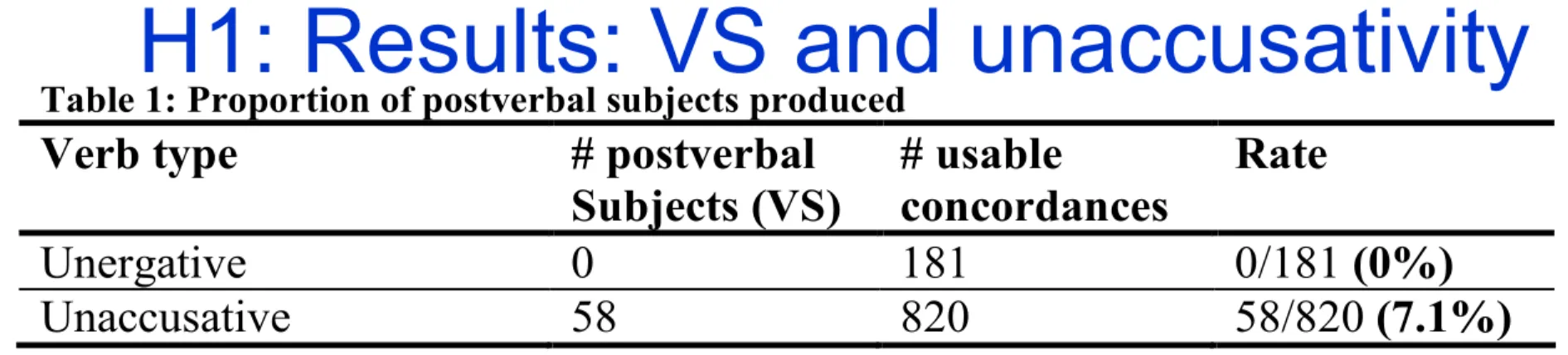
H1: Results: VS and unaccusativity
Table 1: Proportion of postverbal subjects produced
Verb type # postverbal Subjects (VS)
# usable
concordances
Rate
Unergative 0 181 0/181 (0%)
H2: Result: VS and weight
HEAVY
Against this society drama emerged an opposition headed by Oscar Wilde and Bernard Shaw.
…so came the decline of the theatre.
LIGHT
So arised the Saint Inquisition… …and from there began a fire.
Still today … exists the bloody fights.
Syntactic weight has to be measured
manually according to some theoretical
H2: Result: SV and weight
HEAVY
…the cases of men mistreated do not appear in the media…
…a disintegration of culture, tradition and society would begin…
…the utopian societies created by the
LIGHT
H3: Result: VS and discourse
FOCUS
…there also exists a wide variety of
optional channels which have to be paid.
So arised the Saint Inquisition.
In 1880 it begun the experiments whose
TOPIC
…our modern world, dominated by science and technology and industrialisation …
because exist the science technology and
Discourse status
(topic/focus) has to be measured manually by establishing
H3: Result: SV and discourse
TOPIC
I use the Internet … I find windows … if they press on any of these windows … these windows cannot appear because a child could enter easily…
Summary/Conclusion
Lexicon-syntax
V
unaccNP
subjSyntax-discourse FOCUS
Syntax-PF HEAVY
NP
subjV
unaccSyntax-discourse TOPIC
Syntax-PF LIGHT