Volume 2006, Article ID 35909, Pages1–10 DOI 10.1155/ASP/2006/35909
Distance Measures for Image Segmentation Evaluation
Xiaoyi Jiang,1Cyril Marti,2Christophe Irniger,2and Horst Bunke2
1Computer Vision and Pattern Recognition Group, Department of Computer Science, University of M¨unster, Einsteinstrasse 62,
D-48149 M¨unster, Germany
2Institute of Computer Science and Applied Mathematics, University of Bern, Neubr¨uckstrasse 10, CH-3012 Bern, Switzerland
Received 17 March 2005; Revised 10 July 2005; Accepted 31 July 2005
The task considered in this paper is performance evaluation of region segmentation algorithms in the ground-truth-based paradigm. Given a machine segmentation and a ground-truth segmentation, performance measures are needed. We propose to consider the image segmentation problem as one of data clustering and, as a consequence, to use measures for comparing clus-terings developed in statistics and machine learning. By doing so, we obtain a variety of performance measures which have not been used before in image processing. In particular, some of these measures have the highly desired property of being a metric. Experimental results are reported on both synthetic and real data to validate the measures and compare them with others.
Copyright © 2006 Hindawi Publishing Corporation. All rights reserved.
1. INTRODUCTION
Image segmentation and recognition are central problems of image processing for which we do not yet have any gen-eral purpose solution approaching human-level competence. Recognition is basically a classification task and one can em-pirically estimate the recognition performance (probability of misclassification) by counting classification errors on a test set. Today, reporting recognition performance on large data sets is a well-accepted standard. In contrast, segmentation performance evaluation remains subjective. Typically, results on a few images are shown and the authors argue why they look good. The readers frequently do not know whether the results have been opportunistically selected or are typical ex-amples, and how well the demonstrated performance extrap-olates to larger sets of images.
The main challenge is that the question “to what extent is this segmentation correct” is much more subtle than “is this face from person x.” While a huge number of segmentation algorithms have been reported, there is only little work on methodologies of segmentation performance evaluation [1]. Several segmentation tasks can be identified: edge detection, region segmentation, and detection of curvilinear structures. Their performance evaluation is of quite different nature. For instance, an evaluation of detection algorithms for curvilin-ear structures must take the elongated shape of this particular feature into account [2]. In some sense, edge detection and region segmentation are two dual problems and their perfor-mance evaluation appears to be a similar task. One may con-vert a segmented region map to an equivalent edge map by
marking the region boundaries only and then applying any edge detection evaluation method. However, a simple exam-ple, as shown inFigure 1, reveals a fundamental difference: although in terms of the boundaries the two segmentation results only differ marginally, their discrepancy in the num-ber of regions is substantially larger. This latter aspect has not been a real concern in evaluating edge detectors [3]. For this reason, we need separate strategies for evaluating region seg-mentation algorithms.
In the present paper, we are concerned with region seg-mentation. Note that thresholding may be considered a spe-cial case of region segmentation (into two or more regions with unique semantic labels). The evaluation of threshold-ing techniques is a topic of its own right and the readers are referred to the recent survey paper [4].
The various methods for performance evaluation, in gen-eral, can be categorized according to the following taxonomy [1]:
(i) theoretical evaluation, (ii) experimental evaluation:
(a) feature-based evaluation:
(1) non-GT (ground-truth)-based evaluation; (2) GT-based evaluation,
(b) task-based evaluation.
(a) (b) Figure1: Two segmentation results.
analytically or by simulation. The major limitations of the-oretical approaches are the simplistic mathematical models and the difficulty in applying them to many of the more modern segmentation algorithms because of their complex-ity. An experimental evaluation can be divided into feature-based and task-feature-based. The former category measures the al-gorithm performance only based on the quality of detected features under consideration, for example, edges and re-gions. Within this category, we can further distinguish be-tween non-GT-based and GT-based approaches. The basic idea of GT-based approaches is to measure the difference between the machine segmentation result and the ground truth (expected ideal segmentation, which is in almost all cases specified manually). In contrast, non-GT-based meth-ods do not assume the availability of GT and compute perfor-mance measures directly by means of some desirable proper-ties of the segmentation result. Task-based evaluation follows a very different philosophy. Image segmentation represents only one, although important, step in achieving the high-level goal of a vision system, for example, object recognition. Of ultimate interest is the overall performance of the system. Instead of abstractly comparing the performance of segmen-tation algorithms, it may be thus more meaningful to con-duct an indirect comparison based on their influences on the final performance of the entire system.
In this paper, we follow the GT-based evaluation para-digm. We propose to consider the image segmentation prob-lem as one of data clustering and, as a consequence, to use measures for comparing clusterings developed in statistics and the machine learning community for the purpose of seg-mentation evaluation. This novel approach opens the door for a variety of measures which have not been used before in image processing. As we will see later, some of the mea-sures even have the highly desired property of being a met-ric. Note that this paper is a substantially extended version of [5]. The extension includes a new distance measure based on bipartite graph matching, more detailed discussion of the distance measures and their properties, and additional com-parison work (Sections4and5.3).
The rest of the paper is structured as follows. We start with a short discussion of related work. Then, measures for comparing clusterings are presented, followed by their the-oretical and experimental validations. Finally, some discus-sions conclude the paper.
2. RELATED WORK
In [6], a machine segmentation (MS) of an image is com-pared to the ground-truth specification to count instances of correct segmentation, under-segmentation, over-segmen-tation, missed regions, and noise regions. These measures
are defined based on the degree of mutual overlap required between a region in MS and a region in GT. A correctly segmented region is recorded if and only if an MS region and the corresponding GT region have a mutual overlap greater than a threshold T. Multiple MS regions that to-gether correspond to one GT region constitute an instance of over-segmentation, while one MS region corresponding to the union of several GT regions is considered as under-segmentation. An MS (GT) region that has no corresponding in GT (MS) constitutes an instance of noise (missing) region. This evaluation method is widely used for texture segmenta-tion [7] and range image segmentasegmenta-tion [6,8–11].
In contrast, the approach from [12] delivers one single performance measure. Considering two different segmenta-tionsS1 = {R11,R21,. . .,Rm1}andS2 = {R12,R22,. . .,Rn2}of the same image, we associate each regionRi
2fromS2with a re-gionR1jfromS1such thatRi2∩R
j
1is maximal. The directional Hamming distance fromS1toS2is defined as
DH
S1=⇒S2
=
Ri2∈S
2
Rk1=Rj
1
Rk
1∩Ri2 (1)
corresponding to the total area under the intersections be-tween allRi2∈S2and their nonmaximally intersected regions
Rk1fromS1. The reversed distanceDH(S2⇒S1) can be sim-ilarly computed. Finally, the overall performance measure is given by
p=1−DH
S1=⇒S2
+DH
S2=⇒S1
2A , (2)
whereA is the image size and p ∈ [0, 1]. Letting MS and GT play the role ofS1andS2, respectively, allows us to mea-sure their discrepancy. Recently, this index has been used to compare several segmentation algorithms by integration of region and boundary information [13].
In [14], another single overall performance measure is proposed. It is designed so that if one region segmentation is a refinement of another (at different granularities), then the measure should be small or even zero. LetR(S,pi) be the set of pixels corresponding to the region in segmentationS
that contains the pixel pi. Then, the local refinement error associated withpiis
ES1,S2,pi
=R
S1,pi
\RS2,pi R
S1,pi , (3) where\denotes set difference. Finally, the overall perform-ance measure is defined as
GCE=1
Amin
⎧ ⎨ ⎩
all pixelspi
ES1,S2,pi
,
all pixelspi
ES2,S1,pi ⎫⎬
⎭,
or
LCE= 1
A
all pixelspi
minES1,S2,pi
,ES2,S1,pi
, (5)
where GCE and LCE stand for global consistency and local consistency error, respectively. Note that both measures are tolerant of refinement. In the extreme case, a segmentation containing a single region and a segmentation consisting of regions of a single pixel are rated byp1=p2=0. Due to their tolerance of refinement, these two measures are not sensible to over- and under-segmentation and may be therefore not applicable in some evaluation situations.
3. MEASURES FOR COMPARING CLUSTERINGS
Given a set of objectsO= {o1,. . .,on}, a clustering ofOis a set of subsetsC = {c1,. . .,ck}such thatci ⊆O,ci∩cj = ∅ ifi=j,ki=1ci=O. Eachciis called a cluster. Clustering has been extensively studied in the statistics and machine learn-ing community [15]. In particular, several measures have been proposed to quantify the difference between two clus-teringsC1= {c11,. . .,c1k}andC2= {c21,. . .,c2l}of the same setO.
If we interpret an image as a setOof pixels and a segmen-tation as a clustering ofO, then these measures can be ap-plied to quantify the difference between two segmentations, for example, between MS and GT. This view of the segmen-tation evaluation tasks opens the door for a variety of mea-sures which have not been used before in image processing. As we will see later, some of the measures are even metrics, being a highly desired property which is not fulfilled by the measures discussed in the last section. In the following, we present three classes of measures.
3.1. Distance of clusterings by counting pairs
Given two clusteringsC1andC2of a setOof objects, we con-sider all pairs of objects (oi,oj),i = j, fromO×O. A pair (oi,oj) falls into one of the four categories:
(i) in the same cluster under both C1 andC2 (the total number of such pairs is represented byN11),
(ii) in different clusters under bothC1andC2(N00), (iii) in the same cluster underC1but notC2(N10), (iv) in the same cluster underC2but notC1(N01). Obviously,N11+N00+N10+N01=n(n−1)/2 holds, where
nis the cardinality ofO.
Several distance measures, also called indices, for com-paring clusterings are based on these four counts. The Rand index introduced in [16] is defined as
RC1,C2
=1− N11+N00
n(n−1)/2. (6) Note that the original definition was actually given by 1− R(C1,C2). The only difference is that the former is a dis-tance (dissimilarity) while the latter is a similarity measure. For comparison purpose, we consistently use distance mea-sures such that a value of zero implies a perfect matching,
that is, two identical clusterings. This remark applies to the two indices below as well.
Fowlkes and Mallows [17] introduce the following index:
FC1,C2
=1−W1
C1,C2
W2
C1,C2
(7)
as the geometric mean of
W1
C1,C2
=k N11 i=1ni
ni−1
/2,
W2
C1,C2
= N11
l j=1nj
nj−1
/2,
(8)
wherenistands for the size of theith element ofC1andnj the jth element ofC2. The termsW1andW2 represent the probability that a pair of points which are in the same cluster underC1are also in the same cluster underC2and vice versa.
Finally, the Jacard index [18] is given by
JC1,C2
=1− N11
N11+N10+N01.
(9)
It is easy to see that the three indices are all distance measures with a value domain [0, 1]. The value is zero if and only if the two clusterings are the same except for possibly assigning different names to the individual clusters, or listing the clus-ters in different order. The case with value one corresponds to the maximum degree of cluster dissimilarity, for example,
C1contains a single cluster whileC2consists of clusters of a single object.
3.2. Distance of clusterings by set matching
This second class of comparison criteria is based on matching the clusters of two clusterings. The term
aC1,C2
=
ci∈C1
max cj∈C2
ci∩cj (10)
measures the matching degree between the clusters ofC1and
C2and takes the maximum valuenonly ifC1=C2. Similarly, a terma(C2,C1) can be defined. Based on these two terms, van Dongen [19] proposes the index
DC1,C2
=2n−aC1,C2
−aC2,C1
(11)
and proves that it is a metric. This index is closely related to the performance measure pin [12]. The only difference is that the former is a distance (dissimilarity) measure while the latter is a similarity measure and they can be mapped to each other by a simple linear transformationD(C1,C2) = 2n(1−p).
weight of this edge is equal to|c1i∩c2j|, that is, it is equal to the number of elements that occur in bothc1iandc2j.
Given this graph, we determine a maximum-weight bi-partite graph matching. Such a matching is defined by a sub-set{(c1i1,c2j1),. . ., (c1ir,c2jr)}such that each of the nodesc1i
andc2j has at most one incident edge, and the total sum of weights is maximized over all possible subsets of edges. In-tuitively, the maximum-weight bipartite graph matching can be understood as a correspondence between the clusters of
C1 and the clusters of C2 such that no two clusters of C1 are mapped to the same cluster inC2, and vice versa. More-over, the correspondence optimizes the total number of ob-jects that belong to corresponding clusters. Algorithms for computing maximum-weight bipartite graph matching can be found in [20], for example.
The sum of weightswof a maximum-weight bipartite graph matching is bounded by the number of objectsnin set
O. Therefore, a suitable normalized measure for the distance ofC1andC2is
BGMC1,C2
=1−w
n. (12)
Clearly, this measure is equal to 0 if and only ifk = land there is a bijective mapping f between the clusters ofC1and
C2, such thatc1i = f(c1i) fori∈ {1,. . .,k}. Values close to one indicate that no good mapping between the clusters of
C1andC2exists, such that corresponding clusters have many elements in common.
3.3. Information-theoretic distance of clusterings
Mutual information (MI) is a well-known concept in infor-mation theory. It measures how much inforinfor-mation about random variableYis obtained from observing random vari-ableX. LetXandYbe two random variables with joint prob-ability distribution p(x,y) and marginal probability func-tionsp(x) andp(y). Then, the mutual information ofXand
Y, MI(X,Y), is defined as
MI(X,Y)=
(x,y)
p(x,y) log p(x,y)
p(x)p(y). (13)
Some properties of MI are summarized below; for a more detailed treatment, the reader is referred to [21],
(i) MI(X,Y)=MI(Y,X). (ii) MI(X,Y)≥0.
(iii) MI(X,Y)=0 if and only ifXandY are independent. (iv)
MI(X,Y)≤min(H(X),H(Y)), (14) where H(X) = −xp(x) logp(x) is the entropy of random variableX.
(v)
MI(X,Y)=H(X) +H(Y)−H(X,Y), (15) where H(X,Y) = −(x,y)p(x,y) logp(x,y) is the joint entropy ofXandY.
In the context of measuring the distance of two cluster-ingsC1andC2over a setOof objects, the discrete values of random variableXare the different clustersci ∈C1 an ele-ment ofOcan be assigned to. Similarly, the discrete values ofY are the different clusterscj ∈C2an object ofOcan be assigned to. Hence, the equation above becomes
MIC1,C2
=
ci∈C1
cj∈C2
pci,cj
log p
ci,cj
pci
pcj
. (16)
As MI(C1,C2)≤min(H(C1),H(C2)) andH(C)≤logk, with
k being the number of clusters present in clusteringC, the upper bound of MI(C1,C2) depends on the number of clus-ters inC1andC2. To get a normalized value, it was proposed to divide MI(X,Y) by log(k·l), wherekandlare the numbers of discrete values ofXandY, respectively [22]. This leads to the normalized mutual information
N MIC1,C2
=1− 1
log(k·l)
ci∈C1
cj∈C2
pci,cj
log p
ci,cj
pci
pcj .
(17)
Meila [23] suggests a further alternative called variation of information:
VIC1,C2
=HC1
+HC2
−2 MIC1,C2
, (18)
where
HC1
= −
ci∈C1
pci
logci
,
HC2
= −
cj∈C2
pcj
logcj
(19)
represent the entropy ofC1andC2, respectively. In general, this index is bounded by logn, which is reached in the case when a clusterC1 contains a single cluster and a clusterC2 consists of clusters of a single object. If, however,C1andC2 have at most K,K ≤ √n, clusters each, theVI(C1,C2) is bounded by 2 logK. Importantly, the index turns out to be a metric.
3.4. Remarks
Among the seven distance measures introduced above,
D(C1,C2) and VI(C1,C2) are provably metrics. The other measures satisfy all properties of a metric except the triangle inequality, for which we are not aware of any proof or coun-terexample. Note that a comparison criterion that is a metric has several advantages. Among others, it makes the criterion more understandable and matches the human intuition bet-ter than an arbitrary distance function of two variables.
30 30 10
(a)
30−α 30 +α
10
α
(b) Figure2: (a) GT and (b) MS of an image of size 10×60.
matrix or contingency table, ofC1andC2. It is ak×lmatrix, whosei jth elementmi j represents the number of points in the intersection ofciofC1andcjofC2, that is,mi j= |ci∩cj|. It can be shown (see the appendix) that
N11=1 2
k
i=1 l
j=1
m2i j−n
,
N00= 1 2
n2− k
i=1
n2 i −
l
j=1
n2 j+
k
i=1 l
j=1
m2 i j
,
N10=1 2
k
i=1
n2i − k
i=1 l
j=1
m2i j
,
N01= 1 2
l
j=1
n2 j−
k
i=1 l
j=1
m2 i j
.
(20)
These relationships reduce the computational complexity to O(N2) only and thus make the indices presented in Section 3.1tractable for large-scale clustering problems like image segmentation. Finally, it is noteworthy that all the other measures can be easily computed from the confusion matrix as well.
The computational complexity of the distances by count-ing pairs amounts toO(N2+kl). Since typicallyk < Nandl <
Nhold, we basically have a quadratic complexityO(N2). The same applies to the index D(C1,C2) and the information-theoretic distances. Since the index BGM(C1,C2) only re-quires a maximum-weight bipartite graph matching, it can be computed in low polynomial time as well.
4. COMPARISON WITH HOOVER INDEX
In evaluating the measures defined in the last section, we did some comparison work. For this purpose, we consider the Hoover measure [6] and the measures from [14]. The mea-sure from [12] was ignored because of its equivalence to the van Dongen index.
We first present some theoretical considerations related to the Hoover index before turning to experimental evalua-tion in the next secevalua-tion. Among the five performance mea-sures from [6] only the correct detectionCDis used. A dis-tance measure (1−CD/#GT regions) is obtained for compar-ison purpose.
The Hoover index depends on the overlap thresholdT. One may expect that it monotonically increases, that is, be-comes worse, with increasing tolerance thresholdT. How-ever, this is not true. It may happen that the Hoover index
becomes larger with increasingT values. If we only choose a particular value ofT, this kind of inconsistency may cause some unexpected effects in comparing different algorithms.1 Another inherent problem of the Hoover index is its in-sensitivity to distortion. Basically, this index counts the num-ber of correctly detected regions. Increasing distortion level has no influence on the count at all as far as the tolerance thresholdT does not become effective. The simple example inFigure 2illustrates this situation. In the machine segmen-tation, the region boundary is shifted to left by a distanceα. As far asα ≤ 30(1−T), the Hoover index consistently in-dicates a perfect segmentation (consisting of two correct de-tected regions). The measures proposed in this paper, how-ever, are all pixel-based. As such they sensitively react to the distortions.
5. EXPERIMENTAL VALIDATION
In the following, we present experiments to validate the pro-posed measures based on both synthetic and real data. The experiments were conducted in range image domain and in-tensity image domain.
5.1. Validation on synthetic data
The range image sets reported in [6,11] have become popu-lar for evaluating range image segmentation algorithms. To-tally, three image sets with manually specified ground truth are available: ABW and Perceptron for planar surfaces and K2T for curved surfaces. ABW and K2T are structured light sensors, while Perceptron is a time-of-flight laser scanner. Each range image has a manually specified GT segmentation. Since range image segmentation is geometrically driven, the GT is basically unique and there is no need to work with mul-tiple GT segmentations as is the case in dealing with intensity images (seeSection 5.3). More details and a comparison of the three image sets can be found in [1]. For each GT image, we constructed several synthetic MS results in the following way. A pointpis selected randomly. We find the pointq near-est topwhich does not belong to the same region asp. Then,
qis switched to the region ofpprovided that this step will not produce additional regions. This basic operation is repeated
1One possibility to alleviate the problem is to define a single performance
(a) (b) (c) (d) Figure3: An ABW image: (a) GT, synthetic MS, (b) 5% distortion, (c) 30% distortion, (d) 50% distortion.
Table1: Hoover index for an ABW image. The two instances of inconsistency are underlined.
Distortion level T=0.55 0.60 0.65 0.70 0.75 0.80 0.85 0.90 0.95
10% 0.222 0.333 0.333 0.444 0.556 0.556 0.556 0.667 0.889
20% 0.778 0.667 0.667 0.667 0.667 0.778 0.778 0.778 1.000
30% 0.778 0.778 0.778 0.889 0.889 0.889 0.778 0.889 1.000
40% 0.889 1.000 1.000 1.000 1.000 1.000 1.000 1.000 1.000
for somed% of all points.Figure 3shows one of the ABW GT images and three generated MS versions.
The Hoover index does not necessarily monotonically increase, that is, becomes worse, with increasing tolerance threshold T. Table 1 lists the Hoover index for a particu-lar ABW image as a function of T and the distortion level
d. There are two instances of inconsistencies. At distortion level 30%, for example, the index value 0.778 forT=0.85 is lower than 0.889 forT=0.80. In addition,Table 1also illus-trates the insensitivity of the Hoover index to distortions. For
T=0.85, for instance, the Hoover index remains unchanged (0.778) at both distortion levels 20% and 30%. Objectively, however, a significant difference is visible and should be re-flected in the performance measures. Obviously, the Hoover index does not perform as one would expect here.
By definition, the indices introduced in this paper have a high sensitivity to distortions.Table 2lists the average val-ues for all thirty ABW test images.2No inconsistencies occur here, and the values are strict monotonically increasing with a growing amount of distortion.
Experiments have also been conducted using the Percep-tron image set, and we observed similar behavior of the in-dices. So far, the K2T image set was not tested yet, but we do not expect diverging outcome.
5.2. Validation on real range images
The Hoover index has been applied to evaluate a variety of range image segmentation algorithms [6,8,9]. In our exper-iments, we only considered the four algorithms compared in
2The ABW image set contains forty images and is divided into ten
train-ing images and thirty test images. Only the test images were used in our experiments.
the original work [6]: University of Edinburgh (UE), Uni-versity of Bern (UB), UniUni-versity of South Florida (USF), and University of Washington (UW).Table 3reports an evalua-tion of these algorithms by means of the indices introduced in this paper. The results imply a ranking of segmentation quality: UE, UB, USF, UW, which coincides well with the ranking from the Hoover index (compare the Hoover index values for T = 0.85 inTable 3 and the original work [6]). Note that the comments above on Perceptron and K2T im-age set apply here as well.
5.3. Validation on real intensity images
Table2: Average index values for thirty ABW test images.
Distance measure d=5% 10% 15% 20% 25% 30% 35% 40% 45% 50%
R 0.024 0.041 0.055 0.068 0.080 0.091 0.102 0.111 0.120 0.129
F 0.046 0.079 0.105 0.129 0.152 0.171 0.190 0.206 0.221 0.235
J 0.088 0.146 0.191 0.229 0.264 0.293 0.320 0.343 0.364 0.382
D 0.027 0.046 0.063 0.078 0.092 0.105 0.117 0.128 0.138 0.149
BGM 0.027 0.047 0.064 0.079 0.094 0.108 0.121 0.133 0.144 0.155
N MI 0.725 0.740 0.751 0.761 0.770 0.777 0.784 0.790 0.796 0.801
VI 0.392 0.601 0.758 0.888 1.002 1.099 1.186 1.260 1.329 1.390
Table3: Index values for thirty ABW test images.
Algorithms R F J D BGM NMI VI Hoover
UE 0.005 0.010 0.020 0.009 0.010 0.707 0.147 0.122
UB 0.008 0.016 0.031 0.013 0.014 0.714 0.209 0.180
USF 0.008 0.017 0.033 0.015 0.016 0.711 0.224 0.230
UW 0.009 0.017 0.033 0.019 0.025 0.848 0.236 0.435
(a) (b) (c) (d) (e)
(f) (g) (h) (i) (j)
(k) (l) (m) (n) (o)
(p) (q) (r) (s) (t)
Table4: Statistics of distance measures.
Error R F J D BGM NMI VI GCE LCE
Isame 0.117 0.197 0.317 0.123 0.215 0.772 1.114 0.087 0.055
Idiff 0.378 0.622 0.792 0.446 0.645 0.943 3.424 0.441 0.375
α-error (%) 10.91 9.53 10.31 5.00 13.13 17.19 7.34 2.20 2.86
β-error (%) 3.18 8.98 7.51 4.57 3.92 8.49 6.04 10.94 7.34
0.8 0.6
0.4 0.2
0 0 20 40 60 80 100 120
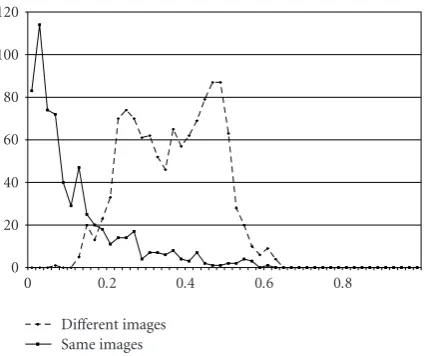
Different images Same images
Figure5: Distribution of Rand index.
nature of segmenting a natural image into an unspecified number of regions, different people produce consistent re-sults on each image. In addition, the experiments help vali-dating the measures by demonstrating that the distance be-tween segmentations of the same image is low, while the dis-tance between segmentations of different images is high.
We conducted a similar experiment to validate the mea-sures proposed in this paper. For this purpose, 50 images were randomly selected from the database. Each of the im-ages has at least five human segmentations. As an example, Figure 5 gives the distribution of the Rand index between pairs of human segmentations. As expected, the distance dis-tribution for segmentations of the same image shows a strong spike near zero, while the distance distribution for segmen-tations of different images is neither localized nor close to zero. The average for all comparison cases of same images
Isameis 0.117, while the average for different images amounts to Idiff = 0.378. Obviously, the two distributions are not
intersection-free, that is, using the Rand index, we will make some error in deciding whether two segmentations corre-spond to different segmentations of the same image (case (I)) or that of two different images (case (II)). This deci-sion error can be quantified in the following way. We use the intersection point of the two curves as the decision thresh-old. Then, we call a decision case (II) made by the machine for the true case (I) anα-error and a decision case (I) for the true case (II) anβ-error. For the Rand index, the prob-ability ofα-error andβ-error is 10.91% and 3.19%, respec-tively. The statistics for all the measures is listed inTable 4.
Obviously, they all tend to have largeα-error probability. The reason simply lies in the missing tolerance of segmentation refinement. Only the measureD(C1,C2) seems to have well-balancedα-error andβ-error probabilities.
The behavior of the measure GCE and LCE from [14] is exactly converse. They tend to have smallα-error proba-bility (due to the tolerance of refinement) and highβ-error probability. It remains an interesting task to find measures with well-balancedα-error andβ-error probabilities (which are better thanD(C1,C2)).
6. CONCLUSIONS
Considering image segmentation as a task of data cluster-ing opens the door for a variety of measures which are not known/popular in image processing. In this paper, we have presented several indices developed in the statistics and ma-chine learning community. Some of them are even met-rics. Experimental results have demonstrated their useful-ness in both range image and intensity image domain. In fact, the proposed approach is applicable in any task of segmentation performance evaluation. This includes diff er-ent imaging modalities (intensity, range, etc.) and different segmentation-tasks (surface patches in range images, texture regions in grey-level or color images). In addition, the useful-ness of these measures is not limited to evaluating different segmentation algorithms. They can also be applied to train the parameters of a single segmentation algorithm [10,24].
Given some reasonable performance measures, we are faced with the problem of choosing a particular one in an evaluation task. Here it is important to realize that the perfor-mance measures may be themselves biased in certain situa-tions. Instead of using a single measure, we may take a collec-tion of measures and define an overall performance measure. One way of doing this could be to select one representative performance measure from each class of (similar) measures and to build an overall performance measure, for instance, by a linear combination. As a matter of fact, such a combi-nation approach has not received much attention in the liter-ature so far. We believe that it will achieve a better behavior by avoiding the bias of the individual measures. The perfor-mance measures presented in this paper provide candidates for this combination approach.
APPENDIX
Given the confusion matrix of sizek×l and the notation
mi j = |ci∩cj|,ci ∈C1,cj ∈C2, we derive the formulas for
From the definition, it immediately follows that
N11= k
i=1 l
j=1
mi j
mi j−1
2
=1
2 k
i=1 l
j=1
m2 i j−
k
i=1 l
j=1
mi j
=1
2 k
i=1 l
j=1
m2 i j−n
.
(A.1)
In addition, we have
N10= k
i=1
ni
ni−1
2 −
l
j=1
mi j
mi j−1 2 =1 2 k
i=1
n2i −n
−1
2 k
i=1 l
j=1
m2i j−n
=1
2 k
i=1
n2 i −
k
i=1 l
j=1
m2 i j
.
(A.2)
Analogously, it holds that
N01= 1 2
l
j=1
n2j− k
i=1 l
j=1
m2i j
. (A.3)
Finally,
N00=n (n−1)
2 −N11−N10−N01
=1
2
n2− k
i=1
n2 i −
l
j=1
n2 j+
k
i=1 l
j=1
m2 i j . (A.4) ACKNOWLEDGMENT
The authors want to thank the maintainers of the Berkeley segmentation data set and benchmark for public availability.
REFERENCES
[1] X. Jiang, “Performance evaluation of image segmentation al-gorithms,” inHandbook of Pattern Recognition and Computer Vision, C. H. Chen and P. S. P. Wang, Eds., pp. 525–542, World Scientific, Singapore, 3rd edition, 2005.
[2] X. Jiang and D. Mojon, “Supervised evaluation methodol-ogy for curvilinear structure detection algorithms,” in Pro-ceedings of 16th International Conference on Pattern
Recogni-tion (ICPR ’02), vol. 1, pp. 103–106, Quebec, Canada, August
2002.
[3] M. S. Prieto and A. R. Allen, “A similarity metric for edge im-ages,”IEEE Transactions on Pattern Analysis and Machine In-telligence, vol. 25, no. 10, pp. 1265–1273, 2003.
[4] M. Sezgin and B. Sankur, “Survey over image thresholding techniques and quantitative performance evaluation,”Journal of Electronic Imaging, vol. 13, no. 1, pp. 146–165, 2004. [5] X. Jiang, C. Marti, C. Irniger, and H. Bunke, “Image
segmen-tation evaluation by techniques of comparing clusterings,” in
Proceedings of 13th International Conference on Image Analysis and Processing (ICIAP ’05), Cagliari, Italy, September 2005. [6] A. Hoover, G. Jean-Baptiste, X. Jiang, et al., “An
experi-mental comparison of range image segmentation algorithms,”
IEEE Transactions on Pattern Analysis and Machine Intelligence, vol. 18, no. 7, pp. 673–689, 1996.
[7] K. I. Chang, K. W. Bowyer, and M. Sivagurunath, “Evaluation of texture segmentation algorithms,” inProceedings of IEEE Computer Society Conference on Computer Vision and Pattern
Recognition (CVPR ’99), vol. 1, pp. 294–299, Fort Collins,
Colo, USA, June 1999.
[8] X. Jiang, “An adaptive contour closure algorithm and its ex-perimental evaluation,”IEEE Transactions on Pattern Analysis and Machine Intelligence, vol. 22, no. 11, pp. 1252–1265, 2000. [9] X. Jiang, K. W. Bowyer, Y. Morioka, et al., “Some further re-sults of experimental comparison of range image segmenta-tion algorithms,” inProceedings of 15th International
Confer-ence on Pattern Recognition (ICPR ’00), vol. 4, pp. 877–881,
Barcelona, Spain, September 2000.
[10] J. Min, M. W. Powell, and K. W. Bowyer, “Automated perfor-mance evaluation of range image segmentation algorithms,”
IEEE Transactions on Systems, Man and Cybernetics—Part B: Cybernetics, vol. 34, no. 1, pp. 263–271, 2004.
[11] M. W. Powell, K. W. Bowyer, X. Jiang, and H. Bunke, “Com-paring curved-surface range image segmenters,” in Proceed-ings of 6th IEEE International Conference on Computer Vision
(ICCV ’98), pp. 286–291, Bombay, India, January 1998.
[12] Q. Huang and B. Dom, “Quantitative methods of evaluating image segmentation,” inProceedings of International
Confer-ence on Image Processing (ICIP ’95), vol. 3, pp. 53–56,
Wash-ington, DC, USA, October 1995.
[13] J. Freixenet, X. Mu˜noz, D. Raba, J. Mart´ı, and X. Cuf´ı, “Yet another survey on image segmentation: region and boundary information integration,” inProceedings of 7th European
Con-ference on Computer Vision-Part III (ECCV ’02), pp. 408–422,
Copenhagen, Denmark, May 2002.
[14] D. Martin, C. Fowlkes, D. Tal, and J. Malik, “A database of hu-man segmented natural images and its application to evaluat-ing segmentation algorithms and measurevaluat-ing ecological statis-tics,” inProceedings of 8th IEEE International Conference on
Computer Vision (ICCV ’01), vol. 2, pp. 416–423, Vancouver,
BC, Canada, July 2001.
[15] A. K. Jain, M. N. Murty, and P. J. Flynn, “Data clustering: a review,”ACM Computing Surveys (CSUR), vol. 31, no. 3, pp. 264–323, 1999.
[16] W. M. Rand, “Objective criteria for the evaluation of cluster-ing methods,”Journal of the American Statistical Association, vol. 66, no. 336, pp. 846–850, 1971.
[17] E. B. Fowlkes and C. L. Mallows, “A Method for comparing two hierarchical clusterings,”Journal of the American Statistical Association, vol. 78, no. 383, pp. 553–569, 1983.
[18] A. Ben-Hur, A. Elisseeff, and I. Guyon, “A stability based method for discovering structure in clustered data,” in
Pro-ceedings of 7th Pacific Symposium on Biocomputing (PSB ’02),
vol. 7, pp. 6–17, Lihue, Hawaii, USA, January 2002.
Centrum voor Wiskunde en Informatica (CWI), Amsterdam, The Netherlands, 2000.
[20] S. Khuller and B. Raghavachari, “Advanced combinatorial al-gorithms,” inAlgorithms and Theory of Computation Hand-book, M. J. Atallah, Ed., chapter 7, pp. 1–23, CRC Press, Boca Raton, Fla, USA, 1999.
[21] T. M. Cover and J. A. Thomas,Elements of Information Theory, John Wiley & Sons, Chichester, UK, 1991.
[22] A. Strehl, J. Ghosh, and R. Mooney, “Impact of similarity mea-sures on web-page clustering,” inProceedings of 17th National Conference on Artificial Intelligence: Workshop of Artificial
In-telligence for Web Search (AAAI ’00), pp. 58–64, Austin, Tex,
USA, July 2000.
[23] M. Meila, “Comparing clusterings by the variation of infor-mation,” inProceedings of 16th Annual Conference on Compu-tational Learning Theory and 7th Workshop on Kernel Machines
(COLT/Kernel ’03), pp. 173–187, Washington, DC, USA,
Au-gust 2003.
[24] L. Cinque, S. Levialdi, G. Pignalberi, R. Cucchiara, and S. Mar-tinz, “Optimal range segmentation parameters through ge-netic algorithms,” inProceedings of 15th International
Confer-ence on Pattern Recognition (ICPR ’00), vol. 1, pp. 474–477,
Barcelona, Spain, September 2000.
Xiaoyi Jiang studied computer science at Peking University, China, and received his Ph.D. and Venia Docendi (Habilitation) de-grees in computer science from the Univer-sity of Bern, Switzerland. After a two-year period as a Research Scientist at the Can-tonal Hospital of St. Gallen, Switzerland, he became an Associate Professor at the Tech-nical University of Berlin, Germany. Cur-rently, he is a Full Professor of computer
sci-ence at the University of M¨unster, Germany. He is the coauthor of the book “Three-Dimensional Computer Vision: Acquisition and
Analysis of Range Images” (in German), published by Springer and
the Guest Coeditor of the Special Issue on Image/Video Indexing and Retrieval in Pattern Recognition Letters, April 2001. He was the coorganizer of the “Range Image Segmentation Contest” at the 15th International Conference on Pattern Recognition, Barcelona, 2000. Currently, he is the Editor-in-Charge of International Journal of Pattern Recognition and Artificial Intelligence. In addition, he is also serving on the editorial advisory board of International Journal of Neural Systems and the editorial board of the IEEE Transactions on Systems, Man, and Cybernetics—Part B, International Journal of Image and Graphics, and Electronic Letters on Computer Vi-sion and Image Analysis. His research interests include multimedia databases, medical image analysis, vision-based man-machine in-terface, 3D image analysis, structural pattern recognition, and per-formance evaluation of vision algorithms.
Cyril Marti received the M.S. degree in computer science from the University of Bern, Switzerland. He is currently working as an Oracle Database Specialist at the Mi-macom AG, Burgdorf. His research inter-ests include pattern recognition and graph matching.
Christophe Irnigerreceived the M.S. and Ph.D. degrees in computer science from the University of Bern, Switzerland. He is cur-rently a Research Assistant with the Institute of Computer Science and Applied Mathe-matics at the University of Bern. His re-search interests include structural pattern recognition and data mining.
Horst Bunkereceived his M.S. and Ph.D. degrees in computer science from the Uni-versity of Erlangen, Germany. In 1984, he joined the University of Bern, Switzerland, where he is a Professor in the Computer Sci-ence Department. From 1998 to 2000, he served as the first Vice-President of the In-ternational Association for Pattern Recog-nition (IAPR). In 2000, he also was the Act-ing President of this organization. He is a