Volume 2011, Article ID 893760,15pages doi:10.1155/2011/893760
Research Article
Sensitivity-Based Pole and Input-Output Errors of
Linear Filters as Indicators of the Implementation
Deterioration in Fixed-Point Context
Thibault Hilaire
1and Philippe Chevrel
21Laboratory of Computer Science (LIP6), University Pierre & Marie Curie, 75005 Paris, France
2Institut de Recherche en Cybern´etique et Communication de Nantes (UMR CNRS 6597), ´Ecole des Mines de Nantes, 44321 Nantes Cedex, France
Correspondence should be addressed to Thibault Hilaire,[email protected]
Received 30 June 2010; Accepted 19 November 2010
Academic Editor: Juan A. L¨opez
Copyright © 2011 T. Hilaire and P. Chevrel. This is an open access article distributed under the Creative Commons Attribution License, which permits unrestricted use, distribution, and reproduction in any medium, provided the original work is properly cited.
Input-output or poles sensitivity is widely used to evaluate the resilience of a filter realization to coefficients quantization in an FWL implementation process. However, these measures do not exactly consider the various implementation schemes and are not accurate in general case. This paper generalizes the classical transfer function sensitivity and pole sensitivity measure, by taking into consideration the exact fixed-point representation of the coefficients. Working in the general framework of the specialized implicit descriptor representation, it shows how a statistical quantization error model may be used in order to define stochastic sensitivity measures that are definitely pertinent and normalized. The general framework of MIMO filters and controllers is considered. All the results are illustrated through an example.
1. Introduction
The majority of control or signal processing systems is implemented in digital general purpose processors, DSPs (Digital Signal Processors), FPGAs (Field Programmable Gate-Array), and so forth. Since these devices cannot com-pute with infinite precision and approximate real-number parameters with a finite binary representation, the numerical implementation of controllers (filters) leads to deterioration in characteristics and performance. This has two separate origins, corresponding to the quantization of the embedded coefficients and the round-offerrors occurring during the computations. They can be formalized as parametric errors and numerical noises, respectively. This paper is focused on parametric errors, but one can refer to [1–4] for round-offnoises, where measures with fixed-point consideration already exist or to [5] for interval-based characterization.
It is also well known that these Finite Word Length (FWL) effects depend on the structure of the realization. In state-space form, the realization depends on the choice of the basis of the state vector. This motivates us to investigate the
coefficient sensitivity minimization problem. It has been well studied with theL2-measure [1,6]. However, this measure
only considers how sensitive to the coefficients the transfer function is and does not investigate the coefficients quantiza-tion, which depends on the fixed-point representation used. In [6], the transfer function error is exhibited for the first time, however, only for quantized coefficients with the same binary-point position.
A common assumption in FWL error analysis is that the perturbations on the coefficients are independent and uniformly distributed random variables in the inter-val [−/2;/2] with some constant depending on the wordlength. As shown in Section 4.1, this range can be different for each coefficient and depends on the coefficient itself and some fixed-point choices for the implementation. In that sense, this paper takes in consideration the different binary-point position of the coefficients in order to define a new stochastic error measure.
order to define and compute the transfer function and poles sensitivity (in both context of open- and closed-loop schemes).
The classical sensitivity analysis is introduced inSection 2 whereas the Specialized Implicit Framework is presented in Section 3.Section 4exhibits the fixed-point implementation scheme and the new transfer function error, and Section 5 presents the pole error. A brief extension to closed-loop cases is shown inSection 6. The optimal realization problem is discussed in Section 7 with an example to illustrate theoretical results. Finally, some concluding remarks are given inSection 8.
Notations. Throughout this paper, real numbers are in low-ercase, column vectors in lowercase boldface, and matrices in uppercase boldface. A∗ will denote the conjugate, A the transpose, AH the transpose-conjugate, tr(A) the trace operator,E{A}the mean operator, Re(A) the real part, and A×Bthe Schur product ofAandB, respectively.
2. Classical Sensitivity Analysis
Classically, in the literature, the sensitivity analysis is per-formed on a state-space realization. Some other extended structures (like direct form,ρ-modal,δ-operator state-space, etc.) have been also studied, and specific sensitivity analysis has been performed for each structure.
Let (A,b,c,d) be a stable, controllable, and observable linear discrete time Single Input Single Output (SISO) state-space system, that is,
x(k+ 1)=Ax(k) +bu(k),
y(k)=cx(k) +du(k), (1)
whereA∈Rn×n,b∈Rn×1,c∈R1×n, andd∈R.u(k) is the scalar input,y(k) is the scalar output, andx(k)∈Rn×1is the
state vector at timek.
Its input-output relationship is given by the scalar transfer functionh:C → Cdefined by
h:z−→c(zIn−A)−1b+d. (2)
2.1. Transfer Function Sensitivity Measure. The quantization of the coefficients A,b,c, and d introduces some uncer-tainties leading to A+ΔA, b +Δb,c +Δc, and d+Δd, respectively. It is common to consider the sensitivity of the transfer function with respect to the coefficients [1,9,10], based on the following definitions.
Definition 1(Transfer Function Derivative). Consider X ∈
Rm×nand f :Rm×n → Cdifferentiable with respect to all the entries ofX. The derivative of f with respect toXis defined by the matrixSX∈Rm×nsuch as
∂ f
∂X SX with (SX)i,j
∂ f
∂Xi,j. (3)
Applied to a scalar transfer functionhwhereh(z) depends on a given matrix X,∂h/∂X is a Multiple Inputs Multiple Outputs (MIMO) transfer function, defined by
∂h ∂X(z)
∂h(z)
∂X , ∀z∈C. (4)
Definition 2(L2-Norm). LetH : C → Ck×l be a function
of the scalar complex variable z (i.e., a MIMO transfer function). ItsL2-norm, denotedH2is defined by
H2
1 2π
2π
0
H(ejω)2
Fdω, (5)
whereYF is the Frobenius norm of the matrixYdefined by
YF
i j Yi j
2
=trYHY. (6)
In [1], Gevers and Li have proposed the L2-sensitivity
measure (denotedML2) toevaluatethe coefficient roundoff errors.
Definition 3 (Transfer Function Sensitivity Measure). The Transfer Function Sensitivity Measure is defined by
ML2 ∂∂hA2
2+
∂h∂b2
2+
∂h∂c2
2+
∂h∂d2
2.
(7)
It can be computed withProposition 4and the following equations
∂h ∂A(z)=G
(z)F(z), ∂h
∂b(z)=G
(z),
∂h
∂c(z)=F(z),
∂h ∂d(z)=1
(8)
with
F(z) (zIn−A)−1b, G(z) c(zIn−A)−1. (9)
F and G can be seen as the MIMO state-space systems (A,b,In,0) and (A,In,c,0), respectively.
Proposition 4. If H is the MIMO state-space system (K,L,M,N), then itsL2-norm can be computed by
H2
2=tr(NN+MWcM),
=tr(NN+LWoL), (10)
where Wc and Wo are the controllability and observability Gramians, respectively. They are solutions to the Lyapunov equations
Wc=KWcK+LL, Wo=KWoK+MM. (11)
Remark 5. This measure is an extension of the more tractable but less natural L1/L2 sensitivity measure proposed by
Tavsanoglu and Thiele [10] (∂h/∂A21instead of∂h/∂A22
in (7)).
Applying a coordinate transformation, defined byx(k) U−1x(k) to the state-space system (A,b,c,d), leads to a new
equivalent realization (U−1AU,U−1b,cU,d).
Since these two realizations are equivalent in infinite precision but are no more equivalent in finite precision (fixed-point arithmetic, floating-point arithmetic, etc.), the
L2-sensitivity then depends onUand is denotedML2(U). It is natural to define the following problem.
Problem 1(OptimalL2-sensitivity problem). Considering a
state-space realization (A,b,c,d), the optimalL2-sensitivity
problem consists of finding the coordinate transformation
Uoptthat minimizes the transfer function sensitivity measure
Uopt=arg min
UinvertibleML2
(U). (12)
In [1], it is shown that the problem has one unique solution, and a gradient method can be used to solve it.
2.2. Pole Sensitivity Measure. In addition to the transfer function sensitivity measure, some other sensitivity-based measures have been developed: the perturbations of the system poles is specially studied [11–14]. Poles are not only structuring parameters, but also indicators of the stability.
Let (λk)1 k ndenote the poles of the system (they are the eigenvalues ofA). The partial pole sensitivity measureΨkis defined as follows:
Ψk ∂|λk|
∂A
2F. (13)
Remark 6. The eigenvaluesλk does not depend onb,c, and
d, so the terms ∂|λk|/∂b, ∂|λk|/∂c, and ∂|λk|/∂d are not considered in the definition (13) (they are null).
Moreover, the moduli of the poles is considered because the FWL error that can cause a stable system to become unstable is determined by how close the pole are to 1 and how sensitive they are to the parameter perturbations. So, the partial pole sensitivities are combined in a global Pole Sensitivity Measure [15].
Definition 7(Pole Sensitivity Measure). The Pole Sensitivity MeasureΨis defined by
Ψ n k=1
ωkΨk, (14)
where (ωk)1 k nare the weighting coefficients. Generally
ωk= 1
1− |λk|, ∀1
kn (15)
to give more weight for the poles closed to the unit circle [15].
Table1:ML2-sensitivity measure and transfer function error for different realizations.
Realization ML2 h−h†2
X1 3.521e+ 5 1.8323
X2 1.142e+ 6 1.4697
X3 4.287e+ 5 1.9852
The pole sensitivity measure is also used in closed-loop context, in some stability-related measures [14, 16], see Section 6.
2.3. Limitations. The classical measures are based on the sensitivity with respect to the coefficients. Since it was classically assumed [1, 6, 12] that the perturbations on the coefficients were independent and uniformly distributed random variable in the interval [−/2;/2] with some positive constant depending on the wordlength only, it was natural to consider the sensitivity as a good evaluation of the overall deterioration (transfer function moving or pole moving). But this is a reasonable consideration only if the coefficients all have the same magnitude order. It is generally not the case in practice.
To illustrate this point, let us consider the first-order transfer functionh : z → 100/(z−0.8). The three follow-ing realizations are state-space realizations of this transfer function, with coefficient quantized in 8-bit fixed-point (in bold are the integer values coding for the coefficients, the exponent part being implicit, seeSection 4.1)
X1=
102·2−7 80·2−3
80·2−3 0
,
X2=
102·2−7 66·23
96·2−9 0
,
X3=
102·2−7 76·2−7
83·21 0
.
(16)
One can remark that all the coefficients do not have the same exponent (these realizations are classical realizations, that is, balanced, arbitrary-scaled, andL2-scaled, resp.). The
quantization error of these coefficients will be completely different, since his quantization error is equal to their power-of-2 part, for example,
ΔX1=
2−7 2−7
21 0
. (17)
So, for the same sensitivity, the quantization of coefficients with higher magnitude will more affect the transfer function and the poles.
But the sensitivity measures previously presented cannot take this into consideration. Table 1 exhibits the transfer function sensitivity measure and the transfer function error
h−h†2(whereh†is the transfer function with quantized
coefficients) for these three different realizations. In that case, X2has the highestL2-sensitivity, but is yet the most resilient
3. Specialized Implicit Framework
3.1. Definitions. Many controller/filter forms, such as lattice filters andδ-operator controllers, make use of intermediate variables, and hence cannot be expressed in the traditional state-space form. The SIF has been proposed in order to model a much wider class of discrete-time linear time-invariant controller implementations than the classical state-space form. It is presented here for MIMO filters/controllers. The model takes the form of an implicit state-space realization [17] specialized according to
⎛ ⎜ ⎜ ⎝
J 0 0
−K In 0 −L 0 Ip
⎞ ⎟ ⎟ ⎠ ⎛ ⎜ ⎜ ⎝
t(k+ 1)
x(k+ 1)
y(k) ⎞ ⎟ ⎟ ⎠=
⎛ ⎜ ⎜ ⎝
0 M N
0 P Q
0 R S ⎞ ⎟ ⎟ ⎠ ⎛ ⎜ ⎜ ⎝
t(k)
x(k)
u(k) ⎞ ⎟ ⎟
⎠, (18)
whereJ∈Rl×l,K∈Rn×l,L∈Rp×l,M∈Rl×n,N∈Rl×m, P ∈ Rn×n,Q ∈ Rn×m,R ∈ Rp×n,S ∈ Rp×m,t(k) ∈ Rl, x(k) ∈ Rn,u(k) ∈ Rm, y(k) ∈ Rp, and the matrix J is lower triangular with 1’s on the main diagonal. Note that x(k+ 1) is the state-vector and is stored from one step to the next, whilst the vectortplays a particular role ast(k+ 1) is independent of t(k) (it is here defined as the vector of intermediary variables). The particular structure ofJallows the expression of how the computations are decomposed with intermediates results that could be reused.
Remark 8. In that sense, the SIF can be seen as an extension of the factored state-space representation (FSSR) proposed by Roberts and Mullis [18] as
⎛ ⎝x(k+ 1)
y(k) ⎞ ⎠=N
i=1
⎛ ⎝Ai Bi
Ci Di ⎞ ⎠ ⎛ ⎝x(k)
u(k) ⎞
⎠. (19)
Indeed, the factored expression
v=M1M0w (20)
can be rewritten by decomposing the computationsM0wand
introducing intermediate vector (and left term) ⎛
⎝ I 0
−M1 I
⎞ ⎠ ⎛ ⎝t
v ⎞ ⎠=
⎛ ⎝M0
0 ⎞
⎠w. (21)
So, the left term of the implicit state space (18) can represent factored state space. But it could also represent not only linear but also affine expression likev=M1(M0w+n0) +n1
and more. In fact, all the algorithms with additions, shifts, and multiplication by a constant can be represented.
It is implicitly assumed throughout the paper that the computations associated with the realization (18) are executed in row order, giving the following algorithm:
(i) J·t(k+ 1)←−M·x(k) +N·u(k),
(ii) x(k+ 1)←−K·t(k+ 1) +P·x(k) +Q·u(k),
(iii) y(k)←−L·t(k+ 1) +R·x(k) +S·u(k).
(22)
Note that in practice, steps (ii) and (iii) could be exchanged to reduce the computational delay. Also note that there is no need to computeJ−1because the computations are executed
in row order andJis lower triangular with 1’s on the main diagonal.
Equation (18) is equivalent in infinite precision to the state-space system (AZ,BZ,CZ,DZ) with AZ ∈ Rn×n,BZ ∈
Rn×m,C
Z∈Rp×n, andDZ∈Rp×m, where
AZ KJ−1M+P, BZ KJ−1N+Q,
CZ=LJ−1M+R, DZ LJ−1N+S.
(23)
This state-space system corresponds to a different parametri-zation than (18) (the finite-precision implementation of the state-space (AZ,BZ,CZ,DZ) will cause different numerical
deterioration than for (18)). The associated system transfer functionHis given by
H:z−→CZ(zIn−AZ)−1BZ+DZ. (24)
A complete framework for the description of all digital controller implementations can be developed by using the following definitions. For further details, see [7].
Definition 9. Arealizationof a transfer matrixHis entirely defined by the data Z, l, m, n, and p, where Z ∈
R(l+n+p)(l+n+m)is partitioned according to
Z ⎛ ⎜ ⎜ ⎝
−J M N K P Q
L R S ⎞ ⎟ ⎟
⎠ (25)
andl,m,n, andpare the matrix dimensions given previously.
The notation Z is introduced to make the further developments more compact (see (44), (70), etc.).
3.2. Equivalent Realizations. In order to exploit the potential offered by the specialized implicit form in improving imple-mentations, it is necessary to describe sets of equivalent sys-tem realizations. TheInclusion Principleintroduced by Ikeda and Siljak [19] in the context of decentralized control, has been extended to the Specialized Implicit Form in order to characterize equivalent classes of realizations [7]. Although this extension gives the formal description of equivalent classes, it is of practical interest to consider only realizations with the same dimensions, where transformation from one realization to another is only a similarity transformation.
Proposition 10. Consider a realizationZ0.
All the realizationsZ1with
Z1=
⎛ ⎜ ⎜ ⎝ Y
U−1
Ip ⎞ ⎟ ⎟ ⎠Z0
⎛ ⎜ ⎜ ⎝
W U
Im ⎞ ⎟ ⎟
⎠ (26)
and U,W, Y are nonsingular matrices, are equivalent to Z0, and share the same complexity (i.e., generically the same
It is also possible to just consider a subset of similarity transformations that preserve a particular structure, by adding specific constraints onU,W, orY.
This will allow us to consider all the realizations Z with a given transfer function as input-output relationship and a given structure, and find the most suitable for the implementation.
3.3. Examples. Here are some examples of structured realiza-tions expressed with the SIF.
3.3.1. Cascaded State-Space. The cascade form is a common realization for filter implementation. It generally has good FWL properties compared to the direct forms. For cascade form, the filter is decomposed into a number of lower order (usually first- and second-order) transfer function blocks connected in series. For the next example, we consider two standardq-operator state-space blocks connected in series as shown inFigure 1.
If two state-space realizations (A1,B1,C1,D1) and
(A2,B2,C2,D2) are cascaded together, then it leads to the
following realization
Z=
⎛ ⎜ ⎜ ⎜ ⎜ ⎜ ⎝
−I C1 0 D1
0 A1 0 B1
B2 0 A2 0
D2 0 C2 0
⎞ ⎟ ⎟ ⎟ ⎟ ⎟
⎠. (27)
The output of first block is computed in the intermediate variable and used as the input of the second block.
The main point is that if we consider the equivalent state-space realization, with parameters
A=
⎛
⎝ A1 0
B2C1 A2
⎞
⎠, B= ⎛ ⎝ B1
B2D1
⎞ ⎠,
C=D2C1 C2
, D=D2D1,
(28)
the parametrization is not the one used in the computations, and the FWL effects will not be the one of the implemented version.
Remark 11. The cascade structuration can be easily extended to a series of specialized implicit forms and to general multiple cascaded systems.
3.3.2.δ-Realizations. Consider theδ-state-space realization
δ[x(k)]=Aδx(k) +Bδu(k),
y(k)=Cδx(k) +Dδu(k),
(29)
R1 R2
u1(k) y1(k)=u2(k) y2(k)
Figure1: Cascade form.
withδ = (q−1)/Δ,Δ ∈ R+∗, and qis the shift operator
[1,20,21]. This operator has been introduced as a unifying time operator, between discrete and continuous time. But it is used in practice for its interesting numerical properties in FWL context.
This realization should be implemented with the follow-ing algorithm:
(i) t←−Aδ·x(k) +Bδ·u(k),
(ii) x(k+ 1)←−x(k) +Δ·t,
(iii) y(k)←−Cδ·x(k) +Dδ·u(k),
(30)
wheretis an intermediate variable. This could be modelled with the specialized implicit form as
⎛ ⎜ ⎜ ⎝
In 0 0 −ΔIn In 0 0 0 Ip
⎞ ⎟ ⎟ ⎠ ⎛ ⎜ ⎜ ⎝
t(k+ 1)
x(k+ 1)
y(k) ⎞ ⎟ ⎟ ⎠=
⎛ ⎜ ⎜ ⎝
0 Aδ Bδ
0 In 0
0 Cδ Dδ ⎞ ⎟ ⎟ ⎠ ⎛ ⎜ ⎜ ⎝
t(k)
x(k)
u(k) ⎞ ⎟ ⎟ ⎠.
(31)
3.3.3.ρDirect-Form II Transposed (ρDFIIt). Li et al. [22–24] have presented a new sparse structure calledρDFIIt. This is a generalization of the transposed direct-form II structure with the conventional shift and the δ-operator and is similar to that of [25]. It is a sparse realization (with 3n+ 1 parameters when n is the order of the controller), leading so to an economic (few computations) implementation that could be very numerically efficient. As we will see later, this realization hasnextra degrees of freedom that can be used to find an optimalrealization within its particular structuration.
Let us define
ρi:z−→ z−Δγi i
, 1in,
ρi:z−→ i
j=1
ρj(z), 1in,
(32)
where (γi)1 i nand (Δi>0)1 i nare two sets of constants. Let (ai)1 i n and (bi)0 i n be the coefficient sets of the transfer function, using the shift operator
h:z−→ b0+b1z−1+· · ·+bn−1z−n+1+bnz−n 1 +a1z−1+· · ·+an−1z−n+1+anz−n.
Therefore, h can be reparametrized with (αi)1 i n and (βi)0 i nas follows:
h(z)=β0+β1ρ− 1
1 (z) +· · ·+βn−1ρn−−11(z) +βnρ−n1(z) 1 +α1ρ−11(z) +· · ·+αn−1ρn−−11(z) +αnρ−n1(z).
(34) Denoting va ⎛ ⎜ ⎜ ⎜ ⎜ ⎜ ⎜ ⎜ ⎝ 1 a1 .. . an ⎞ ⎟ ⎟ ⎟ ⎟ ⎟ ⎟ ⎟ ⎠
, vb ⎛ ⎜ ⎜ ⎜ ⎜ ⎜ ⎜ ⎜ ⎝ b0 b1 .. . bn ⎞ ⎟ ⎟ ⎟ ⎟ ⎟ ⎟ ⎟ ⎠ , vα ⎛ ⎜ ⎜ ⎜ ⎜ ⎜ ⎜ ⎜ ⎝ 1 α1 .. . αn ⎞ ⎟ ⎟ ⎟ ⎟ ⎟ ⎟ ⎟ ⎠
, vβ ⎛ ⎜ ⎜ ⎜ ⎜ ⎜ ⎜ ⎜ ⎝ β0 β1 .. . βn ⎞ ⎟ ⎟ ⎟ ⎟ ⎟ ⎟ ⎟ ⎠ , (35)
the parameters (ai)1 i n, (bi)0 i n, (αi)1 i n, and (βi)0 i n are related [23] according to
va=κΩvα,
vb=κΩvβ,
(36)
whereκ ni=1ΔiandΩ ∈Rn+1×n+1is a lower triangular matrix whoseith column is determined by the coefficients of the z-polynomial nj=iρj(z) for 1 i n and with
Ωn+1,n+1=1.
Equation (34) can be, for example, implemented with a transposed direct form II (seeFigure 2), and each operator
ρi−1 can be implemented as shown inFigure 3(each ρ−k1 is obtained by cascading the (ρ−i1)1 i k). Clearly, whenγi=0, Δi=1 (1in),Figure 2is the conventional transposed
direct form II. Whenγi =1,Δi =Δ(1in), one gets
theδtransposed direct form II. This form was first proposed as an unification for the shift-direct form II transposed and the δ-direct form II transposed. It is now used to exploit the n extradegrees of freedom given by the choice of the parameters (γi)1 i n.
The corresponding algorithm is
(i) y(k)←−β0u(k) +w1(k),
(ii) wi(k)←−ρ−i1
βiu(k)−αiy(k) +wi+1(k)
,
(iii) wn(k)←−ρ−n1
βnu(k)−αny(k)
.
(37)
By introducing the intermediate variables needed to realize theρ−1
i operator (according toρ−i1=(1/(q−1−γi))Δi, with
the multiplication byΔi done last, seeFigure 3), theρDFIIt can be rewritten as
t= ⎛ ⎜ ⎜ ⎜ ⎜ ⎜ ⎜ ⎜ ⎝ Δ1 Δ2 . .. Δn ⎞ ⎟ ⎟ ⎟ ⎟ ⎟ ⎟ ⎟ ⎠
x(k) + ⎛ ⎜ ⎜ ⎜ ⎜ ⎜ ⎜ ⎜ ⎝ β0 0 .. . 0 ⎞ ⎟ ⎟ ⎟ ⎟ ⎟ ⎟ ⎟ ⎠
u(k),
x(k+ 1)=
⎛ ⎜ ⎜ ⎜ ⎜ ⎜ ⎜ ⎜ ⎜ ⎝
−α1 1
−α2 0 . ..
..
. . .. 1
−αn 0
⎞ ⎟ ⎟ ⎟ ⎟ ⎟ ⎟ ⎟ ⎟ ⎠ t, + ⎛ ⎜ ⎜ ⎜ ⎜ ⎜ ⎜ ⎜ ⎝ γ1 γ2 . .. γn ⎞ ⎟ ⎟ ⎟ ⎟ ⎟ ⎟ ⎟ ⎠
x(n) + ⎛ ⎜ ⎜ ⎜ ⎜ ⎜ ⎜ ⎜ ⎝ β1 β2 .. . βn ⎞ ⎟ ⎟ ⎟ ⎟ ⎟ ⎟ ⎟ ⎠
u(k),
y(k)=1 0 · · · 0t.
(38)
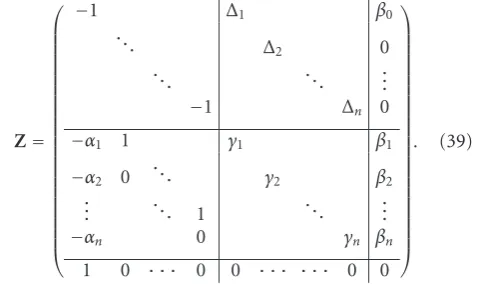
Within the SIF Framework, theρDFIIt form is described by Z= ⎛ ⎜ ⎜ ⎜ ⎜ ⎜ ⎜ ⎜ ⎜ ⎜ ⎜ ⎜ ⎜ ⎜ ⎜ ⎜ ⎜ ⎜ ⎜ ⎜ ⎜ ⎜ ⎝
−1 Δ1 β0
. .. Δ2 0
. .. . .. ...
−1 Δn 0
−α1 1 γ1 β1
−α2 0 . .. γ2 β2
..
. . .. 1 . .. ...
−αn 0 γn βn
1 0 · · · 0 0 · · · · 0 0 ⎞ ⎟ ⎟ ⎟ ⎟ ⎟ ⎟ ⎟ ⎟ ⎟ ⎟ ⎟ ⎟ ⎟ ⎟ ⎟ ⎟ ⎟ ⎟ ⎟ ⎟ ⎟ ⎠ . (39)
Remark 12. Thanks to the SIF, there is no need to use another operator unlike the shift operator.
4. Sensitivity-Based Transfer Function Error
4.1. Fixed-Point Implementation. In this article, the notation (β,γ) is used for the fixed-point representation of a vari-able or coefficient (2’s complement scheme), according to Figure 4.βis the total wordlength of the representation in bits, whereas γ is the wordlength of the fractional part (it determines the position of the binary-point). They are fixed for each variable (input, states, output) and each coefficient, and implicit (unlike the floating-point representation). β
and γ will be suffixed by the variable/coefficient they refer to. These parameters could be scalars, vectors, or matrices, according to the variables they refer to.
Let us suppose that the coefficients wordlength βZ is
+ +
+ +
+
βn βn−1 βi β1 β0
ρ−1
n ρ−i+11 ρ−i1 ρ1−1
αn αn−1 αi α1
y(k)
u(k)
Figure2: GeneralizedρDirect Form II.
+
ρ−1
i
z−1
γi
Δi
Figure3: Realization of operatorρ−1
i .
the wordlength as optimization variables, in order to find hardware realizations that minimize hardware criteria like power consumption or surface, under certain numerical accuracy constraints, likeL2-sensitivity ones [26]. This is not
considered here). Then, the coefficientZi j is represented in fixed point by (βZi j,γZi j) with
γZi j =βZi j−2−
log2 Zi j
, (40)
where theaoperation roundsato the nearest integer less or equal toa(for positive numbersais the integer part).
Remark 13. The binary point position is not defined for null coefficients; however, this is no problem because these coefficients will not be represented in the final algorithm (the null multiplications are removed).
So, in order to consider coefficients that will be quantized without error, we introduced aweightingmatrixδZsuch that
(δZ)i j ⎧ ⎨ ⎩
0 ifZi j is exactly implemented
1 otherwise. (41)
The exactly implemented coefficients are 0 and the positive and negative powers of 2 (including±1).
Remark 14. In some specific computational cases the fixed-point representation chosen for the coefficients is not always the best one as defined in (40). For example, in theRoundoff Before Multiplication scheme, some extraquantizations are added to the coefficients, in order to avoid shift operations after multiplications [2]. Only the classical case (correspond-ing to theRoundoffAfter Multiplication) is considered here, as defined by (40).
± 2β−γ−2 · · · 21 20 2−1 · · ·
β−γ−1
β
γ
2−γ
Integer part Fractional part
s
Figure4: Fixed-point representation.
Remark 15. It is also possible to choose any γZi j such that γZi j βZ
i j−2− log2|Zi j|(e.g., choose the same binary-point position for all the the coefficients, given by the binary-point position of the coefficient with highest magnitude). But in that case, the coefficients could be coded with less meaningful bits and have a higher relative error. When the ratio between the greatest and lowest magnitude is too high, then underflows occur for the lowest coefficients that cannot be represented. For example, this is common for the Direct Form realizations with high (or low)L2-gain.
During the quantization process, the coefficients are changed from Z into Z† Z + ΔZ. For a rounding quantization, the (ΔZi,j) are independent centered random variables uniformly distributed [27,28] within the ranges
−2−γZi j−1
ΔZi,j<2 −γZi j−1
, so their second-order moments are given by
σΔ2Zi j E
ΔZi j
2
= 2
−2γZi j
12 δZi j
(42)
(exactly implemented coefficients are not changed by the quantization).
4.2. Sensitivity-Based Transfer Function Error. As a conse-quence, the sensitivity of each coefficient should not be considered with the same weight, since there is no special reason for the (ΔZi j) to be all in the same range and share the same binary-point position. So it is interesting to evaluate how the transfer function is changed fromHtoH† H+ΔH by the coefficient quantization, rather than evaluate only its sensitivity.
By an extension of the SISO state-space definition given in [6], this degradation can be evaluated in a statistical way with the following definition.
Definition 16(Sensitivity-Based Transfer Function Error). A measure of the transfer function error can be statistically defined by
σ2 ΔH
1 2π
2π
0 E
ΔHejω2
F dω. (43)
The transfer function error is a tractable measure that can be evaluated with the two following propositions.
Proposition 18. The sensitivity-based transfer function error of a realization Z, with H as a transfer function, can be computed by
σ2 ΔH=
δδHZ ×ΞZ
2
F
, (44)
where
(i)δH/δZ∈R(l+n+p)×(l+n+m)is the transfer function
sen-sitivity matrix (previously introduced in [7]) defined by ! δH δZ " i j ∂∂ZHi j
2
, (45)
(ii)ΞZ∈R(l+n+p)×(l+n+m)is defined by
ΞZi j ⎧ ⎪ ⎪ ⎨ ⎪ ⎪ ⎩
2−βZi j+1
√
3
Zi j
2(δZ)i j ifZi j=/ 0
0 ifZi j=0,
(46)
(iii)x2is the nearest power of 2 lower than|x|:
x2 2log2|x|, ∀x∈R. (47)
Proof. A first-order approximation gives
ΔH(z)= i,j
∂H
∂Zi j
(z)ΔZi j, ∀z∈C. (48)
Hence, for allω∈[0, 2π],
EΔHejω2F
=E ⎧ ⎪ ⎨ ⎪ ⎩ i,j
∂H
∂Zi j
ejωΔZi j 2 F ⎫ ⎪ ⎬ ⎪ ⎭ =E ⎧ ⎪ ⎨ ⎪ ⎩
k,l i,j∂∂HZi jkl
ejωΔZ i j
2⎫⎪⎬
⎪ ⎭
=
i,j
k,l
E
⎧ ⎨ ⎩ ∂Hkl
∂Zi j
ejωΔZ i j 2 ⎫ ⎬ ⎭ +
i,j
k,l
r,s r /=i s /=j
E
'
∂Hkl
∂Zi j
ejωΔZi j∂ Hkl
∂Zrs
ejωΔZrs (
=
i,j
k,l ∂Hkl
∂Zi j
ejω 2
σ2 ΔZi j,
(49)
because the random variables (ΔZ)i jare all independent and centered. Then,
σΔ2H=
i,j
σΔ2Zi j
1 2π 2π 0 ∂∂ZHi j
ejω 2 F dω = i j ∂∂ZHi j
2 2 σ2
ΔZi j.
(50)
Finally, considering (40) and (42) for nonnull coefficients, we get
σ2 ΔZi j=
4 32
−2βZi jZ
i j 2
2(δZ)i j. (51)
Remark 19. This proposition is the extension of Proposi-tion 2 in [10] to the SIF and MIMO transfer function.
Proposition 20. The transfer function sensitivity∂H/∂Zcan be explicited by
∂H
∂Z =H1H2, (52)
whereis the operator defined by
AB Vec(A)·
)
Vec (B)*, (53)
Vec(·)is the classical operator that vectorizes a matrix, andH1
andH2are defined by
H1:z−→CZ(zIn−AZ)−1M1+M2,
H2:z−→N1(zIn−AZ)−1BZ+N2,
(54)
with
M1
KJ−1 I
n 0
, M2
LJ−1 0 I p , N1 ⎛ ⎜ ⎜ ⎝
J−1M
In
0 ⎞ ⎟ ⎟
⎠, N2
⎛ ⎜ ⎜ ⎝
J−1N
0 Im ⎞ ⎟ ⎟ ⎠. (55)
The dimensions ofM1,M2,N1, andN2are, respectively,n×
(l+n+p),m×(l+n+p),(l+n+m)×n, and(l+n+m)×p. The transfer function sensitivity matrix δH/δZ can be computed by
!
δH
δZ "
i,j=
H1Ei,jH22, (56)
whereEi,j is the matrix of appropriate size with all elements being 0 except the(i,j)th element which is unity.
The system H1Ei,jH2 can be seen as the following
state-space system, so that Proposition 4 can be used in order to compute theL2-norm:
⎛ ⎜ ⎜ ⎝
AZ 0 BZ
M1Ei,jN1 AZ M1Ei,jN2
M2Ei,jN1 CZ M2Ei,jN2
⎞ ⎟ ⎟
Proof. The proof is based on the following lemma and can be found in [29].
Lemma 21. LetXbe a matrix inRp×lwhileGandHare two transfer matrices independent ofX with values inCm×p and Cl×n, respectively. Then,
∂(GXH)
∂X =GH, ∂+GX−1H,
∂X = +
GX−1,
+ X−1H,.
(58)
By expanding (23) in (24), and usingLemma 21, all the derivative∂H/∂XwithX∈ {J,K,. . .,S}can be obtained and then gathered using
∂ ∂Z=
⎛ ⎜ ⎜ ⎜ ⎜ ⎜ ⎜ ⎝
−∂ ∂J
∂ ∂M
∂ ∂N
∂ ∂K
∂ ∂P
∂ ∂Q
∂ ∂L
∂ ∂R
∂ ∂S
⎞ ⎟ ⎟ ⎟ ⎟ ⎟ ⎟ ⎠
. (59)
Equation (56) is quite straightforward and comes from the definition of the operator.
Remark 22. In order to simplify the expressions, matrix extensions of log2, floor operator·, and power of 2 can be used. For example, ifM∈Rp×q, then log
2(M)∈Rp×qsuch
as (log2(M))i,j log2(Mi,j).
The binary-point positions of the coefficients can then be computed by
γZ=βZ−2·½Z−
log2|Z|, (60)
where½Zrepresents the matrix with all coefficients set to 1
and with the same size thanZ. Also, theΞZmatrix is expressed by
ΞZ
2
√
32
−βZ× Z
2×δZ. (61)
Remark 23. In the classical case where the wordlengths of the coefficients are all the same (equal toβ), we can define a normalized transfer function errorσΔ2Hby
σ2 ΔH
3σ2 ΔH
2−2β+2. (62)
This measure is now independent of the wordlength and can be used for some comparisons. It can be computed by
σ2 ΔH=
δδHZ × Z2×δZ
2
F.
(63)
4.3. Comparison with the Classical ML2 Measure. It is of interest to remark the relationship with the classical ML2 measure. In [6] where the transfer function error appears for the first time (applied on a SISO state-space system), the coefficients are supposed to have the same fixed-point
representation, so their second-order moments (σZ2i j) are all
equal and denotedσ2
0. So, in that case, theML2satisfies
ML2=
σΔ2H σ2
0
. (64)
Here, the transfer function errorσ2
ΔHcan be seen as an
exten-sion of the ML2 measure with fixed-point considerations. The sensitivity is weighted according to the variance of the quantization noise of each coefficient. More details in that comparison can be found in [8].
5. Sensitivity-Based Pole Error
The same considerations applies to the poles. It is interesting to evaluate how the pole moduli are changed from |λk|to |λk|† |λk|+Δ|λk|by the coefficient quantization.
In the same way as inDefinition 16, the degradation can be evaluated in a stochastic way.
Definition 24(Sensitivity-Based Pole Error). The sensitivity-based pole error is defined by
σΔ2|λ|
n
k=1
σΔ2|λk|ωk, (65)
where σ2
Δ|λk| is the second-order moment of the random
variableΔ|λk|
σ2 Δ|λk| E
-(Δ|λk|)2
.
. (66)
This measure is tractable thanks to the two following propositions.
Proposition 25. It can be computed with
σ2 Δ|λk|=
∂|λk|
∂Z ×ΞZ
2F, (67) whereΞZis the matrix already defined in(46).
Proof. A first-order approximation gives
Δ|λk| =
i,j
∂|λk|
∂Zi j ΔZi j. (68)
So,
σΔ2|λk|=
i,j
r,s
∂|λk|
∂Zi j
∂|λk|
∂ZrsE
-ΔZi jΔZrs .
=
i j
∂|λk|
∂Zi j 2
σ2 ΔZi j
(69)
since the (ΔZi j) are indepedent centered random variables.
Proposition 26. The pole sensitivity, with respect to the coefficients, can be computed by
∂|λk|
∂Z = 1
|λk|
ReM1λkykxkN1
where (xk)1 k n are the right eigenvectors corresponding to the eigenvalues(λk)1 k nand(yk)1 k nthe column vector of the matrix My = (y1 y2 · · · yn)defined byMy M−x ,
with Mx (x1 x2 · · · xn).M1 and N1 are the matrices
previously defined in(55).
Proof. The proof is based on the following lemmas, proved in [1,14].
Lemma 27. Let V0, V1, and V2 be constant matrices of
appropriate dimension.
(i)IfA=V0+V1XV2, then
∂λk
∂X =V
1∂λk ∂AV
2. (71)
(ii)IfA=V0+V1X−1V2, then
∂λk
∂X = − +
V1X−1
,∂λk
∂A +
X−1V 2
,
. (72)
This lemma can be applied toJ,K,L,. . .,S, and gives
∂λk
∂Z =M
1∂λk ∂AN
1. (73)
Then, the pole sensitivity matrix ∂|λk|/∂A can be finally computed with the following lemma.
Lemma 28. The derivative of the eigenvalues (and their moduli) of a given matrix with respect to that matrix is given by
∂λk
∂A =y
kxk,
∂|λk|
∂A = 1
|λk| Re
!
λk ∂λk ∂A "
.
(74)
Remark 29. Roughly similar toRemark 23, it is also possible to normalize the sensitivity-based pole error in the common case where the coefficients have all the same wordlength (equal toβ). We can define anormalized pole errorσΔ2|λ|by
σΔ2|λ| σ2
Δ|λ|
2−2β+2. (75)
This measure is now independent of the wordlength and can be used for some comparisons. It could be computed by
σ2 Δ|λ|=
n
k=1 ωk
∂|λk|
∂Z × Z2×δZ 2
F. (76)
6. Extension to the Closed-Loop Control
In previous sections, the filtering problems were considered, and the open-loop contexts were implicitly taken into account. In this section, we extend previous results to closed-loop case, where a filter (denoted here as controller) is
m1
m2 p1
p2
plant
controller
P
C
S
w(k) z(k)
u(k)
y(k)
Figure5: Closed-loop system considered.
controlling a plant in a feedback scheme. The problem has an important practical interest in the context of robust control theory [30], when considering the model uncertainties of the process or even of the controller in the sense of FWL implementation [1].
Let us consider a plantP(defined by its transfer function or equivalently by a state-space relationship) controlled by a controllerCin a standard form [30], as shown inFigure 5. w(k)∈Rp1andz(k)∈Rm1are the exogenousp
1inputs and m1outputs (to control), whereasu(k)∈Rp2andy(k)∈Rm2
are thep2control andm2measure signals, respectively.
The plant P is defined by the following state-space relation:
xP(k+ 1)=AxP(k) +B1w(k) +B2u(k),
z(k)=C1xP(k) +D11w(k) +D12u(k),
y(k)=C2xP(k) +D21w(k),
(77)
where A ∈ RnP×nP, B1 ∈ RnP×p1, B
2 ∈ RnP×p2, C1 ∈
Rm1×nP,C2 ∈ Rm2×nP,D11 ∈ Rm1×p1,D
12 ∈ Rm1×p2, and
D21∈Rm2×p1. Note that theD22term is null.
The controller is realized in the SIF form (see (18)), with
l,m2,n, and p2 as intermediate variable, input, state and
output dimensions, respectively.
Unlike open-loop context, the whole system S is here considered, with w(k) and z(k) as inputs and outputs, respectively. Its transfer function is given by
H:z−→CZ
zInP+n−AZ
−1
BZ+DZ (78)
withAZ ∈ RnP+n×nP+n,BZ ∈ RnP+n×p1,CZ ∈ Rm1×nP+n,
DZ∈Rm1×p1and
AZ=
⎛
⎝A+B2DZC2 B2CZ BZC2 AZ
⎞ ⎠,
BZ=
⎛
⎝B1+B2DZD21 BZD21
⎞ ⎠,
CZ=
C1+D12DZC2 D12CZ
,
DZ=D11+D12DZD21.
(79)
The closed-loop poles of the system, denoted (λk)1 k n+nP,
are the eigenvalues of the matrixAZ. Their moduli indicate
In order to evaluate the closed-loop transfer function degradation or the pole moduli deviation, the two closed-loop measures are used, as a natural extension to the open-loop case.
Definition 30(Closed-Loop Sensitivity-Based Error). A mea-sure of the closed-loop sensitivity-based transfer function error can be statistically defined by
σ2 ΔH 1 2π 2π 0 E
ΔHejω2
F dω. (80)
The closed-loop sensitivity-based pole error is defined by
σ2 Δ|λ|
n
k=1 σ2
Δ|λk|ωk. (81)
They can be computed withProposition 31.
Proposition 31. The closed-loop transfer function error is given by
σ2 ΔH=
δδHZ ×ΞZ 2 F , (82)
whereδH/δZis obtained from the closed-loop transfer function sensitivity∂H/∂Zgiven by
∂H
∂Z =H1H2 (83)
with
H1:z−→CZ
zIn+nP−AZ
−1
M1+M2,
H2:z−→N1
zIn+nP−AZ
−1
BZ+N2,
M1=
⎛
⎝B2LJ−1 0 B2 KJ−1 I
n 0
⎞ ⎠,
N1=
⎛ ⎜ ⎜ ⎝
J−1NC 2 J−1M
0 In
C2 0
⎞ ⎟ ⎟
⎠, N2=
⎛ ⎜ ⎜ ⎝
J−1ND 21 0 D21 ⎞ ⎟ ⎟ ⎠,
M2=
D12LJ−1 0 D12
.
(84)
In the same way, the sensitivity-based closed-loop pole error
∂|λk|/∂Zis given by
∂ λk
∂Z = 1 λ
k
ReM1λkykxkN
1
, ∀1kn,
(85)
wherexkandykare associated toAZas inProposition 26.
Proof. Lemmas21and27can be used in the same way they are used to compute the derivative∂H/∂Zand ∂|λk|/∂Zin Propositions20and26. See [31] for more details.
7. Optimal Realization
7.1. Invariance with respect to Scaling. Let us consider a scaling of the intermediate variables and the states. The realizationZ0is changed intoZ1=T1Z0T2with
T1 ⎛ ⎜ ⎜ ⎝ Y
U−1 Ip
⎞ ⎟ ⎟ ⎠, T2
⎛ ⎜ ⎜ ⎝ W U Im ⎞ ⎟ ⎟ ⎠ (86)
with U,Y, and W some invertible diagonal matrices. So x(k) is changed inU−1x(k) andt(k) is changed inW−1t(k).
Remark 32. This is similar to (26), but hereU,Y, andW are diagonal. This only implies scaling.
Proposition 33(Invariance to scaling). A scaling with powers of 2 (U,Y, and W diagonal with Uii = 2ui, Yii = 2yi, Wii=2wiwithui,yiandwi∈Z) does not change the transfer
function errorσΔ2Hnor the pole errorσΔ2|λ|.
Proof. LetF2(x) denotes the fractional value of log2|x|
F2(x) log2|x| −
log2|x|. (87)
Then, the operator·2satisfies
ab2= a2b22F2(a)+F2(b), (88)
and hence
(Z1)i j
2=
/ (T1)ii
0
2
(Z0)i j
2
(T2)j j
2Φi j (89)
withΦi j 2F2((T1)ii)+F2((T2)j j)+F2((Z0)i j). So,ΞZ1 is deduced fromΞZ0by
+ ΞZ1
, i j=
+ ΞZ0
, i j
/ (T1)ii
0
2
(T2)j j
2Φi j. (90)
By remarking that the similarity onZ0changes the transfer
functionH1andH2in
H1|Z1=H1|Z0T
−1
1 , H2|Z1=T
−1
2 H2 Z0 (91)
it comes that the sensitivity transfer function is changed in
∂H
∂Z Z
1
=T−
1 ∂ H ∂Z Z 0 T−
2 , (92)
and then
∂H
∂Zi j (ΞZ)i j
Z1
= ∂H ∂Zi j
(ΞZ)i j Z0
×
/ (T1)ii
0
2
(T1)ii
(T2)j j
2
(T2)j j Φi j. (93)
Now we can remark thatΦi j ∈ {1, 2, 4}andΦi j =1 if the power of 2 are used for the scaling. Alsoa2/a=1 ifais a
power of 2.
The same proof can be applied on the pole error since
∂|λk|
∂Z
Z1
=T−
1 ∂ |λk|
∂Z Z
0 T−
7.2. Optimal Problem. Even if it is not the main goal of this paper, it is now possible to consider optimal realization, according to a FWL criterion. LetJbe a given criterion (it could be sensitivity-based transfer function error, pole error, or a combination of these two criteria), then the problem consists of finding the optimal realization that minimizes
Jor equivalently finding the optimal coordinate transform (U,Y,W) that transform a given realization, that is,
Uopt,Yopt,Wopt
= arg min U,Y,Winvertible
J+U,Y,W,. (95)
According to Proposition 33, J is invariant to power-of-2 scaling, and this optimization problem has an infinite number of solutions. Thus, it could be of interest to normalize all the coordinate transforms with regards to an extra consideration. For example, this could be aL2-scaling
constraint, even if it is not necessary here.
The idea is to define and set the binary-point position of the states and the intermediate variables [8]. This gives us a bound on the L2-gain of the transfer functions from
the input u to the states x and intermediate variables t, respectively. One possible constraint is to ensure that
1
e
i (zIn−AZ)−1BZ22, (96)
1
e
iJ−1M(zIn−AZ)−1BZ+J−1N22. (97)
This relaxed L2-constraints were proposed in [32] as an
extension of the strict L2-scaling, that still prevents the
implementation from overflow. Any other successive power of 2 can be used for the boundaries.
The inequalities (96) can also be expressed with the controllability GramianWcof the realization.
With that normalization, the optimal problem is now a constrained optimization problem. One way to deal with it is to normalize each coordinate transform (U,Y,W) before applying it. More details can be found in [8].
Since the sensitivity-based transfer function error σ2 ΔH
and pole error σ2
Δ|λ| measures are nonsmooth, this
opti-mization problem can be solved with a global optiopti-mization method such as the Adaptive Simulated Algorithm (ASA) [33,34]. A gradient-base method such as the quasi-Newton algorithm leads to local optima and are not used here.
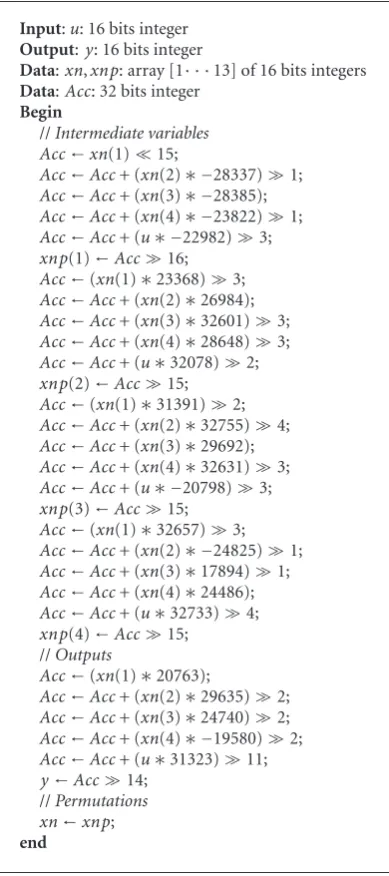
The FWR Toolbox (sources available at http:// fwrtoolbox.gforge.inria.fr) was used for the numerical examples, and few minutes of computation were here required on a desktop computer.
7.3. Numerical Examples. Let us consider the filter with coef-ficients given by the Matlab command . We are considering, in order to compare them, some equiva-lent (in infinite precision) realizations described below. The values of the measures are shown inTable 2.
7.3.1. State-Space Realization
Z1: the canonical form (corresponds to the Direct Form
II).
Table 2: σ2
ΔH, σΔ2|λ| and number of operations for the different
realizations.
Realization σ2
ΔH σΔ2|λ| Nb +×
Z1 6989.1918 28144.499 8 + 12×
Z2 1.6782 2.5804 20 + 25×
Z3 0.70122 1.749 20 + 25×
Z4 1.9094 0.8868 20 + 25×
Z5 0.79439 0.9441 20 + 25×
Z6 0.90704 23.8916 12 + 13×
Z7 0.66403 2.3766 12 + 17×
Z8 3.0183 1.5589 12 + 17×
Z9 0.67242 2.0486 12 + 17×
Z2: thebalanced realization (it is often considered as a
good realization. The work in [1] shows that the balanced realizations minimizes theL1/L2sensitivity
measure).
Z3: the normalized σΔ2H-optimal realization. It is
ob-tained with ASA and (63) as criterion.
Z4: the normalized σΔ2|λ|-optimal realization (obtained
with ASA and (75)).
Even if the goal of this paper is not multiobjective optimal realization, it is interesting to look for a realization that is good enoughfor the two measures. One possibility is to consider the following tradeoffcriterion:
J1 σ
2 ΔH
+
σΔ2H
,opt +
σ2 Δ|λ|
σΔ2|λ|
opt, (98)
where (σΔ2H)
opt
and (σΔ2|λ|)
opt
are the optimum values obtained for σ2
ΔH and σΔ2|λ| in realization Z3 and Z4,
respectively.
Z5: the J1-optimal realization. With this measure, we
aim to have a realization that simultaneously has low transfer function error and low pole error.
7.3.2.ρDirect Form II Transposed
Z6: theδ-Direct Form II transposed (γi=1).
Z7: the normalizedσΔ2H-optimalρDFIIt realization. The
optimal (γi)1 i 4are
γ=0.49984 0.73389 0.69192 0.70086. (99)
Z8: the normalizedσΔ2|λ|-optimalρDFIIt realization. Here
the optimal (γi)1 i 4values are