Volume 2006, Article ID 84340, Pages1–14 DOI 10.1155/ASP/2006/84340
FPGA-Based Reconfigurable Measurement Instruments with
Functionality Defined by User
Guo-Ruey Tsai and Min-Chuan Lin
Department of Electronics Engineering, Kun-Shan University of Technology, Taiwan
Received 2 October 2004; Revised 5 March 2005; Accepted 25 May 2005
Using the field-programmable gate array (FPGA) with embedded software-core processor and/or digital signal processor cores, we are able to construct a hardware kernel for measurement instruments, which can fit common electronic measurement and test requirements. We call this approach the software-defined instrumentation (SDI). By properly configuring, we have used the hardware kernel to implement ann-channel arbitrary waveform generator with various add-on functions, a wideband and pre-cise network analyzer, a high-speed signal digitizer, and a real-time sweep spectrum analyzer. With adaptively reconfiguring the hardware kernel, SDI concept can easily respond to the rapidly changing user-application-specified needs in measurement and test markets.
Copyright © 2006 Hindawi Publishing Corporation. All rights reserved.
1. INTRODUCTION
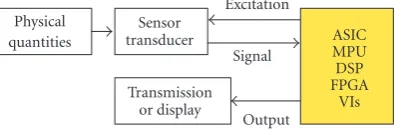
As the power of FPGA increases [1, 2], we find ourselves with the ability to design, simulate, analyze, and even emu-late the more complex devices with application-specified em-bedded processor and/or digital signal processor cores. From the viewpoint of SDI concept [3], the process of measure-ment has been reduced only to signal excitation, captures, conditioning, processing, and output display as illustrated in
Figure 1[4].Figure 2illustrates that the traditional instru-mentation technique depends on digital signal processor, mi-croprocessor unit, virtual instruments, application-specified integrated circuit (ASIC), or FPGA, which are in charge of the responsibility of signal conditioning and signal process-ing.
The instrument market is fragmented because instru-ments are specialized in hardware to serve thousands of slightly divergent test applications. In fact, the traditional classification of measurement instruments (such as volt-meter, frequency counter, function generator, oscilloscope, signal analyzer, etc.) has become blurred, and to some ex-tent can be replaced with a single set of reconfigurable hard-ware, called hardware kernel. The hardware kernel can be re-configured by software to implement a specified measure-ment instrumeasure-ment. With such a software-defined architec-ture concept applied to the circuit level, we have two ad-vantages. First, it can dramatically reduce the number of hardware components in all mixed-signal designs. This then possibly means a much smaller chip size for system-on-chip
implementation. Second, it can provide automatic adjust-ment or compensation for circuit component variations due to temperature dependence, aging, manufacturing tol-erances, and so forth.
Physical quantities
Sensor transducer
Excitation Signal
Signal conditioning Transmission
or display Output
Signal processing
Figure1: Measurements technique by SDI.
Physical quantities
Sensor transducer
Excitation Signal Transmission
or display
Output
ASIC MPU DSP FPGA
VIs
Figure2: Instrumentation technique.
2. HARDWARE KERNEL FOR THE RECONFIGURABLE INSTRUMENTS
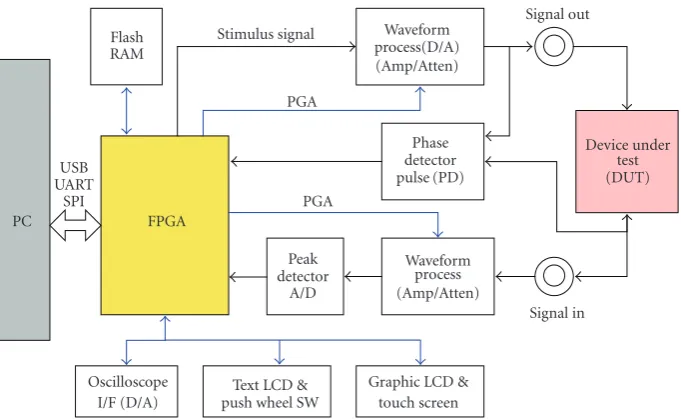
Figure 3illustrates the proposed hardware kernel architec-ture. Besides FPGA, we need other ASIC chips to process ana-log signals. In order to measure time, frequency, and phase responses of the device under test (DUT), we need the fol-lowing function modules: digital-to-analog converter, wave-form amplifier, analog-to-digital converter, wavewave-form sharp-ener, phase detector, hardware peak/trough detector, and hu-man input devices (HIDs).
The original stimulus signal generated by FPGA is in dig-ital form. For analog exciting signal requirement, it must be converted by digital-to-analog converter, filtered and shaped by low-pass-filter, and amplified or attenuated by amplifier or DC offset. The amplitude of the exciting signal can be adjusted through automatic gain control which is achieved by FPGA-generating programmable gain-adjustment (PGA) signal.
We also need signal capture and digitization modules. The output signals from DUT can be digital or analog. The latter needs to be captured and digitized by analog-to-digital converter. To meet the input signal limitations to analog-to-digital converter, the signal gain of output analog signals still needs to be controlled by the PGA signal which is generated by FPGA.
We need to detect the inevitable phase drift between in-put and outin-put signals from DUT. By waveform sharpening circuit, we can transform the periodical analog signal into square wave. The phase difference can be drawn out from the duty cycle of the square wave. The duty cycle is calculated by the FPGA or ASIC chip. The process of phase detection is shown asFigure 4.
To calculate sine wave excitation and response amplifi-cation factor, we need peak extraction circuit to detect two peak-to-peak values and get the quotient between them. From the data array, the embedded processor in FPGA can take out the peak values (maximum or minimum) for fur-ther processing.
All human interface devices (HID) for manipulation and test data presentation are basic interfaces for each instru-ment. The proposed hardware kernel includes the follow-ing HIDs: push wheel switch, led, text LCD, graphic display STN/LCD or color TFT/LCD, keyboard, touch panel, even oscilloscope signal driver.
The flash RAM can be used to store sine, Log, or other mathematic function lookup tables for exciting signal gener-ation, and ease fast data operations.
This system can be operated in on-line mode and the per-sonal computer (PC) can control and communicate with it. Without the PC, this system is also a stand-alone device off -line operated by panel components and displayed to liquid crystal display (LCD). We have designed the panel controller and LCD controller using the embedded processor.
For on-line operations, we can design a PC development platform with powerful graphic unit interface (GUI) and mathematic functions package, which can be supported from Matlab or LabVIEW. On the other hand, the hardware kernel should have some on-line operation interfaces, such as USB, SPI, or UART to communicate with the PC.
3. RECONFIGURABLE INSTRUMENTS
With the complete hardware kernel architecture, we can con-figure FPGA to match the necessary function specifications for various measurement environments and requirements. Here we introduce five types of SDI design algorithms for specified applications.
3.1. Arbitrary waveform generator
Utilizing direct digital synthesizer (DDS) [2, 9–11] algo-rithm, we can generate any periodic function with arbi-trary frequency, amplitude, and waveform. As illustrated in
Figure 5, the function waveforms are preloaded into flash RAM, and will be directly loaded into the built-in RAM in FPGA when powered up. The waveform frequency can be set up to half the system clock. Using 32-bit phase accumulator can achieve a frequency resolution of 0.02 Hz. The embed-ded 8− bit processor in FPGA is in charge of the control of HIDs and setting calculation of frequency and amplitude. Arranged asFigure 6, we reorganize the DDS data processing path and generate two channels of FM, PM, FSK, or PSK sig-nals.Section 4will describe ann-channel arbitrary waveform generator with various add-on functions in detail.
3.2. DC transfer function analyzer
We use a transfer function analyzer to analyze the trans-fer function between input and output signals, and we can observe the linearity characteristics of the measured sen-sor/transducer. The input/output transfer curve measure-ment is essential for characterizing DUTs with electronic circuits. Arranging the FPGA software design flow as in
PC USB UART
SPI
FPGA
Oscilloscope I/F (D/A)
Text LCD & push wheel SW
Graphic LCD & touch screen Flash
RAM
Stimulus signal
PGA
PGA
Peak detector
A/D
Waveform process (Amp/Atten)
Phase detector pulse (PD) Waveform process(D/A) (Amp/Atten)
Signal in Signal out
Device under test (DUT)
Figure3: Hardware kernel for the reconfigurable instruments.
S1 S2
Zero crossing (comparator)
I1
I2
Phase detector (RS discriminator)
P0
Figure4: Phase detection
3.3. Steady-state network analyzer
For the hardware kernel as inFigure 3, when using DDS tech-nique to generate sweep sine wave, and retrieving the phase and peak response of the DUT, we can collect the tabular data of the system frequency response. The frequency response spectrum can be constructed by calculating the tabular data in logarithm by the embedded processor and put into dis-play on the color graphic LCD. We also can upload the data array to a PC for further processing.Section 5will describe a wideband and precise network analyzer based on FPGA in detail.
3.4. Transient-state analyzer
When the proposed arbitrary function generator generates synchronized periodic signal as the required exciting sig-nal which is fed into the DUT, we will get the time re-sponse output which needs further transient analysis, as shown inFigure 8. To overcome the lower sampling rate of the analog-to-digital converter, a multipass algorithm is pro-posed.Section 6will describe a multipass algorithm digitizer based on FPGA in detail.
We can haven-time the effective sampling rate. When the exciting signal is designed and presented as a periodically variable duty-cycle square wave, a step response analyzer is built up. If an FFT algorithm is built into the FPGA, the hard-ware kernel will be configured as a softhard-ware-based spectrum analyzer.
3.5. Real-time spectrum analyzer
Figure 9illustrates a real-time sweep spectrum analyzer us-ing a fixed IF filter and a sweepus-ing local oscillator (LO). The mixer output contains the input signal, the LO signal, the sum and difference between these two signals, and var-ious other frequency components. If we know the LO fre-quency exactly, then by sending these frefre-quency components through a narrow IF filter, we can identify both the amplitude and the frequency of the unknown input signal. Whenever any of these components falls within the IF filter bandwidth, an AC voltage, which is related to the input signal’s ampli-tude, is produced. This AC voltage is converted to a DC volt-age by an envelope detector, and the result is displayed on the y-axis of the screen.
By HDL coding or schematic entry, we can implement the mixer, narrow IF filter, envelope detector, voltage-control oscillator (VCO), and other processing algorithms into the same FPGA chip.Section 7will describe an FPGA-based de-sign of real-time sweep spectrum analyzer in detail. The next section describes the developed n-channel arbitrary wave-form generator with various add-on functions.
4. n-CHANNEL ARBITRARY WAVEFORM GENERATOR WITH VARIOUS ADD-ON FUNCTIONS [5]
4.1. DDS waveform generator
DDS is the most popular technique to synthesize AC in-centive signals for instrumentation, measurement, and dig-ital communications. Generating synthesized waveforms by DDS technique has the following benefits: high frequency resolution, precise frequency control, and low complexity.
PC DAC
Internal bus
I/F controller (USB/SPI)
Embedded
CPU DDS
SRAM (build-in) Panel
controller
LCD controller
Flash controller
SRAM controller
Panel LCD Flash
FPGA
Figure5: System architecture for arbitraryn-channel function generator.
Modulatution sensitivity
(kf)
Frequency control
word
Frequency modulation signal
(FM) Phase modulation signal (PM)
Frequency register
Phase register Phase accumulator
Output D/A+ LPF
Waveform table
Figure6: On-chip FM/PM modulation.
Tablet graphic display Yes
Vi>final Vi<=Vi+Vstep A/D digitization No
D/A output Vi<=initial
Figure7: DC transfer function measurement.
can implement all the necessary digital logic circuits and the lookup memory in the same FPGA chip so that a better per-formance can be achieved by avoiding interchip connections [3,10]. To generate the required analog signals, commercial digital-to-analog converters (DAC) can be adopted. Lowpass filters (LPF) are required to filter out high frequency noise.
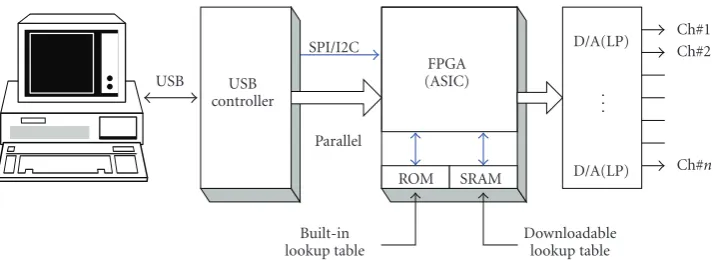
The entire instrument system includes a PC platform, USB controller, FPGA waveform synthesizer, and DAC/LPF output buffer, as shown in Figure 11. The PC is the sys-tem development platform, responsible for arbitrary func-tion waveform editing, previewing, encoding, lookup data downloading, and the coding and decoding of USB com-mands. The multiple operation windows and GUI applica-tion programs are coded by Visual Basic language.
The USB controller will deal with the messages inter-change between PC platform and FPGA chip. The Cypress EZ-USB controller is utilized to communicate the PC with the FPGA. It provides some DLL files, which can be called and linked by Visual Basic, Visual C languages, and/or Lab-VIEW programs in the PC platform, and simplifies the de-sign for both messages interchange and transmission control of GUI windows. Besides the parallel interface, we can also use the SPI or I2C techniques to communicate between USB
controller and FPGA to save the pins resource of the FPGA. By the plug-n-play property of USB interface, a PC can be used to develop many AWG instruments simultaneously.
4.2. FPGA realization
PC FPGA USB
UART SPI
Oscilloscope I/F (D/A)
Graphic LCD & touch screen
Waveform process (RC, compatator)
Waveform process (D/A)
(Amp/Atten) Arbitrary
stimulus signal
PGA
Multipass timing control
PGA Bitstream
Signal in Signal out
Device under test (DUT)
Figure8: Transient state analyzer.
LO
IF
Envelope detector
CRT
Sweep generator
Figure9: Real-time sweep spectrum analyzer.
Frequency control
Clock
Phase accumulator
Waveform map in
SRAM
Digital-to-analog converter
Output
Figure10: Simplified block diagram of the direct digital
synthe-sizer.
affords on-chip true single-port blocked synchronous RAM. The total available memory size is 56 kbit. The FPGA chip is configured into four main parts: hand-shaking controller between USB and FPGA, SRAM (block RAM), SRAM con-troller, and remaining control logic. The SRAM is utilized for both in and downloadable lookup tables. The built-in lookup table can also be reserved for specified wave-forms output directly or built-in self-test purpose for the
instrument itself. Together withnDACs, we can reconfigure the SRAM capacity intonparts forn-channel analog signal outputs. In this case, we have up to 56 channel outputs us-ing 1 kbit per channel. On the PC platform, you can down-load each channel waveform one by one. Adopting 50 MHz clock frequency and 32-bit phase accumulator word length, we have a 0.01164 Hz frequency resolution.
4.3. Function performance
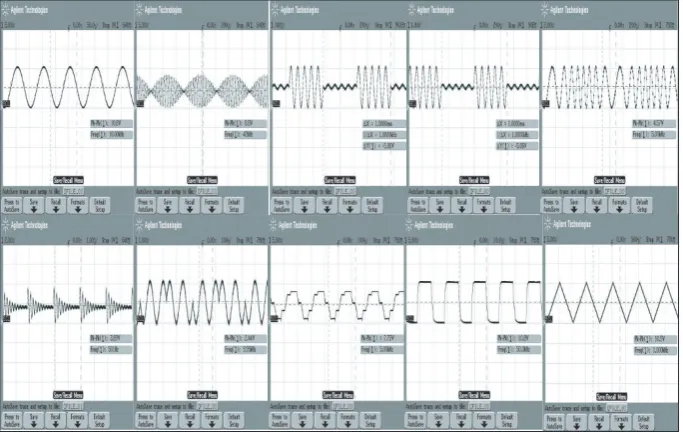
After integrating all the interfacing software, firmware, and hardware, the instrument can afford typical fundamental waveforms output, such as sinusoidal, square, and triangle functions. We can also edit any mathematical equations in the edit window and output their waveforms. Typical modu-lated waveforms, such as AM, FM, and others, can be edited and stored into the waveform banks in advance. You can choose anyone you like from the waveform banks and freely output to any desired channel. The instrument also provides piecewise linear function output with multiple data points periodically. Choosing FPGA with larger on-chip SRAM ca-pacity for lookup table usage, we can flexibly expand the out-put channel numbers or improve the waveform resolution. With the programmability in the PC development platform, we can output the waveforms to individual channels inde-pendently, or generate a mixed waveform, which is a linear combination among several other channels.
USB USB controller
SPI/I2C
Parallel
Built-in lookup table
Downloadable lookup table ROM SRAM
FPGA (ASIC)
D/A(LP) D/A(LP)
. . .
Ch#n
Ch#2 Ch#1
Figure11: The system architecture of then-channel arbitrary waveform generator.
4.4. Add-on function
The instrument also provides an algorithm for more advanced custom-made waveforms generation. Taking a custom-made FSK signal generator as the example, you can input or edit a modulation bitstream on the PC platform, and download it to the SRAM in FPGA chip. Processed by a preset FSK control code, we can combine both the bitstream channel and sine wave channel to generate the desired FSK signal.Figure 14shows the custom-made signal generation flow.
The algorithm receives the data from both sine wave and piecewise linear generators, and respectively decides the fre-quency for “1” and “0” which can control the accumulator phase increment generator and construct the designed FSK signal. AM-ASK control code can be coded to generate the designed AM-ASK signal by the same approach. With the re-served input port, the external FSK control code IP can di-rectly be fed into and generate the designed FSK signal wave-form by the stand-alone instrument.
5. WIDEBAND AND PRECISE PHASE DETECTOR BASED ON FPGA WITH EMBEDDED
PROCESSOR [6]
We can use the multiplier phase detector [4] or logarithmic amplifiers to implement a phase detector. But these two ap-proaches are both mixed-mode type and unsuitable for sys-tem on-chip (SoC) design which is in all-digital type. There exist several digital design methodologies for phase detec-tor, such as EXOR phase detecdetec-tor, JK flip-flop phase detecdetec-tor, phase-frequency detector, Nyquist-rate phase detector, zero-crossing phase detector, and Hilbert-transform phase detec-tor [12,13]. But they are all only suitable for some specified narrowband frequency range. To detect phase in another fre-quency range, we must modify phase detection and calcula-tion circuits to meet the necessary requirements, and then be able to get the precise value of phase difference.
5.1. All-digital phase detector
The proposed phase detector is an all-digital approach to measure the phase difference of two signals with the same
frequency. Gathering the signal frequency by control circuit in FPGA and calculating data by the embedded processor in FPGA, we can adaptively adjust the sampling clock, which is used to measure the pulse period. This phase detector auto-matically detects and adjusts the sampling clock without any circuits’ modification.
Figure 15demonstrates the proposed all-digital adaptive algorithm for phase detection, including incoming signal’s frequency recovery circuit, sampling clock generator, and all-digital phase detectors. The period of sampling clock, Ts, is the function of both income signal frequency (fs) and phase resolution (Δp). And the phase value,Pd, is the function of both sampling period (Ts) and the pulse duration of phase difference (ΔPt):
Ts= f
fs,Δp
, (1)
Pd=f
Ts,ΔPt
. (2)
From (1), we must get the incoming signal frequency and desired phase resolution at first, and then put them into the programmable fractional-N frequency synthesizer. Finally, we have the sampling clock required for phase detec-tion. Combining the sampling clock and a specially designed counter algorithm, we can get a phase difference value with 8 to 12 bits from (2).
5.2. FPGA realization
We design the whole system with our proposed phase mea-surement method for specified network analyzer applica-tions and implement it by FPGA, as illustrated inFigure 5. From the operation point of view, we have USB interface for PC on-line operation, and embedded processor for stand-alone off-line control. The DDS-powered function genera-tor is used for sweep stimulus signal generagenera-tor and sampling clock generator. The all-digital phase lock loop (PLL) with programmable divide-by-N module is used for the phase detection of uncontrollable random input signals. And an LCD display controller is also included for stand-alone use display.
Figure12: Typical output waveforms displayed by Agilent 54622D oscilloscope.
(a)
(b)
Figure13: Displayed 1 kHz sinusoidal spectrum comparison
be-tween (a) the reconfigurable instrument and (b) Agilent 33120 A signal generator. The spectrums are displayed by Agilent 54622D.
charge of the control of USB communication and setting cal-culation of frequency, amplitude, and sampling clock.
When the input signal of DUT is not generated by the system function generator, but comes from other uncontrol-lable signal source, we use both the all-digital phase locked
loop and fractional-N frequency synthesizer [14], as illus-trated inFigure 16, to recover input signal’s frequency and generate required sampling clock. To meet the requirement of precise resolution, the programmable scale-factor-N di-vider must generate the counting clock required for calculat-ing the duration of phase difference. Constituted by counters, the all-digital phase detector can output 8- to 12-bit digital signals for phase calculation according to the requirement of phase resolution and the successive processing circuits.
5.3. Performance analysis
Table 1lists the comparison of measured phase differences of RC circuit from 10 to 10 kHz measured by Agilent 54621A oscilloscope and our proposed method, respectively. From the results, it is apparent that our proposed method is precise enough, and the measurement frequency range is relatively wide without specified parameter adjustment and further special logic circuits.
When we adopt automatic sweep stimulus signal gen-erator, which is controlled by a PC, to generate the input signal, and collect and analyze the data by LabVIEW pro-gram, we have the amplitude and phase response as shown in
Figure 17. It is evident that the measurement is rather precise within a wide frequency range. It supports that our proposed method is suitable for all-digital SoC system realization.
6. HIGH-SPEED SIGNAL SAMPLER BY MULTIPLE-PATH ALGORITHM [7]
PC platform
FSK control code Channel 1 sine wave SG
Channel 0 bitstream SG
FPGA
FSK O/P
External I/P
Figure14: The customer-made FSK signal generation flow.
U2 input signal U1 input
signal
Sampling clock (Ts) Frequency calculation
and sampling clock generator
All-digital phase detector
PD [8· · ·0]
Figure15: All-digital adaptive algorithm for phase detection.
U1 input
signal Sampling
clock (fs=N∗fU1) All digital PLL
Divider-N
Programmable scalar factor N
Figure16: All-digital PLL fractional-N frequency synthesizer.
limitation to the whole A/D converter for capturing high-bandwidth periodic signals.
6.1. Multipass method
According to the sampling theory, we need a sampling rate two times larger than the greatest signal frequency so that the original signal can be reconstructed after it was sampled. The higher the sampling rate is, the more complete the sig-nal reconstruction is. For a periodic sigsig-nal, if we periodically sample the signal whose frequency can be larger or even less than the signal frequency with the available sampling device, we can get a set of sampled signal values. Then, we take a fix
Table1: Comparison of the measured phase differences of RC
cir-cuit.
Frequency (Hz) Phase measured (degree) Agilent 54621A Proposed method
10 0.00 0
50 0.00 0
100 −4.32 −4
500 −16.20 −16
1 K −31.68 −32
2.5 K −52.20 −51
5 K −64.80 −64
10 K −72.00 −71
0 10 Hz
1 50 Hz
2 100
Hz 3 500
Hz 4 1 KHz
5 2.5 KHz
6 5 KHz
7 10 KHz −14
−12 −10 −8 −6 −4 −2 0
dB
−70 −60 −50 −40 −30 −20 −10 0
de
gr
ee
Frequency response Network analyzer
Figure17: Automatic sweep RC-circuit frequency response by our
system.
time shifttshift, calculated as follows:
Δtshift=
sampling−time
n , (3)
Δtshift Sample
Si
gn
al
(A
/D
)
Pass 1 sample Pass 2 sample
Figure18: Multipass under-sampling algorithm.
By this way, the apparent sampling rate isntimes higher than the real-time sampling rate. Ifnis large enough, we can overcome the problem of the low real-time sampling rate and get more satisfactory signal reconstruction.
6.2. FPGA realization
We use an FPGA chip, an RC circuit, an LF398 sample/hold chip, and an LM319 comparator chip to implement the mul-tipass method, as shown inFigure 19. The built-in DDS arbi-trary waveform generator is used to generate the desired pe-riodical signal waveform whose data stream is stored in the waveform data table. The external R-2R circuit is used to con-vert the digital data streams into continuous analog signal. To verify the captured signal quality, we directly bypass the out-put signal into the sample/hold chip so that we can compare the original and the captured signals. Through the compara-tor chip, the compared result between the output signal from sample/hold chip and the RC circuit output signal is fed into the SAR A/D converter. The delta-sigma D/A converter out-puts the bitstreams to the RC circuit, and then the charged output signal is fed into the comparator chip. The internal DDS module provides the necessary synchronous signal for repeated sampling. If the tested signal comes from other sig-nal source, we need the all-digital phase lock loop (ADPLL) module (Figure 16) for signal synchronization and timing control. The memory controller is in charge of the storage and transfer of the digital data streams. The TDC signal ex-tractor is used for signal reconstruction. The interface circuit can be used for PC communication and data transfer con-troller.
6.3. System performance
In this demonstration, we use 50 MHz of system clock rate. We use the DDS module to generate a sine wave with fquency of 100 kHz as the stimulus signal. From the step re-sponse of RC circuit, as shown in Figure 20, we have the 151μs steady state rise time and 136μs fall time.
By estimation, the minimum converting time of the SAR ADC is about 160μs. In other words, the real-time maximum signal capture sampling speed is about 780 Hz for 8 quan-tum bits. According to the calculation formula of the real-time sampling rate of the delta-sigma D/A converter, shown as follows, we have the real-time sampling rate 760 Hz for ADC bit=8 andF=15:
SR= 50 MHz
2(ADC bit +1)×(F+ 1)×ADC bit. (4)
Figure 21 shows the comparison of original input 100 kHz sine wave and the captured signal by the pro-posed signal capturer. The captured signal has 256 sampled points per period. We can find that the signal reconstruction is rather satisfactory. We have demonstrated an ultrahigh-speed signal capturer based on a single FPGA chip. The multipath algorithm has enhanced the sampling rate from a 760 Hz real-time sampling rate up to a 25.6 MHz apparent sampling rate. For further applications, we can use this de-sign to measure the transient response of the device under test.
7. ALL-DIGITAL REAL-TIME SPECTRUM ANALYZER [8]
A spectrum analyzer is used to analyze the frequency com-ponents in signals under test. By mathematical calculation, the traditional fast Fourier transform (FFT) can transform the time-domain waveform to frequency-domain waveform of the signal and become the key technique of the spectrum analyzer. The sweeping frequency technique combined with digital technique is also used to implement spectrum analysis [15]. In general, the analysis accuracy of FFT technique is ba-sically worse than that of the sweeping frequency technique equipped with digital intermediate-frequency filter. From the viewpoint of dynamic range decaying effect, the FFT tech-nique is also worse. For smaller frequency range, the pro-cessing speed of FFT technique is better, but worse for wider frequency range. In the form of digital intelligent property (IP), which can be mapped to a single FPGA chip, we de-sign a real-time sweep spectrum analyzer. The system func-tion block diagram of real-time sweep spectrum analyzer is shown inFigure 22.
7.1. Theory of operation
The mixer is used to combine the signal under test and the sweeping signals generated by the local oscillator (LO). The mixer is a multiplier circuit, so the output is an amplitude-modulated signal. According to the formula of triangular al-gebra, we have the signals with sum frequency and difference frequency, as shown in the following expression:
sin2π f0t
×sin2π fin
= 1 2cos 2π
f0−fin
t−1 2cos 2π
f0+ fin
t, (5)
fre-FPGA
PC USB UART
SPI
Waveform
data table DDS AWG
Me
m
o
ry
co
n
tro
ll
er
Si
gn
al
re
co
n
st
ru
ct
io
n
Multipass algorithm
Delta-sigma DAC IF
TDC SAR
A/D ADPLL DLL
Sync. Digital Periodic signal
R-2R circuit
Analog periodic signal
Device under test S/H
Analog signal
Bitstream
Figure19: FPGA-based all digital signal capturer.
Figure20: The step response of delta-sigma D/A converter.
quency. The central frequency of the finite-impulse-response (FIR) bandpass filter (fIF) is
fIF=f0+ fin. (6)
When the AM signal is passed to the FIR filter, the signal with frequency band meeting the pass band of the filter can pass through. The following peak detector can get the passed sig-nal’s amplitude, which will be shown in the X-Y mode of os-cilloscope.
If we fix the LO frequency, then we must adjust the cen-tral frequency of FIR filter adaptively to properly detect all the frequency components of the signal under test. The adap-tive central frequency must satisfy (6).
It seems that the IF filter with adaptive central frequency is not practical from the viewpoints of cost, accuracy, and speed. In contrast, keeping the central frequency of filter fixed, and linearly (or logarithmically) sweeping the LO fre-quency, we have the following relation:
f0=fIF−fin, (7)
Figure21: The comparison of original and captured 100 kHz sine
wave.
Signal input
Local oscillator
Sweep
generator Scope
X-axis Y-axis Mixer
Bandpass
filter Peak detector
Figure22: The function blocks diagram of real-time sweep
spec-trum analyzer.
where the changing frequency fin is the possible frequency
Sine wave 1000×(2×3.14)
ADC1
Mult FIR filter Envelope detect
DAC1
DAC2
Oscilloscope XY display
Sweep generator Sweep 1 Sweep 2 Acc width Acc 1k v4 60M Index
Frequency parameter Sine
parameter DDS sine wave oscillator 100
Z−1 b a
(ab)
z−3
Frequency in Filter out Signal in Signal out
Figure23: The signal processing flow of real-time sweep spectrum analyzer constructed by both Simulink and system generator.
Table2: Analysis performance for the filters with different central frequencies.
Central frequency 1 MHz 100 kHz 1 kHz
Frequency resolution 10 kHz 1 kHz 10 Hz
Scanning range 10 kHz∼ 1 kHz∼ 10 Hz∼
2 MHz 200 kHz 2 kHz
System clock rate 60 MHz 60 MHz 60 MHz
7.2. FPGA realization
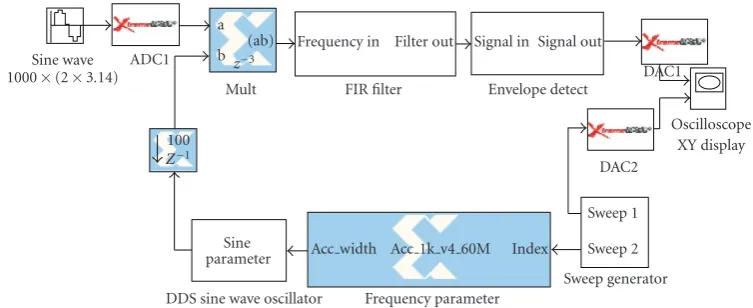
We use software-hardware codesign and cosimulation ap-proach to design a real-time sweep spectrum analyzer core, which can be built in a real-time electrical harmonic analyzer. First, we use the Simulink (with Matlab) function blocks to build up a sweep spectrum analyzer system, as shown in
Figure 23.
In the same time, we integrate the Xilinx System Gener-ator DSP Block Library [16] into the Simulink. With these library modules, we can cosimulate the total system and generate configuring bit for the corresponding FPGA chip so that we can perform the hardware verification. Software simulation can proceed by Simulink, or by ModelSim RTL-simulation. The Xilinx ChipScope is used to execute the hardware simulation and debugging.
Here, besides the ADC and DAC devices, we have de-signed an all-digital spectrum analyzer, where we use digital multiplier as the mixer, equiripple technique to implement FIR band-pass filter. The equiripple technique can make the attenuated band of frequency response of the filter equally smooth and optimizes the filter design.
7.3. System performance
We can implement multiple FIR filters in the same FPGA chip. Here, we demonstrate three different filters with central frequencies of 1 kHz, 100 kHz, and 1 MHz, respectively.
Table 2shows their analysis performance.
The X-spacing is 20 Hz and the Y-axis represents the component amplitude inFigure 24. We notice that the odd harmonic peaks like 10 Hz, 30 Hz, 50 Hz, and 70 Hz are
clearly shown. The relative amplitudes ratios are the same as the expected by FFT calculation.
To verify the analysis resolution in the highest detectable frequency of 2 kHz for the filter with central frequency of 1 kHz, we input an AM signal with carrier frequency of 2 kHz and modulation frequency of 20 Hz.Figure 25shows the de-tected spectrum.
InFigure 25, the central frequency is 2000 Hz, the left fre-quency is difference frequency of 1980 Hz, and the right fre-quency is sum frefre-quency of 2020 Hz. TheX-spacing is 20 Hz. We can easily differentiate between different frequency com-ponents with resolution less than 20 Hz.
The proposed digital IP can analyze the frequency span ranges from 10 Hz to 2 MHz. It can be flexibly utilized for FPGA-based real-time digital signal processing applications, such as visualized signal analysis, noise level monitoring, test and measurement of music studio, voice noise process, voice instruction interpreter, voice reading, and hearing aid design.
8. FLEXIBLY RECONFIGURABLE SDI SYSTEM DESIGN
Waveform display
Backlight intensity high
Graticule grid
XY Display Ch1 vs Ch2
Color palette normal
Off(Y) Ref1 (X) versus Ch2 (Y) Ch1 (X) versus Triggered
XY Off(YT) XY display
Tek run Triggered
Figure24: Analyzed spectrum of input square signal with period of 10 Hz.
Waveform display
Backlight intensity high
Graticule grid
XY Display Ch1 vs Ch2
Color palette normal
Off(Y) Ref1 (X) versus Ch2 (Y) Ch1 (X) versus Triggered
XY Off(YT) XY display
Tek run Triggered
Figure25: Detected spectrum of AM signal with carrier frequency of 2 kHz and modulation frequency of 20 Hz.
In another exchange way, the PC can also send more so-phisticated excitation signals to the instrument for more specific applications. We can use LabVIEW programs or C codes to achieve these. For the off-line process, the function-predefined configuring bitstream files are stored in different EPROMs (flash). We can use the function selection switch to order CPLD to send different CE (chip enable) signals to the selected configuring-EPROM (flash). When powered up, the instrument will be re-configured to work with new function.
Increasing or replacing different configuring EPROM (flash), we can add new functions to the proposed SDI system with-out changing or redesigning the system hardware.
9. CONCLUSIONS
PC platform
Function selection switch reconfiguring
On-line CPLD Data
exchange SDI
FPGA
Off-line reconfiguring
EPROM (flash)
F#1
EPROM (flash)
F#2
EPROM (flash)
F#n
CE1 CE2 CEn
Figure26: Flexibly reconfigurable SDI system.
reconfigurable, reusable, flexible, and rapidly prototyped will be the key to success in measurement and test market. This proposed FPGA-based reconfigurable instrument really meets the evolution trend. Once you have derived a mea-surement algorithm, you can easily build up a specialized instrument by SDI approach, such as an LCR (inductance-capacitance-resistance) meter, or biomedical monitor, and so forth.
ACKNOWLEDGMENT
This work was supported by National Science Council (NSC-93-2215-E-168–004), Taiwan
REFERENCES
[1] Xilinx Incorporation, “The programmable logic data book,” 2002.
[2] M. Cummings and S. Haruyama, “FPGA in the software ra-dio,”IEEE Communications Magazine, vol. 37, no. 2, pp. 108– 112, 1999.
[3] G.-R. Tsai, M.-C. Lin, G.-S. Sun, and Y.-S. Lin, “Single chip FPGA-based reconfigurable instruments,” inProceedings of In-ternational Conference on Reconfigurable Computing and FP-GAs (ReConFig ’04), Colima, Mexico, September 2004. [4] S. A. Dyer,Survey of Instrumentation and Measurement, John
Wiley & Sons, New York, NY, USA, 2001.
[5] J.-W. Hsieh, G.-R. Tsai, and M.-C. Lin, “Using FPGA to imple-ment a n-channel arbitrary wave form generator with various add-on functions,” inProceedings of 2nd IEEE International Conference on Field-Programmable Technology (FPT ’03), pp. 296–298, University of Tokyo, Tokyo, Japan, December 2003. [6] G.-R. Tsai, M.-C. Lin, W.-Z. Tung, K.-C. Chuang, and
S.-Y. Chan, “Wide-band and precisely measurement method of phase detector based on FPGA with embedded processor,” in Proceedings of International Conference on Informatics, Cyber-netics and Systems (ICICS ’03), I-SHOU University, Kaohsi-ung, Taiwan, December 2003.
[7] G.-R. Tsai and M.-C. Lin, “High speed signal sampler by multiple-path algorithm,” in Proceedings of IEEE Region 10 Conference (TENCON ’04), vol. 1, pp. 29–31, Chiang Mai, Thailand, November 2004.
[8] G.-R. Tsai and M.-C. Lin, “Implementation of a real-time har-monic analyzer core by a single FPGA chip,” inProceedings of 25th Symposium on Electrical Power Engineering, Tainan, Tai-wan, November 2004.
[9] J. Tierney, C. Rader, and B. Gold, “A digital frequency synthe-sizer,”IEEE Transactions on Audio and Electroacoustics, vol. 19, no. 1, pp. 48–57, 1971.
[10] C. Dick and F. J. Harris, “Configurable logic for digital com-munications: some signal processing perspectives,”IEEE Com-munications Magazine, vol. 37, no. 8, pp. 107–111, 1999. [11] J. Vankka, M. Waltari, M. Kosunen, and K. A. I. Halonen,
“A direct digital synthesizer with an on-chip D/A-converter,” IEEE Journal of Solid-State Circuits, vol. 33, no. 2, pp. 218–237, 1998.
[12] W. C. Lindsey and C. M. Chie , “A survey of digital phase-locked loops,”Proceedings of the IEEE, vol. 69, no. 4, pp. 410– 431, 1981.
[13] R. E. Best,Phase-Locked Loops: Design, Simulation, and Ap-plications, McGraw-Hill, New York, NY, USA, 5th edition, 2003.
[14] T. Watanabe and S. Yamauchi, “An all-digital PLL for fre-quency multiplication by 4 to 1022 with seven-cycle lock time,”IEEE Journal of Solid-State Circuits, vol. 38, no. 2, pp. 198–204, 2003.
[15] N. Kularatna, Modern Electronic Test and Measuring Instru-ments, IEE, London, UK, 1996.
[16] Xilinx System Generator v6.2 User Guide, 2004.
[17] Xilinx, “The Low-Cost, Efficient Serial Configuration of Spar-tan FPGAs,” XAPP098, 1998.
[18] Xilinx, “Configuring Spartan-II FPGAs from Parallel EPR-OMs,” XAPP178, 1999.
Guo-Ruey Tsaiwas born in Tainan, Taiwan, in 1953. He received the B.S. and M.S. de-grees in electronics engineering from the National Chiao Tung University, Taiwan, in 1975 and 1977, respectively. Since 1993, he has been a Faculty Member at Kun Shan University, Taiwan, where he is currently an Associate Professor in the Department of Electronics Engineering. His research inter-ests are in embedded processor architecture,
parallel processing algorithms, and FPGA-based instrumentation and measurement system design.
Min-Chuan Linwas born in Chang-Hua, Taiwan, in 1956. He received the B.S. de-gree from the National Taiwan University, Taiwan, in 1979, and the M.S. and Ph.D. degrees in electro-optical engineering from the National Chiao Tung University, Tai-wan, in 1987 and 1992, respectively. Since 1993, he has been a Faculty Member at Kun Shan University, Taiwan, where he is cur-rently an Associate Professor in the