Volume 2007, Article ID 59704,7pages doi:10.1155/2007/59704
Research Article
Efficient and Precise Processing for Squinted Spotlight SAR
Through a Modified Stolt Mapping
Marijke Vandewal,1Rainer Speck,2and Helmut S ¨uß2
1Optronics and Microwave Department, Royal Military Academy, Renaissancelaan 30, Brussel 1000, Belgium 2Deutsches Zentrum f¨ur Luft-und Raumfahrt e.V. (DLR), Postfach 1116, Wessling 82230, Germany
Received 26 January 2006; Revised 29 August 2006; Accepted 29 August 2006
Recommended by Christoph Mecklenbr¨auker
Processing of squinted SAR spotlight data is a challenge because of the significant range migration effects of the raw data over the
coherent aperture time. Although in theory the (ω,k)-algorithm takes care of these aspects, its digital implementation requires
a time-consuming interpolation step. Moreover, the limited precision of this interpolation can introduce distortions at the edges of the final image especially for squinted geometries. A wave number domain processing using a modified Stolt mapping will be developed and analyzed to enhance the quality of the final SAR image. Additionally, the proposed algorithm has a decreased
computational load compared to the original (ω,k)-algorithm. Simulation results will validate the focusing and efficiency
perfor-mances of the modified wave number domain algorithm.
Copyright © 2007 Marijke Vandewal et al. This is an open access article distributed under the Creative Commons Attribution License, which permits unrestricted use, distribution, and reproduction in any medium, provided the original work is properly cited.
1. INTRODUCTION
The atmospheric penetration and long-range capabilities of a synthetic aperture radar (SAR), combined with its high reso-lution, have made SAR imaging a favored approach for pro-viding twenty-four hour all weather detection and
recogni-tion at “safe” standoffranges. To achieve high resolution, a
range dependent filter operation must be performed on the received raw data. The existing SAR processing algorithms
differ in the approximations they use to combat problems
as large data sets, range migration effects, secondary range
decompression, and others. A majority of algorithms apply
to raw data organized in an orthogonal (X,Y) grid (where
X is the along-track andY the across-track direction) and
can be classified as stripmap mode processing algorithms, given the nature of stripmap data acquisition. Other algo-rithms work on a (range, azimuth angle) grid and can thus be classified as the pure spotlight mode processing algorithms, given the nature of spotlight data acquisition in a polar for-mat. In order to process raw data acquired in a spotlight op-erating mode with a stripmap mode processing algorithm,
these data have to be organized in an (X,Y) grid. As a
re-sult the range migration over the coherent aperture time as well as the change in range migration across the scene will be important, which makes processing of this kind of data
challenging. These effects get even stronger when the squint
angle increases, so in particular for a squinted spotlight op-eration mode, a high quality processor is mandatory.
The (ω,k)-algorithm [1–3] applies to raw data that are
organized in an (X,Y) matrix and is thus by definition
con-sidered as a stripmap mode processing algorithm. This wave number domain processing is known for its elegant math-ematical development since it deals with the SAR transfer function, without any approximation, through a change of variables (Stolt mapping) in the frequency domain. Although in theory the Stolt mapping takes care of the aspects typical for squinted spotlight SAR data, its digital implementation requires an interpolation step that can introduce distortions at the edges of the final image as the squint angle augments
[4]. Increasing the precision of the interpolation kernel by
using a longer interpolation function is possible; however,
the computational efficiency of the algorithm will decrease
significantly [5].
Solutions have been proposed in the literature to cir-cumvent the disadvantages of the practical implementation
of the (ω,k)-algorithm when processing squinted spotlight
SAR data. In [4,6] the most common version of the (ω,k
)-algorithm is identified as a zero-Doppler processing, refer-ring to the output geometry of the processed data which is
the degradations caused by the Stolt mapping on squinted data have been identified and quantified for a zero-Doppler output geometry. As a solution, a generalized wave number domain processing in an output geometry close to the ac-quisition geometry is proposed. This wave number
“acqui-sition Doppler” processing allows a very efficient Stolt
map-ping and applies to all squint angles. In [7,8] another
solu-tion for the (ω,k)-algorithm using the zero-Doppler output
geometry has been proposed. Here the range walk (the linear component of the range migration) of the SAR raw data is removed before the actual processing. This leads to a limited skewing and shifting of the spectrum after the Stolt mapping, thus resulting in better performances regarding the overall
resolution and the memory efficiency. On the other hand
due to the removal of the range walk, the signal expression in the frequency domain has changed and the Stolt mapping requires a 2-dimensional interpolation. Knowing that the in-terpolation step is by far the most time consuming part of the
code, the time efficiency of this processing can decrease.
The purpose of this paper is to improve the focusing
per-formances of the (ω,k)-algorithm using the zero-Doppler
output geometry for squinted spotlight data without increas-ing the computation time for a given set of parameters and for a given interpolation function length. As for the
range-Doppler algorithm [1], where part of the Stolt mapping is
replaced by an interpolation in the range-Doppler domain for moderate squint angles, this paper investigates such sep-aration with respect to high squint angles to alleviate the interpolation step associated to the Stolt mapping. As an immediate consequence, for a given interpolation accuracy
and thus efficiency of the algorithm, the focusing
perfor-mances are improved, or, for a given focusing performance,
the efficiency of the processor increases. The paper is
or-ganized as follows: first, a state of the art is given on the wave number domain zero-Doppler processing clarifying the causes of performance limitations for high squint angles. Next, a solution is proposed to circumvent these shortcom-ings through a modified Stolt mapping which will not
de-crease the time and memory efficiency. On the contrary, they
both are enhanced as a consequence of the modified Stolt mapping. Finally, simulation results will validate the perfor-mances of the modified wave number domain processing. An unmanned aerial vehicle (UAV) from the high-altitude long-endurance (HALE) category has been chosen as the SAR platform. Indeed, the favored operating mode for reconnais-sance missions of a SAR-UAV system is the squinted spotlight mode.
2. WAVE NUMBER DOMAIN PROCESSING
To understand the principle of the (ω,k)-algorithm, it is im-portant to mathematically represent the raw SAR signal in the frequency domain after removal of the range chirp.
Ifg(τ) represents the pulse envelope, the received pulse,
h(τ,t,R), is expressed by (1) after coherent demodulation for the removal of the carrier, and is the return of a point target on a zero reflecting background. The two-way antenna beam pattern is not represented since it does not contribute to the
essence of the analyzed themes:
h(τ,t,R)=gτ−2cR
·exp
−j4π λ R
,
R=r2 sl+V2
t−t0
2 .
(1)
The variables and parameters in (1) are defined as follows:
(i) tandτare slow time and fast time, respectively;
(ii) Ris the slant range between a point scatterer and the
antenna phase center and depends on slow time and the position of the point scatterer in the scene; (iii) rslis the slant range at closest approach of a point
scat-terer andt0 the time at which this closest approach
takes place; the origin of the slow time axis is taken in the middle of the synthetic aperture interval;
(iv) Vis the platform velocity;
(v) g(·) is the pulse envelope;
(vi) λis the carrier wavelength of the transmitted signal;
(vii) cis the speed of light.
Fourier transforming this kernel to the range frequency domain (ν) results in (2), whereG(ν) represents the envelope
of the range frequency spectrum andν0the carrier frequency
of the transmitted signal:
H(ν,t)=G(ν)·exp
−j4π c R
ν+ν0
. (2)
For the Fourier transformation into the azimuth frequency
domain (f), the stationary phase method can be applied [9].
The stationary point is reached fort∗for which the azimuth
wave number,kf, and the range wave number,kν, have been
introduced in (3). The variablekνt is considered as the total
range wave number andkν0as the range wave number related
to the carrier frequency of the transmitted signal:
t∗= − rslkf Vk2
vt−k 2 f
+t0,
kνt =kv+kν0= 4π
c ν+
4π
c ν0,
kf = 2Vπf .
(3)
The azimuth Fourier transformation can now be
approxi-mated by (4), where unessential multiplicative constants are
not represented:
Hkνt,kf
∼
=Gkνt
·exp −jrsl
k2
νt−k
2
f+kfVt0
.
(4)
Now the actual analysis of the wave number domain process-ing can begin. First, all the scatterers in the same range bin as the scene center will be correctly focused after multiplication with the phase reference function in (5), whererref refers to
the slant range of the scene center at closest approach:
φref=rref
k2
νt−k
2
0 50 100 150 200 250 370
390 410 430
Azimuth wave number (kf)
Range
w
av
e
n
umber
(
kvt
)
(a)
0 50 100 150 200 250
370 390 410 430
Azimuth wave number (kf)
Range
w
av
e
n
umber
(
ky
)
(b)
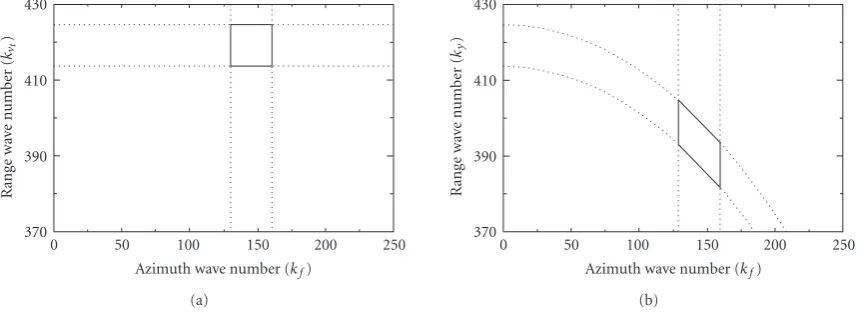
Figure1: Illustration of the data spectrum before (a) and after (b) the Stolt mapping within the defined bandwidths (squint angle=20◦).
At this point all the point scatterers at the reference rangerref
are correctly focused and the defocusing of the other point scatterers increases with (rsl−rref). Introducing an
appropri-ate change of variables (6) will correctly focus the scatterers at all ranges and will lead to the signal in (7):
kf =kf,
ky=
k2
νt−k
2 f,
(6)
Sky,kf=Gky·exp−jrsl−rref
·ky+kfVt0
.
(7)
Figure 1illustrates the range wave number before (a) and af-ter (b) the Stolt mapping as a function of the azimuth wave
number. The full line box onFigure 1(a)indicates the size of
the data spectrum before the Stolt mapping: the two hori-zontal dotted lines delimit the range bandwidth and the two
vertical dotted lines delimit the azimuth bandwidth for a 20◦
squint angle (using the parameters ofTable 1inSection 4).
The change of variables of (6) transforms equidistant lines
of constant total range wave number (the dotted
horizon-tal lines onFigure 1(a)) into curves inky(the dotted curved
lines onFigure 1(b)). This results in a skewing and a
down-ward shifting of the data spectrum (as indicated by the full
line box onFigure 1(b)).
A first immediate consequence is that the new
sam-ples are not equally sampled inkyand thus interpolation is
needed to allow inverse Fourier processing (to return to the time domain). A high quality interpolation kernel is required to avoid the introduction of artifacts at the edges of the final
SAR image [4,5] for high squint angles, where the skewing
of the spectrum after the Stolt mapping becomes important. The nature of the interpolation function as well as its size are of importance, however, as mentioned before the increase of
the latter will decrease significantly the computational effi
-ciency of the processor.
A second consequence is that the computational effi
-ciency of the (ω,k)-algorithm decreases with the squint
an-gle. Indeed, looking at the full line box of Figures1(a)and
1(b), an increase of the size of the data spectrum in the range
0 50 100 150 200 250
370 390 410 430
Azimuth wave number (kf)
Range
w
av
e
n
umber
(
kz
)
Figure2: Illustration of the data spectrum after the modified Stolt
mapping within the defined bandwidths (squint angle=20◦).
wave number direction is noted. For the given set of
parame-ters and a squint angle of 20◦, the needed bandwidth in range
after the Stolt mapping is more or less twice the range band-width of the data before the Stolt mapping.
3. USE OF A MODIFIED STOLT MAPPING
The purpose of this paragraph is to propose a solution that will enhance the focusing performances of the wave number domain processor for a given interpolation kernel. Since the skewing of the spectrum has been identified in the previous
section as the main cause of degradation effects at the edges
of the image, the aim is to change the Stolt mapping of (6).
A new change of variables is proposed in (8) to even out the
skewing over the interval of the range wave numbers by tak-ing the curvature of the carrier range wave number as the reference curve:
kf =kf, kz=k2
νt−k
2 f+
kν0−
kv2
0−k
2 f
. (8)
The impact of this change of variables is illustrated inFigure
as a function of kf. The full line box delimits the size of
the data spectrum after the modified Stolt mapping. As in-tended, the skewing of the spectrum is reduced drastically and the simulation results in the next section show that the overall resolution performances are enhanced. A second con-sequence is that the size of the data spectrum did not change
significantly, meaning that the computational efficiency of
the modified (ω,k)-algorithm is now quasi-independent of
the squint angle.
The resulting signal after the modified change of vari-ables is given by (9). Comparing (9) with (7) shows that an unwanted phase term is present that needs to be corrected.
Since this phase term only depends on range and onkf, it can
be eliminated by multiplying the data with the phase
func-tion of (10) in the range-Doppler domain. The extra
com-putational load of this operation is negligible since it can be performed within the loop of the inverse Fourier transfor-mation after the interpolation step:
Hkz,kf∼=Gkz·exp −jrsl−rref
·kz−kν0+
k2
ν0−k
2 f
+kfVt0
, (9)
φc=exp jrsl−rref
·−kν0+
k2
ν0−k
2 f
. (10)
The physical interpretation of this modified change of vari-ables can be easily done after expanding and rewriting the square root term as in [1] leading to (11):
k2
νt−k
2 f ∼=
⎛ ⎜ ⎜ ⎜ ⎜ ⎜ ⎜ ⎝
kν0D
azimuth modulation
+ kν
D range migration − k 2 fk2ν
2k3
ν0D
3 SRC ⎞ ⎟ ⎟ ⎟ ⎟ ⎟ ⎟ ⎠ . (11)
Higher-order terms have been neglected in (11) andDis
de-noted as the migration parameter, expressed by
D= 1−k2f
k2
ν0
. (12)
The three terms on the right-hand side of (11) represent,
respectively, the azimuth modulation, the range migration (RM), and the secondary range compression (SRC). Indeed, the normal Stolt change of variables corrects for these three terms (and other higher-order terms that have been
omit-ted in (11)) simultaneously through the Stolt mapping in the
wave number domain. The azimuth modulation is the
dom-inant term in (11) and is the main contributor to the
shift-ing and the skewshift-ing of the spectrum after the Stolt mappshift-ing.
When the same development as in (11) is done for the
modi-fied change of variables, it becomes clear that it is exactly that
term which is cancelled out (13). The correction of the
resid-ual azimuth modulation is then done in the range-Doppler
Table1: Simulation parameters.
Altitude 18 km
Velocity,V 175 m/s
Squint angle 20◦
Pulse repetition frequency 500 Hz
Carrier frequency,ν0 10 GHz
Chirp rate,γ 24.0 MHz/μs
Pulse length 10.9μs
Aperture time 6.0 s
Range resolution 0.5 m
Azimuth resolution 0.5 m
domain (see (10)):
k2
νt−k2f+
kν0−
k2
v0−k
2 f ∼ = ⎛ ⎜ ⎜ ⎜ ⎜ ⎜ ⎜ ⎝
kν0D
azimuth modulation
+ kν
D range migration − k 2 fkν2
2k3
ν0D
3 SRC ⎞ ⎟ ⎟ ⎟ ⎟ ⎟ ⎟ ⎠
+kν0−kν0D
.
(13)
Looking at the exact formulation of the range-Doppler
algo-rithm [1], there is a strong analogy between this algorithm
and the (ω,k)-algorithm using the modified Stolt mapping.
Indeed, in both cases the azimuth modulation is corrected in the range-Doppler domain through a phase multiplication and the RM as well as the SRC are corrected through a
map-ping of the data. However, an important difference remains:
in the range-Doppler algorithm, the mapping is done in the
range-Doppler domain, whereas for the (ω,k)-algorithm this
is performed in the wave number domain.
The main advantage is that through the modified Stolt
change of variables the same efficiency is obtained as with
the exact formulation of the range-Doppler algorithm but without making any approximations throughout the whole program.
4. SIMULATION RESULTS
The set of parameters inTable 1has been used to simulate a
raw data set for a squint angle of 20◦(defined between the
across-track direction and the antenna looking direction). The values of the platform related parameters correspond to the characteristics of a HALE UAV such as the Global Hawk. The squinted geometry has been defined in such a way that the slant range between the scene center and the antenna phase center in the middle of the aperture time is 40 km. The
illuminated scene (600 m×600 m) is composed of 9 point
targets, distributed as inFigure 3and the antenna points to
0 300 600 0
300 600
Azimuth (m)
Range
(m)
A B C
D E F
G H I
Scene center
Figure3: Geometry of the illuminated scene.
As mentioned in the previous sections, the focusing
per-formances of the (ω,k)-algorithm using the zero-Doppler
output geometry for squinted spotlight data can degrade at the edges of the image. This has been illustrated by analyzing the 3 dB-resolution in the azimuth and range direction of the
processed point targetsE(scene center),IandB. The cubic
convolution has been used as the interpolation method since it closely approximates the theoretically optimum sinc inter-polation function using cubic polynomials. The number of neighboring points used during the interpolation is limited to four (imposed by the used programming language) and an oversampling factor of 8 has been used to enhance the quality
of the interpolation step. OnFigure 4the contours of
mag-nitude of the processed point targets has been represented
to give a qualitative impression of the difference in focusing
performances across the illuminated scene. In the upper left corner these performances have been quantified by the exact value of the 3 dB-resolution in both directions (Az: azimuth, Ra: range).
These results show that the broadening of the azimuth resolution is rather high at the edges of the scene, especially at far range (broadening of 21% compared to the obtained azimuth resolution for the scene center).
Analogous to this analysis, the focusing performances
of the modified (ω,k)-algorithm have been presented on
Figure 5. For the far range point target the original az-imuth broadening of 21% is diminished to 2%, thanks to the modified Stolt mapping. As an additional advantage, the
time needed to process the data with the modified (ω,k
)-algorithm is only 60% of the time that was required for the original wave number domain processing. As a result the
computational efficiency of the modified wave number
al-gorithm is similar to the one obtained when processing non-squinted raw data.
5. CONCLUSIONS
This paper described the state of the art of the (ω,k
)-algo-rithm using the zero-Doppler output geometry when pro-cessing squinted spotlight data. The limitations of the digi-tal implementation of this algorithm have been described as well as their impact on the overall focusing performances. A
Az: 0.509 m Ra: 0.51 m
Azimuth (samples)
Range
(samples)
(a) TargetE
Az: 0.616 m Ra: 0.514 m
Azimuth (samples)
Range
(samples)
(b) TargetI
Az: 0.55 m Ra: 0.515 m
Azimuth (samples)
Range
(samples)
(c) TargetB
Figure 4: Resolution analysis after processing with the original
(ω,k)-algorithm (squint angle=20◦).
modified wave number domain algorithm has been proposed to improve these performances for a given set of parame-ters and a given interpolation kernel, typical for the (ω,k )-algorithm. As an additional advantage the computational ef-ficiency of this new algorithm is expected to increase since the size of the data spectrum can be reduced to the size in
case of no squint. The raw data of point targets at diff
Az: 0.509 m Ra: 0.51 m
Azimuth (samples)
Range
(samples)
(a) TargetE
Az: 0.519 m Ra: 0.517 m
Azimuth (samples)
Range
(samples)
(b) TargetI
Az: 0.517 m Ra: 0.521 m
Azimuth (samples)
Range
(samples)
(c) TargetB
Figure 5: Resolution analysis after processing with the modified
(ω,k)-algorithm (squint angle=20◦).
range. Moreover, the overall computation time has been im-proved considerably by the proposed modifications and has been proven to be approximately independent of the value of the squint angle.
REFERENCES
[1] I. G. Cumming and F. H. Wong,Digital Processing of Synthetic
Aperture Radar Data, chapter 5, 8, Artech House, Boston, Mass, USA, 2005.
[2] W. G. Carrara, R. S. Goodman, and R. M. Majewski,Spotlight
SAR Signal Processing Algorithms, chapter 10, Artech House, Boston, Mass, USA, 1995.
[3] R. Bamler, “A comparison of range-Doppler and wavenumber
domain SAR focusing algorithms,”IEEE Transactions on
Geo-science and Remote Sensing, vol. 30, no. 4, pp. 706–713, 1992. [4] G. Fornaro, E. Sansosti, R. Lanari, and M. Tesauro, “Role of
pro-cessing geometry in SAR raw data focusing,”IEEE Transactions
on Aerospace and Electronic Systems, vol. 38, no. 2, pp. 441–454, 2002.
[5] P. T. Gough and D. W. Hawkins, “Unified framework for
mod-ern synthetic aperture imaging algorithms,”International
Jour-nal of Imaging Systems and Technology, vol. 8, no. 4, pp. 343– 358, 1997.
[6] G. Fornaro, G. Franceschetti, and S. Perna, “Motion compensa-tion of squinted airborne SAR raw data: role of processing
ge-ometry,” inProceedings of IEEE International Geoscience and
Re-mote Sensing Symposium (IGARSS ’04), vol. 2, pp. 1518–1521, Anchorage, Alaska, USA, September 2004.
[7] P. Berens, “Extended range migration algorithm for squinted
spotlight SAR,” inProceedings of IEEE International Geoscience
and Remote Sensing Symposium (IGARSS ’03), vol. 6, pp. 4053– 4055, Toulouse, France, July 2003.
[8] P. Berens, “Efficient wave number domain processing for
squinted spotlight SAR,” inProceedings of 5th European
Confer-ence on Synthetic Aperture Radar (EUSAR ’04), vol. 1, pp. 171– 174, Ulm, Germany, May 2004.
[9] M. Soumekh,SAR Signal Processing, John Wiley & Sons, New
York, NY, USA, 1999.
Marijke Vandewalwas born in Sint-Tru-iden, Belgium, in 1973. She received a B.S. degree in electronic engineering in 1996 from the Polytechnics Faculty of the Belgian Royal Military Academy (RMA). From 1996 to 2001 she served the Belgian Air Force working in the radar domain. In 2001, she started with a research project on SAR sim-ulation, conducted under a joint supervi-sion between the German Aerospace Center
(DLR) and the RMA. In 2006, she obtained the Ph.D. degree in ap-plied sciences at the Vrije Universiteit Brussel (VUB) in Belgium. Since her return to the RMA in 2001, she has been working as an Assistant in the Optronics, Microwave, and Radar Department. Her main research interests are in synthetic aperture radar (SAR), elec-tromagnetic propulsion, laser applications, and imaging methods using electromagnetic waves in general.
Rainer Speckwas born in Pforzheim, Ger-many, in 1962. He received the Dipl.-Ing. (M.S.E.E.) and the Dr.-Ing. (Ph.D.E.E.) de-grees in electrical engineering from the University of Karlsruhe, Karlsruhe, Germa-ny, in 1990 and 1994, respectively. Since 1996, he has been with the Depart-ment for Reconnaissance and Security of the Microwaves and Radar Institute,
Ger-man Aerospace Center (DLR), Oberpfaff
Helmut S¨ußmade his Diploma in physics in 1978 at the University of Mainz. In 1982, he obtained a Ph.D. degree at the University of Bochum. From April 1987 to March 1988 he obtained a Postdoctoral Fellowship from the US National Science Foundation at the JPL (California Institute of Technology); re-search topics: analysis of multisensor data, design of high-resolution aperture synthe-sis radiometer. In 1994, he was appointed