Volume 2008, Article ID 849246,10pages doi:10.1155/2008/849246
Research Article
A Method for Source-Microphone Range Estimation in
Reverberant Environments Using Arrays of Unknown
Geometry
Denis McCarthy and Frank Boland
Department of Electronic and Electrical Engineering, School of Engineering, Trinity College, Dublin, Ireland
Correspondence should be addressed to Denis McCarthy, [email protected]
Received 18 December 2006; Revised 24 April 2007; Accepted 23 September 2007
Recommended by Joe C. Chen
This paper proposes a technique for determining the distance between a sound source and the microphones in an array. The proposed “Range-Finder” algorithm is robust in the presence of reverberation and, in contrast with previously published source-localization techniques, does not require knowledge of the relative positions of the microphones. We discuss the factors affecting the accuracy of our range estimates and present the results of experiments using simulated and real data to demonstrate the efficacy of our approach.
Copyright © 2008 D. McCarthy and F. Boland. This is an open access article distributed under the Creative Commons Attribution License, which permits unrestricted use, distribution, and reproduction in any medium, provided the original work is properly cited.
1. INTRODUCTION
Estimating the distance between a source and a receiver has been a central problem in array signal processing since the earliest days of radar and sonar. For indoor applications, using microphone arrays, such estimates could have use in source localization or speaker tracking. In addition, they could inform decisions regarding microphone selection, al-lowing us to select the microphone(s) nearest the source or farthest from some likely interference. Range estimates could also have use in determining appropriate speech enhance-ment strategies, such as when deciding whether or not to use a dereverberation algorithm.
Typically, range is determined by measuring the time-of-flight of a transmitted or reflected soundwave and mul-tiplying it by some known propagation speed. In [1] this is achieved by simultaneous transmission of a soundwave and a “time-stamped” radio signal. Provided that the transmit-ter and receiver are synchronized, the time-of-flight may be easily obtained as the difference in the times of transmission and reception. However, in a majority of cases the sources of interest will not be specifically designed transmitters and so such techniques have limited application.
Given the knowledge of the relative microphone posi-tions, the source-microphone range may easily be obtained
from estimates of the relative position of the source—an end to which a variety of solutions have been proposed.
For the sake of clarification, we note that many of the methods, presented in the literature as “source-localization” techniques, are, in fact, solutions to the related but distinct problem of delay-vector estimation, that is, obtaining the rel-ative intersensor time-delay estimates (TDEs). Furthermore, in many cases, the source “location” is defined in terms of a bearing line only. In this paper, we use the term “source lo-calization” to refer to the problem of estimating the position of a source, with respect to some coordinate system.
calculated as a weighted average of the closest intersections between bearing-line pairs. In [6,7] the authors estimate the source location via a least-squares fitting of the TDEs for an ad hoc deployment of sensors.
Relative range estimates may also be obtained from a comparison of received signal power. In [8] the authors com-bine TDEs and relative signal power measurements to deter-mine the location of a source in the extreme near-field of a two-element array. In [9] the authors present a method for source localization that utilizes received signal energy only. Whilst this technique is reported as returning consistently ac-curate source-bearing estimates, in the presence of reverber-ation range estimreverber-ation is shown to be subject to a significant bias.
The use of techniques employing power measurements is commonly restricted to nonreverberant acoustic environ-ments, or to situations where the effects of reverberation are negligible. This is due to the difficulty inherent in modelling and/or mitigating against the presence of reverberation and its consequent adverse effects. Techniques that use TDEs only are preferred when reverberation is present although, as we have noted, these require knowledge of the relative micro-phone positions.
However, for many practical applications, microphone locations will be unknown or unreliable. Yet, the question of how to estimate the range between a sound source and a mi-crophone, in the presence of reverberation and with the rela-tive positions of the microphones unknown, remains largely unaddressed. We propose a solution to this problem. Our method combines relative power measurements with TDEs in such a way as to mitigate against the adverse effects of reverberation and obtain absolute source-microphone range estimates for microphones at unknown locations.
In the following section, we will briefly discuss the rel-evant characteristics of sound propagation in rooms. In Section 3, we derive a well-known but na¨ıve range estima-tor as well as the proposed “Range-Finder” algorithm. In Section 4, we address the factors affecting range-estimate dis-tribution. In Section 5, we present the results of a series of simulations and experiments designed to test the per-formance of our algorithm. We discuss the potential uses of the Range-Finder algorithm and suggest future work in Section 6.
2. SOUND PROPAGATION IN ROOMS
In a noiseless but reverberant environment, the signal re-ceived at some microphone,m0, will consist of a direct-path
component and multiple reflected components jointly re-ferred to as reverberation. The input to the microphone may be modelled as the convolution of the source-microphone impulse response,h0(t), and the source signal,s(t):
x0(t)=
t
0s(p)h0(t−p)d p. (1)
In the frequency domain,
X0(ω)=S(ω)H0(ω) =S(ω)
Hd p0(ω) +Hmp0(ω)
, (2)
whereHd p0is the component ofH0due to direct-path (non-reflected) propagation andHmp0 is the reverberant compo-nent due to multipath reflections. The received signal power spectrum may be calculated as follows. Note that, for clarity, we omit the dependence onωin the sequel
X02
= |S|2H
0 2
= |S|2H
d p0
2
+Hmp0
2
+ 2ReHd p0H ∗
mp0
, (3)
where Re{ }denotes the real component and∗denotes the complex conjugate.
In air, for an omnidirectional source and receiver, the power of the direct-path component of sound, received at m0, is inversely proportional to the squared
source-microphone range, that is, the squared distance between the source and the microphone,
Hd p 0
2
∝ 1
r02
, (4)
wherer0 = |s−m0|andsandm0denote the Cartesian
co-ordinates of the source andm0, respectively. The direct-path
component therefore decays at a rate of 6 dB per doubling of the source-microphone range. This model does not address effects due to variations of air pressure or temperature, how-ever, in a room environment it is reasonable to assume a ho-mogenous medium. From (4), we may derive an expression for the power of the direct-path component of the sound re-ceived at some microphonema:
Hd pa2
=Hd p0
2 r0
ra
2
. (5)
The reverberant component of an impulse response will be dependent upon factors such as the dimensions and surface absorption characteristics of the room. These vary widely from room to room and so we cannot know|Hmp0|
2
a priori.
Typically, the degree to which a room is reverberant is described with reference to a metric known as the reverber-ation time (RT60). The RT60is defined as the average time
taken for the reverberant sound energy to decay by 60 dB. Although useful for conveying a general idea of how rever-berant a room may be, specifying the RT60gives no idea of
how reverberant a recorded sound will be. Consider, for ex-ample, a recording made in a room at a distance of 1 m from a sound source. This recording will be perceived as being less reverberant than one made in the same room at 5 m from the source. This is because the direct path component decays as we get farther from the source, despite the RT60being the
same in each instance.
−5 0 5 10
DRR
(dB)
−0.4−0.2 0 0.2 0.4 0.6 0.8 1 1.2 1.4 1.6
log2(r) Data
“Best fit”
Office
(a)
−5 0 5 10 15
DRR
(dB)
−0.5 0 0.5 1 1.5 2 2.5
log2(r) Data
“Best fit”
Classroom
(b)
0 5 10 15 20
DRR
(dB)
−0.5 0 0.5 1 1.5 2 2.5
log2(r) Data
“Best fit”
Reception hall
(c)
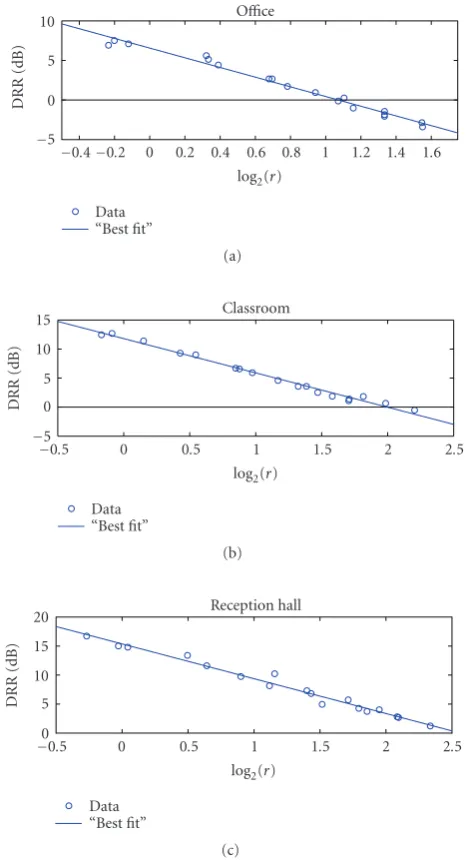
Figure1: Direct-to-reverberant ratios versus log2(r), whereris the source-microphone range. Results shown are for an office, class-room, and reception hall.
microphone,m0, may be defined as follows:
DRR0=
Hd p0
2
dω Hmp0
2
dω. (6)
An investigation of DRRs in real rooms proves informa-tive.Figure 1shows a plot of DRRs, found at a variety of lo-cations in an office, classroom, and reception hall. The DRRs are plotted with respect to log2(r). The reverberation times were determined experimentally using the transient decay method [10] and were found to be 0.6, 0.5, and 1.1 seconds, respectively. The DRR estimates were obtained as follows. Recordings were made at varying locations in each room and at varying distances relative to a single source—in this case a loudspeaker. The sampling rate was 48 kHz. In each instance,
the microphone was placed directly in front of the loud-speaker so as to avoid complications due to the directivity of the source. The loudspeaker produced a maximum-length-sequence (MLS) of approximate duration 5.5 seconds, also at a sampling rate of 48 kHz. These recordings were then cross-correlated with the “clean” MLS to obtain an impulse re-sponse estimate, from which a DRR estimate was calculated. Figure 1also shows “best-fit” linear approximations of the data. The slopes of these fits are−6.12,−5.99, and−5.915 decibels per doubling of range for the office, classroom, and hall, respectively. Given that we can expect|Hd p0|
2to decay at
a rate of 6 dB per doubling of the source-microphone range, these results suggest that, in a given room,E{|Hmp0|
2dω}
(whereE{ }is the expectation operator) is a constant that is independent of the source-microphone range.
We define the following:
Fa,b= Hmpa
2
−Hmpb
2
+ 2ReHd paHmp∗ a−Hd pbHmp∗ b
dω,
(7)
where the aandb subscripts denote the impulse response components corresponding to the microphonesmaandmb,
respectively. Consider the cross-terms in (7). Direct path propagation applies a delay and scaling to a sound wave. Therefore, for any source-microphone impulse response,
Hd pis a scaled exponential. Similarly,Hmpmay be considered
to be the sum of scaled exponentials corresponding to mul-tiple reflected sound waves. As such,Hd pHmp∗ is also the sum
of multiple scaled exponentials. Therefore, invoking the cen-tral limit theorem, we will assume Re{Hd paH
∗
mpa}dωand
Re{Hd pbH ∗
mpb}dω to be zero-mean normally distributed
random variables. Following from our previous results, we also assume |Hmpa|
2dω and |H
mpb|
2dω to be random
variables distributed about the same mean. Therefore, invok-ing the central limit theorem once again, we may consider
Fa,bto be a zero-mean normally distributed random variable.
Note that if Hd p and Hmp are nonzero at ω = 0,
Re{Hd pHmp∗ }dωwill exhibit a positive bias. We may ignore
this, however, as the frequency responses of real microphones will not have a nonzero component atω=0.
As an aside, we note that a brief inspection of the results inFigure 1reveals that although it had the greatest RT60, the
reception hall was not the most reverberant of the rooms in which we took measurements. This further illustrates the in-adequacy inherent in characterizing the degree of reverbera-tion in a room by specifying its RT60alone. Our results do,
however, suggest an alternative metric. The intercept of best-fit line with the y-axis defines the spatially averaged “DRR-at-1 m” and we will use this metric to describe acoustic con-ditions in the sequel.
3. RANGE ESTIMATION
3.1. A na¨ıve range estimator
Whenτa is the relative intersensor time-delay between ma
andm0,
ra−r0=cτa, (8)
wherecis the speed of sound in air. Using any one of a va-riety of time-delay estimation techniques, we may obtain an estimate of the relative intersensor time-delay,τa. In
noise-less, anechoic environments the direct-path sound accounts for all acoustic energy received by the microphones and so, by substituting (3) and (8) into (5) and performing algebraic manipulation, we obtain a simple and well-known estimator ofr0:
r0=
cτa
Ha2/H02
1−Ha2/H02
. (9)
Unfortunately, in nonideal acoustic environments, the pres-ence of interfering reverberation can severely distort this esti-mate, making the above range estimator unsuitable for use in practical environments. Where more than two microphones are available, the most accurate range estimate will be ob-tained by using only those two microphones closest to the source. These may be presumed to have the highest DRRs. The outputs of the remaining microphones will contain pro-portionally greater levels of reverberation and will, therefore, lead to greater distortion in the range estimates.
3.2. The Range-Finder algorithm
From (5) and (8), Hd p
a
2
−Hd pb
2
=Hd po
2 r0
r0+cτa
2
− r0
r0+cτb
2
. (10)
The term in the square brackets is a function ofr0,τa, andτb
which we denote asGa,b(r0,τa,τb):
Ga,b
r0,τa,τb
= r0
r0+cτa
2
− r0
r0+cτb
2
. (11)
Integrating (3) across the full bandwidth of the signal, we obtainP0—the total received signal power atm0:
P0=
|S|2H
d p0
2
+Hmp0
2
+ 2ReHd p0Hmp∗ 0
dω.
(12)
We defineΛa,bas being the difference between the total
re-ceived signal power atmaandmb:
Λa,b=Pa−Pb. (13)
Let us assume, for the moment, that|S|2is a constant with
respect to frequency (we will return to this assumption later). Substituting (12) into (13) and performing algebraic manip-ulation yields
Λa,b= |S|2
kGa,b
r0,τa,τb
+Fa,b
, (14)
wherek = |Hd p0|
2
dω. From (14), we see that the diff er-ence between the signal power received at two microphones is proportional to the sum of a scaled, deterministic function,
Ga,b(r0,τa,τb), and a zero-mean and normally distributed
random variable,Fa,b. We define the following vectors,
not-ing that we have omitted the arguments of theGa,b(r0,τa,τb)
terms for clarity:
G=G0,1,G0,2,. . .,G1,2,G1,3,. . . GM−2,M−1
T
,
F=F0,1,F0,2,. . .,F1,2,F1,3,. . . FM−2,M−1
T
,
Λ=Λ0,1,Λ0,2,. . .,Λ1,2,Λ1,3,. . .ΛM−2,M−1
T
= |S|2[kG+F].
(15)
Once again, using any of the many well-known tech-niques for delay-vector estimation, we may obtain the time-delay estimatesτa andτb. We then defineGa,b(r0) and the
corresponding vectorG(r0) from
Ga,b
r0
=Ga,b
r0,τa,τb
. (16)
Following from the Cauchy-Schwartz inequality, the optimal range estimate,r0, is obtained by a matched-filtering of the
power-difference vector,Λ, withG(r0)/|G(r0)|:
r0=arg max
r0
1 Gr0
G(r0)TΛ
. (17)
Following from this estimate, we may easily obtain estimates of the remaining source-microphone ranges,
{r1,r2,. . .,rM−1}, by insertingr0and the TDEs used to
cal-culateG(r0) into (8).
Previously, we assumed|S(ω)|2to be a constant with
re-spect to frequency. In many cases, including that of human speech, this is unrealistic. In reality, speech is both a lowpass and often harmonic signal. This poses particular problems. We have assumed Fa,b to be a zero-mean, normal random
variable. The analysis and experimental evidence underpin-ning this assumption are for broadband signals and we can-not reasonably expect it to hold for cases, such as speech, where the bulk of the energy is concentrated at low frequen-cies.
This problem was overcome as follows. The microphone outputs are split into individual, nonoverlapping subbands. The bandwidth of these subbands are chosen such that they are narrow enough that |S(ω)|2 is roughly constant within
the subband whilst also being wide enough that there is al-ways a direct-path speech component present.Λis then cal-culated for each subband. Each Λis normalized and, from these, an average power-difference vector,Λ, is found across all the subbands. The range estimate is found, as in (17) by a matched filtering ofΛwithG(r0)/|G(r0)|.
4. ESTIMATE DISTRIBUTION AND ACCURACY
is not necessarily the case. We will also show how the accu-racy of a range estimate is dependant upon the actual source-microphone ranges. We restrict our analysis to the situa-tion where we have three microphones only—the minimum number required to implement the Range-Finder. We do this both for the sake of simplicity and to allow us to employ an alternative formulation of the Range-Finder algorithm. This alternative formulation more clearly illustrates how the dis-tribution of range estimates is related to the disdis-tribution of the ratio of normal random variables, a well-understood, al-beit nontrivial, distribution that has received extensive study in the literature.
4.1. An alternative formulation of the Range-Finder
The range estimate,ro, is that which maximizes the
expres-sion in (17). For two vectors with given norms, the dot prod-uct of the vectors is a maximum when they are propor-tional. Therefore, we may writeG(r0) ∝ Λ. For the
three-microphone case, this implies
G0,1
r0
,G0,2
r0
∝Λ0,1,Λ0,2
. (18)
Using an equivalent expression, we defineQ0,1,2:
G0,1
r0
G0,2
r0
= Λ0,1
Λ0,2 =
Q0,1,2, (19)
and from this, we obtain an alternative formulation for the Range-Finder:
r0=arg min
r0
Q0,1,2−
G0,1
r0
G0,2
r0
. (20)
For 3 microphones there are, of course, 5 further permuta-tions ofQ(Q0,2,1,Q1,2,0, etc.). However, all may be shown to
yield identical range estimates and so we will consider only
Q0,1,2. Furthermore, to simplify our analysis, we will assume
that 0 ≤τ1 ≤τ2. We note that this relationship is for
sim-plicity only and is not an absolute requirement. Rather, it is merely a result of the arbitrary way in which we assign labels to the microphones. Once again, omitting the arguments of theGa,b(r0,τa,τb) terms for clarity:
Q0,1,2=G0,1
+F0,1
/k G0,2+
F0,2
/k. (21)
From (21), we see that Q0,1,2 is the ratio of normally
dis-tributed and correlated random variables, with unknown variances and means ofG0,1andG0,2, respectively. Such a
ra-tio is itself a Cauchy distributed random variable.
4.2. Cauchy distribution
In [11] it is shown that, following a translation and a change of scale,Q0,1,2has the same distribution as the ratio of two
uncorrelated normal random variables of unity variance,
N(α, 1)/N(β, 1). The real constantsαandβmay be calculated as follows:
α= ±G0,1/σ0,1−ρG0,2/σ0,2
1−ρ2 , β=
G0,2
σ0,2
, (22)
whereσa,bis the standard deviation of (Fa,b)/k,ρis the
cor-relation betweenΛ0,1andΛ0,2(which may be shown to be
0.5), and the sign ofαis chosen to be the same as that ofβ. For the sake of simplicity and to avoid unwieldy equations, the following discussion will be with reference to the simpli-fied standard formN(α, 1)/N(β, 1). From [12], the probabil-ity densprobabil-ity function (PDF), p(t), ofN(α, 1)/N(β, 1) may be given as shown below:
p(t)
=exp
−0.5α2+β2
π1 +t2
1+qexp0.5q2
q
0exp
−0.5x2dx
,
q= √β+αt
1 +t2.
(23)
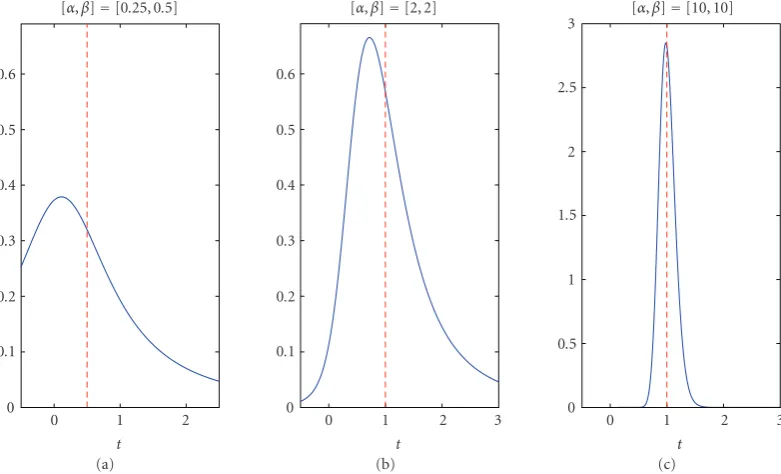
Figure 2shows the PDFs for varying values ofαandβ. A very wide variety of distribution shapes are possible and the ones shown are chosen for specific illustrative purposes. For a more complete selection of graphs please see [12]. Shown also isα/β (dashed line). InFigure 2, the distribu-tions are not symmetric aboutα/β. In addition and contrary to what we might expect, the “mean” ofN(α, 1)/N(β, 1) is notα/β. In fact, strictly speaking, the mean and variance of
N(α, 1)/N(β, 1) do not exist. This is becauseN(α, 1)/N(β, 1) is undefined when the denominator equals zero.
In practice, we may calculate a pseudomean and pseu-dovariance by considering only those estimates that fall within certain bounds. A natural bound would be that value of Q0,1,2 corresponding to a range estimate of zero meters
(negative range estimates cannot be correct). In setting such bounds, however, we should be mindful that the consequent truncation of the PDF may introduce a bias into the pseu-domean.
In general, when defined within sufficiently wide bounds, the pseudomean tends towardsα/βfor|α|,|β| 1, as oc-curs when G0,b σ0,b. Furthermore, under these
condi-tions, Q0,1,2 tends to have quite a narrow distribution (see
Figure 2(c)). Unfortunately, the converse is also the case. In general, without knowingσ0,1or σ0,2, we cannot
calcu-late/estimate the distribution of Q0,1,2 and, hence, cannot
quantify the bias that any given bounds may introduce. We can, however, identify certain situations in which such a bias is likely to be very large. Consider the case wherer0 cτb,
that is, when the array is remote from the source. From in-spection of (11), we see that under these conditions,G0,b→0.
As a result,Q0,1,2is widely distributed, causing our range
es-timates to exhibit a large variance and, depending upon the bounds used, the mean of the range estimates to be subject to a potentially large bias.
4.3. The effect of array geometry
The actual source-microphone ranges determine the values ofr0,τ1andτ2. We have seen how these parameters can affect
the distribution ofQ0,1,2and bias its pseudomean away from
G0,1/G0,2. In this respect, therefore, the accuracy with which
0 0.1 0.2 0.3 0.4 0.5 0.6
0 1 2
t [α,β]=[0.25, 0.5]
(a)
0 0.1 0.2 0.3 0.4 0.5 0.6
0 1 2 3
t [α,β]=[2, 2]
(b)
0 0.5 1 1.5 2 2.5 3
0 1 2 3
t [α,β]=[10, 10]
(c) Figure2: Portions of the PDFs ofN(α, 1)/N(β, 1), also shown isα/β(dashed line).
bias/error inQ0,1,2translates into an error in the
correspond-ing range estimate. To investigate this second effect of array geometry, we examine how a fixed bias,ξ, translates into an error in the range estimate.
Consider an estimate,r0, of the true range,r0, and let us
assume that this estimate contains some error,0:
G0,1
r0
G0,2
r0
=Q0,1,2=G0,1
G0,2+ξ. (24)
As an illustrative example, we plotG0,1/G0,2againstr0for
[cτ1,cτ2]=[1 m, 5 m] inFigure 3. Outside of a small region
aroundr0=0, asr0increases the slope of the graph reduces
and0becomes larger.
Figure 4, showing |(d/dr0)(G0,1/G0,2)| with respect to
cτ1/r0 and cτ2/r0, provides a more complete description
of how array geometry affects estimate accuracy. Note that the region where cτ2/r0 < 1 is not shown as in this
re-gion|(d/dr0)(G0,1/G0,2)|→∞, obscuring the remaining
de-tail in the graph. However, it is the region where (r0 +
cτ1)/r0 ≈ (r0+cτ2)/r0 that is of particular interest. Here,
|(d/dr0)(G0,1/G0,2)|approaches zero leading to a very large
0. In the extreme case, whereτ1 = τ2, no range estimate
may be found asG0,1/G0,2will be unity for all values ofr0.
Similarly, no range estimate may be found ifτ1orτ2equals
zero, asG0,1/G0,2will be zero or undefined, respectively, for
all values ofr0.
The analysis in this section has been limited to the three microphone case. However, the results of our analysis have implications for implementations of the Range-Finder us-ing any number of microphones. To obtain accurate range estimates, we require access to a minimum of three micro-phones for which no two are equidistant (or approximately equidistant) from the sound source. Furthermore, we will
0.4 0.5 0.6 0.7 0.8 0.9 1
G0,1 G0,2
0 0.5 1 1.5 2 2.5 3 3.5 4 4.5 5
r0(m) ξ
ξ
0
0
[cτ1,cτ2]=[1 m, 5 m]
Figure3:G0,1/G0,2versusr0for [cτ1,cτ2]=[1 m, 5 m]. Range esti-mate error increases withr0.
not achieve accurate range estimation whenr0 cτ1,cτ2.
Under such conditions we may expect Q0,1,2 to exhibit a
wide distribution and significant bias. This bias/error will then translate into a large error in the range estimate due to (r0+cτ1)/r0≈(r0+cτ2)/r0.
0 0.5 1 1.5 2 2.5 3 3.5 4
cτ1 r0
1 1.5 2 2.5 3 3.5 4 4.5 5 cτ2
r0
0.05 0.1 0.15 0.2 0.25
dr0d
G0,1 G0,2
Figure4:|(d/dr0)(G0,1/G0,2)|with respect tocτ1/r0andcτ2/r0.
[0 m, 0 m, 0 m]
[5.25 m, 6.95 m, 2.44 m]
S1
S2
S3
m0
m1
m2
m3
m4
m5
Figure5: A diagram of the simulated room and setup. For precise coordinates of the microphones and loudspeakers, seeTable 1.
which r0 cτ1 cτ2. We will discuss this further and
consider the potential applications of the Range-Finder al-gorithm inSection 6.
5. SIMULATIONS AND EXPERIMENTS
5.1. Simulations
A series of simulations were performed to examine the per-formance of the Range-Finder algorithm and compare it to that of the na¨ıve range estimator under varying reverberant conditions. Our simulated environment,Figure 5, was a sim-ple rectangular room of dimensions [5.25 m, 6.95 m, 2.44 m] and uniform surface absorption coefficient of 0.3. In this room, we simulated three omnidirectional sources and six omnidirectional microphones (seeTable 1for coordinates). The sampling frequency used was 10 kHz. The source-microphone impulse responses were generated using an acoustic modeling software package [13]. A ray tracing al-gorithm was used to determine first 20 milliseconds of the impulse response after and including the arrival of the
direct-Table1: The coordinates of the microphone and source locations for the simulated room. Coordinates are in meters.
(m) m0 m1 m2 m3 m4 m5 S1 S2 S3
x 3 3 2 2 4 4 1 2.5 4
y 4 3 3 2 2 1 5.5 5.5 5.5
z 2 1 2 1 2 1 1 1 1
path component. Statistical, random reverberant tails were used for the remaining reflections. Two “source signals”— a maximum-length sequence (MLS) of 5.5 seconds in du-ration and concatenated voice samples of approximately 13 seconds total duration, both bandlimited to avoid aliasing— were convolved with each impulse response to obtain the simulated “recordings.” The TDEs were calculated geomet-rically, using the source and microphone coordinates and a known speed of sound.
The recordings were split into segments of 8192 sam-ples and windowed using a Hamming window. The segment overlap was 50%. In the case of the speech recordings, the sig-nals were separated into eight nonoverlapping subbands with bandwidth 10/16 kHz and Λ was determined as described inSection 3. For each segment, the Range-Finder algorithm (original formulation (17)) was then used to estimate the distance between the sources and each of the microphones. Negative range estimates and estimates greater than 5 m were ignored—having been determined that wider boundaries did not increase the accuracy of the range estimates.
To investigate the effect of reverberation, the DRR at 1 m of the simulated room was varied by applying an appropriate scaling to the direct-path components of the simulated im-pulse responses. Range estimates were then obtained as pre-viously described. The results for each source are shown in Figures6and7. The mean of the range estimates,±one stan-dard deviation, is shown with respect to the DRR at 1 m. The results shown relate to the estimates ofr0only. Estimates of
the remaining ranges (r1tor5) are omitted because, as is
ap-parent from (8), these will exhibit an identical bias and dis-tribution to those corresponding tor0. Note thatm0is the
closest microphone to each source. The estimates ofr0will,
therefore, exhibit the greatest percentage error.
The means of the results obtained using the voice record-ings are slightly more accurate than those found using the MLS recordings, albeit with a significantly greater variance. Each set of graphs shows that the range estimates are sub-ject to a negative bias that reduces as the reverberation levels decrease. InSection 4.2, we discussed the factors that may ex-plain the presence of a bias in the range estimates. While it is not necessarily the case that any such bias should be nega-tive, from inspection of the PDFs inFigure 2we see that the density below the mean tends to be greater than that above. Therefore, we may speculate that, for a finite number of esti-mates, any bias present would tend to be negative, although the precise nature of such a bias is ultimately determined by the reverberation levels present and the array geometry and estimate bounds used.
1 1.5 2 2.5 3 3.5
Range
(m)
6 7 8 9 10 11 12 13 14 15 16
DRR at 1 m (dB) Source 1
(a)
0 0.5 1 1.5 2 2.5
Range
(m)
6 7 8 9 10 11 12 13 14 15 16
DRR at 1 m (dB) Source 2
(b)
0 0.5 1 1.5 2 2.5
Range
(m)
6 7 8 9 10 11 12 13 14 15 16
DRR at 1 m (dB) Source 3
(c)
Figure6: Mean range estimates±standard deviation for source producing an MLS.
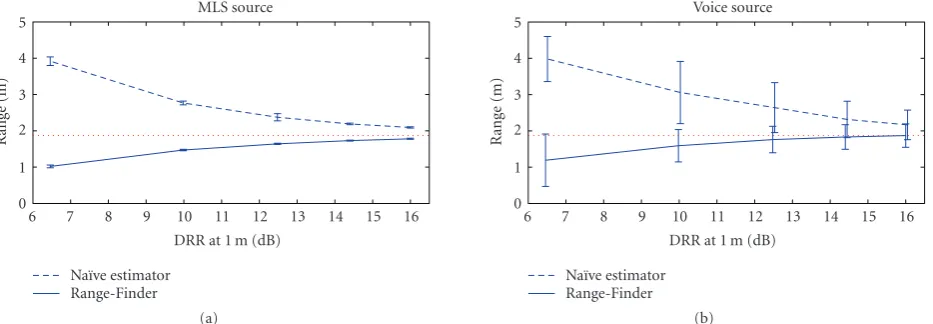
derived in Section 3. The estimates made using the na¨ıve range estimator were found using the two microphones clos-est to the source so as to achieve the bclos-est possible results. The results shown are for Source 2 but are illustrative of the results obtained for the other sources. In both the voice and MLS cases, the Range-Finder algorithm outperforms the na¨ıve range estimator.
5.2. Experiments
A series of recordings were made to test the Range-Finder under real conditions. The room used was the office, which was chosen for being a highly reverberant environment that would best highlight the superior performance of the Range-Finder over the na¨ıve range estimator. Six microphones were positioned at distances of between 0.8 m and 3 m from a loudspeaker, at intervals of roughly 0.5 m. The loudspeaker and microphones were arranged so as to be approximately colinear, so as to avoid errors due to the directionality of the source. Voice and MLS signals were produced by the loud-speaker. The microphone outputs were recorded before being bandlimited and downsampled to a sampling rate of 10 kHz. These recordings were then split into segments of 8192 sam-ples and windowed using a Hamming window. The segment overlap was 50%. The TDEs were found using a PHAT-GCC [14] and range estimates were obtained for each segment.
1 1.5 2 2.5 3 3.5
Range
(m)
6 7 8 9 10 11 12 13 14 15 16
DRR at 1 m (dB) Source 1
(a)
0 0.5 1 1.5 2 2.5
Range
(m)
6 7 8 9 10 11 12 13 14 15 16
DRR at 1 m (dB) Source 2
(b)
0 0.5 1 1.5 2 2.5
Range
(m)
6 7 8 9 10 11 12 13 14 15 16
DRR at 1 m (dB) Source 3
(c)
Figure7: Mean range estimates±standard deviation for a voice source.
This procedure was repeated for each of three setups in which the loudspeaker and microphones were arranged colinearly along the length and each diagonal of the office, respectively. The results are shown inFigure 9and, as with the simu-lations, clearly show the superior performance of the Range-Finder method. As before, the variances of the results found using voice recordings are greater than those found using MLS recordings, however, there is no noticeable trend with respect to the bias in the mean of the estimates.
6. DISCUSSION
We have proposed a method for estimating source-microphone ranges that is robust against the effects of rever-beration. We have discussed the factors affecting the distri-bution and accuracy of the range estimates obtained by our method and have presented simulated and real experimental results demonstrating its efficacy.
0 1 2 3 4 5
Range
(m)
6 7 8 9 10 11 12 13 14 15 16
DRR at 1 m (dB) MLS source
Na¨ıve estimator Range-Finder
(a)
0 1 2 3 4 5
Range
(m)
6 7 8 9 10 11 12 13 14 15 16
DRR at 1 m (dB) Voice source
Na¨ıve estimator Range-Finder
(b)
Figure8: A comparison of mean range estimates (±one standard deviation) for the na¨ıve range estimator and the Range-Finder algorithm.
0 0.5 1 1.5 2
Range
(m)
1 2 3
Setup MLS
Range-Finder True range Na¨ıve estimator
(a)
0 0.5 1 1.5 2 2.5
Range
(m)
1 2 3
Setup Voice
Range-Finder True range Na¨ıve estimator
(b) Figure9: Mean range estimates±standard deviation from real-room recordings.
implementation of the Range-Finder requires that the micro-phones be positioned such that there is a sufficient “spread” in the distances from the source to each microphone.
This then precludes the application of the Range-Finder method to the classical scenario of closely spaced micro-phones and a farfield source. Nonetheless, there are sev-eral scenarios in which this requirement is likely to be met and, hence, to which we may successfully apply the Range-Finder method. Consider, for example, the case in which it is required to capture the contributions of a large and dis-tributed group of talkers using a finite number of remote microphones. Under such conditions, it may be found that the classical approach of concentrating the microphones in a closely spaced array causes many of the participants to be a significant distance from all available microphones. As the DRR of recorded sound reduces with increasing distance (see Figure 1) this could cause the contributions from some talk-ers to be degraded unacceptably. We may, then, prefer to dis-tribute the microphones throughout or around the group of participants such that every potential talker is sufficiently close and has unobstructed access to at least one micro-phone. Given the wide distribution of the microphones, it
is also likely that, when the sound source is any given talker, we will have access to at least three microphones for which
r0 cτ1 cτ2. We may, therefore, expect accurate range
estimates.
We also note that it is often most advantageous to be able to estimate source-microphone ranges in scenarios in which these are not equal for all microphones (so that we may de-termine which microphones are closest/farthest away, etc.). In addition, when microphones are widely separated, deter-mining their relative locations is likely to be cumbersome and prone to error. Where microphones are frequently moved, say in response to changes in the distribution of participant talkers, it may not be practical to measure microphone loca-tions at all. The Range-Finder algorithm is, therefore, most effective in precisely those scenarios in which it may be re-quired to estimate source-microphone ranges in the absence of reliable microphone-location information.
in which the microphones and sound source are colinear. For such a setup, the intersensor time delays will be identical for allr0(assuming that the source is not in the interior of the
array). As a result, no TDE-based localization technique can return a unique estimate ofr0. Where the source and
micro-phones are nearly colinear, we can expect significant error in our range estimates due to errors in the TDEs.
It is apparent, therefore, that the relative positions of the microphones and sound source have a significant bearing upon the accuracy or otherwise of source localization algo-rithms as well as that of the Range-Finder method. For this reason, any experimental comparisons made between their relative performances would yield scenario-specific results that could not be considered valid in general.
So far, we have assumed an omnidirectional source. In doing so, we have ignored a very pressing practical problem. In reality, sources of interest are likely to be directional and the received sound intensity will depend not only upon the microphone’s distance from the source but also its relative azimuth and elevation. If the azimuth-elevation-dependant gain were known for each microphone, it could easily be in-cluded in our formulation of the Range-Finder. However, we are unlikely to have such information, or, indeed, to know the orientation of the source relative to the microphones. A further complicating factor is that source directionality is frequency-dependant, with sources typically becoming in-creasingly directional with frequency.
We should, however, be careful not to overstate the diffi -culties that directionality presents. Some studies would sug-gest that directivity would not be a significant factor at fre-quencies below 4 kHz and within an azimuth of±30◦ rela-tive to the direction in which a talker is facing [15]. If we could assume that the microphones were within some an-gular boundaries relative to the source, then we may ap-ply the Range-Finder with confidence. Yet, in the absence of comprehensive data regarding azimuth-elevation-dependant gain for the source of interest, it is hard to see how we might specify and justify the required angular boundaries. We therefore require such data and are limited in application when it is not available.
We note that not all microphones need to be within the specified boundaries; only a minimum of 3 need be and the remaining ranges may be found from the TDEs. Future work will focus on determining the directionality of typical sources and on methods for automatically determining which, if any, of the microphones we should use in the presence of a direc-tional source.
We also note that, when the source and microphones are colinear, the directionality of the source does not pose a problem. However, as previously mentioned, given such a setup, TDE-based source localization techniques will fail. This, therefore, suggests a role for the Range-Finder as an auxiliary source localization algorithm.
ACKNOWLEDGMENTS
The support of the Informatics Commercialisation initiative of Enterprise Ireland is gratefully acknowledged. Denis
Mc-Carthy also acknowledges the financial support, from Trinity College, of a postgraduate studentship.
REFERENCES
[1] L. Girod and D. Estrin, “Robust range estimation using acous-tic and multimodal sensing,” inProceedings of IEEE/RSJ Inter-national Conference on Intelligent Robots and Systems (IROS ’01), vol. 3, pp. 1312–1320, Maui, Hawaii, USA, October-November 2001.
[2] J. Chen, J. Benesty, and Y. Huang, “Time delay estimation in room acoustic environments: an overview,”EURASIP Journal on Advances in Signal Processing, vol. 2006, Article ID 26503, 19 pages, 2006.
[3] D. Gisch and J. M. Ribando, “Apollonius’ problems: a study of their solutions and connections,”American Journal of Under-graduate Research, vol. 3, no. 1, pp. 15–26, 2004.
[4] E. W. Weisstein, ““Apollonius’ Problem” from MathWorld-A wolfram web resource,” http://mathworld.wolfram.com/ ApolloniusProblem.html.
[5] M. S. Brandstein, J. E. Adcock, and H. F. Silverman, “A closed-form method for finding source locations from microphone-array time-delay estimates,” in Proceedings of IEEE Interna-tional Conference on Acoustics, Speech and Signal Processing (ICASSP ’95), vol. 5, pp. 3019–3022, Detroit, Mich, USA, May 1995.
[6] K. Yao, R. E. Hudson, C. W. Reed, D. Chen, and F. Lorenzelli, “Blind beamforming on a randomly distributed sensor array system,”IEEE Journal on Selected Areas in Communications, vol. 16, no. 8, pp. 1555–1567, 1998.
[7] Y. Huang, J. Benesty, G. W. Elko, and R. M. Mersereau, “Real-time passive source localization: a practical linear-correction least-squares approach,”IEEE Transactions on Speech and Au-dio Processing, vol. 9, no. 8, pp. 943–956, 2001.
[8] H. Teutsch and G. W. Elko, “An adaptive close-talking micro-phone array,” inProceedings of IEEE Workshop on Applications of Signal Processing to Audio and Acoustics (ASSP ’01), pp. 163– 166, New Paltz, NY, USA, October 2001.
[9] S. T. Birchfield and R. Gangishetty, “Acoustic localization by interaural level difference,” inProceedings of IEEE International Conference on Acoustics, Speech and Signal Processing (ICASSP ’05), vol. 4, pp. 1109–1112, Philadelphia, Pa, USA, March 2005.
[10] K. S. Sum and J. Pan, “On the steady-state and the transient de-cay methods for the estimation of reverberation time,”Journal of the Acoustical Society of America, vol. 112, no. 6, pp. 2583– 2588, 2002.
[11] G. Marsaglia, “Ratios of normal variables,”Journal of Statisti-cal Software, vol. 16, no. 4, pp. 1–10, 2006.
[12] G. Marsaglia, “Ratios of normal variables and ratios of sums of variables,”Journal of the American Statistical Association, vol. 60, no. 309, pp. 193–204, 1965.
[13] EASE, “Enhanced acoustic simulator for engineers,” version 4.0,http://www.renkus-heinz.com/ease/.
[14] C. H. Knapp and G. C. Carter, “Generalized correlation method for estimation of time delay,”IEEE Transactions on Acoustics, Speech, and Signal Processing, vol. 24, pp. 320–327, 1976.