Volume 2007, Article ID 84078,14pages doi:10.1155/2007/84078
Research Article
Exploiting the Expressiveness of Cyclo-Static Dataflow
to Model Multimedia Implementations
Kristof Denolf,1Marco Bekooij,2Johan Cockx,1Diederik Verkest,1, 3, 4and Henk Corporaal5
1Nomadic Embedded Systems (NES), Interuniversity Micro Electronics Centre (IMEC), Kapeldreef 75, 3001 Leuven, Belgium 2NXP Research, Systems and Circuits, Prof. Holstlaan 4, 5656 AE Eindhoven, The Netherlands
3Department of Electrical Engineering, Katholieke Universiteit Leuven (KU-Leuven), 3001 Leuven, Belgium 4Department of Electrical Engineering, Vrije Universiteit Brussel (VUB), 1050 Brussels, Belgium
5Faculty of Electrical Engineering, Technical University Eindhoven, Den Dolech 2, 5612 AZ Eindhoven, The Netherlands
Received 14 September 2006; Revised 11 February 2007; Accepted 23 April 2007
Recommended by Roger Woods
The design of increasingly complex and concurrent multimedia systems requires a description at a higher abstraction level. Using an appropriate model of computation helps to reason about the system and enables design time analysis methods. The nature of multimedia processing matches in many cases well with cyclo-static dataflow (CSDF), making it a suitable model. However, channels in an implementation often use for cost reasons a kind of shared buffer that cannot be directly described in CSDF. This paper shows how such implementation specific aspects can be expressed in CSDF without the need for extensions. Consequently, the CSDF graph remains completely analyzable and allows reasoning about its temporal behavior. The obtained relation between model and implementation enables a buffer capacity analysis on the model while assuring the throughput of the final implemen-tation. The capabilities of the approach are demonstrated by analyzing the temporal behavior of an MPEG-4 video encoder with a CSDF graph.
Copyright © 2007 Kristof Denolf et al. This is an open access article distributed under the Creative Commons Attribution License, which permits unrestricted use, distribution, and reproduction in any medium, provided the original work is properly cited.
1. INTRODUCTION
The increasing complexity and concurrency in digital multi-processor systems used to build modern multimedia codecs or wireless communications require a design flow covering different abstract layers that evolve gradually towards a fi-nal, efficient implementation. Describing the system first at higher level of abstraction, using a model of computation (MoC), permits the designer to model and reason about the system.
Dataflow MoCs have proven to be useful for describing multimedia processing applications [1] as they enable a nat-ural visual representation exposing the parallelism and al-lowing an evaluation of the temporal behavior. Cyclo-static dataflow (CSDF) [2] is particularly interesting because this variant is one of the most expressive dataflow models while still being fully analyzable at design time (e.g., consistency checks, dead-lock analysis).
An implementation on a multiprocessor platform has optimized communication channels, often based on shared buffers, to improve the efficiency. Examples are a sliding
win-dow for data reuse or a circular buffer with multiple con-sumers. Also, due to implementation restrictions, buffer sizes are limited. As it is not always clear how the behavior of such channels can be expressed in a CSDF model, the designer could judge it as an unsuited MoC, thus losing its analysis potential.
This paper studies how such implementation aspects can be represented in a CSDF model within its current defini-tion. Its main contribution is the modeling of special behav-ior on channels, such as data reuse or shared buffers, used in an implementation to improve the efficiency. The proposal of a short-hand notation for these special channels provides an intuitive expression of shared memory related aspects in CSDF without requiring extensions of the MoC. As a result, the enriched CSDF graph remains fully analyzable at design time and allows reasoning about the temporal behavior. The capabilities of the approach are demonstrated by describing a power-efficient custom implementation of an MPEG-4 part 2 video encoder using these special channels.
forward edge assuring the synchronization and one back-ward edge monitoring the free buffer space. Conditions are formulated on those two edges to assure functional correct-ness of the modeled application (i.e., no overwriting of live data) and these conditions are verified for every special chan-nel. A basic technique for the buffer capacity calculation through life-time analysis is presented.
Other works only mention using extensions to (C)SDF to describe image [3] and video [4] applications without a formal description of these extensions. Reference [5] inte-grates CSDF in a parameterized dataflow model to allow dy-namic data production and consumption rates. The model-ing of buffer bounds by using a feedback edge is introduced in [1] for interprocessor communication graphs (a type of homogenous synchronous dataflow graph) and in [6] to ex-plore the tradeoffbetween throughput and buffer require-ments. To deal with global parameters, [7] describes a syn-chronous piggybacked dataflow model.
This paper is organized as follows. After summarizing dataflow theory and introducing the basics of CSDF in the next section, the modeling of an implementation including its special edges is discussed inSection 3. InSection 4, an ap-proach for the buffer capacity calculations is presented. Af-ter the case study on an MPEG-4 part 2 video encoder in Section 5, conclusions close this document.
2. DATAFLOW MODELS
In the application specific domain, specialized models of computation like dataflow models aid in identifying and exploring the parallelism, and in the manual or automatic derivation of optimized implementations [8]. The choice of the model of computation is a tradeoffbetween its ex-pressiveness and well-behavior [3]. In this work, a dataflow model is chosen as it combines the expressivity of block dia-grams and signal flow charts while preserving the semantics for system design and analysis tools [9]. More specifically, a cyclo-static dataflow model is chosen as it is one of the most expressive while keeping all analysis potentials at design time.
2.1. Definitions of dataflow theory
A comprehensive introduction to dataflow modeling is in-cluded in [1,10]. This subsection gives a summary to intro-duce the dataflow definitions and terminology. In dataflow, the application is described as a directed graphG. The ver-tices of this graph are called actors and correspond to the tasks of the application transforming input data into out-put data. They are by definition atomic (i.e., indivisible). The edges (arcs) represent channels carrying tokens between the communicating actors. The edges act as First-In-First-Out (FIFO) queues with a theoretically unlimited depth. A token is a synchronizing communication object. It can be used to represent a container or just to model synchronization. Con-tainers are fixed-size data structures.
The actor execution is data-driven: it is enabled to fire as soon as sufficient tokens are available on all inputs (i.e, its firing-rule, a boolean expression in the number and/or the
value of tokens, turns true). An actor consumes tokens from its input edges in one atomic action at the start of the firing and writes tokens on its output edges in one atomic action at the end of the firing. The number of tokens consumed and produced is, respectively, given by the consumption and pro-duction rules on the corresponding edges. The response time (RT) of an actor is the elapsed time between its enabling and the end of the firing.
The data-driven operation of a dataflow graph allows synchronization between the actors: an actor cannot be ex-ecuted prior to the arrival of its input tokens. When a graph can run without a continuous increase or decrease of tokens on its edges (i.e., with finite queues) it is said to be consistent. A dataflow graph is called nonterminating or live if it can run forever.
For a DSP-application, both the liveness and consistency of the graph are required to get a proper execution. A forever running execution can be obtained by repeating one itera-tion of a periodic schedule [11]. To keep the number of to-kens on the edges limited, the number of toto-kens produced on an edge during one period must equal the number of tokens consumed from it. The number of actor firings in one period can be derived from this consistency requirement. The exis-tence of a deadlock-free schedule for one iteration [11] is a sufficient condition for a graph to be live. Any such schedule is called a valid static schedule of the graph.
Depending on how the consumption and production to-gether with the firing rules are specified, different classes of graphs are distinguished [2]: homogeneous synchronous dataflow (HSDF), synchronous dataflow (SDF), cyclo-static dataflow (CSDF), and dynamic dataflow (DDF). This paper concentrates on the CSDF model.
2.2. Temporal monotonic behavior
The data-driven operation of a dataflow graph allows its ex-ecution in a selftimed manner: actors start as soon as they are enabled. Additionally, the FIFO ordering of the tokens assures they cannot overtake each other. The FIFO order-ing of the tokens is automatically respected on the edges of a dataflow graph as these edges act as queues. In the actors, the FIFO ordering is guaranteed if autoconcurrency is excluded by a selfcycle with a single token forcing sequential firing of this actor or by making the response time of the actors con-stant.
In this work, the focus is on cyclo-static dataflow [2] as it is deterministic and allows checking conditions such as dead-locks and bounded memory execution at compile/design time. This is not always possible for DDF. Additionally, if dynamic dataflow concepts are required to model a multi-media application, this is often only needed for a part of the graph and can sometimes be reduced to CSDF by consider-ing worst-case scenarios [15].
After introducing the elements and properties of CSDF in the next subsection, it will be shown that there exists a consis-tent relation between CSDF model and implementation. As a result, containers will not arrive later in an implementation with selftimed execution than the corresponding tokens in the CSDF model. If worst-case response times are used while building this schedule, the worst-case throughput is known and guaranteed.
2.3. Basics of CSDF
Cyclo-static dataflow modeling was first proposed by Bilsen et al. [2] as extension of SDF. In CSDF, each actor Ahas an execution sequence of lengthLA, called the actor period. Consequently, the production and consumption are also se-quences of constant integers noted on the corresponding side of the edgeeuas{pPu(0),puP(1),. . .,puP(LP−1)}for the pro-ducerPand{cu
C(0),cuC(1),. . .,cCu(LC−1)}for the consumer
C. The (i+1)th firing of actorPproducespu
P(imodLP) tokens on edgeeu. Similarly, the (j+ 1)th firing of actorCconsumes
cuC(jmodLC) tokens from the same edge. The firing rule of an actorAbecomes true for its (j+ 1)th firing if all inputs contain at leastcuA(jmodLA) tokens. Also for CSDF, the con-sistency can be evaluated through the balance equations and a valid static schedule can be found [2] at compile time.
The rest of this subsection briefly explains how the con-sistency and liveliness of a CSDF graph are evaluated. More details are given in [1,2]. The following notation are used in the rest of the text:
(i) LAactor period or cycle length of the sequences of ac-torA;
(ii) puA(i) number of tokens produced on edgeeuby actor
Aduring its (i+ 1)th firing
pAu(i)=
⎧ ⎪ ⎪ ⎪ ⎨ ⎪ ⎪ ⎪ ⎩
(i+ 1)th element in the
production sequence if 0≤i≤LA−1,
pu A
imodLA
ifi≥LA;
(1)
(iii)cu
A(j) number of tokens consumed from edgeeuby ac-torAduring its (j+ 1)th firing
cAu(j)=
⎧ ⎪ ⎪ ⎪ ⎨ ⎪ ⎪ ⎪ ⎩
(j+ 1)th element in the
production sequence if 0≤j≤LA−1,
cuA
jmodLA
if j≥LA;
(2)
(iv) PuA(k) number of tokens produced on edgeeuby actor
Aafterkfirings
Pu A(k)=
k−1
i=0
pu
A(i); (3)
(v) Cu
A(l) number of tokens consumed from edgeeuby ac-torAafterlfirings
CAu(l)= l−1
j=0
cuA(j); (4)
(vi) qb
Abasic repetition rate of actorA(see below).
A CSDF graphGis compactly represented by its topology matrixΓcontaining one column for each actor and one row for each edge. Its (i,j)th entry corresponds to the total num-ber of tokens produced/consumed by the actor with numnum-ber
jon the edge with numberiduring one period. If the actor with number j produces tokens, the entry is positive while for a consuming actor, the entry is negative. The actor period matrixLcontains one row with the actor periods. Its jth en-try holds the actor period of the actor with numberj.
A period balance vectorris a positive solution of the bal-ance equations
Γ·rT=0. (5)
Such a period balance vector only exists if
rank(Γ)=NG−1 (6) withNGthe number of actors in the CSDF graph. A repeti-tion vectorqis the product of a period balance vectorrwith the actor periods
q=r·Ldiag (7)
withLdiagthe diagonal version ofL. The basic repetition vec-torqbcan be derived from any arbitrary repetition vectorq as
qb=q
s, withs=gcdy∈G
qy
Ly
. (8)
The existence of a repetition vector is a necessary condi-tion for bounded memory execucondi-tion (consistency) but is not sufficient to guarantee the existence of a valid static schedule (liveliness). To check if such a schedule with repetition vector
qactually exists for a consistent (C)SDF graph, [2,11] pro-pose the construction of a single-processor schedule for one iteration, that is, one in which each actorAfires at leastqbA times.
3. USING CSDF TO MODEL IMPLEMENTATIONS
P C pu
P cuC
eu
1 1
1
1 1
1 (a) Regular channel
P C
d cub
P pubC
eub
pPu f cu fC eu f
1 1
1
1 1
1 (b) CSDF equivalent
Figure1: The feedback edgeeublimits the size of edgeeutod.
units holding a fixed amount of data, are communicated over these FIFOs. These containers can be free or completed. Note the difference with a dataflow model where a token can rep-resent a container or just synchronization. Tasks have pro-duction and consumption sequences and can only start if sufficient completed containers are present on its input FI-FOs and sufficient free containers are available in its output FIFOs. More specifically, executing a task consists of the fol-lowing steps: (i) acquire: check the availability of the com-pleted input containers and free output containers, (ii) ex-ecute the code of the function describing the task behavior (accessing the data in the container), and (iii) release: signal the completion of the production of the output containers and the finishing of the consumption of the input contain-ers. The elapsed time between the successful acquiring and releasing in a task execution is bounded by the worst-case re-sponse time, known at design time. Finally, it is assumed that at most one instance of a task can execute at any time. This is important when the task keeps an internal state with data that is needed during a next execution and to maintain the FIFO ordering of the containers.
In a real implementation, also other communication types than the regular channel are deployed, often to opti-mize the data transfer. Examples are a sliding window for data reuse or a shared buffer with multiple consuming tasks. Such communication types are called special channels. The next subsections describe how the regular channel and which types of special channels can be expressed with a CSDF graph. Their CSDF representation is essential to be able to use the design time analysis techniques of CSDF.
3.1. Blocking write and blocking read
In the modeling of such an implementation task graph as a CSDF graph, a task corresponds to an actor with a response
time equal to the task’s worst-case response time. The acquire and release of containers in the implementation are, respec-tively, represented by the removal and arrival of tokens on the edges in the CSDF model. While a container is always represented by tokens in the dataflow model, the inverse is not necessarily true, as tokens can also express synchroniza-tion only. For example, a selfcycle on each actor models that no two instances of a task can execute simultaneously.
The blocking read behavior of a FIFO queue (i.e., the stalling of the consuming task because the queue is empty) is modeled by the data-driven operation of the actors. Be-cause of the fixed depth of the FIFO queue, it also has a block-ing write: the producblock-ing task is halted as long as the FIFO is full. This blocking read and blocking write behavior can be represented by a pair of queues in opposite direction [1,6] in the CSDF graph (seeFigure 1(b)). The tokens on the for-ward queueeu f (from producerPto consumerC) represent completed containers while the tokens on the feedback queue
eub indicate the free containers. The fixed size of the FIFO buffer (i.e., its depth expressed as a number of containers it can maximally hold) is modeled by the number of initial to-kensdoneubfor an initially empty FIFO.
The tight coupling between the tokens and the contain-ers is expressed by requiring that a producing or consuming task releases at the end of the task execution all containers acquired at the start of the task invocation,
∀i,j∈N:pu fP (i)=cubP (i), c u f
C (j)=pubC(j). (9)
Consumingcu fC tokens fromeu f releases the correspond-ing containers, but only at the end of the fircorrespond-ing with the pro-duction of the same number of tokens pCuboneub. To pro-duce pu fP tokens representing completed containers at the end, the same numbercubP of them is consumed at the start of the firing, expressing the acquiring of the containers. Conse-quently, the tokens on the two edges represent correctly how the containers are used in the task graph: acquiring at the start of the execution and releasing at the end of the execu-tion.
Note that the presence of a selfcycle with one initial token is assumed but not drawn in the following CSDF graphs of this text.
3.2. Decoupling tokens from containers
Figure2: Data reuse in the overlapping regions of the search area data for motion estimation.
Similarly, the production of a container over multiple task executions cannot be expressed in the common CSDF interpretation as the acquired containers at the start are re-leased to the consuming task at the end of the same invoca-tion. Finally, edges represent point-to-point communication, hindering the expression of shared containers between mul-tiple tasks.
Relaxing the requirement in (9) allows breaking this tight relation between tokens and containers and enables the mod-eling of special data communication. During a firing of the producer, the number of produced tokenspu fP oneu f can dif-fer from the number of consumed tokenscubP fromeub. Sim-ilarly, a consumer firing can consume a different number of tokens fromeu f than the number produced oneub.
In the example ofFigure 2, this decoupling of tokens and containers allows releasing only the left, nonoverlapping part of the search area (pubC), while the complete search area was required to enable the execution of the motion estimation (cCu f), withpCub< cu fC . The next subsection discusses the be-havior of this special channel and other types (dealing with the other restrictions listed above) in detail.
Bounded memory condition
To maintain bounded memory execution, during one period of the producing task, the sum of acquired containers at the producer should equal the sum of completed containers (first equality of (10)). Similarly, during one period of the con-sumer, the sum of released containers has to equal the sum of consumed completed containers (second equality of (10)).
PPu f
LP
=CPub
LP
, CCu f
LC
=PubC
LC
. (10)
Mutual exclusiveness condition
Additionally, at any moment at the producing task, the sum of completed containers should not be larger than the sum of acquired containers to avoid writing in a nonfree container.
∀k∈N0:CPub(k)≥PPu f(k). (11)
P C
pu
P cCu
eu rCu
(a) Special channel
P C
d
cu C pPu
eub
puP cuC eu f
(b) CSDF equivalent
Figure3: Nondestructive reads between a producerPwith period
LPand production sequencep= {puP(0),. . .,puP(LP−1)}and a con-sumerCwith periodLCand sequencesr= {ruC(0),. . .,rCu(LC−1)} andc= {cu
C(0),. . .,cuC(LC−1)}for whichcuC(j)≤rCu(j).
Data preservation condition
Similarly at any moment at the consuming task, the sum of released containers should not be larger than the sum of ac-quired new containers to avoid loss of data.
∀k∈N0:PCub(k)≤C u f
C (k). (12)
The number of free containers f in the buffer of edgeeu afterkfirings ofPandlfirings ofCis
f =d−Cub
P (k) +PubC(l). (13)
3.3. Modeling special channels
Using the decoupling of tokens and containers, the following subsections present some interesting cases of modeling spe-cial behavior on edges of the task graph. For each of these special channels, a CSDF equivalent is given when possible. If the equivalent exists, the special channel becomes a short-hand notation for the CSDF graph.
3.3.1. Nondestructive read
An edgeeuwith nondestructive reads (seeFigure 3(a)) allows a consuming taskCto acquire during its (j+ 1)th invocation
ru
C(j) containers of which onlycuC(j) containers are released, with
∀j∈N:ru
C(j)≥cuC(j). (14) This special channel enables data reuse: the same container is accessed over multiple invocations of the same task. Because this container remains available on the special channel, the number of acquired containersrCu(j) consists of a number of reused containers and a number of additionally acquired containers. Note that during the first task invocation, all ac-quired containers are additionally acac-quired containers.
is obtained with (15) as the difference between the number of acquired containers and the number of released contain-ers. When the number of acquired containersrCu(j) is smaller than the number of reused containersr(j−1) from the pre-vious invocation, this equation calculatesr(j) recursively,
r(j)=
⎧ ⎪ ⎪ ⎪ ⎨ ⎪ ⎪ ⎪ ⎩ ru
C(0)−cCu(0) if j=0,
ru
C(j)−cuC(j) if j >0, rCu(j)> r(j−1),
r(j−1)−cuC(j) otherwise.
(15)
To avoid an accumulation of containers in the channel that would lead to unbounded memory requirements (i.e., an inconsistent graph), the sum of additionally acquired con-tainers during a repetition of the task should equal the num-ber of released containers (bounded memory condition of (10)). This requires that the number of reused containers of the last firing of the repetition (qC) is zero. Consequently, at least all reused containersr(qC−2) of the one but last firing of the repetition should be acquired, and all acquired con-tainers need to be released:
rCu
qC−1
=cuC
qC−1
≥rqC−2
. (16)
Proof of (16). In order to prove (16), both cases of (15) are considered for j=(qC−1)>0 while requiring thatr(qC− 1)=0.
(1) Whenru
C(qC−1)> r(qC−2) withr(qC−1)=0 in (15),
cuC
qC−1
=rCu
qC−1
. (17)
(2) Whenru
C(qC−1)≤r(qC−2) withr(qC−1)=0 in (15),
cCu
qC−1
=rqC−2
. (18)
Combining this with (14),
rCu
qC−1
≤cuC
qC−1
,
ru C
qC−1
≥cu C
qC−1
=⇒ru C
qC−1
=cu C
qC−1
.
(19)
Overall,
rCu
qC−1
=cCu
qC−1
≥rqC−2
. (20)
The above condition on the last firing of the repetition also applies to the last firing of the actor period, or
rCu
LC−1
=cCu
LC−1
≥rLC−2
. (21)
This condition can sometimes be met by setting the ac-tor period appropriately. In video processing for instance, extending the actor period from a row basis to a frame ba-sis allows the correct releasing of all reused containers at the
frame border, when no data reuse dependencies exist be-tween frames.
Figure 3(b) shows how this data reuse behavior is ex-pressed in CSDF using the decoupling of tokens and contain-ers. Only containers that are no longer reused are released as indicated by the production pubC =cuCon the feedback edge
eub. The forward edgeeu f assures the correct synchronization between the actorsPandC.
The numbercu fC on this forward edge expresses the num-ber of additionally acquired containerscuC, that is, the re-quired number of new completed containers.cu fC = cuC is calculated in (22) so that actorCcan only start firingjif the sum of reused containersr(j−1) and additionally acquired containerscuC(j−1) at least equalsrCu(j),
cu fC =cuC(j)=
⎧ ⎪ ⎪ ⎪ ⎨ ⎪ ⎪ ⎪ ⎩ ru
C(0) if j=0,
rCu(j)−r(j−1) if j >0, rCu(j)> r(j−1),
0 otherwise.
(22)
Of the bounded memory, mutual exclusiveness and data preservation conditions (see (10), (11), (12)) of the special channel, only those at the consumer side need to be checked. The ones at the producer are automatically fulfilled aspu fP =
cubP (since the producer behavior is like a regular channel).
Proof of the requirements in(12)and(10).The data preser-vation condition of (12) becomes
Pub C(l)≤C
u f
C (l)=⇒CuC(l)≤CuC(l). (23) In order to use (22), two cases are distinguished as follows.
(1)rCu(l−1)> r(l−2)
Cu
C(l)≤CuC(l),
CCu(l)≤CuC(l−1) +cuC(l−1).
(24)
Using (22) to replacecuC(l−1),
CCu(l)≤CuC(l−1) +rCu(l−1)−r(l−2). (25)
IfrCu(j) ≤ r(j−1) forl−x < j < l−1 andx > 1, then according to (15),r(l−2)=rCu(l−x)−
x
j=2cuC(l−j) and according to (22),cuC(j)=0 makingCuC(l−1)=CuC(l−
x+ 1),
Cu
C(l)≤CuC(l−x+ 1)+rCu(l−1)−ruC(l−x)+ x
j=2
cu C(l−j),
Cu
C(l−x)+cuC(l−1)≤CuC(l−x+ 1)+rCu(l−1)−rCu(l−x). (26)
WithcuC(l−x)=rCu(l−x)−r(l−x−1),
IfrCu(j)≤r(j−1) forl−y < j < l−x−1 andy > x, then
cuC(j)=0 andr(l−y−1)=rCu(l−y)−
y
j=x+1cCu(l−j),
CuC(l−y)+cCu(l−1)≤CuC(l−y)+rCu(l−1)−r(l−y−1). (28)
Assume thatl−y−1=0,
cuC(0) +cuC(l−1)≤cuC(0) +rCu(l−1)−r(0). (29) Withr(0)=rCu(0)−cuC(0) (see (15)),
cu
C(0) +cCu(l−1)≤rCu(0) +rCu(l−1)−
ru
C(0)−cuC(0)
,
cuC(l−1)≤rCu(l−1).
(30)
(2)ru
C(l−1)≤r(l−2)
Cu
C(l)≤CuC(l). (31) IfrCu(j)≤r(j−1) forl−x < j≤l−1 withx >1, according to (15),r(l−1)=ru
C(l−x)−
x
j=1cCu(l−j) and according to (22),cuC(j)=0 makingCuC(l)=CuC(l−x+ 1),
CuC(l)≤CuC(l−x+ 1),
CuC(l)≤CuC(l−x) +cuC(l−x).
(32)
Using (22) to replacecuC(l−x),
Cu
C(l)≤CuC(l−x) +rCu(l−x)−r(l−x−1). (33) WithrCu(l−x)=r(l−1) +
x
j=1cCu(l−j) (see above),
CCu(l)≤CCu(l−x) +r(l−1) + x
j=1
cuC(l−j)
−r(l−x−1),
Cu
C(l−x)≤CuC(l−x) +r(l−1)−r(l−x−1). (34)
Ifru
C(j)≤r(j−1) forl−y < j≤l−x−1 and y > x, then
cuC(j)=0 andr(l−y−1)=rCu(l−y)−
y
j=x+1cCu(l−j),
CuC(l−y)≤CuC(l−y) +r(l−1)−r(l−y−1). (35) Assume thatl−y−1=0,
cu
C(0)≤cuC(0) +r(l−1)−r(0). (36) WithcuC(0)=rCu(0) (see (22)),
cuC(0)≤rCu(0) +r(l−1)−r(0). (37) Withr(0)=rCu(0)−cuC(0) (see (15)),
0≤r(l−1). (38) To check the bounded memory condition of (10),LCfirings are considered orl=LC
Cu
C(LC)=CuC
LC
. (39)
Because of (21),rCu(LC−1)≥r(LC−2). This matches the first case of the proof above. SubstitutinglbyLCand replacing the inequality by an equality yields
cu C
LC−1
=ru C
LC−1
. (40)
This is true because of (21).
P C
pu
P cCu
eu suP
(a) Special channel
P C
d
cu C puP
eub
puP cuC eu f
(b) CSDF equivalent
Figure4: Partial updates between a producerPwith periodLPand sequencesp= {pu
P(0),. . .,puP(LP−1)}ands= {suP(0),. . .,suP(LP− 1)}for whichpu
P(i)≤suP(i) and a consumerCwith periodLCand sequencec= {cu
C(0),. . .,cuC(LC−1)}.
3.3.2. Partial update
An edgeeuwith partial updates (seeFigure 4(a)) allows the acquiring of su
P(i) containers by the producing task during the (i+ 1)th invocation of which only puP(i) containers are full and released at the end of the task execution, with
∀i∈N:su
P(i)≥pPu(i). (41) This enables the production of data in a container over mul-tiple invocations. Because this container remains available on the special channel, the number of acquired containerssu
P(i) consists of a number of uncompleted containers and a num-ber of additionally acquired containers. Note that during the first task invocation, all acquired containers are additionally acquired containers. An example of partial updating is a task that completes the data in a container over 2 invocations: data on the even positions is written during the first execu-tion, while the data on the odd positions is produced during the second execution.
The number of uncompleted containerss(i) in task invo-cationithat are continued during the next invocationi+ 1 is calculated with (42) as the difference between the number of acquired containers and the number of completed contain-ers. When the number of acquired containerssuP(i) is smaller than the number of reused containerss(i−1) from the pre-vious invocation, this equation calculatess(i) recursively,
s(i)=
⎧ ⎪ ⎪ ⎪ ⎨ ⎪ ⎪ ⎪ ⎩
suP(0)−puP(0) ifi=0,
suP(i)−puP(i) ifi >0,suP(i)> s(i−1),
s(i−1)−pu
P(i) otherwise.
(42)
To avoid the loss of partially produced data, the num-ber of containers acquired during the last invocation has to include the remaining uncompleted ones from the previous executions(s) (calculated with (42)) and all of them need to be released
Similar to the nondestructive read, this condition can sometimes be met by setting the actor period appropriately. If this is not possible, the channel is misused as scratchpad. Such temporal data should be stored in a local buffer of the task.
The partial update behavior is represented inFigure 4(b) using the decoupling of tokens and containers. Only the completed containers are released to be used by the con-sumer, as indicated by the productionpPu f = puPon the for-ward edgeeu f. Consequently, this edgeeu f synchronizes the producer and the consumer. Equation (44) makes sure that the sum of uncompleted containerss(i−1) and additionally acquired containerspubP = puP(i) at least equals the number of acquired containerssuP(i) for data production during firing
i,
cPub=puP=
⎧ ⎪ ⎪ ⎪ ⎨ ⎪ ⎪ ⎪ ⎩ su
P(0) ifi=0,
su
P(i)−s(i−1) ifi >0,suP(j)> s(i−1),
0 otherwise.
(44)
Of the bounded memory, mutual exclusiveness and data preservation conditions (see (10), (11), (12)) of the special channel, only the ones at the producer need to be checked. The conditions at the consumer are automatically fulfilled as
cu fC = pCub. The proof is similar to the nondestructive read one.
3.3.3. Multiple consumers
An edgeeuwith multiple consumers (seeFigure 5(a)) allows
Nconsuming tasksC1· · ·CNto consume the same contain-ers produced by a taskP. Each consumerCycan have its own actor periodLCy as long as there exists a solution for their combined balance equations in (45) to obey the consistency condition,
rP·PPu
LP = ⎧ ⎪ ⎪ ⎪ ⎨ ⎪ ⎪ ⎪ ⎩
rC1·CuC1
LC1
, ..
.
rCN·CuCN
LCN
.
(45)
A multiple consumer edge works with a composed con-sume: a container can only be released at the consume side if all actors C1· · ·CN have released this container. Equa-tion (46) calculates the composed consumeccu(j
c) afterly firings of the tasksCy(with 1≤y≤N). The indexjccounts the composed consumes by incrementingjcwhenever a con-suming task Cy executes. To make sure all consumers no longer need the container(s), this equation looks for the con-suming task with the minimum sum of consumed contain-ers and subtracts the sum of previously composed consumed containers,
ccu(j
c)= min 1≤y≤N
Cu Cy ly
−Cu cc
jc
, with jc=
N
y=1
ly
−1.
(46)
P
C1
CN eu
puP
cuC1
cuCN . . .
(a) Special channel
P CC
C1
CN pu
P puP
pu P cu C1 cu CN . . . eu1f
euN f
cu C1
cCNu eu1b
euNb eub d
1 1
1
(b) CSDF equivalent
Figure5: Multiple consumers on an edge between a producerP
with periodLPand sequence p= {puP(0),. . .,puP(LP−1)}andN consumersC1,· · ·,CN with periodsLC1,. . .,LCN and sequences
c1 = {cu
C1(0),. . .,cuC1(LC1−1)},. . .,cN = {cuCN(0),. . .,cCNu (LCN − 1)}.
Such a multiple consumer edge is represented in CSDF using the decoupling of tokens and containers inFigure 5(b). On each of theN forward edgeseuy f, the same number of tokenspPurepresenting the available completed containers is produced during a firing of the producer. The number of to-kens consumed from these forward edges can vary for theN
consumers, including the consume sequence length, as long as the balance condition of (45) is met. The composed con-sume is modeled by theCCactor with a zero response time. Only when all consuming actors have released a container, it is made available as free container on the backward edgeeub. As the size of the container, bufferd is shared over all edges, the number of free containers f (in the shared buffer) equals the number of initially free containers d decreased with the number of acquired containers afterkfirings of the producer and incremented with the number of composed consumed containers afterlccomposed consumptions,
f =d−Cub
P (k) +CuCC
lc
. (47)
Using (46),Cu
CC(lc) can be rewritten and the number of free containers f becomes
f =d−CPub(k) + min1≤y≤N
PCyuyb
ly
, (48)
P1
C
PN pu
P1
pPu1
cu C eu .
. .
Figure6: The multiple producers special channel with producers
P1,. . .,PNhas no CSDF equivalent as the token order depends on the response time.
The bounded memory, mutual exclusiveness conditions (see (10), (11)) of the special channel are met as for all edges
puy fP = cubP ,c uy f C = p
uyb
C and theCC actor has all ones as consumption and production rates. The data preservation condition (12) is satisfied because the composed consume can only lead to a later releasing of a container that was still needed by another consuming task.
3.3.4. Multiple producers
An edgeeuwith multiple producers (seeFigure 6) allowsN producing tasksP1· · ·PNto produce containers. This spe-cial channel has no CSDF equivalent, as the token arrival de-pends on the actual response time of the producer, leading to nondeterministic behavior. Consequently it is invalid.
Multiple producers with partial updates on a single edge would allow these tasks to produce their part of the token. Still, this is equivalent to separate edges between the produc-ers and the consumproduc-ers and does not offer the protection of the data that is produced like in the equivalent.
3.3.5. Combinations
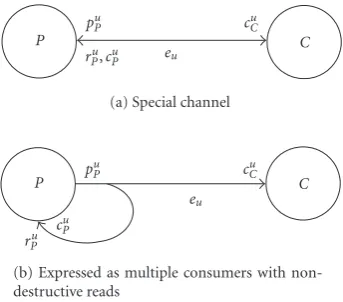
All valid previous special channels can be combined, like an edge with partial updates and nondestructive reads, an edge with partial updates and multiple consumers, and so forth. An interesting combination is multiple consumers with non-destructive reads as it allows a producing taskPto read pre-viously produced containers back (seeFigure 7(a)) by con-sidering the producer also as a consumer on the same special channel (seeFigure 7(b)).
3.4. Other implementation aspects
All special channels described above represent a synchroniz-ing communication. The implementation of an application can also use nonsynchronizing communication, to pass for instance parameters or if synchronization becomes obsolete when tasks never execute concurrently due to ordering con-straints.
P C
pu
P cuC
eu rPu,cPu
(a) Special channel
P p C
u
P cuC
eu
rPu cPu
(b) Expressed as multiple consumers with non-destructive reads
Figure7: Special case of the multiple consumers with nondestruc-tive read: a nondestrucnondestruc-tive read-back at the producer side.
P C
ru C pu
P=0 cCu=0 suP=rCu
su P
Figure8: Notation of a global buffer.
A B C D e1 e2 e3
e4
1 1 2 2 1 1
1
1
1
Figure9: Some actors do not fire concurrently due to the schedule or the graph topology.
3.4.1. Global parameters
Global parameters are used in an implementation to pass the most recent settings to a task. Through a global buffer with an updating mechanism, the consuming tasks only see the new parameters when the producer completed the new data in a container. The nonsynchronizing behavior of such a communication (seeFigure 8) and its dynamic consump-tion and producconsump-tion pattern cannot be modeled in CSDF.
On the other hand, these global parameters do not influ-ence the temporal behavior (since they are a form of non-synchronizing communication) nor need to be considered during the buffer capacity calculation as their size is fixed at design time (depending on the number and the size of the parameters).
3.4.2. Serialized actors
to the graph topology. A schedule ordering constraint (e.g., a sequential scheduleA,B,C,D) of the same graph but with-out edgee4 can be represented by adding edgee4. Using a global buffer allows the sharing of container space between such serialized actors. In the literature, this approach is com-bined with lifetime analysis for memory optimized software synthesis [17,18].
4. BUFFER CAPACITY CALCULATION
The (minimum) buffer capacitiesdare calculated at design time by manually constructing a (desired) static periodic schedule and combining this with a life-time analysis of the tokens using the worst-case actor response times. The sched-ule needs to cover at least a complete iteration in the periodic phase. As a result, it is constructed from the start and also in-cludes the transient phase before reaching the periodic phase. As no dead-lock is allowed in this periodic schedule to assure the liveliness of the graph, the minimum buffer size is found if the number of free tokens f on the feedback edge is zero when the difference between the total number of consumed and produced tokens on this edge reaches a maximum. The buffer capacityduof edgeeuis derived from (48), the generic case for the all valid special channels, by setting f to zero and considering the life-time analysis from start until one period in steady state (periodic phase) is completed. Assuming the desired schedule reaches the periodic phase afterkSSfirings of the producerPandly,SSfirings of the consumersCy
du= max
0≤k<kSS+qbP; 0≤ly<ly,SS+qbCy
CPub(k)−1min≤y≤N
PCyuyb
ly
.
(49)
The throughput of the constructed static schedule relates toµ−1, withµbeing the iteration period (or total execution time of one period) of this periodic schedule. The temporal monotonic behavior guarantees that moving to a selftimed execution after the buffer sizing yields an implementation with at least this throughput.
Practically, the life-time analysis monitors the number of tokens on the forward and the backward edge of all edgeseu in the CSDF graphG: the forward one for the evaluation of the firing condition, the backward one for the buffer capacity calculation. Consequently, the evaluationPPuy f(k)−C
uy f C (ly) oneuy f is made at the end of each firing of its producer or consumer. The evaluationCPuyb(k)−P
uyb
C (ly) oneuybis made at the start of each firing of its producer or consumer. The maximum over all euy during the transient phase and one iteration period in the periodic phase of the desired schedule yields the buffer sizedu.
The formula fordu(see (49)) and the practical approach presented above only provide a basic buffer sizing technique to find the minimum buffer capacity for the given desired schedule. For an efficient multiprocessor implementation, four related elements need to be considered in the tradeoff:
A B
2 rB1=2
{1, 1, 2}
e1
(a) Example nondestructive read FIFO
A B
2 2
{2, 1, 1}
{1, 1, 2}
e1f e1b d1
(b) Example nondestructive CSDF equivalent
Figure10: Example nondestructive read keeping one container for data reuse.
2 4 3 5 4 6 4
# tokens one1b # tokens one1f B
A
2 0 2 1 2 2 2
0 3 6 9 12
Time Transient Periodic
Figure11: Schedule and life-time analysis of the buffer capacity.
throughput, response times, schedule settings, and buffer ca-pacities. Optimization algorithms exploring these tradeoffs are outside the scope of this paper.
Example 1. Consider the nondestructive read edge ofFigure 10(a) with its CSDF equivalent inFigure 10(b). The basic repetition vectorqbis calculated from the topology matrixΓ and the actor periods. Assume the worst case response times are known, RTA =3 and RTB =2 and the desired schedule is a pipelined parallel operation of both actors,
Γ=2 −4; L=1 3; r=2 1; q=qb=2 3. (50)
CC ME MC TC TU
EC
BP e12
6(width/16)(height/16)
{p,r,c}4
CC {c,r} 4 MC
p2CCe1 e5 rMC5 =1 e6 e8 e9
e10 e11 e2
e3 c2MErME2 =3
{0, 0,. . ., [N]}
{1, 0,. . ., 0} {0, 0, 0, 0, 0, 1}
c12 CC
e4
1 1
6
1 1 1
1
1 1
6 1 1
1 1
ni
1
Figure12: CSDF graph representing the partitioning of the MPEG-4 part 2 SP encoder scheme.
Table1: Detailed information of the actors in the encoder CSDF graph.
Actor name Acronym Functionality Actor period
Copy control CC Fill the memory hierarchy and the new video inputs (width/16)(height/16)
Motion estimation ME Find the motion vectors width/16
Motion compensation MC Get predicted block and calculate error 6(width/16)(height/16)
Texture coding TC Transform, quantization, and inverse 1
Texture update TU Add and clip compensated and predicted blocks 1
Entropy coding EC AC/DC, MV prediction and VLC coding m
Bitstream packetization BP Add headers and compose the bitstream N
contains 6 time units. The required buffer capacity for the desired schedule is 6 (the maximum on the # tokens one1b line).
5. MPEG-4 PART 2 VIDEO ENCODER EXAMPLE
To illustrate the expressiveness of a CSDF graph when to-kens are decoupled from containers, an MPEG-4 part 2 video encoder [19] is presented as a case study. The con-structed dataflow graph (seeFigure 12) supports the parti-tioning phase of the implementation of a low-power, fully dedicated MPEG-4 part 2 encoder [20]. When the behav-ior of the data communication between two actors cannot be expressed by regular CSDF edges, special channels are in-serted. In the video encoder example, this happens to main-tain the effect of high-level memory optimizations, like data-reuse and the sharing of local buffers.
The dataflow graph is a combination of a CSDF graph with compile time parameters related to the maximum sup-ported resolution (width×height) and a DDF part after the entropy coding (EC). The meaning of the variables mand
N in the graph relate to this dynamic behavior and will be explained later. The regular and special channels are used in
Table2: Production and consumption sequences instantiated for a resolution of 80×48 pixels.
Symbol Sequence
p2
CC {3, 1, 1, 1, 1}
c2
ME {1, 1, 1, 1, 3}
p4
CC {7, 1, 1, 1, 0, 2, 1, 1, 1, 0, 0, 0, 0, 0, 0}
c4
MC c(j÷6) withc= {0, 0, 0, 0, 0, 0, 1, 1, 1, 2, 0, 1, 1, 1, 7}
r4
MC r(j÷6) withr= {7, 8, 9, 10, 10, 11, 6, 6, 6, 11, 7, 6, 6, 6, 6}
r4
CC {6, 3, 4, 5, 10, 11, 6, 6, 6, 11, 7, 6, 6, 6, 6}
c4
CC {0, 0, 0, 0, 0, 2, 1, 1, 0, 1, 2, 1, 1, 0, 6}
c12
CC {42, 6, 6, 6, 0, 12, 6, 6, 6, 0, 0, 0, 0, 0, 0}
the dataflow graph as short-hand notation: every drawn edge represents a forward and a backward CSDF edge (to model the bounded buffer sizes). Remember that a selfcycle with one initial token is assumed on every actor.
Table3: Buffer and token size of all edges.
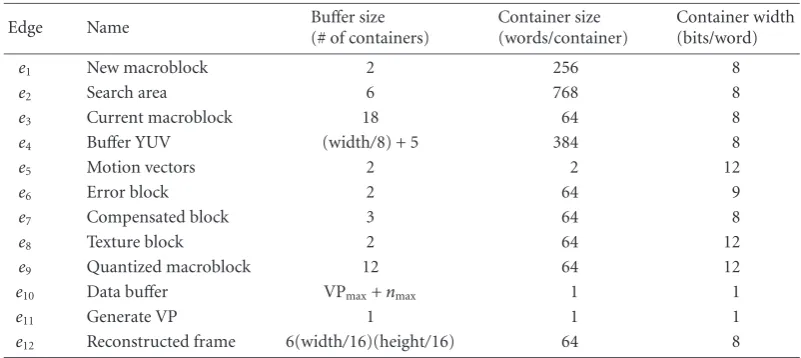
Edge Name Buffer size
(# of containers)
Container size (words/container)
Container width (bits/word)
e1 New macroblock 2 256 8
e2 Search area 6 768 8
e3 Current macroblock 18 64 8
e4 Buffer YUV (width/8) + 5 384 8
e5 Motion vectors 2 2 12
e6 Error block 2 64 9
e7 Compensated block 3 64 8
e8 Texture block 2 64 12
e9 Quantized macroblock 12 64 12
e10 Data buffer VPmax+nmax 1 1
e11 Generate VP 1 1 1
e12 Reconstructed frame 6(width/16)(height/16) 64 8
EC TU TC MC ME IC & CC
Time
Figure 13: MPEG-4 part 2 SP encoder desired schedule with pipelined parallel operation for one frame with resolution of 80×
48 pixels.
estimation. Edgee4is drawn as a bidirectional edge, as it rep-resents nondestructive read back behavior at the producer side, sharing data between the copy controller and the mo-tion compensamo-tion. Edgee5is a nondestructive read special channel passing the motion vectors to the motion compen-sation. These motion vectors are reused for the six blocks of the macroblock. Edgee12is a regular channel with initial to-kens (represented by the full dot and the number of initial tokens).
Table 1 details for every actor its full name, function-ality, and actor period. The production/consumption se-quences reflect the behavior of the video encoder. They are represented as compactly as possible inFigure 12due to the long actor periods: (i) if the sequence contains a repeated pattern, only this pattern is listed and (ii) a symbolic repre-sentation is used if the cycle of the sequence spans more than 6 phases. As these symbols are a function of the compile time parameters width and height, they are instantiated for a max-imum resolution of width=80 and heigth=48 inTable 2. Note that even this small resolution results in a sequence pe-riod of 90 forc4MCandrMC4 . A short notation is used for them. The real design [20] for which the CSDF graph is built has a supported resolution of 704×576.
The number of bits generated by the entropy coder varies depending on the type of sequence and the quantization de-gree (DDF). Edgese10ande11cooperate in a special way to deal with this. The compressed information is accumulated on edgee10with the number of bitsnivarying per firing of
the actor EC. When the size of a video packet is reached dur-ing themth firing, the number of bitsN =m−1
i=0 n(i) accu-mulated on edgee10is written on edgee11(noted as [N] in the produce sequence, representing the value of the single to-ken). Once this is completed, actor BP can fire and consumes 1 token from edgee11containing a scalar with the total num-ber of tokens to consume from edgee10, resulting inN fir-ings of BP that consume 1 token frome10. As the maximum number of bits allowed in a video packet (VPmax) is defined by the levels of the MPEG-4 part 2 standard, this edge can be interpreted in worst-case conditions as CSDF to calculate the buffer bound of edgee10.
To maximize the throughput while relaxing the response time requirements for the HW design, the desired schedule for a fully dedicated design is a pipelined and parallel opera-tion (seeFigure 13). This sets the goal of the buffer capacity calculation to: find the minimal buffer sizes that maximize the throughput while also maximizing the response times. There are no processing resource constraints as every actor is implemented as a separate hardware accelerator. Under those circumstances, the worst-case actor RT equals its critical RT, defined as
RTcritA = µ
qbA
(51)
and directly relates to the throughput required in the specifi-cation through the iteration periodµof the desired pipelined parallel schedule. The practical technique of the previous sec-tion now has the necessary givens for the life-time analysis of the edges. The resulting buffer sizes are summarized in Table 3, together with their name, their container size, the width of an element in a container, and the communication primitive type that is selected for the hardware implementa-tion [20].
6. CONCLUSIONS
processing, making it a good abstraction means to reason about the parallelism required in an efficient implemen-tation. Among different dataflow models of computation, CSDF is one of the most expressive MoCs while keeping the full analysis potential (e.g., consistency checks, dead-lock analysis, etc.).
This paper shows that implementation specific aspects, like data reuse and shared buffers to improve the efficiency or restricted buffer sizes, can also be expressed in a CSDF graph that is used as an analysis model. Representing the optimized data communication behavior and memory lim-itations of such special channels, often related to the use of shared circular buffers, by two edges allows the correct mod-eling of the synchronization and the free buffer space be-tween the communicating tasks. Consequently, the graph re-mains completely analyzable and allows reasoning about its temporal behavior. Additionally, the special channels are a short-hand notation and a more intuitive representation of this optimized data communication, enriching CSDF with the expression of shared memory aspects.
With worst-case response times and a desired schedule as given, a buffer capacity calculation at design time through a life-time analysis of the CSDF model is presented. The ob-tained consistent relation between the model and the im-plementation combined with the temporal monotonic be-havior when moving to selftimed execution assures that the throughput of the final implementation is at least the one derived from the iteration period of the desired sched-ule.
A CSDF graph of an MPEG-4 part 2 video encoder using shared buffers and exploiting reuse is constructed. With this CSDF model, the correct buffer capacities are calculated for a fully dedicated encoder implementation operating as a video pipeline.
REFERENCES
[1] S. Sriram and S. S. Bhattacharyya,Embedded Multiprocessors: Scheduling and Synchronization, Marcel Dekker, New York, NY, USA, 2000.
[2] G. Bilsen, M. Engels, R. Lauwereins, and J. Peperstraete, “Cyclo-static dataflow,”IEEE Transactions on Signal Processing, vol. 44, no. 2, pp. 397–408, 1996.
[3] A. Davare, Q. Zhu, J. Moondanos, and A. Sangiovanni-Vincentelli, “JPEG encoding on the intel MXP5800: a platform-based design case study,” inProceedings of the 3rd IEEE Workshop on Embedded Systems for Real-Time Multime-dia (ESTMED ’05), pp. 89–94, New York, NY, USA, September 2005.
[4] H. Hwang, T. Oh, H. Jung, and S. Ha, “Conversion of ref-erence C code to dataflow model H.264 encoder case study,” inProceedings of the Asia and South Pacific Design Automation Conference (DAC ’06), pp. 152–157, Yokohama, Japan, January 2006.
[5] F. Haim, M. Sen, D.-I. Ko, S. S. Bhattacharyya, and W. Wolf, “Mapping multimedia applications onto configurable hard-ware with parameterized cyclo-static dataflow graphs,” in Pro-ceedings of IEEE International Conference on Acoustics, Speech and Signal Processing (ICASSP ’06), vol. 3, pp. 1052–1055, Toulouse, France, May 2006.
[6] S. Stuijk, M. Geilen, and T. Basten, “Exploring trade-offs in buffer requirements and throughput constraints for syn-chronous dataflow graphs,” inProceedings of the 43rd Design Automation Conference (DAC ’06), pp. 899–904, San Francisco, Calif, USA, July 2006.
[7] C. Park, J. Jung, and S. Ha, “Extended synchronous dataflow for efficient DSP system prototyping,”Design Automation for Embedded Systems, vol. 6, no. 3, pp. 295–322, 2002.
[8] S. Edwards, L. Lavagno, E. A. Lee, and A. Sangiovanni-Vincentelli, “Design of embedded systems: formal models, val-idation, and synthesis,”Proceedings of the IEEE, vol. 85, no. 3, pp. 366–390, 1997.
[9] E. A. Lee and T. M. Parks, “Dataflow process networks,” Pro-ceedings of the IEEE, vol. 83, no. 5, pp. 773–801, 1995. [10] S. S. Bhattacharyya, S. Sriram, and E. A. Lee,
“Resynchroniza-tion for multiprocessor DSP systems,”IEEE Transactions on Circuits and Systems I: Fundamental Theory and Applications, vol. 47, no. 11, pp. 1597–1609, 2000.
[11] E. A. Lee and D. G. Messerschmitt, “Static scheduling of syn-chronous data flow programs for digital signal processing,” IEEE Transactions on Computers, vol. 36, no. 1, pp. 24–35, 1987.
[12] P. Poplavko, T. Basten, M. Bekooij, J. van Meerbergen, and B. Mesman, “Task-level timing models for guaranteed per-formance in multiprocessor networks-on-chip,” inProceedings of the International Conference on Compilers, Architecture, and Synthesis for Embedded Systems (CASES ’03), pp. 63–72, San Jose, Calif, USA, October-November 2003.
[13] M. H. Wiggers, M. Bekooij, P. Jansen, and G. Smit, “Efficient computation of buffer capacities for multi-rate real-time sys-tems with back-pressure,” in Proceedings of the 4th Interna-tional Conference on Hardware/Software Codesign and System Synthesis (CODES+ISSS ’06), pp. 10–15, Seoul, Korea, Octo-ber 2006.
[14] M. H. Wiggers, M. Bekooij, P. Jansen, and G. Smit, “Efficient computation of buffer capacities for cyclo-static real-time sys-tems with back-pressure,” inProceedings of the 13th IEEE Real Time and Embedded Technology and Applications Symposium (RTAS ’07), pp. 281–292, Bellevue, Wash, USA, April 2007. [15] J. Teich and S. S. Bhattacharyya, “Analysis of dataflow
pro-grams with interval-limited data-rates,”Journal of VLSI Sig-nal Processing Systems for SigSig-nal, Image, and Video Technology, vol. 43, no. 2-3, pp. 247–258, 2006.
[16] I. E. G. Richardson,H.264 and MPEG-4 Video Compression: Video Coding for Next-Generation Multimedia, John Wiley & Sons, New York, NY, USA, 2003.
[17] P. K. Murthy and S. S. Bhattacharyya, “Shared buffer imple-mentations of signal processing systems using lifetime analy-sis techniques,”IEEE Transactions on Computer-Aided Design of Integrated Circuits and Systems, vol. 20, no. 2, pp. 177–198, 2001.
[18] H. Oh and S. Ha, “Memory-optimized software synthesis from dataflow program graphs with large size data samples,” EURASIP Journal on Applied Signal Processing, vol. 2003, no. 6, pp. 514–529, 2003.
[19] “Information technology—generic coding of audio-visual objects—part 2: visual,” ISO/IEC 14496-2:2004, June 2004. [20] K. Denolf, A. Chirila-Rus, and D. Verkest, “Low-power
Kristof Denolf received the M.Eng. de-gree in electronics from the Katholieke Hogeschool, Brugge-Oostende, Belgium, in 1998, the M.S. degree in electronic sys-tem design from Leeds Metropolitan Uni-versity, Leeds, UK, in 2000 and is currently a Ph.D. candidate at the Eindhoven Uni-versity of Technology, The Netherlands. He joined the Multimedia (MM) group of the Nomadic Embedded Systems devision, at
the Interuniversity Micro Electronics Centre (IMEC), Leuven, Bel-gium, in 1998. His main research interests are the cost efficient design of advanced video processing systems and the end-to-end quality of experience.
Marco Bekooijreceived an M.S.E.E. degree from Twente University of Technology, in 1995 and a Ph.D. degree from the Eind-hoven University of Technology, in 2004. He is currently a Senior Researcher at NXP Semiconductors. He has been involved in the design of a channel decoder IC for digi-tal audio broadcasting and a compiler back-end for VLIW processors with distributed register files. His current research interest is
the design and analysis of predictable multiprocessor systems.
Johan Cockxreceived his degree in electri-cal engineering from the Katholieke Univer-siteit Leuven, Belgium, 1983. From 1983 to 1985 he was a member of the CAD research group at the ESAT laboratory of that uni-versity, working on modular circuit simu-lation. From 1986 to 1996, he worked for Silvar-Lisco, later renamed to EDC, on a wide range of electronic design tools includ-ing a schematic editor, the core data
struc-ture of DSP station behavioral synthesis tool suite, and a dynamic dataflow simulator. He was an early adopter of object oriented pro-gramming techniques in general and the C++ propro-gramming lan-guage in particular. In 1996, he joined the Design Technology for Integrated and Communication Systems (DESICS) division of the Interuniversity Micro Electronics Center (IMEC), Heverlee, Bel-gium, where he did research on C++-based concurrent timed sim-ulation of embedded systems (TIPSY—comparable to but preced-ing SystemC), automated overhead removal from object oriented C++ programs, functional parallelization (SPRINT), translation of C++ code to readableCcode, andCcode cleaning for embedded application. He is author/coauthor of two patent applications and several papers on these subjects.
Diederik Verkestreceived the Master and Ph.D. degrees in applied sciences from the Katholieke Universiteit Leuven (Belgium) in 1987 and 1994, respectively. He has been working in the VLSI design method-ology group of the IMEC laboratory (Leu-ven, Belgium) on several topics related to formal methods, system design, hard-ware/software codesign, reconfigurable sys-tems, and multiprocessor systems. He is
currently in charge of the research at IMEC on design technology for nomadic embedded systems. He is Professor at the University of Brussels (VUB) and at the University of Leuven (KU-Leuven).
He is Member of IEEE and a Golden Core Member of the IEEE Computer Society. He published and presented over 100 articles in International Journals and at International Conferences. Over the past years, he was a member of the programme and/or organization committees of several major international conferences such as ISSS, CODES, FPL, DATE, and DAC. He was the General Chair of the Design, Automation, and Test in Europe Conference, DATE’03.
Henk Corporaal has gained an M.S. de-gree in theoretical physics from the Univer-sity of Groningen, and a Ph.D. degree in electrical engineering, in the area of com-puter architecture, from Delft University of Technology. He has been teaching at sev-eral schools for higher education, has been Associate Professor at the Delft University of Technology in the field of computer ar-chitecture and code generation, had a Joint