R E S E A R C H
Open Access
Efficient 2D to 3D video conversion implemented
on DSP
Eduardo Ramos-Diaz
1*, Victor Kravchenko
2and Volodymyr Ponomaryov
1Abstract
An efficient algorithm to generate three-dimensional (3D) video sequences is presented in this work. The algorithm is based on a disparity map computation and an anaglyph synthesis. The disparity map was first estimated by employing the wavelet atomic functions technique at several decomposition levels in processing a 2D video sequence. Then, we used an anaglyph synthesis to apply the disparity map in a 3D video sequence reconstruction. Compared with the other disparity map computation techniques such as optical flow, stereo matching, wavelets, etc., the proposed approach produces a better performance according to the commonly used metrics (structural similarity and quantity of bad pixels). The hardware implementation for the proposed algorithm and the other techniques are also presented to justify the possibility of real-time visualization for 3D color video sequences.
Keywords:disparity map, multi-wavelets, anaglyph, 3D video sequences, quality criteria, atomic function, DSP
1. Introduction
Conversion of available 2D content for release in three-dimensional (3D) is a hot topic for content providers and for success of 3D video in general. It naturally com-pletely relies on virtual view synthesis of a second view given the original 2D video [1]. 3DTV channels, mobile phones, laptops, personal digital assistants and similar devices represent hardware, in which the 3D video con-tent can be applied.
There are several techniques to visualize 3D objects, such as using polarized lens, active vision, and anaglyph. However, some of those techniques have certain draw-backs, mainly the special hardware requirements, such as the special display used with the synchronized lens in the case of active vision and the polarized display in the case of polarized lens. However, the anaglyph technique only requires a pair of spectacles constructed with red and blue filters where the red filter is placed over the left position producing a visual effect of 3D perception. Anaglyph synthesis is a simple process, in which the red channel of the second image (frame) replaces the red channel in the first image (frame) [2]. In the literature, several methods to compute anaglyphs have been
described. One of them is the original Photoshop algo-rithm [3], where the red channel of the left eye becomes the red channel of the anaglyph and vice versa for the blue and green channels of the right eye. Dubois [4] suggested the least square projection in each color com-ponent (R, G, B) from R6 space to the 3D subspace.
Two principal drawbacks of these algorithms are the presence of ghosting and the loss of color [5].
In the 2D to 3D conversion, depth cues are needed to generate a novel stereoscopic view for each frame of an input sequence. The simplest way to obtain 3D informa-tion is the use of moinforma-tion vectors directly from com-pressed data. However, this technique can only recover the relative depth accurately, if the motion of all scene objects is directly proportional to their distance from the camera [1].
In [6], the motion vector maps, which are obtained from the MPEG4 compression standard, are used to construct the depth map of a stereo pair. The main idea here is to avoid the disparity map stage because it requires extremely computationally intensive operations and cannot suitably estimate the high-resolution depth maps in the video sequence applications. In paper [7], a real-time algorithm for use in 3DTV sets is developed, where the general method to perform the 2D to 3D conversion consists of the following stages: geometric analysis, static cues extraction, motion analysis, depth * Correspondence: [email protected]
1
National Polytechnic Institute, ESIME-Culhuacan, Santa Ana 1000 Col. San Francisco Culhuacan, 04430, Mexico City, Mexico
Full list of author information is available at the end of the article
assignment, depth control, and depth image based ren-dering. One drawback of this algorithm is that it requires extremely computationally intensive operations.
There are several algorithms to estimate the DM such as the optical flow differential methods designed by Lucas & Kanade (L&K) and Horn and Schunk [8,9], where some restrictions in the motion map model are employed. Other techniques are based on the disparity estimation where the best match between pixels in a stereo pair or neighboring frames is found by employing a similarity measure, for example, the normalized cross-correlation (NCC) function or the sum of squared dif-ference (SSD) between the matched images or frames [10]. A recent approach called the region-based stereo matching (RBSM) is presented in [11], where the block matching technique with various window sizes is com-puted. Another promising framework consists of stereo correspondence estimation based on wavelets and multi-wavelets [12], in which the wavelet transform modulus (WTM) is employed in the DM estimation. The WTM is calculated from the vertical and the horizontal detail components, and the approximation component is employed to normalize the estimation. Finally, the cross correlation in wavelet transform space is applied as the similarity measure.
In this article, we propose an efficient algorithm to perform a 3D video sequence from a 2D video sequence acquired by a moving camera. The framework uses the wavelet atomic functions (WAF) for the disparity map estimation. Then, the anaglyph synthesis is implemented in the visualization of the 3D color video sequence on a standard display. Additionally, we demonstrate the DSP
implementation for the proposed algorithm with differ-ent sizes of the 2D video sequences.
The main difference with other algorithms presented in literature is that the proposed framework performing sufficiently good depth and spatial perception in the 3D video sequences does not require intensive computa-tional operations and can generate 3D videos practically in real-time mode.
In the present approach, we employ the WAFs because they have already demonstrated successful per-formance in medical image recognition, speech recogni-tion, image processing, and other technologies [13-15].
The article is organized as follows: Section 2 presents the proposed framework, Section 3 contains the simula-tion results, and Secsimula-tion 4 concludes the article.
2. The proposed algorithm
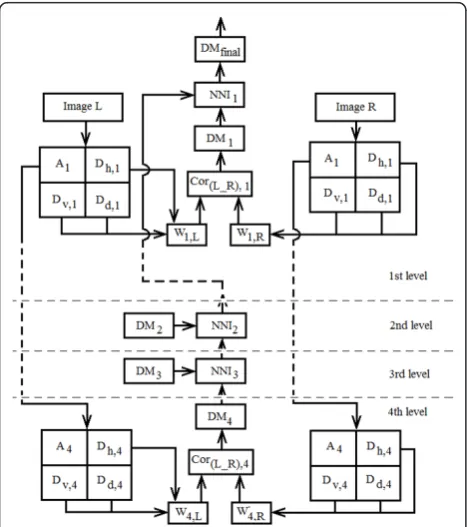
The proposed framework consists of the following stages: 2D color video sequence decomposition, RGB component separation, DM computation using wavelets at multiple decomposition levels (M-W), in particular wavelet atomic functions (M-WAF), disparity map improvement via dynamic range compression, anaglyph synthesis employing the nearest neighbor interpolation (NNI), and 3D video sequence reconstruction and visua-lization. Below, we explain in detail the principal 3D reconstruction stages (Figure 1).
2.1. Disparity map computation
Stereo correspondence estimation based on the M-W (M-WAF) technique is proposed to obtain the disparity map. The stereo correspondence procedure consists of two stages: the WAF implementation and the WTM computation.
Here, we present a novel type of wavelets known as WAFs, first introducing basic atomic functions (up, fupn,πn) used as the mother functions in wavelet
con-struction. The definition of AFs is connected with a mathematical problem: the isolation of a function that
Figure 1The proposed framework.
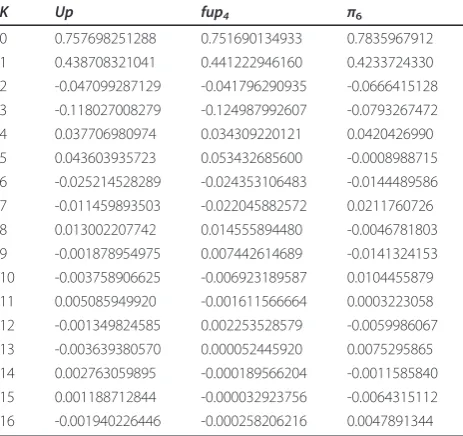
Table 1 Filter coefficients {hk} for scale function(x) generated from different WAF based onup, fup4, andπ6.
K Up fup4 π6
has derivatives with a maximum and minimum similar to those of the initial function. To solve this problem requires an infinitely differentiable solution to the differ-ential equations with a shifted argument [15]. It has been shown that AFs fall within an intermediate cate-gory between splines and classical polynomials: likeB -splines, AFs are compactly supported, and like polyno-mials, they are universal in terms of their approximation properties.
The simplest and most important AF is generated by infinity-to-one convolutions of rectangular impulses that are easy to analyze via the Fourier transform. Based on N-to-one convolution of (N + 1) identical rectangle impulses, the compactly supported spline θN(x) can be
defined as follows:
θN(x)=
1 2π ∞ −∞ ejux
sinu/2 u/2
N+1
du. (1)
The function up(x) is represented by the Fourier transform for infinite convolutions of rectangular impulses with variable length of duration 2-k, as in Equation 2:
up(x)= 1 2π ∞ −∞ ejux ∞ k=1
sinu·2−k
u·2−k du. (2)
The AFfupN(x) is defined by the convolution of spline θN-1(x) and AFup(x) in the interval [-(N+2)/2, (N+2)/
2]. Thus,fupN(x) can be written in the following form:
fupN(x)=
∞
−∞
ejux
sinu/2
u/2 N∞
k=1
sinu·2−k
u·2−k du, fup0(x)≡up(x). (3)
The generalization of AFup(x) as presented above, the AFupm(x) is defined as follows:
upm(x) = 1 2π ∞ −∞ ejxu ∞ k=1 sin2 mu (2m)k
mu (2m)kmsin
u (2m)k
du, m= 1, 2, 3, up1(x) =up(x). (4)
The functionπm(x) can be represented by the inverse
Fourier transform πm(t)=
1 2π ∞ −∞e ixtF
m(t)dt using
such representation for functionFm(t):
Fm(t)= m
k=1
sin(2m−1)t+ MV=2(−1)vsin(2m−2v+ 1)t
(3m−2)t . (5)
The detailed definitions and properties of these func-tions can be found in [15].
The wavelet decomposition procedures employ several decomposition levels to enhance the quality of the depth maps. The discrete wavelet transform (DWT) and inverse DWT are usually implemented using the filter
bank techniques for a scheme with only two filters: low pass (LP) H(z) (decomposition) and H(z)˜ (reconstruc-tion), and high pass (HP) G(z) (decomposition) and
˜
G(z) (reconstruction), where: G(z) = zH(-z) and
˜
G(z) =z-1H(-z) [16]. The scale function (x) is asso-ciated with filterH(z) in accordance to scaling equation:
φ(x) = 2
H(1) k∈Zhkφ(2x−k) and can be expressed by
it Fourier transform φˆ(ω) =∞
k=1
H(ej2ωk)
H(1) . The wavelet
functions are computed using linear combination of
scale functions
ψ(x) = 2
H(1) kgkφ(2x−k), wheregk= (−1)
k+1h∗ −k−1,
and {hk} are the coefficients of the LP filter in it Fourier
series:
H(ω) =√2H0(ω) =
k
hkejkω forH0(ω) :hk= √ 2 2π π −π
H0(ω)ejkωdω, (6)
and wavelet ψ˜(x) = 2
˜
H(1) kg˜kφ˜(2x−k). The HP
fil-ter is represented by Fourier series with coefficients {hk}:
G(ω) = ejωH∗(ω+π) =
k
(−1)k+1h∗−k−1e−jkω. (7)
The coefficients {hk} should satisfy such normalization
condition: √1
2 khk=H0(0) = 1. Finally, wavelets of
decomposition and reconstruction are employed in such a form: ψ˜i,k= 2−i/2ψ˜(x/2i−k) and
ψi,k= 2−i/2ψ(x/2i−k), respectively, wherei and kare
indexes of translation and scale [16].
The procedure to synthesis the WAF consists of per-forming a scale function (x) that should generate the sequence of compact subspaces satisfying such property, each next subspaceVj+1 is into a previous oneVj: Vj⊂
L2(X),jÎ X; ⋃jVj=L2(X); ⋂jVj= {0};f(x)Î Vj⇔f(2x)Î
Vj+1. Finally, it should be existed such scale function (x) that: (a) with their shifts forms theRieszbases; (b) it has symmetric and finite Fourier transform φ˜(ω). Because the scale AF (x) and WAF ψ(x) are not com-pactly supported but they rapidly decrease (due to infi-nite differentiability), it is possible to select an effective support from such limit conditions: ||j-jef||•100% ≤
0.001%, ||ψ-ψef||•100% ≤ 0.001%. Filter coefficients hk
for the scale function (x) generated from different WAFs: up,fupn,upn,πncan be found in [17]. In Table
1, we only present the coefficientshkfor scale function (x) generated from AF up, fup4 and π6 that exposes
one see below in simulation results. The effective sup-ports for scale function(x) and waveletψ(x) generated from used AF are [-16, 16].
The Wavelet technique, which the developed method uses, is based on the DWT. In proposed framework for DM estimation, the wavelets on each decomposition level are computed as follows [12]:
Ws =|Ws| s, (8)
|Ws|=
|Dh,s |2+|Dv,s|2+|Dd,s |2
|As |
, (9)
whereWsis the wavelet for a chosen decomposition
levels;Dh, s, Dv, s, Dd, sare the horizontal, vertical, and
diagonal detail components at each a level s, As is the
approximation component, and θsis the phase that is
defined as follows:
θs=
εs if Dh,s >0
π−εs ifDh,s <0
, εs =arctg
Dh,s
Dv,s
. (10)
Once the Ws is computed for each an image stereo
pair or neighboring frames for a video, the disparity map for each level of decomposition can be formed using the cross-correlation function in wavelet trans-form space:
Cor(L R),s(x,y) =
(i,j)∈P
WLi,j·WRx+i,y+j
i,j∈PWL2
i,j·
i,j∈P
W2 R
x+i,y+j, (11)
where WL andWR are the wavelet transform for the
left and right images in each decomposition level s, and P is sliding processing window. Finally, the disparity map for each level of decomposition is computed by applying the NNI technique. In this work, we propose using four levels of decomposition in DWT.
A block diagram of the proposed M-WAF framework is presented in Figure 2.
2.2. Disparity map improvement and anaglyph synthesis The classical methods used in anaglyph construction can produce ghosting effects and color loss. One way to reduce these artifacts in anaglyph synthesis is to use the dynamic range compression of the disparity map [18]. The dynamic range compression permits retaining the depth ordering information, which reduces the ghosting effects in the non-overlapping areas in the anaglyph. Therefore, the dynamic range reduction of the disparity map values can be employed to enhance the map qual-ity. Using the Pth law transformation for dynamic range compression [18], the original disparity mapDis chan-ged as follows:
Dnew=a·DP, (12)
whereDnewis the new disparity map pixel value, 0 <a
< 1 is a normalizing constant, and 0 <P< 1.
At the final stage, the anaglyph synthesis is performed using the improved disparity map. To generate an ana-glyph, the neighboring frames in a grid dictated by the disparity map should be re-sampled. During numerous simulations, thebilinear,sinc and NNIs were implemen-ted to find an anaglyph with a better 3D perception. The NNI showed a better performance during the simu-lations and it was sufficiently fast in comparison with the other investigated interpolations. Thus, the NNI was chosen to successfully create the required anaglyph in this application. The NNI is performed for each pair of neighboring frames in the video sequence. NNI [19] that uses this framework changes the values of the pixels to the closest neighbor value. To perform the NNI in the current decomposition level and to form the resulting disparity map, intensity of each pixel is changed. The new intensity value is determined by comparing a pixel in the low resolution disparity fromith decomposition level with the closest pixel value in the actual disparity map from (i -1)th decomposition level.
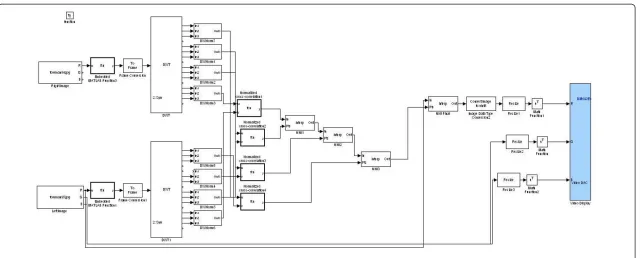
2.3. DSP implementation
M-WAF procedure, and the third DSP generates the ana-glyph. The developed algorithm in Simulink™is shown in Figure 3.
3. Simulation results
In the simulation experiments, various synthetic images are used to obtain the quantitative measure-ments. The synthetic images were obtained from http://vision.middlebury.edu/stereo/data. Aloe, Venus, Lampshade1, Wood1, Bowling1, andReindeer were the synthetic images used, all in PNG format (480 × 720 pixels). We also used the following test color video sequences in CIE format (250 frames, 288 × 352 pix-els):Coastguard, Flowers, and Foreman. The test video sequences were obtained from http://trace.eas.asu.edu/ yuv/index.html. In order to use the test color video sequences in the same sizes, we reformatted them in 480 × 720 pixels on Avi format. Additionally, the real life video sequences named Video Test1 (200 frames, 480 × 720 pixels) and Video Test2 (200 frames, 480 × 720 pixels) were recorded to apply the proposed algo-rithm in a common scenario. Video Test1 shows a truck moving in the scenery and Video Test2 shows three people walking toward the camera. Two quality objective criteria, quantity of bad disparities (QBD) [12] and similarity structure image measurement (SSIM) [21], were chosen as the quantitative metrics to justify the selection of the best disparity map algorithm in the 3D video sequence reconstruction. The QBD values have been calculated for different synthetic images as follows:
QBD = 1 N
x,y
|dE
x,y−dG
x,y|2, (13)
where N is the total number of pixels in the input image, anddEanddGare the estimated and the ground
truth disparities, respectively.
The SSIM metric values are defined as follows:
SSIMx,y=lx,y·cx,y·sx,y, (14)
where the parametersl,c, andsare calculated accord-ing to followaccord-ing equations:
lx,y= 2μX
x,yμY
x,y+C1 μ2
X
x,y+μ2
Y
x,y+C1
, (15)
cx,y= 2σX
x,yσY
x,y+C2 σ2
X
x,y+σY2x,y+C2
, (16)
sx,y= σXY
x,y+C3 σX
x,y+σY
x,y+C3
. (17)
In Equations (15) to (17),Xis the estimated image,Yis the ground truth image,μandsare the mean value and stan-dard deviation for theXorYimages, andC1=C2=C3= 1.
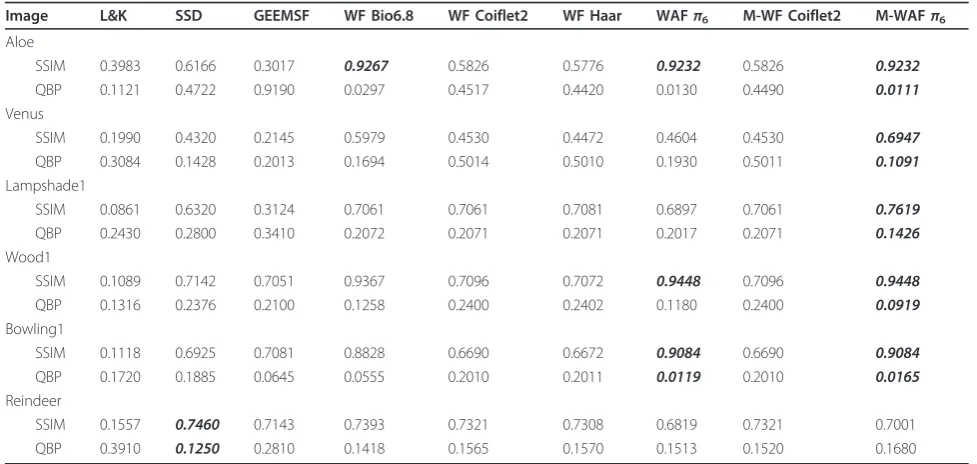
Table 2 presents the values of QBD and SSIM for the proposed framework based on M-WAFs and the other techniques applied to different synthetic images.
The simulation results presented in Table 2 indicate that the best overall performance of disparity map
Table 2 QBD and SSIM for proposed and existed algorithms for different test images
Image L&K SSD GEEMSF WF Bio6.8 WF Coiflet2 WF Haar WAFπ6 M-WF Coiflet2 M-WAFπ6
Aloe
SSIM 0.3983 0.6166 0.3017 0.9267 0.5826 0.5776 0.9232 0.5826 0.9232
QBP 0.1121 0.4722 0.9190 0.0297 0.4517 0.4420 0.0130 0.4490 0.0111
Venus
SSIM 0.1990 0.4320 0.2145 0.5979 0.4530 0.4472 0.4604 0.4530 0.6947
QBP 0.3084 0.1428 0.2013 0.1694 0.5014 0.5010 0.1930 0.5011 0.1091
Lampshade1
SSIM 0.0861 0.6320 0.3124 0.7061 0.7061 0.7081 0.6897 0.7061 0.7619
QBP 0.2430 0.2800 0.3410 0.2072 0.2071 0.2071 0.2017 0.2071 0.1426
Wood1
SSIM 0.1089 0.7142 0.7051 0.9367 0.7096 0.7072 0.9448 0.7096 0.9448
QBP 0.1316 0.2376 0.2100 0.1258 0.2400 0.2402 0.1180 0.2400 0.0919
Bowling1
SSIM 0.1118 0.6925 0.7081 0.8828 0.6690 0.6672 0.9084 0.6690 0.9084
QBP 0.1720 0.1885 0.0645 0.0555 0.2010 0.2011 0.0119 0.2010 0.0165
Reindeer
SSIM 0.1557 0.7460 0.7143 0.7393 0.7321 0.7308 0.6819 0.7321 0.7001
reconstruction is produced by the M-WAF framework. The minimum value of QBP and the maximum value of SSIM are obtained when the M-WAFπ6 is used,
fol-lowed by WAF π6. At the final stage, when the
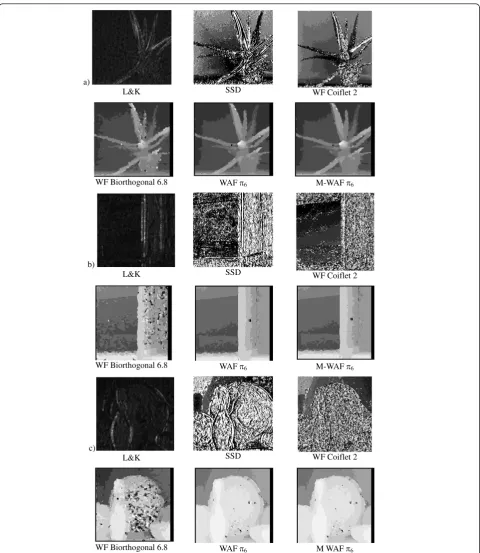
ana-glyphs were synthesized, the NCC was calculated in a sliding window with 5 × 5 pixels. The SSD algorithm was implemented in a window of size 9 × 9 pixels. The L&K algorithm was performed according to [9]. For all tested algorithms, the dynamic range compression was applied with the parametersa = P= 0.5. Figure 4 shows the obtained disparity map for all tested images and all implemented algorithms; evidently, the M-WAF π6
implementation produces the best overall visual results. Based on the objective quantity metrics and the sub-jective results presented in Figure 4, M-WAF π6 has
been selected as the technique to estimate the disparity map for video sequence visualization.
The anaglyphs, which were synthesized with the M-WAF algorithm, showed sufficiently good 3D visual per-ception with reduced ghosting and color loss. The spec-tacles with blue and red filters are required to observe Figures 5 and 6.
Processing time values were computed during the DSP implementation and the Table 3 shows the processing times for the video sequences using Matlab and the serial DSP implementation. Here, the tested video sequences were:Flowers,Coastguard, Video Test1, and Video Test2(all with 480 × 720 pixels and with 240 × 360 pixels in RGB format).
The processing time values were measured since the moment the sequence was acquired from the DSP until the anaglyph was displayed in a regular monitor.
The processing times in Table 3 lead to a possible conclusion that the DSP algorithm can process up to 20 frames per sec for a frame of 240 × 360 pixels size in RGB format. Additionally, the DSP algorithm can pro-cess up to 12 frames per sec for a frame of 480 × 720 pixels size in RGB format. Processing time values for L&K and SSD algorithms implemented in Matlab were 22.59 and 16.26 s, accordingly, because they required extremely computationally intensive operations.
4. Conclusion
This study analyzed the performance of various 3D reconstruction methods. The proposed framework based on M-WAFs is the most effective method to reconstruct the disparity map for 3D video sequences with different types of movements. Such framework produces the best depth and the best spatial perception in synthesized 3D video sequences against other analyzed algorithms that is confirmed by numerous simulations for different initial 2D color video sequences. TheM-WAFalgorithm can be applied to any type of color video sequence with-out additional information. The performance of the DSP implementation shows that the proposed algorithm can practically visualize the final 3D color video sequence in real-time mode. In future, we suppose to optimize the
Table 3 Processing times for different algorithms.
Algorithm Matlab
Time/frame, s (240 × 360)
Matlab
Time/frame, s (480 × 720)
Serial Processing in DSP
Time/frame, s (240 × 360)
Serial Processing in DSP
Time/frame, s (480 × 720)
Classic wavelet families (Coif2, Db6.8, Haar)
4.20 6.16 0.0314 0.0713
Wavelet atomic functions (up, fup4,π6) 4.23 6.19 0.0312 0.0715
M-WAF (up, fup4,π6) 4.84 6.77 0.0489 0.081
M-classic wavelet families (Coif2, Db6.8, Haar)
4.85 6.76 0.0480 0.080
Figure 3Developed algorithm in Simulink™.
et
al
.
EURASIP
Journal
on
Advances
in
Signal
Processing
2011,
2011
:106
ls.com/conte
nt/2011/1/106
Page
7
of
a)
L&K SSD WF Coiflet 2
WF Biorthogonal 6.8 WAFπ6 M-WAF π6
b)
L&K SSD WF Coiflet 2
WF Biorthogonal 6.8 WAF π6 M-WAF π6
c)
L&K SSD WF Coiflet 2
WF Biorthogonal 6.8 WAFπ6 M WAF π6
a) b)
c) d)
e) f)
Figure 5Synthesized anaglyphs usingM-WAFπ6for the following test images.(a)Venus,(b)Aloe,(c)Bowling1,(d)Lampshade,(e)
Reindeer, and(f)Wood1.
a) b)
c) d)
proposed algorithm in order to increase the processing speed up to the film velocity.
List of abbreviations
CCS: code composer studio; 3D: three-dimensional; LP: low pass; M-W: multiple decomposition levels; NCC: normalized cross-correlation; QBD: quantity of bad disparities; RBSM: region-based stereo matching; SSD: sum of squared difference: WAF: wavelet atomic functions; WTM: wavelet transform modulus.
Author details 1
National Polytechnic Institute, ESIME-Culhuacan, Santa Ana 1000 Col. San Francisco Culhuacan, 04430, Mexico City, Mexico2Institute of Radio Engineering and Electronics, Russian Academy of Sciences, Moscow, Russia
Competing interests
The authors thank the National Polytechnic Institute of Mexico and CONACY (Project 81599) for their support of this work
Received: 3 June 2011 Accepted: 18 November 2011 Published: 18 November 2011
References
1. A Smolic, P Kauff, S Hnorr, A Hournung, M Kunter, M Muller, M Lang, Three dimensional video postproduction and processing. Proc IEEE.99(4), 607–625 (2011)
2. I Ideses, L Yaroslavsky, New methods to produce high quality color anaglyphs for 3D visualization, inICIAR, Lecture Notes in Computer Science, vol. 3212. (Springer Verlag, Germany, 2004), pp. 273–280. doi:10.1007/978-3-540-30126-4_34
3. W Sanders, D McAllister, Producing anaglyphs from synthetic images, in
Proceedings of SPIE Stereoscopic Displays and Virtual Reality Systems X.5006, 348–358 (2003)
4. E Dubois, A projection method to generate anaglyph stereo images, in
Proceedings of IEEE International Conference on Acoustic Speech Signal Processing, vol. 3. (Salt Lake City, USA, 2001), pp. 1661–1664 5. A Woods, T Rouke, Ghosting in anaglyphic stereoscopic images, in
Stereoscopic Displays and Applications XV, Proceedings of SPIE-IS&T Electronic Imaging, SPIE.5291, 354–365 (2004)
6. I Ideses, L Yaroslavsky, B Fishbain, 3D from compressed video, in Stereoscopic displays and virtual reality systems. Proc SPIE.6490(64901C) (2007)
7. J Caviedes, J Villegas, Real time 2D to 3D conversion: Technical and visual quality requirements. inInternational Conference on Consumer Electronics, ICCE-IEEE897–898 (2011)
8. DJ Fleet,Measurement of Image Velocity, (Kluwer Academic Publishers, Massachusetts, 1992)
9. SS Beauchemin, JL Barron, The computation of optical flow. ACM Comput Surv.27(3), 433–465 (1995). doi:10.1145/212094.212141
10. A Bovik,Handbook of Image and Video Processing, (Academic Press, USA, 2000)
11. BB Alagoz, Obtaining depth maps from color images by region based stereo matching algorithms. OncuBilim Algor Syst Labs.08(4), 1–12 (2008) 12. A Bhatti, S Nahavandi, inStereo Vision, vol. Chap 6. (I-Tech, Vienna, 2008),
pp. 27–48
13. Gulyaev YuV, VF Kravchenko, VI Pustovoit, A new class of WA-systems of Kravchenko-Rvachev functions in Doklady mathematics.75(2), 325–332 (2007)
14. C Juarez, V Ponomaryov, J Sanchez, V Kravchenko, Wavelets based on atomic function used in detection and classification of masses in mammography, inLecture Notes in Artificial Intelligence.5317, 295–304 (2008)
15. V Kravchenko, H Meana, V Ponomaryov, inAdaptive Digital Processing of Multidimensional Signals with Applications, (FizMatLit Edit, Moscow, 2009) http://www.posgrados.esimecu.ipn.mx/
16. Y Meyer,Ondelettes, (Hermann, Paris, 1991)
17. VF Kravchenko, AV Yurin, New class of wavelet functions in digital processing of signals and images. J Success Mod Radio Electron, Moscow, Edit Radioteknika.5, 3–123 (2008)
18. I Ideses, L Yaroslavsky, Three methods that improve the visual quality of colour anaglyphs. J Opt A Pure Appl Opt.7, 755–762 (2005). doi:10.1088/ 1464-4258/7/12/008
19. A Goshtasby,2D and 3D Image Registration, (Wiley Publishers, USA, 2005) 20. Texas Instruments, TMS320DM642 Evaluation Module with TVP Video
Encoders. Technical Reference 507345-0001 Rev B (December 2004) 21. WS Malpica, AC Bovik, Range image quality assessment by structural
similarity. inICASSP 2009 IEEE International Conference on Acoustics, Speech and Signal Processing, IEEE1149–1152 (2009)
doi:10.1186/1687-6180-2011-106
Cite this article as:Ramos-Diazet al.:Efficient 2D to 3D video conversion implemented on DSP.EURASIP Journal on Advances in Signal
Processing20112011:106.
Submit your manuscript to a
journal and benefi t from:
7Convenient online submission
7Rigorous peer review
7Immediate publication on acceptance
7Open access: articles freely available online
7High visibility within the fi eld
7Retaining the copyright to your article