Volume 2008, Article ID 834973,14pages doi:10.1155/2008/834973
Research Article
One-Class SVMs Challenges in Audio Detection
and Classification Applications
Asma Rabaoui, Hachem Kadri, Zied Lachiri, and Noureddine Ellouze
Unit´e de Recherche Signal, Image et Reconnaissance des Formes, Ecole Nationale d’Ingenieurs de Tunis (ENIT), BP 37, Campus Universitaire, 1002 Tunis, Tunisia
Correspondence should be addressed to Asma Rabaoui,[email protected]
Received 2 October 2007; Revised 7 January 2008; Accepted 24 April 2008
Recommended by Sergios Theodoridis
Support vector machines (SVMs) have gained great attention and have been used extensively and successfully in the field of sounds (events) recognition. However, the extension of SVMs to real-world signal processing applications is still an ongoing research topic. Our work consists of illustrating the potential of SVMs on recognizing impulsive audio signals belonging to a complex real-world dataset. We propose to apply optimized one-class support vector machines (1-SVMs) to tackle both sound detection and classification tasks in the sound recognition process. First, we propose an efficient and accurate approach for detecting events in a continuous audio stream. The proposed unsupervised sound detection method which does not require any pretrained models is based on the use of the exponential family model and 1-SVMs to approximate the generalized likelihood ratio. Then, we apply novel discriminative algorithms based on 1-SVMs with new dissimilarity measure in order to address a supervised sound-classification task. We compare the novel sound detection and classification methods with other popular approaches. The remarkable sound recognition results achieved in our experiments illustrate the potential of these methods and indicate that 1-SVMs are well suited for event-recognition tasks.
Copyright © 2008 Asma Rabaoui et al. This is an open access article distributed under the Creative Commons Attribution License, which permits unrestricted use, distribution, and reproduction in any medium, provided the original work is properly cited.
1. INTRODUCTION
Kernel-based algorithms have been recently developed in the machine learning community, where they were first introduced in the support vector machine (SVM) algorithm. There is now an extensive literature on SVM [1] and the family of kernel-based algorithms [2]. The attractiveness of such algorithms is due to their elegant treatment of nonlinear problems and their efficiency in high-dimensional problems. They have allowed considerable progress in machine learning and they are now being successfully applied to many prob-lems.
Kernel methods, which are considered one of the most successful branches of machine learning, allow applying linear algorithms with well-founded properties such as gen-eralization ability, to nonlinear real-life problems. They have been applied in several domains. Some of them are direct application of the standard SVM algorithm for sound detec-tion or estimadetec-tion and others incorporate prior knowledge into the learning process, either using virtual training
sam-ples or by constructing a relevant kernel for the given prob-lem. The applications include speech and audio processing (speech recognition [3], speaker identification [4], extraction of audio features [5], and audio signal segmentation [6]), image processing [7], and text categorization [8]. This list is not exhaustive but shows the diversity of problems that can be treated by kernel methods.
In this field, data are often represented by sequences of varying length. These are some reasons that make kernel methods particularly suited for signal processing applica-tions. Another aspect is the amount of available data and the dimensionality. One needs methods that can use little data and avoid the curse of dimensionality.
Support vector machines (SVMs) have been shown to provide better performance than more traditional techniques in many signal processing problems, thanks to their ability to generalize especially when the number of learning data is small, to their adaptability to various learning problems by changing kernel functions, and to their global optimal solution. For SVMs, few parameters need to be tuned, the optimization problem to be solved does not have numerical difficulties—mostly because it is convex. Moreover, their generalization ability is easy to control through the param-eterν, which admits a simple interpretation in terms of the number of outliers [2].
This paper focuses on the new challenges of SVMs on sound detection and classification tasks in an audio recogni-tion system. In general, the purpose of sound (event) recog-nition is to understand whether a particular sound belongs to a certain class. This is a sound recognition problem, similar to voice, speaker, or speech recognition. Sound recognition systems can be partitioned into two main modules. First, a sound detection stage isolates relevant sound segments from the background by detecting abrupt changes in the audio stream. Then, a classifier tries to assign the detected sound to a category.
Generally, the classical event detection methods are based on the energy calculation [16]. In recent years, some new methods based on a model selection criterion have attracted more attention especially in the speech community and has been applied in many statistical sound detection methods especially for speaker change detection [17–20]. On the other hand, the sounds classifiers are often based on statistical models. Examples of such classifiers include Gaussian mix-ture models (GMMs) [21], hidden Markov models (HMMs) [22], and neural networks (NNs) [23]. In many previous works, it was shown that most of the used paradigms for sound recognition tasks perform very well on closed-loop tests, but performance degrades significantly on open-loop tests. As an attempt to overcome this drawback, the use of adaptive systems that provide better discrimination capa-bilities often results in overparameterized models which are also prone to overfitting. All these problems can be attributed simply to the fact that most systems do not generalize well.
In this paper, we focus on the specific task of event detection and classification using the one-class SVMs (1-SVMs). 1-SVM distinguishes one class of data from the rest of the feature space given only a positive data set. Based on a strong mathematical foundation, 1-SVM draws a nonlinear boundary of the positive data set in the feature space using a parameter to control the noise in the training data and another one to control the smoothness of the boundary. 1-SVMs have proved extremely powerful in some previous audio applications [6,15,24].
The sound detection and classification steps are repre-sented in Figure 1. Only the colored blocks in the sound
recognition process will be addressed in this paper. For the event detection task, the proposed approach which does not require any pretrained models (unsupervised learning) is based on the use of the exponential family model and 1-SVMs to approximate the generalized likelihood ratio, thus increasing robustness and allowing detecting events close to each others. For the sound classification task, the proposed approach presented has several original aspects, the most prominent being the use of several 1-SVMs to perform mul-tiple class classification and the use of a sophisticated dissim-ilarity measure. In this paper, we will demonstrate that the 1-SVM methodology creates reliable classifiers (i.e., classifiers with very good generalization performance) more easy to implement and tune than the common methods, while having a reasonable computation cost.
The remainder of this paper is organized as follows.
Section 2 gives an overview of the 1-SVM-based learning theory. We discuss the proposed 1-SVMs-based algorithms and approaches to sound detection in Section 3 and to sound classification in Section 4. Experimental results and discussions are provided in Section 5. Section 6 concludes the paper with a summary.
2. THE ONE-CLASS SVMs
The One-class approach [2] has been successfully applied to various problems [10,15,25–27]. To denote a one-class classification task, a large number of different terms have been used in the literature. The term single-class classifica-tion originates from Moya [28], but also outlier detection [29], novelty detection [6, 23] or concept learning [30] are used. The different terms originate from the different applications to which one-class classification can be applied. Obviously, its first application is outlier detection examples, to detect uncharacteristic objects from a dataset, which do not resemble the bulk of the dataset in some way. These out-liers in the data can be caused by errors in the measurement of feature values, resulting in an exceptionally large or small feature value in comparison with other training objects. In general, trained classifiers only provide reliable estimates for input objects resembling the training set.
1-SVM distinguishes one class of data from the rest of the feature space given only a positive data set (also known as target data set) and never sees the outlier data. Instead, it must estimate the boundary that separates those two classes based only on data which lie on one side of it. The problem therefore is to define this boundary in order to minimize misclassifications by using a parameter to control the noise in the training data and another one to control the smoothness of the boundary.
The aim of 1-SVMs is to use the training datasetX = {x1,. . .,xm}inRd so as to learn a functionfX : Rd → R such that most of the data inXbelong to the setRX= {x∈
RdwithfX(x)≥0}while the volume ofR
Xis minimal. This problem is termed minimum volume set (MVS) estimation [31], and we see that membership of x to RX indicates whether this datum is overall similar toX, or not. Thus, by learning regionsRXi for each class of sound (i=1,. . .,N),
Input audio stream
Features extraction
Event
detection boundariesEvents
(a) Unsupervised events detection
Training
audio events Features extraction Testing
audio events
Models learning
Audio event recognized (class assigned to event) Calssifier
Supervised training of the audio events
Online testing (event classification) (b) Supervised events classification
Figure1: The event recognition process is composed into two main tasks: the sound detection task and the sound classification task. As illustrated in (a), an unsupervised algorithm based on 1-SVMs will be applied to address the event detection task. In (b), a supervised learning classification algorithm based on 1-SVMs will be proposed.
Separation hyperplane
W
Non-SVs
The smallest sphere enclosing data (SVDD)
Hypersphere S
Margin SV Non-margin SV
(outlier) O
Origin ρ/w
w θ
ξi/w
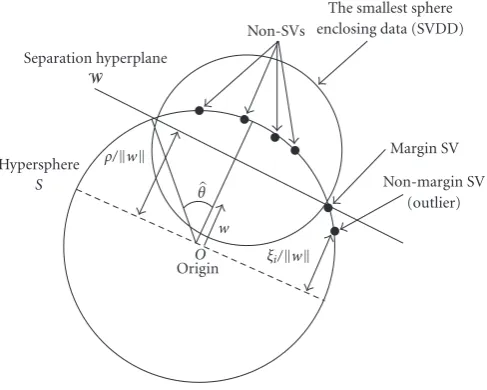
Figure2: In the feature spaceH, the training data are mapped on a hypersphereS(o,R=1). The 1-SVM algorithm defines a hyperplane with
equationW= {∈Hs.t.w,H−ρ=0}, orthogonal tow. Black dots represent the set of mapped data, that is,k(xj,·), i=1,. . .,m. For RBF kernels, which depend only onx−x,k(x,x) is constant, and the mapped data points thus lie on a hypersphere. In this case, finding the smallest sphere enclosing the data is equivalent to maximizing the margin of separation from the origin.
assignment of a datumxto a class is performed as detailed in
Section 4.1.
1-SVMs solve MVS estimation in the following way. First, a so-calledkernel functionk(·,·);Rd×Rd →Ris selected, and it is assumed to bepositive definite[2]. Here, we assume a Gaussian RBF kernel such that k(x,x) = exp[−x −
x2/2σ2], where·denotes the Euclidean norm inRd. This kernel induces a so-calledfeature spacedenoted byH via the mappingφ : Rd →H defined byφ(x)k(x,·), whereH is shown to be reproducing kernel Hilbert space (RKHS) of functions, with dot product denoted by·,·H. (We stress on the difference between thefeature space, which is a (possibly infinite dimensional) space of functions, and the space of feature vectors, which isRd. Though confusion between these two spaces is possible, we stick to these names as they are widely used in the literature.) The reproducing kernel property implies thatφ(x),φ(x)H = k(x,·),k(x,·)H =
k(x,x) which makes the evaluation of k(x,x) a linear operation inH, whereas it is a nonlinear operation inRd. In the case of the Gaussian RBF kernel, we see thatφ(x)2
H φ(x),φ(x)H = k(x,x) = 1, thus all the mapped data are located on the hypersphere with radius one, centered onto the origin of H denoted by S(o,R=1) (Figure 2). The 1-SVM approach proceeds in feature space by determining the hyperplaneW that separates most of the data from the hypersphere origin, while being as far as possible from it. Since inHthe image byφofRXis included in the segment of hypersphere bounded byW, this indeed implements MVS estimation [31]. In practice, let W = {(·) ∈ H with (·),w(·)H−ρ=0}, then its parametersw(·) andρresult from the optimization problem
min w,ξ,ρ 1 2w(·)
2 H+
1 νm
m
j=1
subject to (for j=1,. . .,m)
w(·),kxj,·
H ≥ρ−ξj, ξj≥0, (2) whereνtunes the fraction of data that are allowed to be on the wrong side ofW (these are the outliers and they do not belong toRX) andξj’s are so-called slack variables. It can be shown [2] that a solution of (1)-(2) is such that
w(·) = m
j=1
αjk
xj,·
, (3)
where theαj’s verify the dual optimization problem
min α
1 2
m
j,j=1
αjαjk
xj,xj
(4)
subject to
0≤αj≤ν1
m,
j
αj=1. (5)
Finally, the decision function is
fX(x)= m
j=1
αjk
xj,x
−ρ (6)
andρis computed by usingfX(xj)=0 for thosexj’s inX that are located onto the boundary, that is, those that verify bothαj=/0 andαj=/1/νm. An important remark is that the solution is sparse, that is, most of the αi’s are zero (they correspond to thexj’s which are inside the regionRX, and they verifyfX(x)>0).
As plotted in Figure 2, the MVS in H may also be estimated by finding the minimum volume hypersphere that encloses most of the data (support vector data description (SVDD) [26, 32]), but this approach is equivalent to the hyperplane one in the case of an RBF kernel.
In order to adjust the kernel for optimal results, the parameterσcan be tuned to control the amount of smooth-ing, that is, large values ofσlead to flat decision boundaries. Also,νis an upper bound on the fraction of outliers in the dataset [2].
3. APPLICATION OF 1-SVMs TO SOUND DETECTION
The detection of an event (called the useful sound) is very important because if an event is lost during the first step of the system, it is lost forever. On the other hand, if there are too many false alarms, the sound recognition system is saturated. Therefore, the performance of the detection algorithm is very important for the entire recognition system. There are many techniques previously used for sound detection with a very simple functional principle (a threshold on energy), or with a statistical model [16,33]. Very simple methods based either on the variance or on the median filtering of the signal energy have been used in many previous works. In [34–36], three algorithms were used: one based on the cross-correlation of two successive windows, a second
one based on the error of energy prediction, and a third one based on the wavelet filtering. Another method widely used in the speech community is based on model selection using Bayesian information criterion (BIC) [20]. Our objective is to develop a new robust unsupervised sound detection technique based on a new 1-SVMs-based algorithm that uses the exponential family model. In this section, we begin by giving a brief description of some previous works with a special emphasis on the BIC detection method.
3.1. Previous works
Sound detection is the first step of every sound analysis system and is necessary to extract the significant sounds before initiating the classification step. Here, we present four classical event detection algorithms: cross-correlation, energy prediction, wavelet filtering, and BIC. The first three methods are widely used for impulsive sound detection [34] and they are based on the energy calculation and use a threshold which must be settled empirically. In recent years, the last method, BIC, has attracted more attention in the speech community and has been applied in many statistical sound detection methods especially for speaker change detection [17–20]. The Bayesian information criterion is a model selection criterion that was first proposed by [37] and widely used in the statistical literature.
The cross-correlation detection method is based on the measure of similarity between two successive signal windows in order to find abrupt changes of the signal. The algorithm calculates the cross-correlation function between two windows and keeps the maximum value. Finally, a threshold on this signal is applied (if the signal is under the threshold, an event detection is generated) [34]. The energy prediction-based detection method computes the signal energy on N sample windows. The next value of the energy is predicted based on the L previous values (L
=prediction length) using the spline interpolation method [36]. Finally, a threshold is settled on the prediction error (the absolute difference between the real value and the predicted value). The wavelet filtering-based sound detection method [35] uses wavelets such as Daubechies to compute DWT [38]. The sound detection algorithm computes the energy of the high-order wavelet coefficients which are the most significant coefficients for short and impulsive signals. The sound detection is achieved by applying a threshold on the sum of energies.
3.2. Sound detection using 1-class SVM and exponential family
In most commonly used model selection sound detection techniques such as the BIC detection method previously described, the basic problem may be viewed as a two-class classification. Where the objective is to determine whetherN
consecutive audio frames constitute a single homogeneous window W or two different windows W1 and W2. In order to detect if an abrupt change occurred at the ith frame within a window ofN frames, two models are built. One which represents the entire window by a Gaussian characterized by μ (mean), Σ (variance); a second which represents the window up to the ith frame, W1 with μ1, Σ1 and the remaining part, W2, with a second Gaussian
μ2,Σ2. This representation using a Gaussian process is not totally exact when abrupt changes are close to each other especially when the events to be detected are too short and impulsive. To solve this problem, our proposed technique uses 1-SVMs and exponential family model to maximize the generalized likelihood ratio with any probability distribution of windows.
3.2.1. Exponential family
The exponential family covers a large number (and well-known classes) of distributions such as Gaussian, multino-mial, and poisson. A general representation of an exponential family is given by the following probability density function:
p(x|η)=h(x) exp ηTT(x)−A(η), (7) whereh(x) is called the base density which is always≥0,ηis the natural parameter,T(x) is the sufficient statistic vector,
and A(η) is the cumulant generating function or the log normalizer.
The choice of T(x) and h(x) determines the member of the exponential family. Also we know that since this is a density function,
h(x) exp ηTT(x)−A(η)dx=1, (8)
then
A(η)=log
exp ηTT(x)h(x)dx. (9)
For a Gaussian distribution, p(x | μ,σ2) = (1/√2π) exp((μ/σ2)x−(1/2σ2)x2−(μ2/2σ2)−logσ). In this case,
h(x)=1/√2π,η=[μ/σ2,−1/2σ2], andT(x)=[x,x2]. Thus, Gaussian distribution is included in the exponential family.
The density function of an exponential family can be written in the case of presence of a reproducing kernel Hilbert spaceH with a reproducing kernelkas
p(x|η)=h(x) exp η(·),k(x,·)H−A(η)
(10)
with
A(η)=log
exp η(·),k(x,·)Hh(x)dx. (11)
3.2.2. Applying 1-SVM to sound detection
Novelty change detection theory using SVM and exponential family was first proposed in [40,41]. In this paper, this prob-lem will be addressed with novel sophisticated approaches. LetX = {x1,x2,. . .,xN}andY = {y1,y2,. . .,yN} be two adjacent windows of acoustic feature vectors extracted from the audio signal, whereNis the number of data points in one window. LetZdenote the union of the contents of the two windows having 2N data points. The sequences of random variablesX andY are distributed according to Px andPy
distribution, respectively. We want to test if there exists a sound change after the samplexNbetween the two windows. The problem can be viewed as testing the hypothesis H0 : Px=Pyagainst the alternativeH1:Px /=Py.H0is the null hypothesis and represents that the entire sequence is drawn from a single distribution, thus there exists only one sound. WhileH1 represents the hypothesis that there is a segment boundary after sample Xn, the likelihood ratio test of this hypotheses test is the following:
Lz1,. . .,z2N
=
N
i=1Px
zi2Ni=N+1Py
zi
2N
i=1Px
zi
= 2N
i=N+1
Py
zi
Px
zi
.
(12)
Since both densities are unknown, the generalized likelihood ratio (GLR) has to be used:
Lz1,. . .,z2N
=
2N
i=N+1
Py
zi
Px
zi
, (13)
whereP0andP0 are the maximum likelihood estimates of the densities.
Assuming that both densities Px andPy are included in the generalized exponential family, thus there exists a reproducing kernel Hilbert spaceHembedded with the dot product·,·Hwith a reproducing kernelksuch that in (10):
Px(z)=h(z) exp ηx(·),k(z,·)
H−A
ηx
,
Py(z)=h(z) exp ηy(·),k(z,·)
H−A
ηy
.
(14)
Using 1-SVM and the exponential family, a robust approximation of the maximum likelihood estimates of the densitiesPxandPycan be written as
Px(z)=h(z) exp
N
i=1
α(x)i k
z,zi
−Aηx
,
Py(z)=h(z) exp
2N
i=N+1
α(y)i k
z,zi
−Aηy
,
(15)
(zN+1 toz2N). Using these three hypotheses, the generalized likelihood ratio test is approximated as follows:
Lz1,. . .,z2N
= 2N
j=N+1
exp2Ni=N+1α (y)
i k
zj,zi
−Aηy
exp2Ni=1α(x)i k
xj,xi
−Aηx
. (16)
A sound change in the frameznexists if
Lz1,. . .,z2N
> sx⇐⇒ 2N
j=N+1
2N
i=N+1
α(y)i k
zj,zi
−
N
i=1
α(x)i k
zj,zi
> sx,
(17)
wheresx is a fixed threshold. Moreover,
2N
i=N+1α
(y)
i k(zj,zi)
is very small and can be neglected in comparison with N
i=1α(x)i k(zj,zi). Then a sound change is detected when 2N
j=N+1
−
N
i=1
α(x)i k
zj,zi
> sx. (18)
3.2.3. Sound detection criterion
Previously, we showed that a sound change exists if the condition defined by (18) is verified. This sound detection approach can be interpreted like this: to decide if a sound change exits between the two windowsXandY, we built an SVM using the dataXas learning data, thenYdata are used for testing if the two windows are homogenous or not.
On the other hand, sinceH0 represents the hypothesis ofPx = Py, the likelihood ratio test of the hypotheses test described previously can be written as
Lz1,. . .,z2N
=
N
i=1Px
zi2Ni=N+1Py
zi
2N
i=1Py
zi
= N
i=1
Px zi Py zi . (19)
Using the same gait, a sound change has occurred if
N
j=1
−
2N
i=N+1
α(y)i k
zj,zi
> sy. (20)
Preliminary empirical tests show that in some cases it is more appropriate to apply two training rounds: after using
X data for learning and Y data for testing, we can use Y
data for learning and X data for testing. This procedure provides more detection accuracy. For that reason, it is more appropriate to use the criterion described as follow:
2N
j=N+1
−
N
i=1
α(x)i k
zj,zi
+
N
j=1
−
2N
i=N+1
α(y)i k
zj,zi
> S,
(21)
where S = sx + sy. Equation (21) can be considered as a distance measure between two datasets. Obviously, higher values of this distance indicate that the two dataset distribu-tions are not similar.
Audio stream Audio parameterization Train data SVM 1 Test data
SVM 2 Train data SVM 2 Test data SVM 1 Distance measure d1 Distance measure d2
Detection criterion:d=d1+d2
Distance curve
Significantpeaks detection Break points detection=sound detection
N ew limits o f the analysis fr ame
Figure3: Block diagram of our sounds detection approach. The method is based on a new distance measuredbetween two adjacent analysis windows. This distance is the sum ofd1in (18) andd2in
(20).d1is obtained by using training dataset from the first window
and testing dataset from the second one.d2is computed by inverting
the datasets.
3.2.4. Our sound detection method
Our technique of sound detection is based on the computa-tion of the distance detailed in (21) between a pair of adjacent windows of the same size shifted by a fixed step along the whole parameterized signal. This allows to obtain the curve of the variation of the distance in time. The analysis of this curve shows that a sound change point is characterized by the presence of a “significant” peak. A peak is regarded as “significant” when it presents a high value. So, break points can be detected easily by searching the local maxima of the distance curve that presents a value higher than a fixed threshold (Figure 3).
4. APPLICATION OF 1-SVMs TO SOUNDS CLASSIFICATION
not directly incorporate discriminative information. It is shown that HMM-based sound recognition systems perform very well on closed-loop tests but performance degrades significantly on open-loop tests. In [42], we showed that this is specially true for impulsive sound classification. As an attempt to overcome these drawbacks, artificial neural networks (ANNs) have been proposed as a replacement for the Gaussian emission probabilities under the belief that the ANN models provide better discrimination capabilities. However, the use of ANNs often results in overparameterized models which are also prone to overfitting.
This can be attributed to the fact that most systems do not generalize well. We need systems with good general-ization properties where the worst case performance on a given test set can be bounded as part of the training process without having to actually test the system. With many real-world applications where open-loop testing is required, the significance of generalization is further amplified.
The application addressed here concerns real-world sound classification. In real environment, there might be many sounds which do not belong to one of the predefined classes, thus it is necessary to define arejection class, which may gather all sounds which do not belong to the training classes. An easy and elegant way to do so consists of esti-mating the regions of high probability of the known classes in the space of features, and considering the rest of the space as the rejection class. Training several 1-SVMs does this automatically.
In order to enhance the discrimination ability of the proposed classification method, the discrimination rule illus-trated by (6) will be replaced by a sophisticated dissimilarity measure described in the subsection below.
4.1. A dissimilarity measure
The 1-SVM can be used to learn the MVS of a dataset of feature vectors which relate to sounds. In the following, we will define a dissimilarity measure by adapting the results of [13,15]. Assume thatN 1-SVMs have been learnt from the datasets{X1,. . .,XN}, and consider one of them, with associated set of coefficients denoted ({αj}j=1,...,m,ρ). In order to determine whether a new datumxis similar to the set X, we will define a dissimilarity measure, denoted by
d(X,x), and deduced from the decision function fX(x) = m
j=1αjk(xj,x)−ρ, in whichρis seen as a scaling parameter which balances the αj’s. Thanks to this normalization, the comparison of such dissimilarity measures d(Xi,x) and
d(Xi,x) is possible. Indeed,
d(X,x)= −log w(·),k(x,·)
H
ρ
= −log w(·)H
ρ cos
w(·)∠k(x,·)
,
(22)
because k(x,·)H = 1, where w(·)∠k(x,·) denotes the angle betweenw(·) andk(x,·).
By doing elementary geometry in feature space, we can show thatρ/w(·)H = cos(θ) (Figure 2). This yields the following interpretation ofd(X,x):
d(X,x)= −log
cosw(·)∠k(x,·) cosθ
. (23)
Finally, the following relation
log m
j=1
αjk
x,xj
+ log[ρ]
=log w(·),k(x,·)H+ log[ρ]=d(X,x) (24)
shows that the normalization is sound, and makesd(X,x) a valid tool to examine the membership ofxto a given class represented by a training setX.
4.2. Multiple sound classes in 1-SVM-based classification algorithm
The sound classification algorithm comprises three main steps. Step one is that of training data preparation, and it includes the selection of a set of features which are computed for all the training data. The value of νis selected in the reduced interval [0.05, 0.8] in order to avoid edge effects for small or large values ofν.
We adopt the following notations. We assume thatX = {x1,. . .,xm}is a dataset inRd. Here, eachxjis the full feature vector of a signal, that is, each signal is represented by one vectorxjinRd. LetXbe the set of training sounds, shared inNcclasses denoted byX1,. . .,XNc. Each class containsmi
sounds,i=1,. . .,Nc.
Algorithm 1(Sound classification algorithm).
Step 1(Data preparation). (i) Select a set of features. (ii) Form the training setsXi= {xi,1,...,xi,mi},i=1,. . .,
Nc by computing these features and forming the feature vectors for all the training sounds selected.
(iii) Set the parameterσ of the Gaussian RBF kernel to some pre-determined value (e.g., set σ as half the average euclidean distance between any two pointsxi,jandxi,j [3]), and selectν∈[0.05, 0.8].
Step 2(Training step). (i) Fori=1,. . .,Nc, solve the 1-SVM problem for the setXi, resulting in a set of coefficients (αi,j,
ρj),j=1,. . .,mi.
Step 3(Testing step). (i) For each soundsto be classified into one of theNcclasses, do
(1) compute its feature vector, denotedx,
(2) fori=1,. . .,Nc, computed(Xi,x) by using (24), (3) assign the soundsto the classisuch thati = arg
Table1: Classes of sounds and number of samples in the database used for performance evaluation.
Classes Total number Total duration (s)
Human screams (C1) 73 189
Gunshots (C2) 225 352
Glass breaks (C3) 88 143
Explosions (C4) 62 180
Door slams (C5) 314 386
Dog barks (C6) 55 97
Phone rings (C7) 51 107
Children voices (C8) 87 140
Machines (C9) 60 184
Total 1015 1778
5. EXPERIMENTS ON SOUND DETECTION AND CLASSIFICATION
5.1. Experimental setup
The major part of the sound samples used in the sound recognition experiments is taken from different sound libraries available on the market [43,44]. Considering several sound libraries is necessary for building a representative, large, and sufficiently diversified database. Some particular classes of sounds have been built or completed with hand-recorded signals. All signals in the database have a 16-bit resolution and are sampled at 44100 Hz.
During database construction, great care was devoted to the selection of the signals. When a rather general use of the sound recognition system is required, some kind of intraclass diversity in the signal properties should be inte-grated in the database. Even if it would be better for a given sound recognition system, to be designed for the specific type of encountered signals, it was decided in this study to incorporate sufficiently diverse signals in the same category. As a result, one class of signals can be composed by very different temporal or spectral characteristics, amplitude levels, and duration and time location.
The selected sounds are impulsive and they are typical of surveillance applications. The number and duration of considered samples for each sound category is indicated in
Table 1.
Furthermore, other nonimpulsive classes of sounds (ma-chines, children voices) are also integrated in the experimen-tation. We note that the number of items in each class is deliberately not equal, and sometimes very different. More-over, explosion and gunshot sounds are very close to each other. Even for a person, it is sometimes not obvious to discriminate between them. They are intentionally diff eren-tiated to test ability of the system in separating very close classes of sounds.
5.2. Sound detection experiments
This section presents sound detection results with exper-iments conducted on an audio stream with length more
Target break point sequence
Detected break point sequence
Real break points
Missed detection
Tolerance
True detected break points
False alarm
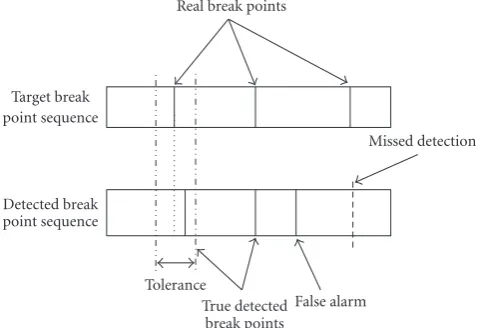
Figure 4: Example of a missed detection and a false alarm of a change point.
than 30 minutes containing the sounds (events) described in Table 1. After extracting the feature vectors (using a frame with length 25 ms and 50% overlap), a sliding analysis window of a fixed length was used. This value is the result of a tradeoffbetween the number of frames inside the analysis windows required for significant statistical estimation and for the fact that this analysis window must not contain more than one sound change point. The sounds to be detected are short and impulsive, thus the window analysis length was fixed to 1.4 seconds.
A change sound detection system has two possible types of error. Type-I-errors occur if a true change is not spotted within a certain window (missed detection). Type-II-errors occur when a detected change does not correspond to a true change in the reference (false alarm).Figure 4illustrates an example of the missed detection, false alarm and change-point tolerance evaluation for the audio detection task. In the conducted experiments, we considered that a change point is detected using a certain tolerance settled to 0.4 second.
Type-I and -II errors are also referred to as precision (PRC) and recall (RCL), respectively, wich are defined as
PRC=Number of correctly found changes Total number of changes found ,
RCL=Number of correctly found changes Total number of correct changes .
(25)
In order to compare the performance of different sys-tems, theF-measure is often used and is defined as
F=2.0×PRC×RCL
PRC + RCL . (26) The F-measure varies from 0 to 1, with a higher F -measure indicating better performance.
0.85 0.8
0.75 0.7
0.65 0.6
0.55
PRC WF
BIC CC
EP 1-SVM 0.5
0.55 0.6 0.65 0.7 0.75 0.8 0.85 0.9
RC
L
Figure5: RCL versus PRC curves of the proposed 1-SVMs-based sound detection methods against the other classical approaches.
were obtained by varying this threshold. In theory, the BIC-based method did not use any threshold. However, in previous works [20], it has been shown that theΔBIC uses a parameter λ that must be settled empirically and this parameter was considered as a hidden threshold.
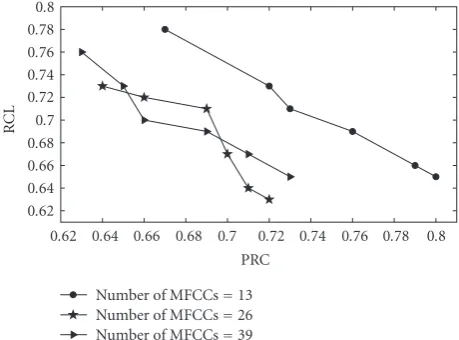
Figure 5presents a recall (RCL) versus a precision (PRC) plot for the different studied methods. We can notice that the proposed 1-SVM-based sound detection method outper-forms the others. Figures6and7illustrate the performance of the detection with different MFCC orders. This study experimented on three different MFCC orders: 13, 26, and 39. Generally, the 13 MFCCs include 12 MFCCs and onelog energy. The 26 MFCCs include the 13 MFCCs and their first-time derivatives, and the 39 MFCCs include the 13 MFCCs and theirs first- and second-time derivatives. As presented inFigure 6, the features with higher dimensions give fewer errors in parameter estimation and better detection perfor-mance. This is due to the fact that 1-SVMs are not sensitive to the dimensionality of the feature vectors. However, using 26 MFCCs and 39 MFCCs with BIC gives low values of PRC and RCL compared to those obtained using 13 MFCCs.
The best results achieved using all the studied methods are illustrated inTable 2. The PRC and RCL values obtained with the sound detection method based on BIC are lower than the proposed method (PRC=0.72, RCL=0.73). This is due essentially to the presence of short sounds that can be close to each others. In this case, we do not have enough data for the good estimation of the BIC parameters. To avoid this deficiency, we used 1-SVMs with the exponential family.
Results obtained with cross-correlation, energy predic-tion, and wavelet filtering methods show that using only an energy-based criterion to detect events is not very appropri-ate when there are sounds that present similar characteristics and which are very close to each others. With wavelet fil-tering, a slightly better result was obtained because it leads to better characterize the acoustical properties of complex audio scenes.
Sound detection using the proposed method based on 1-SVMs presents better results than all the other techniques. In
0.9 0.85
0.8 0.75
0.7
PRC Number of MFCCs=13 Number of MFCCs=26 Number of MFCCs=39 0.65
0.7 0.75 0.8 0.85 0.9
RC
L
Figure6: RCL versus PRC curves of the effect of the MFCC order in the proposed 1-SVMs-based method.
0.8 0.78 0.76 0.74 0.72 0.7 0.68 0.66 0.64 0.62
PRC Number of MFCCs=13 Number of MFCCs=26 Number of MFCCs=39 0.62
0.64 0.66 0.68 0.7 0.72 0.74 0.76 0.78 0.8
RC
L
Figure7: RCL versus PRC curves of the effect of the MFCC order in the BIC-based method.
Table2: Sound detection results using various techniques.
Techniques RCL PRC F
1-SVM 0.85 0.86 0.85
Wavelet filtering 0.77 0.76 0.76
BIC 0.73 0.72 0.72
Cross-correlation 0.68 0.70 0.69
Energy prediction 0.61 0.63 0.62
fact, the obtained higher value of PRC (0.86) indicates that our technique avoids many false alarms. Moreover, by using this method, we can detect approximately the major break points that exist in the audio stream (higher RCL=0.85).
5.3. Sound classification experiments
Table3: Confusion Matrix obtained by using a feature vector containing 12 cepstral coefficients MFCC + Energy + Logenergy + SC + SRF. 1-SVMs are applied with an RBF kernel (σ=10).
C1 C2 C3 C4 C5 C6 C7 C8 C9
C1 100 0 0 0 0 0 0 0 0
C2 0 90.66 0 9.33 0 0 0 0 0
C3 0 0 93.33 0 6.66 0 0 0 0
C4 0 20.05 0 75.19 4.76 0 0 0 0
C5 0 0.95 0 1.9 97.14 0 0 0 0
C6 0 0 0 0 5.26 94.73 0 0 0
C7 0 0 0 0 0 0 100 0 0
C8 0 0 0 3.45 3.45 0 0 93.1 0
C9 0 0 0 0 0 0 0 0 100
Total recognition rate = 93.79%
Table4: Confusion Matrix obtained by using a feature vector containing 12 cepstral coefficients MFCC + Energy + Logenergy + SC + SRF. M-SVMs(1-vs-1) are applied with an RBF kernel (σ=10).
C1 C2 C3 C4 C5 C6 C7 C8 C9
C1 100 0 0 0 0 0 0 0 0
C2 0 88.15 2.19 9.66 0 0 0 0 0
C3 0 0 90.33 0 6.66 0 3 0 0
C4 0 20.05 0 75.19 4.76 0 0 0 0
C5 0 0.95 0 3.9 95.14 0 0 0 0
C6 0 0 0 0 5.26 94.73 0 0 0
C7 0 0 1.2 9.66 0 0 89.14 0 0
C8 0 0 0 13.45 3.45 0 0 83.1 0
C9 0 0 0 0 0 0 0 0 100
Total recognition rate = 90.64%
samples in each sound (segment). The analysis window is Hamming with length 25 milliseconds and 50% overlap. The selected feature vector contains 12 Mel-frequency cepstral coefficients (MFCCs), the energy, the Logenergy, the Spectral Centrod (SC), and the spectral rolloff point (SRF). More details about these features and theirs computations can be found in our previous work [24,45]. The used database is illustrated in Table 1, 70% of the samples are used for the training set and 30% for the testing set.
Evaluations on the 1-SVM-based system using a Gaus-sian RBF kernel with individual features are compared to the results obtained by the M-SVM-based classifiers (multiclass) and by a baseline HMM-based classifier.
A multiclass pattern sound recognition system can be obtained from two-class SVMs. The basis theory of SVM for two-class classification in beyond the scope of this paper (see our previous works for more details [46]). There are gener-ally two schemes for this purpose. One is the one-versus-all (1-vs-all) strategy to classify between each class and all the remaining; the other is the one-versus-one (1-vs-1) strategy to classify between each pair. However, the best method of extending the two-class classifier to multiclass problems is not clear. The 1-vs-all approach works by constructing for each class a classifier which separates that class from the
remainder of the data. A given test example is then classified as belonging to the class whose boundary maximizes the margin. The 1-vs-1 approach simply constructs for each pair of classes a classifier which separates those classes. A test example is then classified by all of the classifiers, and is said to belong to the class with the largest number of positive outputs from these subclassifiers.
Table5: Confusion Matrix obtained by using a feature vector containing 12 cepstral coefficients MFCC + Energy + Logenergy + SC + SRF. M-SVMs(1-vs-all) are applied with an RBF kernel (σ=10).
C1 C2 C3 C4 C5 C6 C7 C8 C9
C1 100 0 0 0 0 0 0 0 0
C2 0 88.76 2.24 6.33 0 2.66 0 0 0
C3 0 0 94.23 0 2.76 0 3 0 0
C4 0 20.09 0 75.15 4.76 0 0 0 0
C5 0 0.95 0 3.9 95.14 0 0 0 0
C6 0 0 0 0 5.26 94.73 0 0 0
C7 0 0 1.2 9.66 0 0 89.14 0 0
C8 0 0 0 13.45 12.62 0 0 73.93 0
C9 0 0 0 0 0 0 0 0 100
Total recognition rate = 90.12%
left-right topology with five states in total. Three of these are emitting states and have output probability distributions associated with them. Our system uses continuous density models in which each observation probability distribution is represented by a mixture Gaussian density. The optimum number of mixture componentsNGin each state is reached by applying a mixture incrementing.
Tables3–6present some confusion matrices illustrating the best results for the different tested classifiers. The performance rate is computed as the percentage number of sounds correctly recognized and it is given by (H/N)×100%, where H is the number of correct sounds andNis the total number of sounds to be recognized.
In order to provide a comparison point, we conducted experiments using HMMs, vs-1), and M-SVM(1-vs-all). By comparison with the other studied classifiers, the use of 1-SVMs is plainly justified by the results presented here, as it yields consistently lower-error rate and a high-classification accuracy.
Due to the need to estimate several classifiers, if we used 1-vs-1 or 1-vs-all approaches to solve an N-class classifi-cation problem in computationally restricted environments this can be a serious impediment. In conclusion, though SVMs are well-founded mathematically to achieve good gen-eralization while maintaining a high-classification accuracy, we need to consider issues such as computation complexity and ease of implementation in order to choose the best classifier approach for a given application.
1-vs-1 classifiers learn to discriminate one class from another class and 1-vs-all classifiers learn to discriminate one class from all other classes. 1-vs-1 classifiers are typically smaller and can be estimated using fewer resources than 1-vs-all classifiers. When the number of classes isNwe need to estimateN(N−1)/2 vs-1 classifiers as compared to 1-vs-all classifiers. On several standard classification tasks, it has been proven that 1-vs-1 classifiers are marginally more accurate than 1-vs-all classifiers. In most cases, the number of 1-vs-1 classifiers that need to be estimated is significantly greater that 1-vs-all classifiers and estimating these classifiers can be very time consuming. In fact, using 1-vs-1 classifiers makes each individual training problem smaller, and hence
55 50 45 40 35 30 25 20 15 10 5 1 0.5 0.1
σ 0
10 20 30 40 50 60 70 80 90
C
o
rr
ect
classification
(%)
Figure8: Influence of the parameterσ in a Gaussian RBF kernel on the accuracy of the proposed 1-SVM-based classification task, when using validation sets and an iteration numberP, as detailed in
Algorithm 1.
the memory CPU time required to train each classifier is greatly reduced, but the number of classifiers to be trained is high. While using a 1-vs-all approach requires many fewer classifiers to be trained, the memory requirements to train each classifier were found to be prohibitive. We used both 1-vs-1 and 1-vs-all classifiers in our experiments reported here in order to apply a complete comparison with the proposed 1-SVM classifier.
Overall, we found the 1-SVM methodology more easy to implement and tune and well adapted to large dimensional feature vectors, while having a reasonable training cost.
Table6: Confusion Matrix obtained with HMMs (NG=3 and 5 iterations in the Baum-Welch algorithm are applied) using a feature vector containing 12 cepstral coefficients MFCC + Energy + Logenergy + SC + SRF.
C1 C2 C3 C4 C5 C6 C7 C8 C9
C1 97.66 0 0 0 0 2.33 0 0 0
C2 0 90.66 0 9.33 0 0 0 0 0
C3 0 0 96.33 0 3.66 0 0 0 0
C4 0 9.05 0 86.19 4.76 0 0 0 0
C5 0 0.95 0 1.9 97.14 0 0 0 0
C6 0 0 0 0 5.26 94.73 0 0 0
C7 0 0 4.76 2.05 7 0 86.19 0 0
C8 0 0 0 3.45 3.45 0 0 93.1 0
C9 0 0 7.66 0 2.85 3.16 1.33 0 85.01
Total recognition rate = 91.89%
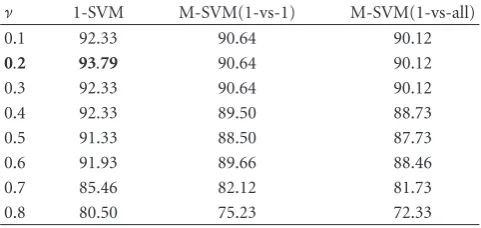
Table7: Sound recognition rates for various values ofνapplied to 1-SVMs- and M-SVMs-based classifiers.
ν 1-SVM M-SVM(1-vs-1) M-SVM(1-vs-all)
0.1 92.33 90.64 90.12
0.2 93.79 90.64 90.12
0.3 92.33 90.64 90.12
0.4 92.33 89.50 88.73
0.5 91.33 88.50 87.73
0.6 91.93 89.66 88.46
0.7 85.46 82.12 81.73
0.8 80.50 75.23 72.33
the kernel parameter,σ. From the dataset, we were able to make validation sets and use them to examine the classi-fication accuracy of the classifier as a function of σ. For a sufficiently large training set, it is possible to select the optimal parameters by applying an original cross-validation procedure [49].
σ must be tuned to control the amount of smoothing because the good performance of RBF kernels highly relies on the choice of this parameter.Figure 8shows the performance of 1-SVMs using an RBF kernel versusσ. It is interesting to point out the behavior of a 1-SVM with an RBF kernel when
σ becomes too small and when it becomes too large. When
σ becomes too small, all the training examples are support vectors. This means that the 1-SVM learns by heart and then is unable to generalize. But, whenσ becomes too large, the RBF kernel will be equivalent to the linear kernel and this leads to flat decision boundaries.
We conducted also some experiences inTable 7to show the effect of the parameterν. The 1-SVM algorithm performs well with the small values ofν. Since the smaller values ofν correspond to the smaller number of outliers, this leads to the larger region capturing most of the training points. It was decided (Table 7) to only allow 20% classification error on the training data, that is,ν=0.2.
We can remark that splitting the multiclass problem into several two classes subproblems is an approach which is generally quite precise when the number of classes is
small (typically up to 5), and when the number of training data is reasonable. Indeed, all the data of all classes are used to train the multiclass SVM, which scales typically from
O((Nc
i=1
Nc
i=1,...,N)i=/i(mi+mi)3) to O((
Nc
i=1mi)3) (each classicontainsmisounds). However, the 1-SVM approach can be generalized to any number of classes, and the com-putational cost for training scales withO(Nc
i=1m3i), which may be far quicker than any of the multiple class approaches. In conclusion, due to the need to estimate several classi-fiers if using 1-vs-1 or 1-vs-all approaches to solve an N-class classification problem, in computationally restricted envi-ronments, this can be a serious impediment. Thus, though SVMs are well founded mathematically to achieve good generalization while maintaining a high-classification accu-racy, we need to consider issues such as computation complexity and ease of implementation in order to choose the best classifier approach for a given application. Hence, in situations where accuracy and generalization are the only most important criterions for selection, we can confirm that both M-SVM strategies should be explored. In the literature, 1-vs-1 classifiers had been shown to perform better than 1-vs-all classifiers in many classification tasks. This conclusion is also confirmed in Table 7. There are, however, other practical issues for this choice, using 1-vs-1 classifiers makes the problem of each individual training smaller, and hence the memory CPU time required to train each classifier is greatly reduced. While using a 1-vs-all approach requires many fewer classifiers to be trained, the memory requirements to train each classifier were found to be prohibitive.
6. CONCLUSION
Moreover, we have developed a multiclass classification strategy by using 1-SVMs to solve a sound classification problem. The proposed system uses a discriminative method based on a sophisticated dissimilarity measure, in order to classify a set of sounds into predefined classes.
There is still room for improvement in the proposed approaches. In particular, our future research will be focused on addressing the following issues. First, in order to process in real time, the available data to train models either for sound detection or classification are always limited. Estimat-ing an accurate model from limited trainEstimat-ing data is still a challenge. Also, in real-world conditions, the complexity of the application context affects negatively segmentation and classification results.
REFERENCES
[1] V. Vapnik,Statistical Learning Theory, John Wiley & Sons, New York, NY, USA, 1998.
[2] B. Sch¨olkopf and A. Smola,Learning with Kernels, MIT Press, Cambridge, Mass, USA, 2002.
[3] N. Smith and M. Gales, “Speech recognition using SVMs,” in
Advances in Neural Information Processing Systems 14, T. G. Dietterich, S. Becker, and Z. Ghahramani, Eds., pp. 1197– 1204, MIT Press, Vancouver, Canada, December 2001. [4] V. Wan and S. Renals, “Evaluation of kernel methods for
spe-aker verification and identification,” inProceedings of IEEE International Conference on Acoustics, Speech and Signal Pro-cessing (ICASSP ’02), vol. 1, pp. 669–672, Orlando, Fla, USA, May 2002.
[5] C. J. C. Burges, J. C. Platt, and S. Jana, “Extracting noise-robust features from audio data,” inProceedings of IEEE Inter-national Conference on Acoustics, Speech and Signal Processing (ICASSP ’02), vol. 1, pp. 1021–1024, Orlando, Fla, USA, May 2002.
[6] M. Davy and S. Godsill, “Detection of abrupt spectral changes using support vector machines: an application to audio signal segmentation,” inProceedings of IEEE International Conference on Acoustics, Speech and Signal Processing (ICASSP ’02), vol. 2, pp. 1313–1316, Orlando, Fla, USA, May 2002.
[7] E. Osuna, R. Freund, and F. Girosi, “Training support vector machines: an application to face detection,” inProceedings of the IEEE Computer Society Conference on Computer Vision and Pattern Recognition (CVPR ’97), pp. 130–136, San Juan, Puerto Rico, USA, June 1997.
[8] E. Leopold and J. Kindermann, “Text categorization with sup-port vector machines. How to represent texts in input space?”
Machine Learning, vol. 46, no. 1–3, pp. 423–444, 2002. [9] J. Shawe-Taylor and N. Cristianini,Kernel Methods for Pattern
Analysis, Cambridge University Press, New York, NY, USA, 2004.
[10] L. Manevitz and M. Yousef, “One-class SVMs for document classification,” Journal of Machine Learning Research, vol. 2, pp. 139–154, 2001.
[11] H. Lodhi, C. Saunders, J. Shawe-Taylor, N. Cristianini, and C. Watkins, “Text classification using string kernels,”Journal of Machine Learning Research, vol. 2, no. 3, pp. 419–444, 2002. [12] C. Leslie, E. Eskin, A. Cohen, J. Weston, and W. Noble,
“Mis-match string kernel for discriminative protein classification,”
Bioinformatics, vol. 1, no. 1, pp. 1–10, 2003.
[13] M. Davy, F. Desobry, A. Gretton, and C. Doncarli, “An online support vector machine for abnormal events detection,”Signal Processing, vol. 86, no. 8, pp. 2009–2025, 2006.
[14] A. Rabaoui, M. Davy, S. Rossignol, Z. Lachiri, and N. Ellouze, “Improved one-class SVM classifier for sounds classification,” inProceedings of IEEE International Conference on Advanced Video and Signal Based Surveillance (AVSS ’07), pp. 117–122, London, UK, September 2007.
[15] F. Desobry, M. Davy, and C. Doncarli, “An online kernel ch-ange detection algorithm,”IEEE Transactions on Signal Pro-cessing, vol. 53, no. 8, pp. 2961–2974, 2005.
[16] A. Dufaux, Detection and recognition of impulsive sounds signals, Ph.D. dissertation, Facult´e des sciences de l’Universit´e de Neuchˆatel, Neuchatel, Switzerland, 2001.
[17] H. Kadri, Z. Lachiri, and N. Ellouze, “Speaker change detec-tion method evaluated on arabic speech corpus,” in Pro-ceedings of the 14th European Signal Processing Conference (EUSIPCO ’06), Florence, Italy, September 2006.
[18] B. W. Zhou and J. H. L. Hansen, “Unsupervised audio stream segmentation and clustering via the Bayesian information criterion,” inProceedings of the 6th International Conference on Spoken Language Processing (ICSLP ’00), pp. 714–717, Beijing, China, October 2000.
[19] M. Cettolo and M. Federico, “Model selection criteria for aco-ustic segmentation,” in Proceedings of the ISCA Workshop on Automatic Speech Recognition: Challenges for the New Millennium (ASR ’00), pp. 221–227, Paris, France, September 2000.
[20] S. Chen and P. Gopalakrishnan, “Speaker, environment and channel change detection and clustering via the Bayesian in-formation criterion,” in Proceedings of DARPA Broadcast News Transcription and Understanding Workshop, pp. 127–132, Landsdowne,Va, USA, February 1998.
[21] J. Bilmes, “A gentle tutorial of the EM algorithm and its application to parameter estimation for Gaussian mixture and hidden Markov models,” Tech. Rep. TR-97-021, International Computer Science Institute, Berkeley, Calif, USA, 1998. [22] L. R. Rabiner, “A tutorial on hidden Markov models and
se-lected applications in speech recognition,”Proceedings of the IEEE, vol. 77, no. 2, pp. 257–286, 1989.
[23] C. M. Bishop, “Novelty detection and neural networks valida-tion,”IEE Proceedings: Vision, Image and Signal Processing, vol. 141, no. 4, pp. 217–222, 1994.
[24] A. Rabaoui, M. Davy, S. Rossignol, Z. Lachiri, and N. Ellouze, “Using one-class SVMs and wavelets for audio surveillance systems,” submitted to IEEE Transactions on Information Forensics and Security.
[25] C. Campbell and P. Bennett, “A linear programming approach to novelty detection,” in Advances in Neural Information Processing Systems 13, pp. 395–401, MIT Press, Denver, Colo, USA, November 2000.
[26] D. Tax,One-class classification, Ph.D. dissertation, Delft Uni-versity of Technology, Delft, The Netherlands, June 2001. [27] A. Ganapathiraju, J. Hamaker, and J. Picone, “Support vector
machines for speech recognition,” inProceedings of the 5th-International Conference on Spoken Language Processing (ICSLP ’98), pp. 2923–2926, Sydney, Australia, November-December 1998.
[28] M. M. Moya, M. W. Koch, and L. D. Hostetler, “One-class classifier networks for target recognition applications,” in
[29] G. Ritter and M. T. Gallegos, “Outliers in statistical pattern recognition and an application to automatic chromosome classification,” Pattern Recognition Letters, vol. 18, no. 6, pp. 525–539, 1997.
[30] N. Japkowicz, Concept-learning in the absence of counter-examples: an autoassociation-based approach to classification, Ph.D. dissertation, The State University of New Jersey, New Brunswick, NJ, USA, 1999.
[31] M. Davy, F. Desobry, and S. Canu, “Estimation of minimum measure sets in reproducing kernel Hilbert spaces and appli-cations,” in Proceedings of IEEE International Conference on Acoustics, Speech and Signal Processing (ICASSP ’06), vol. 3, pp. 668–671, Toulouse, France, May 2006.
[32] D. M. J. Tax and R. P. W. Duin, “Support vector data descrip-tion,”Machine Learning, vol. 54, no. 1, pp. 45–66, 2004. [33] T. Yamada, N. Watanabe, F. Asano, and N. Kitawaki, “Voice
activity detection using non-speech models and hmm compo-sition,” inProceedings of International Workshop on Hands-Free Speech Communication (HSC ’01), pp. 131–134, Tokyo, Japan, April 2001.
[34] D. Istrate, M. Vacher, and J. F. Serignat, “D´etection et classi-fication des sons: application aux sons de la vie courante et `a la parole,” inActes du 20`eme Colloque GRETSI: Traitement du Signal et des Images (GRETSI ’05), vol. 1, pp. 485–488, Louvain-la-Neuve, Belgique, September 2005.
[35] M. Vacher, D. Istrate, L. Besacier, J. F. Serignat, and E. Castelli, “Life sounds extraction and classification in noisy environ-ment,” inProceedings of the 5th IASTED International Con-ference on Signal and Image Processing (SIP ’03), pp. 77–82, Honolulu, Hawaii, USA, August 2003.
[36] D. Istrate,D´etection et reconnaissance des sons pour la surveil-lance m´edicale, Ph.D. dissertation, Institut National Polytech-nique de Grenoble, Grenoble, France, December 2003. [37] G. Schwarz, “Estimation of the dimension of a model,”The
Annals of Statistics, vol. 6, pp. 461–464, 1978.
[38] S. Mallat,A Wavelet Tour of Signal Processing, Academic Press, New York, NY, USA, 1998.
[39] P. Delacourt and C. J. Wellekens, “DISTBIC: a speaker-based segmentation for audio data indexing,”Speech Communica-tion, vol. 32, no. 1, pp. 111–126, 2000.
[40] S. Canu and A. Smola, “Kernel methods and the exponential family,” in Proceedings of the 13th European Symposium on Artificial Neural Networks (ESANN ’05), pp. 447–454, Bruges, Belgium, April 2005.
[41] A. Smola, “Exponential families and kernels,” Berder Sum-mer School, 2004,http://sml.nicta.com.au/∼smola/teaching/ summer2004/.
[42] A. Rabaoui, Z. Lachiri, and N. Ellouze, “Hidden Markov mod-el environment adaptation for noisy sounds in a supervised recognition system,” inProceedings of the 2nd International Symposium on Communication, Control and Signal Processing (ISCCSP ’06), Marrakech, Morroco, March 2006.
[43] Leonardo Software, Santa Monica, USA, http://www.leonar-dosoft.com/
[44] Real World Computing Paternship, “Cd-sound scene database in real acoustical environments,” 2000,http://tosa.mri.co.jp/ sounddb/indexe.htm.
[45] A. Rabaoui, M. Davy, S. Rossignol, Z. Lachiri, and N. Ellouze, “S´election de descripteurs audio pour la classification des sons environnementaux avec des SVMs mono-classe,” inActes du 21`eme Colloque GRETSI: Traitement du Signal et des Images (GRETSI ’07), Troyes, France, September 2007.
[46] A. Rabaoui, H. Kadri, Z. Lachiri, and N. Ellouze, “Using robust features with multi-class SVMs to classify noisy sounds,” in
Proceedings of the 3rd International Symposium on Commu-nications, Control and Signal Processing (ISCCSP ’08), Julians, Malta, March 2008.
[47] L. R. Rabiner, M. J. Cheng, A. E. Rosenberg, and C. A. McGon-egal, “A comparative performance study of several pitch detection algorithms,”IEEE Transactions on Acoustics, Speech, and Signal Processing, vol. 24, no. 5, pp. 399–418, 1976. [48] N. Cristianini and J. Shawe-Taylor,An Introduction to Support
Vector Machines and Other Kernel-Based Learning Methods, Cambridge University Press, Cambridge, UK, 2000.