Volume 2009, Article ID 762050,11pages doi:10.1155/2009/762050
Research Article
Throughput-Optimal Scheduling with Low Average
Delay for Cellular Broadcast Systems
Chan Zhou and Gerhard Wunder
German-Sino Lab for Mobile Communications, Fraunhofer Institute for Telecommunications, Heinrich-Hertz-Institut, Einsteinufer 37, 10587 Berlin, Germany
Correspondence should be addressed to Chan Zhou,[email protected]
Received 3 March 2008; Revised 6 June 2008; Accepted 31 July 2008
Recommended by Christian Peel
While a number of scheduling policies achieve the maximum throughput region, the average delay minimization problem for cellular broadcast systems still awaits its complete solution. To this end, we introduce a scheduling policy which decomposes the cross-layer delay optimization problem into two subproblems: allocation of physical resources and user priority management. The first subproblem is translated into a weighted sum rate maximization problem that can be efficiently solved for different channel models. The solution of the second subproblem determines the weight factors in the maximization problem expressing the priorities of users. For the latter subproblem we present a so-calledidle state predictionalgorithm minimizing our relevant delay measure. Analytical and simulative tools are used to show that the introduced scheduling policy provides both optimal throughput and low delay performance.
Copyright © 2009 C. Zhou and G. Wunder. This is an open access article distributed under the Creative Commons Attribution License, which permits unrestricted use, distribution, and reproduction in any medium, provided the original work is properly cited.
1. Introduction
Allocating limited resources at medium access control (MAC) layer and physical (PHY) layer among users (from now on briefly scheduling) is a fundamental problem in the design of next generation wireless systems. In general, a scheduling problem can be formulated as some kind of optimization problem, where the objective is to max-imize/minimize some system performance measure under PHY layer constraints as well as quality of service (QoS) constraints on the MAC layer. One important performance measure is the total system throughput and it is therefore often considered as an objective of the optimization problem. Throughput-optimal scheduling policies are the policies, which can support any vector of arrival rates inside the ergodic achievable rate region [1, 2]. There exist quite a few scheduling policies which achieve this figure of merit [1,3–9].
An important observation is that even though two different scheduling policies have the same throughput performance, they might significantly differ in, for example, their packet delay performance. Hence, in a system with
random packet arrivals stored temporarily in queues, an enhanced performance criterion is to keep the queue lengths as short as possible so that the average packet delay of each user is minimized. One widely applied scheduling policy is the maximum weight matching scheduling (MWMS) policy which maximizes the sum of the rates weighted by the packet queue length of each user [3,4,10–12]. It was shown in [12] that the MWMS policy is delay-optimal for multiple-access channels. However, this result is based on the polymatroidal structure of the capacity region of multiple-access channels. For broadcast channels (BCs), MWMS is not delay-optimal even with symmetry assumptions. Motivated by this fact, Seong et al. introduced in [9] another throughput-optimal scheduling policy called queue proportional scheduling (QPS) which provides superior delay and fairness properties for the BC compared to MWMS. It minimizes the maximum draining time of the queueing system without new arrival. Based on the QPS policy, the delay region for such queueing systems can be characterized if the channel state is quasistatic [13].
by Little’s law can be calculated as the average queue length divided by the average arrival rate. Based on this expression, a scheduling problem can be formulated as a cross-layer optimization problem containing system parameters and constraints in PHY layer and MAC layer. A direct solution of such a problem involves a large number of optimization variables and is intractable. The focus of this paper is to provide a new approach to this problem.
Contributions. We first analyze some general characteristics of throughput-optimal scheduling policies. It is shown that they can be generally formulated as weighted sum rate maximization problems differing only in the choice of the weight factors. Furthermore, we prove that for throughput-optimal policies the weight factors are independent of the current channel state. Hence, the cross-layer scheduling problem is decomposed into two separate optimization subproblems:
(1) finding the optimal weight factors according to the queue states;
(2) solving the weighted sum rate maximization problem with respect to the instantaneous channel states.
Both subproblems are only coupled by the weight factors in the maximization problem. Interestingly, it was pointed out in [14,15] that the solutions of such an optimization problem itself exhibit a layered structure with only limited degree of cross-layer coupling. Under some mild conditions, the complete optimization problem can be decomposed into several subproblems and the interfaces among them are quantified as the optimization variables coordinating the subproblems.
For Step 1 we introduce an iterative algorithm called idle state prediction (ISP) algorithm to obtain the optimal weight factors. This algorithm calculates the delay-optimal weight factors under the assumption that no new arrivals occur in the future by using the ergodic achievable rate region and the current queue state. Obviously, since we assume a dynamic scenario with random arrivals, the weight factors have to be recalculated in each time slot according to the updated queue state. Once the weight factors are fixed, the actual resource allocation is determined by maximizing the weighted sum of rates according to the instantaneous channel state. Note that we do not further comment on the weighted sum rate maximization problem in Step 2 for which there exist already efficient algorithms (multiple input multiple output (MIMO) [16–18], orthogonal frequency division multiplex (OFDM) [19,20]). Simulations show that the delay performance can be significantly improved by the introduced scheduling policy.
The rest of this paper is organized as follows. In
Section 2 we describe the system model and define the stability and delay measurement used in this paper. The characteristics of the throughput-optimal scheduling are analyzed in Section 3. Based on these characteristics, we introduce our parameter separation concept for the design of throughput-optimal policies. InSection 4we present our scheduling policy for both static and dynamic channels.
The scheduler is evaluated through simulations inSection 5. Finally, we conclude withSection 6.
Notations. We use boldface letters to denote vectors and normal fonts with subscript are the elements of the vectors.
x denotes the l1-norm of the vector x. The inequality between two vectorsx≤ystands forxbeing componentwise smaller than or equal toy. Furthermore we usexto denote the smallest integer larger thanxandAcis the complement of a setA.
2. System Model
2.1. PHY Layer. We consider a single-cell downlink system in which a base station simultaneously suppliesM mobile users. The channel between the base station and each user is assumed to be constant within a time slot and varies from one time slot to another in an i.i.d. manner. The channel state of usermin thenth time slot is denoted ashm(n) ∈
S, where S is an arbitrary countable or uncountable set, and all channel states of the user setM := {1,. . .,M}are collected in the vectorh(n) ∈ SM. Here, the setSis used to indicate that the general approach is not restricted to a specific transmission scheme. For example, in an MIMO system the channel state can be described as a matrix of complex channel gains such thathm(n)∈Cnrnt wherenr,nt are the number of transmit and receive antennas at the base station and mobiles, respectively. Likewise, for an OFDM system the channel state can be defined as a vector of complex channel gains on each subcarrierhm(n) ∈ CK, whereK is the number of subcarriers. In the nth time slot the data is transmitted through the channel at rater(n)∈RM
+ lying in the achievable rate region denoted asC(h(n),P) with given sum power budgetP. For technical reasons we assume that the transmit ratesrm(n) are uniformly bounded by some real constantcr>0.
Note that it is not relevant for the purposes of this paper in what way the achievable rate region is parameterized. It is just assumed that we are able to solve the following maximization problem:
rμ,h(n):= arg max r∈C(h(n),P),
μTr, (1)
whereμ ∈ RM
+ is the set of weight factors. The solution of (1) is a point on the convex hull of the achievable rate region
C(h(n),P). Observe thatμalso represents the normal vector of the convex hull at the pointr(μ,h(n)) (seeFigure 1). Then, the ergodic achievable rate region is given by
Cerg
P:= μ=1
r1,. . .,rM:μTr≤μTE
rμ,h(n), (2)
0 0.5 1 1.5 2 2.5 3
r1 0
0.5 1 1.5 2 2.5 3 3.5 4 4.5 5
r2
μ
r(μ,h)
Convex hull ofC(h,P)
Figure1: Ergodic rate region and expected rate allocation in a 2-user scenario. The solution of the weight maximization problem (1) is a point on the convex hull of the achievable rate region C(h(n),P). The vector of weight factorsμcan be interpreted as the normal vector of the convex hull at the obtained point.
In order to show the applicability of our approach let us provide an example. We denote by COFDMA(h(n),P) the achievable region of an orthogonal frequency division multiple access (OFDMA) system, where each subcarrier is exclusively assigned to one user. Due to the limited number of coding and modulation schemes only certain rates are achievable. Furthermore, there is a fixed power budget on each subcarrier k denoted by pk and
kpk ≤ P. The achievable OFDMA region is defined as
COFDMA
h(n),P
≡
M
m=1θm,k=1,∀k
θm,k∈{0,1}
r:rm=
K
k=1
rm,khm,k,pk
θm,k
, (3)
where θm,k ∈ {0, 1} is the indicator if user mis mapped onto subcarrier k and rm,k(hm,k,pk) is the rate of user m on subcarrier k with transmit power pk in one time slot (e.g., 2 bits for QPSK). The parameterhm,k is the reported (quantized) channel state of user mon subcarrier k. Due to these practical constraints COFDMA(h(n),P) is a set of discrete rate points, nevertheless the solution in (1) achieves the points on the convex hull of COFDMA(h(n),P) and the formulation of the ergodic achievable regionCerg(P) is still valid. A detailed description of this region can be found in [20].
2.2. MAC Layer. Assuming that the transmission is time-slotted, data packets arrive randomly at the MAC and queue up in a buffer reserved for each userm∈M. Simultaneously the data is read out from the buffers according to the system state, that is, the random channel state and the current queue lengths. Thus, the system can be modeled as a queueing
system with random processes reflecting the arrival and the departure of data packets.
Denoting the queue state of themth buffer in time slot
n∈Nbyqm(n) and arranging all queue states in the vector q(n) ∈ RM
+ the evolution of the queueing system can be written as
q(n+ 1)=q(n)−r(n) +a(n)+, (4) where [x]+m = max{0,xm}, for allm ∈ M.a(n) ∈ RM+ is a random vector denoting the amount of arrival packets during thenth time slot and the vectorr(n) ∈ RM
+ is the amount of transmitted data. Without loss of generality we set the length of a time slotT=1, so thata(n) andr(n) are equal to the arrival and transmit rate during the time slot
n. We assume that the size of a data packet is constant and the sequence of arrival packets forms an i.i.d. sequence of variables over time. To simplify the notation we set the packet size to 1 without loss of generality. Further we make the technical assumption that the maximum numbers of arrival packets within one time slot are uniformly bounded by real constantca >0. The vector of mean arrival rates is denoted asρ=E{a(n)} ∈RM
+.
The transmit rate r(n) is determined by the applied scheduling policy. In this paper, we consider only stationary scheduling policies which are the mappings
P :SM×RM
+ −→RM+,
h(n),q(n)r(n). (5) We further assume that the scheduling policies are only dependent on the proportion of the individual queue lengths and not dependent on the normq(n); this covers most existing policies. The rate allocation according to the scheduling policy P is denoted as rP(h(n),q(n)). Since
both arrival rates a(n) and channel state h(n) are i.i.d., the evolution of the queueing system can be modeled as a discrete-time Markov chain with general state space.
2.3. A Cross-Layer Performance Measure. The throughput region is defined as the set of all arrival rate vectors for which the Markov chain in (4) is stable in some sense [2]. There exist several relevant stability measures for Markov chains in literature, for example, strongly stable, weakly stable, recurrent. In this paper we resort to the definition of weak stability as in [21].
Definition 1. If for every>0 there isB >0 andN0() such that for alln > N0(), it follows Pr(q(n)> B)<; then the Markov chain isweakly stable.
In contrast the definition of an unstable Markov chain is more subtle.
Definition 2. A Markov chain is said to beuniformly transient if there is a countable cover ofRM
+ with uniformly transient sets, that is, there isC < ∞withE(ηA)≤C for allx ∈A,
whereηA=
∞
n=1I(q(n)∈A).
under a specific scheduling policyPwhen the corresponding queueing system driven by P is weakly stable (uniformly transient). It is well-known that any vector of arrival rates inside the ergodic achievable rate region is stabilizable and all other vectors of arrival rates are not stabilizable [1,2]. Thus, a scheduling policy is calledthroughput-optimalif it keeps the system weakly stable for any vector of arrival ratesρwhich lies in the ergodic achievable rate region.
Having defined throughput-optimal scheduling poli-cies we now introduce a relevant cross-layer performance measure for average packet queueing delay. Consider the following quantity:
D(N)= 1
M
M
m=1
Dm(N)= 1
MN
N
n=1 M
m=1
αmqm(n), (6)
where the natural number N ≥ 1 is the length of the observation time window and α1,. . .,αm are positive real factors. If the factors are chosen such thatαm := 1/ρm = 1/E{am(n)}, and the limit limN→+∞(1/N)Nn=1αmqm(n) exists and is equal to its stationary value, then Dm(N) represents the average queueing delay of each packet of user
mas N → +∞[22]. Note that even if the average arrival ratesρm are not known a priori or they are approximately estimated “on the fly,” so thatαm=/1/ρm, (6) still represents a useful, measurable quantity for practical purposes. In this case,D(N) is the weighted average delay where the weight factor equalsαmρm.
3. Parameter Separation Design of
Throughput-Optimal Scheduling Policies
In this section, we study some general characteristics of throughput-optimal scheduling policies.
Theorem 1. A throughput-optimal policy always allocates the rate vector on the convex hull of the instantaneous rate region.
Proof. If the scheduling policy P allocates a rate vec-tor rP(h(n),q(n)) in the interior of the convex hull of
C(h(n),P), we have
μ∗TrPh(n),q(n)< max r∈C(h(n),P)μ
∗Tr (7)
for someμ∗ ∈ RM
+. Disregarding sets of measure zero and since the policy is independent of time indexn, the ergodic achievable rate regionCP
erg(P) of the policyP is smaller than
Cerg(P),
CP
erg(P) :=
q∈RM +
r1,. . .,rM:r≤E
rPh,q⊂Cerg
P.
(8)
Thus, the scheduling policy does not achieve the entire ergodic rate region Cerg(P) and is not throughput-optimal.
Theorem 1is to be understood in the sense that if the rates are not allocated on the convex hull of the instantaneous
rate region, some arrival traffic with ρ ∈ C(h(n),P) can be constructed so that the queueing system is uniformly transient. Since not all arrival rates withρ∈C(h(n),P) can be supported, the policy is not throughput-optimal.
Therefore, throughput-optimal scheduling policies can be formulated as an optimization problem,
rPh(n),q(n)= arg max
r∈C(h(n),P)
μPh(n),q(n)Tr, (9)
whereμP determined by scheduling policyP is a mapping
from the current channel stateh(n) and the queue stateq(n) to the set of weight factors. Generally two mappingsμP and
μP lead to the same rate point, where the convex hull has no unique supporting hyperplane. In this case, we define μP to be equivalent to μP if they lead to the same point.
The following theorem presents an important property of the mappingμP.
Theorem 2. The mappingμP which characterizes a
through-put-optimal scheduling policy is independent of the current fading stateh(n).
Proof. We choose arbitrarily a weight vectorμ∗ correspond-ing to a fixed boundary pointr∗ of the ergodic achievable rate region, hence μ∗ is independent of the instantaneous channel state. According to Theorem 1 we have for the channel statehand the queue stateq
rPh,q=arg max r∈C(h,P)
μPh,qTr. (10)
Thus, for fixedq∈RM
+, we have
μ∗TErPh,q|q=E
μ∗Targ max r∈C(h,P)
μPh,qTr|q
≤E
max r∈C(h,P)
μ∗Tr
=μ∗Tr∗.
(11)
Equality holds if and only if μP(h, q) = μ∗ and the
boundary point is achieved by the scheduler P, otherwise the scheduling policy gives a rate vector in the interior of the ergodic rate region. Therefore, ifμP is dependent of the
instantaneous channel state, we can choose an arrival process whose mean rateρ∗fulfills
max q∈RM
+
μ∗TErPh,q|q<μ∗Tρ∗<μ∗Tr∗. (12)
Define a bounded positive function withx∈RM +
V(x)=1− 1
we have
ΔV=EVq(n+ 1)−V(q(n)|q(n)
=E
μ∗Tq(n)−r(n)+a(n)+−μ∗Tq(n)
μ∗Tq(n)−r(n)+a(n)++1μ∗Tq(n)+1|q(n)
E
μ∗Ta(n)−μ∗Tr(n)
μ∗Tq(n) +a(n)+ 1(μ∗Tq(n) + 1|q(n)
,
(14)
ifq(n)is sufficiently large. Since the arrival rate is bounded
am(n)< ca<+∞, for allm∈M, it holds
ΔV >E
μ∗Ta(n)−μ∗TrPh(n),q(n)
μ∗Tq(n) +c
aμ∗+ 1
μ∗Tq(n) + 1|q(n)
= μ∗Tρ∗−μ∗TE
rPh(n),q(n)|q(n)
μ∗Tq(n) +c
aμ∗+ 1
μ∗Tq(n) + 1
>0.
(15)
Since the last inequality holds for anyq(n), according to [23, Theorem 8.4.2] the queueing system is uniformly transient.
As we introduced inSection 1, cross-layer design usually improves the system performance at the cost of high com-putational complexity. The optimization problem involves variables and constraints from both PHY and MAC layer. The resources, which can be dynamically adapted, are not only limited to transmit power, but can also be extended to code, frequency, and space according to the applied physical model. At the same time, the scheduler must consider the possible evolution of the queue states in subsequent time slots. However, following the result in Theorem 2, we can define the weight vector μP(q) of a
throughput-optimal policy as a function only determined by queue state q. In this way, the classical cross-layer optimization problem can be divided into two subproblems: finding the optimal weight vector μP(q) according to the queue
states; solving the resource allocation problem (9) with the given weight vector. By the separation of the optimization parameters, the complexity of the optimization problem is largely reduced. Since the second subproblem can be efficiently solved for various physical models, the scheduling design problem reduced to find the optimal weight vector for the optimization problem. Particularly for the considered delay optimization problem, the interface between the two subproblems is the weight factorμP(q). An illustration of the
scheme is shown inFigure 2. The average packet delayD(N) is dependent on the rate allocationrP, which is controlled
by the weight factor μP. Thus in Subproblem 1 we aim
to find the optimal weight factor which minimize averaged delayD(N). The obtained weight factorμP is then used in
Subproblem 2 to calculate the rate allocationr. The details of this scheduling algorithm is introduced in the next section.
Subproblem 1
Priority management:μP=arg minD(N) μ
μP
Subproblem 2
Resource allocation:r= arg max
r∈Ch(n),P
μPTr
Figure2: Illustration of parameter separation. The suboptimiza-tion problems are coupled by the weight factorμP.
4. Scheduling Design
In this section, we introduce our scheduling policy. First, we solve the delay-optimization problem for a queueing system with a static channel and no new packet arrivals. Then, we adapt the scheduling policy to the queueing system with dynamic channels and random packet arrivals.
4.1. Scheduling Policy for a Static Channel. Consider a static channelhand the initial queue statesq(n =1), we assume there is no packet arriving after n = 1 and we choose a sufficiently large observation time windowNwithqm(N)= 0, for allm∈M, so that the buffers are completely emptied within the time window. Thus, the scheduling policy can be written as the solution of the optimization problem:
min M
m=1
Dm(N)≡min N
n=1 M
m=1
αmqmn
s.t. qnm+1=qmn−rmn, rn∈C(h,P),
qn
m−rmn ≥0, ∀m∈M,n∈[1,. . .,N], (16)
where qn
m, rmn denote the queue length and transmit rate of user m in time slot n. For convenience, we also use the superscript to denote the time slot in the following. Extending the problem (16) to each queue stateqnwe have the equivalent optimization problem
min N
n=1 M
m=1
αmq1m− M
m=1
(N−n)αmrnm
s.t. rn∈Ch,P,
q1 m−
n
t=1
rt
m≥0, ∀m∈M,n∈[1,. . .,N]. (17)
(1) Setμ(0)m =αm, for allm∈Mand calculater(0)=arg maxr∈C(h,P)μ(0)Tr.
(2) Initialize the length of non-idle stateη(0)m =minm∈M(q1m/r
(0)
m ), for allm∈M.
(3) Set the orderπso thatq1
π(1)/r (0)
π(1)≥q1π(2)/r (0)
π(2)≥ · · · ≥q1π(M)/r (0)
π(M).
(4) Sett=0.
repeat
(5.1) Setη(t+1)=η(t)
form=1 toMdo
(5.2.1)η =η(t+1)
repeat
(5.2.2.1) Increaseηπ(m)and calculateμnby settingηπ∗(m)=ηπ(m)in (19).
(5.2.2.2) Solve the maximization problem (20) and calculate the evolution of the queue state.
ifqηπ(m)
π(m) ≥0then η(πt(+1)m)=ηπ(m)
end if untilqηπ(m)
π(m) <0
end for
t=t+ 1
untilη(mt)−ηm(t−1)<, for allm∈M
(6)η∗=η(t)
is the predefined error tolerance ofηm.
Algorithm1: Idle state prediction algorithm.
large. Therefore, we introduce in the following an iterative algorithm calledidle state predictionalgorithm to solve the problem.
Formulating the Lagrangian function of (17)
L(rn,λn)= N
n=1 M
m=1
αmq1m− N
n=1 M
m=1
(N−n)αmrmn
−
N
n=1 M
m=1
λn m
q1 m−
n
t
rt m
.
(18)
Denoteη∗m=αmN− N
t=1λtm, ifηm∗is known, we can get the optimalμn
mwith
μn m=
⎧ ⎨ ⎩
αm
ηm∗−n+ 1
n≤ηm∗, 0 n > η∗m,
(19)
and the delay-optimization problem is transformed into
max N
n=1 μnTrn
s.t. rn∈Ch,P,
(20)
whereμnis the vector of weight factors in thenth time slot. The parameters η∗m in (19) can be interpreted as the expected service time of user mif the optimal solution is applied. In the time slots n > ηm∗ the buffer of user mis emptied and the corresponding transmitter is in idle state. Based on this property, η∗ is obtained with an iterative approach given inAlgorithm 1.
Theorem 3. η(t)obtained inAlgorithm 1converges to the toη∗
which gives the optimalμni for the delay-optimization problem (16).
Proof. In any time slotn > ηm∗, we haveμnm=0 which means the buffer ofith user is empty at thenth time slot. In anyn≤
η∗m, themth buffer must be nonempty. Therefore, ifη(t) = η∗, we have qm(η∗m) = 0, for all m ∈ M, andη(t+1) = η∗=η(t). The break condition in Step (6) is fulfilled and the algorithm stops at the optimum.
For two usersi,j ∈M, ifη∗i ≥η∗j, the optimal weight factors
μn i
μnj
= αi
ηi∗−n+ 1
αj
η∗j −n+ 1 > αi
αj =
μ(0)i
μ(0)j
, n∈1,. . .,η∗j
.
(21)
The rate allocation is determined by the given weight factor, thus
rin
rn j
> r
(0) i
r(0)j
, n∈1,. . .,η∗j
(22)
follows.
From (22), we have
ri(0)
r(0)j
≤
η∗
j
n=1 rin η∗j
n=1 rnj
≤
η∗j
n=1rin+ η∗i
n=η∗j+1r
n i η∗j
n=1 rnj
=q1i
q1j
, (23)
and it holds
qi1
ri(0)
≥ q
1 j
r(0)j
Therefore,πin Step (3) gives also the order ofη∗so that
η∗π(i)≥η∗π(j), ifi < j.
For theπ(M)th user withη∗π(M)=mini∈Mη∗π(i), we have
μnπ(M)
μn i
= απ(M)
η∗π(M)−n+ 1
αi
η∗i −n+ 1
≤ απ(M)
αi =
μ(0)π(M)
μ(0)i ,
∀n∈1,. . .,η∗π(M)
,∀i∈M,i /=π(M).
(25)
It followsrn π(M) ≤r
(0)
π(M), for alln ∈[1,. . .,
η∗π(M)
].Hence, in the initial stateη(0)π(M)≤η∗π(M)and furtherη
(0)
m =ηπ(0)(M) ≤
η∗m, for allm ∈M,m /=π(M). In each iteration step, if the optimumη∗is not achieved,η(mt+1)can always be increased so thatη(mt+1) > η(mt), for allm∈M. Hence, the convergence of the algorithm is proven.
4.2. Scheduling Policy for Dynamic Channels. It is worth noting that if channel state h(n) varies over time and the base station has the knowledge of each channel state in advance, the algorithm in the previous subsection can also be used in this case with some modifications. However, such a noncausal scheduler is not realizable. The base station has usually only the current channel state information and the statistical knowledge of the channel. In this case, the optimal weight factors are calculated by the ergodic achievable rate region and under the assumption that there is no new packets arrival. In the next time slot, the weight factors must be recalculated according to the new queue state.
If no new packet arrives after the time slotn = 0, the expected delay for a given policyP is
1
ME
M
m=1
Dm(N)
= 1
ME
N
n=1 M
m=1
αmq1m− M
m=1
(N−n)αmrmPn
,
(26)
whererPn
m is the rate allocated by the policyP for themth user atnth time slot. FromTheorem 2, we know that ifP is a throughput-optimal policy, then
ErPhn,qn=arg max r∈Cerg(P)
μPqnTr, (27)
whereμPis independent of the current channel state. Hence,
the optimization problem is equivalent to
min N
n=1 M
m=1
αmq1m− M
m=1
(N−n)αmrnm
s.t. rn∈Cerg(P),
q1 m−
n
t=1
rt
m≥0, ∀m∈M,n[∈1,. . .,N]. (28)
Then, the optimization problem can be solved using
Algorithm 2.
In the system with new packet arrivals, the weight vector
μshould be recalculated according to the new queue state and the rate allocation is determined byμand the current channel stateh(n).
As we introduced inSection 2, if we chose the factorαm= 1/ρm, the limit limN→+∞D(N) represents the average delay
of each packet. Average arrival ratesρm can be estimated by previous arrival processes. However, even if the estimation deviates from the actual arrival rate, limN→+∞D(N) can still
be considered as a useful delay measurement.
The ergodic achievable rate region is also estimated based on the history. The ergodic region is calculated from a number of sampled fading states, thus the computational complexity might be very high. In [9], a method is intro-duced to approximate the boundary surface of Cerg(P) by utilizing a hypersphere. Only M + 1 boundary points on
Cerg(P) are necessary to characterize the hypersphere so that the complexity is significantly reduced.
In order to prove the throughput-optimality of the policy, we need some technical propositions. The following propositions show the scheduling behavior as the queue length in the system increases. Supposing that the queue length of some users are bounded by some constantc ≥ 0, while the sum of queue lengthqis increasing, we denote the set of these users asG1:= {m|qm≤c,m∈M}and the remainder asG2=M/G1.
Proposition 1. Ifqiis bounded,i∈G1, andqjis unbounded,
j∈G2whileqis increasing, there exists someB >0, so that
ηi
ηj <
1, ∀q> B (29)
for arbitrary1>0.
Proof. We denote the expected service time for useri,jasηi,
ηjandηi,ηjwhere the initial queue length of useriis fixed toqiand the queue length of user j is increased such that
qj> qj. Suppose
ηi
ηj
≥ ηi
ηj
, (30)
then the weight factor
μni
μn j
= αi
ηi−n+ 1
αj
ηj−n+ 1 ≥ αi
ηi−n+ 1
αj
ηj−n+ 1 =μ n i μn j ,
∀n∈1,. . .,ηi
.
(31)
The rate allocation rn
i and rin are determined by the weight factorμn
i,μni , then it holds
rn
i ≥rin, ∀n∈
1,. . .,ηi
. (32) Further, we have
qi=
ηi
n=1
rn i >
ηi
n=1
rn i ≥
ηi
n=1
rn
foreach time slotn,do
(1) Calculateη∗according to current queue statequsingAlgorithm 1, where the static rate regionC(h,P) is replaced with the ergodic achievable rate regionCerg(P).
(2) Calculate the weight factorμm=αmη∗m, for allm∈Mfor the current time slot.
(3) Calculate the current rate allocation
r∗=arg max
r∈C(hn,P)
μTr,
wherehnis the current channel state. end for
Algorithm2
and reach a contradiction. Therefore, it is shown that ifqiis fixed,ηi/ηjmonotonously decreases with growingqjas long asηi/ηj>0 and the proof follows.
Proposition 2. Ifqi,qjare unbounded,i,j∈G2,whileqis increasing such thatqi=γiq,qj=γjq, for someγi,γj> 0, there exist someB >0, so that
1−ηηij
<2, ∀q> B (34) for arbitrary2>0.
Proof. Consider two queue stateqandq,q =θqfor someθ >1. The estimated service time for queue stateqand q is denoted asη,η and the expected rate allocation at the
nth time slot isrnandrn. Without loss of generality, we set
ηi/ηj>1. Suppose
ηi
ηj
≥ ηi
ηj, (35) it holds
1/ηi
ηi
n=1rin
1/ηj ηj
n=1rnj
=
1/ηi
qi
1/ηj
qj
=
1/ηi
γi
1/ηj
γj
>
1/ηinη=i1rni
1/ηj ηj
n=1rnj
=
1/ηi
qi
1/ηj
qj =
1/ηi
γi
1/ηj
γj ,
(36)
thenηi/ηj > ηi/ηj follows which leads to the contradiction to (35). Hence,ηi/ηjdecreases withqas long asηi/ηj >1 and the proof follows.
Theorem 4. The proposed scheduling policy keeps the system stable for any set of arrival rates of which the expected valueρ lies inside the ergodic achievable rate region.
Proof. For the proof of weak stability it is sufficient to show that for anyρ ∈Cerg(P), the Lyapunov driftΔV is negative for some lower bounded functionV : RM
+ → R+ [21,23]. Supposing that there are i ∈ G2 whose queue lengths are unbounded, we choose
V(q)=
i∈G2
αiqi. (37)
Since qiis unbounded whileri < cr, for alli ∈ G2, the drift
ΔV =E
i∈G2
αi
qni +ani −rin +
−
i∈G2
αiqin qn =E
i∈G2
αi
ani −rni
|qn
.
(38)
Choose arbitrary j∈G2and according to Propositions1 and2, we have
ΔV ≤E
i∈G2
αi
ηi
ηj +2
an i −rin
qn ≤ 1 ηj
i∈G2
αi
ηiρi−E
rn i|qn
+
i∈G2
2αi
ca+cr
≤ 1
ηj
i∈M
αiηi
ρi−E{rin|qn}
+
i∈G2
2αi
ca+cr
+
i∈G1
1αi
ca+cr
.
(39)
Defineβ=maxr∈Cerg(P)mini∈M(ri−ρi), we have
ΔV≤ 1
ηj
i∈M
αiηi(−β) +
i∈G2
2αi
ca+cr
+
i∈G1
1αi
ca+cr
(40)
≤ −β
i∈M
αi+2β
i∈G2
αi+2
i∈G2
αi
ca+cr
+1
i∈G1
αi
ca+cr
. (41)
Since the first addend in (41) is constant and the last three addends vanish by increasing qn, the driftΔV < 0 for
qn> BifBis sufficiently large. Hence, the Markov chain is weakly stable and the proof follows.
5. Numerical Evaluations
0 2 4 6 8 10 12
r2(Mbit/s) 0
2 4 6 8 10 12
r1
(Mbit/s)
Cerg(P)
ρ
Figure3: Ergodic achievable rate region of an OFDMA system for 2 users. 7 sets of arrival rates (x-marks in the figure) are chosen from the inside/outside of the rate region to test the throughput and delay performance of the system.
throughput-optimal policies: MWMS [3] and QPS [9]. MWMS uses the queue length as the weight factor in the maximization problem:
rP(hn,qn)=arg max r∈C(hn,P)
qnTr. (42)
For the QPS policy, the weight vector is chosen as the norm at the boundary point ofCerg(P), whereE{rP(hn,qn)|qn}is proportional toqn,
ErPhn,qn=qn max
xqn∈Cerg(P)x,
s.t. rPhn,qn∈Chn,P,
(43)
wherexis a scalar.
The performance of the three schedulers are compared for an OFDMA system as described in [20]. The system has 250 orthogonal subcarriers and an entire bandwidth of 2.5 MHz. The multipath channel is modeled as i.i.d block fading and the length of channel impulse response
Lm = 4, for all m ∈ M. The length of a time slot T is 2 milliseconds and in every slot 27 OFDM symbols are transmitted per subcarrier. The modulation is adapted to the different channel states on each subcarrier and can be chosen from QPSK, 16QAM, 64QAM. The source data is coded at rate 2/3, so that the decoding error probability at the receiver is lower than 1e-3. For an average receive SNR of 15 dB the ergodic achievable rate region for two users is shown inFigure 3. Note that the small number of users is
3 4 5 6 7 8 9
ρ2(Mbits/s) 101
102
Av
er
ag
e
p
ac
ke
t
d
el
ay
(m
s)
MWMS QPS ISP
Figure 4: Delay performance of the OFDMA system driving by MWMS, QPS, and the introduced ISP scheduling policy. The sets of average arrival rates in the system are indexed by the arrival rate of user 2.
not a limitation but facilitates the description of the ergodic achievable rate region.
We choose arrival rateρ1 =[366, 488, 610, 732, 854, 977, 977] packet/s and ρ2 = [732, 976, 1220, 1464, 1708, 1954, 2440] packet/s for user 1 and 2, respectively, where the size of a packet is 512 bytes. In Figures3and4, the arrival rates are converted to Mbit/s for convenience. In order to verify the stability properties of the system the last set of arrival rates is chosen to lie outside the ergodic achievable rate region.
The average packet delay in the system with the selected sets of arrival rates is shown inFigure 4. It can be seen that for the sets of arrival rates inside the ergodic rate region the system is kept stable in the sense that the average packet delay is finite. For the arrival ratesρ =[977; 2440] packet/s the packet delay tends to go to infinity. All three scheduling policies are throughput-optimal. Compared to the other two scheduling policies, the introduced scheduling policy has the best delay performance and achieves a significant gain. Note that in order to show the rapid growth of the delay time by increased arrival rates, they-axis is logarithmically scaled.
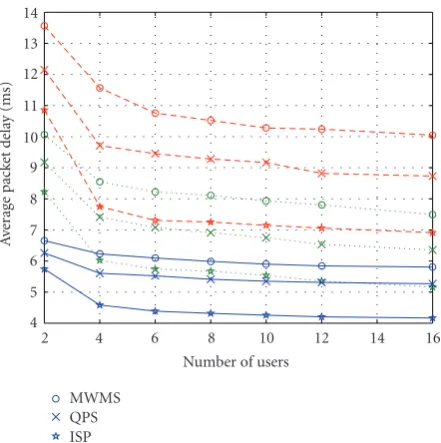
In Figure 5, we compare the delay performance with respect to the number of supported users in the system. The number of users is increased fromM =2 toM=16, while the sum of expected arrival rate remains the same. Denote the sum of expected arrival rate bySρ, we set ρi = 2Sρ/3M for i ∈ M, if i is odd and ρi = 4Sρ/3M for i ∈ M, if i is even. The other physical parameters are the same as in Figures 3 and 4. Figure 5 shows the average packet delay in the system resulting from the different scheduling policies. Solid lines are simulated by arrival rate set 1 with
2 4 6 8 10 12 14 16 Number of users
4 5 6 7 8 9 10 11 12 13 14
Av
er
ag
e
p
ac
ke
t
d
el
ay
(m
s)
MWMS QPS ISP
Figure5: Delay performance of MWMS, QPS, and ISP scheduling policy with respect to number of supported users in the system. Solid lines are simulated by arrival rate set 1. Dotted lines are simulated by arrival rate set 2. Dashed lines are simulated by arrival rate set 3.
by arrival rate set 3 with Sρ = 2196 packet/s. Same as in
Figure 4, it can be observed that the delay increases with increasingSρ. FixingSρ, the delay decreases with the number of users due to multiuser diversity. At the same time, because of higher flexibility in resource allocation, ISP scheduler provides even more performance gain in delay than the other two schedulers. In case of M = 6, ISP scheduler achieves about 30% reduction in averaged delay compared to QPS.
6. Conclusion
In this paper, we presented a concept to design throughput-optimal scheduling policies for cellular BC systems. In general it is shown that the scheduling problem can be formulated as a weighted sum rate maximization problem, where the characteristics of the scheduling policy is deter-mined by the choice of weight factors in the maximization problem classifying all throughput-optimal policies. Based on this concept, a throughput-optimal policy is developed to achieve low delay performance. The weight factors achieving the minimum averaged delay are obtained by an iterative procedure, called idle state prediction (ISP) algorithm. The convergence of the algorithm as well as the throughput-optimality of the scheduling policy are proven. Numerical results show that ISP reduces significantly average packet delay compared to other existing scheduling policies. In systems with larger number of users, this advantage becomes even more noticeable due to higher flexibility in resource allocation.
Acknowledgments
Parts of this work were supported by the German Ministry for Education and Research under Grant FK 01 BU 566 (the ScaleNet project). Some other parts were presented at the IEEE Globecom 2007 in Wash (USA), November 2007.
References
[1] A. Eryilmaz, R. Srikant, and J. R. Perkins, “Stable scheduling policies for fading wireless channels,”IEEE/ACM Transactions on Networking, vol. 13, no. 2, pp. 411–424, 2005.
[2] G. Wunder and C. Zhou, “Queueing analysis for the OFDMA downlink: throughput regions, delay and exponential backlog bounds,” submitted to the IEEE Transactions on Wireless Communications.
[3] L. Tassiulas and A. Ephremides, “Stability properties of constrained queueing systems and scheduling policies for maximum throughput in multihop radio networks,” IEEE Transactions on Automatic Control, vol. 37, no. 12, pp. 1936– 1948, 1992.
[4] N. McKeown, A. Mekkittikul, V. Anantharam, and J. Walrand, “Achieving 100% throughput in an input-queued switch,” IEEE Transactions on Communications, vol. 47, no. 8, pp. 1260– 1267, 1999.
[5] M. Andrews, K. Kumaran, K. Ramanan, A. Stolyar, P. Whiting, and R. Vijayakumar, “Providing quality of service over a shared wireless link,”IEEE Communications Magazine, vol. 39, no. 2, pp. 150–154, 2001.
[6] S. Shakkottai and A. L. Stolyar, “A study of scheduling algorithms for a mixture of real and non-real time data in HDR,” Tech. Rep., Bell Laboratories, Murray Hill, NJ, USA, October 2000.
[7] S. Shakkottai and A. L. Stolyar, “Scheduling for multiple flows sharing a time-varying channel: the exponential rule,” in Analytic Methods in Applied Probability: In Memory of Fridrikh Karpelevich, vol. 207 ofAmerican Mathematical Society Trans-lations, Series 2, pp. 185–202, American Mathematical Society, Providence, RI, USA, 2002.
[8] A. Eryilmaz, R. Srikant, and J. R. Perkins, “Throughput-optimal scheduling for broadcast channels,” inModelling and Design of Wireless Networks, vol. 4531 ofProceedings of SPIE, pp. 70–78, Denver, Colo, USA, August 2001.
[9] K. Seong, R. Narasimhan, and J. M. Cioffi, “Queue pro-portional scheduling via geometric programming in fading broadcast channels,”IEEE Journal on Selected Areas in Com-munications, vol. 24, no. 8, pp. 1593–1602, 2006.
[10] M. J. Neely, E. Modiano, and C. E. Rohrs, “Power allocation and routing in multibeam satellites wit time-varying chan-nels,”IEEE/ACM Transactions on Networking, vol. 11, no. 1, pp. 138–152, 2003.
[11] E. M. Yeh and A. S. Cohen, “Throughput and delay optimal resource allocation in multiaccess fading channels,” in Pro-ceedings of the IEEE International Symposium on Information Theory (ISIT ’03), p. 245, Yokohama, Japan, June-July 2003. [12] E. M. Yeh and A. S. Cohen, “Delay optimal rate allocation
in multiaccess fading communications,” in Proceedings of the 42nd Allerton Conference on Communication, Control, and Computing, pp. 140–149, Monticello, Ill, USA, October-September 2004.
Global Telecommunications Conference (GLOBECOM ’07), pp. 3343–3347, Washington, DC, USA, November 2007. [14] M. Chiang, “Balancing transport and physical layers in
wireless multihop networks: jointly optimal congestion con-trol and power concon-trol,”IEEE Journal on Selected Areas in Communications, vol. 23, no. 1, pp. 104–116, 2005.
[15] X. Lin, N. B. Shroff, and R. Srikant, “A tutorial on cross-layer optimization in wireless networks,”IEEE Journal on Selected Areas in Communications, vol. 24, no. 8, pp. 1452–1463, 2006. [16] H. Viswanathan, S. Venkatesan, and H. Huang, “Down-link capacity evaluation of cellular networks with known-interference cancellation,” IEEE Journal on Selected Areas in Communications, vol. 21, no. 5, pp. 802–811, 2003.
[17] R. B¨ohnke and K.-D. Kammeyer, “Weighted sum rate maxi-mization for the MIMO-downlink using a projected conjugate gradient algorithm,” in Proceedings of the 1st International Workshop on Cross Layer Design (IWCLD ’07), pp. 82–85, Jinan, China, September 2007.
[18] J. Liu and Y. T. Hou, “Maximum weighted sum rate of multi-antenna broadcast channels,” inProceedings of the IEEE Global Telecommunications Conference (GLOBECOM ’07), Washington, DC, USA, November 2007.
[19] L. Li and A. J. Goldsmith, “Capacity and optimal resource allocation for fading broadcast channels—I: ergodic capacity,” IEEE Transactions on Information Theory, vol. 47, no. 3, pp. 1083–1102, 2001.
[20] G. Wunder, C. Zhou, H.-E. Bakker, and S. Kaminski, “Throughput maximization under rate requirements for the OFDMA downlink channel with limited feedback,”EURASIP Journal on Wireless Communications and Networking, vol. 2008, Article ID 437921, 14 pages, 2008.
[21] E. Leonardi, M. Mellia, F. Neri, and M. Ajmone Marsan, “Bounds on average delays and queue size averages and variances in input-queued cell-based switches,” inProceedings of the 20th Annual Joint Conference of the IEEE Computer and Communications Societies (INFOCOM ’01), vol. 2, pp. 1095– 1103, Anchorage, Alaska, USA, April 2001.
[22] L. Kleinrock, Queueing Systems, vol. 1, John Wiley & Sons, New York, NY, USA, 1975.