Volume 2008, Article ID 235357,12pages doi:10.1155/2008/235357
Research Article
About Advances in Tensor Data Denoising Methods
Julien Marot, Caroline Fossati, and Salah Bourennane
Institut Fresnel CNRS UMR 6133, Ecole Centrale Marseille, Universit´e Paul C´ezanne, D.U. de Saint J´erˆome, 13397 Marseille Cedex 20, France
Correspondence should be addressed to Salah Bourennane,[email protected]
Received 15 December 2007; Revised 15 June 2008; Accepted 31 July 2008
Recommended by Lisimachos P. Kondi
Tensor methods are of great interest since the development of multicomponent sensors. The acquired multicomponent data are represented by tensors, that is, multiway arrays. This paper presents advances on filtering methods to improve tensor data denoising. Channel-by-channel and multiway methods are presented. The first multiway method is based on the lower-rank (K1,. . .,KN) truncation of the HOSVD. The second one consists of an extension of Wiener filtering to data tensors. When multiway tensor filtering is performed, the processed tensor is flattened along each mode successively, and singular value decomposition of the flattened matrix is performed. Data projection on the singular vectors associated with dominant singular values results in noise reduction. We propose a synthesis of crucial issues which were recently solved, that is, the estimation of the number of dominant singular vectors, the optimal choice of flattening directions, and the reduction of the computational load of multiway tensor filtering methods. The presented methods are compared through an application to a color image and a seismic signal, multiway Wiener filtering providing the best denoising results. We apply multiway Wiener filtering and its fast version to a hyperspectral image. The fast multiway filtering method is 29 times faster and yields very close denoising results.
Copyright © 2008 Julien Marot et al. This is an open access article distributed under the Creative Commons Attribution License, which permits unrestricted use, distribution, and reproduction in any medium, provided the original work is properly cited.
1. INTRODUCTION
Tensor data modelling and tensor analysis have been improved and used in several application fields. These appli-cation fields are quantum physics, economy, psychology, data analysis, chemometrics [1]. Specific applications are the characterization of DS-CDMA systems [2], and the classification of facial expressions. For this application, a multilinear independent component analysis [3] was created. Another specific application is in particular the processing and visualization of medical images obtained through mag-netic resonance imaging [4].
Tensor data generalize the classical vector and matrix data to entities with more than two dimensions [1,5,6]. In signal processing, there was a recent development of multicomponent sensors, especially in imagery (color or multispectral images, video, etc.) and seismic fields (an antenna of sensors selects and records signals of a given polarization). The digital data obtained from these sensors are fundamentally multiway arrays, which are called, in the signal processing community and in this paper in particular, higher-order tensor objects, or tensors. Each multiway array entry corresponds to any quantity. The
elements of a multiway array are accessed via several indexes. Each index is associated with a dimension of the tensor generally called “nth-mode” [5, 7–10]. Measured data are not fully reliable since any real sensor will provide noisy and possibly incomplete and degraded data. Therefore, all problems dealt with in conventional signal processing such as filtering, restoration from noisy data must also be addressed when dealing with tensor signals [6,11].
In order to keep the data tensor as a whole entity, new signal processing methods have been proposed [12–
15]. Hence, instead of adapting the data tensor to the classical matrix-based algebraic techniques [16, 17] (by rearrangement or splitting), these new methods propose to adapt their processing to the tensor structure of the multicomponent data. Multilinear algebra is adapted to multicomponent data. In particular, it involves two tensor decomposition models. They generalize that the matrix SVD has been initially developed in order to achieve a multimode principal component analysis and recently used in tensor signal processing. They rely on two models: PARAFAC and TUCKER3 models.
set between CANDECOMP and PARAFAC models. The CANDECOMP/PARAFAC model, referred to as the CP model [21], has recently been applied to food indus-try [22], array processing [23], and telecommunications [2]. PARAFAC decomposition of a tensor containing data received on an array of sensors yields strong identifiability results. Identifiability results depend firstly on a relationship between the rank, in the sense of PARAFAC decomposi-tion, of the data tensor, secondly on the Kruskal rank of matrices which characterize the propagation and source amplitude.
In particular, nonnegative tensor factorization [24] is used in multiway blind source separation, multidimensional data analysis, and sparse signal/image representations. Fixed point optimization algorithm proposed in [25] and more specifically fixed-point alternating least squares [25] can be used to achieve such a decomposition.
(2) The TUCKER3 model [10, 26] adopted in higher-order SVD (HOSVD) [7, 27] and in LRTA-(K1,. . .,KN) (lower-rank (K1,. . .,KN) tensor approximation) [8, 28,
29]. We denote by HOSVD-(K1,. . .,KN) the truncation of HOSVD, performed with ranks (K1,. . .,KN), in modes 1,. . .,N, respectively. This model has recently been used as multimode PCA in seismics for wave separation based on a subspace method, in image processing for face recognition and expression analysis [30,31]. Indeed tensor representation improves automatic face recognition in an adapted independent component analysis framework. “Mul-tilinear independent component analysis” [30] distinguishes between different factors, or modes, inherent to image formation. In particular, this was used for classification of facial expressions. The TUCKER3 model is also used for noise filtering of color images [14].
Each decomposition method corresponds to one defini-tion of the tensor rank. PARAFAC decomposes a tensor into a summation of rank one tensors. The HOSVD-(K1,. . .,KN) and the LRTA-(K1,. . .,KN) rely on the nth-mode rank definition, that is, the matrix rank of the tensornth-mode flattening matrix [7,8]. Both methods perform data projec-tion onto a lower-rank subspace. In this paper, we focus on data denoising [6,11] by HOSVD-(K1,. . .,KN), lower-rank (K1,. . .,KN) approximation, and multiway Wiener filtering [6]. Lower-rank (K1,. . .,KN) approximation and multiway Wiener filtering were further improved in the past two years. Some crucial issues were recently solved to improve tensor data denoising. Statistical criteria were adapted to estimate the values of signal subspace ranks [32]. A particular choice of flattening directions improves the results in terms of signal to noise ratio [33,34]. Multiway filtering algorithms rely on alternating least squares (ALS) loops, which include several costly SVD. We propose to replace SVD by the faster fixed point algorithm proposed in [35]. This paper is a synthesis of the advances that solve these issues. The motivation is that by collecting papers from a range of application areas (including hyperspectral imaging and seismics), the field of tensor signal denoising can be more clearly presented to the interested scientific community, and the field itself may be cross-fertilized with concepts coming from statistics or array processing.
Section 2presents the tensor model and its main prop-erties. Section 3 states the tensor filtering issue. Section 4
presents classical channel-by-channel filtering methods.
Section 5 reminds the principles of two multiway tensor filtering methods, namely lower-rank tensor approximation (LRTA) and multiway Wiener filtering (MWF), developed over the past few years.Section 6presents all recently pro-posed improvements for multiway tensor filtering methods which permit an adequate choice of several parameters for multiway filtering methods. The parameter choice is performed as follows: the signal subspace ranks are estimated by a statistical criteria, nonorthogonal tensor flattening for the improvement of tensor data denoising when main directions are present, and fast versions of LRTA and MWF obtained by adapting fixed point and inverse power algo-rithms for the estimation of leading eigenvectors and smallest eigenvalue.Section 7exemplifies the presented algorithms by an application to color image and seismic signal denoising; we study the computational load of LRTA and MWF and their fast version by an application to hyperspectral images.
2. DATA TENSOR PROPERTIES
We define a tensor of orderN as a multidimensional array whose entries are accessed viaNindexes. A tensor is denoted byA∈CI1×···×IN, where each element is denoted bya
i1···iN,
andCis the complex manifold. An orderN tensor has size In in mode n, where n refers to the nth index. In signal processing, tensors are built on vector spaces associated with quantities such as length, width, height, time, color channel, and so forth. Each mode of the tensor is associated with one quantity. For example, seismic signals can be modelled by complex valued third-order tensors. Tensor elements can be complex values, to take into account the phase shifts between sensors [6]. The three modes are associated, respectively, with sensor, time, and polarization. In image processing, multicomponent images can be modelled as third-order tensors: two dimensions for rows and columns, and one dimension for the spectral channel. In the same way, a sequence of color images can be modelled by a fourth-order tensor by adding to the previous model one mode associated with the time sampling. Let us defineE(n) as the nth-mode vector space of dimension In, associated with the nth-mode of tensor A. By definition, E(n) is generated by the column vectors of thenth-mode flattening matrix. Thenth-mode flattening matrixAnof tensorA ∈
RI1×···×IN is defined as a matrix fromRIn×Mn, whereM
U ∈ RJn×In, thenth-mode product between tensorAand
matrixUleads to the tensorB=A×nU, which is a tensor of RI1×···In−1×Jn×In+1×···×IN, whose entries are
bi1···in−1jnin+1···iN =
In
in=1
ai1···in−1inin+1···iNujnin. (1)
Next section presents the principles of subspace-based tensor filtering methods.
3. TENSOR FILTERING PROBLEM FORMULATION
The tensor data extend the classical vector data. The measurement of a multiway signalX by multicomponent sensors with additive noiseN results in a data tensorRsuch that
R=X+N. (2)
R, X, andN are tensors of orderNfromRI1×···×IN. Tensors
N and X represent noise and signal parts of the data, respectively. The goal of this study is to estimate the expected signalXthanks to a multidimensional filtering of the data [6,11,13,14]:
X=R×1H(1)×2H(2)×
3· · · ×NH(N), (3)
Equation (3) performsnth-mode filtering of data tensorR bynth-mode filterH(n).
In this paper, we assume that the noiseN is independent from the signalX, and that thenth-mode rankKnis smaller than thenth-mode dimensionIn(Kn < In, ∀n = 1 toN). Then, it is possible to extend the classical subspace approach to tensors by assuming that, whatever the nth-mode, the vector space E(n) is the direct sum of two orthogonal subspaces, namely,E(1n)andE
(n)
2 , defined as
(i)E1(n)is the subspace of dimensionKn, spanned by the Knsingular vectors and associated with theKnlargest singular values of matrixXn; E(1n)is called the signal subspace [37–40];
(ii)E2(n)is the subspace of dimensionIn−Kn, spanned by theIn−Knsingular vectors and associated with the In−Knsmallest singular values of matrixXn; E(2n)is called the noise subspace [37–40].
Hence, one way to estimate signal tensor X from noisy data tensorR is to estimateE(1n)in every nth-mode ofR. The following section presents tensor channel-by-channel filtering methods based on nth-mode signal subspaces. We present further a method to estimate the dimensions K1,K2,. . .,KN.
4. CHANNEL-BY-CHANNEL FILTERING
The classical algebraic methods operate on two-dimensional data matrices and are based on the singular value decom-position (SVD) [37,41,42], and on Eckart-Young theorem
concerning the best lower-rank approximation of a matrix [16] in the least-squares sense. Channel-by-channel filtering consists first of splitting data tensor R, representing the noisy multicomponent image into two-dimensional “slice matrices” of data, each representing a specific channel. According to the classical signal subspace methods [43], the left and right signal subspaces, corresponding to, respectively, the column and the row vectors of each slice matrix, are simultaneously determined by processing the SVD of the matrix associated with the data of the slice matrix. Let us consider the slice matrix R(:, :,i3,. . .,ij,. . .,iN) of data tensorR. ProjectorsPon the left signal subspace andQon the right signal subspace are built from, respectively, the left and the right singular vectors associated with theK largest singular values ofR(:, :,i3,. . .,ij,. . .,iN). The parameterK simultaneously defines the dimensions of the left and right signal subspaces. Applying the projectors Pand Q on the slice matrix R(:, :,i3,. . .,ij,. . .,iN) amounts to compute its best lower-rankK matrix approximation [16] in the least-squares sense. The filtering of each slice matrix of data tensor Rseparately is called in the following “channel-by-channel” SVD-based filtering ofR. It is detailed in [5].
Channel-by-channel SVD-based filtering is appropriate only on some conditions. For example, applying SVD-based filtering to an image is generally appropriate when the rows or columns of an image are redundant, that is, linearly dependent. In this case, the rank K of the image is equal to the number of linearly independent rows or columns. It is only in this case that it would be safe to throw out eigenvectors fromK+ 1 on.
Other channel-by-channel processings are the following: consecutive Wiener filtering of each channel (2D-Wiener), PCA followed by 2D-Wiener (PCA-2D Wiener), or soft wavelet threshold (SWT). PCA aims at decorrelating the data (PCA-2D SWT) [44–46].
Channel-by-channel filtering methods exhibit a major drawback; they do not take into account the relationships between the components of the processed tensor. Next section presents multiway filtering methods that process jointly all data ways.
5. REVIEW OF MULTIWAY FILTERING METHODS
Multiway filtering methods process jointly all slice matrices of a tensor, which improves the denoising results compared to channel-by-channel processings [6,11,13,14,32].
5.1. Lower-rank tensor approximation
The LRTA-(K1,. . .,KN) ofRminimizes the tensor Frobenius norm (square root of the summation of squared modulus of all terms) R−Bsubject to the condition thatB ∈
RI1×···×IN is a rank-(K1,. . .,KN) tensor. The description
of TUCKALS3 algorithm, used in lower-rank (K1,. . .,KN) approximation is provided inAlgorithm 1.
(1)Input:data tensorRand dimensionsK1,. . .,KNof allnth-mode signal subspaces.
(2)Initializationk=0: forn=1 toN, calculate the projectorsP0(n)given by HOSVD-(K1,. . .,KN): (a)nth-mode flattenRinto matrixRn,
(b) compute the SVD ofRn,
(c) compute matrixU(0n)formed by theKneigenvectors associated with theKnlargest singular values ofRn.
U(0n)is the initial matrix of thenth-mode signal subspace orthogonal basis vectors,
(d) form the initial orthogonal projectorP(0n)=U (n) 0 U
(n)T
0 on thenth-mode signal subspace,
(e) compute the truncation of HOSVD, with signal subspace ranks (K1,. . .,KN), of tensorRgiven by
B0=R×1P(1)0 ×2· · · ×NP(0N).
(3)ALS loop
Repeat until convergence, that is, for example, whileBk+1−Bk2> ε, ε >0, being a prior fixed threshold, (a) forn=1 toN,
(i) formB(n),k:
B(n),k=R×1P(1)
k+1×2· · · ×n−1P(kn+1−1)×n+1P(kn+1)×n+2· · · ×NP(kN), (ii)nth-mode flatten tensorB(n),kinto matrixB(n),k
n ,
(iii) compute matrixC(n),k=B(n),k n RTn,
(iv) compute matrixU(kn+1) composed of theKneigenvectors associated with theKnlargest eigenvalues ofC(n),k.
U(kn)is the matrix of thenth-mode signal subspace orthogonal basis vectors at thekth iteration, (v) computeP(kn+1) =U(kn+1)U(kn+1)T,
(b) computeBk+1=R×1P(1)k+1×2· · · ×NP(kN+1),
(c) incrementk. (4)Output
The estimated signal tensor is obtained throughX=R×1P(1)kstop×2· · · ×NPk(Nstop).Xis the lower-rank (K1,. . .,KN) approximation oR, wherekstopis the index of the last iteration after the convergence of TUCKALS3 algorithm.
Algorithm1: Lower-rank (K1,. . .,KN) approximation—TUCKALS3 algorithm.
a multimode PCA in order to perform white noise removal in color images, and denoising of multicomponent seismic waves [11,14].
5.2. Multiway wiener filtering
Let Rn, Xn, and Nn be the nth-mode flattening matrices of tensors R, X, and N, respectively. In the previous subsection, the estimation of signal tensor X has been performed by projecting noisy data tensorR on eachn th-mode signal subspace. Thenth-mode projectors have been estimated thanks to multimode PCA achieved by lower-rank (K1,. . .,KN) approximation. In spite of the good results provided by this method, it is possible to improve the tensor filtering quality by determiningnth-mode filtersH(n), n=1 to N, in (3), which optimize an estimation criterion. The most classical method is to minimize the mean square error between the expected signal tensor X and the estimated signal tensorXgiven in (3):
eH(1),. . .,H(N)
=EX−R×1H(1)×
2· · · ×NH(N)2
. (4)
Due to the criterion which is minimized, filtersH(n), n=1 toN, can be called “nth-mode Wiener filters” [6].
According to the calculations presented in [6], the minimization of (4) with respect to filter H(n), for fixed
H(m), m /=n, leads to the following expression ofnth-mode Wiener filter [6]:
H(n)=γ(XRn)Γ
(n)
RR −1
. (5)
The expressions of γ(XRn) andΓRR(n) can be found in [6]. γ(XRn) depends on data tensorRand on signal tensorX.Γ(RRn)only depends on data tensorR.
In order to obtainH(n)through (5), we suppose that the filters{H(m), m =1 to N, m /=n}are known. Data tensor R is available, but signal tensor X is unknown. So, only the termΓ(RRn)can be derived, and not the termγ
(n)
XR. Hence,
some more assumptions on X have to be made in order to overcome the indetermination over γ(XRn) [6,13]. In the
one-dimensional case, a classical assumption is to consider that a signal vector is a weighted combination of the signal subspace basis vectors. In extension to the tensor case, [6,13] have proposed to consider that the nth-mode flattening matrixXncan be expressed as a weighted combination ofKn vectors from thenth-mode signal subspaceE(1n):
Xn=V(sn)O(n), (6)
with Xn ∈ RIn×Mn, and Vs(n) ∈ RIn×Kn being the matrix
Nn, since signal subspace E(1n) and noise subspace E(2n) are supposed mutually orthogonal. Supposing that noiseN in (2) is white, Gaussian, and independent from signalX, and introducing the signal model equation (6) in (5) leads to a computable expression ofnth-mode Wiener filterH(n) (see [6]):
H(n)=V(n) s γ
(n)
OOΛ
(n)−1
Γs V(n) T
s . (7)
We define matrixT(n)as
T(n)=H(1)⊗ · · · ⊗H(n−1)⊗H(n+1)⊗ · · · ⊗H(N), (8)
where⊗stands for Kronecker product, and matrixQ(n)as
Q(n)=T(n)TT(n). (9)
In (7),γ(OOn)Λ(Γns)−1is a diagonal weight matrix given by
γ(n)
OOΛ
(n)−1 Γs =diag
β1 λΓ
1
,. . .,βKn
λΓ
Kn
, (10)
where λΓ1,. . .,λΓKn are the Kn largest eigenvalues of Q
(n)
-weighted covariance matrixΓ(RRn)=E[RnQ(n)RTn]. Parameters β1,. . .,βKn depend on λ
γ
1,. . .,λγKn which are the Kn largest
eigenvalues ofT(n)-weighted covariance matrix γ(n)
RR=E[RnT(n)RTn], according to the following relation:
βkn=λ
γ kn−σ
(n)2
Γ , ∀kn=1,. . .,Kn. (11)
Superscript γ refers to the T(n)-weighted covariance, and subscript Γ to the Q(n)-weighted covariance. σ(n)2
Γ is the
degenerated eigenvalue of noise T(n)-weighted covariance matrixγ(NNn) =E[NnT(n)NTn]. Thanks to the additive noise and the signal independence assumptions, the In−Knsmallest eigenvalues of γ(RRn) are equal to σΓ(n)2, and thus, can be
estimated by the following relation:
σΓ(n)2=
1 In−Kn
In
kn=Kn+1
λγkn. (12)
In order to determine the nth-mode Wiener filters H(n) that minimizes the mean square error (see (4)), the alternating least squares (ALSs) algorithm has been proposed in [6,13]. It can be summarized inAlgorithm 2.
Both lower-rank tensor approximation and multiway tensor filtering methods are based on singular value decom-position. We propose to adapt faster methods to estimate only the needed leading eigenvectors and dominant eigen-values.
6. CHOICE OF PARAMETERS FOR MULTIWAY
FILTERING METHODS
6.1. nth-mode signal subspace rank estimation by statistical criteria
The subspace-based tensor methods project the data onto a lower-dimensional subspace of each nth-mode. For the
LRTA-(K1,K2,. . .,KN), the (K1,K2,. . .,KN)-parameter is the number of eigenvalues of the flattened Rn (for n = 1 to N) which permits an optimal approximation of R in the least squares sense. For the multiway Wiener filter, it is the number of eigenvalues which permits an optimal restoration of X in the least mean squares sense. In a noisy environment, it is equivalent to the usefulnth-mode signal subspace dimension. Moreover, because the eigenvalue distribution of the nth-mode flattened matrixRn depends on the noise power ofN, theKn-value decreases when noise power increases.
Finding the correctKn-values which yield an optimum restoration appears, for two reasons, as a good strategy to improve the denoising results [32]. Actually, for all n th-modes, if Kn is too small, some information is lost after restoration, and if Kn is too large, some noise may be included in the restored information. Because the num-ber of feasible (K1,K2,. . .,KN) combinations is equal to I1·I2· · · · ·IN which may be large, an estimation method is chosen rather than empirical method. We review a method, for the Kn-value estimation for each nth-mode, which adapts the well-know minimum description length (MDL) detection criterion [47]. The optimal signal subspace dimension is obtained by minimizing MDL criterion. The useful signal subspace dimension is equal to the lowern th-mode rank of thenth-mode flattened matrixRn.
Consequently, for each mode, the MDL criterion can be expressed as
MDL(k)= −log
i=In
i=k+1λ 1/(In−k) i (1/(In−k))
i=In
i=k+1λi
(In−k)Mn
+1
2k(2In−k)logMn.
(13)
When we consider lower-rank tensor approximation, (λi)1≤i≤In are either the In singular values ofRn (see step
2c of Algorithm 1), or the theIn eigenvalues of C(n),k (see step (3)(a)iv). When we consider multiway Wiener filtering, (λi)1≤i≤Inare theIneigenvalues of either matrixγ
(n)
RRor matrix Γ(n)
RR(see steps 2(a)iiB and 2(a)iiE).
Thenth-mode rankKnis the value ofk(k∈[1,. . .,In− 1]) which minimizes MDL criterion.
The estimation of the signal subspace dimension of each mode is performed at each ALS iteration.
6.2. Flattening directions for SNR improvement
To improve denoising quality, flattening is performed along main directions in the image, which are estimated by SLIDE algorithm [48].
6.2.1. Rank reduction and flattening directions
(1)Initializationk=0:R0=R⇔H(n)
0 =IIn, identity matrix, for alln=1 toN. (2)ALS loop:
repeat until convergence, that is,Rk+1−Rk2< ε, withε >0 a prior fixed threshold, (a) forn=1 toN,
(i) formR(n),k:
R(n),k=R×1H(1)
k+1×2· · · ×n−1H(kn+1−1)×n+1H(kn+1)×n+2. . .×NH(kN),
(ii) determineH(kn+1) =arg minZ(n)X−R(n),k×nZ(n)2subject toZ(n)∈RIn×Inthanks to the following procedure: (A)nth-mode flattenR(n),kintoR(n),k
n =Rn(H(1)k+1⊗ · · · ⊗H (n−1)
k+1 ⊗H
(n+1)
k ⊗ · · · ⊗H(kN))T, andRintoRn, (B) computeγ(RRn)=E[RnR(nn),k
T ],
(C) determineλγ1,. . .,λγKn, theKnlargest eigenvalues ofγ
(n)
RR, (D) forkn=1 toIn, estimateσΓ(n)
2
thanks to (12) and forkn=1 toKn, estimateβknthanks to (11),
(E) computeΓ(RRn)=E[R
(n),k n R(nn),k
T ], (F) determineλΓ
1,. . .,λΓKn, theKnlargest eigenvalues ofΓ
(n)
RR,
(G) determineV(sn), the matrix of theKneigenvectors associated with theKnlargest eigenvalues ofΓ(RRn), (H) compute the weight matrixγ(OOn)Λ(n)
−1
Γs given in (10),
(I) computeH(kn+1), thenth-mode Wiener filter at the (k+ 1)th iteration, using (7),
(b) formRk+1=R×
1H(1)k+1×2· · · ×NH(kN+1),
(c) incrementk.
(3)output:X=R×1H(1)kstop×2· · · ×NH(kNstop), withkstopbeing the last iteration after convergence of the algorithm.
Algorithm2
a diagonal, in this case, the rank of the matrix isI1. This is also true for tensors. If a color image has been corrupted by a white noise, a lower-rank approximation performed with the rank of thenth-mode signal subspace leads to the reconstruction of initial signal. In the case of a straight line along a diagonal of the image, the signal subspace is equal to the minimum dimension of the image. In this case, no truncation can be done without loosing information and the image cannot be restored this way. If the line is either horizontal or vertical, the truncation to rank-(K1=1, K2=
1, K3=3) leads to a good restoration [34].
6.2.2. Estimation of main directions
To retrieve main directions, a classical method is the Hough transform [49]. In [48, 50], an analogy between straight line detection and sensor array processing has been drawn. This method can be used to provide main directions of an image. The whole algorithm is called subspace-based LIne DEtection (SLIDE). The number of main directions is given by MDL criterion [47]. The main idea of SLIDE is to generate virtual signals out of the image to set the analogy between localization of sources in array processing and recognition of straight lines in image processing. Principles of SLIDE are detailed in [48]. In the case of a noisy image containingd straight lines, the signal measured at thelth row of the image is [48]
zl= d
k=1
ejμ(l−1) tanθk·e−jμx0k+n
l, l=1,. . .,N, (14)
where μ is a propagation parameter [48], nl is the noise resulting from outlier pixels at thelth row. Starting from this
signal, the SLIDE method [48,50] estimates the orientation θkof thedstraight lines. Defining
al(θk)=ejμ(l−1) tanθk, sk=e−jμx0k, (15)
we obtain
zl= d
k=1
al(θk)sk+nl, ∀l=1,. . .,N. (16)
Thus, theN×1 vectorzis defined by
z=As+n, (17)
wherezandnareN×1 vectors corresponding, respectively, to received signal and noise, Ais a N×dmatrix and sis thed×1 source signal vector. This relation is the classical equation of an array processing problem.
SLIDE algorithm uses TLS-ESPRIT algorithm, which splits the array into two subarrays [48]. SLIDE algorithm [48,50] provides the estimation of the anglesθk:
θk=tan−1 1 μΔIm
ln λk
|λk|
, k=1,. . .,d, (18)
where Δ is the displacement between the two subarrays,
{λk, k=1,. . .,M}are the eigenvalues of a diagonal unitary matrix that relates the measurements from the first subarray to the measurements resulting from the second subarray, and “Im” stands for “imaginary part.” Details of this algorithm can be found in [48].
6.3. Fast multiway filtering methods
We present in the general case the fast fixed-point algorithm proposed in [35] for computingK leading eigenvectors of any matrixC, and show how, in particular, this algorithm can be inserted in an ALS loop to compute signal subspace projectors for each mode. We present the inverse power method which estimates the leading eigenvalues and shows how it can be inserted in multiway filtering algorithm to compute the weight matrix for each mode.
6.3.1. Fast singular vector estimation
One way to compute theKorthonormal basis vectors of any matrixCis to use the fixed-point algorithm proposed in [35]. ChooseK, the number of required leading eigenvectors to be estimated. Consider matrixCand set iteration index p←1. Set a thresholdη. Forp=1 toK.
(1) Initialize eigenvectorup, whose length is the number of lines ofC(e.g., randomly). Set counter it←1 and uit
p←up. Setu0pas a random vector.
(2) Whileuit p T
uit−1
p −1< η,
(a) updateuit
pasuitp←Cuitp,
(b) do the Gram-Schmidt orthogonalization pro-cessuit
p←uitp− j=p−1
j=1 (uitp T
uitj)uitj,
(c) normalizeuit
pby dividing it by its norm:uitp ← uit
p/uitp,
(d) increment counterit←it+ 1.
(3) Increment counterp←p+ 1 and go to step (1) until pequalsK.
The eigenvector with dominant eigenvalue will be estimated first. Similarly, all the remaining K − 1 basis vectors (orthonormal to the previously estimated basis vectors) will be estimated one by one in a reducing order of dominance. The previously estimated (p−1)th basis vectors will be used to find the pth basis vector. The algorithm for pth basis vector will converge when the new value u+
p and old value upare such thatu+pTupis close to 1. The smallerη, the more accurate the estimation. LetU=[u1u2· · ·uK] be the matrix whose columns are theK orthonormal basis vectors. Then, UUT is the projector onto the subspace spanned by theK eigenvectors associated with dominant eigenvalues.
So fixed-point algorithm can be used in LRTA-(K1,K2,. . .,KN) to retrieve the basis vectors U(0n) in steps (2)b, (2)c, and the basis vectors U(kn) in step 3(a)iv. Thus, the initialization step is faster since it does not need theIn basis vectors but only theKnfirst ones and it does not need in step (2)b the SVD of the data tensornth-mode flattening matrix Rn. In multiway Wiener filtering algorithm, fixed-point algorithm can replace every SVD to compute theKn largest eigenvectors of matrixV(sn)in step 2(a)iiG.
6.3.2. Fast singular value estimation
Fixed-point algorithm is sufficient to replace SVD in lower-rank tensor approximation, but we notice that, when mul-tiway Wiener filtering is performed, the eigenvalues of γ(RRn) are required in step 2(a)iiC, and the eigenvalues ofΓ(RRn)are required in step 2(a)iiF. Indeed, multiway Wiener filtering involves weight matrices which depend on eigenvalues of signal and data covariance flattening matrices γ(RRn) and Γ(n)
RR (see (10)). This can be achieved in steps 2(a)iiC
and 2(a)iiF of multiway Wiener filtering algorithm by the following calculation involving the previously computed leading eigenvectors: V(sγn)TγRR(n)V
(n)
sγ = diag{[λγ1,. . .,λγKn]},
andV(snΓ)TΓRR(n)Vs(Γn)=diag{[λΓ1,. . .,λΓKn]}, respectively.
MatrixV(sγn) (resp.,Vs(nΓ)) contains theKnleading eigen-vectors ofγRR(n)(resp.,Γ
RR(n)) associated with theKnlargest eigenvalues. These eigenvectors are obtained by fixed point algorithm.
Here is the detail of the way we obtained the Kn eigenvalues of matricesγRR(n)andΓ
RR(n).
We give some details concerning matrixγRR(n):
γRR(n)=Vsγ(n)Λ(sγn)V(n)
T
sγ +V(nγn)Λ(nγn)V(n)
T
nγ . (19)
When we multiplyγRR(n)left byV(n)T
sγ and right byV(sγn), we obtain
V(sγn)TγRR(n)V(sγn)=Λ(n)
sγ +0=Λ(sγn)=diag{[λγ1,. . .,λγKn]}.
(20)
Similarly are obtained the dominant eigenvalues of matrix
ΓRR(n).
Thus,βkncan be computed following (11). But multiway
Wiener filtering also requires theIn−Knsmallest eigenvalues ofγRR(n), equal toσ(n)
Γ (see step 2(a)iiD of Wiener algorithm
and (12)). Thus, we adapt the inverse power method to retrieveγRR(n)smallest eigenvalue.
(1) Initialize randomlyx0of sizeKn×1. (2) Whilex−x0/x ≤εdo
(a)x←γRR(n)
−1 ·x0, (b)λ← x, (c)x←x/λ, (d)x0←x,
(3)σΓ(n)=1/λ.
Therefore, σΓ(n)2 can be estimated in step 2(a)iiD, and the
calculation of (10) can be performed in a fast way.
7. APPLICATION OF MULTIWAY FILTERING METHODS
(a) (b)
(c) (d) (e)
Figure1: (a) Nonnoisy image. (b) Image to be processed, impaired by an additive white noise, with SNR=8.1 dB. (c) Channel-by-channel SVD-based filtering of parameterK=30. (d) Lower-rank (30, 30, 2) approximation. (e) MWF-(30, 30, 2) filtering.
0 2 4 6 8 10 12
0 5 10 15 20
(a)
0 2 4 6 8 10 12
0 5 10 15 20
(b)
0 2 4 6 8 10 12
0 5 10 15 20
(c)
0 2 4 6 8 10 12
0 5 10 15 20
(d)
Figure2: Polarization component 1 of a seismic signal: nonnoisy impaired results with LRTA-(8, 8, 3), and result with MWF-(8, 8, 3).
100 101 102 103 104
50 100 150 200 250 300
(a) LRFP, LRTA
100 101 102 103
50 100 150 200 250 300
(b) MWFP, MWSVD
on the required computational times. The subspace ranks are estimated by MDL criterion unless it is specified.
A multiway white noiseN which is added to signal tensor Xcan be expressed as
N =α·G, (21)
where every element of G ∈ RI1×I2×I3 is an independent
realization of a normalized centered Gaussian law, and where αis a coefficient that permits to set the noise power in data tensorR.
To evaluate quantitatively the results obtained by the pre-sented methods, we define the signal to noise ratio (SNR, in dB) in the noisy data tensor by SNR=10 log(X2/N2), and to a posteriori verify the quality of the estimated signal tensor, we use the normalized quadratic error (NQE) criterion defined as follows: NQE(X)= X−X2/X2.
7.1. Denoising of a color image impaired by additive noise
Let us consider the “sailboat” standard color image of
Figure 1(a) represented as a third-order tensor X ∈
R256×256×3. The ranks of the signal subspace for each mode are set as 30 for the 1st mode, 30 for the 2nd mode, and 2 for the 3rd mode. This is fixed thanks to the following process. For Figure 1(a), we took the standard nonnoisy “sailboat” image and we artificially reduced the ranks of the nonnoisy image, that is, we set the parameters (K1,K2,K3) to (30, 30, 2), thanks to the truncation of HOSVD. This permits to ensure that, for each mode, the rank of the signal subspace is lower than the corresponding dimension. This also permits to evaluate the performance of the filtering methods applied, independently from the accuracy of the estimation of the values of the ranks by MDL or AIC criterion.
Figure 1(b) shows the noisy image resulting from the impairment ofFigure 1(a) and represented asR =X+N. Third-order noise tensorN is defined by (21) by choosingα such that, considering the definition above, the SNR in the noisy image of Figure 1(b) is 8.1 dB. In these simulations, the value of the parameter K of channel-by-channel SVD-based filtering, the values of the dimensions of the row, and column signal subspace are supposed to be known and fixed to 30. In the same way, parameters (K1,K2,K3) of lower-rank (K1,K2,K3) approximation are fixed to (30, 30, 2). The channel-by-channel SVD-based filtering of noisy image R (seeFigure 1(b)) yields the image ofFigure 1(c), and lower-rank (30, 30, 2) approximation of noisy data tensorRyields the image of Figure 1(d). The NQE criterion permits a quantitative comparison between channel-by-channel SVD-based filtering, LRTA-(30, 30, 2), and MWF-(30, 30, 2). The obtained NQE is, respectively, 0.09 with channel-by-channel SVD-based filtering, 0.025 with LRTA-(30, 30, 2), and 0.01 with MWF-(30, 30, 2). From the resulting image, presented onFigure 1(d), we notice that dimension reduction leads to a loss of spatial resolution. However, the choice of a set of valuesK1,K2,K3which are small enough is the condition for an efficient noise reduction effect.
Therefore, a tradeoffshould be considered between noise reduction and detail preservation. When MDL criterion
[32, 47] is applied to the left singular values of the flattening matrices computed over the successiventh-modes, the correct tradeoff is automatically reached. In the next simulation, a multicomponent seismic wave is received on a linear antenna composed of 10 sensors. The direction of propagation of the wave is assumed to be contained in a plane which is orthogonal to the antenna. The wave is composed of three components, represented as signal tensor X. Each consecutive component presents aπ/2 radian phase shift.Figure 2represents nonnoisy component 1, impaired component 1 (SNR = −10 dB), the results of denoising by LRTA-(8, 8, 3), and MWF-(8, 8, 3) (NQE = 0.8 and 3.8, resp.).
7.2. Hyperspectral images: denoising results and compared computational loads
The proposed fast lower-rank tensor approximation, that we name lower-rank fixed point (LRFP), and the proposed fast multiway Wiener filtering, that we name multiway Wiener fixed point (MWFP), are compared with the versions of lower-rank tensor approximation and multiway Wiener filtering which use SVD, respectively, named lower-rank tensor approximation (LRTA) and multiway Wiener SVD (MWSVD).
The proposed and comparative methods can be applied to any tensor data, such as color image, multicomponent seismic signals, or hyperspectral images [6]. We exemplify the proposed method with hyperspectral image (HSI) denoising. The HSI data used in the following experiments are real-world data collected by HYDICE imaging, with a 1.5 m spatial and 10 nm spectral resolution and including 148 spectral bands (from 435 to 2326 nm). Then, HSI data can be represented as a third-order tensor, denoted byR ∈
RI1×I2×I3. A multiway white noiseN is added to signal tensor
X. We consider HSI data with a large amount of noise, by setting SNR = 3 dB. We process images with various number of rows and columns, to study the proposed and compared algorithm speed as a function of the data size. Each band has fromI1=I2=20 to 256 rows and columns. Number of spectral bandsI3is fixed to 148. Signal subspace ranks (K1,K2,K3) chosen to perform lower-rank (K1,K2,K3) approximation are equal to (10, 10, 15). Parameter η (see
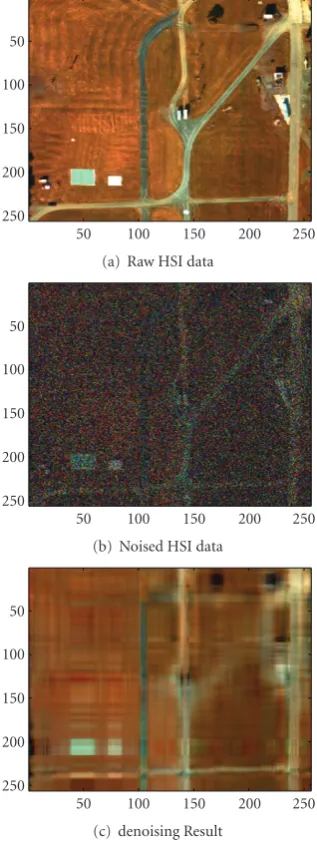
Section 6.3.1) is fixed to 10−6, and 5 iterations of the ALS algorithm are needed for convergence. Figure 3(a) (resp., (b)) provides the evolution of computational times for both LRFP and LRTA-based (resp., MWFP and MWSVD-based) tensor data denoising, for values ofI1andI2varying between 60 and 256, in second, with a 3.0 Ghz PC running windows (same conditions are used throughout all experiments). Considering an image with 256 rows and columns, LRFP-based method leads to SNR=17.03 dB with a computational time equal to 68 seconds and LRTA-based method leads to SNR = 17.20 dB with a computational time equal to 43 minutes, 22 seconds. Then with these image sizes, and the ratios K1/I1 = K2/I2=410−2, and K3/I3=110−1, the proposed method is 38 times faster, yielding SNR values that differ by less than 1%. MWFP-based method leads to SNR=
250 200 150 100 50
50 100 150 200 250
(a) Raw HSI data
250 200 150 100 50
50 100 150 200 250
(b) Noised HSI data
250 200 150 100 50
50 100 150 200 250
(c) denoising Result
Figure 4: HSI image: results obtained by lower-rank tensor approximation using LRFP, LRTA, MWFP, or MWSVD.
MWSVD-based method leads to SNR = 17.27 dB with a computational time equal to 17 minutes, 4 seconds. Then, the proposed method is 29 times faster, yielding SNR values that differ by less than 1%. The gain in computational times is particularly pronounced with K1/I1, K2/I2, and K3/I3 ratio values which are relatively low, which is relevant for denoising applications. Figure 4(a) is the raw image with I1 = I2 = 256; Figure 4(b) provides the noised image;
Figure 4(c) is the denoising result obtained by the LRTA algorithm. Results obtained with LRFP, MWFP, or MWSVD algorithms look very similar.
8. CONCLUSION
This paper deals with tensor data denoising methods, and last advances in this field. We review lower-rank
tensor approximation (LRTA) and multiway Wiener filtering (MWF), and remind they yield good denoising results, especially compared to channel-by-channel SVD-based pro-cessing. These methods rely on tensor flattening along each mode, and on the projection of the data upon a useful signal subspace. We propose a synthesis of the last advances in tensor signal processing methods. We show how the signal subspace ranks can be estimated by statistical criteria; we demonstrate that, by flattening tensors along main direc-tions, output SNR is improved, and propose to use the fast SLIDE algorithm to retrieve these main directions; we adapt fixed-point algorithm and inverse power method to replace the costly SVD in lower-rank tensor approximation and multiway Wiener filtering methods, thus obtaining much faster algorithms. We exemplify the proposed improved methods on a seismic signal, color, and hyperspectral images.
ACKNOWLEDGMENT
The authors would like to thank the anonymous reviewers who contributed to the quality of this paper by providing helpful suggestions.
REFERENCES
[1] N. D. Sidiropoulos and R. Bro, “On the uniqueness of multilinear decomposition of N-way arrays,” Journal of Chemometrics, vol. 14, no. 3, pp. 229–239, 2000.
[2] N. D. Sidiropoulos, G. B. Giannakis, and R. Bro, “Blind PARAFAC receivers for DS-CDMA systems,”IEEE Transac-tions on Signal Processing, vol. 48, no. 3, pp. 810–823, 2000. [3] M. A. O. Vasilescu and D. Terzopoulos, “Multilinear
inde-pendent components analysis,” in Proceedings of the IEEE Computer Society Conference on Computer Vision and Pattern Recognition (CVPR ’05), vol. 1, pp. 547–553, San Diego, Calif, USA, June 2005.
[4] D. C. Alexander, C. Pierpaoli, P. J. Basser, and J. C. Gee, “Spa-tial transformations of diffusion tensor magnetic resonance images,”IEEE Transactions on Medical Imaging, vol. 20, no. 11, pp. 1131–1139, 2001.
[5] D. Muti, S. Bourennane, and J. Marot, “Lower-rank tensor approximation and multiway filtering,” to appear in SIAM Journal on Matrix Analysis and Applications.
[6] D. Muti and S. Bourennane, “Multidimensional filtering based on a tensor approach,”Signal Processing, vol. 85, no. 12, pp. 2338–2353, 2005.
[7] L. De Lathauwer, B. De Moor, and J. Vandewalle, “A multi-linear singular value decomposition,”SIAM Journal on Matrix Analysis and Applications, vol. 21, no. 4, pp. 1253–1278, 2000. [8] L. De Lathauwer, B. De Moor, and J. Vandewalle, “On
the best rank-1 and rank-(R1,R2,. . .,RN) approximation of higher-order tensors,”SIAM Journal on Matrix Analysis and Applications, vol. 21, no. 4, pp. 1324–1342, 2000.
[9] P. M. Kroonenberg,Three-Mode Principal Component Anal-ysis: Theory and Applications, DSWO Press, Leiden, The Netherlands, 1983.
[11] D. Muti and S. Bourennane, “Multiway filtering based on fourth-order cumulants,”EURASIP Journal on Applied Signal Processing, vol. 2005, no. 7, pp. 1147–1158, 2005.
[12] D. Muti and S. Bourennane, “Fast optimal lower-rank tensor approximation,” inProceedings of the 2nd IEEE International Symposium on Signal Processing and Information Technology (ISSPIT ’02), pp. 621–625, Marrakesh, Morocco, December 2002.
[13] D. Muti and S. Bourennane, “Multidimensional estimation based on a tensor decomposition,” inProceedings of the IEEE Workshop on Statistical Signal Processing (SSP ’03), pp. 98–101, St. Louis, Mo, USA, September-October 2003.
[14] D. Muti and S. Bourennane, “Multidimensional signal pro-cessing using lower-rank tensor approximation,” in Proceed-ings of the IEEE International Conference on Acoustics, Speech, and Signal Processing (ICASSP ’03), vol. 3, pp. 457–460, Hong Kong, April 2003.
[15] D. Muti and S. Bourennane, “Traitement du signal par d´ecomposition tensorielle,” inProceedings of the 19th GRETSI Symposium on Signal and Image Processing, Paris, France, September 2003.
[16] C. Eckart and G. Young, “The approximation of a matrix by another of lower rank,”Psychometrika, vol. 1, no. 3, pp. 211– 218, 1936.
[17] D. Muti, S. Bourennane, and M. Guillaume, “SVD-based image filtering improvement by means of image rotation,” in Proceedings of the IEEE International Conference on Acoustics, Speech, and Signal Processing (ICASSP ’04), vol. 3, pp. 289–292, Montreal, Canada, May 2004.
[18] R. A. Harshman and M. E. Lundy, “The PARAFAC model for three-way factor analysis and multidimensional scaling,” in Research Methods for Multimode Data Analysis, H. G. Law, C. W. Snyder Jr., J. Hattie, and R. P. McDonald, Eds., pp. 122–215, Praeger, New York, NY, USA, 1984.
[19] J. D. Carroll and J.-J. Chang, “Analysis of individual differences in multidimensional scaling via an n-way generalization of “Eckart-Young” decomposition,”Psychometrika, vol. 35, no. 3, pp. 283–319, 1970.
[20] J. Kruskal, “Rank, decomposition, and uniqueness for 3-way and N-way arrays,” inMultiway Data Analysis, Elsevier/North-Holland, Amsterdam, The Netherlands, 1988.
[21] H. A. L. Kiers, “Towards a standardized notation and termi-nology in multiway analysis,”Journal of Chemometrics, vol. 14, no. 3, pp. 105–122, 2000.
[22] R. Bro,Multi-way analysis in the food industry, Ph.D. thesis, Royal Veterinary and Agricultural University, Copenhagen, Denmark, 1998.
[23] N. D. Sidiropoulos, R. Bro, and G. B. Giannakis, “Parallel factor analysis in sensor array processing,”IEEE Transactions on Signal Processing, vol. 48, no. 8, pp. 2377–2388, 2000. [24] M. Welling and M. Weber, “Positive tensor factorization,”
Pattern Recognition Letters, vol. 22, no. 12, pp. 1255–1261, 2001.
[25] A. Cichocki and R. Zdunek, “Ntflab for signal processing,” Tech. Rep., Laboratory for Advanced Brain Signal Processing, BSI, RIKEN, Saitama, Japan, 2006.
[26] L. R. Tucker, “Some mathematical notes on three-mode factor analysis,”Psychometrika, vol. 31, no. 3, pp. 279–311, 1966. [27] O. Alter and G. H. Golub, “Reconstructing the pathways of a
cellular system from genome-scale signals by using matrix and tensor computations,”Proceedings of the National Academy of Sciences of the United States of America, vol. 102, no. 49, pp. 17559–17564, 2005.
[28] L. De Lathauwer,Signal processing based on multilinear algebra, Ph.D. thesis, Department of Electrical Engineering, Katholieke Universiteit Leuven, Leuven, Belgium, September 1997. [29] A. Smilde, R. Bro, and P. Geladi,Multi-Way Analysis:
Applica-tions in the Chemical Sciences, John Wiley & Sons, New York, NY, USA, 2004.
[30] M. A. O. Vasilescu and D. Terzopoulos, “Multilinear image analysis for facial recognition,” in Proceedings of the 16th International Conference on Pattern Recognition (ICPR ’02), vol. 2, pp. 511–514, Quebec, Canada, August 2002.
[31] H. Wang and N. Ahuja, “Facial expression decomposition,” in Proceedings of the 9th IEEE International Conference on Computer Vision (ICCV ’03), vol. 2, pp. 958–965, Nice, France, October 2003.
[32] N. Renard, S. Bourennane, and J. Blanc-Talon, “Multiway filtering applied on hyperspectral images,” inProceedings of the 8th International Conference on Advanced Concepts for Intelligent Vision Systems (ACIVS ’06), Lecture Notes on Computer Science, pp. 127–137, Springer, Antwerp, Belgium, September 2006.
[33] D. Letexier, S. Bourennane, and J. Blanc-Talon, “Nonorthog-onal tensor matricization for hyperspectral image filtering,” IEEE Geoscience and Remote Sensing Letters, vol. 5, no. 1, pp. 3–7, 2008.
[34] D. Letexier, S. Bourennane, and J. Blanc-Talon, “Main flat-tening directions and Quadtree decomposition for multi-way Wiener filtering,”Signal, Image and Video Processing, vol. 1, no. 3, pp. 253–265, 2007.
[35] A. Hyv¨arinen and E. Oja, “A fast fixed-point algorithm for independent component analysis,”Neural Computation, vol. 9, no. 7, pp. 1483–1492, 1997.
[36] B. W. Bader and T. G. Kolda, “Algorithm 862: MATLAB tensor classes for fast algorithm prototyping,”ACM Transactions on Mathematical Software, vol. 32, no. 4, pp. 635–653, 2006. [37] I. Wirawan, K. Abed-Meraim, H. Maˆıtre, and P. Duhamel,
“Blind multichannel image restoration using subspace based method,” inProceedings of the IEEE International Conference on Acoustics, Speech, and Signal Processing (ICASSP ’03), vol. 5, pp. 9–12, Hong Kong, April 2003.
[38] J. M. Mendel, “Tutorial on higher-order statistics (spectra) in signal processing and system theory: theoretical results and some applications,”Proceedings of the IEEE, vol. 79, no. 3, pp. 278–305, 1991.
[39] N. Yuen and B. Friedlander, “Asymptotic performance analysis of blind signal copy using fourth-order cumulants,” Interna-tional Journal of Adaptive Control and Signal Processing, vol. 10, no. 2-3, pp. 239–265, 1996.
[40] N. Yuen and B. Friedlander, “DOA estimation in multipath: an approach using fourth-order cumulants,”IEEE Transactions on Signal Processing, vol. 45, no. 5, pp. 1253–1263, 1997. [41] H. Andrews and C. Patterson III, “Singular value
decom-position and digital image processing,”IEEE Transactions on Acoustics, Speech and Signal Processing, vol. 24, no. 1, pp. 26– 53, 1976.
[42] H. Andrews and C. Patterson III, “Singular value decomposi-tion (SVD) image coding,”IEEE Transactions on Communica-tions, vol. 24, no. 4, pp. 425–432, 1976.
[44] D. L. Donoho, “De-noising by soft-thresholding,”IEEE Trans-actions on Information Theory, vol. 41, no. 3, pp. 613–627, 1995.
[45] S. G. Chang, B. Yu, and M. Vetterli, “Adaptive wavelet thresholding for image denoising and compression,” IEEE Transactions on Image Processing, vol. 9, no. 9, pp. 1532–1546, 2000.
[46] J.-C. Pesquet, H. Krim, and H. Carfantan, “Time-invariant orthonormal wavelet representations,”IEEE Transactions on Signal Processing, vol. 44, no. 8, pp. 1964–1970, 1996. [47] M. Wax and T. Kailath, “Detection of signals by information
theoretic criteria,”IEEE Transactions on Acoustics, Speech and Signal Processing, vol. 33, no. 2, pp. 387–392, 1985.
[48] H. K. Aghajan and T. Kailath, “Sensor array processing techniques for super resolution multi-line-fitting and straight edge detection,”IEEE Transactions on Image Processing, vol. 2, no. 4, pp. 454–465, 1993.
[49] R. O. Duda and P. E. Hart, “Use of the Hough transformation to detect lines and curves in pictures,”Communications of the ACM, vol. 15, no. 1, pp. 11–15, 1972.