Volume 2008, Article ID 491503,12pages doi:10.1155/2008/491503
Research Article
Digital Communication Receivers Using Gaussian Processes for
Machine Learning
Fernando P ´erez-Cruz1, 2and Juan Jos ´e Murillo-Fuentes3
1Department of Electrical Engineering, Princeton University, Princeton, NJ 08544, USA
2Department of Signal Theory and Communications, Carlos III University of Madrid, Avda. Universidad 30, 28911 Legan´es, Spain 3Departamento de Teor´ıa de la Se˜nal y Comunicaciones, Escuela T´ecnica Superior de Ingenieros, Universidad de Sevilla,
Paseo de los Descubrimientos s/n, 41092 Sevilla, Spain
Correspondence should be addressed to Fernando P´erez-Cruz,[email protected]
Received 13 October 2007; Revised 18 March 2008; Accepted 19 May 2008
Recommended by An´ıbal Figueiras-Vidal
We propose Gaussian processes (GPs) as a novel nonlinear receiver for digital communication systems. The GPs framework can be used to solve both classification (GPC) and regression (GPR) problems. The minimum mean squared error solution is the expectation of the transmitted symbol given the information at the receiver, which is a nonlinear function of the received symbols for discrete inputs. GPR can be presented as a nonlinear MMSE estimator and thus capable of achieving optimal performance from MMSE viewpoint. Also, the design of digital communication receivers can be viewed as a detection problem, for which GPC is specially suited as it assigns posterior probabilities to each transmitted symbol. We explore the suitability of GPs as nonlinear digital communication receivers. GPs are Bayesian machine learning tools that formulates a likelihood function for its hyperparameters, which can then be set optimally. GPs outperform state-of-the-art nonlinear machine learning approaches that prespecify their hyperparameters or rely on cross validation. We illustrate the advantages of GPs as digital communication receivers for linear and nonlinear channel models for short training sequences and compare them to state-of-the-art nonlinear machine learning tools, such as support vector machines.
Copyright © 2008 F. P´erez-Cruz and J. J. Murillo-Fuentes. This is an open access article distributed under the Creative Commons Attribution License, which permits unrestricted use, distribution, and reproduction in any medium, provided the original work is properly cited.
1. INTRODUCTION
Gaussian processes are typically used to characterize the noise component in digital communication systems, as it is mainly caused by thermal noise fluctuations [1]. In this paper, we propose the Gaussian processes (GPs) framework to design nonlinear receivers in digital communication sys-tems. GPs were initially presented as a nonlinear estimation technique in 1978 [2] and were rapidly forgotten due to its computation complexity. In the mid-nineties, they were independently rediscovered [3]. Since then, they have been shown to fit many different applications [4] and nowadays their computational complexity is no longer a limiting issue [5].
There is a vast literature on machine learning techniques for designing digital communication systems. The channel equalization problem has been addressed with different machine learning tools, such as multilayered perceptrons
(MLPs) [6], radial basis function networks (RBFNs) [7], recurrent RBFNs [8], self-organizing feature maps (SOFMs) [9], wavelet neural networks [10], GCMAC [11], kernel adaline (KA) [12], or support vector machines (SVMs) [13], among many others. Other digital communication systems that have also benefited from nonlinear detection and estimation algorithms are multiuser detection [14,15], multiple-input multiple-output systems [16], beam forming [17], predistortion [18], and plant identification [19], to name a few.
performance. Also, it makes the length of the training sequence hard to predict, as it depends on how well the chosen structure or hypeparameters fits the current problem. For example, SVM with a Gaussian kernel needs to fit its width, which is proportional to the noise level [12,13,22]. If the width is too large, the SVM can be optimized with short-training sequences, but its performance is poor. If it is too small, it requires a significantly longer training sequence to avoid overfitting. For each instantiation of the problem, there is an optimal width. This kernel width depends not only on the channel values and noise level, as we would expect, but also on the actual values of the noise themselves. Ideally, we would like to choose the kernel width every time we receive a new training sequence. But this would involve training a different SVM for each possible width and then choosing the optimal receiver (validation). In addition, this width is not the only SVM’s hyperparameter. We must also validate the soft margin that trades offthe minimization of the training errors and the maximization of the margin. Therefore, we would have to train a set of receivers with different width and soft-margin hyperparameters to find the optimal setting in each problem. However, typically, we can only solve a single optimization problem in the receiver. We thus prespecify the SVM hyperparameters, as it is the case with other nonlinear tools referenced earlier.
In previous work, we introduced Gaussian processes for machine learning as a novel nonlinear tool for designing digital communication receivers. Gaussian processes can be applied to regression and classification problems [4], and in this paper we use both settings for tuning digital communication receivers with short training sequences. We compare Gaussian processes for regression (GPR) and Gaussian processes for classification (GPC) to state-of-the-art linear and nonlinear receivers to show their strength in solving this relevant problem. We have presented some preliminaries results for multiuser detection in CDMA systems [23, 24] and channel equalization in [25]. In this paper, we extend these results and include GPC in our comparisons.
Gaussian processes for machine learning are rooted in Bayesian statistics [4], and consequently build a likelihood function for its hyperparameters given the training examples. This likelihood can be optimized to set the hyperparameters. This property makes GPs an attractive tool for designing nonlinear digital communication receivers, compared to other nonlinear machine learning tools, because the hyper-parameters can be optimally set for each instantiation of our problem with a single optimization procedure.
For short training sequences, hyperparameter mismatch significantly affects the performance of digital communi-cation receivers, while for longer training sequences, this performance is not sensitive to variations in the hyperpa-rameters. Most papers applying nonlinear machine learning for designing digital communication receivers propose fixed hyperparameters and sufficiently long training sequences. We focus on short-training sequences and show that fixed hyperparameters underperform compared to GPR receivers with optimally trained hyperparameters.
Gaussian processes can be extended for solving classi-fication problems. In this case, the posterior is no longer tractable and we need to use approximations to compute the prediction for each class label [4]. A Gaussian distribution is typically used to approximate the GPC’s posterior, either using Laplace [26] or expectation propagation methods [27]. However, GPC computational complexity is significantly higher than that of GPR, and hence they might not be as suited for designing digital communication receivers as GPR. Moreover, their performance is not as good as that of GPR receivers as we show and explain in the experimental section. The rest of the paper is organized as follows. We present the design of digital communication receivers as an optimization problem in Section 2and show how different nonlinear machine learning tools can be fitted in this framework. Section 3 is devoted to Gaussian processes for regression and how it can be understood as a nonlinear MMSE estimation. The optimization of the GPR hyperpa-rameters is proposed inSection 4.Section 5introduces GPC briefly. We present some computer simulations inSection 6 to illustrate the benefits of GPR for channel equalization and multiuser detection compared to other state-of-the-art nonlinear tools. We conclude with some final remarks and proposed further work inSection 7.
2. NONLINEAR OPTIMIZATION FOR COMMUNICATION RECEIVERS
2.1. Channel model and MMSE
We consider throughout the paper the following determinis-tic channel model:
x=Hs+z, (1)
where s is a random variable column-vector representing the transmitted symbols,Hcorresponds to the deterministic channel gains, unknown to both the transmitter and receiver,
zis zero-mean Gaussian noise, andxrepresents the received symbols. This model is general enough to capture most standard communication systems.
(i)Intersymbol interference:each element insis a symbol transmitted at a different time instant.His a Toeplitz matrix, in which each row represents the channel impulsive response. (ii)Multiple-input multiple-output:(H)i j represents the gain from theith receiving antenna to the jth transmitting antenna and s represents the symbols transmitted by the antenna array.
(iii)Fading:His a diagonal matrix with the fading coef-ficients andsrepresents the symbols transmitted at each time instant.
(iv)CDMA:the columns ofHcollect each user’s spread-ing code and each element of s represents the symbol transmitted by the users.
We can also combine different H matrices to accom-modate other communication systems. For example,H =
represents the downlink channel in a mobile communication network.
The source s that achieves capacity (maximum infor-mation transmission rate) [28] is a zero-mean Gaussian distribution with a covariance matrix given by the right eigenvectors of the channel matrix [29].sbeing a continuous random variable, we can estimate in the receiver the transmitted vector using a minimum mean squared error (MMSE) detector:
fmmse(x)=arg min f(·) E
s−f(x)2. (2)
The function fmmse(x) is the mean value ofsgiven the received vectorx,E[s | x], which is a linear function ofx
ifsis Gaussianly distributed. Practical structural constraints dictate the use of discrete constellations, such as PSK and QAM, which depart from the optimal Gaussian distribu-tions. Although linear detectors cannot achieveE[s | x] if
sis a discrete random variable, and thus the MMSE is only a proxy for minimizing the probability of misclassification, still digital communication receivers use linear MMSE detectors for estimating the transmitted vector, because they can be easily implemented and hopefully their performance is not severely degraded. For example, if s ∈ {±1} and equiprobable andH = 1, thenE[s | x] =tanh(x/σ2
z). The linear MMSE solution is given by
wmmse=arg min
w E
s−wx2=Exx−1E[xs].
(3)
IfHis unknown, we can replace the expectations by sample averages using a training sequence.
2.2. Machine learning for digital communication receivers
The design of digital communication receivers can be readily understood as a supervised classification problem [6,30], in which the receiver constructs a classifier for deciding over the incoming symbols. Machine learning tools optimize the risk of misclassification:
fopt(x)=arg min f(·)E
Ls,f(x)
=arg min f(·) L
s,f(x)p(s,x)ds dx,
(4)
whereL(·) is a loss function that measures the penalty for wrongly classifying a pattern, and f(x) is the nonlinear model to predicts.
The joint density,p(s,x), is typically unknown, and thus we use a training sequence{xi,si}ni=1 and the empirical risk
minimization (ERM) inductive principle [31] to obtain the optimal solution:
fopt(x)=arg min f(·)
n
i=1 Lsi,f
xi
+λΩf
, (5)
where we have included a regularization term, λΩ(f), to avoid overfitting and to ensure that the minimum of
the empirical risk converges to the minimum risk [31] as the number of training samples increases. The number of training patternsndetermines the symbols in the preamble of each transmission needed to adjust the receiver. This number should be small to maximize the number of bits used to transmit information, as we need to retransmit the preamble in each burst of data.
The nonlinear machine learning approaches mentioned in the introduction can be cast as the optimization in (5) using an appropriate nonlinear model, loss function, and regularizer. For example, f(x) = wφ(x), where φ(x) is a nonlinear transformation to a higher-dimensional space;
L(si,f(xi)) = (1 − siwxi)+, hinge loss, where (y)+ =
max(y, 0); andΩ(f)= w2weight decay [21] gives an
SVM for a binary antipodal constellation, which constructs the nonlinear classifier using the “kernel trick” forφ(·) [32]. The convexity of the optimization in (5) depends on
f(·),L(·,·), andΩ(·). In some cases, as in SVM or KA, it leads to a convex functional and in others, as in MLP or RBFN, it does not. But in any case, these machine learning approaches rely on an iterative optimization tool [21,32] for solving (5).
If we choosef(x)=wφ(x),L(s,f(x))=(s−wφ(x))2 andΩ(f)= w2, we get a convex functional:
wnl mmse=arg min
w n
i=1
si−wφ
xi
2
+λw2
(6)
that can be analytically optimized as
wnl mmse=ΦΦ+λI−1Φs, (7)
where Φ = [φ(x1),. . .,φ(xn)] and s = [s1,. . .,sn]. We denote this solution as nonlinear MMSE, since it is a nonlinear extension of (3), in which we have substitutedx
by φ(x) and we have replaced the expectations by sample averages.
In the next section, we show (7) is equivalent to the mean solution provided by Gaussian processes for regression with a Gaussian likelihood function and that it can be solved using kernels [33]. Moreover, interpreting (7) as GPR allows optimizing its hyperparameters by maximum likelihood (Section 4). This optimization improves the performance of (7) with respect to other nonlinear machine learning procedures when the number of training samples is low, because for reduced training datasets the performance of nonlinear machine learning methods significantly depends on its hyperparameters.
3. GAUSSIAN PROCESSES FOR REGRESSION
We present GPR from the Bayesian generalized linear regression viewpoint. Although from this opening we lose the GPs interpretation and we can only work with Gaus-sian likelihood models, we believe it is a simpler way to understand GPR. This approach mimics how most machine learning textbooks introduce nonlinear regression [21,32, 35] and it helps understanding GPR as a nonlinear MMSE estimation. Therefore, practitioners in signal processing for digital communications can readily relate to this new tool for estimation and detection. Both interpretations are described in [34], where they are shown to be identical for Gaussian likelihood models. There is more about GPs than what we introduce in this summary, for interested readers, GPs extensions can be found in [4].
A generalized linear regressor expresses the input-output relation as
s=wφ(x) +ν, (8)
where φ(·) is a nonlinear transformation to a higher-dimensional feature space and νis a random variable that measures the deviation betweensand its estimate. Given a labeled training sequence (D = {xi,si}ni=1, where the input xi ∈Rd and the outputsi ∈R) and a statistical model for
ν, we can compute the regressorwby maximum likelihood (ML),
wML=arg max
w
n
i=1 pνi
=arg max
w
n
i=1
psi−wφ
xi
.
(9)
We use these ML weights to predict the outputs for future test pointsx∗:
s∗=wMLφ
x∗. (10)
In Bayesian machine learning,w is considered to be a random variable and, to predict the outcome ofx∗, we use
its conditional density given the training dataset, p(w|D). This conditional density, known as the posterior ofw, can be computed through Bayes rule,
p(w|D)=p(w|s,X)= p(s|X,w)p(w)
p(s|X)
= p(w)
p(s|X) n
i=1
psi|xi,w
,
(11)
where p(si | xi,w) is the likelihood function ofw,p(w) its prior distribution andX=[x1,. . .,xn].
To predict the output for a new test pointx∗we integrate
outw:
ps∗|x∗,D=
Wp
s∗|x∗,wp(w|D)dw, (12)
in which the conditional density of eachs∗(the likelihood of w) is weighted by the posterior ofwand is summed over all possiblew. As a result, we get a full statistical description of
s∗, given all the available information (x∗ andD). In this
setting, we predict the value of s∗ using the full statistical
model ofw, not only its maximum likelihood estimate. This setting is quite general, as we can use any model for the likelihood and prior for solving the regression estimation problem. Gaussian likelihood,p(s|x,w)=N(wφ(x),σ2
ν), leads to the MMSE criterion, and a zero-mean Gaussian prior, p(w)=N(0,σ2
wI), allocates probability mass to every
possiblewand allows solving (12) analytically. The posterior distribution in (11) is then a Gaussian density function,
p(w|D)=N(μw,Σw), where
μw=σ2 w
σ2
wΦΦ+σν2I−1Φs, (13)
Σ−w1= Φ
Φ σ2 ν + I σ2 w . (14)
Actually, the posterior mean in (13) is identical to the maximum a posteriori (MAP) of (11):
μw=wMAP=arg max
w
p(w|s,X)
=arg max
w
logp(s|X,w) + logp(w)
=arg max
w − 1 σ2 ν n
i=1
si−wφ
xi 2 − 1 σ2 w
w2
,
(15)
which is identical to (6) forλ = σ2
ν/σw2. We can also check
that (13) is equal to (7). Therefore, the GPR mean prediction can be regarded as a nonlinear MMSE estimation for the nonlinear mappingφ(·).
The prediction for s∗ in (12) is a Gaussian density
function,p(s∗|x∗,D)=N(μs∗,σs∗):
μs∗=φ
x∗μw=φx∗ΣwΦ s
σ2
ν , (16)
σ2
s∗ =φ x
∗Σwφ
x∗=φx∗Φ Φ σ2 ν + I σ2 w −1
φx∗.
(17)
There is an alternative formulation forμs∗ andσs2∗, in which we do not need to know the nonlinear mappingφ(·) and we only need to work with its inner product or kernel, defined as
kxi,xj
=σw2φ
xi
φxj
. (18)
To obtain this alternative formulation, we first define the covariance matrixCas
(C)i j=k
xi,xj
+σν2δi j, (19)
which can be related toΣwas follows:
Σ−1
w Φ= ΦΦ σ2 ν + I σ2 w Φ =Φ σ2
wΦΦ+σν2I
σ2
νσw2
=ΦC
σ2
νσw2 .
Now if we premultiply (20) by Σw and postmultiply it
by C−1, we obtain the following equivalency: Σ
wΦ/σν2 = σ2
wΦC−1, which can be used to simplify (16) and express
the GPR prediction mean as
μs∗=φ
x∗σw2ΦC−1s=kC−1s, (21)
where
k=σ2 wφ
x∗Φ=kx∗,x1,. . .,kx∗,xn
. (22)
To compute the prediction for any vectorx∗, we do not
need to know the nonlinear mappingφ(·), only its kernel. The complexity of computingμs∗in (21) is linear, because we can precompute the vectorC−1sthat does not depend onx
∗
and we only need to filterkwith it for each new test pattern. We can also define the variance of our predictor using kernels as
σ2
s∗=k
x∗,x∗−kC−1k, (23)
which is achieved after applying to (14) the matrix inversion lemma described in [36] .
Equations (21) and (23) represent the predictions forx∗
given by the Gaussian processes view of GPR. The matrix
Cis the covariance matrix of a multidimensional Gaussian distribution, hence its name, that describes the training data, and the vectorkrepresents the covariance vector between the training dataset and the test vector. Therefore, the function
k(·,·) has to be a positive-definite function to ensure that the Gaussian processes covariance matrixCis also positive definite.
4. HYPERPARAMETER OPTIMIZATION
If eitherφ(·) ork(·,·) is known, we can analytically predict the output of any incoming sample using (21). But for most estimation problems, the best nonlinear transformation (or its kernel) is unknown. As discussed in the Section 2, the optimal setting of the hyperparameters could be obtained by cross-validation, similarly to any other nonlinear machine learning method. In this case, the nonlinear MMSE would be as good as any of the other methods, as it would require either to try different settings or to rely on a prespecify one.
From the point of view of Bayesian machine learning, we can proceed as we did for the parameterswinSection 3. First, we compute the likelihood of the hyperparameters of the kernel given the training dataset:
p(s|X,θ)= p(s|wX,θ)p(w|D,θ)dw
= 1
(2π)nCθ exp
−1
2s
C−1
θ s
,
(24)
where θ represents the hyperparameters of the covariance function or kernel. We have addedθto the covariance matrix, likelihood, and posterior to explicitly indicate that they depend on the kernel’s hyperparameters. This was omitted in the GPR presentation inSection 3for clarity purposes.
Second, we can define a prior for the hyperparameters,
p(θ), that can be used to construct its posterior density:
p(θ|D)= p(s|X,θ)p(θ)
p(s|X) . (25)
Third, we can integrate out the hyperparameters to obtain the predictions:
ps∗|x∗,D= ps∗|x∗,Dθpθ|Ddθ. (26)
However, in this case, the hyperparameters’ likelihood does not have a conjugate prior and the posterior is nonanalytical. Hence the integration has to be done either by sampling or approximations. Although this approach is well principled, it is computational intensive and it is not feasible for digital communications receivers. For example, Markov-chain Monte Carlo (MCMC) methods require several hundreds to several thousands samples from the posterior ofθto integrate it out in (26). For the interested readers, further details can be found in [4].
Alternatively, we can use the likelihood function of the hyperparameters and compute its maximum to obtain its optimal setting [3], which is used to describe the kernel for the test samples. Although setting the hyperparameters by maximum likelihood is not a purely Bayesian solution, it is fairly standard in the community and it allows using Bayesian solutions in time-sensitive applications. The maximum likelihood hyperparameters are given by
θML=arg max
θ p(s|X,θ)
=arg max
θ logp(s|X,θ)
=arg max θ
−sC−1
θ s−logCθ.
(27)
This optimization is nonconvex [37]. But as we increase the number of training samples, the likelihood becomes a unimodal distribution around the maximum likelihood hyperparameters and the ML solution can be found using gradient ascent techniques. See [4] for further details.
4.1. Covariance matrix
To optimize the kernel hyperparameters in (27), we need to describe a kernel in a parametric form. Kernel design is one of the most challenging open problems in machine learning, as it is mainly driven by each particular application. We need to incorporate our prior knowledge into the kernel, but, at the same time, we want the kernel to be flexible to explain previously unknown trends in the data. In [4], a list of flexible kernels, (i.e., linear, Gaussian, neural networks, Mat´ern, among others; and their properties are described). The rules on how to combine them are also described, (i.e., the sum or product of two kernel functions is also a valid kernel function).
For example, if we know the optimal solution to be linear, we could use the linear kernel:k(x,x)=σ2
wxx. The only
unknown hyperparameters in this case are σ2
we do not need to know these variances a priori. In the remaining of this text, we consider, without loss of generality, the last term in (19) to be part of the designed kernel, asδi j is a valid kernel and the weighted sum of kernel functions (with nonnegative weights) is also a kernel. In general, kernel functions are more complex and they incorporate several hyperparameters. For example, the Gaussian kernel with automatic relevance determination (ARD) proposes one nonnegative weight,γ, per input dimension:
kxi,xj
=α1exp
− d
=1 γ
xi−xj
2
+α2xi xj+α0δi j,
(28)
where we have added a linear kernel to use this covariance function for designing digital communication receivers. For this kernel function we define the hyperparameters asθ = [logα0, logα1, logα2, logγ], because these hyperparameters need to be positive to ensure that k(·,·) is a positive semidefinite function. Hence, we can apply unconstrained optimization tools if we work overθ.
The covariance function in (28) is a good kernel for designing digital communication receivers using GPR, because it contains a linear and a universal nonlinear part, as the RBF kernel has an infinite VC dimension [31]. The linear part can mimic the best linear decision boundary and the nonlinear part modifies it, where the linear explanation is not optimal to obtain the expectation of s given x. If the channel is linear, then the ML solution sets α1 = 0 and there is no interference of the nonlinear term with the nonlinear one in the solution. Also, using a radial basis kernel for the nonlinear part seems an appropriate choice to achieve nonlinear decisions for digital communication receivers, because the received symbols form a constellation of clouds of points with Gaussian spread around its centers.
4.2. Discussion
Gaussian Processes for regression is a nonlinear regres-sion tool that, given the covariance function, provides an analytical solution to any regression estimation problem. Moreover, it does not only give point estimates, but it also assigns confidence intervals for them. In GPR, we perform the optimization step to set the covariance function hyper-parameters by maximum likelihood, unlike SVM or other nonlinear machine learning tools, in which the optimization is used to set the optimal parameters. In these methods, the hyperparameters have to be either prespecified or estimated by cross-validation [20].
Cross-validation optimizes several functionals (typically less than 10) for each possible setting of the hyperparameters [21]. The number of hyperparameters that can be tuned is quite limited (at most 2 or 3), as the computational complexity of cross-validation increases exponentially with the number of hyperparameters. These remarkable draw-backs limit the application of these nonlinear tools to digital communications receivers, since we face complex nonlinear problems with reduced computational resources and short-training sequences. By exploiting the GPs framework, as stated in this paper, we can avoid them.
5. GAUSSIAN PROCESS FOR CLASSIFICATION
Gaussian process for classification is a bit trickier than the regression counterpart, because we cannot rely on a Gaussian likelihood function to predict the labels of each class as the outcomes come from a discrete set [4]. Thereby to predict the class labels, we need to resort to numerical integration or approximations to tractable density models. A generalized linear binary classifier predicts for an inputxthe class label as follow:
p(s=+1|w,x)=p(s=+1| f)=σ(f), (29)
where f = wφ(x) is an underlying continuous function,
σ(·) is a sigmoid that squashes f between 0 and 1, andp(s= −1 | f)= 1−p(s= +1 | f).σ(·) is typically the logistic function or the cumulative density function of a Gaussian [4].
Given a labeled training sequence (D= {xi,si}ni=1, where
the input xi ∈ Rd and the output si ∈ {±1}), we can compute the posterior over the underlying function f = [f1,. . .,fn]using Bayes rule, as we did inSection 3for GPR withw, and we can integrate outf to predict the class label for any new test pointx∗. We can compute the class label for
the test samples as follows:
ps∗=+1|x∗,D= σf∗pf∗|x∗,Ddf∗, (30)
where
p(f∗|x∗,D)= p(f∗|x∗,X,f)p(f|D)df, (31)
p(f|D)=p(f|X,s)=
ip
si| fi
p(f|X)
p(s|X) . (32)
In (31), we compute the distribution for the underlying function in the test point and in (30) we integrate out the underlying function to predict the probability that the class label of that point is +1. Both integrals are intractable due to the likelihood model employed for f in (29). GPC typically relies on a Gaussian approximation for the posterior density
p(f | D), to analytically solve (31), and (30) is a one-dimensional integral that can be easily solved numerically. The standard approximations to the posterior are Laplace or expectation propagation, as explained in [27]. Further details on how to approximate the posterior and train the covariance function hyperparameters can be found in [4].
6. EXPERIMENTAL RESULTS
We carry out two sets of experiments. First, we design a receiver for a CDMA system with strong near-far require-ments and intersymbol interference. In the second exper-iment, we deal with a channel equalization problem with a nonlinear amplifier in the receiver. The results in these experiments allow drawing some general conclusions about the advantages of GPs for designing digital communication receivers. For both experiments, the channel model is given by
For all these systems, we train a linear MMSE receiver (denoted by “MMSE” and a dashed line), a GPR (“GPR” and a solid line), and a GPC with an EP approximation to its posterior (“GPC” and a dash-dotted line). We approximate the GPC posterior using the EP algorithm, because it pro-vides superior performances than the Laplace approximation as suggested in [27]. For the GPs receivers, we work with the covariance matrix in (28). We also report a linear SVM receiver (“SVMl” and a dotted line with circles) and a nonlinear SVM (“SVMnl” and a dotted line with bullets) with an RBF kernel [32]. For the SVMs we train a set of receivers with different hyperparameters and we report the best result. We useC =0.5, 1, 2, 5, and 10 andσ =kσzwith
k=1, 2, 5, and 10. Thereby, the comparison is biased in favor of the SVM when compared to the GPR and GPC solutions. All the figures are obtained for 100 independently trained trials with 105test symbols.
6.1. Linear multiuser detection
In our first experiment, we employ Gold spreading codes with 31 chips per user, because they have favorable cross-correlation properties that limit the interferences by other users and their delayed replicas [38]. We report results for systems operating with 3 and 16 users and we assume the user of interest is 50 dB bellow the other users. This is a fairly standard scenario when one of the users is close to the base station and it is assigned little power. We use the received 31 chips to detect each transmitted symbol.
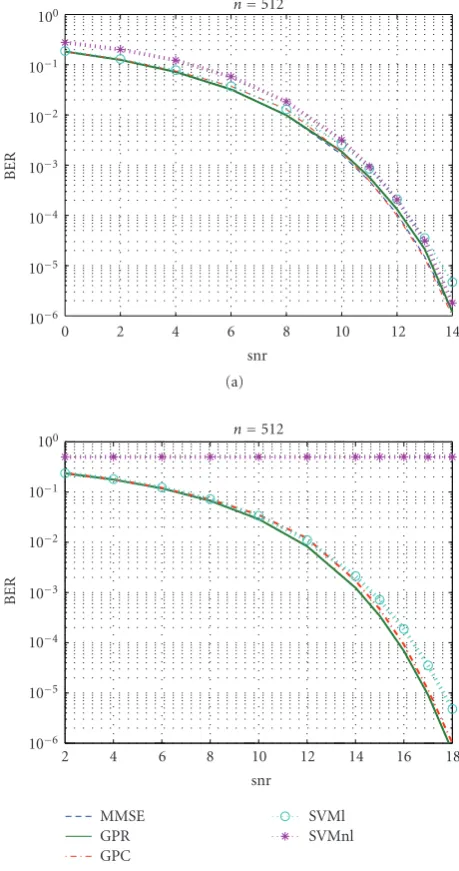
We show the bit error rate (BER) versus the signal-to-noise ratio (snr) for 3 users in Figure 1(a) and 16 users
in Figure 1(b) with 512 training symbols. The solution is
almost linear and all the receivers perform similarly well except for the nonlinear SVM for 16 users. The training sequence for the nonlinear SVM with 16 users is not long enough, and hence the nonlinear SVM is unable to detect the transmitted bits and reports chance-level performances. The GPR solution is quite similar to the MMSE solution, because it almost shuts down its nonlinear part in (28). As we show inSection 3, the GPR with a linear kernel and the linear MMSE provide equivalent solutions in this case. This result is quite relevant, as we do not tell the GPR receiver that the solution is linear. It finds out on its own, when it maximizes the hyperparameters’ likelihood. The GPC also cancels its nonlinear part and it is able to avoid overfitting. The linear SVM detector presents the worse performance among the proposed methods that converge in both cases, although it is barely noticeable in the figures.
The optimal solution is almost linear and all the pro-posed procedures perform equally well, once the training sequence is long enough. The training sequence of 512 symbols is not long enough for the nonlinear SVM with 16 users and it is unable to correctly tune its multiuser detector. If we had increased the training sequence to several thousand samples, the nonlinear SVM would converge and it would provide a solution close to the other algorithms. The differences in BER are not significant to decide which method is best, but the differences in training time might lead us to choose one over the others, as we discuss in short.
n=512
10−6 10−5 10−4 10−3 10−2 10−1 100
BER
0 2 4 6 8 10 12 14
snr (a)
n=512
10−6 10−5 10−4 10−3 10−2 10−1 100
BER
2 4 6 8 10 12 14 16 18
snr MMSE
GPR GPC
SVMl SVMnl (b)
Figure1: We report the BER versus thesnrfor a multiuser detector with 3 users in (a) and 16 users in (b). The dashed line represents the linear MMSE receiver, the solid line the GPR, the dash-dotted line the GPC, the dotted line with circles the linear SVM, and the dotted line with bullets the nonlinear SVM.
snr=14 dB
10−6 10−5 10−4 10−3 10−2 10−1 100
BER
3 4 5 6 7 8 9
log2n (a)
snr=18 dB
10−7 10−6 10−5 10−4 10−3 10−2 10−1 100
BER
3 4 5 6 7 8 9
log2n MMSE
GPR GPC
SVMl SVMnl (b)
Figure 2: We report the BER versus the length of the training sequence for a multiuser detector with 3 users andsnr=14 dB in (a) and 16 users andsnr=18 dB in (b). The dashed line represents the linear MMSE receiver, the solid line the GPR, the dash-dotted line the GPC, the dotted line with circles the linear SVM, and the dotted line with bullets the nonlinear SVM.
From these 2 plots, we can easily understand why the nonlinear SVM is unable to converge for 16 users with 512 training symbols. For 3 users, the nonlinear SVM needs longer training sequences than the other methods, before it can significantly reduce the BER. For 16 users, the learning problem is harder and it needs several thousand samples to achieve convergence.
The GPR, MMSE, and linear SVM learn the solution as the number of training examples increases and they behave almost equally well for 16 users. The GPC needs the
training sequence to be long enough before it can produce a meaningful solution. It needs at least 64 symbols for 3 users and 256 for 16 to be able to produce nonchance-level performances. But once the training sequence is long enough, it converges to the optimal solution. It does not provide intermediate solutions as the other methods do.
For 16 users, the GPR receiver presents the fastest learning curve closely followed by the linear MMSE and linear SVM solutions. We conjecture this is due to the GPR optimal training of its hyperparameter, because it is able to adjust them for each training sequence, while the linear SVM uses a constant setting, which might be good for a long training sequence, but not as good for shorter ones.
In this example, we can readily understand the advan-tages of using GPR for solving multiuser detection problems, as for very short-training sequences, we are able to obtain the best possible solution, and if it is linear, it even improves the linear MMSE solution. The GPR and linear MMSE detectors provide the same solution as the number of samples increases; but for short-training sequence, the GPR detector is able to optimally set its hyperparameters to provide better performance than the linear MMSE. Also, as we see in the next example, if the solution is nonlinear, it is able to achieve nonlinear multiuser detectors, significantly improving the linear MMSE solution.
6.2. Nonlinear multiuser detection
We repeat Experiment 2 in [22], in which 3 users transmit with an orthogonal 8-dimension spreading code. The solu-tion for user 2 is highly nonlinear and we report the BER versus thesnrinFigure 3. The linear SVM and MMSE clearly underperform compared to the nonlinear methods. The GPR and nonlinear SVM achieve almost identical results. The GPC for low snr mimics the results of the nonlinear methods (snr <14 dB); and for highsnr, it reports the same results as the linear receivers (snr >16 dB). This behavior is explained by the length and diversity of the training sequence. If the training sequence is long enough, the GPC receiver provides the best nonlinear decision function, otherwise it reports the best linear decision function to avoid overfitting. For lowsnr, 512 symbols is long enough for the GPC to achieve the best nonlinear decision function and the GPC receiver trains its hyperparameters to obtain this nonlinear detector. For highsnr, there is not enough diversity in a training sequence with 512 symbols and it is only able to report the best linear detector, as it shuts down its nonlinear part to avoid overfitting. In the first experiment, we already saw that GPC receivers need longer training sequences than GPR, even to achieve the best linear detector. It is clear in this experiment that for nonlinear decision function, GPC receivers even need longer training sequences.
n=512
10−7 10−6 10−5 10−4 10−3 10−2 10−1 100
BER
2 4 6 8 10 12 14 16 18
snr MMSE
GPR GPC
SVMl SVMnl
Figure3: We report the BER versussnr for a multiuser detector with 3 users and a training sequence of 512 symbols. The dashed line represents the linear MMSE receiver, the solid line the GPR, the dash-dotted line the GPC, the dotted line with circles the linear SVM and the dotted line with bullets the nonlinear SVM. The linear SVM is on top of the linear MMSE line.
linear MMSE and reports the same solution as a nonlinear SVM. The nonlinear SVM is not as good as the GPR with the covariance matrix in (28), because for (almost) linear solutions, it needs significantly longer training sequences, which is a waste of resources in wireless communication systems, as the preamble must be as short as possible. Also a SVM cannot use a kernel as in (28), because it would need to cross validate (or hand pick) too many hyperparameters.
6.3. Nonlinear channel equalization
Now we turn to the channel equalization problem, in which the channel is represented by (33), and we add a memoryless nonlinearity to the receiver that transforms each received signal as follows:
xi=xi+ 0.2xi2−0.1xi3+zi, (34)
wherexi = (Hs)i. This channel model is typically used to described nonlinear amplifiers in wireless communication receivers as explained in [12]. To construct the equalizers, we use 6 received samples to predict each transmitted symbol with a delay of 2 samples.
In Figure 4, we show the BER versus the snr for all
equalizers andn=512. Forsnrless than 22 dB, the nonlinear GPR equalizer achieves the minimum BER with a gain larger than 3 dB for BER around 10−3. For larger snr, the performance of this nonlinear equalizer degrades and the linear equalizers perform significantly better. The nonlinear SVM equalizer performs as the GPR equalizer forsnrlower than 17 dB, but for largersnr the training sequence is not
n=512
10−5 10−4 10−3 10−2 10−1 100
BER
0 5 10 15 20 25
snr MMSE
GPR GPC
SVMl SVMnl
Figure4: We report the BER versussnrfor a channel equalization problem with a nonlinear channel model. The dashed line repre-sents the linear MMSE receiver, the solid line the GPR, the dash-dotted line the GPC, the dash-dotted line with circles the linear SVM, and the dotted line with bullets the nonlinear SVM.
long enough and its solution degrades (overfitting). Forsnr
larger than 20 dB, the nonlinear SVM equalizer is not able to reduce the achieved BER. The nonlinear SVM and the GPR as the snr increases are not able to get optimal equalizers, because there is not enough diversity in the training sequence and they overfit to it. The GPR performance is better than the SVM for largesnr, because it uses a covariance function in (28) that incorporates a linear term. Although it overfits the nonlinear part, the linear component allows the GPR to reduce the BER for largesnr. If we had increased the training sequence, the SVM and GPR would perform better than the linear methods for larger values of thesnr.
The GPC shuts down the nonlinear part and performs as the linear SVM. This is the same effect that we saw for large
snrinFigure 3, the training set is not long enough to ensure it can train the nonlinear part of its covariance function and it consequently sets it to zero. In Figure 4forsnr less than 10 dB, although we can barely notice it, the GPC equalizer follows the nonlinear solutions, as the training sequence is long enough to train its nonlinear component in this case.
In any case, for thesnrof interests between 10 and 20 dB, the GPR receivers (and nonlinear SVM) are significantly better than the linear methods and the GPC. For this range of snr, the BER is not low enough for most digital communication applications, but we can significantly reduce the BER using channel coding strategies [37] with high-data rates, instead of increasing thesnr.
6.4. Discussion
In the experiments, we show the behavior of GPR for designing digital communication receivers and we show it has many favorable properties for solving such task when we use it with the covariance function in (28).
(i) If the solution is linear, the GPR receiver shuts down the nonlinear part of the covariance function and performs as the linear MMSE detector for long training sequences. It converges faster than the MMSE detector to the optimal solution. It does not degrade its performance when canceling the nonlinear part of the kernel.
(ii) If the solution is nonlinear, the GPR receiver is able to achieve very good performances, comparable to a nonlinear SVM receiver with optimal hyperparameters, and it needs shorter-training sequences to achieve such solutions. The GPR receiver performs significantly better than the linear detectors.
(iii) The GPR receiver performs a single optimization procedure. This is a highly desirable quality as in one step we get the optimal hyperparameters without needing to try several solutions and check which one is best. The GPR decides if it needs a linear or a nonlinear solution in that single optimization without relying on a “genie” or another procedure to check if the optimal solution is linear.
(iv) The GPR can overfit if the training sequence is not sufficiently long, as we can see inFigure 4. But in this case the overfitting does not degrade the solution as much as it does for the nonlinear SVM. It only happens for very large
snr, in which we do not typically transmit.
(v) The GPR receiver uses a least square lost function, which is not ideal for solving classification problems when we are interested in minimizing the misclassification error. But for digital communication problems in which the noise is Gaussian, the use of this loss function is not critical and the GPR-receiver performs as well as the receivers based on classification loss functions (GPC and SVM).
The GPC would initially seem like a better choice for designing digital communication receivers, because it minimizes the misclassification error and it can optimize the hyperparameters, just as the GPR does. But in our experiments we show that GPC receivers usually need longer training sequences before they can tune their nonlinear part and they decide to train a linear detector in cases where a nonlinear detector clearly performs better. We believe that in order for GPC to perform better than (as well as) GPR receivers, we need far longer training sequences, which might not be available in digital communication systems. We conjecture that this limitation of GPC for training digital communication receiver is due to the posterior
approximation, because its loss function is more suitable than the ones the GPR uses and we train the GPC receiver with the same covariance function.
The SVM performs as well as GPR for the proposed problem, but it needs longer training sequence to deal with its fixed hyperparameters or longer training resources to fine tune its hyperparameters. We do not believe there is an intrinsic advantage for GPR for this problem. Although we believe that GPR being able to tune its hyperparameters by maximum likelihood allows solving the problem easier, as we build the receiver with a single optimization procedure.
7. CONCLUSIONS
We have proposed GPR and GPC for designing digital communication receivers. GPR follows a wide range of machine learning tools that have been successfully applied to the design of digital communication receivers. But GPR presents several properties that we believe make it a much better candidate for designing these receivers. First of all, GPR can be viewed as a nonlinear MMSE. MMSE is the standard criterion used for designing digital communication receivers, as it trades off inverting the channel and not amplifying the noise. Second, its solution is analytical given the nonlinear function, while most machine learning methods need to perform an optimization problem to achieve their solution. Third, it can train its hyperparameters by maximum likelihood, while other machine learning algorithms need to cross-validate their hyperparameters or structure. Forth, its computation complexity is not a limiting issue as addressed in [5].
To highlight the advantages of GPs as digital com-munications receivers we compare their performances to that of SVM. SVM provides solutions as good as the GPR does, but it needs more training samples. The GPR fits its covariance function by maximum likelihood, and hence it does not suffer from this problem. The GPC could be initially thought of as a better candidate for designing digital communication receivers, since we are solving a classification problem. However, as we have shown in this paper it needs significantly longer training sequences to provide the same accuracy level as GPR receivers. One possible advantage of GPC compared to GPR for digital communication receivers is that they provide posterior probability estimates for the received bits, which could be sequentially used by a channel decoder to improve the BER. Some preliminary results of this idea can be found in [39].
ACKNOWLEDGMENTS
REFERENCES
[1] M. Salehi and J. G. Proakis,Communication Systems Engineer-ing, Prentice-Hall, New York, NY, USA, 2nd edition, 2001. [2] A. O’Hagan and J. F. C. Kingman, “Curve fitting and optimal
design for prediction,”Journal of the Royal Statistical Society Series B, vol. 40, no. 1, pp. 1–42, 1978.
[3] C. K. I. Williams and C. E. Rasmussen, “Gaussian processes for regression,” inAdvances in Neural Information Processing Systems, D. S. Touretzky, M. C. Mozer, and M. E. Hasselmo, Eds., vol. 8, pp. 514–520, MIT Press, Cambridge, Mass, USA, 1996.
[4] C. E. Rasmussen and C. K. I. Williams,Gaussian Processes for Machine Learning, MIT Press, Cambridge, Mass, USA, 2006. [5] J. Qui˜nonero-Candela and C. E. Rasmussen, “A unifying
view of sparse approximate Gaussian process regression,”The Journal of Machine Learning Research, vol. 6, no. 2, pp. 1939– 1960, 2005.
[6] G. J. Gibson, S. Siu, and C. F. N. Cowan, “The application of nonlinear structures to the reconstruction of binary signals,” IEEE Transactions on Signal Processing, vol. 39, no. 8, pp. 1877– 1884, 1991.
[7] S. Chen, G. J. Gibson, C. F. N. Cowan, and P. M. Grant, “Reconstruction of binary signals using an adaptive radial-basis-function equalizer,”Signal Processing, vol. 22, no. 1, pp. 77–93, 1991.
[8] J. Cid-Sueiro, A. Art´es-Rodr´ıguez, and A. R. Figueiras-Vidal, “Recurrent radial basis function networks for optimal symbol-by-symbol equalization,”Signal Processing, vol. 40, no. 1, pp. 53–63, 1994.
[9] T. Kohonen, K. Raivio, O. Simula, O. Venta, and J. Henriksson, “Combining linear equalization and self-organizing adap-tation in dynamic discrete-signal detection,” in Proceedings of the International Joint Conference on Neural Networks (IJCNN ’90), vol. 1, pp. 223–228, San Diego, Calif, USA, June 1990.
[10] P.-R. Chang and B.-C. Wang, “Adaptive decision feedback equalization for digital satellite channels using multilayer neural networks,”IEEE Journal on Selected Areas in Commu-nications, vol. 13, no. 2, pp. 316–324, 1995.
[11] F. J. Gonz´alez-Serrano, F. P´erez-Cruz, and A. Art´es-Rodr´ıguez, “Reduced-complexity equaliser for nonlinear channels,” Elec-tronics Letters, vol. 34, no. 9, pp. 856–858, 1998.
[12] B. Mitchinson and R. F. Harrison, “Digital communications channel equalization using the Kernel Adaline,”IEEE Transac-tions on CommunicaTransac-tions, vol. 50, no. 4, pp. 571–576, 2002. [13] F. P´erez-Cruz, ´A. Navia-V´azquez, P. L. Alarc ´on-Diana, and
A. Art´es-Rodr´ıguez, “SVC-based equalizer for burst TDMA transmissions,”Signal Processing, vol. 81, no. 8, pp. 1681–1693, 2001.
[14] D. G. M. Cruickshank, “Radial basis function receivers for DS-CDMA,”Electronics Letters, vol. 32, no. 3, pp. 188–190, 1996. [15] R. Tanner and D. G. M. Cruickshank, “Volterra based receivers
for DS-CDMA,” inProceedings of the 8th IEEE International Symposium on Personal, Indoor and Mobile Radio Communi-cations (PIMRC ’97), vol. 3, pp. 1166–1170, Helsinki, Finland, September 1997.
[16] M. S´anchez-Fern´andez, M. de-Prado-Cumplido, J. Arenas-Garc´ıa, and F. P´erez-Cruz, “SVM multiregression for non-linear channel estimation in multiple-input multiple-output systems,”IEEE Transactions on Signal Processing, vol. 52, no. 8, pp. 2298–2307, 2004.
[17] M. Mart´ınez-Ram ´on, J. L. Rojo- ´Alvarez, G. Camps-Valls, and C. G. Christodoulou, “Kernel antenna array processing,”IEEE Transactions on Antennas and Propagation, vol. 55, no. 3, pp. 642–650, 2007.
[18] F.-J. Gonz´alez-Serrano, J. J. Murillo-Fuentes, and A. Art´es-Rodr´ıguez, “GCMAC-Based predistortion for digital modula-tions,”IEEE Transactions on Communications, vol. 49, no. 9, pp. 1679–1689, 2001.
[19] J. Arenas-Garc´ıa, M. Mart´ınez-Ram ´on, ´A. Navia-V´azquez, and A. R. Figueiras-Vidal, “Plant identification via adaptive combination of transversal filters,”Signal Processing, vol. 86, no. 9, pp. 2430–2438, 2006.
[20] G. S. Kimeldorf and G. Wahba, “Some results in Tchebychef-fian spline functions,”Journal of Mathematical Analysis and Applications, vol. 33, no. 1, pp. 82–95, 1971.
[21] C. M. Bishop, Neural Networks for Pattern Recognition, Clarendon Press, Oxford, UK, 1995.
[22] S. Chen, A. K. Samingan, and L. Hanzo, “Support vector machine multiuser receiver for DS-CDMA signals in multi-path channels,”IEEE Transactions on Neural Networks, vol. 12, no. 3, pp. 604–611, 2001.
[23] J. J. Murillo-Fuentes, S. Caro, and F. P´erez-Cruz, “Gaussian processes for multiuser detection in CDMA receivers,” in Advances in Neural Information Processing Systems, Y. Weiss, B. Sch¨olkopf, and J. Platt, Eds., vol. 18, pp. 939–946, MIT Press, Cambridge, Mass, USA, 2006.
[24] F. P´erez-Cruz and J. J. Murillo-Fuentes, “Gaussian processes for digital communications,” inProceedings of the IEEE Inter-national Conference on Acoustics, Speech and Signal Processing (ICASSP ’06), vol. 5, pp. 781–784, Toulouse, France, May 2006.
[25] S. Caro, F. P´erez-Cruz, and J. J. Murillo-Fuentes, “Gaussian processes for regression in channel equalization,” in Pro-ceedings of the 14th European Signal Processing Conference (EUSIPCO ’06), Florence, Italy, September 2006.
[26] C. K. I. Williams and D. Barber, “Bayesian classification with Gaussian processes,”IEEE Transactions on Pattern Analysis and Machine Intelligence, vol. 20, no. 12, pp. 1342–1351, 1998. [27] M. Kuss and C. E. Rasmussen, “Assessing approximate
infer-ence for binary Gaussian process classification,”The Journal of Machine Learning Research, vol. 6, pp. 1679–1704, 2005. [28] T. M. Cover and J. A. Thomas,Elements of Information Theory,
John Wiley & Sons, New York, NY, USA, 1991.
[29] G. G. Raleigh and J. M. Cioffi, “Spatio-temporal coding for wireless communication,”IEEE Transactions on Communica-tions, vol. 46, no. 3, pp. 357–366, 1998.
[30] R. Parisi, E. D. Di Claudio, G. Orlandi, and B. D. Rao, “Fast adaptive digital equalization by recurrent neural networks,” IEEE Transactions on Signal Processing, vol. 45, no. 11, pp. 2731–2739, 1997.
[31] V. N. Vapnik,Statistical Learning Theory, John Wiley & Sons, New York, NY, USA, 1998.
[32] B. Sch¨olkopf and A. Smola,Learning with Kernels, MIT Press, Cambridge, Mass, USA, 2001.
[33] F. P´erez-Cruz and O. Bousquet, “Kernel methods and their potential use in signal processing,” IEEE Signal Processing Magazine, vol. 21, no. 3, pp. 57–65, 2004.
[35] S. Haykin, Neural Networks: A Comprehensive Foundation, Prentice-Hall, Upper Saddle River, NJ, USA, 2nd edition, 1999. [36] L. L. Scharf,Statistical Signal Processing: Detection, Estimation, and Time Series Analysis, Addison-Wesley, New York, NY, USA, 1990.
[37] D. J. C. MacKay,Information Theory, Inference and Learning Algorithms, Cambridge University Press, Cambridge, UK, 2003.
[38] R. Gold, “Optimal binary sequences for spread spectrum multiplexing,”IEEE Transactions on Information Theory, vol. 13, no. 4, pp. 619–621, 1967.