TEK
REFERENCE" MANUAL
Part No. 061-3393-00 Product Group 07
TEKTRONIX
SMALLTALK
Please Check at the
Rear of this Manual
for
NOTES
and
Copyright © 1987, Tektronix, Inc. All rights reserved.
:.~~~~f!~~lxprod~.Eis::ar~_-:~vered by U.S. and foreign patents, issued and
~-pem:ting:·'-~fi·is::G()"c~"mt~m~Y--ri·ofbe copied in whole or in part, or otherwise reproduced except as specifically permitted under U.S. copyright law, without the prior written concent of Tektronix, Inc. P.O. Box 500, Beaverton, Oregon 97077.
Specifications subject to change.
TEKTRONIX ,TEK, and UTek are registered trademarks of Tektronix, Inc.
UNIX is a trademark of AT&T Bell Laboratories.
PELLUCIDA is a trademark of Bigelow & Holmes.
HELVETICA and TIMES are registered trademarks of Linotype Corp.
UniFLEX is a registered trademark of Technical Systems Consultants, Inc.
Revision Information
MANUAL: Tektronix Smalltalk Reference
This manual supports the following versions of this product: Im~ge,V~rsio~.:l T~~,~ " . ,
REV DATE DESCRIPTION
" ' .
, .,
JUNE 1987 Original Issue
. -,",'" •... " ...
Contents
Introduction Classes
AbstraetFileStatus AbstraetSystemCall AimSystemCali DisplayState ExternalBinaryData ExternalData ExternalPointerData FileDireetory FileStream
FixedSizeExternalPointerData Inaddr
IntegerPointer lovee
Itimerval Ltehars Msghdr OSFilter Pipe
PipeReadStream PipeStream PipeWriteStream PointerArray Rlimit Rusage ScreenView Sgttyb Sockaddrln SockaddrUn Stat
StrikeFont
StrikeFontManager StructOutputTable StructureArray Subtask Tchars TextStyle
TextStyleManager Timeval
Contents
Timezone UniflexFileStatus UniflexSystemCall UTekFileStatus
UT ekSystem Call Utsname VirtualStrikeFont Wait
---~,:·TTI)~
Introduction
This manual, as its name implies, is meant to be a source of reference information about Tektronix Smalltalk. Use this manual when you seek information about a class, such as its protocol, background to relate the class to other Smalltalk classes and the world outside Smalltalk, and examples of how to use the class. If you are new to Smalltalk or need a topical approach to a problem, you should read the
Tektronix Smalltalk Users
manual before, or in addition to, looking here. Since this manual does not cover all Smalltalk classes, you might want to refer to other Smalltalk texts.The first edition of the
Tektronix Smalltalk Reference
manual contains Smalltalk classes added to the system by Tektronix and classes which appeared in Smalltalk-80 but have been substantially revised or enlarged by Tektronix. This edition includes 47 classes that fit those criteria for inclusion. Future editions of the manual will document classes meeting the same criteria as this edition, plus classes which have not been previously documented in print. Other information which has been proposed for inclusion in future editions includes• Pool Dictionaries, • Global Variables, • Error Messages, and • File Formats.
Arrangement of this Book
Following this introduction you will find the classes arranged alphabetically. The alphabetic arrangement of classes will continue in future editions, and additional sections for the information outlined above will follow the classes.
Introduction
Contents of Class Entries
The figure below is an example of the standard format which begins each class entry.
CD
®
~--~~-~---~-AbstractSystemCall
OS-Interface
®
~~---~
Object subclass: #AbstractSystemCali instanceVariableNames: class Variable Names: poolDictionaries: category:
'operationType operation' 'ErrorMessages '
'ErrorConstants OSConstants ' 'OS-Interlace'
@ This is an abstract class which represents operational requests to some underlying
{
Summary
operating system. Several assumptions are ...
3393-6
Partial Class Entry (Sample)
Explanation
(1)-
class name(2)-
class category@-
class definition@-
class commentParts 1 through 4 of every entry contain information extracted directly from the image. If a class is operating system-dependent (or otherwise release-specific), that restriction is included in Part 2.
Additional Parts of Class Entries
Introduction.: :"" I
Instance Variables
An alphabetic list of instance variables, their default class, and a brief description of each variable.
Inherited Instance Variables
Sometimes this is included to explain class-specific usage of inherited variables. It follows the format of the Instance Variables.
Class Variables
An alphabetic list of class variables, their default class, and a brief description of each variable. An exception to the usual format was made for concrete classes in the ExternalData hierarchy. The conventions established for defining their class variables are discussed under the appropriate superclass,
ExternalBinaryData or ExternalPointerData. Inherited Class Variables
Sometimes this is included to explain class-specific usage of inherited variables. It follows the format of the Class Variables.
Pool Dictionaries
An alphabetic list of shared pools and a brief description of each dictionary. Inherited Pool Dictionaries
Sometimes this is included to explain class-specific usage of inherited shared pools. It follows the format of the Pool Dictionaries.
Instance Methods
-message category
messageSelector method comment
NameOfClass class
instanceVariableNames: 'name 1 name2 etc.'
The box above only appears if a class has class instance variables. NameOfClass class -Instance Variables
Introduction
Class Methods
-message category
messageSelector method comment Rationale
The purpose of this class - why it's in the image. Background
Information relating this class to other classes and, sometimes, to the operating system.
Discussion
Implementation information, a description of the class' protocol, practical advice.
Examples
"How to" information, sample code using the class and an explanation of the sample code. When the example is taken from the image, its class location is given.
Related Classes
Classes are listed if they would be helpful in the understanding of this class. The list might include subclasses (if any), other classes often used with this class, and the superclass. Classes are listed here even if they are not currently included in this manual.
Typeface and Font Conventions
Some conventions were established for the use of fonts and typefaces in the Summary, Rationale, Background, Discussion, Examples, and Related Classes sections of each entry. Different fonts and typefaces were usually not used in method comments, nor in the descriptions of instance variables, class variables, pool dictionaries, and class instance variables. Those parts are derived from the released image. Occasionally, an engineer has used the '#' symbol to denote a global variable in method or variable comments (e.g., ... global variable #08 ... ). • Code fragments and example code appear in a serif font, for example:
Transcript show: ...
Introduction
• A bold face is used for the names of classes, instance and class variables, pool dictionaries, global variables, and message selectors.
global variables:
· .. install the appropriate subclass as
as ...
· .. path relative to Disk ...class name and message selector:
· .. using the PositionableStream method nextCNumber ...
Instance variables and shared variables:
· .. the value at DefaultTextStyle in the TextConstants dictionary ... (TextConstants is a shared pool.)
· .. deal with the Forms in the glyphs instance variable .. . · .. the class variable BrkcDatalndex holds the offset .. . · .. the sizelnBytes class instance variable ...
• Italic is used for the names of UTek system calls and utilities, for file and path names, the names of protocols (also called "message categories"), and temporary variables in example code.
UTek system calls and utilities:
· .. access the UTek program
we.
· .. some filters such as
cat,
which ... · .. theaeeept(2)
system call ...book titles and sections of UTek Command Reference:
· .. documented under
inet(4)
in the manualUlekCommandReference,
Volume 2.
temporary variables:
Introduction
file names and path names:
· .. Examples are
BertrandVariable12 font ...
· .. structure is found in
sys/un.h.
protocols (message categories):
· .. the
initialize-release
method initializeFrom:.About Preliminary Manuals
The first time a manual is published it may contain some inaccuracies or be incomplete - this manual is considered a preliminary manual. Your comments and corrections are encouraged, so that the next edition of this manual will be an improvement and no longer be preliminary. In the case of this particular manual, the term "preliminary" is appropriate because important information that is expected in a reference manual has not been included. As explained above, new sections providing information in addition to the classes will appear in future editions.
What Do You Think?
Eventually, it would be great if this manual documented every class in Tektronix Smalltalk. That's a long-range plan. Until that time, you might want to make known your nominations for the classes or class categories that you want documented. Aside from that, write about your gripes (or even what you like!) and someone responsible for this documentation will respond - that's a promise.
Send your correspondence about this manual to: Tektronix, Inc.
P.o.
Box 500, M.S. 50-470Beaverton, OR 97077
AbstractFileStatus
08-1 nterface
Object subclass: #AbstractFileStatus instanceVariableNames:
classVariableNames: poolDictionaries: category:
Summary
'OS-Interface'
AbstractFileStatus is an abstract class which represents the status of an operating system file. Instances of concrete subclasses of this class encapsulate information about a file status.
A file status is returned by the portable operations named status:
and
statusName:
which are defined by the system call class for your operating system, referred to by the global variable OS.
Instance Methods
accessing
buffer
Answer the buffer which holds the file status information.
Subclass
responsibility.
description
Answer a String that contains a short description (file size and last modification time) of the receiver.
file Size
Answer the file size in bytes.
Subclass responsibility.
IsDlrectory
AbstractFileStatus
OS-InterfaceisReadable
Answer true if the file represented by the receiver is readable.
Subclass
responsibility.
IsWrltable
Answer true if the file represented by the receiver is writable.
Subclass
responsibility.
lastModified
Answer the time of the last modification to the file.
Subclass responsibility.
comparing
=
aFileStatusAnswer true if the receiver and aFileStatus describe the same file.
Subclass
responsibility .
hash
Hash is reimplemented because
=
is implemented.Subclass responsibility.
copying
copy
Answer another instance just like the receiver.
Rationale
The operating system maintains many pieces of information about a file, such as read and write permissions. File status information is available directly through the file status class for your operating system, or indirectly through FlleStream. AbstractFileStatus establishes the pattern of protocol to be. included in concrete subclasses for different operating systems. As an abstract class it provides a portable view of file status.
To obtain information about a file, the message selectors defined by this class are preferred. Methods are implemented in the appropriate subclass for your operating system. The subclass for your operating system may have additional methods to provide pieces of file status information unique to your operating system.
Related Classes
Subclasses:
AbstractSystemCal1
OS-Interface
Object subclass: #AbstractSystemCall instanceVariableNames:
classVariableNames: poolDictionaries: category:
Summary
'operationType operation' 'ErrorMessages '
'ErrorConstants OSConstants ' 'OS-Interface'
This is an abstract class which represents operational requests to some underlying operating system. Several assumptions are made about this operating system: • It has multiple directories that contain files and/or other directories.
• It has files that have some form of status information and can be randomly read, written, and truncated.
• It has some means of running other programs. Multi-tasking is not assumed. • It has some facility, such as pipes, for communicating with other running
programs.
• It has file descriptors, which are used for uniquely identifying files and pipes. • It has some means of receiving and sending interrupts.
Instances of concrete subclasses of this class encapsulate all information involved in making a single request to the operating system. This typically includes arguments, results, and control information.
System calls are performed by creating an instance containing the arguments for the call and then sending an "execution" message to the instance. Subclasses will typically define instance creation messages for all possible system calls supported by the host operating system.
The class protocol also defines a set of "portable" or generic operations. These high level functions are expected to be supported by any modern operating system. These operations are performed by sending a message directly to the class, which will cause the operations to be performed and the result returned. It is the
AbstractSystemCali
OS-InterfaceWherever possible, the "portable" operations should be used to ensure operating system independence. The global variable
as
is set to a subclass ofAbstractSystemCall, as appropriate for the system.
as
should be used in code {instead of the name of your system call class} to insure the portability of the code.Instance Variables
operation <Smalllnteger>
Operation code passed to the operating system. operationType <Symbol>
Identifies which type of operating system interface (which primitive) this call uses.
Class Variables
ErrorMessages <.Array>
An Array of error messages Strings indexed by the integer returned by the message errorCode.
Pool Dictionaries
ErrorConstants
Symbolic names are associated with error codes. OSConstants
Symbolic names are associated with constants used by the various operating systems.
Instance Methods
constants
constant: aString
AbstractSystemCall OS-Interface
errors
errorCode
Return an integer which identifies an error condition. This may not be valid if no error has occurred.
Subclass responsibility.
errorCodeFor: errorString
Answer a value from the ErrorConstants pool that corresponds to aString. If aString is not found, notify the user that it is a bad key.
error Keyword
Return a keyword associated with the present error condition. errorKeywordFor: errorlndex
Answer a keyword from the ErrorConstants pool that corresponds to errorlndex. If none is found, return a String representation of the errorlndex.
errorString
Return a long, descriptive string describing the present error condition. If there is no string available, return aString representation of the error code. issue Error
execution
Issue a notifier with a string that is associated with the present error code. If there is no string available, issue a notifier with the error code.
environmentlnvoke
Return various system information depending on the value of the operation instance variable. Possible values of operation are:
operation 1
2 3 4 5
6
7
system information
command line arguments' address environment variables' address
hardware configuration block address (UTek only) interpreter version string' address
AbstractSystemCall
OS-Interfaceinvoke
Perform the system call, return true if it executed without error, return false otherwise. Users of #invoke must check the return value if they expect valid resultsl
Subclass responsibility.
value
Evaluate the system call represented by the receiver. Create an error notifier if the system call results in an error.
valuelfError: aBlock
Evaluate the system call represented by the receiver. Evaluate aBlock if the system call resulted in an error.
operation type
environmentOperation
The desired operation involves an environment request.
Class Methods
-class initialization
initialize
Initialize the pool dictionaries and class variables used by
AbstractSystemCail and its subclasses. This should be overridden by a concrete subclass.
install
This message is normally executed by a concrete subclass of
AbstractSystemCall, causing that subclass to become known by the global variable #OS.
whoAml
constants
This message attempts to determine which concrete subclass is a valid value for the global variable #OS.
constant: aString
AbstractSystemCall
OS-InterfaceerrorKeywordFor: errorlndex
Return a String from the ErrorConstants pool that corresponds to errorlndex. If none is found, return a String representation of the errorlndex.
errorValueFor: errorString
Return a value from the ErrorConstants pool that corresponds to aString. If aString is not found, notify the user that it is a bad key. This method need only be used for keys that are illegal Smalltalk identifiers (i.e., contain the underscore character, for example, 'EDFS_CD'), otherwise, the variable names can be used directly.
keysAtValue: val
Return a Sorted Collection of all OSConstants keywords that are associated with the value val.
keywordsForConstant: val
Return a Sorted Collection of all OSConstants keywords that are associated with the value val.
file names
backupFlleName: aFileName
Answer a string which is a backup file name for the file named, aFileName.
Subclass responsibility.
checkFlleName: aFileName flxErrors: fixErrors
Check aFileName for validity as a file name. If there are problems (e.g., illegal length or characters) and fixErrors is false, notify an error. If there are problems and fixErrors is true, make the name legal (by omitting illegal characters) and answer the new name. Otherwise, answer the name.
Subclass responsibility.
completePathname: aDirectoryName
AbstractSystemCal1 OS-Interface
currentDirectoryPseudonym
Answer the string which represents the name for the current directory.
Subclass responsibility.
fIIeDlrectory: aFileDirectory dlrectoryName: aFileName
Answer a file directory name derived from the string, aFileName, and the file directory, aFileDirectory.
Subclass responsibility.
fullDlrectoryName: aDirectoryName
Answer the full path name of the string, aDirectoryName, starting at the directory Disk. A trailing path name separator is considered part of a directory name even if not explicitly stored.
Subclass responsibility.
IsBackupFlleName: aFileName
Does aFileName correspond to a name that is usually a backup file name?
Subclass responsibility.
IsFileDlrectoryName: aFileName
Is aFileName the name of a directory?
Subclass responsibility.
islnvisibleFileName: aFileName
Is aFileName such that it would normally not be displayed in a file listing? S
ubc lass responsibility.
separateDlrectoryNameAndFileName: aFileName
Split the string, aFileName, into a directory name and a file name within the directory. Return an Array of two elements. Array at: 1 is the directory name, Array at: 2 is the file name.
Subclass responsibility.
general inquiries
asTlme: osSeconds
Convert the operating system's notion oftime to a Time.
Subclass
responsibility.
defaultlnterruptCode
Answer an operating system representation of the default interrupt action.
Subclass responsibility.
fileStatusClass
AbstractSystemCall OS-Interface
fontDirectory
Return the FileDirectory which contains font files. Each file contains a font in external font format.
Subclass responsibility.
ignorelnterruptCode
Answer an operating system representation of the ignore interrupt action.
Subclass responsibility.
IsValid
Does this class represent the operating system running on this machine? (This method must return true in only one subclass.)
max FileName Size
Answer the maximum number of characters permissible in file names.
Subclass responsibility.
maxOpenFiles
Answer the maximum number of files that may be open at one time. S
ubc lass responsibility.
smalltalklnitializationDirectory
Return the FileDirectory which contains initialization files. Each file contains Smal/talk readable data used during class initialization.
Subclass
responsibility .
smalltalk InterpreterVerslonStrlng
Return a String identifying the Smalltalk interpreter that is currently running.
Subclass responsibility.
textLineDelimiter
Answer a String containing the characters which delimit a 'line' in a file.
Subclass responsibility.
portable directory operations
change Directory: directoryName
Change the current directory to the specified directory.
Subclass
responsibility.
createDirectory: directoryName
AbstractSystemCal1
OS-InterfacecurrentDlrectoryName
Return a String with the
name
of the current working directory.Subclass
responsibility.
nextFileName: directoryStream
Answer the next file name in directoryStream. Advance the directory stream beyond that name. Answer nil if none. Avoid recursion; do not return the current directory, even if it is next.
Subclass responsibility.
removeDlrectory: directoryName
Remove the directory named aDirectoryName.
Subclass responsibility.
portable file operations
close File: aFileDescriptor
Close the file referred to by aFileDescriptor.
Subclass responsibility.
create: aString
Create a new file named aString. Answer a writeOnly fileDescriptor for the file.
Subclass responsibility.
existingName: fileName
Answer true if a file or directory named fileName exists.
Subclass
responsibility.
freeFileDescrlptors
Answer the number of available file descriptors. For some operating systems this might be a very large numberl
Subclass responsibility.
open: fileName
Open the file named fileName. Answer a readWrite fileDescriptor for the file.
Subclass responsibility.
openForRead: fileName
Open the file named fileName. Answer a readOnly fileDescriptor for the file.
Subclass responsibility.
openForWrlte: fileName
Open the file named fileName. Answer a writeOnly fileDescriptor for the file.
Subclass responsibility.
read: fileDescriptor Into: aStringOrByteArray
AbstractSystemCall
OS-Interfaceread: fileDescriptor Into: aStringOrByteArray size: count
Fill aStringOrByteArray with, at most, count data elements from the file referred to by fileDescriptor. Return the number of bytes read, or zero if at end.
Subclass responsibility.
remove: fileName
Remove the file named fileName.
Subclass responsibility.
rename: fileName as: newFileName
Rename the file named fileName to have the name newFileName. Notify an error if fileName does not exist; but not if newFileName exists.
Subclass
responsibility.
seek: aFileDescriptor to: aFilePosition
Position the file known by aFileDescriptor to aFilePosition bytes from its beginning.
Subclass responsibility.
shorten: fileDescriptor
Shorten a file to its current position.
Subclass responsibility.
size: fd
Return the count of available bytes from the file or pipe known by the file descriptor fd.
Subclass responsibility.
status: fileDescriptor
Answer a FileStatus for the file referred to by its fileDescriptor.
Subclass
responsibility .
statusName: fileName
Answer a FileStatus for the file named fileName.
Subclass responsibility.
validFlfeDescrlptor: fileDescriptor
Answer true if an open file with the specified file descriptor exists.
Subclass
responsibility.
write: fileDescriptor from: aStringOrByteArray size: byteCount
Write byteCount bytes of data from aStringOrByteArray to the file known by fileDescriptor.
Subclass responsibility.
portable subtask operations
defaultlnterrupt: anlnterruptiD
AbstractSystemCal1 OS-Interface
executeUtility: aCommand withArguments: anOrderedCollection
Execute a binary program and return the entire results generated by the program as a string. No mechanism for input to the executable program is provided. Notify an error if the program cannot be executed or if the program terminates abnormally.
Subclass responsibility.
executeUtllityWlthErrorMapplng: aCommand withArguments: anOrderedCollection
Execute a binary program and return an array of two strings. The first string contains the entire normal output generated by the program. The second string contains any error message output from the program. No mechanism for input to the executable program is provided. Notify an error if the program cannot be executed or if the program terminates abnormally. S
ubc1ass responsibility.
Ignorelnterrupt: anlnterruptlD
Set the specified interrupt to be ignored.
setlnterrupt: interruptiD to: aSemaphoreOrParameter
Override the default action for the interrupt known by interruptJD by connecting it to a semaphore or some system specific parameter. If specified, the semaphore is posted on interrupt. The state of the interrupt once it has been received is system dependent.
Subclass responsibility.
shell
Cause control to be passed to the operating system command interpreter. Return to Smalltalk is system dependent.
Subclass responsibility.
Rationale
There was a desire to move system call dependencies from individual classes like FileStream, Pipe, and Subtask to one hierarchy and implement them there so that they are more easily maintained for different operating systems. A hierarchy was established to deal with multiple operating systems. AbstractSystemCall was created to define a minimum set of services to be provided to Smalltalk by any operating system. AbstractSystemCall defines those services with selector names that an application program can use and guarantee portability to any Tektronix Smalltalk operating system.
AbstractSystemCall
OS-InterfaceThe class variables are declared in AbstractSystemCall so that they are named in one place, and are initialized by separate system call classes.
Discussion
Since it is an abstract class, there is no instance creation protocol for this class. The protocol here is a template for subclasses. To make a system call, create an instance of a subclass. Read about the system call class for your operating system in this manual. It will implement the protocol found here, plus additional protocol which is operating system dependent.
Class Protocol
Class initialization
methods intialize the class variables and pool dictionaries, install the appropriate subclass asas,
and determine which subclass should beas.
The initialize method returns self, because that method should be overridden by a subclass. You might have use for the whoAml message in operating system dependent code. If you want to specify a certain operating system in the code, you could include something likeAbstractSystemCall whoAmI name = #ParticularSystemCall iITrue:[ ...
Use of the message name and the symbol are needed so that a correct boolean will be returned instead of a notifier that ParticularSystemCall is not recognized.
Constants
methods access the pool dictionaries, ErrorConstants andOSConstants. Two methods, constant: and errorValueFor:, access a pool for an argument String which contains an underscore or other illegal identifier character. Another use for the constant: message is in a workspace, for example, where the pool dictionary is not directly accessible.
File names
methods are implemented by a subclass.General inquiries
methods are implemented by a subclass.Portable directory operations
methods are implemented by a subclass.Portable file operations
methods are implemented by a subclass.AbstractSystemCali OS-Interface
Instance Protoco I
Constants
has one method, constant:, which calls the class method of the same name.Errors
has several methods for accessing ErrorConstants and specifies one method, errorCode, to be implemented by a subclass. Some of the methods implemented here are overridden in a subclass.Execution
has several methods to execute a system call and one method, environmentlnvoke, that executes the system call primitive for environment operations. Some of the methods implemented here are overridden in a subclass.Operation type
has one method to set the operationType instance variable for an environment operation.Examples
The following code can be executed in a workspace. It will cause the name of your system call class to display in the System Transcript. There are no other messages that you are likely to send to this class.
Transcript cr; show: AbstractSystemCall whoAmI printString.
Related Classes
Subclass:
AimSystemCall
OS-Interface
AbstractSystemCall subclass: #AimSystemCall instanceVariableNames:
c1assVariableNames: poolDictionaries: category:
Summary
'DO In DOOut D11n D10ut D21n AOln AOOut errno 'StringTerminator '
'OS-Interface'
This is an abstract class which defines the basic mechanism used to perform operating system calls on the various Tektronix 4000 series bitmapped workstations. It also provides interfaces for accessing the display subsystem, operating system environment variables, and the command line arguments used when Smalltalk was invoked.
These system call objects contain all of the information normally used to perform a system call by an assembly language programmer. This includes the values of machine registers passed to or returned from the system call, any parameters lists, the operation ID of the function to be performed, and any error information. Since there may be several different interfaces to the underlying operating system, instances also contain a field which identifies which particular type of interface needs to be used. Input and output parameter descriptors are defined in subclasses.
Instance Variables
AOIn <Object>
An input parameter descriptor for the value to be passed in AO. AOOut <Object>
An output parameter descriptor for the value to be returned in AO. OOln <Object>
An input parameter descriptor for the value to be passed in DO. OOOut <Object>
An output parameter descriptor for the value to be returned in DO. 011n <Object>
AimSystemCall
OS-Interface01 Out <Object>
An output parameter descriptor for the value to be returned in 01. 021n <Object>
An input parameter descriptor for the value to be passed in 02. errno <Smalllnteger or nil>
Error code return by the operating system, nil if no error.
Class Variables
StringTerminator <String>
This must be appended to strings before sending them to the operating system.
Instance Methods
initialize-release
OOln: din OOOut: dout AOln: ain AOOut: aout
Set 0 and A registers. Set unspecified input registers to nil and unspecified output registers to false.
OOln: dOin OOOut: dOout 011n: d1 in 01 Out: d10ut 021n: d2in Set 0 registers.
011n: d1in 01 Out: d10ut Set 01 registers.
operation: opcode with: argO
operation: opcode with: argO with: arg1
operation: opcode with: argO with: arg1 with: arg2
operation: opcode with: argO with: arg1 with: arg2 with: arg3
operation: opcode with: argO with: arg1 with: arg2 with: arg3 with: arg4 operation: opcode with: argO with: arg1 with: arg2 with: arg3 with: arg4
accessing
with: argS
Set up the arguments for a system call. Set the operation to the proper code.
AOOut
Return the value of the instance variable AOOut. OOOut
AimSystemCall
OS-InterfaceD10ut
Return the value of the instance variable 010ut.
errors
errorCode
execution
Return an integer which identifies an error condition. This may not be valid if no error has occurred.
displaylnvoke
Perform a display system call. Invoke
Perform the system call, return true if it executed without error, return false otherwise. Users of #invoke must check the return value if they expect valid results!
systemlnvoke
Make a system call. Return success or failure of that system call. Notify if the primitive failed.
operation type
dlspJayOperation
The desired operation involves the display. operation
Return the current operation. operation: opcode
Set the code of the operation. system Operation
The desired operation involves the operating system.
portable subtask operations
termlnatedSubtaskExltCode
AimSystemCall OS-Interface
termlnatedSubtaskExltlnterrupt
Return a portion of the status returned from the wait system call. This portion represents the value of the signal causing termination. The receiver must be an instance representing a wait system call that has been executed.
Subclass responsibility.
termlnatedSubtasklD
Return the 10 returned from the wait system call. The receiver must be an instance representing a wait system call that has been executed.
Class Methods
class initialization
Initialize
Initialize the class variables used by AimSystemCall subclasses.
environment variables
argCount
Return the number of arguments on the command line used to invoke Smalltalk.
Subclass responsibility.
originalEnvlronment
Return the operating system environment variables in use when Smalltalk was invoked.
Subclass responsibility.
file names
checkFileName: aFileName flxErrors: fixErrors
Check aFileName for validity as a file name. If there are problems (e.g., illegal length or characters) and fixErrors is false, notify an error. If there are problems and fixErrors is true, make the name legal (by omitting illegal characters) and answer the new name. Otherwise, answer the name. Control characters, spaces, rubouts, and all characters with an ASCII value greater than 127 will be considered illegal.
completePathname: aOirectoryName
Answer the complete path name of the string, aDirectoryName. A trailing path name separator is considered part of a directory name even if not explicitly stored.
currentDirectoryPseudonym
AimSystemCall OS-Interface
file Directory: aFileDirectory dlrectoryName: aFileName
Answer a file directory name derived from the string, aFileName, and the file directory, aFileDirectory.
fullDlrectoryName: aDirectoryName
Answer the full path name of the string, aDirectoryName, starting at the directory Disk. A trailing path name separator is considered part of a directory name even if not explicitly stored.
IsFileDirectoryName: aFileName
Is aFileName the name of a directory? IslnvislbleFileName: aFileName
Return true if the string, aFileName, is the name of a file which is normally not displayed in a directory listing.
path Name Leve ISeparator
Answer the character which delimits directory names in a file name path. pathNameLevelSeparatorString
Answer a string containing the character which delimits directory names in a file name path.
separateDirectoryNameAndFileName: aFileName
Split the string, aFileName, into a directory name and a file name within the directory. Return an Array of two elements. Array at: 1 is the directory name, Array at: 2 is the file name.
general inquiries
abnormalTerminationCoda
Return the code for abnormal task termination.
Subclass responsibility.
brokenPlpelnterrupt
Return the interrupt number for the broken pipes interrupt.
Subclass
responsibility .
deadChildlnterrupt
Return the interrupt number for the terminated child process interrupt.
Subclass responsibility.
getMachlneNama
AimSystemCall
OS-InterfacenonBlocklngWalt
Does this class' #wait method return immediately rather than blocking?
Subclass responsibility.
pack: upperlnteger intoRegisterWith: lowerlnteger
Answer a 32 bit value created by packing the upper and lower Integers together.
prioritylnterval
Return the interval of valid priorities in order of descending priority for this task and effective user.
Subclass responsibility.
returnKeyCode
Answer Smalltalk character value which should be assigned when the return key is pressed.
Subclass responsibility.
smalltalklnterpreterVersionString
Return a String identifying the Smalltalk interpreter that is currently running. stringTerminator
Return the Character that must be appended to strings before sending them off to the operating system.
te rm i natel nterru pt
Return the interrupt number for the terminate interrupt. This interrupt can be caught.
Subclass responsibility.
terminateUncondltionallylnterrupt
Return the interrupt number for an unconditional termination interrupt. This interrupt cannot be caught.
Subclass responsibility.
textLlneDelimiter
Return a String containing the characters that delimit a 'line' in a file. valid Priority: aPriority
Is aPriority a valid priority for this task and user?
Subclass responsibility.
portable file operations
close File: aFileDescriptor
Close the file referred to by aFileDescriptor. duplicateFd: fileDescriptor
AimSystemCall
OS-InterfaceduplicateFd: oldFileDescriptor with: newFileDescriptor
Cause newFileDescriptor to reference the same open file as
oldFileDescriptor. If newFileDescriptor currently references an open file, that file is first closed.
Subclass responsibility.
newPlpe
Return an instance of Pipe.
Subclass responsibility.
remove: fileName
Remove the file named fileName.
portable subtask operations
brokenPipesProcessWlth: aBlock
Return a process that monitors broken pipes. ABlock is executed after the receipt of each broken pipe signal.
Subclass responsibility.
execute: program wlthArguments: args with Environment: environment Answer an instance of the exec system call. It has not been invoked yet.
Subclass responsibility.
execute Utility: aCommand wlthArguments: anOrderedCollection
Execute a binary program and return the entire results generated by the program as a string. No mechanism for input to the program is provided. Notify an error if the program cannot be executed or if the program terminates abnormally.
executeUtilityNoCheck: aCommand wlthArguments: anOrderedCollection Execute a binary program and return the entire results generated by the program as a string. No mechanism for input to the program is provided. Some utilities (rsh, grep) return abnormal termination status after executing successfully - use this method for such programs.
execute UtilityWithErrorMapplng: aCommand withArguments: anOrderedCollection
Execute a binary program and return an array of two strings. The first string contains the entire normal output generated by the program. The second string contains any error message output from the program. No mechanism for input to the executable program is provided. Notify an error if the program cannot be executed or if the program terminates abnormally. exit: exitParam
Answer an instance of the exit system call. It has not been invoked yet.
AimSystemCall
OS-Interfacefork
Answer an instance of the for~ system call. It has not been invoked yet.
Subclass responsibility.
forkShell
Fork an operating system shell. Exit the shell to return to Smalltalk.
Subclass responsibility.
sendlnterrupt: interruptlD to: tasklD
Send the interrupt known by interruptiD to the task known by tasklD. Return true if the operation was successful, false otherwise.
Subclass
responsibility.
setTaskPrlority: priority
Set the priority of Smalltalk to the value priority.
Subclass responsibility.
startSubtask: execute Call with Block: childBlock
Fork a copy of Smalltalk. In the child copy, execute childBlock and invoke executeCall, which must be an instantiated 'exec' system call.
Subclass
responsibility.
terminate: tasklD
Using an interrupt, attempt to terminate the task known by tasklD. This termination is requested in a manner which can be intercepted.
Subclass
responsibility.
terminatedSubtasksProcessWlth: aBlock
Return a Process that monitors spawned child tasks. ABlock is executed after the termination of each child task. The dead child signal is
automatically reset by the operating system.
Subclass responsibility.
terminate Unconditionally: tasklD
wait
Terminate this task unconditionally.
Subclass responsibility.
Answer an instance of the wait system call. It has not been invoked yet.
Subclass responsibility.
system-display operations
blackOnWhite Normal video. cursorOff
AimSystemCall OS-Interface
cursorOn
Turn on the cursor. dlsableCursorPannlng
Disables panning when the cursor reaches any viewport boundary. dlsableJoydlskPannfng
Disables panning with the joydisk. enableCursorPannfng
Enables panning when the cursor reaches any viewport boundary. enableJoydfskPannfng
Enables panning with the joydisk. getDisplayState: buff
Return the 36 word status report of the display system. getMouseBounds
Get the limits of mouse movement as a rectangle - upper left in DO, lower right in 01.
getVlewport
Return the upper left position of the viewport within the display bitmap. setMouseBounds: upperXY 10werRight: 10werXY
Set the limits of mouse movement to a rectangle - upper left in 01, lower right in 02.
setVlewport: xyCoord
Set the upper left position of the viewport in the display bitmap. timeOutOff
Disables automatic screen saver. timeOutOn
Enables automatic screen saver. turn Dlsp layOff
Sets the display to be blanked. turn DisplayOn
Sets the display to be visible. whiteOnBlack
AimSystemCall
OS-Interfacesystem-environment
configurationAddress
Get the address of the configuration block of the machine running this Smalltalk.
copyrightAddress
Get the address of the copyright string for this Smalltalk interpreter. InterpreterVerslonAddress
Get the address of the string identifying the version of this Smalltalk interpreter.
invocationArgumentsAddress
Get the address of the argument array for this invocation of Smalltalk. InvocationEnvironmentAddress
Get the address of the environment array for this invocation of Smalltalk. machinelDAddress
Get the address of a string that identifies the operating system and machine upon which Smalltalk is running.
timeCorrectionDifference
Get a Smalllnteger representing the number of seconds difference between UTek time (GMT) and local time.
system-event operations
clearAlarm
Clear the alarm used by the graphics. eventsDlsable
Turn off events. events Enable
Turn on events. A side effect of this call is to set keyboard code to zero. eventSignalOn
Produce event signals. getAlarmTime
Aim System Call OS-Interface
setAlarmTlme: time
Set the millisecond timer to the desired time. setKeyboardCode: aCode
Set the keyboard code - 0 sets keyboard to output event codes and 1 sets the keyboard to output ANSI terminal code. Event codes are what Smalltalk expects.
termlnalOff
Turn off the terminal emulator. terminal On
Turn on the terminal emulator.
Rationale
AimSystemCall is an abstract class that implements protocol related to the display subsystem of Tektronix 4000 series bitmapped workstations. These display operations are implemented at this level to be inherited by concrete subclasses for various operating systems. Other system call protocol that concrete subclasses have in common has been implemented at this level. Instance variables are defined for data passed in registers when making a system call. A class variable is defined for the string terminator that subclass operating systems have in common.
Discussion
The protocol here is a template for subclasses. There is no occasion upon which you should send a message to this class. To make a system call, create an instance of a subclass. Read about the system call class for your operating system in this manual. It will implement the protocol found here, plus additional protocol which is operating system dependent.
Class Protocol
Class initialization
contains one method which sets the value of the class variable. It calls the abstract superclass method of the same name, which returns self. The major work of initializing is done in a subclass method.Environment variables
methods are implemented by a subclass.AimSystemCall OS-Interface
General inquiries
methods are implemented by a subclass, except forstringTerminator, which returns the character the operating systems expect at the end of strings, pack:intoRegisterWith:, which packs two integers into a 32 bit word, and smalltalklnterpreterVersionStrlng, which returns the version number of the interpreter in a String.
Portable file operations
methods are implemented by a subclass, except forcloseFile:, which closes a file, and remove:, which removes a file from its directory. Those two operations are implemented here because subclasses use the same selector to achieve the result of each portable message.
Portable subtask operations
are operations that Smalltalk requires from the operating system in order to run a Subtask, a spawned child process from the operating system's point of view. AimSystemCall implements the "execute Utility" methods which start a subtask. The other methods in this message category areimplemented by a subclass.
System-display operations
are methods which enable or disable display attributes. They are implemented here because they are applicable for all immediate subclasses.System-environment
methods return the address of environment variables at the time Smalltalk was invoked, the address of command line arguments, and information about the software, including the copyright address, the address of the interpreter version, and the adjustment amount between UTek and Smalltalk time. An address returned by one of these methods can be converted to a String by sending the address as the argument to the Stringinstance creation
message fromCStrlng:.System-event operations
are methods which enable or disable event attributes. Events are user-interface occurrences, such as a key-press, mouse movement, and joydisk movement. The built-in alarm (timer) and terminal emulator are also included in the category of events. Events are implemented here because they are applicable for all immediate subclasses.Instance Protocol
Initialize-release
has three methods which set the values of the register instance variables plus several methods, overridden by subclasses, which set up the operation and arguments to a system call.AimSystemCali
OS-InterfaceErrors
has one method that returns the value of errno.Execution
has two methods. displaylnvoke and invoke. which call the proper primitive to communicate with the operating system. and systemlnvoke which calls a subclass method to make a primitive call.Operation type
has methods to set the operationType instance variable and a method that sets and one that returns the value of operation.Portable subtask operations
are operations which an instance of a subclass would perform for a Subtask. such as answer the exit code. the interrupt ID. or the task IDof the Subtask. The methods are implemented by a subclass. except terminatedSubtasklD. which returns the value of DOOut.
Related Classes
Subclasses:
UniflexSystemCa" (UniFLEX only) UTekSystemCa" (UTek only)
DisplayState
OS-Parameters
ExternalBinaryData variableByteSubc1ass: #DisplayState
instanceVariableNames: classVariableNames: poolDictionaries: category:
Summary
'BlackOnWhiteBitPosition CursorDatalndex CursorLinkedBitPosition CursorOffsetXDatalndex CursorOHsetXYDatalndex CursorOffsetYDatalndex CursorOnBitPosition CursorPanningBitPosition DisplayOnBitPosition EventsBitPosition HeightDatalndex JoyPanningBitPosition KeyboardCodeDatalndex KeyCapsLockLED BitPosition LinelncrementDatalndex MouseBoundLrDatalndex MouseBoundUIDatalndex ScreenSaverBitPosition StateBitsDatalndex TerminalEmulatorBitPosition TotalSizeDatalndex ViewportDatalndex ViewPortHeightDatalndex ViewPortWidthDatalndex WidthDatalndex ' 'OS-Parameters'DisplayState captures all of the information about the state of the display in a single class. This class is represented in the operating system as the C structure below. DisplayState provides creation and accessing protocol for the structure.
struct displaystate { int disp_stateBits; int disp_viewport; int disp_mouse80und_ul;
short disp_cursor[16]; char disp_keyboardCode; char disp_reserved1; short disp_linelncrement; short disp_width;
1* bit definitions as below *1
1* upper left corner point of viewport *1 1* upper left corner point of mouse bounds *1
1* lower right corner point of mouse bounds *1
1* the cursor image */
1* current keyboard encoding:
Q ... events, 1 ... ansi *1 1* reserved for future use *1
DisplayState
OS-Parametersshort short short short short int
disp_height; disp_ viewPortWidth; disp_ viewPortHeight; disp_cursorOffsetX; disp_cursorOffsetY; disp_reserved[2] ;
1* height of virtual display bitmap *1 1* width of viewport *1
1* height of viewport *1 1* X graphic cursor offset *1 1* Y graphic cursor offset *1 1* reserved for future use *1
stateBits Definition
name bit position
*
commentdisplayOn 1 1 means on 1 0 means off
screenSaver 2 1 means screen saver on 1 0 means off
blackOnWhite 3 1 means black on white 1 0 means white on black terminalEmulator 4 1 means emulator output enabled 10 disabled keyCapsLockLED 5 1 means the Caps Lock LED is illuminated
cursorOn 9 1 means graphics cursor is enabled
cursorLinked 10 1 means mouse is linked to cursor
cursorPanning 11 1 means cursor movement can cause panning
joyPanning 12 1 means joydisk causes viewport panning
events 17 1 means events mechanism is turned on
*
Smalltalk bit positions are counted from position 1, not 0 as in the C structure statebits field.The structure is documented under getDisplayState in the system call section of the manual that documents platform-specific extensions for your operating system.
Class Variables
BlackOnWhlteBltPosltlon CursorDatalndex
DisplayState
OS-ParametersEventsBltPosltion He Ig ht Datalndex JoyPannlngBItPosltlon KeyboardCodeDatalndex KeyCapsLockLEDBItPoslt~n
LlnelncrementDatalndex MouseBoundLrDatalndex MouseBoundUIDatalndex ScreenSaverBltPosltlon State B ItsDatalndex
TermlnalEmulatorBItPosltion TotalSlzeDatalndex
VlewportDatalndex VlewPortHelg htDatalndex ViewPortWldthDatalndex WidthDatalndex
Each C structure class variable holds the offset of a single field in the structure. The name of a class variable is constructed from a field name, stripped of its prefix, with the string 'Datalndex' appended. For example, the class variable StateBitsDatalndex holds the offset of the
"disp_stateBits" field. For this structure, each bit position in the "disp_stateBits" field has its own class variable.
Instance Methods
accessing
cursorOffsetX
Return the value of the structure field named cursorOffsetX. cursorOffsetY
Return the value of the structure field named cursorOffsetY. height
DisplayState OS-Parameters
keyboard Code
Return the value of the structure field named keyboardCode. linelncrement
Return the value of the structure field named Iinelncrement. mouseBoundLr
Return the value of the structure field named mouseBoundLr. mouseBoundLrX
Return the X coordinate of the value of the structure field named mouseBoundLr.
mouseBoundLrY
Return the Y coordinate of the value of the structure field named mouseBoundLr.
mouseBoundUI
Return the value of the structure field named mouseBoundUI. mouseBoundUIX
Return the X coordinate of the value of the structure field named mouseBoundUI.
mouseBoundUIY
Return the Y coordinate of the value of the structure field named mouseBoundUI.
stateBits
Return the value of the structure field named stateBits. viewport
Return the value of the structure field named viewport. vlewPortHe Ig ht
Return the value of the structure field named viewPortHeight. viewPortWidth
Return the value of the structure field named viewPortWidth. viewportX
Return the X coordinate value of the structure field named viewport. viewportY
Return the Y coordinate value of the structure field named viewport. width
DisplayState
OS-Parametersaccessing-status
blackOnWhite
Answer true if the blackOnWhite state bit is set. cursor Linked
Answer true if the cursorLinked state bit is set. cursorOn
Answer true if the cursorOn state bit is set. cursorPannlng
Answer true if the cursorPanning state bit is set. displayOn
Answer true if the displayOn state bit is set. events
Answer true if the events state bit is set. joyPannlng
Answer true if the joyPanning state bit is set. keyCapsLockLED
Answer true if the keyCapsLockLED state bit is set. screenSaver
Answer true if the screenSaver state bit is set. terminal Emulator
Answer true if the terminalEmulator state bit is set.
printing
prlntOn: aStream
DisplayState
OS-ParametersClass Methods
-class initialization
Initialize
Assign offset values to the class variables and define the size of the structure.
Rationale
The display state structure stores in one place all important attributes that affect the current environment of the display. The structure is used in support of the following system call:
getDisplayState
Discussion
DisplayState does not provide protocol to modify the C structure in the operating system. Its purpose is to provide access to the information in the structure. AimSystemCall provides protocol for changing the state of the display. Under
system-display operations
you will find methods to enable and disable display attributes, for example, inverse/normal video, cursor panning, and joydisk panning. See the manual that documents platform-specific extensions for your operating system for more information about display attributes and the fields in the displaystate structure.Related Classes
ExternalBinaryData
OS-Parameters
ExternalData variableByteSubclass: #ExternalBinaryData instanceVariableNames:
classVariableNames: poolDictionaries: category:
Summary
'OS-Parameters'
ExternalBinaryData is an abstract class for non-Smalltalk data structures that do not have imbedded pointers. The concrete classes representing non-Smalltalk data structures are used to pass information between Smalltalk and the operating system, for example, when making system calls. The indexable fields of instances of subclasses represent the same bytes as the named fields of the external language's data structure. This is explained in the "Discussion" section.
Subclasses implement creation and accessing methods for specific non-Smalltalk data types such as displaystate, a C structure, and wait, a C union.
Instance Methods
accessing
dataArea
Answer the data portion of the receiver.
replaceFrom: start to: stop with: replacement startingAt: repStart This destructively replaces elements from start to stop in the receiver, starting at index repStart in the Collection replacement. Answer the receiver.
conversion
asStringFrom: start to: stop
Create a string from the receiver's bytes between start and stop, inclusive.
ExternalBinaryData class
ExternalBinaryData
OS-ParametersExternalBinaryData class -
Instance Variables
sizelnBytes <Integer>
Number of bytes required to represent the data area of an instance.
Class Methods
accessing
numberOfPointers
Return the number of pointers imbedded in the structure represented by an instance of the receiver.
pointersSize
Answer the pointers size of any instance. sizeof
Answer the number of bytes in the data section of any instance.
instance creation
new
Return a new instance of the receiver.
Rationale
Since all external data classes either do or do not contain pointers, the ExternalData hierarchy splits at this level into ExternalBlnaryData and
ExternalPolnterData. ExternalBlnaryData is an abstract class which implements protocol common to all of its concrete subclasses which, by definition, do not contain pointers. Inherited protocol designated as subclass responsjbility is implemented in this class. All subclasses of the ExternalBlnaryData branch of the external data hierarchy have a class instance variable, sizelnBytes, defined here as the number of bytes in the data area of all instances of a subclass.
Discussion
Naming Conventions for Subclasses' Class Variables
External BinaryData
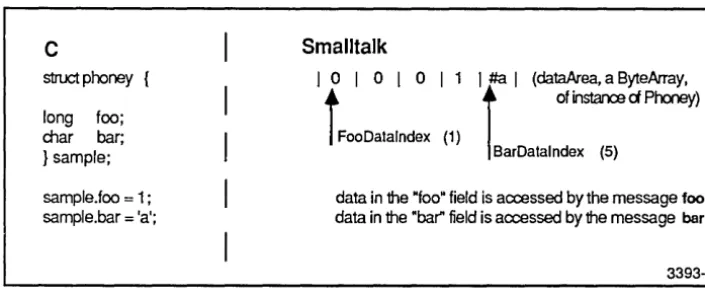
OS-ParametersPhoney object representing the structure with "faa" in it. See Figure 1 for a simple example.
c
struct phoney {
long foo;
mar bar;
} sample;
sample.foo
=
1 ; sample.bar = 'a';Smalltalk
I
0I
0I
0I
1I
#aI
(dataArea, a ByteArray,t
t
of in~ ci Phoney)FooDatalndex (1)
BarDatalndex (5)
data in the "foo" field is accessed by the message foo
data in the "bar" field is accessed by the message bar
3393-5
Figure 1
An example will help to illustrate the class variables miming convention. The following is the definition of the C structure which the Rusage class represents.
struct rusage { struct timeval struct timeval long long long long long long long long long long long long long long ru_utime; ru_stime; ru_maxrss; rujxrss; rujdrss; rujsrss; ru_minf/t; ru_majflt; ru_nswap; rujnblock; ru_oublock; ru_msgsnd; ru_msgrcv; ru_nsignals; ru_nvcsw; ru_nivcsw;
1* user time used *1 1* system time used *1
1* integral shared memory size *1 1* integral unshared data size *1 1* integral unshared stack size *1 1* page reclaims *1
1* page faults *1 1* swaps *1
1* block input operations *1 1* block output operations *1 1* messages sent *1 1* messages received *1 1* signals received *1
ExternalBinaryData OS-Parameters
The first two fields of struct rusage are of type struct timeval, defined as follows.
struct timeval {
long tv_sec; 1* seconds *1 long tv_usee; 1* microseconds *1
There are fourteen class variables for the Rusage fields with simple data types (all the fields of type long). In addition to the fourteen class variables for the simple fields of struct rusage, Rusage has class variables for the fields whose data type is a structure - rusage fields ru_utime and ru_stime are of type struct timeval. The additional variables are named StimeSecDatalndex, StimeUsecDatalndex, UtimeSecDatalndex, and UtimeUsecDatalndex. These names are derived from the field name in struct rusage and the name of the field in struct timeval. Field names are stripped of their prefix, as usual, to arrive at the "structure within a structure" class variable names.
-If an external data structure has fields which are not presently used, usually indicated by "reserved" in the field comment, the Smalltalk class for the structure does not have class variables for the "reserved" fields.
Naming Conventions for Subclasses' Protocol
ExternalBinaryData
OS-ParametersWhen a structure field is another structure, separate accessing messages are provided for the fields in the imbedded structure. For example, the Rusage method stimeSec returns the value of the tv_sec field of the timeval structure addressed by the struct rusage ru_stime field.
Protocol to set the value of a field which is an imbedded structure takes an instance of the class representing the imbedded structure as an argument. For example, the ltimerval method Interval: takes an instance of Timeval as an argument and sets the value of the it_interval field, which is of type struct timeval.
ExternalBinaryData Class Protocol
Accessing
methods implement inherited protocol to return the numberOfPolnters (0 for all subclasses) and the size Of all instances of a subclass, the sizelnBytes class instance variable. The pointersSize method exists to parallel theExternalPointerData method of that name; it returns 0 since no subclasses contain pointers.
Instance creation
defines the method new to return an instance with the correct number of indexable variables. As an abstract class, you would not send the message new to ExternalBinaryData to create an instance of this class. The method is implemented here for use in subclasses.InStance creation
methods in concrete subclasses return an instance of the class with the fields filled, either with data obtained via a system call or data supplied as arguments to the instance creation message. There is no pattern for subclasses'instance creation
protocol - it varies according to the common uses of individual structures.ExternalBinaryData Instance Protocol
Accessing
has one method, dataArea, which returns the receiver, since all instances of subclasses are strictly data (no pointers). Subclasses of the other branch of external data, ExternalPointerData, have an instance variable, dataArea, which is returned when the message dataArea is sent to an instance of a subclass. The inherited method replaceFrom:to:with:startingAt: is reimplemented; it invokes a primitive to perform a memory to memory data copy.ExternalBinaryData OS-Parameters
Adding Classes to this Hierarchy
If you are adding a subclass of ExternalBinaryData and the conventions just described are unclear to you, the best idea is to find a structure class similar to the structure you are adding and model your class on the similar one. Your new class' protocol must include a class initialization method which initializes the class
variables and size In Bytes. Remember to execute the Initialize method for the new class.
Related Classes
Subclasses:
DlsplayState lnaddr
Integer Pointer ltimerval Ltchars Rlimlt Rusage Sgttyb Sockaddrln SockaddrUn Stat
Tchars Timeval Timezone Utsname Walt
You might also want to look at ExternalData, the superclass. If you are adding a class for a structure with imbedded pointers, read about ExternalPointerData -your new class should be a subclass of that class or its subclass,
ExternalData
OS-Parameters
Object subclass: #ExternalData instanceVariableNames: classVariableNames: poolDictionaries: category:
Summary
'Char Int Long Pointer Short ' 'OS-Parameters'
ExternalData is an abstract class for defining data structures suitable for communicating with non-Smalltalk languages. Translation must occur to change Smalltalk objects to the data structure of another language, and vice versa. This class reimplements some 8yteArray protocol.
Naming Conventions for Subclasses and Subclass Protocol
A class is created for each external language structure. A structure with imbedded machine pointers is made a subclass of ExternalPointerData. A structure without imbedded machine pointers is made a subclass of External8inaryData. The class name is the same as the structure name. For example, the class Sockaddrln provides creation and accessing protocol for a C structure of that name. Fields are accessed by the names given in the structure, stripped of the prefix. For example, in Sockaddrln, the "sin_family" field is accessed with the message family. Offsets into the structure are provided as class variables.
Class Variables
Char <Integer>
Number of bytes for a C char type. Int <integer>
Number of bytes for a C int type. Long <Integer>
Number of bytes for a C long type. Pointer <integer>
Number of bytes for a C pointer type. Short <Integer>
ExternalData OS-Parameters
Instance Methods
accessing
at: index
Answer the value of the indexable field, index, of the receiver's dataArea. at: index put: anObject
Store the value, anObject, in the indexable field, index, of the receiver's dataArea.
dataArea
Answer the data portion of the receiver.
Subclass responsibility.
doubleWordAt: index put: value
Set the value of the double word (4 bytes) starting at byte index. numberOfPolnters
Return the number of pointers imbedded in the structure represented by the receiver.
replaceFrom: start to: stop with: replacement startingAt: repStart This destructively replaces elements from start to stop in the receiver, starting at index repStart in the Collection replacement. Answer the receiver. No range checks are performed.
slgnedlntegerDoubleWordAt: index
Answer the value of the double word (4 bytes) starting at byte index. Treat the value as a 2's complement signed integer.
signedlntegerWordAt: index
Answer the value of the word (2 bytes) starting at byte index. Treat the value as a 2's complement signed integer.
sizeof
Answer the number of bytes in the data section of the receiver. unsignedlntegerDoubleWordAt: index