SoK: A Consensus Taxonomy in the Blockchain Era
*Juan A. Garay Texas A&M University
[email protected]
Aggelos Kiayias†
University of Edinburgh & IOHK
[email protected]
Sunday 8thDecember, 2019
Abstract
Consensus is arguably one of the most fundamental problems in distributed computing, playing also an important role in the area of cryptographic protocols as the enabler of a secure broadcast functionality. While the problem has a long and rich history and has been analyzed from many dif-ferent perspectives, recently, with the advent of blockchain protocols like Bitcoin, it has experienced renewed interest from a much wider community of researchers and has seen its application expand to various novel settings.
One of the main issues in consensus research is the many different variants of the problem that exist as well as the various ways the problem behaves when different setup, computational assump-tions and network models are considered. In this work we perform a systematization of knowledge in the landscape of consensus research in the Byzantine failure model starting with the original formu-lation in the early 1980s up to the present blockchain-based new class of consensus protocols. Our work is a roadmap for studying the consensus problem under its many guises, classifying the way it operates in the various settings and highlighting the exciting new applications that have emerged in the blockchain era.
1 Introduction
The consensus problem—reaching agreement distributedly in the presence of faults—has been exten-sively studied in the literature starting with the seminal work of Shostak, Pease and Lamport [PSL80, LSP82]. The traditional setting of the problem involves parties connected by point-to-point channels, possibly using digital signatures in order to ensure the integrity of the information that is exchanged in the course of the protocol. For a relatively recent overview of the many variants of consensus that are considered in the distributed systems literature see Cachinet al.[CGR11]. Tolerating “Byzantine” behav-ior, i.e., the presence of parties that may behave arbitrarily, possibly in malicious ways, has been one of the hallmark features in the study of the problem.
Bitcoin was introduced by Nakamoto in 2008-2009 [Nak08a, Nak09], with the objective of providing a payment system that is decentralized in the sense of not relying on a central authority that should be trusted for transactions to be considered as final. Expectedly, the fundamental enabling component of the Bitcoin system is a consensus mechanism that facilitates agreement on the history of transactions. Given the conflicting interests of the Bitcoin protocol participants, such a system should be resilient to Byzantine behavior, which brings us to the main contribution of Bitcoin in the context of the consensus
problem, namely. a non-traditional and novel approach from the perspective of distributed computing to solve the problem in a setting that until then had not received sufficient attention.
In light of these developments, it is important to rethink the consensus problem in the blockchain era and organize the landscape that is currently being formed, acknowledging all the new directions and novel tools that have become available in the context of consensus protocol design.
One main aspect of our work is to look into the consensus problem from a modeling perspective providing the definitions needed to understand the problem and the solutions that have been developed over the years both in the traditional and the newer blockchain settings. In the course of this, we pro-vide a taxonomy of protocols and impossibility results that comprehensively outline what is currently known about consensus and which questions continue to remain open. Also important is to “extract” the relevant consensus question that is particular to Bitcoin, which we term “ledger consensus” (some-times referred to as “Nakamoto consensus”), and which is an instance of the state machine replication problem that has been long-studied in distributed systems [Sch90].
Consequently, in this paper we provide precise definitions of the relevant versions of consensus that have been investigated and systematize the existing knowledge about the problem with respect to (i) the network model, (ii) trusted setup assumptions, and (iii) computational assumptions under which, and at what cost in terms of running time and communication overhead, the problem can be solved.
We emphasize that our approach is problem-centric and the results being overviewed conceptual and fundamental in nature, with afeasibility focus with respect to the “resources” mentioned above, which means that in the case of classical consensus, a very active area of research in the distributed systems community, we might only mention in passing (if at all) the more recent results on practical Byzantine fault tolerance, for example. As such, our systematization complements the various other enumerative surveys of results and publications on the subject (e.g., [CGR11, BSA+17, SJS+18]).
Organization of the paper. We start in Section 2 by specifying a model of multi-party protocol execu-tion and how protocols’ properties will be deemed satisfied, as well as presenting the definiexecu-tion of (vari-ants of ) the consensus problem. We then specify the available resources and assumptions mentioned above under which the problem has been studied: Network assumptions (communication primitives, synchrony) in Section 3; trusted setup assumptions (no setup, public-state setup, private-state setup) in Section 4; and computational assumptions (none, one-way functions, proofs-of-work, random oracle) in Section 5. We then overview possibility (i.e., constructions) and impossibility results for consensus with respect to number of parties as a function of misbehaving parties (resp., honest vs malicious computa-tional power), trusted setup, running time and communication costs in the tradicomputa-tional (point-to-point communication) setting (Section 6), and in the Bitcoin (peer-to-peer) setting (Section 7).
We present ledger consensus in Section 8. After defining the problem, we proceed to the evaluation of existing results through a similar lens as in the case of (standard) consensus, including an adaptation to ledger consensus of the impossibility of standard consensus for dishonest majorities.
Supplementary material including the ideal specification of some of the resources available to the protocol can be found in the appendix.
2 Model and Definitions
2.1 Protocol execution
generated (we will henceforth call this an ITI, for interactive Turing machineinstance), the identity tape is initialized to a specific value that remains constant throughout the instance’s execution. The ITI may communicate with other ITI’s by writing to its outgoing communication tape.
Let us consider a protocolΠthat is modeled as an ITM. Ideally, we would like to consider the exe-cution of this protocol in an arbitrary setting, i.e., with an arbitrary set of parties and arbitrary configu-ration. A common way to model this in distributed cryptographic protocols is to consider that a certain program, thought of as an adversary, produces this configuration and therefore the properties of the protocol should hold for any possible choice of that program, potentially with some explicitly defined restrictions. The advantage of this particular modeling approach is that it obviates the need to quantify over all the details that concern the protocol (and substitutes them with a single universal quantification over all such “environments”).
Suppose now that we have a protocolΠthat is specified as an ITM and we would like to consider all possible executions of this protocol in the presence of an adversaryA, that is also modeled as an ITM. We capture this by specifying a pair of ITMs (Z,C), called theenvironmentand thecontrol program, respectively. The environmentZ is given some input which may be trivial (such as a security parameter 1κ) and is allowed to “spawn” new ITIs using the programs ofΠandA. By convention, only a single instance ofA will be allowed. Spawning such new instances is achieved by writing a single message to its outgoing tape which is read byC. The control program is responsible for approving such spawning requests byZ. Subsequently, all communication of the instances that are created will be routed via
C, i.e.,C will be receiving the instances’ outgoing messages and will be approving whether they can be forwarded to the receiving parties’ incoming tape. Note that this may be used to simulate the existence of point-to-point channels; nevertheless, we will take a more general approach. Specifically, the control functionC, will by definition only permit outgoing messages of running ITIs to be sent to the adversary
A (with instructions for further delivery). This captures the fact that the network cannot be assumed to bede factosafe for the instances that are communicating during the protocol execution (see below where we explain how the adversarial influence in the network may be constrained). Beyond writing messages that are routed thoughA, ITIs can also spawn additional ITIs as prescribed by the rules hardcoded in
C. This enables instances of a protocolΠto invoke subroutines that can assist in its execution. These subroutines can be sub-protocols or instances of “ideal functionalities” that may be accessible by more than a single running instance.
Given those features, the above approach provides a comprehensive framework for reasoning about protocol executions. In case a polynomial-time bound is required, in the setting where a computational assumption is employed that holds only for polynomial-time bounded programs, for example, some care needs to be applied to ensure that the total execution run time of the (Z,C) system remains polynomial-time. This is because even if all ITIs are assumed to be polynomially bounded, the total execution run time may not be. We refer to Proposition 3 in [Can01] for more details regarding enforcing an overall polynomial-time bound.
resources that may be available to the participants running the protocol. For instance, a secure chan-nel functionality may be spawned to transmit a message between two instances ofΠthat will only leak the length of the message to the adversary. As another example, a message-passing functionality may ensure that all parties are activated prior to advancing to the next communication round (see below in synchronous vs. asynchronous executions).
Execution of multiparty protocols. When protocol instances are spawned byZ they will be initialized with an identity which is available to the program’s code, as well as, possibly, with the identities of other instances that may run concurrently (this is at the discretion of the environment programZ). The iden-tities themselves may be useful to the program instance, as they may be used by the instance to address them. We will use the notationVIEWΠ,A,Z to denote anexecutionof the protocolΠwith an adversaryA and an environmentZ. The execution is a string that is formed by the concatenation of all messages and all ITI states at each step of the execution of the system (Z,C). The parties’ inputs are provided by the environmentZ which also receives the parties’ outputs. Parties that receive no input from the environment remain inactive. We denote by INPUT() the input tape of each party.
We note that by adopting the computational modeling of systems of ITMs by [Can01] we obviate the need of imposing a strict upper bound on the number of messages that may be transmitted by the adversary in each activation. In our setting, honest parties, at the discretion of the environment, are given sufficient time to process all messages delivered by any communication functionality available to them as a resource. It follows that denial of service attacks cannot be used to the adversary’s advantage in the analysis – i.e., they are out of scope from our perspective of studying the consensus problem.
Properties of protocols. In our statements we will be concerned withpropertiesof protocolsΠ. Such properties will be defined as predicates over the random variableVIEWΠ,A,Z by quantifying over all
adversariesA and environmentsZ.
Definition 1. Given a predicateQwe say thatthe protocolΠsatisfies property Qprovided that for allA andZ,Q(VIEWΠ,A,Z) holds.
Note that in some cases, protocols may only satisfy properties with a small probability of error over all possible executions. The probability space is determined by the private coins of all participants and the functionalities they employ. In such cases, we may indicate that the protocol satisfies the property with some (small, typically negligigle in a security parameter) error probability. We will only consider properties that are polynomial-time computable predicates. Our notion of execution will capture the single-session, stand-alone execution setting for protocols, hence properties will be single-session prop-erties.
Asynchronous vs. synchronous execution. The model above is able to capture various flavors of syn-chrony. This is achieved by abstracting the network communication as a functionality and specifying how the adversary may interfere with message delivery. The functionality may keep track of parties’ ac-tivations and depending on the case ensure that parties will be given a chance to act as the protocol execution advances.
assume that thetotalset of parties is known, but, nevertheless, only a small subset of them may be active in a particular moment during the protocol execution.
Setup assumptions. In a number of protocols, there is a need to have some pre-existing configuration (such as the knowledge of a common reference string [CRS], or a public-key infrastructure [PKI]). Such setup assumptions can be also captured as separate functionalitiesF that are available to the protocol ITIs.
Permissioned vs. permissionless networks. In the context of the consensus problem, this terminology became popular with the advent of blockchain protocols. The Bitcoin blockchain protocol is the proto-typical “permissionless” protocol where read access to the ledger is unrestricted and write access (in the form of posting transactions) can be obtained by anyone that possesses BTC (which may be acquired, in principle, by anyone that is running the Bitcoin client and invests computational power solving proofs of work). On the other hand, a permissioned protocol imposes more stringent access control on the read and write operations that are available as well as with respect to who can participate in the protocol. Ex-trapolating from the terminology as applied in the ledger setting, a permissionless consensus protocol would enable any party to participate and contribute input for consideration of the other parties. With this in mind, the traditional setting of consensus is permissioned, since only specific parties are allowed to participate; on the other hand, consensus in the blockchain setting can be either permissioned or permissionless.
Cryptographic primitives. We now overview some standard cryptographic primitives, as they are em-ployed by some of the consensus protocols. Adigital signature schemeconsists of three PPT algorithms (Gen,Sign,Verify) such that (vk,sk)←Gen(1κ) generates a public-key/secret-key pair;σ←Sign(sk,m) signs a messagem; andVerify(vk,m,σ) returns 1 if and only ifσis a valid signature formgivenvk. A digi-tal signature scheme isexistentially unforgeable, if for any PPT adversaryAthat has access to aSign(sk,·) oracle, the event thatA returns some (m,σ) such thatVerify(vk,m,σ)=1 has measurenegl(κ), where the probability is taken over the coin tosses of the algorithms,negl() denotes a negligible functon, andκ is the security parameter. Acollision resistant (keyed) hash function family{Hk}k∈K has the property that Hk: {0, 1}∗→{0, 1}κ, it is efficiently computable and the probability to producex6=ywithHk(x)=Hk(y)
givenkisnegl(κ). Another, less standard primitive that has been widely deployed in consensus protocol design with the advent of the Bitcoin blockchain isproof of work(PoW); see Section 5 for more informa-tion on the primitive.
2.2 The consensus problem
As mentioned earlier, consensus (akaByzantine agreement), formulated by Shostak, Pease and Lam-port [PSL80, LSP82], is one of the fundamental problems in the areas of fault-tolerant distributing com-puting and cryptographic protocols, in particular secure multi-party computation [Yao82,GMW86,BGW88, CCD87]. In the consensus problem,n parties attempt to reach agreement on a value from some fixed domainV, despite the malicious behavior of up to t of them. More specifically, every partyPi starts
the consensus protocol with an initial valuev ∈V, and every run of the protocol must satisfy (except possibly for some negligible probability) the following conditions (we note that all properties below are expressible asQpredicates according to Definition 1).
– Termination:All honest parties decide on a value.
– Validity:If all honest parties have the same initial valuev, then all honest parties decide onv.
The domainV can be arbitrary, but frequently the caseV ={0, 1} is considered given the efficient trans-formation of binary agreement protocols to the multi-valued case cf. [TC84].1
There exist various measures of quality of a consensus protocol: itsresiliency, expressed as the frac-tion (nt) of misbehaving parties a protocol can tolerate; its running time—worst number of rounds by which honest parties terminate; and its communication complexity—worst total number of bits/mes-sages communicated during a protocol run.
In the consensus problem, all the parties start with an initial value. A closely related variant is the single-source version of the problem (aka theByzantine Generalsproblem [LSP82], or simply (reliable or secure) “broadcast”), where only a distinguished party—thesender—has an input. In this variant, both the Termination and Agreement conditions remain the same, and Validity becomes:
– Validity:If the sender is honest and has initial valuev, then all honest parties decide onv.
A stronger, albeit natural, version of the consensus problem requires that the output value be one of the honest parties’ inputs, a distinction that is only important in the case of non-binary inputs. In this version, calledstrong consensus[Nei94], the Validity condition becomes:
– Strong Validity:If the honest parties decide onv, thenvis the input of some honest party.
Note that the distinction with the standard version of the problem is only relevant in the case of non-binary inputs. Further, the resiliency bounds for this version also depend on|V|(see Section 6).
Another way to enhance validity is to require that the output of an honest party conforms to an ex-ternalpredicateQ[CKPS01]. In this setting, each inputvis accompanied by a proofπand is supposed to satisfyQ(v,π)=1 (for instance,πcan be a digital signature onvandQ would be verifying its valid-ity). Note that the resulting guarantee is weaker than strong validity (since it could be the case that the decision is made on an input suggested by a corrupted party), but nevertheless it can be suitable in a multi-valued setting where only externally validated inputs are admissible as outputs.
Finally, we point out that, traditionally, consensus problems have been specified as above, in a property-basedmanner. Protocols for the problem are then proven secure/correct by showing how the properties (e.g., the Agreement, Validity and Termination conditions) are met. Nowadays, however, it is widely ac-cepted to formulate the security of a protocol via the “trusted-party paradigm” (cf. [GMW86, Gol01]), where the protocol execution is compared with an ideal process where the outputs are computed by a trusted party that sees all the inputs. A protocol is then said to securely carry out the task if running the protocol with a realistic adversary amounts to “emulating” the ideal process with the appropriate trusted party. One advantage of such a simulation-based approach is that it simultaneously capturesall
the properties that are guaranteed by the ideal world, without having to enumerate some list of desired properties. Simulation-based definitions are also useful for applyingcomposition theorems(e.g., [Can00, Can01]) that enable proving the security of protocols that use other protocols as sub-routines, which typically would be the case for consensus and/or broadcast protocols.
The above captures the classical definition of the consensus problem. A related and recently exten-sively studied version of the problem is state-machine replication or “ledger” consensus that we will treat in Section 8.
On the necessity of an honest majority.Regardless of the resources available to the parties in the proto-col execution, an upper bound of (less than)n/2 can be shown for resiliency (see, for example, [Fit03]).
Specifically, consider a setnof parties that are equally divided with respect to their initial values between inputs 0 and 1, and an adversary that with 1/3 probability corrupts no one (case 1), with 1/3 probability corrupts the parties that have input 0 (case 2) and with 1/3 probability corrupts the parties that have input 1 (case 3). In any case, the adversarial parties follow the protocol. Observe that case 1 requires from the honest parties to converge to a common output (due to Agreement), while in the other two cases the honest parties should output 0 (case 2) and 1 (case 3). However, all three cases are perfectly indistinguishable in the view of the honest parties and as a result a logical contradiction ensues.
3 Network Assumptions
3.1 Communication primitives
Consensus protocols are described with respect to a network layer that enables parties to send messages to each other. An important distinction we will make is between point-to-point connectivity vs. message “diffusion” as it manifests in a peer-to-peer communication setting.
Point-to-point channels. In this setting parties are connected with pairwise reliable and authentic channels. We call that resource RMT, forreliable message transmission. When a party sends a message it specifies its recipient as well as the message contents and it is guaranteed that the recipient will receive it. The recipient can identify the sender as the source of the message. In such fixed connectivity setting, all parties are aware of the set of parties running the protocol. Full connectivity has been the standard communication setting for consensus protocols, see [LSP82], although sparse connectivity has also been considered (cf. [DPPU88, Upf92]). We present the functionality for RMT in the appendix.
In terms of measuring communication costs in this model, it will be simpler for us to use the (maxi-mum) total number of messages in a protocol run, rather than the total number of communicated bits, assuming a suitable message size. See, e.g., [Fit03] (Chapter 3) for a detailed account of the communica-tion complexity of consensus (and broadcast) protocols.
Peer-to-peer diffusion. This setting is motivated by peer-to peer message transmission that happens via “gossiping,” i.e., messages received by a party are passed along on to the party’s peers. We refer to this basic message passing operation as “Diffuse.” Message transmission is not authenticated and it does not preserve the order of messages in the views of different parties. When a message is diffused by an honest party, there is no specific recipient and it is guaranteed that all activated honest parties will receive the same message. Nonetheless, the source of the message may be “spoofed” and thus the recipient may not reliably identify the source of the message,2and when the sender is malicious not everyone is guaranteed to receive the same message. Contrary to the point-to-point channels setting, parties may neither be aware of the identities of the parties running the protocol nor their precise number. The ideal functionality capturing the diffuse operation is also presented in Appendix A.
In order to measure the total communication costs of peer-to-peer diffusion, one needs to take into account the underlying network graph. The typical deployment setting will be a sparse constant-degree graph for which it holds that the number of edges equalsO(n). In such setting, each invocation of the primitive requiresO(n) messages to be transmitted in the network.
Relation between the communication primitives. It is easy to see that given RMT, there is a straight-forward, albeit inefficient, protocol that simulates Diffuse; given a message to be diffused, the protocol
using RMT will send the message to each party in the set of parties running the protocol. On the other hand, it is not hard to establish that no protocol can simulate RMT given Diffuse. The argument is as follows, and it works no matter how the protocol using Diffuse may operate. When a partyAtransmits a messageMto partyB, it is possible for the adversary in the Diffuse setting to simulate a “fake” party
Athat sends a messageM06=MtoBconcurrently. Invariably, this will result to a setting whereBhas to
decide which is the correct message to output and will have to produce the wrong message with non-negligible probability. It follows that Diffuse is a weaker communication primitive: one would not be able to substitute Diffuse for RMT in a protocol setting.
Other models. The above models may be extended in a number of ways to capture various real world considerations in message passing. For instance, in point-to-point channels, the communication graph may change over the course of protocol execution with edges being added or removed adversarially, something that may also result in temporary network partitions. Another intermediate model between point-to-point channels and diffusion, formulated by Okun [Oku05a], is to have a diffusion channel with “port awareness,” i.e., the setting where messages from the same source are linkable, or without port awareness, but where each party is restricted to sending one message per round (see Section 3.2 for the notion of round) and their total number is known. Yet another intermediate model in terms of par-tial knowledge of parties and authentication has been treated, e.g., in [BF99, ABdSFG08] and follow-up works.
3.2 Synchrony
The ability of the parties to synchronize in protocol execution is an important aspect in the design of consensus protocols. Synchrony in message passing can be captured by dividing the protocol execution in rounds where parties are activated in some sequence and each one of them has the opportunity to send messages which are received by the recipients at the onset of the next round. This reflects the fact that in real world networks messages are delivered most of the time in a timely fashion and thus parties can synchronize the protocol execution in discrete rounds.
A first important relaxation to the synchronous model is to allow the adversary to control the activa-tion of parties so that it acts last in each round having access to all messages sent by honest participants before it decides on the actions of the adversarial participants and the ordering of message delivery for the honest parties in the next round. This concept is standard in the secure mult-iparty computation lit-erature [GMW87, BGW88, CCD88] and is commonly referred to as the “rushing adversary” [Can01]. This is captured by the functionalities in Figures 3 and 4. A second relaxation is to impose a time bound on message delivery that is not known to the protocol participants. We shall refer to this as the “partially synchronous setting” [DLS88]. The partial synchronous setting is easy to capture by the functionalities in Figures 3 and 4 as follows: a parameter∆∈Nis introduced in each functionality that determines the maximum time a message can remain “in limbo.” For each message that is sent, a counter is introduced that is initially 0 and counts the number of rounds that have passed since its transmission (note that this concept of round is not any more a “message passing” round). When this counter reaches∆the message is copied to theinbox(·) strings for the active participants.
Finally, in the “fully asynchronous setting” (cf. [Can01]), where messages may be arbitrarily delayed
or droppedconsensus is trivially impossible.
4 Setup Assumptions
In the context of protocol design, a setup assumption refers to information that can be available at the onset of the protocol to each protocol participant. Consensus protocols are designed with respect to a number of different setup assumptions that we outline below.
4.1 No setup
In this setting we consider protocols that parties do not utilize any setup functionality beyond the ex-istence of the communication functionality. Note that the communication functionality may already provide some information to the participants about the environment of the protocol; nevertheless, this setting is distinguished from other more thorough setup assumptions that are described below. We note that in this setting it may be of interest to consider protocol executions wherein the adversary is allowed a certain amount of precomputation prior to the onset of execution that involves the honest parties.
4.2 Public-state setup
A public-state setup is parameterized by a probability ensembleD. For each input sizeκ, the ensembleD specifies a probability distribution that is sampled a single time at the onset of the protocol execution to produce a string denoted bysthat is of length polynomial inκ. All protocol parties, including adversarial ones, are assumed to have access to s. In this setting, the consensus protocol will be designed for a specific ensembleD.
The concept of a public-state setup can be further relaxed in a model that has been called “sun-spots” [CPS07], where the ensemble is further parameterized by an indexa. The definition is the same as above but now the protocol execution will be taken for some arbitrary choice ofa. Intuitively, the parameteracan be thought as an adversarial influence in the choice of the public strings. In this setting, the consensus protocol will be designed with respect to the ensemble class {Da}a.
4.3 Private-state setup
As in the public state case, a private state setup is parameterized by an ensembleD. For each input sizeκ and number of partiesn,Dspecifies a probability distribution that is sampled a single time to produce a sequence of values (s1, . . . ,sn). The length of each valuesiis polynomial inκ. At the onset of the protocol
execution, the ensemble is sampled once and each protocol participant will receive one of the values
si following some predetermined order. The critical feature of this setting is that each party will have
private access tosi. Observe that, trivially, the setting of private-state setup subsumes the setting of
public-state setup.
As in the case of a public-state setup, it is important to consider the relaxation where the ensemble
D is parameterized by string a. As before sampling fromDa will be performed from some arbitrary choice ofa. It is in this sense where private-state setup has been most useful. In particular, we can use it to express the concept of a public-key infrastructure (PKI). In this setting the ensembleD employs a digital signature algorithm (Gen,Sign,Verify) and samples a value (vki,ski)←Gen(1κ) independently
to all parties’ public (verification) keys and its own private key. Other types of private setup include “correlated randomness” [Bea96], where parties get correlated random strings (r1,r2, ...,rn) drawn from
some predetermined distribution, which has been used to implement a random beacon [Rab83]. One may consider more complicated interactive setups, such as for example the adversary choosing
asomehow based on public information available about (s1, . . . ,sn), but we will refrain from considering
those here. An alternative (and subsumed by the above) formulation of a private setup includes the avail-ability of a broadcast channel prior to the protocol execution, which enables participants to exchange shared keys [PW92].
5 Computational Assumptions
The assumptions used to prove the properties of consensus protocols can be divided into two broad categories. In the information-theoretic (aka “unconditional”) setting, the adversary is assumed to be unbounded in terms of its computational resources. In the computational setting, on the other hand, a polynomial-time bound is assumed.
5.1 Information-theoretic security
In the information-theoretic setting the adversarial running time is unbounded. It follows that the ad-versary may take arbitrary time to operate in each invocation. Note that the protocol execution may continue to proceed in synchronous rounds, nevertheless the running time of the adversary within each round will dilate sufficiently to accomodate its complete operation. When proving the consensus prop-erties in this setting we can further consider two variations: perfect and statistical. When a property, Agreement for example, is perfectly satisfied this means that in all possible executions the honest par-ties never disagree on their outputs. On the other hand, in the statistical variant, there will be certain executions where the honest parties are allowed to disagree. Nevertheless, these executions will have negligible density in a security parameter (in this case,n) among all executions. We observe that the sta-tistical setting is only meaningful for a probabilistic consensus protocol, where the honest parties may be “unlucky” in their choices of coins.
5.2 Computational security
In the computational setting the adversarial running time, and/or the computational model within which the adversary (and the parties running the protocol) are expressed becomes restricted. We distinguish the following variants.
One-way functions. A standard computational assumption is the existence of one-way functions. A one-way function is a functionf :X →Y for which it holds that f is polynomial-time computable, but the probabilityA(1|x|,f(x))∈f−1(f(x)) for a randomly sampledx, is negligible in|x|for any polynomial time bounded programA. One-way functions, albeit quite basic, are a powerful primitive that enables the construction of more complex cryptographic algorithms that include symmetric-key encryption, tar-get collision-resistant hash functions and digital signatures [NY89]; the latter in particular play an impor-tant role when categorizing consensus protocols as we see below.
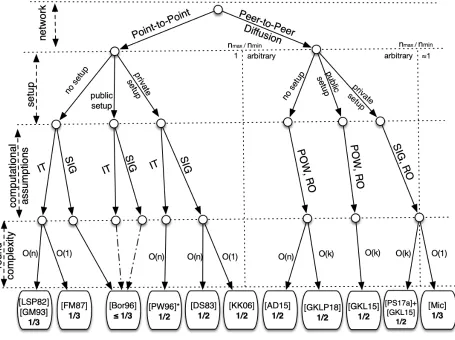
Figure 1: The taxonomy of consensus protocols and impossibility results in the synchronous setting; nmax/nminrefers toparticipation tolerance(cf. Sec 7).
identified as important for the application of the primitive specifically to blockchain protocols, includ-ing amortization resistance, sampleability, fast verification, hardness against tamperinclud-ing and message attacks, and almostk-wise independence [GKP17]. Some variants of PoWs have been shown to imply one-way functions [BGJ+16].
6 Consensus in the Point-to-Point Setting
In the traditional network model of point-to-point reliable channels between every pair of parties, the problem was formulated in [LSP82] in the two settings described in Section 5: the information-theoretic setting and the computational (also calledcryptographic, orauthenticated) setting. As mentioned above, in the former no assumptions are made about the adversary’s computational power, while the latter relies on the hardness of computational problems (such as factoring large integers or computing discrete logs), and requires a trusted setup in the form of a PKI. Depending on the setting, some of the bounds on the problems’ quality measures differ. Refer to Figure 1 (specifically, the left subtree) as we go through the classification below.
Number of parties.For the information-theoretic setting,n>3tis both necessary and sufficient for the problem to have a solution. The necessary condition is presented in [LSP82] for the broadcast problem (see [FLM86] for the consensus version of the impossibility result), as the special case of 3 parties (“gen-erals”), having to agree on two values (‘attack’, ‘retreat’), with one of them being dishonest. As in the information-theoretic setting (with no additional setup) the parties are not able to forward messages in an authenticated manner, it is easily shown that an honest receiver cannot distinguish between a run where the sender is dishonest and sends conflicting messages, and a run where a receiver is dishonest and claims to have received the opposite message, which leads to the violation of the problem’s con-ditions (Agreement and Validity, respectively). The general case (arbitrary values ofn) reduces to the 3-party case. The (broadcast) protocol presented in [LSP82] matches this bound (n>3t), and essentially consists in recursively echoeing messages received in a round while excluding the messages’ senders. (In the first round, only the sender sends messages.) This is done fort+1 rounds, at which point the parties take majority of the values received for that instance, returning that value as they exit that recursive step. The party’s output is the value returned for the first recursive call. t+1 rounds were later shown to be optimal (see below), but the protocol requires exponential (inn) computation and communication.
Lamportet al.[LSP82] also formulated the problem in the computational setting, where, specifically, there is a trusted private-state setup (of a PKI), and the parties have access to a digital signature scheme. This version of the problem has been referred to asauthenticatedByzantine agreement. In contrast to the information-theoretic setting, in the computational setting with a trusted setup the bounds for broad-cast and consensus differ: n>t [LSP82] andn>2t (e.g., [Fit03]), respectively. The protocol presented in [LSP82] runs int+1 rounds but, as in the information-theoretic setting, is also exponential-time; an efficient (polynomial-time) protocol was presented early on by Dolev and Strong [DS83], which we now briefly describe. In this protocol in the first round the sender digitally signs and sends his message to all the other parties, while in subsequent rounds parties append their signatures and forward the result. If any party ever observes valid signatures of the sender on twodifferentmessages, then that party for-wards both signatures to all other parties and disqualifies the sender (and all parties output some default message). This simple protocol is a popular building block in the area of cryptographic protocols.
The original formulation of the problem in the computational setting assumes a PKI. In [Bor96], Borcherding considered the situation where no PKI is available, which he refers to as “local authenti-cation,” meaning that no agreement on the parties’ keys is provided, as each party distributes its verifi-cation key by itself. Borcherding shows that in this case, as in the information-theoretic setting above, broadcast and consensus are not possible if n≤3t, even though this setting is strictly stronger, as a dishonest party cannot forge messages sent by honest parties. The gist of the impossibility is that the adversary can always confuse honest parties about the correct protocol outcome and digital signatures cannot help if they are not pre-associated with the parties running the protocol in advance (something only ensured given a private setup).
par-ties’ input values), Fitzi and Garay [FG03] showed that the problem has a solution if and only ifn >
max(3,|V|)tin the unconditional setting3, whereV is the domain of input/output values, andn> |V|tin the computational setting with a trusted setup, giving resiliency-optimal and polynomial-time protocols that run int+1 rounds.
Running time. Regarding the running time of consensus protocols, a lower bound oft+1 rounds for deterministic protocols was established by Fischer and Lynch [FL82] for the case of benign (“crash”) fail-ures, and extended to the setting with malicious failures where messages are authenticated by Dolev and Strong [DS83]. As mentioned above, the original protocols by Lamportet al.already achieved this bound, but required exponential computation and communication. In contrast to the computational setting, where a polynomial-time resiliency- and round-optimal protocol was found relatively soon [DS83], in the information-theoretic setting this took quite a bit longer, and was achieved by Garay and Moses [GM98]. In a nutshell, the [GM98] result builds on the “unraveled” version of the original protocol, presented and calledExponential Information Gatheringby Bar-Noyet al. [BDDS92], applying a suite of “early-stopping” (see more on this below) and fault-detection techniques to prune the tree data structure to polynomial size. Regarding strong consensus, thet+1-round lower bound also applies to this version of the problem, which the protocols by Fitzi and Garay [FG03] achieve (as well as being polynomial-time and resiliency-optimal).
In thet+1-round lower bound for deterministic protocols,tis the maximum number of corruptions that can be tolerated in order to achieve consensus in a given model. Dolev, Reischuk and Strong [DRS90] asked what would the running time be when theactualnumber of corruptions, say,f is smaller thant, and showed a lower bound of min{t+1,f+2} for any consensus protocol, even when only crash failures occur, which is important when f is very small. They called a consensus protocol satisfying this prop-erty early-stopping. Faster termination, however, comes at a price of non-simultaneous termination, as they also showed that if simultaneous termination is required, thent+1 rounds are necessary. (See also [DM90].)
Optimal early stopping for the optimal number of parties (i.e.,n>3t) was achieved in the information-theoretic setting by Berman and Garay [BGP92b]; the protocol, however, is inefficient, as it requires ex-ponential communication and computation. Relatively recently, an efficient (polynomial-time) optimal early-stopping consensus protocol was presented by Abraham and Dolev [AD15a].
The abovet+1-round lower bound applies to deterministic protocols. A major breakthrough in fault-tolerant distributed algorithms was the introduction of randomization to the field by Ben-Or [BO83] and Rabin [Rab83], which, effectively, showed how to circumvent the above limitation by using randomiza-tion. Rabin [Rab83], in particular, showed that linearly resilient consensus protocols in expectedconstant
rounds were possible, provided that all parties have access to a “common coin” (i.e., a common source of randomness). Essentially, the value of the coin can be adopted by the honest parties in case disagree-ment at any given round is detected, a process that is repeated multiple times. This line of research culminated with the work of Feldman and Micali [FM97], who showed how to obtain a shared random coin with constant probability from “scratch,” yielding a probabilistic consensus protocol tolerating the maximum number of misbehaving parties (t<n/3) that runs in expected constant number of rounds.
The [FM97] protocol works in the information-theoretic setting; these results were later extended to the computational setting by Katz and Koo [KK09], who showed that assuming a PKI and digital sig-natures there exists an (expected-)constant-round consensus protocol tolerating t <n/2 corruptions. Recall that broadcast protocols in the computational setting with setup tolerate an arbitrary number (i.e.,n >t) of dishonest parties; in contrast, the protocol in [KK09] assumesn >2t (as it is based on VSS—verifiable secret sharing[CGMA85]). In [GKKO07], Garayet al. consider the case of a dishonest majority (i.e.,n≤2t), presenting an expected-constant-round protocol fort =n2+O(1) dishonest
ties (more generally, expectedO(k2) running time whent = n2 +k), and showing the impossibility of expected-constant-round broadcast protocols whenn−t=o(n).
The speed-up on the running time of probabilistic consensus protocols comes at the cost of uncer-tainty, as a party that terminates can never be sure that other parties have also terminated—i.e., there cannot besimultaneoustermination [DRS90], which is an issue when these protocols are invoked from a higher-level protocol, as a party cannot be sure how long after he receives his output from a call to such a probabilistic termination(PT) consensus protocol (cf. [CCGZ16]) he can safely carry out with the execution of the calling protocol. The sequential composition of PT consensus protocols was ad-dressed by Lindellet al. [LLR06] while the parallel composition of such protocols by Ben-Or and El-Yaniv [BE03]. (The issue in the case of parallel invocations of expected-constant-round PT protocols is that the overall running time of the parallel executions is not necessarily expected constant.) The above results on sequential and parallel composition, however, do not use simulation-based security, and it was therefore unclear how (or if ) one would be able to use them to instantiate consensus (and/or broad-cast) from a higher-level protocol. Such formal simulation-based (and therefore composable) definition and constructions of consensus protocols with probabilistic termination has been recently presented in [CCGZ16].
Trusted setup. We already covered this aspect above while describing the protocols achieving the dif-ferent bounds on the number of parties; here we briefly summarize it. There is no trusted setup in the unconditional setting, although in the case of randomized protocols there is the additional requirement of the point-to-point channels being private in addition to reliable, while the “authenticated” consen-sus protocols assume a PKI. Related to a trusted setup assumption, we remark that if apre-computation
phase is allowed in the information-theoretic setting where reliable broadcast is guaranteed, then Pfitz-mann and Waidner showed that broadcast and consensus are achievable with the same bounds on the number of parties as in the computational setting, using a tool known as a “pseudo-signatures” [PW92].
Communication cost.A lower bound ofΩ(n2) on the number of messages (in fact,Ω(nt)) was shown by Dolev and Reischuk for consensus for both information-theoretic and computational security [DR85]; for the latter, what they showed was that the number of signatures that are required by any protocol isΩ(nt), resulting in anΩ(nt|σ|) bit complexity (for a constant-size domain), where|σ|represents the maximum signature size. The first information-theoretically secure protocols to match this bound were given by Bermanet al.[BGP92a] and independently by Coan and Welch [CW89]; regarding computa-tional security, the protocol presented by Dolev and Strong [DS83] requires that many messages. By re-laxing the model and allowing for a small probability of error, King and Saia [KS16], presented a protocol that circumvents the impossibility result (with message complexity ˜O(n1.5)).
The above bounds (except for [KS16]) reflect the fact that in typical protocols messages are commu-nicated at leastΩ(n2) times, resulting in an overall communication complexity of at leastΩ(`n2) for`-bit messages. In [FH06, HR14], Fitzi and Hirt and Hirt and Raykov show protocols for consensus and broad-cast, respectively, where the long message is communicatedO(n) times, which is optimal as no protocol can achieve consensus or broadcast of an`-bit message with communication complexityo(`n). See also [Pat11, GP16] for further improvements.
Beyond synchrony.The case of partial synchrony, introduced in [DLS88], considers the existence of an unknown bound∆that determines the maximum delay of a message that is unknown to the protocol participants.4 As shown in [DLS88], the resiliency bounds presented in the point-to-point subtree of Figure 1 remain unaltered in the no setup and public setup cases, but it degrades ton/3 in the private setup case.
In the eventual delivery setting, as mentioned above, deterministic consensus is impossible but it is still feasible to obtain protocols with probabilistic guarantees. Furthermore, note that in this setting it is not possible to account for all of the honest parties’ inputs since parties cannot afford to wait for all the parties to engage (since corrupt parties may never transmit their messages and it is impossible to set a correct time-out). In more detail, without a setup in the information-theoretic setting, it is possible to adapt the protocol in [FM97] and achieven/4 resilience [Fel88] (see Figure 1). By allowing the protocol not to terminate with negligible probability, Canetti and Rabin showed how to bring the resiliency to
n/3 [CR93], which was later on improved to guarantee termination with probability 1 by Abrahamet al.[ADH08]. Efficiency improvements to the above two results (specifically, communication of the first one, and running time of the second one) were more recently presented in [PCR14, BCP18], respectively. In the private-setup setting, assuming one-way functions, it is possible to obtain an always-terminating protocol withn/3 resiliency (cf. [Fel88]). We note that it is infeasible to go beyondn/3 resiliency, as shown in [BCG93, Can96], where this bound is argued for fail-stop failures, and thus the above results are optimal in this sense.
Most protocols mentioned above demonstrate the feasibility of the respective bounds. Much effort has also been dedicated to achieving practical Byzantine fault tolerance (BFT) in the eventual message delivery model. For completeness, here we mention some relevant results, with the work by Castro and Liskov [CL02] as a notable instance, where they focus on a fault-tolerant replicated transactions ser-vice in the cryptographic setting with the corresponding Safety and Liveness properties (see Section 8), achievingn/3 resiliency. Cachinet al.[CKS05] study consensus in the same model, showing an efficient coin tossing protocol assuming a random oracle. Other related works focusing on practical efficiency in-clude the work by Kursawe and Shoup on “asynchronous” atomic broadcast [KS05] (atomicity means that broadcast executions are ordered in such a way that two broadcast requests are received in the same or-der by any two honest parties), following the “optimistic” approach presented in [CL02] where first only a “Bracha broadcast” protocol [Bra84] is first attempted, reverting to the use of cryptography if things go wrong. Finally, Milleret al.[MXC+16] improve on the communication complexity of the protocol
in [CKPS01], and guarantee Liveness without any timing assumptions, which was the case in [CL02].
Property-based vs. simulation-based proofsAs mentioned in Section 2.2, consensus and broadcast protocols have been typically proven secure/correct following aproperty-basedapproach. It turns out, as pointed out by Hirt and Zikas [HZ10] (see also [GKKZ11]), that in the case ofadaptiveadversaries who can choose which parties to corrupt dynamically, during the course of the protocol execution (cf. [CFGN96]), most existing broadcast and consensus protocols cannot be proven secure in a simulation-based man-ner. The reason, at a high level, is that when the adversary (having corrupted a party) receives a message from an honest party, can corrupt that party and make him change his message to other parties. This cre-ates an inconsistency with the ideal process, where the party has already provided his input to the trusted party/ideal functionality that abstracts consensus. To be amenable to a simulation-based proof, instead of sending its initial message “in the clear,” the sender in a broadcast protocol sends acommitmentto the message, allowing the simulator in the ideal process to “equivocate” when the committed value becomes known in case the party has been corrupted and the initial value changed [HZ10, GKKZ11].
7 Consensus in the Peer-to-Peer Setting
sources across rounds can be established and the exact number of parties that participate may be un-known to the protocol participants. Moreover, since the adversary may inject messages in the network, an honest party cannot infer the number of participants from a message count.
We note that in a precursor model, where there is no correlation of message sources, but the point-to-point structure is still in place albeit without authentication, Okun showed that deterministic consensus algorithms are impossible for even a single failure [Oku05b, Oku05a], but that probabilistic consensus is still feasible by suitably adapting the protocols of [BO83, FM97]5; the protocol, however, takes exponen-tially many rounds.
The consensus problem in the peer-to-peer setting has mostly been considered in the computational setting utilizing one-way functions and the proof-of-work (PoW) primitive (Section 5). The first sugges-tion for a solusugges-tion was informally described in [AJK05], where it was suggested that PoWs can be used as an “identity assignment” tool, which subsequently can be used to bootstrap a standard consensus protocol like [DS83]. Nevertheless, the viability of this plan was never fully analyzed until an alternative approach to the problem was informally described by Nakamoto in an email exchange [Nak08b], where he argued that the “Byzantine Generals” problem can be solved by a blockchain/PoW approach tolerat-ing a number of misbehavtolerat-ing parties strictly belown/2. As independently observed in [ML14, GKL14], however, with overwhelming probability the Validity property is not satisfied by Nakamoto’s informal suggestion.
The blockchain approach suggests to string PoWs together in a hash chain and achieve agreement using a rule that favors higher concentrations of computational effort as reflected in the resulting hash chains. The inputs to the consensus problem are “entangled” within the PoWs themselves and the final output results from a processing of the hash chain. The approach was first formalized in [GKL15] where also two constructions were provided that satisfy all properties assuming a public setup.
Without access to a public setup, it is also possible to obtain a construction based on the results of [AD15b], who were the first to formalize the [AJK05] informal approach of using PoWs for identity as-signment. Moreover, a blockchain-based approach is also possible as shown in [GKLP18]. Using a private setup, it becomes feasible to use primitives such as digital signatures and verifiable random functions (by storing the public key information as part of the public part of the setup, while the secret key informa-tion is the private part of the setup) and obtain even more efficient construcinforma-tions such as the consensus sub-protocol of [CM19].
Number of parties.One of the most important characteristics of consensus in the peer-to-peer setting is that the actual number of parties that are running the protocol is not assumed to be known in advance. Instead, the actual number of parties becomes a run-time execution parameter and the protocol is sup-posed to be able to tolerate a range of different of possible choices for the number of parties. We capture this by posing a range of possible operational values [nmin,nmax], and posit that if the actual number of parties falls within the range then the properties will be guaranteed. We call the rationmax/nminfor a given protocol a protocol’sparticipation tolerance. We note that this notion is somewhat related to models that have been considered in fault-tolerant distributed computing and secure multiparty com-putation (see, e.g., [GP92] and [HLP11], respectively). In such scenarios the parties are subject to two types of faults, Byzantine and benign, such as “going to sleep,” but adversarially scheduled. In the latter type, the parties will cease participating in the protocol execution.
In the convention introduced in [GKL15], each party has a fixed quota of hashing queries that is al-lowed per round. As a result, the number of parties is directly proportional to the “computational power” that is present in the system and the total number of PoWs produced by the honest parties collectively would exceed that of the adversary assuming honest majority with very high probability. Given this it is tempting to imagine a direct translation of computational power to a set of identities [AJK05]. The main
problem is that the set of identities as perceived by the honest partipants in the protocol execution might be inconsistent. This was resolved with the protocol of [AD15b] where PoWs are used to build a “graded” PKI, where keys have ranks. The graded PKI is an instance of thegraded agreementproblem [FM97], or partial consistency problem [CFF+05], where honest parties do not disagree by much, according to some metric. Subsequently, it is possible to morph this graded consistency to global consistency by run-ning multiple instances of [DS83]. This can be used to provide a consensus protocol with resiliencyn/2 without a trusted setup.
It is unnecessary though for the parties to reach consensus by establishing identities. In the first consensus protocol presented in [GKL15], the parties build a blockchain where each block contains a value that matches the input of the party that produced the block. The protocol continues for a certain number of rounds that ensures that the blockchain has grown to a certain length. In the final round, the parties remove ak-block suffix from their local blockchain, and output the majority bit from the remain-ing prefix. Based on the property called “common prefix” in [GKL15], it is shown that with overwhelmremain-ing probability in the security parameter, the parties terminate with the same output, while using the “chain quality” property, it is shown that if all the honest parties start with the same input, the corrupt parties cannot overturn the majority bit, which corresponds to the honest parties’ input. The number of toler-ated misbehaving parties in this protocol is strictly belown/3, a sub-optimal resiliency due to the low chain quality of the underlying blockhain protocol. The maximum resiliency that can be expected is
n/2, something that can be shown by easily adapting the standard argument for the necessity of honest majority shown in Section 2.
Optimal resiliency can be reached by the second consensus protocol of [GKL15] as follows: The pro-tocol substitutes Bitcoin transactions with a type of transactions that arethemselvesbased on PoWs, and hence uses PoWs in two distinct ways: for the maintenance of the ledger and for the generation of the transactions themselves. The protocol requires special care in the way it employs PoWs since the ad-versary should be incapable of “shifting” work between the two PoW tasks that it faces in each round. To solve this problem, a special strategy for PoW-based protocol composition is introduced in [GKL15] called “2-for-1 PoWs.” In the second solution presented in [GKL15] the number of tolerated misbehaving parties is strictly belown/2.
We note that all these protocols come with a hard-coded difficulty level for PoWs which is assumed to be correlated with the number of partiesn. Iff is the probability that at least one honest party will produce a PoW in a round of protocol execution, it holds that f approaches 0 for smallnwhile it ap-proaches 1 for largen. It follows that the choice of PoW difficulty results in an operational range of values [nmin,nmax] and it is possible to set the difficulty for any constant rationmax/nmin, so the participation tolerance of the protocol can be set to any arbitrary constant. We note that the lower boundnmincan be arbitrarily small as long as we are able to assume that even a single party has sufficient computational power to ensure that finding PoWs is not very rare. In case this is not true andn <nmin, the protocol cannot be guaranteed to satisfy Validity with high probability, while on the other hand, ifn>nmax, the protocol cannot be guaranteed to achieve agreement with high probability.
Using digital signatures and verifiable random functions (VRFs) (or just digital signatures and a hash function modeled as a random oracle), it is possible to implement the second consensus proto-col in [GKL15] over an underlying blockchain protoproto-col that uses a public-key infrastructure as opposed to PoWs, and allows for arbitrary participation tolerance such as [PS17] for optimal resiliency ofn/2. The idea is as follows: one can use VRFs for each participant to enable a random subset of elected transac-tion issuers in each round. The ledger will then incorporate such transactransac-tions within a window of time following the same technique and counting argument as in the second consensus protocol of [GKL15]. In Figure 1 this is the protocol referred to in the second leaf from the right.
set-ting assuming PoW, one will have to also take into account that periods of silence, i.e., rounds without any message passing, may also be required for ensuring the required properties with high probability in
κ, a security parameter. In the consensus protocol derived from the protocol of [AD15b],O(n) rounds are required wherenis the number of parties. This can be improved toO(κ) by, e.g., using a blockchain-based approach [GKLP18]. In the public-setup setting, assuming that the number of parties fall within the operational range, the protocols of [GKL15] run also in timeO(κ).
It is worth noting the contrast to the approach used in randomized solutions to the problem in the standard setting (cf. Section 6), where achieving consensus is reduced to (the construction of ) a shared random coin, and comparable guarantees are obtained after a poly-logarithmic number of rounds in the number of parties. The probabilistic aspect in the blockchain setting stems from the parties’ likelihood of being able to provide proofs of work.
In the private setup setting it is possible to improve the running time to expected constant, e.g., by deploying the consensus sub-protocol of Algorand [CM19] for 1/3 resiliency.
Trusted setup. The relevant trusted setup assumption in the above protocols include a fresh random string, that can be incorporated as part of a “genesis block” in the blockchain protocol setting, or in gen-eral as part of the PoWs6. The objective of this public setup is to prevent a pre-computation attack by the adversary that will violate the relative superiority of honest parties which would be derived by the hon-est majority assumption. Note that protocols that require no trusted setup such as [AD15b,GKLP18] take advantage of a special randomness exchange phase prior to PoW calculation that guarantees freshness without the need of a common random string.
It is worth to emphasize the fundamental advantage of the PoW setting compared to other compu-tational assumptions that have been used for consensus. Specifically, it is known that without a private setup, consensus is not possible with more thann/3 corruptions [Bor96] even assuming digital signa-tures. The n/3 impossibility result does not apply here since, essentially, proofs of work can make it infeasible for the adversary to present diverging protocol transcripts without investing effort for distinct PoW calculations.
Another observation is that assuming a private setup in the peer-to-peer setting, one can simulate point-to-point connectivity, and thus run any consensus protocol from the previous section; neverthe-less, this reduction is not efficient and in the peer-to-peer setting with private-setup one can still obtain protocols that are more efficient (e.g., with subquadratic communication complexity).
Communication cost.The total number of transmitted messages in the consensus protocols described above is, in expectation,O(n2κ) for the case of [AD15b, GKLP18] counting each invocation of the diffuse channel as costingO(n) messages. For the two protocols of [GKL15] the number of messages isO(nκ) in the public setup setting. In the private setup setting it can be possible to reduce this further using techniques from [CM19].
We recall that an important difference with randomized consensus protocols in the standard setting is that parties send messages in every round, while in the PoW setting (honest) parties only communicate whenever they are able to produce a proof of work; otherwise, they remain silent. This also suggests that there may be honest parties that never diffuse a message7and thus it is feasible to drop communication costs to belown2(with a probabilistic guarantee; cf. Section 6).
Beyond synchrony. The consensus protocols of [GKL15] in Figure 1 can be analyzed in the partial syn-chronous setting as well (refer to the the full version of [GKL14] as a starting point). Recall that the way
6Alternatively, the protocols would consider as valid any chain that extends the empty chain, and where the adversary is not allowed any pre-computation.
the protocols operate in this setting is that a parameterisation of difficulty is hardcoded that provides a reasonable PoW production rate over message passing time. The security of the protocols will then be at the theoretical maximum in terms of resiliency as long as the original estimate is close to being safe (network delay is low) and will degrade if the estimate is worse, dissipating entirely when the delay gets larger (for the full argument, see [PSS17], where it is shown how the blockchain protocol’s consistency collapses when delay is arbitrarily large).
Property-based vs. simulation-based proofs.To our knowledge, there is no simulation-based treatment of consensus in the peer-to-peer setting, however it is easy to infer a functionality abstracting the prob-lem. The only essential difference is that the actual number of parties involved in the execution are to be decided on the fly and will be unknown to the protocol participants.
8 Ledger Consensus
Ledger consensus (aka “Nakamoto consensus”) is the problem where a set of servers (or nodes) operate continuously accepting inputs (“transactions”) that belong to a setTand incorporate them in a public data structure called theledger. We assume that the language of all valid ledgersLhas an efficient mem-bership test and moreover for all tx there is anL ∈Lsuch that tx∈L. We call a languageLtrivialif it holds that for all tx1, tx2∈Tthere existsL ∈Lthat contains both tx1, tx2. The purpose of ledger con-sensus is to provide a unique view of the ledger to anyone asking to see it. The ledger view of a partyP
is denoted byLPgwhile the “settled” portion of the ledger in the view ofP is denoted byLP. Note that
it always holdsLP ¹LPg, where¹denotes the standard prefix operation. The properties that a ledger
consensus protocol must satisfy are as follows:
– Consistency(orPersistence): This property mandates that if a client queries an honest node’s ledger at roundr1and receives the responseLf1, then a client querying an honest node’s ledger at round
r2≥r1will receive a responseLf2that satisfiesL1¹Lf2.
– Liveness: If a transaction tx is given as input to all honest nodes at a roundr and it holds that tx is valid w.r.t.LPgfor every honest partyP, then at roundr+uit holds thatLPincludes tx for any
honest partyP.
In classical distributed systems literature, such problem is often referred to asstate machine repli-cation[Sch90]. Consistency ensures that parties have the same view of the log of transactions, while Liveness ensures the quick incorporation of transactions. Furthermore, a third property, called “order” in [Sch90], is introduced which, in our notation, can be expressed as follows.
– Serializability: For transactions tx, tx0, if tx is given as input to all honest nodes at a roundr and it holds that tx is valid w.r.t. LPgand tx06∈LPgfor every honest partyP, then it holds that for any r0>r, the ledgerLPof any honest party cannot include tx0, tx in this order.
with parameterubecause of Strong Validity and Termination. It is worth noting that “plain” Validity by itself is not enough, since a ledger protocol is supposed to run for any given set of transactions and as a result it is possible that no two honest nodes would ever agree on a set of inputs. In this case, Validity might just provide that honest parties’ agree on an adversarial value, which might be the empty string. As a result the ledger would be empty and Liveness would be violated. However it is possible to deal with this problem without resorting to the full power of Strong Validity. For instance, it is sufficient to consider a variant of consensus where each party has an input setXiand the joint output setSsatisfies
thatXi⊆S. We note that such a “union” consensus protocol can be implied by Interactive Consistency,
as defined in [PSL80], and it has also recently been considered explicitly as a consensus variant [DG17]. Other intermediate notions of Validity such as apredicate-basednotion [CKPS01] can be useful here as well.
Let us now comment how the reduction can be performed under different setup and network as-sumptions. First, if a setup assumption is used, observe that the above reduction will require the avail-ability of the setup everyurounds. Given this might be impractical, one may consider how to emulate the sequence of setups using a single initial setup. This approach is non-black-box on the underlying protocol and may not be straightforward. For instance, when sequentially composing a PoW-based consensus protocol that relies on a public setup, the security of the protocol may non-trivially rely on the unpredictability of thei-th setup. Techniques related to sequential composition of a basic building block protocol have appeared in a number of ledger protocols, including [KRDO17, BPS16, CM19]. Re-garding network aspects, we observe that the reduction can proceed in essentially the same way in the peer-to-peer setting as in the point-to-point setting. Finally, note that when simultaneous termination is not available in the underlying consensus protocol, special care is needed in applying composition (cf. [CCGZ16]).
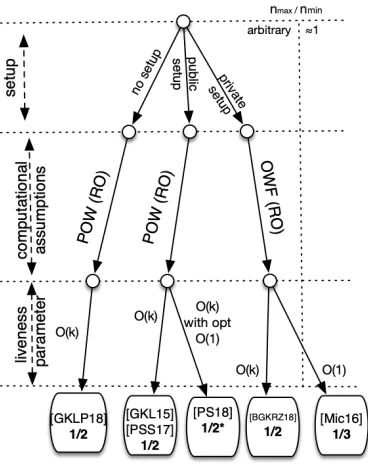
Ledger consensus was brought forth as an objective of the Bitcoin blockchain protocol. For this rea-son, in the remaining of the paper, we only consider the problem in the peer-to-peer setting, although we note that in the point-to-point setting it is possible to adapt standard BFT methods to solve the problem. We refer to, e.g., [MXC+16, GAG+18] for some recent examples. We remark also that combining private setup and the peer-to-peer setting, it is straightforward to simulate the point-to-point setting by relying on the authentication information that can be made available by the setup. A pictorial overview of our protocol classification is presented in Figure 2.
Number of parties.We start with an adapation of the impossibility result for dishonest majority as shown in [Fit03]. The result shows that in all the relevant cases for practice, specifically, ledger consensus with non-trivial ledgers, or providing serializability as defined above, honest majority is a necessary require-ment.
Theorem 1. Suppose that the transaction setTsatisfies|T| ≥2. Ledger consensus is impossible in case the adversary controls n/2nodes, assuming either (i) the languageLis non-trivial or (ii) Serializability holds.
Proof. For simplicity we describe the impossibility result in a setting where the properties are perfectly satisfied. The same argument can be easily extended to the setting where the properties are satisfied with overwhelming probability. Suppose all parties are split in two setsA1,A2of size exactlyn/2. We describe an environment and an adversary. The environment prepares two transactions tx1, tx2∈Tthat are in conflict, i.e., it holds that no validL exists for which it holds that both tx, tx0∈L but they can be
both validly added to some ledger since they are members ofT. The environment provides at round 1 the appropriate sequence of transactions so that parties inAb receive transaction txb respectively and
advances the execution for at leastu rounds, the Liveness parameter. We consider three adversaries