OBJECT ORIENTED SHADOW DETECTION AND
REMOVAL IN IMAGE HAVING CAST SHADOWS
1
Yuvraj Singh,
2Sushil Kakkar
1
Electronics and Communication
,B.G.I.E.T ,Sangrur,P.T.U, (India)
2
Assistant professor, Dept. of Electronics and Communication,B.G.I.E.T Sangrur, P.T.U, (India)
ABSTRACT
A shadow is created when an object lies in the path of a light source. Shadows are cast by the occluding object,
or the object itself can be shaded; a phenomenon known as “self-shading”. Due to the difference between the
light intensity reaching a shaded region and a directly lit region, shadows are often characterized by strong
brightness gradients. While non-shadow regions are illuminated by both direct (e.g., sunlight, flashlight) and
diffuse (e.g., skylight, fluorescent, incandescent) light sources, shadow regions are only illuminated by diffuse
light. The change between shadow and non-shadow regions is thus not only a brightness difference, but a color
one as well. In outdoor scenes, for example, the lit areas are illuminated by sunlight and skylight, while the
shadow regions are illuminated by skylight alone, which creates a bluish color cast. This property of shadows,
together with the fact that a certain color can exist in both lit and shaded objects, makes them problematic in a
number of different computer vision applications such as tracking, object (or people) recognition, and white
balancing. In image manipulation or compositing, shadows are often unwanted artifacts that are unavoidable
due to image capture conditions (e.g., photographs taken in an urban environment). While shadow compositing
and removal has dramatically improved in recent years, automatic shadow detection is still a challenge and
requires additional assumptions or information. We have presented a method of shadow detection and removal
based on two dimensional chromaticity based intensity ratios which gives good results in detecting and
removing of cast shadows in a still image.
Keywords: Chromaticity, Gray Scale, Morphological, Removal, Shadow Detection, Etc.
I INTRODUCTION
1.1 Foreground Object detection and shadow
Color is the prominent visual features used for object detection and tracking in the robotic vision and machine
perception systems. Visual object tracking is a process of continuously estimating the state of an object in an
imagegiven prior states from previous frames. The state of an object can be position, velocity, shape, size and
so on. Object tracking can be difficult due to noise, partial or full occlusions, complex object motion, and shape
and illumination changes. In order to deal with these difficulties, object tracking algorithms require robust
measurements which can describe the appearance of objects correctly when the environmental conditions
change. Therefore foreground object detection becomes a fundamental step in many image analysis applications,
such as automated visual surveillance, video indexing, and human machine interaction. Many methods for
foreground object detection have been proposed such as background subtraction, optical flow and temporal
difference [1]. However, foreground object detection techniques are often affected by factors such as shadow,
segmentation, detection and tracking. Furthermore, other problems may also be caused, e.g., objects may be
merged, object shapes may be altered, the background may be misclassified as foreground and missing objects
[2]. Therefore, the accurate detection of a moving object and the acquisition of its exact shape by eliminating
shadows have a great effect on the performance of subsequent steps such as tracking, recognition, classification,
and activity analysis.
1.2 Observations for reliable shadow detection
Human visual system [18] seems to utilize the following observations for reliable shadow detection:
Shadow is dark but does not change significantly neither the color nor the texture of the background
covered [19].
Shadow is always associated with the object that cast it and to the behavior of that object (e.g. if a
person opens his arms, the shadow will reflect the motion and the shape of the person).
Shadow shape is the projection of the object shape on the background. For an extended light source
(not a point light source), the projection is unlikely to be perspective.
Both the position and strength of the light sources are known.
Shadow boundaries tend to change direction according to the geometry of the surfaces on which they
are cast.
1.3 Shadow Variant Features
The important shadow variant features chosen by different scholars are as follows [20]:
Intensity Difference: Since shadows are expected to be relatively dark, the statistics about the intensity
of image segments in neighboring pixels measure the intensity difference using their absolute
differences. In neighboring segments the difference of intensity values are measured. Also the feature
vector with the averaged intensity value and the standard deviation are taken into account.
Illumination changes: This change in a single image can be modeled by a linear transformation [14] of
diagonal-offset model. The five basic types of the illumination changes can be defined [15], as follows:
(a) Light intensity changes,
(b) Light intensity shifts,
(c) Light intensity changes and shifts,
(d) Light color changes and
(e) Light color change and shifts.
Local Max: In a local patch, shadows have values that are very low in intensity; therefore, the local
max value is expected to be small. On the contrary, non-shadows often have values with high
intensities and the local max value is expected to be large.
Smoothness: Shadows are often a smoothed version of their neighbors. This is because the shadows
tend to suppress local variations on the underlying surfaces [13]. The method subtracts a smoothed
version of the image from the original version. Already smooth areas will have small differences where
as highly varied areas will have large differences. To measure the smoothness, the standard deviations
Skew-ness: Several statistical variables (standard deviation, skew-ness and kurtosis) are used to
measure the shadow. This shows that the asymmetries in shadows and in non-shadows are different and
good cues for locating shadows. This odd order statistic is also found to be useful in extracting
reflectance and gloss from natural scenes. The shadow invariant features chosen for shadow analysis ae
given as follows:
Gradient Similarity: In the image-formation, transforming the image with a pixel-wise log
transformation makes the shadow an additive offset to the pixel values in the scene. To capture this
cue, measure the similarity between the distributions of a set of first order derivative of Gaussian filters
in neighboring segments of the image. This similarity is computed using the L1 norm of the difference
between histograms of gradient values from neighboring segments.
Texture Similarity: It is observed that the textural properties of surfaces change little across shadow
boundaries. The textural properties of an image region are measured using the method with a bank of
Gaussian derivative filters consisting of 8 orientations and 3 scales and then clustering is applied to
form 128 discrete centers. The primary difference is that distortion artifacts in the darker portions of the
image and which lead to a slight increase in the number of lower-index Textron’s. They are indicated
by more blue pixels.
II LITERATURE REVIEW
Some shadow detection reviews have been reported in the literature [2-4], from the views of physical,
geometrical, and heuristic techniques. Most of the real-time shadow detection techniques work at pixel level and
use color information for shadow detection directly or indirectly, wholly or partially. Shadow detection methods
can be categorized into two kinds: statistical based and video features based. The statistical methods use models
that are often acquired by learning to segment the shadow from foreground, through statistical analysis of the
features of target pixel in illumination and shadow [5-8]. However, the video data used for learning is usually
hard to obtain. The other kind of shadow detection methods use video features, such as geometric, color,
gradient and brightness, etc. These methods are more general than those by learning. The methods based on
image features can be further divided into the following four categories [2]: color based, light physical
characteristics based, geometric relations based, and texture based. The color based method is mostly on the
basis of a single pixel and is combined with color information to test the shadow that makes certain assumptions
about the shadow properties:
(a) a shadow darkens the background area on which it falls;
(b) a shadows falls on the background plane;
(c) a shadow changes luminance of an area more significantly than color [9].
If these assumptions are not satisfied, the accuracy of color-based approaches for shadow detection will
decrease obviously. For example, if some parts of the foreground object are darker than the background, they
would be detected as shadow easily. Light physical characteristics based methods are usually linear attenuation
models of the light intensity, which has the assumption that illumination source produces pure white light. In
outdoor environment, the main light source is sunlight (white) and the reflected light comes from the sky (blue).
Generally, other light sources are influenced by sunlight. If sunlight is blocked, the effect of reflected light from
Bhanu et al. [10] presented a dichromatic model that takes into account two light sources to predict the color
changes of the shaded region better. Further work is to consider a variety of different light intensity conditions,
and build a more general nonlinear attenuation model to adapt to the indoor and outdoor scenes [11, 12]. These
methods still use the chromaticity characteristics, and if the foreground color is closer to the cast shadow, there
would be some mistakes. Geometric feature based methods mainly consider that under certain light source,
shape and size of shadow, position relationship between objects, and segment shadow from foreground can be
ensured. These methods do not need background model, however they need detailed shape information and
other information of foreground targets. Therefore, these methods can only detect specific objects, meanwhile
they need position relationship between objects and shadow. In the case of multiple shadows and multiple
objects, these methods do not work well. Texture based methods assume that the texture of shaded region is
invariant. These methods generally include the following steps: (1) detect foreground with shadow; (2) classify
foreground as either foreground or shadow based on the texture correlation. If texture of candidate area is
similar to that of background, it may be misclassified as the shadow. Shadow detection methods based on
texture are effective without color information and robust to illumination changes. However, they need to
compare adjacent pixels, and the complexity is high. The intensity variance of pixel is not only related to the one
in previous frames, but also related to the adjacent pixels in the same frame.
In Wu et al. [23], users are asked to submit a quadmap containing shadow, non-shadow, and penumbra regions
of similar textures. Simplifications of these user requirements are focused towards reducing the time spent
selecting shadow and non-shadow regions. Wu and Tang [24] employ user-supplied context that indicates
candidate shadow regions. Arbel and Hel-Or’s method [21] allows a shadow mask to be calculated using only a
few keypoints, and Shor and Lischinski [22] proposed reducing external information to one user-supplied
keypoint per shadow region. Instead of “growing” a shadow region based on a few keypoints, Drew and Reza
[25] calculate invariant images based on a few selected patches in the image. While these detection algorithms
can provide very accurate results for still images and deliver good subsequent shadow removal, their
requirements are strongly dependent on the complexity of the image. Moreover, even minimal user interaction
prevents a detection algorithm to be incorporated in a fully automatic workflow, such as in-camera image
processing. This paper presents a feature, named chromaticity based local intensity ratio, which reflects
illumination invariance. The experimental results demonstrate that this feature is robust to illumination change.
III PROPOSED WORK
This section describes the basic steps carried out in our algorithm of shadow detection and removal which uses
two dimensional chromaticity properties of RGB color space. Before that a brief discussion has been done about
color spaces. A color histogram depicts the color distribution of the objects in a specific color space, e.g., RGB,
HSV, YCbCr [16]. Therefore, the color constancyof color spaces determines the color invariance properties of
color histograms. As our proposed work uses RGB color space, there is a brief review regarding RGB color
spaceThe RGB color space has three channels: red, green, and blue. A histogram can be derived by calculating
the number of pixels that have colors in a fixed range which depends on the number of bins. The RGB
histogram has no illumination invariance properties [17]. As in our proposed system the inputs are RGB color
images having cast shadows by an object in it, the outputs are evaluated in the form of object wise shadow
Algorithm used
1. Read RGB image in mat lab workspace.
2. Convert image to double precision for fast calculations.
3. For pixel i=1 to m* n where m and n are number of rows and columns in the image. Do the steps
given below.
4. Calculate geometric mean.
5. Evaluate chromaticity in red direction as Red / G. Mean.
6. Evaluate Chromaticity in blue direction as Blue/ G. Mean.
7. Evaluate two-dimensional chromaticity by plotting one dimensional chromaticity in Red and Blue
directions in orthogonal direction.
8. Evaluate a projection line orthogonal two both red and blue direction chromaticity’s by varying
the angle of the line
9. Project both chromaticity values on this orthogonal line which gives a shadow free gray scale
image.
10. Vary the angle for another projection line and extract another gray scale image.
11. Do this for a few directions and apply morphological operations like dilation and erosion and
detect shadow region
12. Applying labeling command and locate separated objects in the image.
13. Mark out the shadowed object in the image and evaluate number of pixels having shadow and
non-shadow region
IV RESULTS AND DISCUSSIONS
The evaluations were done through various images in both quantitative and qualitative methods. The benchmark
images are tested and results are shown in Figures and tables. The results at various stages of the algorithm has
been displayed as below
Step 1) input image Step 2) Image after shadow removal
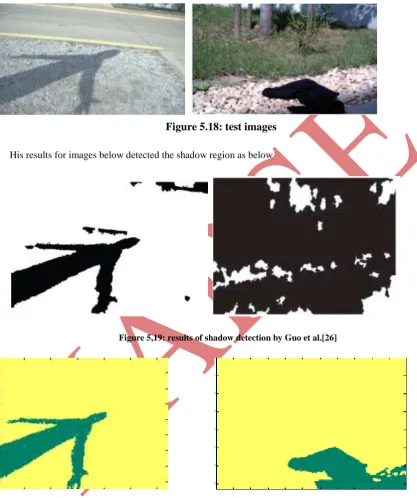
In comparison to Guo et al.[26] Our method gives better result in shadow detection for images having cast shadows of single
object.
Below are the results for Guo et al.[26] and presented work in terms of shadow detected area.
In comparison to Guo et al. [26],
Figure 5.18: test images
His results for images below detected the shadow region as below
Figure 5,19: results of shadow detection by Guo et al.[26]
Figure 5.20: results of shadow detection by presented scheme.
It is clear from above that our technique gives better results in shadow detection than Guo et al. [26] when a
single object casts shadow in an image.
V CONCLUSION
To detect foreground without shadow, this paper presents chromaticity based intensity ratio according to
foreground object,and morphology method is also used to remove scatter shadow that is falsely detected as
foreground. Experimental results demonstrate that the proposed method can eliminate shadow on foreground
effectively. However, the foreground may be easily detected as background if it is similar to background or
shadow.
REFERENCES
[1] M.Piccardi, "Background subtraction techniques: a review", Proc. SMC'04, pp.3099-3104, 2004.
[2] Sanin A, Sanderson c., and Lovell B., "Shadow detection: A survey and comparative evaluation of recent
methods". Pattern Recognition, Vol. 45, pp. 1684-1695, 2012.
[3] AI-Najdawi N, Bez H.E., Singhai J, and Edirisinghe E.A. "A survey of cast shadow detection algorithms".
Pattern Recognition Letters, Vol. 33, pp. 752-764, 2012.
[4] A Prati, 1. Mikic, M. Trivedi, and R. Cucchiara, "Detecting moving shadows: algorithms and evaluation",
IEEE Transactions on Pattern Analysis and Machine Intelligence Vol. 25, No. 7, 918-9234, 2003.
[5] A Joshi and N. Papanikolopoulos. "Learning to detect moving shadows in dynamic environments", IEEE
Transactions on Pattern Analysis and Machine Intelligence, Vol. 30, No. 11, pp. 2055-2063, 2008.
[6] Z. Liu, K. Huang, T. Tan, and L. Wang, "Cast shadow removal combining local and global features",
Proceeding of IEEE Conference on Computer Vision and Pattern Recognition, pp. 1-8, 2007.
[7] N. Martel-Brisson and A Zaccarin, "Learning and removing cast shadows through a multi distribution
approach", IEEE Transactions on Pattern Analysis and Machine Intelligence, Vol. 29, No. 7, pp.
1133-1146, 2007.
[8] F. Porikli and J. Thornton, "Shadow flow: a recursive method to learn moving cast shadows", Proceeding
of IEEE International Conference on Computer Vision, pp. 891-898, 2005.
[9] M. Shoaib, R. Dragon, and J. Ostermann, "Shadow detection for moving humans using gradient-based
background subtraction", Proc. IEEE Int. Conf. Acoust. Speech Signal Process , pp. 773-776, 2009.
[10] S. Nadimi and B. Bhanu. "Physical models for moving shadow and object detection in video", IEEE
Transactions on Pattern Analysis and Machine Intelligence, Vol. 26, No. 8, pp. 1079-1087, 2004.
[11] J.-B. Huang and c.-S. Chen, "Moving cast shadow detection using physics-based features", Proceeding of
IEEE Conference on Computer Vision and Pattern Recognition, pp. 2310-2317, 2009.
[12] N. Martel-Brisson and A Zaccarin, "Kernel-based learning of cast shadows from a physical model of light
sources and surfaces for low-level segmentation", Proceeding of IEEE Conference on Computer Vision and
Pattern Recognition, pp. 1-8, 2008.
[13] Pizarro, Daniel, and Adrien Bartoli. "Shadow resistant direct image registration." In Image Analysis, pp.
928-937. Springer Berlin Heidelberg, 2007.
[14] Drew, Mark S., Jie Wei, and Ze-Nian Li. "On illumination invariance in color object recognition." Pattern
Recognition 31, no. 8 (1998): 1077-1087.
[15] Van De Sande, Koen EA, Theo Gevers, and Cees GM Snoek. "Evaluating color descriptors for object and
scene recognition." Pattern Analysis and Machine Intelligence, IEEE Transactions on 32, no. 9 (2010):
[16] Rautiainen, Mika, and Timo Ojala. "Color Correlograms in Image and Video Retrieval." In 10th Finnish Artificial Intelligence Conference, pp. 203- 212. 2002.
[17] Reinhard, Erik, Michael Adhikhmin, Bruce Gooch, and Peter Shirley. "Color transfer between images."
Computer Graphics and Applications, IEEE 21, no. 5 (2001): 34-41.
[18] Benedek, et al., Bayesian foreground and shadow detection in uncertain frame rate surveillance videos.,
IEEE Transactions on Image Processing 17.4 (2008): 608-621.
[19] Zhu J, et al., Learning to recognize shadows in monochromatic natural images, In CVPR 2010, IEEE, pp.
223–230.
[20] Tappen, Marshall, and Jiejie Zhu. "Systems and Methods for Automatically Identifying Shadows in
Images." U.S. Patent 20,120,213,440, issued August 23, 2012.
[21] E. Arbel and H. Hel-Or, “Texture-preserving shadow removal in color images containing curved surfaces,”
in Proc. IEEE Conf. Computer Vision Pattern Recognition, Minneapolis, MN, USA, 2007.
[22] Y. Shor and D. Lischinski, “The shadow meets the mask: Pyramid-based shadow removal,” Comput.
Graph. Forum, vol. 27, no. 2, pp. 577–586, 2008.
[23] T.-P. Wu, C.-K. Tang, M. S. Brown, and H.-Y. Shum, “Natural shadow matting,” ACM Trans. Graph., vol.
26, no. 2, Article 8, 2007.
[24] T.-P. Wu and C.-K. Tang, “A Bayesian approach for shadow extraction from a single image,” in Proc.
IEEE 10th Int. Conf. Computer Vision, Washington, DC, USA, 2005.
[25] M. S. Drew and H. Reza, “Sharpening from shadows: Sensor transforms for removing shadows from a
single image,” in Proc. IS&T/SID 17th Color Imaging Conf., 2009.
[26] R. Guo, Q. Dai, and D. Hoiem, “Paired Regions for Shadow Detection and Removal,” in Proc. IEEE