Function Private Predicate Encryption for Low Min-Entropy
Predicates
Sikhar Patranabis, Debdeep Mukhopadhyay, and Somindu C. Ramanna Department of Computer Science and Engineering
Indian Institute of Technology Kharagpur, India [email protected] {debdeep,somindu}@cse.iitkgp.ac.in
Abstract. In this work, we propose new predicate encryption schemes for zero inner-product en-cryption (ZIPE) and non-zero inner-product enen-cryption (NIPE) predicates from prime-order bilinear pairings, which are both attribute and function private in the public-key setting.
• Our ZIPE scheme is adaptively attribute private under the standard Matrix DDH assumption for unbounded collusions. It is additionally computationally function private under a min-entropy variant of the Matrix DDH assumption for predicates sampled from distributions with super-logarithmic min-entropy. Existing (statistically) function private ZIPE schemes due to Boneh et al. [Crypto’13, Asiacrypt’13] necessarily require predicate distributions with significantly larger min-entropy in the public-key setting.
• Our NIPE scheme is adaptively attribute private under the standard Matrix DDH assumption, al-beit for bounded collusions. It is also computationally function private under a min-entropy variant of the Matrix DDH assumption for predicates sampled from distributions with super-logarithmic min-entropy. To the best of our knowledge, existing NIPE schemes from bilinear pairings were neither attribute private nor function private.
Our constructions are inspired by the linear FE constructions of Agrawal et al. [Crypto’16] and the simulation secure ZIPE of Wee [TCC’17]. In our ZIPE scheme, we show a novel way of embedding two different hard problem instances in a single secret key - one for unbounded collusion-resistance and the other for function privacy. With respect to NIPE, we introduce new techniques for simultaneously achieving attribute and function privacy. We also show natural generalizations of our ZIPE and NIPE constructions to a wider class of subspace membership, subspace non-membership and hidden-vector encryption predicates.
1
Introduction
Predicate encryption (PE) [14, 5, 30] is a modern public-key primitive that enables fine-grained role-based access control on encrypted data, which makes it desirable for a number of real-life applications. In a PE scheme, a single master secret key msk is used to derive several secret keys of the form skf, where f is a
Boolean function over Σ. A ciphertext corresponds to an attribute-message pair (I, M)∈Σ× M, where Σ is a pre-defined set of attributes andMis a set of payload messages. Decryption of a ciphertext corresponding to (I, M) byskf revealsM if and only iff(I) = 1. Based on the security notion achieved, a PE scheme may
be classified into one or more of the categories described below.
Public Attribute PE. In a public attribute PE system, a ciphertext ct on (I, M) leaks no informa-tion about the message M to an adversary possessing secret-keys that do not decrypt ct (i.e., skf such
that f(I) = 0). The attribute I, on the other hand, is public. Such schemes are often nomenclatured as
attribute-based encryption (ABE). Concrete ABE schemes have been proposed for a wide range of Boolean predicates, including equality/identity testing (IBE) [10, 24], keyword search [9, 1], Boolean formulae [29], regular languages [35], general polynomial-size circuits [22, 11, 27], and even Turing machines [25].
supports, in addition to equality, conjunctive, range and subset predicates, and also for zero-inner-product encryption (ZIPE) [30, 33]. ZIPE has been realized using bilinear maps [30, 33] and also from lattice-based techniques [5, 2, 6].
In a more recent work [36], Wee demonstrated many new techniques for achieving selectively simulation-secure attribute private PE from prime-order bilinear groups under the standard Matrix DDH assumption. The main result of this work is a partially hiding predicate encryption scheme for functions that compute an arithmetic branching program on public attributes, followed by an inner product predicate on private attributes. In the realm of lattices, Gorbunov et al. [28] showed how to construct attribute private PE for all circuits from the learning with errors (LWE) assumption.
Although attribute privacy has been realized for many different predicates from bilinear pairings, it remains open to construct pairing-based attribute private PE for certain simple predicates such as non-zero inner-product encryption (NIPE) [7] and its natural generalization to a broader class of subspace non-membership encryption (SNME) predicates.
Function Private PE. In a function private PE, a secret-keyskfreveal no information beyond the absolute
minimum about the underlying predicatef. Note that the notions of attribute and function privacy for a PE are mutually exclusive in the sense that one does not necessarily imply the other. In the setting of private-key PE, there already exist function private constructions from pairings for predicates such as ZIPE [8, 20]. In fact, using techniques introduced by Brakerski et al. [15], any private-key PE can be made function private in a generic manner. However, in the setting of public-key PE, formalizing a realistic notion of function privacy is significantly more challenging [12, 13].
Consider, for example, an adversary against an IBE scheme who is given a secret-keyskid corresponding to an identityid. As long as the adversary has some apriori information thatidbelongs to a setS such that
|S|is at most polynomial in the security parameterλ, it can fully recoverid fromskid : it can simply resort to encrypting a random messageM under each identity inS, and decrypting usingskid to check for a correct recovery.
Hence, in the setting of public-key PE, function privacy can only hold under the minimal assumption that each predicate is sampled from a distribution with min-entropy at least super logarithmic in the security parameterλ[12, 13]. Under similar assumptions, function private public-key constructions have been reported for IBE [12], ZIPE [3] and subspace membership encryption (SME) [13], which is essentially a generalization of ZIPE. These works throw open several interesting questions. We discuss them below.
1. The PE schemes proposed in [12, 13] are inherently restricted to satisfying astatistical notion of function privacy. For a vast majority of applications, a relaxedcomputational notion of function privacy suffices. It is currently open to design public-key PE schemes with function privacy in this relaxed computational setting.
2. The function private PE schemes in [12, 13]necessarily assume predicate distributions with min-entropy
k ≥ λ (where λ is the security parameter). 1 This is a rather stringent assumption in the context of real-world predicates. An interesting question is whether a public-key PE scheme can be function private for predicate distributions with only super-logarithmic min-entropy.
There are several real-world applications that warrant the study of PE schemes which are simultaneously attribute and function private. These include searching on encrypted data, secure information retrieval, secure mail gateways and payment gateways, and many others. The reader is referred to [12] for an elaborate discussion of these applications.
1.1 Our Contributions
We focus on the following questions discussed in the previous section:
Is it possible to design attribute private PE from bilinear maps for the non-zero inner product functionality?
What is a meaningful definition of function privacy against resource-bounded adversaries?
Can the min-entropy requirements on the underlying predicate distributions be restricted to a bare minimum while defining function privacy?
Are there constructions for public-key PE that are provably function private, with respect to the relaxed definition, under standard computational assumptions?
In this paper, we answer these questions in the affirmative by first presenting a relaxed definition of function privacy taking into account resource bounded adversaries and restricting the min-entropy requirements of the underlying predicate distributions toω(logλ). We then present new pairing-based constructions in the public key setting for subspace membership encryption (SME) and subspace non-membership encryption (SNME) that generalize ZIPE and NIPE respectively. Our constructions are adaptively attribute private and com-putationally function private in tandem, under variants of the well-known matrix Diffie-Hellman (MDDH) assumption.
Our ZIPE scheme is the first to achieve computational function privacy for predicates with super-logarithmic min-entropy. As already mentioned, existing (statistically) function private ZIPE schemes due to Boneh et al. [13] necessarily require predicate distributions with significantly larger min-entropy in the public-key setting. Our NIPE scheme is first to achieve both attribute and function privacy under group-theoretic assumptions, albeit in the bounded collusion setting. Existing constructions for NIPE based on group-theoretic assumptions [7, 16] were neither attribute nor function private, even in the bounded collu-sion setting.
Our key technical contributions may be summarized as follows.
• Relaxing function privacy definition to account for resource-bounded adversraries and underlying predi-cates sampled from distributions with min-entropyk=ω(logλ) (λbeing the security parameter).
• Introduction of a min-entropy variant of MDDH assumption where the matrix provided in the instance does not have the uniform distribution but guaranteed to haveω(logλ) min-entropy.
• Simple and efficient constructions for ZIPE and NIPE from prime-order asymmetric bilinear pairings, that are simultaneously attribute and function private under the presumed hardness of matrix DDH and its min-entropy variant, respectively, so long as the predicates are sampled from distributions with super-logarithmic min-entropy.
• Generalizations of the aforementioned constructions to a broader class of predicates, namely SME and SNME.
Our constructions are inspired by the linear FE constructions of Agrawal et al. [6] and the simulation secure ZIPE of Wee [36]. In our SME (and hence ZIPE) scheme, we show a novel way of embedding two different hard problem instances in a single secret key - one for unbounded collusion-resistance and the other for function privacy. With respect to SNME (and hence NIPE), we introduce new techniques for simultaneously achieving attribute and function privacy, albeit in the bounded collusion setting.
1.2 Overview of Results and Techniques
In this section, we briefly explain the core ideas of our attribute private and function private SME/SNME in terms of the simplest cases, namely, ZIPE/NIPE. The security of our constructions follow from different variants of the Matrix DDH assumption over both source groups of a bilinear pairing.
The Matrix DDH assumption in a groupGof prime orderqgiven by a generatorgrequires distinguishing between two distributions – (gA, gAr) and (gA, gu) – whereA∈
Z(qk+1)×k,r∈Zkq andu∈Zkq+1 are sampled
uniformly and independently from their respective domains (here k≥1 and it is assumed that A has full rank with overwhelming probability). For the function privacy proofs we rely on a special form of the MDDH assumption parameterized by (m, n) – an instance (with respect to a groupG=hgi) consists ofgW, guwhere W←R−V∗ for some source distributionV∗ overZm×n
q of min-entropy ω(logλ) and the task is to determine
Denote an asymmetric pairing by the 7-tupleG= (G1,G2,GT, q, g1, g2, e) where|G1|=|G2|=|GT|=q, g1, g2respectively generateG1,G2ande:G1×G2→GT is a non-degenerate, efficiently computable bilinear
map. CallG Matrix DDH-hard if the Matrix DDH assumption holds in bothG1 andG2.
Zero Inner-Product Encryption (ZIPE). Our attribute and function private ZIPE construction, named ΠZIPE, is inspired by the simulation secure ZIPE scheme of Wee [36]. The public parameters and the master
secret key in ΠZIPEare given by
pp=
g1, gA1, g
S0·A
1 , g
S1·A
1 , . . . , g
Sn·A
1 , e(g1, g2)K·A
,
msk= (g2,S0,S1, . . . ,Sn,K,B0),
where A←R−Zq(k+1)×k, S0,S1, . . . ,Sn R
←−Z(2qk+1)×(k+1), K R
←−Z1q×(k+1) and B0
R
←−Z(2qk+1)×k are sampled
uniformly. A ciphertextcton attribute vectorx= (x1, . . . , xn)∈Znq and messageM is given by
ct= c0,{cj}nj=1, cn+1=
g1(A·r)T,ng((xj·S0+Sj)·A·r)T
1
on
j=1, M·e(g1, g2) (K·A·r)T
,
forr←R−Zkq. The secret keyskw on a vectorw= (w1, . . . , wn)∈Znq is defined as
skw= h0,{hj}nj=1
=
gK+y
Pn
j=1wj·t·Sj
2 ,
n
gywjt
2
on
j=1
,
wherey←R−Zq andt= (B0·s)T fors
R
←−Zkq.
For correctness, we restrict the message spaceMto an exponentially smaller subset ofGT. The decryption
algorithm computes
M =cn+1·
n
Y
j=1
e(cj, hj)
e(c0, h0),
which returns the correct message if hx,wi= 0. Whenhx,wi 6= 0 the message thus computed is uniformly distributed in GT and with high probability will be outside M. In such a case, the decryption algorithm
may return a symbol⊥indicating failure.
We prove that ΠZIPE is adaptively attribute private assuming the hardness of the decisional MDDH
problems in G1 and G2. The attribute privacy game asks an adversary to distinguish between encryptions
to attribute vectorsx0andx1. Or in other words, the adversary is given a challenge ciphertext forxb where b ←R− {0,1} and its task is to guess b. Essentially, we need to argue that the components {cj}n
j=1 in the
challenge ciphertext hide the attributex.
The proof relies on the dual system proof methodology and proceeds through a sequence of games, each changing the distribution of challenge ciphertext and keys. The key steps in the proof are listed below.
1. The reduction first embeds an instance of MDDH in G1 in the challenge ciphertext to make it
semi-functional. At this stage, the exponent of ciphertext componentc0is no longer correlated toAand this
is consistent with the other components.
2. In a series of subsequent games, we turn each secret key provided to the adversary upon a key extract query tosemi-functional form by embedding MDDH instances in the groupG2. This step is crucial for
unbounded collusion resistance.
3. Once the distribution of all keys are modified, we apply a “change of basis” to the challenge ciphertext, and argue that xb is information theoretically hidden from the adversary.
We prove the indistinguishability of each pair of consecutive games by resorting to a set of techniques involving dual bases in prime-order bilinear groups (similar techniques have been used in prior works, notably [23, 26, 17]). The reader may refer to Section 4 and Appendix??for the detailed proof.
ω(logλ)-source overZq. The challenger samples a vectorwaccording to one of the distributions, computes a
secret keyskwfor vectorwand gives it to the adversary. The adversary’s task is to determine the distribution
ofwlooking atskw. To prove that the secret key hides the distribution from whichwwas sampled, we embed
an instance of the min-entropy variant of the MDDH assumption in the challenge secret key provided to the adversary. If the instance is sampled from the correct distribution, the secret key is well-formed. On the other hand, if the instance is uniformly random, the secret key perfectly hides the distribution from which w was sampled. The reader may refer to Section 4 for the detailed proof.
Note that our ZIPE scheme essentially embeds two different problem instances in the same secret key - an MDDH problem instance over G2 that is exploited to achieve unbounded collusion-resistance in the
attribute privacy experiment, and a min-entropy MDDH instance overG2, which is the basis for the proof
of function privacy. We believe that this “simultaneous embedding” strategy is of independent interest, and may be useful in other applications.
Non-Zero Inner-Product Encryption (NIPE). Our NIPE scheme is inspired by the linear FE con-struction of Agrawal, Libert and Stehl´e [6] referred to as LinFE in what follows. A LinFE ciphertext ct is created by encrypting a vectorxof lengthn. Decryption ofctby a secret key, generated for a linear function (given by a lengthnvectorw), returns the value of the inner-producthx,wi.
In a NIPE scheme, a ciphertext is associated with a payload message Mand a vector x while a secret key corresponds to a vectory. to be encoded in the ciphertext. Decryption algorithm should be designed to returnM iffhx,wi 6= 0. To derive NIPE fromLinFE, we use two instantiations of theLinFEwith independent master secret keys. The public parameters and master secret key for the resulting scheme would be
pp= g, gA, gS1, gS2 msk= (S
1,S2).
The ciphertext for (x, M) will result from encodingxandM·xusing the two individual schemes as shown below:
ct= gAr1, gx+S1Ar1, gAr2, gM·x+S2Ar2.
Herer1,r2are sampled uniformly at random fromZkq. A secret keyskw= (wTS1,wTS2) helps in recovering
gMhx,wi and ghx,wi with respect to g. One may recoverM by simply computing the discrete logarithm of
gMhx,wibyghx,wiwhich is possible only whenhx,wi 6= 0. The restriction on the inner-products now shifts to the messages that is, the messages have to lie in a polynomial-sized subset ofZq. A similar technique has
been previously used in [4] to construct public revocation and traitor-tracing from LinFE and revocation, in particular, can be seen as a special case of NIPE. However, our naive construction is not sufficient to (simultaneously) achieve attribute privacy and function privacy since the secret key already reveals too much information aboutw.
To circumvent the problem, we adapt the construction to the bilinear map setting. This is because functions are associated with secret keys and a basic step to ensure privacy of the function encoded in the secret key components is to hide them in the exponents of elements coming from a discrete log hard group. Ciphertext components already live in a cyclic group. Decryption requires combining the ciphertext and key components to recover the message which can be facilitated if the two groups are equipped with a pairing/bilinear map. Furthermore, the secret key is additionally randomized withy∈Zq (for the generalized
case of SNME, this would be a vectory∈Zm
q wherewis replaced by a matrixW∈Zmq×n). Randomization is
essential for the function privacy proof, which exploits the hardness of a min-entropy variant of the MDDH assumption. We now discuss the construction of a NIPE scheme possessing both attribute and function privacy.
Let G = (G1,G2,GT, q, g1, g2, e) denote an asymmetric bilinear map ensemble. The public parameters
and master secret key for our modified scheme ΠNIPE would be similar to the naive scheme we described earlier except thatppcomponents now live in G1.
pp=g1, g1A, g
S1
1 , g
S2
1
msk= (g2,S1,S2).
Similarly, the ciphertext for (x, M) for ΠNIPE is given by
ct=gAr1
1 , g
x+S1Ar1
1 , g
Ar2
1 , g
M·x+S2Ar2
1
wherer1,r2are uniformly distributed inZkq. Secret key forwwould now be defined as
skw=
gy2·w, gy·wTS1
2 , g
y·wTS
2
2
randomized byysampled uniformly fromZq. During decryption, ciphertext and key components are paired
to obtained e(g1, g2)M yhx,wi and e(g1, g2)yhx,wi. Message M can be recovered by computing the discrete
logarithm of the former with respect to the latter, conditioned onhx,wi 6= 0.
Unlike the SME case, we can only prove attribute privacy of our SNME scheme in the bounded collusion model. More precisely, an adversary is allowed to query at mostn−1 secret keys, so that the master secret key components S0,S1. . . ,Sn retain sufficient entropy from the adversary’s point of view. The proof then
proceeds via a sequence of two hybrid experiments, in each of which the proof embeds a fresh MDDH instance in the challenge ciphertext.
We argue that when these instances are sampled from the “random” distribution instead of the “real” dis-tribution, the challenge ciphertext perfectly hides which attribute-message pair among (x0, M0) and (x1, M1)
is being encrypted. The argument for perfect hiding relies on hash proof systems [18, 19], similar to those used by Agrawal et al. in proving the security of their linear FE scheme [6]. Finally, the scheme is adaptively secure because the reduction knows the master secret key at any time, which allows it to answer all secret key queries without knowing the challenge attributes beforehand. The reader may refer to Section 5 and Appendix?? for the detailed proof.
To prove function privacy, we again rely on the min-entropy variant of the MDDH assumption over the group G2. This proof is technically very similar to the proof of function privacy for our SME scheme. The
reader may refer to Section 5 for the detailed proof.
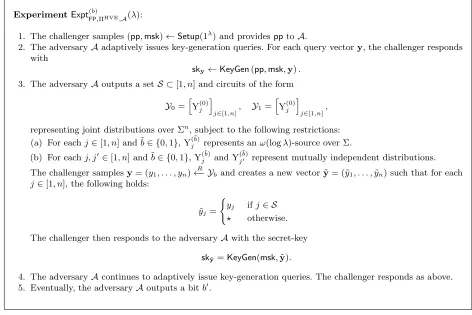
Hidden Vector Encryption (HVE). We extend our techniques to construct a hidden vector encryption wherein a secret key for a vectory∈(Σ∪ {?})nallows decryption of a ciphertext on attribute vectorx∈Σn
if for eachj∈[1, n], eitheryj =xjoryj =?. Although attribute-private HVE is implied by attribute-private SME, the implication does not extend to function privacy. In fact, defining function privacy for HVE itself is tricky given the presence of wildcard characters. We overcome this issue by presenting a weaker notion of function privacy for HVE that allows revealing positions of thewildcard (?) characters in a given predicate vector, while hiding the contents of the other “non-wildcard” positions. Also presented is a construction of HVE that is provably function private in this weaker model from bilinear maps. The construction is quite similar to our SME construction, except for certain minor tweaks to account for the presence of wildcard characters. The proofs of attribute and function privacy (in the weak model) also follow analogously.
1.3 Open Problems
Several interesting questions remain unanswered. The construction of NIPE/SNME we present have a re-striction – attribute privacy only holds in the bounded collusions model. It would be interesting to obtain constructions free of this restriction. Another problem is to construct efficient function-private PE for richer functionalities such as Boolean and arithmetic span programs from standard assumptions.
1.4 Organization of the Paper
In Section 2, we present the notation, a quick review of bilinear maps and related assumptions followed by definitions of PE and associated security notions. This is followed by a description of min-entropy variants of MDDH assumption required for our proofs. We formalize the relaxed computational notion of function privacy and discuss related issues in Section 3. In Section 4, we present our SME construction followed by proofs of attribute privacy and function privacy. Section 5 describes our construction of SNME. Due to lack of space, we provide details of some proofs in Appendices?? and??. In addition, we describe the function private hidden vector encryption and its proof idea in Appendix 6.
2
Background and Preliminary Definitions
2.1 Notation
This section summarizes the notations used throughout the rest of the paper. We writex←R−χto represent that an elementxis sampled uniformly at random from a set/distributionX. The outputaof a deterministic algorithmAis denoted byx=Aand the outputa0 of a randomized algorithmA0 is denoted byx0← A0.
We refer toλ∈Nas the security parameter, and denote byexp(λ),poly(λ) andnegl(λ) any generic (un-specified) exponential function, polynomial function and negligible function in λ respectively. Note that a functionf :N→Nis said to be negligible in λif for every positive polynomialp,f(λ)<1/p(λ) whenλis sufficiently large.
Fora, b∈Zsuch thata≤b, we denote by [a, b] the set of integers lying betweenaandb(both inclusive). For a finite fieldFq (qbeing aλ-bit prime) andm, n∈N, we denote byFmq ×nthe space of allm×nmatrices
W with elements from Fq. We use the short-hand notation Fmq to represent the vector space Fmq ×1. The
transpose of a matrixW∈Fmq×n is denoted as WT. The symbol0is used to denote an all-zero matrix of
appropriate dimension.
Finally, the min-entropy of a random variable Y is denoted as H∞(Y) and is evaluated as H∞(Y) =
−log (maxyPr[Y =y]). A random variable Y is said to be ak-source if H∞(Y)≥k.
2.2 Predicate Encryption
Definition 1. (Predicate Encryption). A predicate encryption (PE) scheme for a class of predicates
F over an attribute space Σ and a payload-message space M is a quadruple of PPT algorithms Π = (Setup,KeyGen,Enc,Dec), defined as follows:
• Setup(1λ): On input the security parameter λ, the setup algorithm generates the public parameter pp
and the master secret key msk.
• KeyGen(pp,msk, f): On input the public parameterpp, the master secret keymskand a predicatef ∈ F, the key-generation algorithm outputs a secret keyskf.
• Enc(pp, I, M): On input the public parameterpp, an attributeI ∈Σ and a payload message M ∈ M, the encryption algorithm outputs a ciphertextct.
• Dec(pp,skf,ct): On input the public parameterpp, a ciphertextctand a secret key skf, the decryption
algorithm outputs either a payload-messageM ∈ Mor the symbol⊥.
Correctness. A PE scheme is said to be functionally correct if for any security parameter λ ∈ N, any predicate f ∈ F, any attribute I ∈ Σ, and any payload message M ∈ M, letting (pp,msk)← Setup(1λ), skf ←KeyGen(pp,msk, f) andct←Enc(pp, I, M), the following hold:
1. Iff(I) = 1, Pr [Dec(pp,ct,skf) =M] = 1,
2. Iff(I) = 0, Pr [Dec(pp,ct,skf) =⊥] with overwhelmingly large probability,
where the probabilities are computed over the randomness of theSetup,KeyGenandEncalgorithms.
Attribute Privacy. Define the experiment Expt(APb),Π,A(λ) as in Fig. 1 for a PE Π = (Setup,KeyGen,Enc,Dec), a security parameter λ ∈ N and a bit b ∈ {0,1}. Let AdvAPΠ,A(λ) denote the advantage of the adversaryAin the aforementioned experiment, defined as
AdvAPΠ,A(λ) :=
PrhExpt(0)AP,Π,A(λ) = 1i−PrhExpt(1)AP,Π,A(λ) = 1i
≤negl(λ).
Definition 2. (Attribute Private PE.) A PE scheme Π is said to beattribute private if for all security parametersλ∈Nand for all PPT adversaries A, it holds thatAdvAPΠ,A(λ)≤negl(λ).
Note that a stronger definition of attribute privacy allows the adversary A in the attribute privacy experiment to query secret keys that can decrypt the challenge ciphertextct∗, subject to the restriction that the challenge messagesM0 andM1are identical. A PE scheme that is attribute private under this definition
ExperimentExpt(b)AP,Π,A(λ):
1. The challenger samples (pp,msk)←Setup(1λ) and providespptoA.
2. The adversaryAadaptively issues key-generation queries. For each query predicatef, the challenger responds with
skf ←KeyGen(pp,msk, f).
3. The adversary A outputs attribute-message pairs (I0, M0) and (I1, M1), such that for each predicate f queried, it holds that
f(I0) =f(I1) = 0. The challenger responds to the adversaryAwith the ciphertext
ct←Enc(pp, Ib, Mb).
4. The adversaryAcontinues to adaptively issue key-generation queries, subject to the aforementioned restric-tions. The challenger responds as above.
5. Eventually, the adversaryAoutputs a bitb0.
Fig. 1.The Attribute Privacy Experiment for Predicate Encryption
2.3 Sub-Classes of Predicate Encryption
In this subsection, we recall definitions of certain sub-classes of predicate encryption that are used in the rest of the paper.
Inner Product Encryption. An inner product encryption (IPE) scheme [30, 33] is a PE over an attribute space Σ =Fnq (qbeing a λ-bit prime) and a set of Boolean predicates fy :Fnq −→ {0,1} such that for each
y∈Fnq andx∈Fnq, we have
fy(x) = (
1 ifhy,xi= 0 0 otherwise.
whereh·,·idenotes the inner product (equivalently, scalar product) of two vectors overZq.
Subspace Membership Encryption. Subspace membership encryption (SME) [13] is a generalization of IPE to accommodate general linear subspaces as opposed to only vector spaces. Formally, an SME scheme is is a PE over an attribute space Σ =Fn
q (qbeing aλ-bit prime) and a set of Boolean predicatesfW:Fnq −→
{0,1} such that for eachW∈Fm×n
q andx∈Fnq, we have
fW(x) = (
1 ifW·x=0 0 otherwise.
Non-Zero IPE. Non-zero IPE (NIPE) [7, 16] is the dual of IPE in the sense that it is a PE over an attribute space Σ =Fn
q (qbeing a λ-bit prime) and a set of Boolean predicates fy :Fnq −→ {0,1} such that for each
y∈Fn
q andx∈Fnq, we have
fy(x) = (
1 ifhy,xi 6= 0 0 otherwise.
λ-bit prime) and a set of Boolean predicatesfW:Fnq −→ {0,1}such that for eachW∈Fmq×n andx∈Fnq,
we have
fW(x) = (
1 ifW·x6=0 0 otherwise.
2.4 Bilinear Maps and Matrix Diffie-Hellman Assumptions
Let GroupGen(1λ) be a PPT algorithm that takes as input a security parameter λ, and outputs a tuple
of the form (G1,G2,GT, q, g1, g2, e), where G1, G2 and GT are distinct cyclic groups of order q (q being a λ-bit prime),g1 is a generator for G1, g2 is a generator for G2, and e : G1×G2 −→ GT is an efficiently
computable non-degenerate asymmetric bilinear map. Also, letW∈Zmq×n be anm×nmatrix with entries
{wi,j}i∈[1,m],j∈[1,n]. Throughout the paper, we use the following notations:
• gW1 : set of group elements{gwi,j
1 }i∈[1,m],j∈[1,n] ∈Gm1×n
• gW2 : set of group elements{g
wi,j
2 }i∈[1,m],j∈[1,n] ∈Gm2×n
• e(g1, g2)W: set of group elements{e(g1, g2)wi,j}i∈[1,m],j∈[1,n]∈GmT×n
Observe the following statements for anym, n, l≤poly(λ):
• For any W1∈Zmq ×n andW2∈Zmq ×n,g
W1+W2
1 is efficiently computable given the tuple
gW1
1 , g
W2
1
. Analogous statement holds for gW1+W2
2 .
• For anyW1∈Zmq×nandW2∈Znq×l,g
W1·W2
1 is efficiently computable given one of the following tuples:
gW1
1 ,W2
or W1, gW2 2
. Analogous statement holds forgW1·W2
2 .
• For anyW1∈Zmq ×n andW2∈Zqn×l, the pairing outpute(g1, g2)W1·W2 is efficiently computable given
the tuple gW1, gW2.
Note that the pairing expressionse(g1, g2)W1·W2 ande
gW1
1 , g
W2
2
are used interchangeably in the sequel. We now review the matrix Diffie-Hellman (MDDH) assumption over the source groups G1 andG2 of a
bilinear map.
TheDm,n-MDDH Assumption. Letm, n∈Nsuch thatm > n, and letDm,ndenote a matrix distribution
overZm×n
q such that a matrixW R
←− Dm,nhas full ranknwith overwhelmingly large probability. TheDm,n
-MDDH assumption [21] holds over the groupGi (fori= 1,2) if the distribution ensembles:
n
giW, giW·yo
W←R−Dm,n,y R ←−Znq
and
gWi , gui
W←R−Dm,n,u R ←−Zmq
are computationally indistinguishable.
The Um,n-MDDH Assumption. TheUm,n-MDDH assumption is a special instance of theDm,n-MDDH
assumption where the matrix distributionDm,nis the uniform distribution overZqm×n.
2.5 A “Min-Entropy” Variant of the MDDH Assumption
In this subsection, we introduce another special instance of theDk1,k2-MDDH assumption where the matrix
distributionDk1,k2 is not uniform, but an ordered collection ofm×nindependentω(logλ)-sources overZq.
We first state and prove the following lemma. Lemma 2.1 Let Wk1,k2 =
Wi,j
i∈[1,k1],j∈[1,k2] be a matrix of independently distributed random variables such that each random variableWi,j fori∈[1, k1] andj∈[1, k2] is an ω(logλ)-source overZq. Then, any
Proof. LetWk1,k2=
Wi,j
i∈[1,k1],j∈[1,k2] be a tuple of (k1×k2) independently distributed random variables
such that each random variable Wi,j fori∈[1, k1] andj ∈[1, k2] is at-source over Zq. Let W R
←− Wk1,k2,
and letWf be any arbitraryk2×k2 sub-matrix ofW. Then, the probability of the event thatWf has a zero
determinant may be quantified as:
PrhDet(W) = 0f i
= 1− k2−1
Y
j=1
1−2−j·t
≤1− 1−2−t(k2−1)≤(k2−1)·2−t,
which is negligible fort=ω(logλ). This completes the proof of Lemma 2.1.
The Min-Entropy-MDDH Assumption. Let k1, k2 ∈ N with k1 > k2, and let Wk1,k2 =
Wi,ji∈[1,k
1],j∈[1,k2]be a tuple ofindependently distributed random variables such that each random variable
Wi,j fori∈[1, k1] andj ∈[1, k2] is anω(logλ)-source overZq. The (k1, k2)-min-entropy-MDDH assumption
holds over the groupGi (fori= 1,2) if the distribution ensembles:
n
giW, giW·yo
W←R−Wk1,k2,y R ←−Znq
and
gWi , gui
W←R−Wk1,k2,u R ←−Zmq
are computationally indistinguishable.
All proofs of function privacy for the schemes presented in this paper are based on the Wm,n-MDDH
as-sumption over the groupG2.
2.6 Dual Bases
We briefly recall the concept of “dual bases” [16], along with some useful lemmas that are used in the rest of the proof. Fix some integers k0, k1, k2 ≥1, and let k =k0+k1+k2. We denote by “basis” a uniformly
sampled tuple of matrices
(B0,B1,B2)
R
←−Zk×k0
q ×Z
k×k1
q ×Z
k×k2
q .
The corresponding “dual basis” is the tuple of matrices (B∗0,B∗1,B2∗)∈Zkq×k0×Z
k×k1
q ×Z
k×k2
q ,
such that the following “non-degeneracy” conditions hold:
BT0 ·B∗0=I0 modq, BT1 ·B1∗=I1 modq, BT2 ·B∗2=I2 modq,
whereI0,I1 andI2 are identity matrices of appropriate dimensions, and the following “orthogonality”
con-ditions hold:
BTi ·B∗j =0 modq fori, j∈ {0,1,2}, i6=j.
We also recall some useful lemmas related to dual bases. These lemmas have been used in many prior works, notably [23, 26, 17].
Lemma 2.2 Let (B0,B1,B2)be a uniformly sampled basis as described above with corresponding dual basis
(B∗0,B∗1,B∗2). Any arbitrary vectoru∈Zkq may be uniquely decomposed asu=u0+u1+u2 such that
u0=B∗0·s0, u1=B1∗·s1, u2=B∗2·s2,
for(s0,s1,s2)∈Zk0
q ×Zkq1×Zqk2. Additionally, the following holds for each i∈ {0,1,2}:
Lemma 2.3 Let (B0,B1,B2)be a uniformly sampled basis as described above with corresponding dual basis
(B∗0,B∗1,B∗2). Let a uniform vectoru←R−Zkq be decomposed asu=u0+u1+u2 such that
u0=B∗0·s0, u1=B1∗·s1, u2=B∗2·s2,
for(s0,s1,s2)∈Zk0
q ×Zkq1 ×Zkq2. Then, for each i ∈ {0,1,2} and for uniform s0i R
←−Zki
q , it holds that the
distributions of the tuples
(ui,{uj}j6=i) and ((ui+B∗i ·s
0
i),{uj}j6=i)
are statistically indistinguishable.
To see that the aforementioned lemma holds, fix an arbitraryi∈ {0,1,2}, setu0 =u+B∗i·s0i for uniform s0i←R−Zki
q , decompose u0 =u00+u01+u02 and observe that:
• For each j∈ {0,1,2} \ {i}, we haveu0j =uj by the orthogonality property.
• The distributions of ui and (ui+B∗i ·s0i) are statistically indistinguishable whenever the vectorsuand
s0i are uniformly random.
Lemma 2.4 Let (B0,B1,B2)be a uniformly sampled basis as described above with corresponding dual basis
(B∗0,B∗1,B∗2). Let (i0, i1, i2)be a fixed but arbitrary permutation of the set{0,1,2}. Let Bbi0,i1 be a basis for the span of the matrices
B∗i
0 |B
∗
i1
and letBbi2 be a basis for the span of the matrixB
∗
i2. Let
t0= (Bi0·s0) T
, t1= (Bi0·s1,0+Bi1·s1,1) T
,
wheres0,s1,0,s1,1 are uniformly sampled vectors of appropriate dimensions. If theU(ki0+ki1),ki0-MDDH as-sumption holds over the bilinear group G2, then for all PPT adversariesA, we have
Pr
A D, gt0
2
= 1−PrA D, gt1
2
= 1≤negl(λ),
whereD:=gB
∗
0
2 , g
B∗1
2 , g
B∗2
2 ,Bbi0,i1,Bbi2
.
Note that Lemma 2.4 is essentially the prime-order analog of the well-known subgroup decision assumption over composite order groups, which has classically been used for dual system encryption [32]. The reader may refer to [17] for the proof of this lemma.
3
Function Privacy of SME and SNME
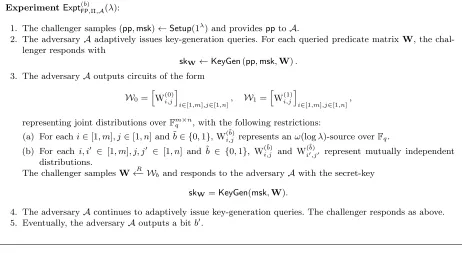
In this section, we define the indistinguishability-based framework for the function privacy of sub-space membership encryption (SME) and subsub-space non-membership encryption (SNME). Let Π = (Setup,KeyGen,Enc,Dec) be an SME (equivalently, SNME) scheme. Define the experiment ExptFP(b),Π,A(λ) as in Fig. 2 for a security parameterλ∈Nand a bitb∈ {0,1}. LetAdvFPΠ,A(λ) denote the advantage of the adversaryAin the aforementioned experiment, defined as
AdvFPΠ,A(λ) :=
PrhExpt(0)FP,Π,A(λ) = 1i−PrhExpt(1)FP,Π,A(λ) = 1i
≤negl(λ).
Definition 3. (Function Private SME.)An SME scheme Π is said to befunction privateif for all security parametersλ∈Nand for all PPT adversaries A, it holds thatAdvFPΠ,A(λ)≤negl(λ).
ExperimentExpt(b)FP,Π,A(λ):
1. The challenger samples (pp,msk)←Setup(1λ) and providespptoA.
2. The adversaryAadaptively issues key-generation queries. For each queried predicate matrixW, the chal-lenger responds with
skW←KeyGen(pp,msk,W).
3. The adversaryAoutputs circuits of the form W0=
h W(0)i,j
i
i∈[1,m],j∈[1,n]
, W1 = h
W(1)i,j i
i∈[1,m],j∈[1,n]
,
representing joint distributions overFmq×n, with the following restrictions:
(a) For eachi∈[1, m], j∈[1, n] and ˜b∈ {0,1}, W(˜i,jb) represents anω(logλ)-source overFq. (b) For each i, i0 ∈ [1, m], j, j0 ∈ [1, n] and ˜b ∈ {0,1}, Wi,j(˜b) and W
(˜b)
i0,j0 represent mutually independent distributions.
The challenger samplesW←R− Wband responds to the adversaryAwith the secret-key
skW=KeyGen(msk,W).
4. The adversaryAcontinues to adaptively issue key-generation queries. The challenger responds as above. 5. Eventually, the adversaryAoutputs a bitb0.
Fig. 2.The Function Privacy Experiment for SME and SNME
The Mutual Independence Condition. Observe that the function privacy experiment requires the adver-sarially chosen distributionsW0 andW1to be constructed such that the individual component distributions
are both “mutually independent” and “sufficiently unpredictable”. A stronger notion of function privacy could allow these components to be “arbitrarily correlated”, so long as they are “individually” sufficiently unpredictable. As shown in [13], such a notion is impossible to satisfy. In other words, if arbitrary correlations were allowed, the adversaryAin the function privacy experiment can always create challenge distributions that satisfy the unpredictability requirement, but secret keys for matrices from these distributions are easily distinguishable. We present a brief illustration here for the sake of completeness.
Consider an IPE scheme (equivalently, an SME scheme of dimension m= 1) and an adversary Ain the function privacy experiment that chooses the challenge distributions as:
W0=
h
W(0)1 ,2W1(0),W(0)2 , . . . ,W(0)n−1i, W1=
h
W(1)1 ,W(1)2 , . . . ,Wn(1)−1,2W(1)n−1i,
where for each j ∈ [1, n−1] and ˜b ∈ {0,1}, Wj(˜b) represents a uniform source over Fq. Clearly, each
individual distribution has min-entropy logq=ω(logλ); yet, secret keys for vectors sampled from W0 can
be distinguished from secret keys for vectors sampled from W1 with non-negligible advantage as follows:
encrypt a messageM under two attribute vectorsx0 andx1 defined as:
x0= (2,−1,0, . . . ,0), x1= (0, . . . ,0,2,−1),
and see which of the two ciphertexts decrypts correctly under the challenge secret key. This justifies the mutual independence criteria imposed in the function privacy experiment.
4
Function Private SME
In this section, we present the construction of an SME scheme that achieves computational function privacy whenever the predicate matrices are sampled from distributions with min-entropyω(logλ). In contrast, the SME scheme of Bonehet al.[13] is statistically function private, albeit for predicate matrices sampled from distributions with min-entropy slightly larger thanλ.
Attribute and function privacy guarantees of our scheme follow from variants of the general D-MDDH assumption in the standard model. More specifically, attribute privacy can be based on theUk+1,k-MDDH
assumption inG1andU2k,k-MDDH assumption inG2, while function privacy follows from theWm,n-MDDH
assumption described in Section 2.4. The scheme is described below, while the proofs of attribute and function privacy are presented subsequently.
4.1 The Construction
LetGroupGen(1λ) be a PPT algorithm that takes as input a security parameterλ∈
N, and outputs the tuple (G1,G2,GT, q, g1, g2, e), where G1, G2 and GT are cyclic groups of prime orderq (q being a λ-bit prime), g1 is a generator for G1, g2 is a generator for G2, and e : G1×G2 −→ GT is an efficiently computable
non-degenerate asymmetric bilinear map. Our scheme ΠSME is parameterized bym, n=poly(λ) in the sense
that it supports predicate matrices of the form W ∈ Zmq×n, and attribute vectors of the form x ∈ Z n q.
Finally, the payload message spaceMis assumed to a “super-polynomially smaller” subset of GT, namely
|M|<|GT|1/2. Our scheme works as follows.2
• Setup(1λ): Uniformly sample (
G1,G2,GT, q, g1, g2, e)←GroupGen(1λ). Also, uniformly sample
A←R−Zq(k+1)×k, S0,S1, . . . ,Sn R
←−Z(2q k+1)×(k+1),
K←R−Z1q×(k+1), B0
R
←−Z(2q k+1)×k
for some constantk >0. Output
pp=
g1, g1A, g
S0·A
1 , g
S1·A
1 , . . . , g
Sn·A
1 , e(g1, g2)K·A
,
msk= (g2,S0,S1, . . . ,Sn,K,B0).
• KeyGen(pp,msk,W): Parse the predicate matrixW∈Zmq×n as
W=wi,ji∈[1,m],j∈[1,n].
Uniformly sample s ←R− Zkq and set t = (B0·s)T. Finally, pick uniform y1, . . . , ym
R
←− Zq and output
skW=
{hj}j∈[0,n]
where
h0=g
(K+Pm
i=1yi·(Pnj=1wi,j·t·Sj))
T
2 ,
hj =g(
Pm
i=1yi·wi,j·t)
T
2 forj∈[1, n].
• Enc(pp,x, M): Given an attribute vectorx=
x1. . . xn
T ∈Zn
q and a messageM ∈ M ⊂GT, uniformly
sampler←R−Zkq and outputct=
{cj}j∈[0,n+1]where
c0=g (A·r)T 1
cj =g((xj·S0+Sj)·A·r)T
1 forj ∈[1, n]
cn+1=M·e(g1, g2)(K·A·r)
T
• Dec(pp,skW,ct): Parse the ciphertext as ct=
{cj}j∈[0,n+1]and the secret key asskW=
{hj}j∈[0,n]. Compute
M =
cn+1·
n
Y
j=1
e(cj, hj)
e(c0, h0).
IfM ∈ M, outputM. Otherwise, output⊥.
Correctness. To see that the aforementioned scheme is functionally correct, observe the following.
n
Y
j=1
e(cj, hj) =
n
Y
j=1
e(g1, g2)(
Pm
i=1yi·wi,j·t·(xj·S0+Sj)·A·r)
T
=e(g1, g2)((
Pn j=1
Pm
i=1yi·wi,j·xj·t·S0+Pnj=1
Pm
i=1yi·wi,j·t·Sj)·A·r)T
=e(g1, g2)(
Pm
i=1yi·Pnj=1wi,j·xj·t·S0·A·r)
T
·e(g1, g2)(
Pm
i=1yi·(Pnj=1wi,j·t·Sj)·A·r)
T
=e(g1, g2)(
Pm
i=1yi·Pnj=1wi,j·xj·t·S0·A·r)
T
·e
g(A·r)
T
1 , g
(Pm
i=1yi·(Pnj=1wi,j·t·Sj))
T
2
=M ·(cn+1)− 1
·e(c0, h0)·e(g1, g2)((y·W·x)·t·S0·A·r)
T
where y=
y1. . . ym. Hence, whenW·x=0 modq, the decryption algorithm recoversM correctly. On
the other hand, whenW·x6=0 modqthe distribution ofM such thatM satisfies the decryption equation is uniformly random over GT, and hence, with overwhelmingly large probability over the randomness of
KeyGenandEnc, the decryption algorithm returns⊥.3
4.2 Attribute Privacy
We state and prove the following theorem.
Theorem 4.1 If the Uk+1,k-MDDH assumption holds over the groupG1 and theU2k,k-MDDHassumption
holds over the groupG2, then for all PPT adversariesA, we have AdvAPΠSME,A(λ)≤negl(λ).
Proof. The proof proceeds through a sequence of experiments, beginning with the “real” attribute privacy experiment and ending with an experiment where the adversary has no advantage. We consider a variant of the “real” attribute privacy experiment where the challenge messagesM0 andM1 are chosen to be equal
by the adversary. One can reduce the case for M0 6=M1 to this case by arguing that an encryption ofMb
for b ∈ {0,1} is indistinguishable from an encryption ofM0 [16, 36]. Hence, it is sufficient to assume that
M0=M1in the hybrid experiments presented next.
Expt-0. This is the “real” experiment. In this experiment, the adversaryAis given the public parameter pp. The adversary chooses two (distinct) vector-message pairs (x0, M0),(x1, M1)∈Znq × M, such that
xb=
x1,b x2,b . . . xn,b
T
for eachb∈ {0,1}.
and M0 =M1. In addition, the adversary (adaptively) issues a maximum ofQkey generation queries (for
some fixed polynomial Q = Q(λ)) corresponding to predicate matrices the form W1, . . . ,WQ ∈ Zmq×n,
subject to the restriction that
(W`·x06= 0 modq)∧(W`·x16=0 modq) for each`∈[1, Q].
It receives in response ct∗,skW1, . . . ,skWQ
, where
ct∗←Enc(pp,xb, M0) for some randomb
R
←− {0,1},
skW` ←KeyGen(pp,msk,W`) for each`∈[1, Q].
Finally, it outputs a bitb0. LetPA,0denote the probability thatb=b0.
3
Expt-1. This experiment is identical to Expt-0 except for the manner in which the challenge ciphertextct∗ is generated. Namely, the challengerBuniformly samplesr←R−Zk
q and uses the master secret key components
S0,S1, . . . ,Sn,Kto generate the ciphertextct∗=
{cj}j∈[0,n+1]
as
c0=g (A·r)T
1 ,
cj= (c0)
(xj,b·S0+Sj)T
j∈[1,n]
, cn+1 =M0·e(c0, g2)
KT
.
Note that for eachj∈[1, n], we essentially have cj =g
v(1)j T
1 , where
v(1)j = (xj,b·S0+Sj)·A·r.
Let PA,1 denote the probability that b =b0, where b0 is the bit output by the adversary A at the end of
Expt-1. Observe that the challenge ciphertextct∗ in Expt-1 has the same distribution as in Expt-0. Hence, we havePA,1=PA,0.
Expt-2. This experiment is identical to Expt-1 except for the manner in which the challenge ciphertext ct∗ is generated. Namely, the challenger B uniformly samples u ←R− Zkq+1, and generates the ciphertext
ct∗={cj}j∈[0,n+1]as
c0=gu
T
1 ,
cj= (c0)
(xj,b·S0+Sj)T
j∈[1,n]
, cn+1=M0·e(c0, g2)
KT
.
Note that for eachj∈[1, n], we essentially have cj =g
v(2)j T
1 , where
v(2)j = (xj,b·S0+Sj)·u.
Let PA,2 denote the probability that b =b0, where b0 is the bit output by the adversary A at the end of
Expt-2. We state the following lemma.
Lemma 4.1 For all PPT adversariesA,|PA,2−PA,1| ≤negl(λ).
The proof of this lemma follows directly from the Uk+1,k-MDDH assumption over the group G1. More
specifically, given a PPT adversary Athat can distinguish between between its views in 1 and Expt-2 with non-negligible probability, one can construct a PPT algorithm that can distinguish between the ensembles
g1A, g1A·r
A←R−Z(k+1)q ×k,r R ←−Zkq
and
g1A, g1u
A←R−Z(k+1)q ×k,u R ←−Zk+1q
with non-negligible probability. Quite evidently, the existence of such a PPT algorithm violates theUk+1,k
-MDDH assumption over the groupG1.
Expt-3. This experiment is identical to Expt-2 except for the manner in which the challenge ciphertextct∗ is generated. Namely, the challengerBuniformly samples a basis
(B0,B1,B2)∈Z(2q k+1)×k×Z
(2k+1)×1
q ×Z
(2k+1)×k
q ,
with corresponding dual basis (B∗0,B∗1,B∗2), and uses B0 as part of the master secret keymsk. It samples
u←R−Zkq+1 and decomposesS0·u∈Z2qk+1 as
S0·u=u0+u1+u2,
such that
Note that such a decomposition always exists by Lemma 2.2. The challengerBthen generates the ciphertext ct∗={cj}j∈[0,n+1]
as
c0=gu
T
1 ,
cj =g
vj(3)T
1
j∈[1,n]
, cn+1=M0·e(c0, g2)
KT
,
where for eachj∈[1, n], we have
v(3)j =xj,b·u0+ xj,1−b·u1 +xj,b·u2+Sj·u.
Let PA,3 denote the probability that b =b0, where b0 is the bit output by the adversary A at the end of
Expt-3. We state the following lemma.
Lemma 4.2 For all unbounded adversariesA,|PA,3−PA,2| ≤negl(λ).
Proof Sketch. We begin with a brief sketch of the proof argument. The detailed proof is presented subse-quently. To prove Lemma 4.2, it is sufficient to prove that for eachj ∈ [1, n] and for all x0,x1 ∈ Znq, the
distributions ofvj(2)andv(3)j are statistically close. Informally, the proof is based on the following observations and a simple application of Lemma 2.3.
1. If one were to decompose Sj·uforj∈[1, n] as
Sj·u=uj,0+uj,1+uj,2,
such that
uj,0=B∗0·sj,0, uj,1=B∗1·sj,1, uj,2=B∗2·sj,2,
for some sj,0,sj,2 ∈ Zkq, sj,1 ∈ Zq, then the public parameter pp and the secret keys skW1, . . . ,skWQ
statistically hide uj,1 for j ∈ [1, n]. In other words, in the view of an unbounded adversary, the
distribution ofuj,1 is statistically indistinguishable from that of a uniformly random vector in the span
ofB∗1. The reasoning behind this observation is detailed in Appendix??
2. For eachj∈[1, n], for allx0,x1∈Znq and for allu1 in the span ofB∗1, the distributions of
(xj,b·u1+uj,1) and (xj,1−b·u1+uj,1)
are statistically indistinguishable wheneveruj,1 is uniform in the span ofB∗1.
Detailed Proof. To prove that|PA,3−PA,2| ≤negl(λ), it is sufficient to prove that for eachj∈[1, n] and for
allx0,x1∈Znq, the distributions of v
(2)
j andv
(3)
j are statistically close, where
v(2)j =xj,b·u0+ xj,b·u1 +xj,b·u2+Sj·u,
v(3)j =xj,b·u0+ xj,1−b·u1 +xj,b·u2+Sj·u.
Now, applying Lemma 2.2, decomposeSj·uforj∈[1, n] as
Sj·u=uj,0+uj,1+uj,2,
such that
uj,0=B∗0·sj,0, uj,1=B∗1·sj,1, uj,2=B∗2·sj,2 for somesj,0,sj,2∈Zkq, sj,1∈Zq.
and rewritev(2)j andv(3)j as
v(2)j = (xj,b·u0+uj,0) + (xj,b·u1+uj,1) + (xj,b·u2+uj,2),
Given the public parameter pp an unbounded adversary A gains the following information regarding the master secret key componentsS1, . . . ,Sn:
{Sj·A}j∈[1,n].
Since u is uniformly random inZk+1
q (and hence, independent of A), the public parameter pp reveals no
informationuj,1 forj∈[1, n] with overwhelmingly large probability.
Similarly, given the secret keysskW1, . . . ,skWQ, an unbounded adversaryApotentially gains the following
information regarding the master secret key componentsS1, . . . ,Sn:
n
X
j=1
(t`)·Sj= n
X
j=1
(B0·s`)
T ·Sj
`∈[1,Q]
.
By the “orthogonality” property of dual bases discussed in Lemma 2.2, we have (uj,1)T·B0=0
for eachj∈[1, n]. Hence, with overwhelmingly large probability, the secret keys also reveal no information aboutuj,1forj∈[1, n].
The aforementioned observations now allow us to claim the following: in the view of an unbounded adversary, the distribution ofuj,1 is statistically indistinguishable from that of a uniformly random vector
in the span of the basis matrixB∗1. Again, for each j ∈[1, n], for allx0,x1 ∈Znq and for any vector u1 in
the span ofB∗1, the distributions of
(xj,b·u1+uj,1) and (xj,1−b·u1+uj,1)
are statistically indistinguishable wheneveruj,1is sampled uniformly from the span ofB∗1. Finally, applying
Lemma 2.3, for each j ∈ [1, n], the distributions of vj(2) and v(3)j are statistically indistinguishable. This
completes the proof of Lemma 4.2. ut
Expt-4-`. For each`∈[0, Q], the experiment Expt-4-`is identical to Expt-3 except for the manner in which the first`secret key queries are answered by the challengerB. More specifically,Buniformly samples a basis (B0,B1,B2) with corresponding dual basis (B∗0,B∗1,B∗2), and usesB0 as part of the master secret keymsk.
For each`0∈[1, `],Buniformly sampless`0,0←R−Zkq ands`0,1←R−Zq, and sets t`0 = (B0·s`0,0+B1·s`0,1)T.
In other words, the vector (t`0)T now lies in the span ofB0|B1and not in the span ofB0, as in the real experiment. The challenger B then generates the secret key corresponding to the predicate matrixW`0 as skW`0 =
{hj,`0}
j∈[0,n]
where
h0,`0 =g(
K+Pm i=1y`0,i·(
Pn
j=1wi,j·t`0·Sj))
T
2 ,
hj,`0 =g( Pm
i=1y`0,i·wi,j·t`0)
T
2 forj∈[1, n].
wherey`0,1, . . . , y`0,m←R−Zq.
LetPA,4,` denote the probability that b=b0, where b0 is the bit output by the adversaryA at the end of
Expt-4-`. We state the following lemma. Lemma 4.3 For all PPT adversariesA,
PA,4,`−PA,4,(`−1)
≤negl(λ)for each`∈[1, Q].
Proof. The proof proceeds through another sequence of hybrid experiments, beginning with an experiment identical to Expt-4-(`−1) and ending with an experiment identical to Expt-4-`. Each experiment in this sequence differs from its predecessor in one of two ways: either the `th secret key sk
` is generated in a
Expt-4-(`−1,1). For each`∈[1, Q], this experiment is identical to Expt-4-(`−1) except for the manner in which the `th secret key query is answered by the challenger B. More specifically, B uniformly samples s`,0,s`,2
R
←−Zkq, and sets
t`= (B0·s`,0+B2·s`,2)T.
In other words, the vector (t`)Tnow lies in the span of
B0|B2
and not in the span ofB0. The challenger
Bthen generates the secret key corresponding to the predicate matrix W` asskW` =
{hj,`}j∈[0,n]
where
h0,`=g
(K+Pm
i=1y`,i·(Pnj=1wi,j·t`·Sj))
T
2 ,
hj,`=g
(Pm
i=1y`,i·wi,j·t`)
T
2 forj∈[1, n].
wherey`,1, . . . , y`,m
R
←−Zq.
Let PA,4,(`−1,1) denote the probability that b = b0, where b0 is the bit output by the adversary A at
the end of Expt-4-(`−1,1). Assuming that the U2k,k-MDDH assumption holds over the group G2, it
follows from Lemma 2.4 (for the permutation (i0, i1, i2) = (0,2,1)) that for each ` ∈ [1, Q], we must
have PA,4,(`−1,1)−PA,4,(`−1)
≤ negl(λ). More specifically, if there exists an adversary A such that
PA,4,(`−1,1)−PA,4,(`−1)
is non-negligible, then one can construct a PPT algorithmB0 such that
Pr
B0 D, gt0
2
= 1
−Pr
B0 D, gt1
2
= 1
≤negl(λ),
whereD:=gB
∗
0
2 , g
B∗1
2 , g
B∗2
2 ,Bb0,2,Bb1
and
t0= (B0·s0)
T
, t1= (B0·s1,0+B2·s1,1)
T
,
for uniformly random vectorss0,s1,0,s1,1.
The reduction is fairly straightforward so we provide a brief intuition here. The algorithmB0 receives as input the tuple D, gtb
2
and needs to output a guess for the bitb∈ {0,1}. It then simulates Expt-4-(`−1,1), wherein it embeds gtb
2 in its response to the`th secret key query. More specifically, it generates the secret
key corresponding to the predicate matrixW` asskW` =
{hj,`}j∈[0,n]where
h0,`=gK
T
·gtTb
2
Pmi=1y`,i·(Pnj=1wi,j·Sj)
T
,
hj,`=gt
T
b
2
Pmi=1y`,i·wi,j
forj∈[1, n].
wherey`,1, . . . , y`,m R
←−Zq.
Additionally, when generating the challenge ciphertext ct∗, it creates the vector u∈Zk+1
q as follows: it
samplesu0,u1,u2 fromZ2qk+1 such that (u0+u2) is uniform in the span of
B∗0|B∗2
andu1 is uniform in
the span ofB∗1, and solves for someusuch thatS0·u= (u0+u1+u2) modq.
Observe that whenb= 0, the simulation is identical to Expt-4-(`−1), while when b= 1, the simulation is identical to Expt-4-(`−1,1).
Expt-4-(`−1,2). For each`∈[1, Q], this experiment is identical to Expt-4-(`−1,1) except for the manner in which the challenge ciphertextct∗ is generated. Namely, the challengerBuniformly samples a basis
(B0,B1,B2)∈Z(2q k+1)×k×Z(2q k+1)×1×Z(2qk+1)×k,
with corresponding dual basis (B∗0,B∗1,B∗2), and uses B0 as part of the master secret keymsk. It samples
u←R−Zk+1
q and decomposesS0·u∈Z2qk+1 as
such that
u0=B∗0·s0, u1=B∗1·s1, u2=B∗2·s2 for somes0,s2∈Zkq,s1∈Zq.
Note that such a decomposition always exists by Lemma 2.2. The challengerBthen generates the ciphertext ct∗={c
j}j∈[0,n+1]
as
c0=gu
T
1 ,
cj =g
v(4,`j −1,2)T
1
j∈[1,n]
, cn+1=M0·e(c0, g2)K
T
,
where for eachj∈[1, n], we have
v(4j ,`−1,2)=xj,b·u0+xj,1−b·u1+ xj,1−b·u2 +Sj·u.
LetPA,4,(`−1,2) denote the probability thatb=b0, whereb0 is the bit output by the adversaryAat the end
of Expt-4-(`−1,2). We claim thatPA,4,(`−1,2)−PA,4,(`−1,1)
≤negl(λ). To see this, apply Lemma 2.2 to
decomposeSj·uforj∈[1, n] as
Sj·u=uj,0+uj,1+uj,2,
such that
uj,0=B∗0·sj,0, uj,1=B∗1·sj,1, uj,2=B∗2·sj,2 for somesj,0,sj,2∈Zkq, sj,1∈Zq,
and observe the following facts:
• For an unbounded adversary A, the only sources of information about u2 and uj,2 are the challenge
ciphertextct∗ and the`th secret key. The argument for this observation closely resembles the argument
presented in the proof of Lemma 4.2 in Appendix ??. More specifically, observe that every secret key other thansk` embeds a vector in the span ofB0, which is orthogonal to bothu2 anduj,2(which lie in
the span ofB∗2). On the contrary, the secret keysk` embeds a vector in the span of
B0|B2
, which is not orthogonal to eitheru2 oruj,2.
• For allx0,x1∈Zqn, for any queried matrixW`∈Zmq×n such that
(W`·x06= 0 modq)∧(W`·x16=0 modq),
and for any vectoru2 in the span ofB∗2, it holds that the distributions of
(xj,b·u2+uj,2) and (xj,1−b·u2+uj,2)
are statistically indistinguishable whenever uj,2 is sampled uniformly from the span of B∗2 for each
j ∈[1, n], even given
n
X
j=1
n
X
i=1
y`,i·w`,i,j·uj,2,
which an unbounded adversary can infer given the secret key skW`. This is argued as follows: for all
x= (x1, . . . , xn)∈Znq, program
˜
uj := (xj·S0+Sj)·u
foru←R−Zkq+1, and observe that the following distributions are statistically indistinguishable:4
{(xj·S0+Sj)·u}j∈[n],
n
X
j=1
n
X
i=1
w`,i,j·Sj·u
, and
{u˜j}j∈[n], n
X
j=1
n
X
i=1
w`,i,j·u˜j−
n
X
j=1
n
X
i=1
w`,i,j·xj
·S0·u
.
This in turn implies that the first tuple should be distributed identically for all x and W` such that
W`·x6=0 modq, since the vectoruin the second tuple hides the subspace membership information.
This immediately proves thatPA,4,(`−1,2)−PA,4,(`−1,1)
≤negl(λ).
4
Expt-4-(`−1,3). For each`∈[1, Q], this experiment is identical to Expt-4-(`−1,2) except for the manner in which the `th secret key query is answered by the challenger B. More specifically, B uniformly samples s`,0,s`,2
R
←−Zkq ands`,1
R
←−Zq, and sets
t`= (B0·s`,0+B1·s`,1+B2·s`,2)
T
.
In other words, the vector (t`)T now lies in the span of
B0|B1|B2
and not in the span of B0|B2
. The challenger B then generates the secret key corresponding to the predicate matrix W` as skW` =
{hj,`}j∈[0,n]where
h0,`=g
(K+Pm
i=1y`,i·(Pnj=1wi,j·t`·Sj))
T
2 ,
hj,`=g(
Pm
i=1y`,i·wi,j·t`)
T
2 forj∈[1, n].
wherey`,1, . . . , y`,m R
←−Zq.
Let PA,4,(`−1,3) denote the probability that b = b0, where b0 is the bit output by the adversary A at
the end of Expt-4-(`−1,3). Assuming that the Uk+1,k-MDDH assumption holds over the group G2, 5
it follows from Lemma 2.4 (for the permutation (i0, i1, i2) = (2,1,0)) that for each ` ∈ [1, Q], we must
have PA,4,(`−1,3)−PA,4,(`−1,2)
≤ negl(λ). More specifically, if there exists an adversary A such that
PA,4,(`−1,3)−PA,4,(`−1,2)
is non-negligible, then one can construct a PPT algorithmB0 such that
Pr
B0 D, gt0
2
= 1
−Pr
B0 D, gt1
2
= 1
≤negl(λ),
whereD:=gB
∗
0
2 , g
B∗1
2 , g
B∗2
2 ,Bb0,2,Bb1
and
t0= (B2·s0)
T
, t1= (B2·s1,0+B1·s1,1)
T
,
for uniformly randoms0,s1,0, s1,1.
The reduction is fairly straightforward so we provide a brief intuition here. The algorithmB0 receives as input the tuple D, gtb
2
and needs to output a guess for the bitb∈ {0,1}. It then simulates Expt-4-(`−1,3), wherein it embedsg(tb+˜t)
2 in its response to the`
th secret key query, where ˜tis a uniform vector in the span
of the basis matrixB0. More specifically, it generates the secret key corresponding to the predicate matrix
W`as skW` =
{hj,`}j∈[0,n]where
h0,`=gK
T
·g(tb+˜t)T
2
Pmi=1y`,i·(Pnj=1wi,j·Sj)
T
,
hj,` =g(tb+˜t)T
2
Pmi=1y`,i·wi,j
forj∈[1, n].
wherey`,1, . . . , y`,m
R
←−Zq.
Additionally, when generating the challenge ciphertext ct∗, it creates the vector u∈Zkq+1 as follows: it
samplesu0,u1,u2 fromZ2qk+1 such that (u2+u1) is uniform in the span of
B∗2|B∗1
andu0 is uniform in
the span ofB∗0, and solves for someusuch thatS0·u= (u0+u1+u2) modq.
Observe that whenb= 0, the simulation is identical to Expt-4-(`−1,2), while whenb= 1, the simulation is identical to Expt-4-(`−1,3).
Expt-4-(`−1,4). For each`∈[1, Q], this experiment is identical to Expt-4-(`−1,3) except for the manner in which the challenge ciphertextct∗ is generated. Namely, the challengerBuniformly samples a basis
(B0,B1,B2)∈Z(2q k+1)×k×Z
(2k+1)×1
q ×Z
(2k+1)×k
q ,
5
with corresponding dual basis (B∗0,B∗1,B∗2), and uses B0 as part of the master secret keymsk. It samples
u←R−Zkq+1 and decomposesS0·u∈Z2qk+1 as
S0·u=u0+u1+u2,
such that
u0=B∗0·s0, u1=B∗1·s1, u2=B∗2·s2 for somes0,s2∈Zkq,s1∈Zq,
and generates the ciphertextct∗={cj}j∈[0,n+1]
as
c0=gu
T
1 ,
cj =g
v(4,`j −1,2)T
1
j∈[1,n]
, cn+1=M0·e(c0, g2)
KT
,
where for eachj∈[1, n], we have
vj(4,`−1,2)=xj,b·u0+xj,1−b·u1+ xj,b·u2 +Sj·u.
Let PA,4,(`−1,4) denote the probability that b = b0, where b0 is the bit output by the adversary A at the
end of Expt-4-(`−1,4). We claim thatPA,4,(`−1,4)−PA,4,(`−1,3)
≤negl(λ). The argument for this claim is
essentially identical to the principal argument for the indistinguishability of Expt-4−(`−1,2) and Expt-4−(`−1,1).
Expt-4-(`−1,5). For each`∈[1, Q], this experiment is identical to Expt-4-(`−1,4) except for the manner in which the`th secret key query is answered by the challengerB. More specifically,Buniformly samples a
basis (B0,B1,B2) with corresponding dual basis (B∗0,B∗1,B∗2), and usesB0 as part of the master secret key
msk. It uniformly sampless`,0
R
←−Zkq ands`,1
R
←−Zq, and sets
t`= (B0·s`,0+B1·s`,1)
T
.
In other words, the vector (t`)T now lies in the span of
B0|B1
and not in the span of B0|B1|B2
. The challenger B then generates the secret key corresponding to the predicate matrix W` as skW` =
{hj,`}j∈[0,n]where
h0,`=g
(K+Pm
i=1y`,i·(Pnj=1wi,j·t`·Sj))
T
2 ,
hj,`=g(
Pm
i=1y`,i·wi,j·t`)
T
2 forj∈[1, n].
wherey`,1, . . . , y`,m
R
←−Zq.
Let PA,4,(`−1,5) denote the probability that b = b0, where b0 is the bit output by the adversary A at
the end of Expt-4-(`−1,5). Assuming that the U2k,k-MDDH assumption holds over the group G2, it
follows from Lemma 2.4 (for the permutation (i0, i1, i2) = (0,2,1)) that for each ` ∈ [1, Q], we must
have PA,4,(`−1,5)−PA,4,(`−1,4)
≤ negl(λ). More specifically, if there exists an adversary A such that
PA,4,(`−1,5)−PA,4,(`−1,4)
is non-negligible, then one can construct a PPT algorithmB0 such that
Pr
B0 D, gt0
2
= 1
−Pr
B0 D, gt1
2
= 1
≤negl(λ),
whereD:=gB
∗
0
2 , g
B∗1
2 , g
B∗2
2 ,Bb0,2,Bb1
and
t0= (B0·s0)
T
, t1= (B0·s1,0+B2·s1,1)
T
,
for uniformly randoms0,s1,0,s1,1.
The reduction is fairly straightforward so we provide a brief intuition here. The algorithmB0 receives as input the tuple D, gtb
2