© 2017, IJCSMC All Rights Reserved 69 Available Online atwww.ijcsmc.com
International Journal of Computer Science and Mobile Computing
A Monthly Journal of Computer Science and Information Technology
ISSN 2320–088X
IMPACT FACTOR: 6.017IJCSMC, Vol. 6, Issue. 8, August 2017, pg.69 – 83
An iOS App for Accelerating the Detection
of Fraudulent XBRL Instance Documents
G
uang Yih Sheu
*Department of Accounting and Information System, Chang-Jung Christian University [email protected]
Abstract— Although fraudulent financial documents are detected manually, smartphone apps may be created to accelerate the detection of fraudulent financial documents. These apps are programmed to study the conformity of a document to the Benford’s law. If unacceptable conformity is concluded, it is more possible that this document is fraudulent. As a preliminary test of such an idea, this study creates an iOS app to evaluate the conformity of an XBRL (eXtensible Business Resource Language) instance document to the Benford’s law. This conformity evaluation is implemented using leading and first-two digital probabilities. The conclusion of evaluation results is determined by visual comparison of actual and theoretical digital probabilities, mean deviation, Chi-square, Kuiper, and Kolmogorov-Smirnov test statistics. The latter three types of test statistics are concluded with respect to 10 %, 5 %, 1 % and 0.1 % significance levels. The current iOS app is run without needing any XBRL taxonomy. It demonstrates that a smartphone can be a handy tool for accelerating the detection of fraudulent XBRL instance documents.
Keywords
—
Benford’s law, XBRL, iOS, Mean deviation test, Chi-square test, Kuiper test, Kolmogorov-Smirnov testI. INTRODUCTION
Nowadays a smartphone is many Taiwan's citizen’s favourite tool for surfing the Internet. They even need smartphone to complete their daily works. For example, salespersons use smartphones to check the availability of a merchandise. Crew in a working team collaborate each other through smartphones. A hospital worker knows the next task from a smartphone.
However, we may be cheated by fraudulent online documents. For example, a company may announce fraudulent financial reports for cheating that this company is worthy of investment. Investors may sustain a great loss due to this fraudulent financial report.
Although fraudulent financial documents should be detected manually, smartphone apps may be created to accelerate the detection of fraudulent financial documents. These smartphone apps can be coded to study the conformity of an online document to the Benford’s law. If unacceptable conformity is obtained, it is more possible that this document is fraudulent [1]. Thus, the search range of fraudulent documents is fast narrowed.
© 2017, IJCSMC All Rights Reserved 70
Evaluating the conformity of an XBRL instance document to the Benford’s law may be divided into five steps [2]: 1. Extract digital data from the XBRL instance document.
2. Calculate digital probabilities based on extracted digital data. Count the total occurrences of bins at specific digits. The digital probability is equal to the total occurrences of a bin divided by the total occurrences of all bins.
3. Employ the resulting digital probabilities to compute test statistics such as mean absolute deviation [3], Chi-square [4], Kuiper [5], and Kolmogorov-Smirnov [6,7] test statistics. Conclude either acceptable or unacceptable conformity according to the resulting test statistics.
4. If possible, compare visually actual digital probabilities to Benford’s law-based theoretical values. This visual comparison helps concluding the conformity of input XBRL instance document to the Benford’s law.
5. In addition, compare the resulting actual digital probabilities to historical values. If apparent difference is between current and historical actual digital probabilities, it is more possible that the input XBRL instance document is fraudulent. A prior manual audit is suggested to check this XBRL instance document.
The proposed iOS app is written in the Swift 3.0. It is coded to complete the above first four steps. Leading and first-two digital probabilities are selectively calculated in the second step. In addition, the mean absolute deviation, Chi-square, Kuiper, and Smirnov tests are chosen to implement the third step. The resulting Chi-square, Kuiper, and Kolmogorov-Smirnov test statistics are concluded with respect to 10 %, 5%, 1 %, and 0.1 % significance levels. The significance level is required to define the critical values for concluding Chi-square, Kuiper, and Kolmogorov-Smirnov test statistics. A figure is plotted to present the resulting actual, theoretical digital probabilities, conclusions, mean deviation, Chi-square, Kuiper, and Kolmogorov-Smirnov test statistics. It denotes the conformity evaluation result of input XBRL instance document to the Benford’s law. A button can be next pressed to output this conformity evaluation report to an email account.
The remainder of this study is organized into four sections. In the next section, available XBRL tools are reviewed. The objective of this review is searching any XBRL tool, which can be a useful reference to the current study. In Sec. 3, the Benford's law is reviewed. Sec. 4 presents the proposed iOS app. This smartphone app is employed to evaluate the conformity of some online XBRL instance documents to the Benford's law. Sec. 5 presents the results. Sec. 6 presents the conclusion of this study. Appendix A lists the important codes of proposed iOS app.
II. RELATED WORK
Currently, only a smartphone app is applicable to XBRL instance documents. This smartphone app is named by ―Company Financials‖ [8]. It was created to visualize the XBRL fillings in the SEC's EDGAR database. It can be also used to calculate and display various financial ratios such as the cash ratio and return assets margin. But, a MobileTogether server seems to be required to extract digital data from an XBRL instance document. In addition, the ―Company Financials‖ app is not designed to evaluate the conformity evaluation of XBRL instance documents to the Benford's law.
Another web site https://www.xbrl.org/view/tools-and-services/ conserves a list of existing XBRL tools. On this list, the Abax site http://abax.xbrl.com is a reporting platform [9] for creating, validating, and viewing XBRL instance documents. XBRL collaboration tools, processors, and software libraries are also available on this web site. The Litix web site http://br-ag.eu/litix/ [10] is an XBRL data platform, available on iPads and through a web interface, that allows an instant analysis of financial reports submitted by companies to the US Securities and Exchange Commission. It processes XBRL instance documents and enables analysts and investors to view, compare and analyse data with a user-friendly graphical interface.
Nevertheless, any too capable of evaluating the conformity of an XBRL instance document to the Benford’s law is not found on the list. Therefore, desktop software such as the Nigrini's Excel add-in [2] and ACL [11] are further tested. These Nigrini's Excel add-in and ACL can be employed to evaluate the conformity of an XBRL instance document to the Benford's law. But, an XBRL taxonomy is additionally required while importing an XBRL instance document [11]. Importing different XBRL instance documents may need different XBRL taxonomies. Conclusively, employing the Nigrini's Excel add-in [2] and ACL [11] to inspect a large amount of XBRL instance documents and evaluation of the conformity of them to the Benford’s law is still time-consuming. A web blog therefore concluded [12] that an XBRL taxonomy impacts what we can do with an XBRL instance document.
© 2017, IJCSMC All Rights Reserved 71
III.BENFORD’S LAW
Suppose the conformity of an XBRL instance document to the Benford’ is to be evaluated. Therefore, digital data are extracted from this XBRL instance document and total occurrences of leading and first-two bins are counted. These total occurrences are further used to compute leading and first-two digital probabilities. If the resulting leading digital probabilities are represented by d1, d2…, d9 and first-two digital probabilities are represented by d10, d11…, d99, it is almost impossible that these d1, d2…, d9 and d10, d11…, d99 are identical to Benford’s law-based theoretical digital probabilities 1, 2…, 9 and 10, 11…, 99. Therefore, we evaluate the conformity of d1, d2…, d99 to the 1, 2…, 99. The 1, 2…, 99 are computed by [1]
)
I
ln(
)
I
(1
ln
I
(1)where the subscript I is equal to 1, 2…99. This study chooses the mean absolute deviation, Chi-square, Kuiper, Kolmogorov-Smirnov tests to evaluate the conformity of dI to I. The mean absolute deviation test statistic is equal to [3]
1 N d statistic test deviation mean N n
i i i
(2)in which n = 1 and N = 9 in checking leading digital probabilities, n = 10 and N = 90 in inspecting first-two digital probabilities, and | | is the absolute function. Table 1 lists the critical values and conclusions for mean absolute deviation test statistics [2].
TABLEI
CRITICAL VALUES AND CONCLUSIONS FOR THE MEAN ABSOLUTE DEVIATION TEST [2] digits range Conclusion
leading 0 to 0.006
0.006 to 0.012 0.012 to 0.015 above 0.015
close conformity acceptable conformity
marginally acceptable conformity non-conformity
first-two 0 to 0.012
0.012 to 0.018 0.018 to 0.022 above 0.022
close conformity acceptable conformity
marginally acceptable conformity non-conformity
The Chi-square test statistic is calculated by [4]
N n i i 2 i i N n i i 2 ii M(d )
M ) M Md ( statistic test square -Chi (3)
where M is the total number of bins retrieved to calculate digital probabilities. The higher calculated Chi-square test statistics, the more digital probabilities d1, d2…, d99 deviate from 1, 2…, 99.
If p is the significance level and leading digital probabilities are employed, the critical values for concluding Chi-square test statistics can be obtained using the Excel software by 13.362 (p =10 %), 15.507 (p =5 %), 20.09 (p =1 %), and 26.124 (p = 0.1 %). If the Chi-square test statistic is above such critical values, an unacceptably conformity of d1, d2…, d99 to the 1, 2…, 99 can be concluded. But, this conclusion can be defeated with the probability of p.
Similarly, if the first-two digital probabilities are adopted, the critical values for concluding Chi-square test statistics are 106.649 (p =10 %), 112.022 (p = 5 %), 122.942 (p = 1 %), and 135.978 (p = 0.1 %).
Meanwhile, the Kuiper test statistic is calculated based on cumulative probabilities [5]; therefore, digital probabilities d1, d2…, d99 and 1, 2…, 99 should be summed to obtain cumulative digital probabilities. For the leading digital probability, the corresponding cumulative digital probabilities are calculated by
© 2017, IJCSMC All Rights Reserved 72
where D and are real-world and theoretical cumulative digital probabilities; respectively. Similarly, for the first-two digital probability, the corresponding cumulative digital probabilities are equal to
9 9 0 1 i i 9 9 9 9 0 1 i i 9 9 11 10 11 11 0 1 11 10 10 0 1 10 d D d d D d D (5)Using Eq. (4) and (5), the Kuiper test statistic is
) D max( ) D max( statistic t
Kuiper tes ii i i (6)
where i = 1, 2..., 9) (for the leading digital probability) or i = 10, 11...,99) (for the first-two digital probability) and max is the maximum function.
The critical value concluding for the Kuiper test statistic can be estimated using the total number of bins collected to compute the digital probabilities. If the total number of bins is over 100, a reference paper provided the following equation [13]:
M K statistic t Kuiper tes for the value
Critical U (7)
in which KU is equal to 1.62 (p =10 %), 1.747 (p = 5 %), 2.001 (p = 1 %), and 2.303 (p = 0.1 %).
Like the Kuiper test, the Kolmogorov-Smirnov test is also implemented using the cumulative digital probabilities [6,7]. The Kolmogorov-Smirnov test statistic is
i i D statistic test Smirnov
-Kolmogorov (8)
where i = 1, 2..., 9) (for the leading digital probability) or i = 10, 11..., 99) (for the first-two digital probability). Suppose over 40 bins are collected to compute the D1, D2…, D99, the critical value for concluding the Kolmogorov-Smirnov test statistic is estimated by [7]
M K statistic test Smirnov -Kolmogorov for the value
Critical S (9)
where KS is equal to 1.22 (p = 10 %), 1.36 (p = 5 %), 1.63 (p = 1 %), and 1.95 (p = 0.1 %).
IV.PROGRAM DESCRIPTION
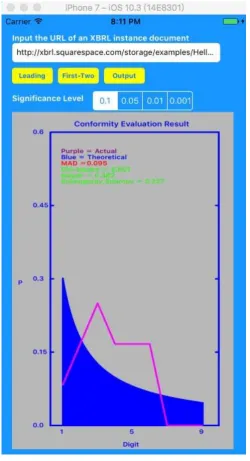
Fig. 1 presents the user interfaces of proposed iOS app. This figure is created on a simulator of the iPhone 7. It is obtained in evaluating the conformity of a HelloWorld XBRL example (http://xbrl.squarespace.com/storage/examples/HelloWorld.xml) to the Benford’s law. Actual and theoretical leading digital probabilities are calculated to plot the graph in this figure.
Observing Fig.1 can find that any XBRL taxonomy is not one of the input data. The input data are the URL (Uniform Resource Locator) of an XBRL instance document and significance level. This significance level is required in computing Eqs. (3), (7), and (9). As a preliminary trial, this study limits the significance level to 10 %, 5 %, 1%, and 0.1 %
© 2017, IJCSMC All Rights Reserved 73 Fig. 1 The user interface of proposed iOS app
After completing the computation of mean deviation, Chi-square, Kuiper, and Kolmogorov-Smirnov test statistics, a third button can be pressed to send the resulting test statistics and the figure in which actual and theoretical digital probabilities are compared to an e-mail account. A pop-up dialog will appear to accept an e-mail address.
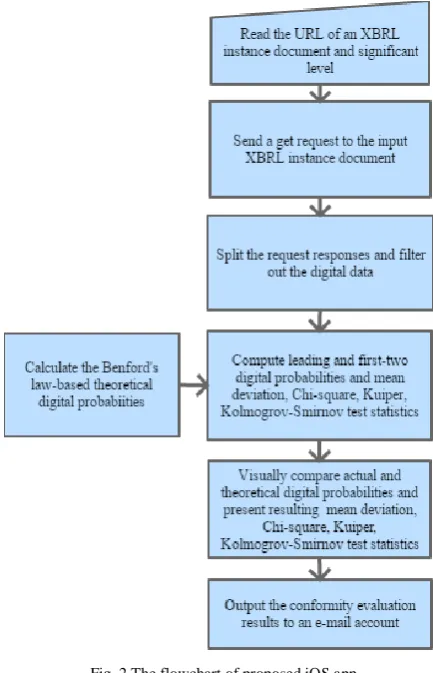
This study creates five steps to parse an XBRL instance document and evaluate the conformity of it to the Benford’s law. These five steps are illustrated by Fig. 2 or listed below
1.After inputting the URL of an XBRL instance document, send a get request to the input XBRL instance document. 2.Split the response contents at chars ―>‖ and ―<‖. Filter out digital data within split results.
3.Employ the retrieved digital data to calculate digital probabilities. Further use the resulting digital probabilities to compute selectively mean deviation, Chi-square, Kuiper, Kolmogorov-Smirnov test statistics.
4.Conclude the resulting test statistics according to Table 1 and Eqs. (5), (7), and (9). The required theoretical digital probabilities are computed by Eq. (1).
5.Compare visually the actual and theoretical digital probabilities and present resulting mean deviation, Chi-square, Kuiper, Kolmogorov-Smirnov test statistics.
© 2017, IJCSMC All Rights Reserved 74 Fig. 2 The flowchart of proposed iOS app
Experiences of teaching accountant students programming languages indicate that the second step is the most important. If digital data in an XBRL instance document can be accurately retrieved, it is not difficult to implement other steps such as the computation of various test statistics and output of the conformity evaluation report to an e-mail account. Even if we desire to add a new method to evaluate the conformity of an XBRL instance document to the Benford’s law, it is easy to add this method into the proposed iOS app.
This study creates a new method to extract digital data from an XBRL instance document. This method is further explained as follows: The structure of an XBRL instance document begins with a root element. In addition to this root element, the contents of an XBRL instance document may be categorized into the following sections:
1. Business Facts: This section can be further divided into items and tuples. An item holds a single value; whereas, a tuple is used to express multiple values.
2. Contexts: In this section, the entities used within the document are defined.
3. Units: In this section, it is defined the units used by numerical and fractional facts within the documents. 4. Footnotes: This section is used to associate one or more facts with some contents.
5. References: The references to an XBRL taxonomy are described in this section.
Currently, the most common method of parsing an XBRL instance document may be visiting of all elements in this XBRL instance document and retrieving all the required element values. Therefore, the corresponding XBRL taxonomy is needed to provide at least the structure of that XBRL instance document. Employing a third-party XML parser such as AEXML and SWXMLHash may simplify such a step.
Instead, this study parses an XBRL instance document without introducing an XBRL taxonomy. Also, any third-party XML parser is not used. The contents of an XBRL instance document is downloaded and split at chars ―>‖ and ―<‖. Each segment resulting from this split is next inspected to extract digital data.
© 2017, IJCSMC All Rights Reserved 75
V. SAMPLE PROGRAM RUN
Three cases of online XBRL instance documents are introduced to test the proposed iOS app.
A. Primary financial statement of the Novartis company
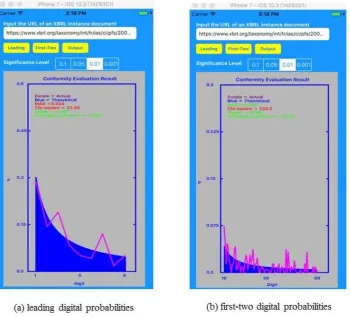
As a first test, the conformity of an online XBRL instance document https://www.xbrl.org/taxonomy/int/fr/ias/ci/pfs/2002-11-15/Novartis-2002-11-15.xml to the Benford’s law is evaluated. This XBRL instance document expresses a balance sheet, income statement, cash flows statement, and statement of changes in equity of the Novartis company (http://www.novartis.com). Creating the XBRL instance document adopts the IASCF-PFS taxonomy and an extension taxonomy to make modifications to the IASCF-PFS taxonomy. The modifications were made to rearrange the taxonomy in the manner that the Novartis company expressed its primary financial statements. Figs. 3(a) and 3(b) describe the conformity evaluation results. The significant level is set to 0.01. The total number of bins retrieved to calculate leading and first-two digital probabilities is 216.
Fig. 3 Conformity evaluation of Novartis company’s primary financial statement to the Benford’s law: (a) leading digital probabilities; (b) first-two digital probabilities
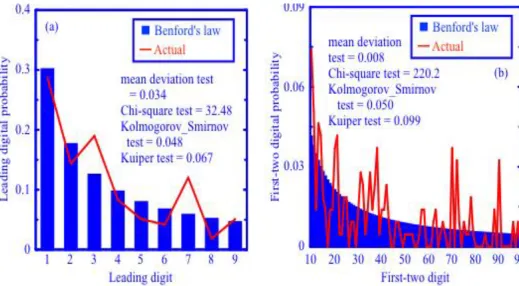
As a check, the resulting digital probabilities are further employed to plot Figs. 4(a) and 4(b). Inspecting Figs. 3(a), 3(b), 4(a), and 4(b) can find that the proposed iOS app provides an accurate visual comparison of actual and Benford’s law-based theoretical digital probabilities.
Either Fig. 3(a) or Fig. 4(a) indicates that XBRL instance document https://www.xbrl.org/taxonomy/int/fr/ias/ci/pfs/2002-11-15/Novartis-2002-11-15.xml contains many numbers starting with the digits 3 and 7. At these two digits, the actual leading digital probabilities are apparently different from theoretical leading digital probabilities. Similar deviations are found in ranges of digits 30 to 40 and 70 to 80. Further inspecting the XBRL instance document https://www.xbrl.org/taxonomy/int/fr/ias/ci/pfs/2002-11-15/Novartis-2002-11-15.xml finds that numbers starting with digits 3 and 7 denote various incomes. If this XBRL instance document is fraudulent, these incomes may be first audited manually. In other words, the proposed smartphone app may be used to quicken the audit of an XBRL instance document. Implementing this audit doesn’t need the corresponding XBRL taxonomy.
© 2017, IJCSMC All Rights Reserved 76 Fig. 4 Visual comparison of theoretical and actual leading and first-two digital probabilities of the first example
B. Adobe Investor Relations
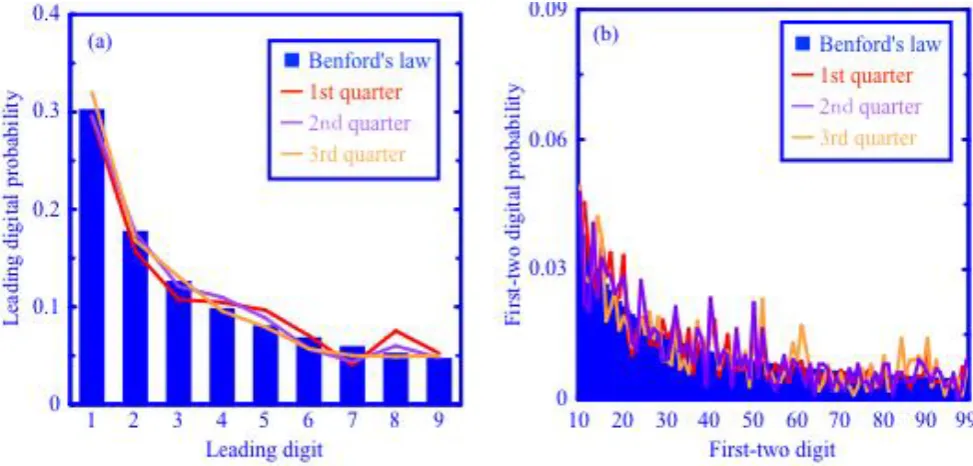
The second example are investor relations of the Adobe company (http://www.adobe.com/investor-relations/xbrl.html). XBRL instance documents on this website present financial facts for investors of the Adobe company (http://www.adobe.com). It is interesting to inspect the conformity of these XBRL instance documents to the Benford’s law. Therefore, the conformity of four XBRL instance documents to the Benford’s law are selectively evaluated. These four XBRL instance documents were uploaded at each quadrature of 2010. Meanwhile, the significant level is set to 0.05.
Conventionally, it is time-consuming to evaluate whether time histories of XBRL instance documents conform acceptably to the Benford’s law. The proposed iOS app quickens this conformity evaluation. Figs. 5(a)-5(d) present the conformity evaluation results of leading digital probabilities. Figs. 6(a)-6(d) present the conformity results of first-two digital probabilities. The total number of extracted bins are listed in captions of these figures.
© 2017, IJCSMC All Rights Reserved 77
© 2017, IJCSMC All Rights Reserved 78
© 2017, IJCSMC All Rights Reserved 79 Fig. 7 Visual comparison of theoretical and actual leading and first-two digital probabilities of the first example
Moreover, Figs. 6(a)-6(d) indicate that unacceptable conformity to the Benford’s law is easily concluded from Chi-square test statistics. In these four figures, all the Chi-square test statistics indicate the unacceptable conformity to the Benford’s law; whereas, some other test statistics don’t. A reference book has pointed out [2] that the Chi-square test statistic is sensitive to the slight difference between actual and theoretical digital probabilities.
In addition, actual digital probabilities are closer to the Benford’s law, if these actual digital probabilities are calculated from more extracted bins. Among Figs. 5(a)-5(d) and 6(a)-6(d), maximum bins have been retrieved to create Figs. 5(d) and 6(d). The corresponding actual digital probabilities conform optimally to the Benford’s law in these two figures.
C. Consolidated Statements of Three Taiwan companies
The third example comes from consolidated statements of three Taiwan companies. These consolidated statements were record at the first quarter of 2015. XBRL instance documents of consolidated statements are downloaded from the website http://mops.twse.com.tw/mops/Web/t164sb02. The first company is the Taiwan Sampo Group (http://www.sampo.com.tw). This company produces electric equipment. The second company is the CLP Group (http://www.clp.com.hk). This company produces bulbs. The third company is the Taiwan Taya Group (http://www.taya.com.tw). This company produces electric wires and cables. If stock prices of succeeding three companies are compared, the stock price of Taiwan Sampo Group is usually highest among them.
Within the consolidated statement of Taiwan Sampo company, total 794 bins are extracted to compute digital probabilities. Within the consolidated statement of CLP Group, it was retrieved 730 bins to compute digital probabilities. Meanwhile, total 915 bins are extracted from the consolidated settlement of Taiwan Taya Group. The significant level is set to 0.001.
Figs. 8(a) and 8(b) plot the conformity evaluation results of Taiwan Sampo company’s consolidated statement. Figs. 9(a) and 9(b) show the conformity evaluation results of CLP Group’s consolidated statement. The conformity evaluation results of Taiwan Taya Group’s consolidated statement are shown in Figs. 10(a) and 10(b).
© 2017, IJCSMC All Rights Reserved 81
VI.CONCLUSIONS
This study presents an iOS app for evaluating the conformity of an XBRL instance document to the Benford’s law. The conformity evaluation is implemented using visual comparison of digital probabilities, mean deviation, Chi-square, Kuiper, and Kolmogorov-Smirnov test statistics. The proposed iOS app is coded to read contained in an XBRL instance document without needing an XBRL taxonomy. It is also unnecessary to re-input digital data within this XBRL instance document. Thus, whether numerous XBRL instance documents conform acceptably to the Benford’s law can be quickly answered by the proposed iOS app. Based on this ability, this study efficiently checks time histories of Adobe company’s investor relations in a year and consolidated statements of three different Taiwan companies. It is time-consuming to apply the previous Excel add-in [2] to implement this check. Through the check, it is found that inspecting time histories of digital probabilities is helpful to the search of fraudulent documents. Digital probabilities, which are computed from time histories of non-fraudulent documents of the same type, vary similarly. In addition, when more bins are collected to calculate digital probabilities, the resulting digital probabilities are closer to Benford’s law-based theoretical values. But, these bins should be collected from the same source.
In conclusion, a smartphone can be a handy tool of fast narrowing the range of fraudulent documents. Such a tool helps smartphone users against the cheat of fraudulent documents.
R
EFERENCES
[1] F. Benford, ―The law of anomalous numbers,‖ Proc. Amer. Phil. Soc., vol. 78, no. 4, pp. 551–572, 1938. [2] M. Nigrini, and J. T. Wells, ―Benford's Law - Application for Forensic Accounting, Auditing, and Fraud
Detection‖, Hoboken, NJ, USA: John-Wiley & Sons, 2012
[3] D. C. Hoaglin, F. Mosteller, J. W. Tukey M., ―Understanding Robust and Exploratory Data Analysis‖, Canada: John-Wiley & Sons, 2008.
© 2017, IJCSMC All Rights Reserved 82
1960.
[6] A. Kolmogorov, ―Sulla determination empirica di una legge di distribuzione,‖ G. Ist. Ital. Attuari, vol. 4, pp. 83-91, 1993.
[7] N. Smirnov, ―Table for estimating the goodness of fit of empirical distributions,‖ Ann. Math. Stat., vol. 19, pp. 279-281, 1948.
[8] Company Financials App Version 2.2, Altova, 2016.
[9] (2017) The Abax website. [Online]. Available: https://abax.xbrl.mx. [10](2017) The Litix website. [Online]. Available: http://litix.br-ag.eu. [11]ACL Software Version 10.0, ACL Software, 2013.
[12](2010) The C. Hoffman’s web blog. [Online]. Available: http://xbrl.squarespace.com.
[13]M. A. Stephens, ―The goodness-of-fit statistic VN: distribution and significance points,‖ Biometrika, vol. 52, no. 3 and 4, pp. 309-321, 1965.
APPENDIX A
The most important codes of proposed iOS app are programmed to extract digital data from an XBRL instance document. As introduced earlier, a Get request is first sent to the input XBRL instance document. The response contents are next split at chars ―<‖ and ―>‖. After excluding such as property and entity numbers, digital data can be accurately extracted. The method for excluding such as property and entity numbers is checking whether the ―identifier‖ keyword exists. If the ―identifier‖ keyword exists, the extracted digital data denote such as property and entity numbers.
Codes for extracting digital data from an XBRL instance document are listed below let request = NSMutableURLRequest(url:(file!) as URL);
request.httpMethod="GET" // send a Get request
let task = URLSession.shared.dataTask(with: request as URLRequest) { data,response,error in
if error != nil {
DispatchQueue.main.async {
let alert = UIAlertController(title: "Error", message: error as! String?, preferredStyle: .actionSheet) alert.addAction(UIAlertAction(title: "OK", style: UIAlertActionStyle.default, handler: nil)) self.present(alert, animated: true, completion: nil)
} }
// response contents
let responseString = NSString(data: data!, encoding: String.Encoding.utf8.rawValue) // split at the char ―<‖
let seperated = responseString?.components(separatedBy: "<") for lines in seperated! {
// split at the char ―>‖ but exclude the identifier if(lines.contains(">") && !lines.contains("identifier")){ let piece=lines.components(separatedBy: ">")
for datatosearch in piece { let digitdata = Int(datatosearch) if (digitdata != nil) {
total += 1 // total retrieved bins if(digitdata! > 0) {
// leading digit
let first=String(datatosearch[datatosearch.startIndex]) // first-two digit
let firsttwo=datatosearch.substring(to: datatosearch.index(datatosearch.startIndex, offsetBy: 2)) let firsti = Int(first)
© 2017, IJCSMC All Rights Reserved 83 let firsttwoi = Int(firsttwo)
pdf[firsttwoi!-1] += 1.0 }
else {
let stringtodigit=datatosearch.substring(from: datatosearch.index(datatosearch.startIndex, offsetBy: 1)) if(stringtodigit.startIndex != stringtodigit.endIndex) {
let first=String(stringtodigit[stringtodigit.startIndex])
let firsttwo=stringtodigit.substring(to: stringtodigit.index(stringtodigit.startIndex, offsetBy: 2)) let firsti = Int(first)
pdf[firsti!-1] += 1.0 let firsttwoi = Int(firsttwo) pdf[firsttwoi!-1] += 1.0 }