Available Online at www.ijcsmc.com
International Journal of Computer Science and Mobile Computing
A Monthly Journal of Computer Science and Information Technology
ISSN 2320–088X
IMPACT FACTOR: 6.017
IJCSMC, Vol. 7, Issue. 12, December 2018, pg.6 – 13
Implementation of Web – Based Bike
Renting Application “Bike – Sharing”
Ratieh Indah Permitasari
1, Riad Sahara
21,2
Faculty of Computer Science, Mercu Buana University, Indonesia
1
[email protected]; [email protected]
Abstract— Bicycles are no longer a sporting tool but an alternative transportation for motorized vehicles that available at several strategic points that can be reached by pedestrians. The convenience offered by this bike-sharing service provider is to support the full activity of each person without depending on motorized vehicles and facilitate mobility because they do not need to bring their own bicycle or find a parking space because the stations have spread in various locations. Through this research, it is expected to be able to build a bicycle rental system that is reliable and computerized, able to accommodate payment transactions that are easy, fast and safe without using cash, which called contactless payment methods and generating rental and payment reports that are precise and accurate for company’s financial reporting purposes. This study using PIECES analysis as a problem analysis to get an overview of the problems and risks and the Spiral development method where several repetitions are carried out so that it can produce applications that are in accordance with user expectations and needs.
Keywords— Rent, Bike – sharing, website, contactless payment
I. INTRODUCTION
special place called kiosk or dock in a locked area in the park area or tourist spot. The convenience offered by this bike-sharing service provider is to support the full activity of each person without depending on motorized vehicles and facilitate mobility because they do not need to bring their own bicycle or find a parking space because the stations have spread in various locations.
A. Research Problems
Based on the background described above, the outlines of the problem are:
1) How to make it easier for visitors to travel to rent bikes quickly and comfortably?
2) How to accommodate lease payment transactions made easily, quickly and safely without using cash? 3) How to produce leasing and payment reports that are fast and appropriate for the needs of the
company's financial statements?
B. Limitation of Research
In this issue so that the discussion is not too extensive, then the focus problem definition are as follows: 1) Application designed the bicycle rental system targeting people who visit city park for leisure.
2) The flow of the bicycle rental process is made to facilitate the rental of bicycles with a computerized system.
3) Transactions from bicycle rentals are recorded in the financial statements.
C. Purpose and Objectives
The benefits of this implementation are:
1) For the Government, it can provide additional income for the city government from the tourism sector, either directly or privately managed by private company.
2) For citizens, it is indirectly encouraging citizens to move more and exercise more.
3) For city that provides bike - sharing service is reduction of the impact of pollution from vehicles because if the number of bikes is sufficiently adequate, several transit slot sites can be built that facilitate mobility of citizens without motorized vehicles so that bicycle rental is not only in the city every corner of the city, especially in the area of stops and stations.
II. RELATED STUDIES
A. Previous Research
According to I. Bettez and J.-S. Bettez, an integrated automobile parking payment and management system and bicycle rental system are presented. In this way, the same infrastructure can support motorists paying for parking and bicyclist renting bikes. To enable deployment of such a system throughout a wide area, stations, which may provide for parking payment, bicycle rental or both, may be solar powered, which may be enabled through the use of power savings features [3].
According to Anthony Bobbitt’s research invents a system that can configure travel data from bicycle tenants based on statistical data recorded from the tenant's trip record through the route map that was taken and forwarded to the server. The present invention relates generally to bicycles and in particular to bicycle rental systems and more particularly to a bicycle tracking and communication system for bicycle rental system [4].
In another study, Mark Sabar Rudiarto et al developing web-based bajaj rental systems to computerize bajaj rental systems that were previously traditional. In this research, a bajaj rental website was developed to support bajaj leasing from the owner to bajaj drivers where the application facilitated the recording of rentals by bajaj owners and in monitoring operational activities [5].
From researches above, the main reference for researchers to conduct research related to bicycle rental is research conducted by Isabelle and Jean-Sebastien Bettez which has similarities with the research raised by researchers, namely the construction of bicycle rental systems and utilizing GPRS as a liaison with servers. While the difference from the research is the construction of a solar power panel system as the main power source that drives the bicycle rental system from Isabelle and Jean-Sebastien Bettez. The strength highlighted by the research conducted by researchers is the practicality of payment by using contactless methods to make it easier to make transactions.
B. Theory Fundamental
1) Bike – sharing
bicycles where public bicycles are provided for short trips available at strategic locations and integrated with transit facilities in various corners of the city [6].
2) Rental
The definition of rent according to the Indonesian dictionary (KBBI) is the use of something by paying rent, money paid for using or lending something, which may be used by paying money with money. Definition of rental according to R. Subekti and Tjiro Soedibjo (1995) is an agreement or a deal whereby one party allows itself to submit a material to another party, so that this party can enjoy it within a certain period of time, which the back party is able to pay for [7].
C. PIECES Analysis
PIECES analysis is very important to do before developing an information system because in this analysis will usually found some major problems and problems that are symptomatic of the main problem [8]. Below will be explained on the understanding of each of the PIECES components as follows:
1) System Performance Analysis
Performance is a system capability in completing tasks quickly so that targets can be achieved immediately.
2) Information Analysis
Information is important because with the information the management (marketing) and users can take the next step.
3) Economic Analysis (Economy)
Utilization of costs used from the utilization of information. An increase in economic needs affects cost control and increased benefits.
4) Control Analysis
This analysis is used to compare systems analyzed based on timeliness, ease of access, and accuracy of processed data.
5) Efficiency Analysis
Efficiency relates to how the source can be used optimally. Operations in a company are said to be efficient or not usually based on the task and responsibility in carrying out the activities.
6) Service Analysis
Improved services show diverse categories. The selected project is a better service improvement for management (marketing), user and other parts which is a symbol of the quality of an information system.
III.METHODOLOGY
A. Research Flow
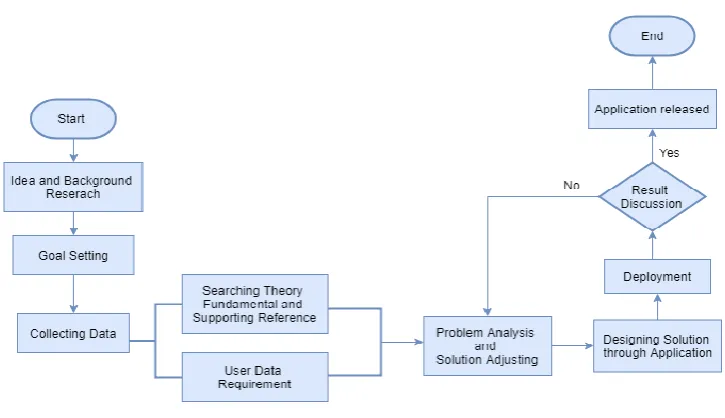
Figure 1. Research Flow
source search by conducting questionnaires and observation also from theory fundamental and related studies. After that perform the problem analysis process in accordance with supporting facts and find suitable solutions. Then made an application design and designed according to a predetermined solution. The next stage is the process of development, deployment, and testing. The Final Stages make a result discussion with potential users. If the results are in accordance with the expected, then the next release of the application, if not then re-analysed until the results in accordance with the expected.
B. Problem Analysis Method
The methodology used to analyse problems is PIECES method where this analysis usually appears on the surface not the main problem, but only the symptoms of the main problem.
Table 1. PIECES Analysis
C. Development Method
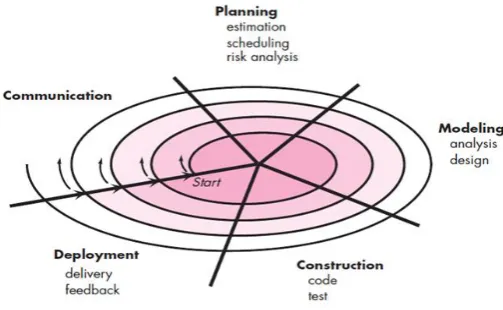
Figure 2. Spiral Method
In the development process using the spiral method repeated several times to produce applications that meet the needs. This cycle keeps repeating until the system is produced as expected.
1) Communication with users, this activity is a process that builds communication with the user. This is needed to build good communication between the developer and the user, especially regarding the needs of the user so that the program is made according to those needs.
2) Planning, planning activities are needed to determine resources, estimated processing time, and other information needed for software development. In this stage, risk analysis activities are carried out to analyse
No Aspect Problem Solution
1 Performance Rentals are done manually where customers come, rent and return bicycles. owners sometimes don't come to tourist spots so customers can't always rent bicycles
With this web, rentals are managed more professionally. Bicycles are always available, and customers can conduct transactions independently. Rentals using the web so that all transactions are recorded in detail.
2 Information Management and calculation of income are ineffective, less accurate.
Using the system so that transaction calculations are more accurate, transaction data can be withdrawn for a certain period.
3 Economics Fluctuative and uncertain income. Bicycle owners are not always available on location
More professional management can attract more public interest
4 Control Transaction income can be manipulated Transaction revenues are recorded in the system and minimize fraud.
5 Efficiency Less efficient if the public interest is high because the queue is not controlled
The process of renting is easier and faster
6 Services The behavior of bicycle owners can cause prospective tenants to be reluctant to rent
both technical and managerial risks. This stage may not exist in the process model that also uses the iteration method, but only in the spiral model.
3) Modelling, Activities needed to build one or more representations of applications and also help researchers to build effectively. At this stage the architecture, interface picture and component level details are described. 1. Data Modelling
2. Functional Modelling 3. Data Design
4. Design Functions 5. Interface Design
4) Construction, Activities needed for coding and testing, which lead to operational software that is ready to be sent to end-users. The coding phase adapts to the programming language used. While the concept of testing leads to a systematic and measurable test design. Provision of end users and their training is also needed at this stage.
5) Deployment, Activities needed to get feedback from users based on their evaluation during software representation. This is needed to get input so that the application will be better and user friendly.
IV.RESULT AND CALCULATION
A. Use Case Design
Admin
User Login
Manage rent data
Reports
Rent bike
Paying
<<include>>
<<include>>
Manage user data <<include>>
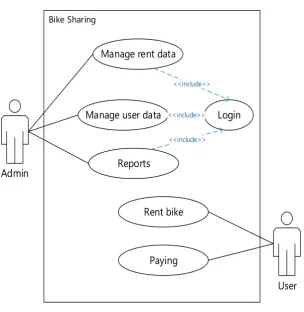
Figure 3. Use Case Bike – Sharing Design
Figure 3 describes as shown below:
1) Admin manage bicycles data by add, delete or update availability type of bicycles that can be rented. 2) Admin manage user’s data such as add, deleting or updating user profile.
3) Admin creates report for certain periods or for any kind of type bicycles. 4) User rent bike from main page.
B. System Implementation
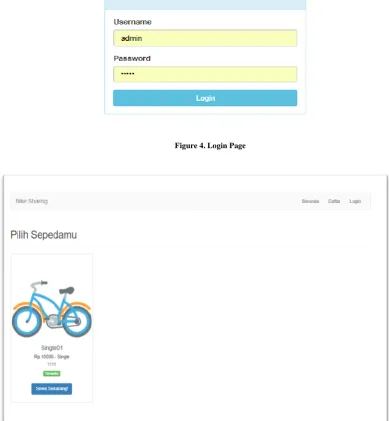
Figure 4. Login Page
Figure 5. Main Page
C. Application Testing
Table 2. Testing Result
V. CONCLUSIONS
The implementation of the Bike Sharing Bike Rental application can be concluded as follows:
1) This application is useful for visitors to tourist places to rent bikes quickly and comfortably by utilizing web-based technology.
2) This application can accommodate rental payment transactions made easily, quickly and safely without using cash.
3) This application can display bicycle rental report data as well as a quick and accurate financial recording report for the needs of the company's financial statements
No Interface
Tested Testing Scenario Expected Results
Tested Results
1. Admin and
User Login
Login by entering the correct username and password
System Displays the main page of each Success
2. Admin and
User Login
Login by not entering correct username and password
System will display "Login Failed! Incorrect username or password”
Success
3. Managing user Admin adds user data System stores user data Success
4. Managing data Admin adds the type of bicycle System saves the type of bicycle that was added
Success
5. Managing data Admin deleting type of bicycles data
System updating and saving bicycles data
Success
6. Managing data Admin adding bicycles data according to type of bicycle availability
System adding and saving bicycles according to type of bicycles
Success
7. Managing data Admin deleting bicycles data according to type of bicycle availability
System deleting bicycles according to type of bicycles availability
Success
8. Reports Admin prints report for any type of bicycle
System display report for any type of bicycle
Success
9. Reports Admin prints report for certain period
System display report for certain period Success
10. Renting bike User choose type of bike they want to rent
System display bike chosen then next to confirmation page
Success
11. Paying rent User fills form rent confirmation with how long bike rented
R
EFERENCES
[1] D. Kim, J. Lee, and S. Choi, “Balancing mobility and CO<inf>2</inf> reduction by a mode share scheme: a comparison of Los Angeles and Seoul metropolitan areas,” Int. J. Urban Sci., vol. 19, no. 2, pp. 168–181, May 2015.
[2] Y.-T. Hsu, L. Kang, and Y.-H. Wu, “User Behavior of Bikesharing Systems Under Demand–Supply Imbalance,” Transp. Res. Rec. J. Transp. Res. Board, vol. 2587, pp. 117–124, 2016.
[3] I. Bettez and J.-S. Bettez, “Bicycle rental system and station,” Jul. 2015.
[4] M. A. Bobbitt, “Bicycle tracking system with communication hub,” Google Patents - US Pat. 9, 569, 966 2017, 2017.
[5] S. Rudiarto, H. Prastiawan, A. A. Hendriawan, and M. History, “Design of Bajaj Transportation Rental Application System With First Come First Served,” vol. 5, no. 06, pp. 318–330, 2018.
[6] J. Larsen, “Bike-Sharing Programs Hit the Streets in Over 500 Cities Worldwide,” Earth Policy Inst., no. April, 2013.
[7] I. Septavia, R. E. Gunadhi, and R. Kurniawati, “SISTEM INFORMASI PENYEWAAN MOBIL BERBASIS WEB DI JASA KARUNIA TOUR AND TRAVEL,” J. Algoritm., vol. 13, no. ISSN : 2302-7339, pp. 1–8, 2015.