Weston, M. A., McLeod, E. M., Blumstein, D. T., and Guay, P.-J. (2012). A review of flight initiation
1
distances and their application to managing disturbance to Australian birds. Emu, 112: 269-286
2 3
A review of flight initiation distances and their application to
4managing disturbance to Australian birds
56
M.A. Weston1†, E.M. McLeod2, D.T. Blumstein3, and P.-J. Guay2 7
8
1
Centre for Integrative Ecology, School of Life and Environmental Sciences, Faculty 9
of Science and Technology, Deakin University, 221 Burwood Highway, Burwood, 10
Victoria 3125, Australia. 11
12
2
School of Engineering and Science, and Institute for Sustainability and Innovation, 13
Victoria University – St-Albans Campus, PO Box 14428, Melbourne MC, VIC, 14
Australia 8001 15
16
3
Department of Ecology and Evolutionary Biology, 621 Charles E. Young Drive 17
South, University of California, Los Angeles, CA, 90095-1606, USA. 18
19
Running Head: Flight initiation distance and management of birds 20
21
Keywords: Flight initiation distance, disturbance, buffers, human wildlife interactions, 22
human wildlife conflict 23
24
Abstract 26
Disturbance, the response of birds to a stimulus such as the presence of a person, is 27
considered a conservation threat for some Australian birds. The distance at which a 28
bird flees from perceived danger is defined as the Flight Initiation Distance (FID), and 29
could be used to designate separation distances between birds and stimuli which 30
might cause disturbance. We review the known FIDs for Australian birds, and report 31
FIDs for 352 species. Most FIDs are from south eastern Australia, and almost all refer 32
to a single walker as the stimulus. A number of prominent factors correlated with FID 33
are discussed (e.g. body mass and the distance at which an approach begins). FIDs 34
have not been used extensively in the management of disturbance, for a variety of 35
reasons including lack and inaccessibility of available data. We call for standardised 36
data collection and greater application of available data to the management of 37
disturbance. 38
Introduction 40
The response of birds to the presence of a stimulus such as a potential predator or a 41
human is referred to as ‘disturbance’ (Van Der Zande and Verstrael 1985; Fox and 42
Madsen 1997). A diverse range of stimuli can disturb birds. Although natural stimuli, 43
such as predators, cause disturbance (e.g. Ward et al. 1994; Burton et al. 1996), most 44
studies focus on anthropogenic sources of disturbance. These include humans 45
themselves, their companion animals, and motorised transport such as aircraft, 46
vehicles and boats (e.g. Kushlan 1979; Andersen et al. 1989; Buick and Paton 1989; 47
Kirby et al. 1993; Burger 1998; Delaney et al. 1999). 48
49
The response of birds to disturbance takes many forms, but most reported 50
responses are behavioural and can be considered vigilance or flight responses 51
(Hediger 1934; Ydenberg and Dill 1986; Hockin et al. 1992), where ‘vigilance’ 52
involves birds stopping their current activity to monitor the approaching human (e.g. 53
Fernández-Juricic et al. 2001) and ‘flight’ involves fleeing on foot, swimming, diving, 54
or on the wing (e.g. Cooke 1980). An increasing number of studies have demonstrated 55
physiological responses to stimuli, such as changes in heart rates, body temperature, 56
and plasma corticosterone levels, which can occur in the absence of any obvious 57
behavioural responses (e.g. Gabrielsen et al. 1977; Kanwisher et al. 1978; Culik et al.
58
1990; Wilson et al. 1991; Culik et al. 1995; Nimon et al. 1995, 1996; Regel and Pütz 59
1997; Weimerskirch et al. 2002; Walker et al. 2006). Responses to disturbance can 60
vary greatly between species. For example, some shorebirds do not leave their nest 61
until humans are nearby, while others leave their nests when humans are several 62
hundred metres distant (e.g. Page et al. 1983; Watson 1988; Yalden and Yalden 63
65
These behavioural and physiological responses are presumed to be costly, and 66
non-benign consequences of human disturbance have been observed among many 67
species. Disturbance induced by humans can result in ecologically significant shifts in 68
behaviour, such as changes in habitat use (e.g. Burger 1981), reduced foraging, 69
diminished parental care (e.g. Weston and Elgar 2005), compromised parental defence 70
resulting in reproductive failure (e.g. Vos et al. 1985), among other changes. 71
Behavioural changes, such as those associated with disturbance, are often assumed to 72
be brief, yet may ultimately have long-lasting impacts on populations (e.g. Flemming 73
et al. 1988). At the population level, high species sensitivity to disturbance (i.e. long 74
‘Flight Initiation Distances’ [FIDs]) is associated with population declines among 75
European birds (Møller 2008) and, in the Cordoba Mountains of Argentina, human 76
presence negatively influenced avian communities, guilds and populations (Heil et al.
77
2007). 78
79
Increasing exposure of birds to disturbance, the possibility of significant 80
negative impacts on the conservation of at least some species, and the legislative 81
requirements to conserve birds and protect bird welfare, have largely prompted a 82
dramatic increase in the number of publications on disturbance to birds over the last 83
35 years (Hockin et al. 1992; Hill et al. 1997; Price 2008). This considerable body of 84
work has emphasised the high variability of the forms and consequences of 85
disturbance to birds. Many studies of disturbance examine factors that mediate 86
responses to disturbance. For example, physical factors such as habitat, internal 87
factors such as learning, and attributes of the stimulus such as number, height and 88
Newman 1978; Burger 1986; Keller 1989; Rodgers and Smith 1995; Jorden 2007). An 90
almost universal theme in the literature is that most forms of disturbance to birds are 91
already common and are likely to occur with greater frequency in the future. Increases 92
in disturbance to birds have been predicted for Europe, North America and Australia 93
(e.g. Boden and Ovington 1973; Goss-Custard and Verboven 1993; Kirby et al. 1993; 94
Flather and Cordell 1995; Gill et al. 1996; Hill et al. 1997). 95
96
Here, we briefly review Flight Initiation Distances (FID) among Australian 97
birds and some of the factors which may mediate FID. Specifically, this review 98
critically describes FID and associated concepts, describes some prominent factors 99
which mediate FID, and considers why FID estimates have not enjoyed greater 100
application in the management of avian disturbance. We redress one barrier to the use 101
of FID data in management by providing available FID data for Australian birds. We 102
are unaware of any published reviews dedicated to this topic to date (but see Lane 103
2003). 104
105
Bridging the theoretical-applied divide: Flight Initiation Distances 106
One of the most consistent findings of disturbance research is that the response of 107
birds is inversely related to the distance between the bird and the stimulus. The 108
distance at which a behavioural escape response occurs is known as Flight Initiation 109
Distance (FID) (Stankowich and Blumstein 2005), a concept apparently first 110
described by Hediger (1934). FID is also known as ‘Flush’ (Stankowich and 111
Blumstein 2005), ‘Displacement’ (Dandenong Valley Authority 1979) or ‘Flight’ 112
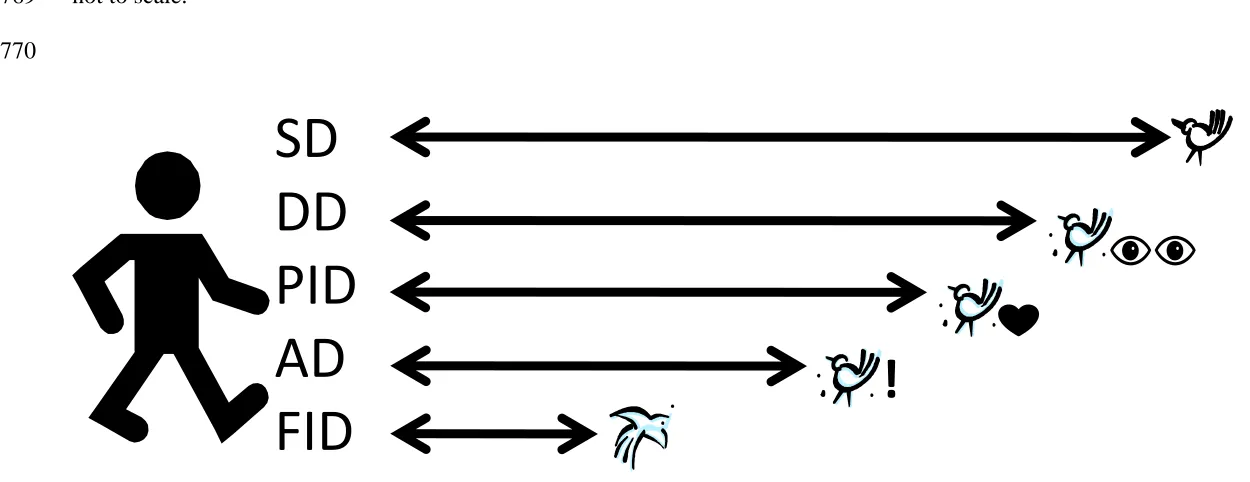
Distance (Hediger 1934).The distance at which a vigilance response is initiated is the 113
Valley Authority 1979) (Fig. 1). The concept of FID is broadly applicable to wild 115
living birds, though for aggressive, highly habituated or domesticated birds, the 116
response often involves an approach to humans, and FID may not adequately reflect 117
the distance at which normal activities are disrupted. Alarm responses vary between 118
species, but many involve raising the head and communicating with nearby 119
conspecifics via alarm calls or other signals such as tail flicking among the Rallidae 120
(Woodland et al. 1980). Non-cryptic promulgation of alarm may also signal to 121
threatening stimuli that they have been detected (Woodland et al. 1980). If AD is 122
evident, it is always greater than or equal to FID (Blumstein et al. 2005; Cárdenas et
123
al. 2005). 124
125
Two other important distances that are often overlooked are: 1) the possible 126
existence of Detection Distance (DD), the distance at which a bird can first detect a 127
stimulus (generally assumed to be visually, though auditory cues could potentially be 128
used to detect loud stimuli such as aircraft, or the sounds of approaching predators in 129
closed habitats) without reacting in other ways, and 2) the Physiological Initiation 130
Distance (PID), the distance at which physiological response (e.g. increased heart rate 131
or corticosteroid secretion) is initiated (Fig. 1). Birds can detect stimuli while not 132
being overtly vigilant and thus DD is greater than or equal to AD (Lima and 133
Bednekoff 1999). The few studies of PID suggest that it is longer than either AD or 134
FID (Nimon et al. 1996), at least in ‘non-startle’ responses (see below). 135
136
Starting distance (the distance at which an investigator approach begins; SD), 137
is usually positively related to FID (Blumstein 2003, 2006, 2010), however where FID 138
‘startle’ response, defined as an instantaneous flight response upon detection of the 140
stimulus. Startles occur at distances below which FID equals SD. Maximum startle 141
distance can be estimated from the regression of FID and SD as the point where FID 142
equals SD for a given species. DD is currently not measurable, so startles occur when 143
the distance at which an approach begins (Starting Distance; SD) equals or is very 144
similar to FID. Essentially, this represents the presentation of a stimulus to a bird 145
rather than an approach. For species with long FIDs, caution must be exercised in 146
relation to achieving sufficient starting distances during approaches; insufficient 147
starting distance may result in only the least sensitive individuals contributing to the 148
measure of FID. 149
150
Prominent factors correlated with FID 151
Life history characteristics influence many aspects of the behaviour of birds, and can 152
be reasonably expected to influence key aspects of decisions in relation to escape 153
behaviour such as flight (Møller and Garamszegi 2012). For example, males and 154
females, old and young individuals, and low and high quality individuals could differ 155
consistently in direction and magnitude of FID. However, studies which examine 156
these attributes in relation to FID are few (but see Thiel et al. 2007). FID itself can be 157
considered a life history trait, whereby FID represents the risk an individual is willing 158
to take, which is expected to be influenced by residual reproductive value (the 159
remaining reproductive value for an individual of a particular age, given it’s particular 160
condition, quality etc.). Thus, associations between FID and other life history traits 161
represent correlations and do not necessarily imply causation. 162
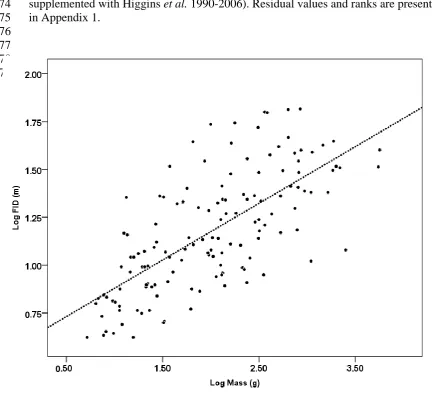
Body mass, a life history trait, explains most of the variation in FID among 163
regression of FID on body mass (both logged [10]) for species with at least ten FIDs 165
and with adequate mass data are presented in Appendix 1 (no phylogenetic 166
corrections; F1,138 = 131.471, P < 0.001, R2 = 0.488, slope = 0.296; Fig. 2). Higher
167
positive residual values indicate species most sensitive to human approaches while 168
negative values of higher magnitude indicate species least sensitive to human 169
approaches. The Hooded Plover Thinornis rubricollis has the highest residual value, 170
and is a species considered to be threatened by human disturbance (Dowling and 171
Weston 1999). The least sensitive species analysed was the Australian Brush Turkey 172
Alectura lathami which sometimes inhabits yards and other human-dominated 173
environments (Marchant and Higgins 1993). 174
175
There are several possible reasons for the general finding that FIDs and body 176
sizes are positively correlated between species. First, if larger-bodied species are more 177
at risk from predators due to their higher detectability, they may diminish depredation 178
risk by initiating the flight response earlier (Holmes et al. 1993). Second, if larger-179
bodied species are less agile or aerodynamic than smaller species, they may require 180
more time or space to escape (Fernández-Juricic et al. 2002). Third, smaller-bodied 181
species may require more foraging time to fulfill their relatively higher energy 182
requirements and thus may react later to disturbance to maximise foraging time 183
(Bennett and Harvey 1987; Blumstein 2006). Other possibilities include that humans 184
may have discriminately hunted or hunt larger species, or that larger species may 185
exhibit higher longevities (i.e. have, on average, higher residual reproductive values) 186
and so minimise risk associated with perceived threats. A number of parameters 187
correlated with body mass may also be correlated with FID, including sensory organ 188
are positively correlated with FID once body mass has been accounted for (Møller and 190
Erritzøe 2010) and others remain to be investigated. 191
192
Larger group sizes are, at least sometimes, associated with longer FIDs; 193
possibly because the flock’s response is dependent on the reaction of the most alert , 194
sensitive or risk-averse constituent of the flock (Cooke 1980; Hilton et al. 1999; 195
Fernández-Juricic et al. 2002), and because at least some birds may initiate a response 196
when nearby birds respond (Hingee and Magrath 2009). However, the reduction in 197
individual vigilance associated with an increase in group size is a frequently reported 198
relationship, and is generally thought to result from a decrease in predation risk to 199
flock members, or an increase in competition among foraging flock members (Roberts 200
1996; Beauchamp 2001; Randler 2005). Flocking species may be more susceptible to 201
disturbance from humans than species that do not flock, both at the individual and 202
possibly the population levels. More studies are required to determine if a threshold in 203
group size exists above which FIDs do not increase but theory predicts that because 204
the benefits of increasing group size attenuate quickly, studies of animals in relatively 205
small group sizes will be important to describing this function. 206
207
Learning is an oft cited influence on escape behaviour such as FID, but no 208
studies on birds known to us unambiguously describe changes in FID with experience 209
i.e. learning (see below). Learning, if it occurs, could potentially influence FIDs in 210
two directions: 1) facilitation (‘sensitisation’), where FIDs increase with increasing 211
exposure to humans; and, 2) habituation where FIDs decrease with increasing 212
exposure to humans. The former is generally suggested to be associated with 213
dangerous, irregular, rapid and unpredictable stimuli such as hunters (Thiel et al.
2007), and dogs which are most commonly unleashed in many bird habitats (see 215
Williams et al. 2009). In contrast, habituation is suggested to result from frequent 216
benign, slow and predictable stimuli like walkers (Weston and Elgar 2007). Both 217
types of learning might potentially occur within a species. Such an explanation might 218
explain examples of behaviour such as the Pacific Black Duck Anas supercisliosa, 219
which in urban parks, where the species is fed, actually approaches humans closely, 220
while in areas where it is hunted, flushes at many hundreds of metres (Unpubl. Data, 221
but see below). The capacity of learning, if any occurs, on the part of birds to change 222
FIDs is little studied and poorly known (but see Gould et al. 2004), but within species 223
variation in FID might at least partly reflect learning . 224
225
Learning has been inferred from the prevalence of humans in particular 226
habitats and the responses of birds in those habitats (i.e. a space – experience 227
substitution). For example, Black Swan Cygnus atratus FIDs toward walkers have 228
been measured by many observers at different sites and vary from 149 m in the 229
relatively undisturbed Coorong, SA (Paton et al. 2000), to only 3.6 m at the extremely 230
busy Albert Park Lake, Melbourne (Monie 2011). Such variation has been used to 231
infer habituation. However, evidence of this type does not necessarily demonstrate 232
learning, and a number of problems exist when using space-experience substitution 233
studies to infer learning. Firstly, dispersal and site fidelity of the species measured 234
will influence the experience of birds at a site and few such studies document the 235
underlying regimes in the occurrence of stimuli (e.g. density or frequency of humans) 236
which are often assumed (but see Glover et al. 2011). Additionally, site comparisons 237
are often confounded with habitat, and many comparisons of these types involve 238
substitutions may also be confounded by the possibility of selection for, or biased 240
recruitment of, less responsive birds in more disturbed habitats. Observed patterns 241
may thus reflect selective pressure or differential recruitment, rather than learning per
242
se. We are unaware of any study that examines the actual experience of free-living 243
individual birds and their response to humans, and we are similarly unaware of any 244
study which discriminates between the potential mechanisms underpinning reported 245
differences in bird responses between birds inhabiting sites experiencing different 246
disturbance regimes. The capacity, if any, for learning on the part of the birds and 247
subsequent adjustment of FIDs thus remains virtually unstudied, poorly known, and is 248
ripe for future study. 249
250
Starting distance (i.e. the distance at which an approach begins; SD) is 251
positively related to FID for most species (Blumstein 2003, 2006). It has been 252
hypothesised that this intriguing finding results from a judgement regarding the value 253
of a ‘patch’ under increasing risk (i.e. an approaching human; Blumstein 2003, 2006). 254
However, an alternative explanation may be that birds monitor approaches and 255
tolerate them for a certain time (and thus maintain a temporal margin of safety; Dill 256
1990) perhaps a measure of the ‘persistence’ of the approach. Or, individuals may 257
tolerate approaches to a certain proportion of AD such as is seen in galahs (Cacatua
258
roseicapilla; Cárdenas et al. 2005) and perhaps other species (Gulbransen et al. 2006). 259
Alternatively, animals may tolerate approach until a threshold in the perception of the 260
stimulus (e.g. increasing size) is reached (Jorden 2007). Many species of birds do not 261
have a large binocular overlap region frontally and thus may not be able to estimate 262
distance efficiently. Obviously, time and distance are highly correlated during a 263
between SD and FID, although distance per se may not be used by birds to decide 265
when to respond to stimuli (but see Cárdenas et al. 2005). Further research into 266
teasing apart these alternative mechanisms remains to be conducted. 267
268
The factors listed above are those that feature prominently in the literature. 269
Blumstein (2006) suggested after body size, diet and sociality (i.e. whether a species 270
is a co-operative breeder) also explained significant variation in avian FID. However, 271
many other potential correlations with FID remain to be investigated thoroughly. For 272
example, birds with more pointed wings have longer FIDs and fly further when 273
disturbed compared with birds with more rounded wings (Fernández-Juricic et al.
274
2006) and ‘personality’ may explain some of the variation of FIDs seen within 275
species. More ‘exploratory’ individual Collared Flycatchers Ficedula albicollis tend 276
to have smaller FIDs than less exploratory individuals (Garamszegi et al. 2009). Other 277
potential influences on FID include age, sex, site attributes including distance from 278
cover and the presence of barriers to human movement such as fences or canals, 279
weather, clothing colour and others mentioned throughout this review (see, for 280
example, Fruziski 1977; Gutzwiller and Marcum 1993; Gould et al. 2004; Thiel et al.
281
2007; Fong et al. 2009). 282
283
FID as a management tool: strengths and shortcomings 284
One of the attractions of documenting FIDs is that they provide a scientific basis for 285
the designation of buffers or separation distances between important habitat and 286
incompatible surrounding land uses, often recreation (Blumstein and Fernández-287
Juricic 2010). Other approaches to mitigate the impacts of disturbance include altering 288
hiding the stimulus (e.g. hides) or by promoting habituation, such as through the use 290
of fences (Ikuta and Blumstein 2003), which make stimuli more predictable and 291
physically separate them from birds so rendering them less threatening (Gates and 292
Gysel 1978). Despite the potential of buffers to restrict any negative effects of 293
disturbance (Davies and Lane 1995), and because of a range of competing factors, 294
FIDs have rarely been used in this way in Australia (Weston et al. 2009). Their use 295
has been limited by a number of ecological, scientific and social factors which are 296
discussed below. 297
298
Relatively few studies in Australia have provided measures of FIDs although 299
data on some species with global distributions are available from overseas (e.g. 300
Møller and Erritzøe 2010). Many older studies of FID relied on subjective 301
measurement of distance and so used distance categories (e.g. Woodland et al. 1980). 302
However, the availability of cost-effective eye-safe laser range finders, which permit 303
accurate measurements of distances at scales relevant to bird FIDs, means collecting 304
data on FIDs is now comparatively cheap and accurate. Despite this, published data 305
on FIDs of Australian birds are only available for 29.3% of the 866 species of birds 306
that occur in Australia (Table 1). Thus, comparatively few FIDs are readily available 307
to managers. Of the 352 FIDs on Australian birds we located, only 48.6% were 308
published in peer-reviewed literature. The remaining FIDs were published in reports 309
with limited circulation, or reports that are difficult to access (e.g. honours theses or 310
other ‘grey literature’; a finding that is paralleled on other continents). The lack of 311
suitable data on which to make management decisions could be addressed by 312
collecting more FID on more species in more locations and encouraging its 313
widespread, positive relationship between body mass and FID, and the species 315
specific residuals from the relationship (Blumstein 2006), may be used as a first 316
approximation or to identify particularly sensitive species and these estimates can be 317
tested and refined with future study. Clearly, the later approach relies on information 318
regarding the species present at a site, and assumes the site is not already avoided by 319
particularly sensitive species. 320
321
There has been a taxonomic bias in available FIDs for Australian birds. 34.0% 322
(of 377 species) and 45.8% (of 489 species) of passerines and non-passerines 323
respectively have published FIDs. In particular, most research has targeted waterbirds, 324
in particular shorebirds (75.9% of 224 species; Table 1). As a result, there are many 325
groups of birds for which few or no FIDs are available. There has also been a regional 326
bias in studies of the FIDs of Australian birds, with most reported from temperate 327
areas (usually coastal), in eastern Australia (where most of the human population 328
resides; Fig. 3), and a habitat bias, with most FIDs available from wetlands, few from 329
grasslands, and few studies which specify the microhabitat of focal birds such as 330
substrate (e.g. for wetland birds, margin or water) (but see Blumstein 2006). 331
332
The great majority of reported FIDs involve non-breeding birds, although 333
disturbance can reduce reproductive success in some species (Davidson and Rothwell 334
1993) and disturbance has been associated with decline among breeding populations 335
of others (Møller 2008). Breeding birds potentially respond very differently to 336
disturbance compared with non-breeding birds (Glover et al. 2011), and few studies 337
report FIDs for dependent or flightless young. 338
FIDs are reported in non-standard ways in the scientific literature, and are 340
presented as averages (e.g. Blumstein 2006) sometimes without measures of variation, 341
as 95th percentiles (e.g. Taylor 2006), or as maxima (Glover 2009). Moreover, a 342
central repository for FID data is not available to managers. Given that virtually 343
nothing is known about the thresholds of response frequencies or intensities which 344
can be tolerated by birds, the precautionary principle suggests that an upper limit is 345
required, this could be 95th percentiles (which still assumes thresholds in tolerance), or 346
maxima (if sampling is sufficient), which would be most appropriate for the 347
designation of buffers for conservation purposes. In at least some cases the FIDs 348
evoked by tangential approaches exceed those evoked by direct approaches (e.g. Heil 349
et al. 2007; but see Burger et al. 2010) suggesting that such effects should be 350
investigated before designating buffers, leading some authors to propose various 351
inflation factors to FIDs (Fernández-Juricic et al. 2005; Blumstein and Fernández-352
Juricic 2010). We believe that it would seem prudent to present full summary 353
statistics and methodological details of all FIDs in publications, to enable managers 354
access and ready interpretation of the data (thus, see Table 2). Additionally, studies of 355
experimentally implemented buffers, derived from FIDs, could inform how FIDs can 356
be used to create effective buffers, and could account for a variety of stimulus types 357
and behaviour, and if studies occur long enough, account for learning on the part of 358
the birds. Studies which examine different methods of calculating buffers in relation 359
to actual FIDs (Fernández-Juricic et al. 2005; Glover et al. 2011) are both needed and 360
useful. 361
362
FIDs from mixed species flocks are not available either because studies have 363
they assume that no species interactions occur and use a focal bird approach 365
(Blumstein et al. 2003). However, many species usually or often occur in mixed 366
flocks (e.g. shorebirds, small passerines) and mixed flocks of shorebirds are known to 367
‘share’ vigilance with other species in flocks (Metcalfe 1983). It may be that in mixed 368
flocks the FID is that of the most sensitive individual irrespective of species, 369
especially for closely or highly coordinated flocking species i.e., the ‘sentinel’ 370
hypothesis (Metcalfe 1983; Paton et al. 2000). Alternatively, it is possible that species 371
respond only to the flight of conspecifics. These possibilities can be envisaged as the 372
extremes of a spectrum. Interspecies interactive FIDs remain unstudied and their 373
study may generate novel and practical insights into managing human disturbance at 374
multi-species sites. 375
376
Another limitation of the FID data currently available is the emphasis on a 377
single walker as the stimulus (92.3% of 352 FIDs). FIDs in response to other stimuli 378
including dog walkers, joggers, powerboats, and canoes have only been reported for 379
11 species (some authors discuss the influence of different stimuli without directly 380
reporting the FIDs e.g. Glover et al. 2011). Although walkers are a useful standard for 381
comparative studies, FID can vary depending on the stimulus involved. For example, 382
shorebirds have larger FIDs towards dog walkers than walkers without dogs (Paton et
383
al. 2000; Glover 2009) and cars do not elicit as strong a response as walkers or 384
cyclists among ducks (Pease et al. 2005). Larger groups of people may evoke longer 385
FIDs (Geist et al. 2005). Aspects of the behaviour of stimuli also influence responses: 386
for example, tangential approaches evoke different responses, sometimes longer FIDs, 387
in comparison with direct ones (Blumstein and Fernández-Juricic 2010; Burger et al.
388
response (Weston et al. 2011). Due to the strong effect of stimulus type, proper 390
management decisions can only be made if FIDs for the prevailing human activities 391
are available for the appropriate species. The use of FIDs for single walkers would 392
underestimate the required buffer needed to protect birds from dog walkers. More 393
studies of the influence of stimulus type on FID may enable some extrapolation of 394
FIDs across stimulus types, which could be cautiously used by managers until better 395
information becomes available. Indeed, currently it is not known whether birds 396
respond specifically to each stimulus or generalise responses into ‘classes’. Different 397
classes of FID are presumably correlated between individuals or species; 398
understanding such patterns might provide general principles regarding what stimuli 399
are likely to cause greatest disturbance. Ultimately, FID-based buffer zones should be 400
viewed as hypotheses ripe for testing and studied in an adaptive management 401
framework (Blumstein and Fernández-Juricic 2010). 402
403
Different authors have used various protocols to measure FIDs. The standard 404
protocol, which has received the broadest patronage and thus seems logical to 405
promote to future investigators, involves a slow continuous approach toward the 406
target bird and the recording of AD and FID as the bird behaviour changes (Blumstein 407
2003). This would also seem to best mimic the behaviour of most recreationists 408
(except possibly birdwatchers or photographers). Other researchers have opted for 409
stepwise advances toward birds with behavioural observations in between each step to 410
monitor vigilance within flocks (Paton et al. 2000). For birds in elevated positions, 411
horizontal and vertical components of FID should be recorded and documented 412
(Møller 2010). SD should be maximised or standardised (see Møller and Garamszegi 413
different datasets and we advocate that the simple method described by Blumstein 415
(2003) should be adopted whenever possible. 416
417
Finally, FIDs may be impractical for planners, policy makers and other 418
stakeholders such as the public, researchers and birdwatchers (see Glover et al. 2011). 419
Some species exhibit FIDs of more than 100 m; the maximum FID recorded for any 420
Australian species to date is 196 m for the Eastern Curlew Numenius
421
madagascariensis (Glover et al. 2011); longer FIDs are likely to occur. Although 422
many Australians accept the need for buffers against human disturbance (Glover et al.
423
2011), large buffers which exclude humans threaten coexistence, including with 424
birdwatchers who at least occasionally cause disturbance (Clarke 1965; Sekercioglu 425
2002). Additionally, close personal encounters with wildlife such as birds, can be a 426
powerful tool for public education and the recruitment of bird researchers, 427
conservationists and advocates; strict buffers would exclude such experiences. 428
However, FIDs can provide information on managing disturbance in ways other than 429
exclusion zones. For example, constraining the extent of human presence (through 430
formed paths or barriers such as fences or canals), and the promotion of habituation 431
(by encouraging predictable and unthreatening behaviour of the stimuli), remain 432
tantalising management responses to disturbance. 433
434
If response to humans is considered a major issue for bird conservation, then 435
the lack of published FID data, and its limited use in management, seems at odds with 436
the concept of scientific management. The divide between science and its application 437
is hardly new, but it is frustrating and challenging to managers and scientists alike 438
fulfil the more theoretical expectations of scientific journals, or aspirations of 440
potential authors. Nevertheless, such data are required if the management of 441
disturbance to birds is to improve. We encourage the development of a common data 442
standard and sharing of these data to enhance the conservation of Australian birds. 443
444
Acknowledgements 445
This research was funded by Melbourne Water, a Victoria University Fellowship and 446
a Faculty of Health Engineering and Science Collaborative Research Grant Scheme to 447
P.J. Guay and some work was supported by the M.A. Ingram Trust. We thank Dr 448
W.K. Steele for his support and advice and H.K. Glover (Deakin University). Data 449
were collected under Deakin University Animal Ethics Committee Permit A48/2008, 450
Victoria University Animal Ethics Committee Permit AEETH 02/10, National Parks 451
Permit 10004656, DSE Scientific Permits Nos 10004656 and 10005536, and Western 452
Treatment Plant Study Permit SP 08/02. This review was greatly improved by the 453
comments of K. Buchanan, G.S. Maguire, J. O’Connor, M. Price, P. McDonald and 454
W.K. Steele and two reviewers. 455
456
References 457
Australian Biosecurity CRC (2009). Knowledge into Practice and Policy. The 458
Science-Policy Interface. (Australian Biosecurity CRC, Brisbane.) 459
Adams, J. L., Camelio, K. W., Orique, M. J., and Blumstein, D. T. (2006). Does 460
information of predators influence general wariness? Behavioral Ecology and
461
Sociobiology 60, 742-747. 462
Andersen, D. E., Rongstad, O. J., and Mytton, W. R. (1989). Response of nesting 463
Red-tailed Hawks to helicopter overflights. Condor 91, 296-299. 464
Australian Biosecurity CRC (2009). 'Knowledge into Practice and Policy. The 465
Science-policy Interface.' (Final report by Australian Biosecurity CRC: 466
Brisbane, Australia.) 467
Beauchamp, G. (2001). Should vigilance always decrease with group size? Behavioral
468
Ecology and Sociobiology 51, 47-52. 469
Bennett, P. M., and Harvey, P. M. (1987). Active and resting metabolism in birds: 470
Blakney, A. H. (2004). Behavioural Responses and Habituation of the Hooded Plover, 472
Thinornis rubricollis (Gmelin 1789), to Disturbance Stimuli. Honours Thesis, 473
University of Tasmania, Hobart, Australia. 474
Blumstein, D. T. (2003). Flight initiation distance in birds is dependant on intruder 475
starting distance. Journal of Wildlife Management 67, 852-857. 476
Blumstein, D. T. (2006). Developing an evolutionary ecology of fear: how life history 477
and natural history traits affect disturbance tolerance in birds. Animal
478
Behaviour 71, 389-399. 479
Blumstein, D. T. (2010). Flush early and avoid the rush: a general rule of anti-480
predator behavior? Behavioural Ecology 21, 440-442. 481
Blumstein, D. T., Anthony, L. L., Harcourt, R., and Ross, G. (2003). Testing a key 482
assumption of wildlife buffer zones: is flight initiation distance a species-483
specific trait? Biological Conservation 110, 97-100. 484
Blumstein, D. T., and Fernández-Juricic, E. (2010). 'A Primer of Conservation 485
Behavior.' (Sinauer Associates, Inc.: Sunderland, USA.) 486
Blumstein, D. T., Fernández-Juricic, E., Zollner, P. A., and Garity, S. C. (2005). 487
Interspecific variation in avian responses to human disturbance. Journal of
488
Applied Ecology 42, 943-953. 489
Boden, R. W., and Ovington, J. D. (1973). Recreation use-patterns and their 490
implications for management of conservation areas. Biological Conservation
491
5, 265-270. 492
Boyer, J. S., Hass, L. L., Lurie, M. H., and Blumstein, D. T. (2006). Effect of 493
visibility on time allocation and escape decisions in Crimson Rosellas. 494
Australian Journal of Zoology 54, 363-367. 495
Buick, A. M., and Paton, D. C. (1989). Impact of off-road vehicles on the nesting 496
success of Hooded Plovers Charadrius rubricollis in the Coorong region of 497
South Australia. Emu 89, 159-172. 498
Burger, J. (1981). The effect of human activity on birds at a coastal bay. Biological
499
Conservation 21, 231-241. 500
Burger, J. (1986). The effects of human activity on shorebirds in two coastal bays in 501
northeastern United States. Environmental Conservation 13, 123-130. 502
Burger, J. (1998). Effects of motorboats and personalised watercraft on flight 503
behaviour over a colony of Common Terns. Condor 100, 528-534. 504
Burger, J., Gochfeld, M., Jenkins, C. D., and Lesser, F. (2010). Effect of approaching 505
boats on nesting Black Skimmers: using response distances to establish 506
protective buffer zones. Journal of Wildlife Management 74, 102-108. 507
Burton, N. H. K., Evans, P. R., and Robinson, M. A. (1996). Effects on shorebird 508
numbers of disturbance, the loss of a roost site and its replacement by an 509
artificial island at Hartlepool, Cleveland. Biological Conservation 77, 193-510
201. 511
Cárdenas, Y. L., Shen, B., Zung, L., and Blumstein, D. T. (2005). Evaluating temporal 512
and spatial margins of safety in Galahs. Animal Behaviour 70, 1395-1399. 513
Clarke, G. (1965). Disturbance of breeding and resting birds by bird-watchers. South
514
Australian Ornithologist 24, 41. 515
Cooke, A. S. (1980). Observations on how close certain passerine species will tolerate 516
an approaching human in rural and suburban areas. Biological Conservation
517
18, 85-88. 518
Culik, B., Adelung, D., and Woakes, A. J. (1990). The effect of disturbance on the 519
breeding season. In 'Antarctic Ecosystems: Ecological Change and 521
Conservation'. (eds. K. R. Kerry, G. Hempel) pp. 177-182. (Springer-Verlag: 522
Berlin, Germany.) 523
Culik, B., Adelung, D., and Woakes, A. J. (1995). Penguins disturbed by tourists. 524
Nature 376, 301-302. 525
Dandenong Valley Authority (1979). Edithvale Wetlands Buffer Area Analysis. 526
Dandenong Valley Authority Environmental Report 2. 527
Davidson, N. C., and Rothwell, P. (1993). 'Disturbance to Waterfowl on Estuaries.' 528
(Wader Study Group: Thetford, U. K.) 529
Davies, P. M., and Lane, J. A. K. (1995). 'Guidelines for design of effective buffers 530
for wetlands on the Swan Coastal Plain ' (Australian Nature Conservation 531
Agency: Canberra, Australia.) 532
Delaney, D. K., Grubb, T. G., Beier, P., Pater, L. L., and Reiser, M. H. (1999). Effects 533
of helicopter noise on Mexican Spotted Owls. Journal of Wildlife Management
534
63, 60-76. 535
Dill, L. M. (1990). Distance-to-cover and the escape decision of an African cichlid 536
fish, Melanochromis chipokae. Environmental Biology of Fishes 27, 147-152. 537
Dowling, B., and Weston, M. A. (1999). Managing the Hooded Plover in a high-use 538
recreational environment. Bird Conservation International 9, 255-270. 539
Dunning, J. B. (2008). 'CRC Handbook of Avian Body Masses. Second Edtion.' (CRC 540
Press: New York, USA.) 541
Fernández-Juricic, E., Blumstein, D. T., Abrica, G., Manriquez, L., Adams, L. B., 542
Adams, R., Daneshard, M., and Rodriguez-Prieto, I. (2006). Effects of body 543
mass, size, and morphology on anti-predator escape and post-escape 544
responses: a comparative study with birds. Evolutionary Ecology Research 8, 545
731-752. 546
Fernández-Juricic, E., Jimenez, M. D., and Lucas, E. (2001). Alert distance as an 547
alternative measure of bird tolerance to human disturbance: Implications for 548
park design. Environmental Conservation 28, 263-269. 549
Fernández-Juricic, E., Jimenez, M. D., and Lucas, E. (2002). Factors affecting intra- 550
and inter-specific variations in the difference between alert distance and flight 551
distances for birds in forested habitats. Canadian Journal of Zoology 80, 1212-552
1220. 553
Fernández-Juricic, E., Vernier, M. P., Renison, D., and Blumstein, D. T. (2005). 554
Sensitivity of wildlife to spatial patterns of recreationist behavior: A critical 555
assessment of minumum approaching distances and buffer areas for grassland 556
birds. Biological Conservation 125, 225-235. 557
Flather, C. H., and Cordell, H. K. (1995). Outdoor recreation, historical and 558
anticipated trends. In 'Wildlife and Recreationists: Coexistence through 559
Management and Research'. (eds. R. L. Knight, K. J. Gutzwiller) pp. 3-16. 560
(Island Press: Washington DC.) 561
Flemming, S. P., Chiasson, R. D., Smith, P. C., Austin-Smith, P., and Bancroft, R. P. 562
(1988). Piping Plover status in Nova Scotia related to its reproductive and 563
behavioral responses to human disturbance. Journal of Field Ornithology 59, 564
321-330. 565
Fong, T. E., DeLong, T. W., Hogan, S. B., and Blumstein, D. T. (2009). The 566
importance of indirect cues in White-browed Sparrow-weaver (Plocepasser
567
Fox, A. D., and Madsen, J. (1997). Behavioural and distributional effects of hunting 569
disturbance on waterbirds in Europe: implications for refuge design. Journal
570
of Applied Ecology 34, 1-13. 571
Fruziski, B. (1977). Feeding habits of Pink-footed Geese (Anser fabalis
572
brachyrhynchus) in Denmark during the spring passage in April 1975. Danish
573
Review of Game Biology 10, 1-11. 574
Gabrielsen, G., Kanwisher, J., and Steen, J. B. (1977). Emotional bradycardia: a 575
telemetry study on incubating Willow Grouse (Lagopus lagopus). Acta
576
Physiologica Scandinavica 100, 255-257. 577
Garamszegi, L. Z., Eens, M., and Török, J. (2009). Behavioural syndromes and 578
trappabillity in free-living Collared Flycatchers, Ficedulla albicollis. Animal
579
Behaviour 77, 803-812. 580
Gates, J. E., and Gysel, L. W. (1978). Avian nest dispersion and fledging success in 581
field-forest ecotones. Ecology 59, 871-883. 582
Geist, C., Liao, J., Libby, S., and Blumstein, D. T. (2005). Does intruder group size 583
and orientation affect flight initiation distance in birds? Animal Biodiversity
584
and Conservation 28, 68-73. 585
Gill, J. A., Sutherland, W. J., and Watkinson, A. R. (1996). A method to quantify the 586
effects of human disturbance on animal populations. Journal of Applied
587
Ecology 33, 786-792. 588
Glover, H. K. (2009). Response Distances of Shorebirds to Disturbance: Towards 589
Meaningful Buffers. Honours Thesis, Deakin University, Burwood, Australia. 590
Glover, H. K., Weston, M. A., and Maguire, G. S. (2011). Towards ecologically 591
meaningful and socially acceptable buffers: Response distances of shorebirds 592
in Victoria, Australia, to human disturbance. Landscape and Urban Planning
593
103, 326-334. 594
Goss-Custard, J. D., and Verboven, N. (1993). Disturbance and feeding shorebirds on 595
the Exe Estuary. In 'Disturbance to Waterfowl on Estuaries'. (eds. N. 596
Davidson, P. Rothwell) pp. 59-66. (Wader Study Group: Thetford, U. K.) 597
Gould, M. L., Green, L., Altenau, B., and Blumstein, D. T. (2004). A study of the 598
species-confidence hypothesis with Spiny-cheeked Honeyeaters 599
(Acanthagenys rufogularis). Emu 104, 267-271. 600
Gulbransen, D., Segrist, T., Del Castillo, P., and Blumstein, D. T. (2006). The fixed 601
slope rule: An inter-specific study. Ethology 112, 1056-1061. 602
Gutzwiller, K. J., and Marcum, H. A. (1993). Avian responses to observer clothing 603
color: Caveats from winter point counts. Wilson Bulletin 105, 628-636. 604
Hediger, H. (1934). Zur Biologie und Psychologie der Flucht bei Tieren. Biologisches
605
Zentralblatt 54, 21-40. 606
Heil, L., Fernández-Juricic, E., Renison, D., Nguyen, V., Cingolani, A. M., and 607
Blumstein, D. T. (2007). Avian responses to tourism in the biogeographically 608
isolated high Córdoba Mountains, Argentina. Biodiversity and Conservation
609
16, 1009-1026. 610
Higgins, P. J. and various authors (1990 - 2006). Handbook of Australian, New 611
Zealand and Antarctic Birds. Volumes 1-7. (Oxford University Press: 612
Melbourne, Australia.) 613
Hill, D., Hockin, D., Price, D., Tucker, G., Morris, R., and Treweek, J. (1997). Bird 614
disturbance: improving the quality and utility of disturbance research. Journal
615
Hilton, G. M., Cresswell, W., and Ruxton, G. D. (1999). Intraflock variation in the 617
speed of escape-flight response on attack by an avian predator. Behavioral
618
Ecology 10, 391-395. 619
Hingee, M., and Magrath, R. D. (2009). Flights of fear: a mechanical wing whistle 620
sounds the alarm in a flocking bird. Proceedings of the Royal Society of
621
London Series B-Biological Sciences 276, 4173-4179. 622
Hockin, D., Ounsted, M., Gorman, M., Hill, D., Keller, V., and Barker, M. A. (1992). 623
Examination of the effects of disturbance on birds with reference to its 624
importance in ecological assessments. Journal of Environmental Management
625
36, 253-286. 626
Holmes, T. L., Knight, R. L., Stegall, L., and Craig, G. R. (1993). Responses of 627
wintering grassland raptors to human disturbance. Wildlife Society Bulletin 21, 628
461-468. 629
Ikuta, L. A., and Blumstein, D. T. (2003). Do fences protect birds from human 630
disturbance? Biological Conservation 112, 447-452. 631
Jorden, C. (2007). Flight Initiation Distance in Jackdaws (Corvus monedula) is 632
Dependent on Predators Approach Speed and Height. Unpubl. Practical 633
Report, University of Bristol, Bristol, UK. 634
Kanwisher, J. W., Williams, T. C., Teal, J. M., and Lawson, K. O. (1978). 635
Radiotelemetry of heart rates from free-ranging gulls. Auk 95, 288-293. 636
Keller, V. (1989). Variations in the response of Great Crested Grebes Podiceps
637
cristatus to human disturbance – a sign of adaptation? Biological
638
Conservation 49, 31-45. 639
Kirby, J. S., Clee, C., and Seager, V. (1993). Impact and extent of recreational 640
disturbance to wader roosts on the Dee estuary: some preliminary results. In 641
'Disturbance to Waterfowl on Estuaries'. (eds. N. Davidson, P. Rothwell) pp. 642
53-66. (Wader Study Group: Thetford, U. K.) 643
Kitchen, K., Lill, A., and Price, M. (2010). Tolerance of human disturbance by urban 644
Magpie-larks. Australian Field Ornithology 27, 1-9. 645
Kushlan, J. A. (1979). Effects of helicopter census on wading bird colonies. Journal
646
of Wildlife Management 43, 756-760. 647
Lane, B. (2003). 'Disturbance Distances for Wetland Birds - A Litterature Review.' 648
(Unpublished report to the Kingston City Council by Brett Lane and 649
Associates Pty Ltd: Mansfield, Australia.) 650
Lima, S. L., and Bednekoff, P. A. (1999). Back to the basics of antipredator vigilance: 651
can nonvigilant animals detect attacks? Animal Behaviour 58, 537-543. 652
Marchant, S., and Higgins, P. J. (1993). 'Handbook of Australian, New Zealand and 653
Antarctic Birds. Volume 2. Raptors to Lapwings.' (Oxford University Press: 654
Melbourne, Australia.) 655
Metcalfe, N. B. (1983). The effects of mixed-species flocking on the vigilance of 656
shorebirds: Who do they trust? Animal Behaviour 32, 986-993. 657
Møller, A. P. (2008). Flight distance and population trends in European breeding 658
birds. Behavioral Ecology 19, 1095-1102. 659
Møller, A. P. (2010). Up, up and away: Relative importance of horizontal and vertical 660
escape from predators for survival and senescence. Journal of Evolutionary
661
Biology 23, 1689-1698. 662
Møller, A. P., and Erritzøe, J. (2010). Flight distance and eye size in birds. Ethology
663
Møller, A. P., and Garamszegi, L. Z. (2012). Between individual variation in risk-665
taking behavior and its life history consequences. Behavioural Ecology
666
doi:10.1093/beheco/ars040. 667
Monie, L. (2011). Factors Affecting Alert Distance and Flight-initiation Distance in 668
Black Swans (Cygnus atratus) at Albert Park Lake, Victoria, Australia. Third 669
Year Research Thesis, Victoria University, St-Albans, Australia. 670
Nimon, A. J., Schroter, R. C., and Oxenham, R. K. (1996). Artificial eggs: measuring 671
heart rate and effects of disturbance in nesting penguins. Physiology and
672
Behavior 60, 1019-1022. 673
Nimon, A. J., Schroter, R. C., and Stonehouse, B. (1995). Heart rate of disturbed 674
penguins. Nature 374. 675
Page, G. W., Stenzel, L. E., Winkler, D. W., and Swarth, C. W. (1983). Spacing out at 676
Mono Lake: breeding success, nest density, and predation in the Snowy 677
Plover. Auk 100, 13-24. 678
Paton, D. C., Ziembicki, M., Owen, P., and Heddle, C. (2000). Disturbance Distances 679
for Water Birds and the Management of Human Recreation with Special 680
Reference to the Coorong Region of South Australia. (University of Adelaide: 681
Adelaide, Australia.) 682
Pease, M. L., Rose, R. K., and Butler, M. J. (2005). Effects of human disturbances on 683
the behavior of wintering ducks. Wildlife Society Bulletin 33, 103-112. 684
Price, M. (2003). Tolerance of a Human Observer by Four Ground-foraging Bird 685
Species in Urban and Rural Areas. Honours Thesis, Monash University, 686
Clayton, Australia. 687
Price, M. (2008). The impact of human disturbance on birds: a selective review. In 688
'Too Close for Comfort: Contentious Issues in Human-Wildlife Encounters'. 689
(eds. D. Lunney, A. Munn, W. Meikle) pp. 163-196. (Royal Zoological 690
Society of New South Wales: Mosman, Australia.) 691
Randler, C. (2005). Coots Fulica atra reduce their vigilance under increased 692
competition. Behavioural Processes 68, 173-178. 693
Regel, J., and Pütz, K. (1997). Effect of human disturbance on body temperature and 694
energy expenditure in penguins. Polar Biology 18, 246-253. 695
Roberts, G. (1996). Why individual vigilance declines as group size increases. Animal
696
Behaviour 51, 1077-1086. 697
Rodgers, J. A., and Smith, H. T. (1995). Set-back distances to protect nesting bird 698
colonies from human disturbance in Florida. Conservation Biology 9, 89-99. 699
Sekercioglu, C. H. (2002). Impacts of birdwatching on human and avian communities. 700
Environmental Conservation 29, 282-289. 701
Stalmaster, M. V., and Newman, J. R. (1978). Behavioural responses of wintering 702
Bald Eagles to human activity. Journal of Wildlife Management 42, 506-513. 703
Stankowich, T., and Blumstein, D. T. (2005). Fear in animals: A meta-analysis and 704
review of risk assessment. Proceedings of the Royal Society of London Series
705
B-Biological Sciences 272, 2627-2634. 706
Taylor, I. R. (2006). Managing visitor disturbance of waterbirds on Australian inland 707
wetlands. In 'Wetlands of the Murrumbidgee River Catchment: Practical 708
Management in an Altered Environment'. (eds. I. R. Taylor, P. A. Murray, S. 709
G. Taylor) pp. 150-157. (Fivebough and Tuckerbil Wetlands Trust: Leeton, 710
Thiel, D., Ménoni, E., Brenot, J.-F., and Jenni, L. (2007). Effects of recreation and 712
hunting on flushing distance of Capercaillie. Journal of Wildlife Management
713
71, 1784-1792. 714
Van Der Zande, A. N., and Verstrael, T. J. (1985). Impacts of outdoor recreation upon 715
nest-site choice and breeding success of the Kestrel. Ardea 73, 90-99. 716
Vos, D. K., Ryder, R. A., and Graul, W. D. (1985). Response of breeding Great Blue 717
Herons to human disturbance in Northcentral Colorado. Colonial Waterbirds
718
8, 13-22. 719
Walker, B. G., Boersma, P. D., and Wingfield, J. C. (2006). Habituation of adult 720
Magellanic Penguins to human visitation as expressed through behavior and 721
corticosterone secretion. Conservation Biology 20, 146-154. 722
Ward, D. H., Stehn, R. A., and Derksen, D. V. (1994). Response of staging Brant to 723
disturbance at the Izembek Lagoon, Alaska. Wildlife Society Bulletin 22, 220-724
228. 725
Watson, A. (1988). Dotterel Charadruis morinellus numbers in relation to human 726
impact in Scotland. Biological Conservation 43, 245-256. 727
Weimerskirch, H., Shaffer, S. A., Mabile, G., Martin, J., Boutard, O., and Rouanet, J. 728
L. (2002). Heart rate and energy expenditure of incubating Wandering 729
Albatrosses: Basal levels, natural variation, and the effects of human 730
disturbance. Journal of Experimental Biology 205, 475-483. 731
Weston, M. A., Antos, M. J., and Glover, H. K. (2009). Birds, buffers and bicycles: a 732
review and case study of wetland buffers. Victorian Naturalist 126, 79-86. 733
Weston, M. A., Ehmke, G., and Maguire, G. S. (2011). Nest return times in response 734
to static versus mobile human disturbance. Journal of Wildlife Management
735
75, 252-255. 736
Weston, M. A., and Elgar, M. A. (2005). Disturbance to brood-rearing Hooded Plover 737
Thinornis rubricollis: responses and consequences. Bird Conservation
738
International 15, 193-209. 739
Weston, M. A., and Elgar, M. A. (2007). Responses of incubating Hooded Plovers 740
(Thinornis rubricollis) to disturbance. Journal of Coastal Research 23, 569-741
576. 742
Williams, K. J., Weston, M. A., Henry, S., and Maguire, G. S. (2009). Birds and 743
beaches, dogs and leashes: Dog owner’s sense of obligation to leash dogs on 744
beaches in Victoria, Australia. Human Dimension of Wildlife 14, 89-101. 745
Wilson, R. P., Culik, B., Danfeld, R., and Adelung, D. (1991). People in Antarctica – 746
how much do Adélie Penguins Pygoscelis adeliae care? Polar Biology 11, 747
363-370. 748
Woodland, D. J., Jaafar, Z., and KnightSource, M.-L. (1980). "Pursuit deterrent" 749
function of alarm signals. The American Naturalist 115, 748-753. 750
Yalden, D. W., and Yalden, P. E. (1989). The sensitivity of breeding Golden Plovers 751
Pluvialis apricaria to human intruders. Bird Study 36, 49-55. 752
Ydenberg, R. C., and Dill, L. M. (1986). The economics of fleeing from predators. 753
Advances in the Study of Behavior 16, 229-249. 754
Table 1. Number and percentage of species in different taxonomic groups for which 758
FID of Australian birds have been reported (Paton et al. 2000; Blumstein et al. 2003; 759
Price 2003; Blakney 2004; Blumstein 2006; Taylor 2006; Kitchen et al. 2010; Glover 760
et al. 2011; Monie 2011). Blanks indicate no FIDs have been located. 761
Order (family) Stimulus Percentage of
species in group Walker Dog Boat Canoe
Casuariiformes 25.0
Casuariidae 1 25.0
Galliformes 30.8
Megapodiidae 2 66.7
Phasianidae 2 25.0
Anseriformes 35.7
Anatidae 10 1 2 1 37.0
Podicipediformes 50.0
Podicipedidae 2 50.0
Columbiformes 32.4
Columbidae 11 32.4
Caprimulgiformes 25.0
Podargidae 1 33.3
Eurostopodidae 1 50.0
Phalacrocoraciformes
29.4
Anhingidae 1 100.0
Phalacrocoracidae 4 57.1
Ciconiiformes 58.6
Pelecanidae 1 100.0
Ardeidae 11 50.0
Threskiornithidae 5 1 1 100.0
Accipitriformes 28.6
Accipitridae 6 28.6
Falconiformes 33.3
Falconidae 2 33.3
Gruiformes 25.0
Rallidae 6 28.6
Charadriiformes 33.6
Burhinidae 1 50.0
Haematopodidae 2 66.7
Recurvirostridae 3 2 3 3 100.0
Scolopacidae 17 3 5 5 38.6
Turnicidae 1 14.3
Laridae 7 21.9
Psittaciformes 28.6
Cacatuidae 7 50.0
Psittacidae 9 22.0
Cuculiformes 31.3
Cuculidae 5 31.25
Coraciiformes 50.0
Alcedinidae 1 33.3
Halcyonidae 4 44.4
Meropidae 1 100.0
Coraciidae 1 100.0
Passeriformes 31.6
Menuridae 1 50.0
Climacteridae 3 50.0
Ptilonorhynchidae 4 40.0
Maluridae 3 13.6
Acanthizidae 16 38.1
Pardalotidae 1 25.0
Meliphagidae 24 32.4
Pomatostomidae 2 50.0
Orthonychidae 2 100.0
Eupetidae 1 12.5
Campephagidae 3 37.5
Pachycephalidae 5 35.7
Oriolidae 2 66.7
Artamidae 7 50.0
Dicruridae 1 100.0
Rhipiduridae 3 42.9
Corvidae 2 28.6
Monarchidae 5 35.7
Corcoracidae 2 100.0
Paradisaeidae 1 25.0
Petroicidae 5 22.7
Cisticolidae 1 50.0
Acrocephalidae 1 50.0
Megaluridae 2 40.0
Timaliidae 1 14.3
Hirundinidae 2 28.6
Pycnonotidae 1 100.0
Turdidae 3 60.0
Nectariniidae 1 33.3
Estrildidae 5 23.8
Passeridae 2 100.0
Motacillidae 2 25.0
Fringillidae 3 75.0
Table 2. Recommended fields for documenting Flight Initiation Distance data, 764
assuming basic methods are fully documented. 765
Aspect Fields
Stimulus Stimulus type (e.g. walker) and number of stimuli per approach Clothing colour
Speed of approach
Relative angle of approach (direct or tangential) Distance at which approach ceased (if required)
Response SD (m)
AD (m) if evident FID (m) if evident
Type of escape (e.g. run, hide, swim, dive) Relative direction of escape
Distance at which escape behaviour ceases
Context Flock size and composition (e.g. number of conspecifics within 10 and 50 m)
Age Sex
Life history stage (e.g. non-breeding) Barriers (e.g. fences, channels) Height (m) if perched
Starting behaviour Substrate
Date, location (including tenure and indices of human presence), species/subspecies being approached
Figure 1. Visual representation of the Detection Distance (DD; ), Physiological Initiation Distance (PID; ), Alarm 767
Initiation Distance (AD; ) and Flight Initiation Distance (FID; ). Presented to illustrate a conceptual framework; distances are 768
not to scale. 769
770
771
!
!
SD
DD
PID
AD
FID
Figure 2. Linear regression of mean FIDs (from Appendix 1, where n ≥ 10), on mean 772
body mass (g; averaged across sexes and Australian masses only; Dunning 2008 773
supplemented with Higgins et al. 1990-2006). Residual values and ranks are presented 774
in Appendix 1. 775
776 777 778 779
0
780
781
Figure 2. Locations in Australia where substantial numbers of FIDs have been 782
reported (Paton et al. 2000; Blumstein et al. 2003; Price 2003; Blakney 2004; Gould 783
et al. 2004; Cárdenas et al. 2005; Adams et al. 2006; Boyer et al. 2006; Taylor 2006; 784
Kitchen et al. 2010; Monie 2011). Many FIDs are not associated with locations that 785
could be mapped, and incidental collections of small numbers of FIDs have been 786
omitted. 787
789
Appendix 1. Available Flight Initiation Distances for birds in Australia (including introduced species) from published sources plus a partly 790
unpublished database provided by DTB. Each row represents the FIDs reported by separate studies or in relation to treatment variables used 791
in studies e.g., different habitats (thus, some taxa are in multiple rows). Only cited figures are presented, data have not been estimated from 792
graphical presentation of results in source documents. Sources were: 1) Blumstein (2006); 2) Monie (2011); 3) Paton et al. (2000); 4) Taylor 793
(2006); 5) Glover et al. (2011); 6) Blakney (2004); 7) Price (2003); 8) Kitchen et al. (2010); 9) Blumstein et al. (2003); 10) D. T. Blumstein 794
Unpubl. Data; 11) Dandenong Valley Authority (1979). Residual values (and ranks, where 1 is the highest positive residual value) are also 795
presented (see Fig. 2 and text), with highly positive values indicating FIDs substantially above that predicted by body mass, highly negative 796
values indicating FIDs substantially below that predicted by body mass. 797
798
Family Common name Scientific name Mean St. Dev. n 95th percentile Residual
(rank)
Source
Casuariidae Emu Dromaius novaehollandiae 58.7 36.2 6 118.1 10
Megapodiidae Australian Brush Turkey Alectura lathami 12.0 13.0 11 33.4 -0.51 (140) 1
Megapodiidae Orange-footed Scrubfowl Megapodius reinwardt 25.9 8.8 4 40.4 10
Phasianidae Stubble Quail Coturnix pectoralis 1.9 0.5 2 2.8 10
Phasianidae Brown Quail Coturnix ypsilophora 5.5 4.7 5 13.1 10
Anatidae Musk Duck Biziura lobata 18.9 1.5 2 21.4 10
Anatidae Black Swan Cygnus atratus 50.4 35.8 19 109.3 1
Anatidae Black Swan Cygnus atratus 3.6 3.8 92 9.9 -0.09 (89) 2
Anatidae Black Swan^ Cygnus atratus 149.0 0.0 1 149.0 3
Anatidae Black Swan^2 Cygnus atratus 113.0 0.0 1 113.0 3
Anatidae Black Swan Cygnus atratus n/a n/a 90 159 4
Anatidae Black Swan Cygnus atratus 40.0 n/a 11
Anatidae Black Swan1 Cygnus atratus 53.0 n/a 11
Anatidae Australian Shelduck^ Tadorna tadornoides 145.0 0.0 1 145.0 3
Anatidae Australian Shelduck Tadorna tadornoides n/a n/a 35 270 4
Anatidae Australian Wood Duck Chenonetta jubata 25.5 24.9 44 66.5 -0.04 (74) 1
Anatidae Australasian Shoveler Anas rhynchotis 19.2 0.0 1 19.2 10
Family Common name Scientific name Mean St. Dev. n 95th percentile Residual (rank)
Source
Anatidae Grey Teal^ Anas gracilis 106.9 10.1 2 123.5 3
Anatidae Grey Teal^2 Anas gracilis 59.0 8.5 2 73.0 3
Anatidae Grey Teal^3 Anas gracilis 49.5 1 3
Anatidae Grey Teal Anas gracilis n/a n/a 72 330 4
Anatidae Chestnut Teal Anas castanea 46.5 21.4 55 81.7 0.25 (18) 1
Anatidae Chestnut Teal Anas castanea n/a n/a 20 260 4
Anatidae Northern Mallard Anas platyrhynchos 12.8 5.0 3 21.1 10
Anatidae Pacific Black Duck Anas superciliosa 38.9 29.0 50 86.6 0.1 (41) 1
Anatidae Pacific Black Duck Anas superciliosa n/a n/a 28 205 4
Anatidae Hardhead Aythya australis 37.1 20.9 9 71.5 10
Podicipedidae Australasian Grebe Tachybaptus novaehollandiae 23.4 14.1 19 46.6 0.09 (46) 1
Podicipedidae Hoary-headed Grebe Poliocephalus poliocephalus 23.8 7.3 4 35.8 10
Columbidae White-headed Pigeon Columba leucomela 26.0 34.5 2 82.7 10
Columbidae Spotted Dove Streptopelia chinensis 12.9 9.0 52 27.7 -0.13 (100) 1
Columbidae Brown Cuckoo-dove Macropygia amboinensis 8.1 4.8 11 16.0 -0.38 (137) 1
Columbidae Emerald Dove Chalcophaps indica 14.2 8.8 2 28.7 10
Columbidae Common Bronzewing Phaps chalcopetra 21.6 9.1 21 36.6 0.01 (61) 10
Columbidae Crested Pigeon Ocyphaps lophotes 12.7 9.2 31 27.8 -0.16 (109) 1
Columbidae Peaceful Dove Geopelia striata 12.1 7.8 27 24.9 -0.01 (67) 10
Columbidae Bar-shouldered Dove Geopelia humeralis 22.1 14.8 93 46.4 0.13 (32) 1
Columbidae Wonga Pigeon Leucosarcia picata 18.5 10.9 22 36.4 -0.09 (90) 1
Columbidae Pied Imperial-pigeon Ducula bicolor 21.5 11.3 4 40.1 10
Columbidae Topknot Pigeon Lopholaimus antarcticus 15.0 7.2 6 26.7 10
Podargidae Tawny Frogmouth Podargus strigoides 6.2 4.4 2 13.3 10
Eurostopodidae Spotted Nightjar Eurostopodus argus 10.8 0.0 1 10.8 10
Anhingidae Australasian Darter Anhinga novaehollandiae 24.0 14.9 20 48.5 -0.15 (108) 1
Phalacrocoracidae Little Pied Cormorant Microcarbo melanoleucos 19.8 14.3 58 43.3 -0.14 (105) 1
Phalacrocoracidae Great Cormorant Phalacrocorax carbo 32.3 20.6 34 66.2 -0.06 (81) 1
Phalacrocoracidae Little Black Cormorant Phalacrocorax sulcirostris 24 15.3 38 49.2 -0.1 (94) 1