Available Online atwww.ijcsmc.com
International Journal of Computer Science and Mobile Computing
A Monthly Journal of Computer Science and Information Technology
ISSN 2320–088X
IMPACT FACTOR: 6.017
IJCSMC, Vol. 8, Issue. 4, April 2019, pg.23 – 34
MANET With ADMEN
SIMULATION
Saed Thuneibat
Department of Electrical Engineering, Al-Balqa Applied University, Jordan
ABSTRACT: Recent trends in wireless technologies are expansion of Ad-hoc networks. Mobile Ad-hoc Networks (MANETs) are becoming more essential to wireless communications due to growing popularity of mobile devices. Ad-hoc networks are multi-hop network that use wireless communication for transmission without fixed infrastructure. In this paper we focused on the simulation of MANET for analysis and comparison of two cases: MANET with and without admen. We Simulate these two cases by NS-2 software. Performance parameters such as delay, jitter and throughput for these cases are analyzed using NSWireless software.
Keywords: MANET, Admen, Simulation.
I.
INTRODUCTION
The main advantages of MANET are high-performance network, no need for expensive infrastructure, the use of unlicensed frequency spectrum and Rapid distribution of information about the transmitter [1], [2].
Despite of these and other challenges, the benefits are great. MANET can be employed anywhere, even where no mobile or Internet services are available. MANET can be useful in disaster recovery where there is not enough time or resources to configure a wired network.
In this paper, we present MANET with admin to be used for control and localization of scholar students in a journey to a natural place. The guide of the journey will be the admin and all students are nodes in MANET. The admin controls the position, the movement and the status of each node for safety.
In second section, we explain the tools used for simulating MANET. Also reviews main NS2 simulation steps. Third section presents the results and analysis of simulation. Finally, the conclusion summarized the paper.
II.
SIMULATION OF MANET BY NS2
Under my superposition, my students: Safiah Aljaradat, Abeer Malkawi and Dyala Jarrar have developed a MANET simulation system in their graduation project at AL-Huson university college, BAU, Jordan.
2.1 Creating Ad-hoc network topology using NSG2
The First step of the simulation design is probably the most important step, we need to clearly specify the objectives and assumptions of the simulation [9], [10]. There are two simulations:
MANET network all nodes communication together (without admen case).
MANET network all nodes communication together via one node (with admen case).
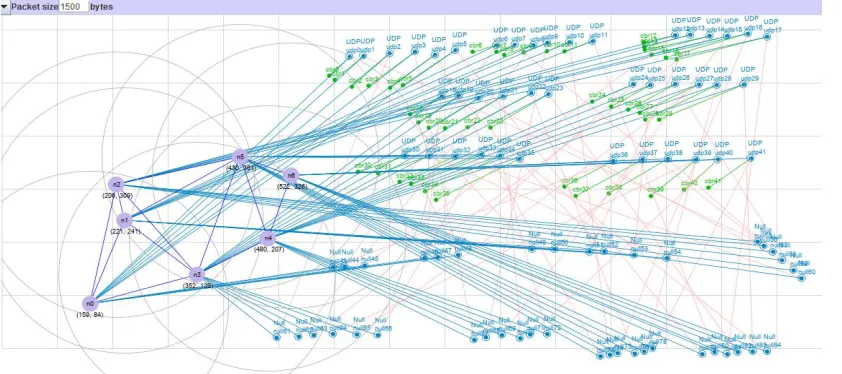
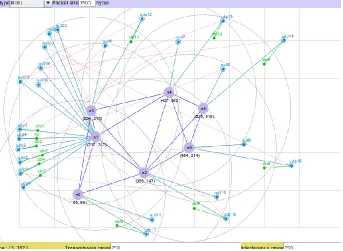
To simulate MANET network, we need in the beginning created the MANET network using the NSG2 software. This network consists of seven nodes, the location of each node is determined on the x, y and z axis, we identified the locations the nodes are moving to, start time movement and speed for each node. The nodes can communicate together using a protocol that regulates transmitter and receiver, we used UDP for sending and NULL for reception. Figure 1 shows the topology of MANET network and figure 2 shows the topology of MANET network with admen.
Figure 2 MANET network with admen topology using NSG2 for NS-2.
2.2 Creating TCL script and operate NAM for wireless nodes using NSG2.
After topologies was designated for MANET network the TCL code was generated, this code will be saved with a name ending (.tcl ). If we assume that we give the name (sps7n .tcl) to MANET without admen and give the name (adm7n .tcl) to MANET with admen, then we modified TCL code named (e.g.,stu1), colour for each node can be changed [11].
A part of TCL code of MANET with admen is shown below. The code shows the properties and specification of each node in the network.
#=================================== # Simulation parameters setup
#=================================== Antenna/OmniAntenna set Gt_ 1;#Transmit antenna gain setval(chan) Channel/WirelessChannel ;# channel type
setval(prop) Propagation/TwoRayGround ;# radio-propagation model setval(netif)Phy/WirelessPhy ;# network interface type
setval(mac) Mac/802_11 ;# MAC type
setval(ifq) Queue/DropTail/PriQueue ;# interface queue type setval(ll) LL ;# link layer type
setval(ant) Antenna/OmniAntenna ;# antenna model setval(ifqlen)2000 ;# max packet
2.3 Operate NAM for wireless nodes using NSG2.
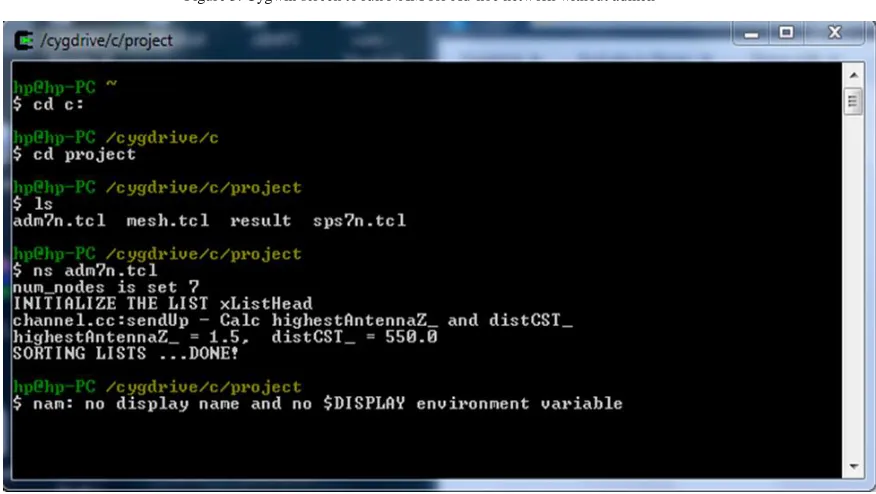
Figure 3. Cygwin screen to run NAM for Ad-hoc network without admen
Figure 4. Cygwin screen to run NAM for Ad-hoc network with admen.
Add (set nam file [open sps7n.nam w]) and (set nam file [open adm7n.nam w]) commands to TCL codes. Operate and select a nam file that you want to execute then can see simulation Ad-hoc network.
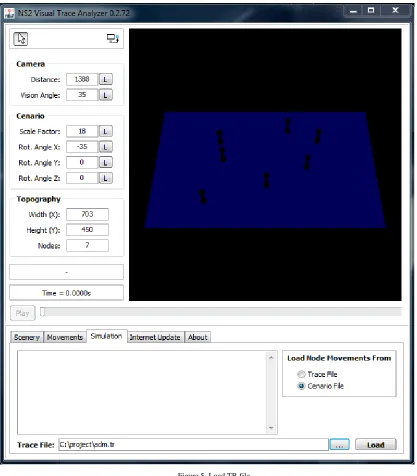
2.4 NS2 Visual Trace Analyzer
Figure 5. Load TR file.
Figure 6. Analysis options.
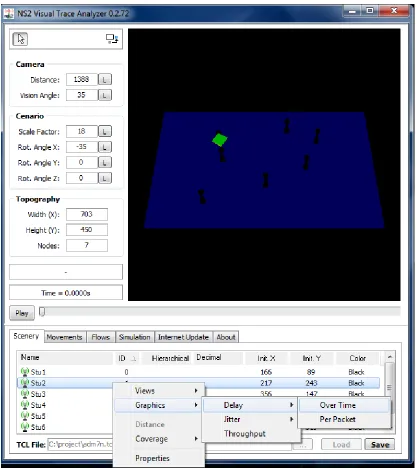
Finally, to define the path in network and the results, by right clicking on cbr, we choose path shifts to know more about routing and packet’s path or choose properties to show the numeric information about delay, jitter and throughput.
III.
RESULTS AND DISCUSSION
3.1 Routing information
We can define how the nodes are connected to each other by knowing the source and destination nodes, the size of packet and which nodes will cross in their routes.
3.1.1 Routing information without admen
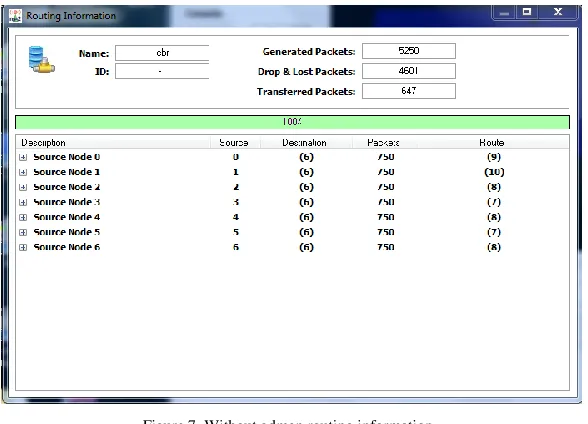
In the case without admen (step by step case), we can see in figure 7 how every node has 6 different destinations, same packet size and different routes.
Figure 7. Without admen routing information.
3.1.2 Routing information with admen
In the case with admen, we noted as shown in the figure 8 that all node has same destination except first node (admen) that have 6 different destinations, and information about packets size and routs.
Figure 8. Admen routing information.
3.2 Delay and Jitter
datagram packet-switched network for two key reasons. First, packets are routed independently. Second, network devices receive packets in a queue, so constant delay pacing cannot be guaranteed.
It can be a considerable issue for real-time multimedia communication traffic, voice and video streams.
3.2.1 Delay and jitter for without admen case
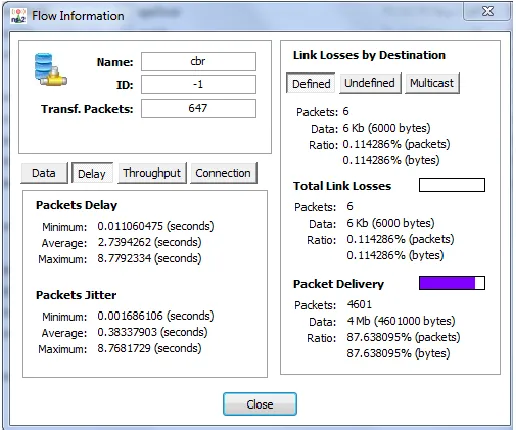
In this case, from figure 9 we note that the minimum delay is equal to 0.011 sec, the average delay is 2.74 sec and the maximum delay is 8.779 sec. when the jitter minimum value is 0.002 sec, the average value is 0.383 sec and the maximum jitter is equal to 8.768 sec. Figure 10 presents the curves of delay and jitter for without admen case.
Figure 9. Without admen delay and jitter values.
Figure 10. Curves of delay and jitter for without admen case.
3.2.2 Delay and jitter for admen case
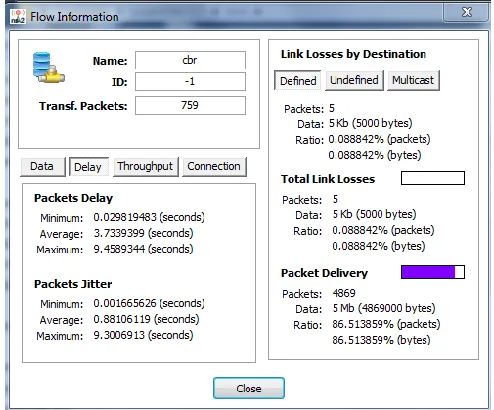
Figure 11. Admen delay and jitter values.
Figure 12. Curves of delay and jitter for admen case
3.3 Throughput values
Throughput refers to how much data can be transferred from one location to another in a given amount of time. It is used to measure the performance of communication systems, as well as Internet and network connections.
3.3.1 Throughput for without admen case
Figure 13. Without admen throughput values.
Figure 14. Curves of throughput for without admen case.
3.3.2 Throughput for with admen case
Figure 15. Admen throughput values.
Figure 16. Curves of throughput for admen case.
IV.
CONCLUSIONS
Through the simulation and analysis of MANET network for both cases (without and with admen) by using NS-2 software, we can conclude the following:
In without admen case, we noted that all nodes have the same packet size to send data but takes different routes, this is the same in second case, but the admen node takes larger packet size.
In without admen case the average delay value is less than in second case because all packets must go through the admin.
In without admen case the jitter value is decreasing with time where second case approach to zero after 2 sec at the simulation start time.
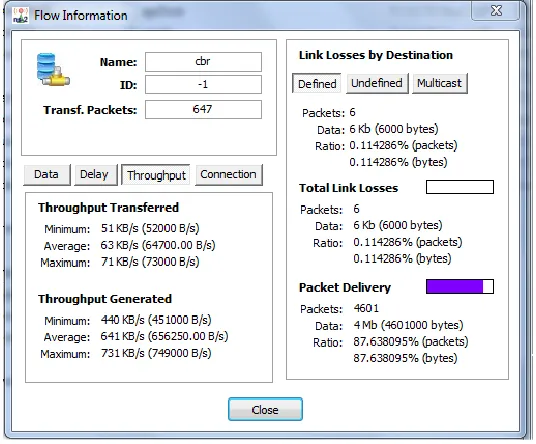
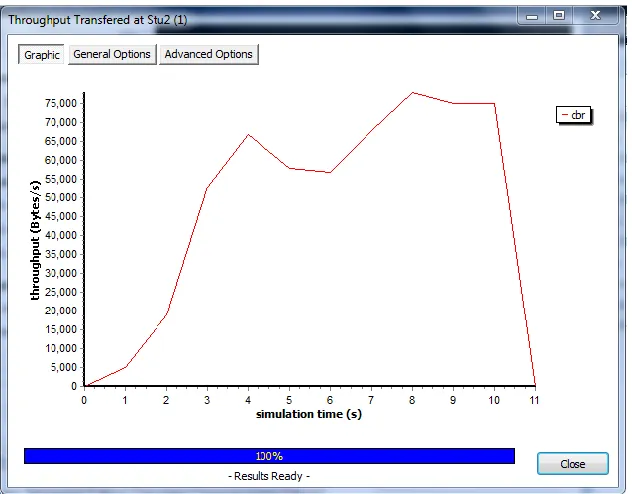
In without admen case the average throughput is less than the second case.
The average delay and average throughput of MNET with admen is larger than average delay and average throughput of without admen but average jitter is smaller.
As we see from above listed conclusions that the proposed case is better, this enables us to use the case when it is required.
REFERENCES
[1] R. Ramanathan and J. Redi, “A Brief Overview of Ad Hoc Networks: Challenges and Directions,” IEEE Communications Magazine, 50 th Anniversary Commemorative Issue, pp. 20-22, May 2002 [2] The Internet Engineering Task Force (IETF). www.ietf.org, 2002.
[3] HiuLi, Xiaoguang Zhang,Ying Liu , “Energy Efficient Routing Based on Ant Colony Algorithm In Mine Equinment Monitoring”,
[4] Lee, S., Su, W., and Gerla, M., "Wireless Ad Hoc Multicast Routing with Mobility Prediction," Mobile Networks and Applications, 6(4): pp. 351-360, 2001.
[5] Imrich Chalmtac, Marco Conti, Jennifer J.-N. Liu “Mobile ad hoc networking: imperatives and challenges.”
[6] Nieminen, K., “Introduction to Ad Hoc Networking”, Networking Laboratory Helsinki University of Technology, pp. 1-10, 2003.
[7] Gruenwald, L., Javed, M., and GU, M. Energy Efficient Data Broadcasting in Mobile Ad-Hoc Networks. In Proc. International Database Engineering and Applications Symposium (IDEAS '02), July 2002.
[8] Pravin Ghosekar, Girish Katkar, Dr. Pradip Ghorpade ”Mobile Ad Hoc Networking: Imperatives and Challenges”
[9] "Introduction to Network Simulator NS2", Second Edition, Teerawat Issariyakul, Ekram Hossain, Department of Electrical and Computer Engineering University of Manitoba 75A Chancellor’s Circle 15 Winnipeg, MB R3T 5V6,Canada.
[10] Zeng, X., Bagrodia, R. and Gerla, M., "Glomosim: A library for parallel simulation of large-scale wireless networks". In Proceedings of the 12th Workshop on Parallel and Distributed Simulation, pp. 154-161.
[11] https://ar.scribd.com/doc/45927779/The-Basic-Concept-NSG2 [12] https://www.wikihow.com/Use-Cygwin