Available Online atwww.ijcsmc.com
International Journal of Computer Science and Mobile Computing
A Monthly Journal of Computer Science and Information Technology
ISSN 2320–088X
IJCSMC, Vol. 4, Issue. 4, April 2015, pg.697 – 703
RESEARCH ARTICLE
Exploring Hottest Trends at Twitter
Saikiran Chepuri
1, Vaibhav Wadhai
2, Suhaib M Ansari
3¹M.Tech & VIT University, India ²M.Tech & VIT University, India ³M.Tech & VIT University, India
1
[email protected]; 2 [email protected]; 3 [email protected]
Abstract
:
Twitter is one of the rising social media platforms which enable users to post and send the short-messages considered as tweets. Detecting hottest trends at twitter via re-tweeting disseminates the information throughout the world. Traditional term-frequency approach considering with fewer regions makes the information to pass through some extent only. The focus of this paper is about extending region by taking into account of the re-tweet count on proposed Linkbased method assuming the increase in the geo-graphical region leads to gain more importance of trends. In this paper, a proposal on Increased Region Space leads in detection of exploring more trends leads to a huge change compared to previous Keybased method. Trends are changing over the time we fetch the twitter trends and then aggregating on individual candidate dataset for the detection on the time intervals between each post at twitter; which shows that the hottest trending topics only based on the reply/mention relationships in social-network posts. The paper determines the technique of gathering several real data sets from Twitter; the experiments show that the proposed Linkbased approach can detect new trending topics at least as earliest as Textbased approach.Keywords: social network, twitter trends, re-tweet count, region expansion, reply mentions
I. INTRODUCTION
With the rapid advancement of Internet technology the communication over online social network community permit clients to spread data in quicker and faster way. Social Network Analysis (SNA) is a discipline of examining to provide on a set of tools and theoretical approaches for holistic discovery of the communication and relations of social systems. Deeper understanding of SNA leads to detect the communities, friendship relations and the mutual relationships between the users connected at one network say, social platform [4].
hours, day and week [1]. The development of Twitter exhibits a few difficulties for uses of NLP and machine adapting. Communication over social networks like Face book, Twitter, YouTube, Flicker, and Oracle gets more and more consideration consistently. Each and every day, the attention of social network data is turning into a more specific subject in the field of data mining [4]. The analysis of Twitter’s network is that in order to discover and identify trending topics is that one must understand and have to estimate its huge quantity at online.
II. MOTIVATION
The main aim of this paper is to spread the information as far as possible. An assumption made to the traditional method is to limit a boundary value (which to be considered as less region initially) then on proposed Linkbased method we try to increase the scalability of the system as it demonstrates to more region when compared to earlier one, the Keybased approach. As the following figure shows the re-tweeting enables the fast spreading of information, this is possible through the user reply/mention of messages in the form of comments, re-tweets, likes , adding favorites, tagging the users with hottest trending topic etc.
Fig 1: Dissemination of information through re-tweets
Eg: If A updates his status as “Fabulous India at #WC2015 “, his friend B comments the A post as “great by #Virat at #WC2015 “ so the same post to be followed to B friend’s who is not in touch with A. However the some people be using #WC2015 and can re-tweet to previous post and it continues to grow at network which finally becomes the most trending topic at twitter.
III. LITERATURE SURVEY
Although there is a significant work pertaining to natural language processing (NLP) techniques. While the twitter have been used to examine the dynamics of social networks, mainly on the temporal behavior of social networks at some stage like in disasters, such as earthquakes and hurricanes etc...
In this paper, an analysis of prior work done on detection of streaming trend topics is done through the tf-idf term weighting, and term frequency analysis to get the trending topics are identified as spikes in the form of both unigrams and bigrams as discussed in[1]. The discussion is gone on implementing NLP through a step refinement of processing stop-lists and stemming algorithm to generate tweets.
Another work related to rumor spreading at online social network which was taken the data set from Sina micro-blogging [2]. This study shows how the topic is spreader out due to increase in the size of community.
Another study shows on how important people responsible for the growth of community by spreading the information through re-tweeting i.e., through the reply/mention of user tweets in the networks, this work done by Kretschmer as reviewed in [3].
A work related to ontology representation for expanding the network by applying clustering algorithm regarding the trends and clusters of network which is discussed in [4].
IV. PROPOSED WORK
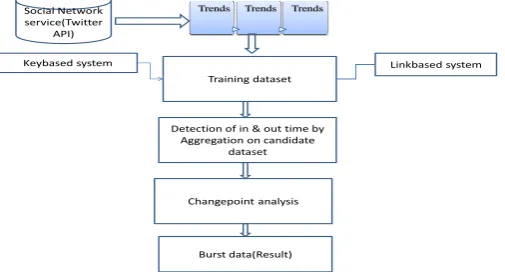
Trends Trends Trends
Training dataset
Detection of in & out time by Aggregation on candidate
dataset
Changepoint analysis
Burst data(Result)
Keybased system Linkbased system
Social Network service(Twitter
API)
Fig 2. Proposed architecture
V. ALGORITHM
Proposed method on analysis of re-tweet count Steps involved:
Input : Social Network dataset
Output: Variation between keybased and linkbased method in terms of total count
Steps:
1. Social Network dataset preparation 2. Training on twitter trends
3. Aggregate on user dataset for time interval detection 4. Change point Analysis:
Total count: from A. Keybased method
B. Linkbased method in retweets/reply. 5. Result estimation through Bar chart.
A. Social Network Dataset preparation
This module prepares up extracting the twitter trends containing #hash taglines which are created from 4-5 days from Internet connecting to twitter API through OAuth protocol mechanism. It is not possible to extract the tweets older than 6 days but in few cases retrieving tweets is considered for its higher participation at twitter.We characterize a post in a social network stream by the number of mentions k it contains, and the set V of names (IDs) of the mentionees (users who are mentioned in the post). There are two types of infinity we have to take into account here. The first is about the number k of users mentioned in a post. Although, in practice a user cannot mention hundreds of other users in a post, we would like to avoid putting an artificial limit on the number of users mentioned in a post. Instead, we will assume a geometric distribution and integrate out the parameter to avoid even an implicit limitation through the parameter. The second type is extending the behaviour of post thus by increasing scalability of the system.
B. Training and Aggregation on Candidate dataset
In this subsection, we eliminate stop-words, punctuations and website address (usually starts with “http(s)”) and numbers, symbols except “#” and letting the trends be identified with the start of a symbol of “#”. So, only user id, user name and screen name (their tagged line at twitter e.g.: @SaikiranChepuri).Now, it shows how many numbers of persons are tweeting on a particular topic, and thus we come to know how much the conversation between/among the persons is being going in particular interval of time which can be done with the help of next section of performing aggregation on selected candidate dataset.
tagline, his friends is also able to re-tweet that and further can forward to the network. So, a re-tweet count is created dynamically for Linkbased approach.
C. Breakpoint analysis and Burst data
In this section, it shows a breakpoint for two methods i.e., Keybased and Linkbased. For Keybased an artificial limit has been restricted to have certain count value is considered while for Linkbased method, we extend the scalability of the network as we are considering a re-tweet count which the total counts of initial Keybased approach will be a high value.
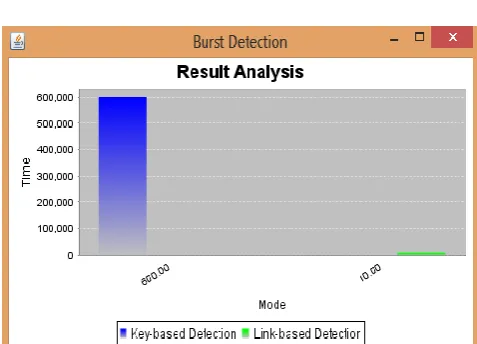
The result between the two methods is demonstrated in the form of Bar chart with the view of comparison to the total count in the two methods. Time and count considered as an X-Y dimension of bar chart gets to know how the topic has been spreading even at remote areas of world by expanding the geometrical region/space.
EVALUATION AND EXPERIMENTAL RESULTS
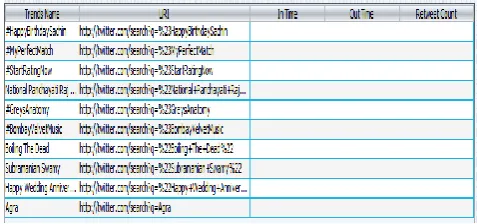
Following figure shows the trending topics at twitter, from which the #HappyBirthdaySachin in India
is getting more spikes which conducted the experiment on April 24
th2015
Fig 3. Fetched trends from Twitter at Internet
We used OAuth protocol which used to get twitter trends and designed a GUI with the help of Java swings the following panel showing the twitter trends along with corresponding URI, In & Out time and Re-tweet count columns.
Here the screen name representing the group at twitter.
On performing keybased method (below at radio button selection) by Aggregating the @rohit_nakhwa user it detects the time interval and total count of 100 which is shown in fig 1 and fig 2
Linkbased
The below figs shows the proof of demonstration which is collected from connecting to Internet.
After performing Aggregation process which shows the change in total count within the interval of time period as shown in below fig.
Difference in total count:
A bar chart progressed about the variation of Time to Total count of two methods. The first one specifying about the less number of count value spending lot of time while the second one (green colored) demonstrates the more number in count value within less time period.
Since, all this is made under the assumption of disseminating the information at each corner of the world through re-tweet count. However, if we go through the Outlier detection methodology at Data mining area will get accurate results.
At glance of internet if we increase the space region across from remote area to metros of city(say from Australia region to US/Green Land region) we let to know how much the topic is been getting importance around the world.
VII. CONCLUSION AND FUTUREWORK
In this paper, discussions made on the importance of twitter trends which are trending over the time. A brief introduction on social network analysis is made initially at the Literature Survey which demonstrated on how communities are formed and about the user relationships between nodes at social network graph. Then the topic went on Keybased and Linkbased approaches performed on individual candidate datasets which results in a variation on total count of two methods. Specifically the re-tweet resulted to gain more count which specifying that increasing the geometrical region can explore the importance of trend. In the future, the work can be done by classifying the network region to identify how the topic is praised/ rumor on a particular trend.
ACKNOWLEDGEMENT
We are very much thankful to our guide Prof.Prabhavathy.P who is currently working as Assistant Professor at VIT University, SITE department for timely and exclusive access to gain information on various Data mining and Data processing issues.
REFERENCES
[1] James Benhardus, “Streaming Trend Detection in Twitter,” UCCS REU for Artificial Intelligence, Natural language processing and Information Retrieval,2010.
[2] LIU Ling-han, QI Jia-yin, YU Chao-yang , “ How Does Praise and Rumor Spread Online? Analyzing User Relationships on Social Networks: A Case Study of Haidilao,” International Conference on Management Science & Engineering,vol. 13,2013.
[3] Zudha Aulia Rachman, Warih Maharani, Adiwijaya ,“ The Analysis and Implementation of Degree Centrality in Weighted Graph in Social Network Analysis” International Conference of Information and Communication Technology, Vol. 13,,2013.
[4] Fakhri Hasanzadeh, Mehrdad Jalali, Majid Vafaei Jahan “ Detecting Communities in Social Networks
by Techniques of Clustering and Analysis of Communications” Institute of Electrical and Electronics Engineers , Vol. 14, 2014.
[5] Shokoufeh salem minab, Mehrdad jalali, “Online Analyzing of Texts in Social Network of Twitter” International Congress on Technology, Communication and Knowledge and IEEE, Vol.14,ppno. 26-27,2014 .
[6] Rocío Abascal-Mena, Rose Lema, Florence Sèdes, “From Tweet to Graph: Social Network Analysis for Semantic Information Extraction” Institute of Electrical and Electronics Engineers, Vol.14,2014.
[7] Xufeng Shang, Yubo Yuan, “Social Network Analysis in Multiple Social Networks Data for Criminal