Reconciling User Privacy and Implicit Authentication for Mobile Devices
∗
Siamak F. Shahandashti
Newcastle University, UK [email protected]
Reihaneh Safavi-Naini
University of Calgary, Canada [email protected]
Nashad Ahmed Safa
University of Calgary, Canada
July 15, 2015
Abstract
In an implicit authentication system, a user profile is used as an additional factor to strengthen the authentication of mobile users. The profile consists of features that are con-structed using the history of user actions on her mobile de-vice over time. The profile is stored on the server and is used to authenticate an access request originated from the device at a later time. An access request will include a vector of recent measurements of the features on the device, that will be subsequently matched against the features stored at the server, to accept or reject the request. The features how-ever include private information such as user location or web sites that have been visited. We propose a privacy-preserving implicit authentication system that achieves im-plicit authentication without revealing information about the usage profiles of the users to the server. We propose an architecture, give a formal security model and a construc-tion with provable security in two settings where: (i) the device follows the protocol, and (ii) the device is captured and behaves maliciously.
Keywords: Implicit Authentication, User Privacy, Ho-momorphic Encryption, Provable Security, Behavioural Features
∗This manuscript has been accepted for publication in
Comput-ers & Security. The manuscript will undergo copyediting, type-setting, and review of the resulting proof before it is published in its final form. Please note that during the production process er-rors may be discovered which could affect the content, and all dis-claimers that apply to the journal apply to this manuscript. A defini-tive version is published in Computers & Security (2015) under DoI:
10.1016/j.cose.2015.05.009[51].
This is an extended version of a paper that appeared in the proceedings of the 29th International Information Security and Privacy Conference IFIP SEC 2014 [49].
cbnd This work is licensed under the Creative Commons Attribution-NonCommercial-NoDerivatives 4.0 International License. It can be shared as long as the original work is credited, but cannot be changed in any way or used commercially. To view a copy of this license, visithttp://creativecommons.org/licenses/by-nc-nd/4.0
1
Introduction
In applications such as mobile commerce, users often pro-vide authentication information using Mobile Internet De-vices (MIDs) such as cell phones, tablets, and notebooks. In most cases, password is the primary method of authen-tication. The weaknesses of password-based authentication systems, including widespread use of weak passwords, have been widely studied (see e.g. [56] and references within). In addition to these weaknesses, limitations of user inter-face on MIDs results in an error-prone process for inputting passwords, encouraging even poorer choices of password by users.
Two-factor authentication systems can potentially pro-vide higher security. Second factors that use special hard-ware such as RSA SecurID tokens1or biometrics, incur ad-ditional cost which limit their wide usage. An attractive method of strengthening password systems is to use im-plicit authentication[30] as an additional factor for authen-tication. The idea is to use the history of a user’s actions on the device, to construct a profile for the user consisting of a set of features, and employ it to verify a future authen-tication request. In the authenauthen-tication phase, the device reports recent user behaviour, and authentication succeeds if the reported recent user behaviour “matches” her stored profile. Experiments in [30] showed that the features col-lected from the device history can be effectively used to distinguish users. Although the approach is general, it is primarily used to enhance security of mobile users carrying MIDs because of the richness of sensor and other data that can be collected on these devices. In such a scenario, a net-work service provider (the carrier) wishes to authenticate a user in possession of the MID.
An important distinction one needs to make is that the goal in implicit authentication is authenticating the user in possession of the device rather than the device itself. Con-sequently, the user profile needs to be stored at the carrier side to ensure that a compromised device cannot be used to impersonate the legitimate user.
The collected data about the user’s actions can be divided into the following categories: (i) device data, such as GPS
location data, WiFi/Bluetooth connections, and other sen-sor data, (ii) carrier data, such as information on cell towers seen by the device, or Internet access points, and (iii) third party data, such as cloud data, app usage data, and calendar entries. As discussed, the user profile including data from a mixture of these categories is stored at the carrier side. This profile however includes private and potentially sensi-tive user data, including device and third party data, that must be protected. One might be lead to think that there is an inherent trade-off between user privacy on one hand and the effectiveness of implicit authentication on the other. In this paper we show that this is a false trade-off; i.e., user privacy and effective implicit authentication can coexist. In particular, we propose an efficient privacy-preserving im-plicit authentication systems with verifiable security.
We consider a network-based implicit authentication sys-tem where user authentication is performed collaboratively by the device (the MID) and the carrier (network service provider), and will be used by application servers to au-thenticate users. The implicit authentication protocol ge-nerates a score for each feature representing the confidence level of the authentication based on that individual feature. Individual scores are subsequently combined based on the carrier authentication policy to accept or reject the user. Individual scores are obtained through a secure two party computation between the device and the carrier. Secure two party protocols can be constructed using generic con-structions based on secure circuit evaluation, e.g. [60, 26], or fully homomorphic encryption [24]. We however opt to design a special-purpose protocol fit for the type of com-putations needed in implicit authentication. This allows us to achieve a level of efficiency which is practical and higher than those provided by generic constructions.
1.1
Our Contributions
We propose an implicit authentication system in which user data is encrypted and stored at the carrier, and an inter-active protocol between the MID and the carrier is used to compute the authentication score. Data privacy is guaran-teed since user data is stored in encrypted form. Because no data is stored on the MID, user data stays protected even if the device is lost or stolen. The main contributions of this paper are proposing a profile matching function that uses the statistics of features to accept or reject a new sam-ple presented by a user, and designing a privacy-preserving protocol for computing a score function for newly presented data.
We assume the user profile is a vector of multiple features (V1, . . . , Vn), each corresponding to a random variable with an associated probability distribution. Samples from the distribution of Vi is stored as the set of values of the vari-ables in the last `i successful logins. A new login attempt generates a vector of values, one for each feature. The veri-fication function must decide if this vector indeed has been
generated by the claimed user. Our proposed verification algorithm takes considers feature separately and computes a score for each feature indicating the confidence level in the presented value being from the claimed user. The final verdict is reached by combining the scores from all features. To determine if a new value presented for a feature vi matches the model (stored distribution of the feature), we will use a statistical decision making approach that uses the
Average Absolute Deviation (AAD)of the distribution. We use AAD to define an interval around the reported value
vi given by [vi−AAD(Vi), vi+ AAD(Vi)] and then deter-mine the score representing the concentration of past user behaviour observations close to the reported value vi by counting the number of the stored values in the user pro-file that fall within the interval: the higher the number is the higher the score for that feature will be. Eventually the scores from all features are considered and the outcome of the authentication according to a certain policy is decided. AAD and standard deviation are commonly used statistical measures of dispersion, estimating the “spread” of a dis-tribution. Our verification algorithm effectively measures similarity of the presented value with the “most common” readings of the variable. Using AAD allows more efficient private computation.
Constructing User Profiles: A user profile is a feature vector (V1, . . . , Vn), where featureVi is modelled by a vec-tor of`i past samples. The vector can be seen as a sliding window that considers the latest `i successful authentica-tion data. Using different`i is allowed for better estimation of the feature distribution. Possible features are the fre-quency of phone calls made or received by the user, user’s typical locations at a particular time, commonly used WiFi access-points, websites that the user frequently visits, and the like. We survey the literature and find several features that are appropriate for our protocols. These are listed in Section 3.2. Some features might be dependent on other ones. For example, given that the user is in his office and it is lunch time, then there is a higher chance that he re-ceives a call from home. We do not consider dependence of features and in selecting them make special care to select those that appear independent.
sacrifice some privacy in the sense that although the actual data samples are not leaked, the protocols do expose lim-ited structural information related to the relative order of data samples. We give formal definitions of our notions of privacy which guarantee that no information other than the relative order of samples is revealed by a secure protocol in the two threat models. We then prove the security of both protocols in the corresponding adversarial models.
The paper is organised as follows. We discuss the re-lated work in the field of behavioural authentication in Sec-tion 1.2. SecSec-tion 2 contains the preliminaries needed for our protocols. System architecture, adversarial models, and the core implicit authentication protocol not guaranteeing pri-vacy are presented in Section 3. We give details of our pro-posed protocols for semi-honest and malicious devices and provide analyses on their computation and communication complexity in Section 4. Formal security definitions and proofs are provided in the appendices.
1.2
Related Work
The privacy problem in implicit authentication was noted in [30]. The three approaches proposed for enhancing pri-vacy are: (i) removing unique identifier information; (ii) using pseudonyms; and (iii) using aggregate data instead of fine grained data. All these methods however have lim-ited effectiveness in protecting users’ privacy while main-taining usefulness of the system. It is well known that user data with identification information removed can be combined with other public data to re-identify individu-als [55], and fixed pseudonyms does not prevent linkability of records [35]. Finally coarse aggregates result in inaccu-rate authentication decisions.
User authentication is a widely studied problem with a wide range of mechanisms, ranging from cryptographic protocols to biometrics and systems that use special to-kens [43, 8, 17, 2]. In a user study of authentication on mobile devices in [22], Furnell et al. showed that users prefer systems that authenticate the user periodically on a contin-uous basis throughout the day in order to maintain confi-dence in the identity of the user.
Implicit authentication systems that authenticate users continuously without disturbing the user, like the system considered in this paper, are the best fit for this require-ment. These schemes have the potential to augment existing cryptographic and password-based authentication systems. Implicit authentication systems have been proposed based on many different features. These include systems that au-thenticate the user based on biometrics [36, 40, 42, 50], ac-celerometers [11], gait recognition [33, 23, 20], call and SMS pattern [52], location pattern [10, 53, 9, 12, 54], keystroke dynamics [14, 28, 61, 38, 19, 59], proximity to other de-vices [32, 48], and touchscreen dynamics [58, 16, 21]. In-dustry products such as Sentry from AdmitOne Security2
2www.admitonesecurity.com
and BehavioMobile from BehavioSec3 implement implicit authentication. A major weakness of all these systems how-ever is that the carrier learns the user’s behaviour. Protect-ing the user’s privacy in such a situation is the motivation for this paper.
Protecting user privacy in implicit authentication systems has been the motivating problem to a few works in the liter-ature. The TrustCube framework proposed in [13] supports implicit authentication. The implicit authentication system based on keystroke dynamics in [41] also provides a level of privacy for the user. However, both of these systems re-quire trusted remote platforms to carry out part or all of the computation. A trusted platform is typically imple-mented as a secure chip able to carry out limited security-sensitive operations. Examples of such platforms include the Trusted Platform Module (TPM), or its proposed mo-bile device equivalent a Momo-bile Trusted Module (MTM)4. Such trusted platforms are yet to be deployed extensively and we view this requirement as a limiting factor of these works. Finally, authors in [45] propose an implicit authen-tication system with user privacy that requires remote at-testation, i.e., the calculations of the device being certified by a trusted third party. The involvement of such a trusted third party, we believe, significantly complicates and limits the usability of such a system. The aim of this paper is to achieve user privacy without requiring a trusted platform or involving a trusted third party.
2
Preliminaries
Our constructions use homomorphic encryption and order preserving (symmetric) encryption. In the following we first give an overview of these primitives.
Homomorphic Encryption (HE): We use here an ad-ditive homomorphic public key encryption scheme [44, 15] which supports addition and scalar multiplication in the ci-phertext domain. Let EHE
pk (·) denote such an encryption algorithm. Given encryptions of aand b, an encryption of
a+bcan be computed asEHE
pk (a+b) =EpkHE(a)EpkHE(b), where represents an efficient operation in the ciphertext space. The existence of the operationenables scalar mul-tiplication to be possible in the ciphertext domain as well; that is, given an encryption of a, an encryption of ca can be calculated efficiently for a knownc. To simplify the no-tation, we use + for both the operations + and. As an instantiation, we use Paillier cryptosystem [44, 15] in which the operationcan be carried out by multiplication of ci-phertexts and scalar multiplication by exponentiation. Pail-lier cryptosystem is semantically secure under the decisional composite residuosity assumption [44, 15].
3www.behaviosec.com
4Specifications of TPM and MTM are available from the Trusted
Order Preserving Encryption (OPE): A functionf :
D 7→Ris order preserving if for alli, j ∈D: f(i)> f(j) if and only ifi > j. An encryption scheme with plaintext and ciphertext spacesDandR, respectively, is order preserving if its encryption algorithm is an order preserving function from D to R for all keys; i.e., an OPE maps plaintext val-ues to ciphertext space in such a way that the order of the plaintext values remains intact. Order preserving (symmet-ric) encryption (OPE) was introduced in [5]. The provided construction was proven secure in the POPF-CCA (pseudo-random order preserving function against chosen-ciphertext attack) model. More details on the security model and en-cryption system are given in Appendix A.
Secure Two-party Computation: In a secure two-party computation, two partiesAandBwith private inputs
xand y, respectively, compute a function f(x, y), ensuring that correctness and privacy are guaranteed. Correctness means that the output is indeedf(x, y) and not something else. Privacy means that neither A norB learns anything about the other party’s input, other than what they would learn from the outputs (if any) that they receive by partici-pating in the protocol. To formalise security of a two-party protocol, the execution of the protocol is compared to an “ideal execution” in which parties send their inputs to a trusted third party who computes the function using the inputs that it receives. Informally, a protocol is considered secure if a real adversary in a real execution can learn “the same” amount of information as, or can “change the proto-col output” not more than what an ideal adversary can do in the ideal model.
Security of two-party protocols is considered against dif-ferent types of adversaries. In the semi-honest model (a.k.a. honest-but-curious model), the adversary follows the protocol specification but tries to learn extra informa-tion from the protocol communicainforma-tions. Amalicious (a.k.a. dishonest) adversary however follows an arbitrary strategy (bounded by polynomial time algorithms) and can deviate from the protocol specification.
There are a number of generic constructions for secure two party computation, e.g. [60, 26], however they have proven to be too inefficient in practice, specially in resource-restricted devices. An alternative approach to realise spe-cific secure two-party protocols is based on homomorphic encryption (HE). In this approach, one party sends its en-crypted inputs to the other party, who then computes the specific desired function in the encrypted domain using the homomorphic properties of the encryption system. Pail-lier’s additively homomorphic cryptosystem [44] and Gen-try’s fully homomorphic scheme [25] are the commonly used tools in this approach.
Average Absolute Deviation: In our protocol we use a model of feature comparison that uses average absolute deviation. The median of a data set is the numeric value
separating the higher half of distribution from the lower half. Theaverage absolute deviation (AAD)of a data set is the average of the absolute deviations and characterises a summary of statistical dispersion of the data set. For a set
X ={x1, x2, . . . , xN} with a median denoted by Med(X), AAD is defined as AAD(X) = N1 PN
i=1|xi −Med(X)|. Let N be an odd number and T and B denote respec-tively the set of top half and bottom half indexes, i.e.,
T = {i | xi > Med(X)} and B = {i | xi < Med(X)}. Note that T and B are both of the same size. The above equation for calculating AAD can be simplified for an odd
N as follows:
AAD(X) = 1
N
X
i∈T
xi−
X
i∈B
xi
. (1)
Notation: Throughout the paper we use EHE
pk andDHEsk to denote the encryption and decryption algorithms of a ho-momorphic encryption scheme such as Paillier cryptosystem with public and secret key pair (pk, sk). For the OPE al-gorithm we useEOPE
k andDkOPE to refer to the encryption and decryption with keyk. Key generation algorithms are denoted by KeyGenHE and KeyGenOPE, respectively for
HE and OPE schemes.
3
System Model
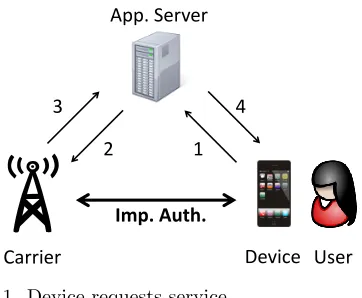
We consider a system including three players: a device, a carrier, and an application server. A user who has the device wishes to obtain some service from the application server. The application server wishes to ensure that a legitimate user is in possession of the device, but at the same time does not want to require user’s frequent active involvement to authenticate herself. Since the carrier is continuously providing service to the device, it has sufficient behavioural information on the user to be able to decide if the user in possession of the device is the legitimate user or not. Hence a natural course of action for the application server would be to consult with the carrier on the legitimacy of the user. A typical protocol for the above scenario consists of the following sequence of messages. First the device requests the service from the application server, which subsequently sends a request to the carrier to pass its judgement on whether the user in possession of the device is the legitimate user or not. The carrier that has been continuously authen-ticating the user is then able to respond to the application server’s request and the application server either provides or refuses service to the device accordingly. Figure 1 shows this scenario. Our focus in this paper is the continuous im-plicit authentication protocol between the carrier and the device. Note that this protocol runs continuously and is transparent to the user.
1 2
4
Imp. Auth. 3
App. Server
Device User Carrier
1. Device requests service 2. AS requests authentication
3. Carrier sends authentication decision 4. AS provides service
Figure 1: The system model and scenario. We propose a privacy-preserving implicit authentication protocol (de-noted by Imp. Auth. above.), which is continuously carried out by the device and the carrier to determine whether the user in possession of the device is legitimate.
computations involved in the protocol. However note that the aim of implicit authentication is to authenticate the user in possession of the device.
Trust Assumptions and the Adversarial Model: We assume the communication channels in the protocol are secure and the information is communicated safely across these channels. User data is stored in encrypted form at the carrier. The device records user data, encrypts it and sends it to the carrier. No data used to develop the user pro-file in implicit authentication is stored on the device. This ensures that if the device is compromised, the adversary cannot learn the user profile and simulate her behaviour.
We aim to protect the data collected by the device, and thus in our protocol we only consider such device data. The information collected by the carrier is known to the car-rier and is not included. Selection of an appropriate set of features that allow sufficient distinguishability of users is outside the scope of this paper. The goal here is to pro-vide privacy for user features that are used as part of the user profile. Nevertheless, we give concrete examples of such distinguishing features from the literature in Section 3.2.
We assume that the carrier correctly follows the proto-col but tries to learn user data through the information it receives by participating in the implicit authentication pro-tocol. This, we believe, is a reasonable assumption given the stature and reputation of carriers on one hand, and the difficulty of tracing the source of data leakage on the other. We assume the device is used by the legitimate user for a period of time before being compromised. This is the period during which the user profile is constructed.
We consider two types of adversaries. Firstly, we consider a less sophisticated adversary that tries to use a stolen de-vice without tampering with the hardware or the software and so the device is assumed to follow the protocol. This also corresponds to the case that the authentication pro-gram resides in a tamper proof [27, 39] part of the device and cannot be modified by the adversary and so a captured device follows the protocol but takes input data from the adversary. We assume the program can be read by the de-vice holder, but cannot be changed. In the second case, the device behaves in a malicious way and may deviate from the protocol arbitrarily to succeed in the authentication proto-col. This corresponds to the case where the device software or hardware is tampered with by the adversary in possession of the device.
In both cases the system must guarantee privacy of the user: that is, neither the carrier nor the adversary in posses-sion of the compromised device should learn the user profile data. Naturally, a stolen device used by an illegitimate user must also fail in authentication.
3.1
Authentication without Privacy
A user profile consists of a record of the distributions of one or more behavioural features of the user. A feature is a random variable that can be sampled by the device and in combination with other features provides a reliable means of distinguishing users. We denote featurei by the random variable Vi that is sampled at each authentication request. If the authentication is successful, the sample is stored by the carrier and used as part of the distribution samples for evaluation of future authentication requests. The variable distribution for the i-th feature is approxi-mated asVi= (vi(t1), vi(t2), . . . , vi(t`i)). Here,vi(tj) is the
feature value at time tj and `i is the length of the feature vector stored in the profile. This feature vector length is a system parameter which is assumed to be an odd integer to simplify the calculation of the mean. As discussed before, we only consider independent features.
Let us denote the user profile byU. The profile consists of a tuple ofnfeatures; that isU = (V1, V2, . . . , Vn).
The implicit authentication protocol is carried out be-tween a carrier and a device. The protocol is carried out continuously and periodically. We consider one round of authentication in the following. At the beginning of each round, the carrier is in possession of a user profile U that consists of featuresVi. The device wishes to authenticate it-self to the carrier as a device whose user behaviour matches the recorded user profile U. The protocol works as fol-lows. The device samples the current features {vi(t)}ni=1 and reports them to the carrier. The carrier considers each reported feature sample vi(t) and by comparing it to the sample distributionVi= (vi(t1), vi(t2), . . . , vi(t`i)) from the
start
finish Current behaviour
Authentication success output:
input:
Authentication failure Scoring algorithmrun
output:
Profile updaterun policy satisfiedis
? yes
no Profile
Update User profiles User
Profile
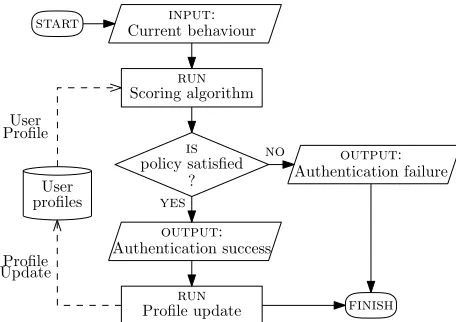
Figure 2: The authentication protocol flow in each round. Data flow is denoted by dashed arrows.
authentication score for the feature i, and denote it by si. Having calculated all the individual feature scores {si}ni=1, the carrier then decides based on a policy if the authen-tication succeeds or not. At the end of the round, if the authentication succeeds, the carrier updates the user pro-file to include the reported sample in the recorded samples. Figure 2 shows the flow of the authentication protocol in each round.
The authentication policy may vary between different car-riers and it is crucial for an implicit authentication protocol to be able to support various carrier authentication policies. An example of a policy is one that requires each score to be above a certain threshold. Another carrier might require that at least a certain number of feature scores are above their corresponding threshold values. A simple and popular authentication policy is to require that a weighted linear combination of feature scores is above a certain threshold. In this case, the feature scores are combined linearly to cal-culate a combined score as S = w1s1(t) +· · ·+wnsn(t), where wi represents the weight assigned to thei-th feature and S is the combined authentication score.
Each individual feature score is calculated by the car-rier as the likelihood that a reported feature value belongs to the corresponding sample distribution recorded as part of the user profile. In this paper, we propose a simple and effective method for calculating these scores as follows. The carrier first calculates a measure of dispersion for the recorded sample distribution, namely the average absolute deviation (AAD). Then, the carrier considers an interval centred around the reported sample, with a length dou-ble the size of the AAD. The carrier counts the number of recorded samples from the user profile that fall within the above interval and considers the proportion of recorded samples that fall within the interval to be the score for the feature. Intuitively, the closer the reported sample is to the centre of concentration for the recorded samples, the more recorded samples will fall in the above interval, and hence
the higher the feature score will be.
More formally, let AAD(Vi) represent the average abso-lute deviation of data in the set Vi. Also let the reported value for thei-th feature at timetbe denoted byvi(t). For a featureViwe define our scoring function at timetas follows:
si(t) = Pr[bli(t)≤Vi≤bhi(t) ], where (2)
bli(t) =vi(t)−AAD(Vi) and bhi(t) =vi(t) + AAD(Vi). The probability Pr[bl
i(t)≤Vi≤bhi(t) ] is approximated by counting the number of elements of Vi that fall within the interval [bl
i(t), bhi(t)] and dividing the count by the number of all elements, i.e. `i, thus calculating the proportion of elements that fall within the interval.
The above method can in theory work with any reason-able measure of dispersion instead of AAD. However, as will be shown in Section 4, the choice of AAD(Vi) allows the carrier to perform the required computation on encrypted data.
3.2
Feature Selection
There are many works in the literature on distinguishing users through their different usage patterns. Most of these works use multiple features extracted from different sources of measurement and then export all the extracted features to a server in which a machine learning algorithm is first trained and then employed to tell users apart. Since such solutions do not address the issue of privacy, they can afford to use sophisticated algorithms based on arbitrarily chosen features which might not each be sufficiently discriminating on their own between different usage patterns. Our authen-tication protocols, on the other hand, require features that are reasonably discriminating on their own. A more careful look at the literature reveals that many such features are indeed available. In the following we list some candidates to be used as features in our protocols. Note that all the fol-lowing candidates can be categorised under “device data”, as described in Section 1.
Perhaps the most natural choice is the device location as sensed by GPS sensors. Jakobsson et al. analysed the lo-cation traces for participants in their study and found that they tend to be concentrated in three clusters corresponding to where the user lives, works, and shops [30]. Furthermore, user’s location is highly correlated with the time of day and day of week. Hence, device latitude and longitude at spe-cific times of day and days of week make good choices as features in our system. Effectively, implicit authentication using device location will then succeed with a good proba-bility if the device is being used in a “usual” location, and fail with a good probability otherwise.
total power consumption by the device varies significantly between different users and hence may be considered a dis-tinguishing factor. They also find out that WiFi session durations for different users are concentrated around consid-erably different average values which span about an order of magnitude of varying lengths. Perhaps more interestingly, their results also demonstrate that users exhibit different and distinct habits in terms of when they start charging their smartphone. The median battery level at the start of charging varies from around 20% for some users to around 80% for others. Users with usually lower battery levels at the start of charging are the ones who are comfortable to wait until their battery is quite drained before worrying about recharging, whereas those with usually higher bat-tery levels at the start of charging actively ensure that they have a good amount of charge on their battery most of the time.
Another interesting study is that of Falaki et al. [18]. They show among other results that users spend quite different and distinctive amounts of time interacting with their smartphones during the period roughly corresponding to “normal working hours” of 9-to-5 (i.e., 9:00 to 17:00), whereas the patterns of their interaction times may not be as significantly distinguishable during other hours of day or the weekend. This 9-to-5 interaction time is distributed around an average which can vary between around 10 min-utes per hour to around 20 minmin-utes per hour.
As a concrete system example, consider one that has the following features: device location latitude and longitude, power consumption while idle (henceforth PCI), WiFi ses-sion length (henceforth WSL), and battery level at the start of charging (henceforth BLS). Let all the features be re-ported on an hourly basis, with latitude and longitude being the GPS reading at the time, BCI being the power consump-tion while idle in the past hour as a percentage of the total power consumption in the past hour, WSL being the total WiFi session length in minutes in the past hour, and BLS being reported in percentage and only present if charging has started in the past hour. A possible implicit authenti-cation policy may be as follows: scores from latitude and longitude are first considered; if they are both above certain thresholds, then at least one of the other scores, i.e., scores from PCI, WSL, and possibly BLS, needs to be above a cer-tain threshold for implicit authentication to succeed; other-wise, all of the other scores need to be above certain thresh-olds for implicit authentication to succeed. Effectively, in such a system if the device is located where it is usually used, implicit authentication succeeds if the usage pattern (expressed as PCI, WSL, and BLS) loosely follows the pre-vious usage pattern of the device, and if the device is located somewhere else, the usage pattern must strictly conform to the previous usage pattern for implicit authentication to succeed.
For all of the features mentioned above, the reported us-age pattern seems to be highly dependent on the time of
day and day of week. Hence, it would make sense to com-pare a reported feature by the device only to those in the recorded usage history profile that belong to the same time of day and day of week. That is, usage pattern reported on a Wednesday at 17:00 would only be compared to usage pattern history on previous Wednesdays at around the same time.
Note that although we have focussed on measurements of continuous variables (such as latitude and longitude, amount of power, and duration of time) in our examples above, we expect that our proposed protocols would work just as well for any discrete variable or in fact for any or-dered nominal data type. As an example of a discrete vari-able, the 9-to-5 interaction time discussed above may be replaced by the number of sessions of interactions during 9-to-5, which as Falaki et al. show is also distinct between different users [18]. As an example of an ordered nominal variable, the activity classes that the Jigsaw sensing en-gine [37] provides may be considered as a feature in our system. Using the accelerometer sensor, Jigsaw is able to robustly classify user’s activity as being stationary, walking, running, cycling, and in a moving vehicle. Assuming users have certain distinctive routines of for example cycling to work around a certain hour of day, the activity output by Jigsaw in different hours of day can potentially constitute features that can reasonably distinguish between different user behaviours. In some cases, other scoring functions such as those suggested by Jakobsson et al. [30], e.g. estimating Pr[Vi =vi] or Pr[Vi ≥vi] instead of what we propose (see Equation 2), would be more appropriate. Our protocols are generic in the sense that they can be easily modified to support such variants.
4
Privacy-Preserving
Authentica-tion
At the heart of the authentication protocol proposed in the previous section is the score computing algorithm. It ba-sically takes two inputs: the stored distribution and the fresh device sample, and it produces a feature score. All the computation takes place at the carrier side, given the two inputs above, where the former is stored by the carrier, and the latter is provided by the device. Both inputs are in plaintext. In this section, we focus on this algorithm and provide a two-party score computing protocol that is able to calculate the feature score fromencrypted profiles stored at the carrier andencrypted fresh samples provided by the device, where the decryption keys are only known to the device.
for the carrier; second, we consider it an overkill to require that the carrier only finds out a potential combined score and nothing about the individual scores, and indeed solu-tions satisfying such a requirement are likely to be inefficient in practice.
In the following we propose a protocol between a device and a carrier that enables the carrier to calculate a feature score for the device, while provably guaranteeing that no information about the stored profile at the carrier is revealed to the device other than the AAD of the stored feature values, and no information about the fresh feature value provided by the device is revealed to the carrier other than how it is ordered with respect to the stored profile feature values.
4.1
A
Protocol
Secure
against
Semi-Honest Adversaries
Let HE = (KeyGenHE, EHE, DHE) be a homomorphic
encryption scheme, such as the Paillier cryptosystem, and OPE = (KeyGenOPE, EOPE, DOPE) be an
order-preserving encryption scheme. The protocol Π we propose consists of four phases: system setup, (user) profile initial-isation, authentication, and profile update. System setup and profile initialisation are carried out once per device, but afterwards the authentication and profile update phases are carried out once per authentication round. Authentication rounds are carried out periodically and continuously. The protocol works as follows:
Phase 1. System Setup: Performed once for each de-vice, KeyGenHE and KeyGenOPE are run by the device
to generate the HE key pair (pk, sk) and the OPE keyk2. Public parameters of the two encryption systems HE and OPE, includingpk, are communicated to the carrier.
Phase 2. Profile Initialisation: This phase is per-formed only once for each device to record the initial `i feature readings and compute an initial AAD for each fea-ture. During this phase the device is assumed to be hon-est. Recall that implicit authentication requires a period of honest device usage to set up a usage profile based on which it is subsequently able to authenticate the user. Dur-ing this phase, the device periodically sends HE and OPE encrypted feature readings ei(t) = EHEpk (vi(t)) and e0i(t) =
EOPE
k2 (vi(t)) to the carrier. The communications end after
`i feature readings. At the end of this phase, the carrier has 2`i ciphertexts for thei-th feature: {ei(tj), e0i(tj)}`j=1i . Since the OPE ciphertextse0i(tj) enable the carrier to com-pare the corresponding plaintexts, the carrier is able to find the HE encryption of the median of the feature read-ings EHE
pk (Med(Vi)), where Med(Vi) denotes the median of
{ vi(tj) }`j=1i . The carrier finds the indexes of the top and bottom half of plaintexts with respect to the median. Let
us denote the set of top half indexes by Ti and the set of bottom half indexes byBi. In other words:
Ti={j|vi(tj)>Med(Vi)}, Bi ={j|vi(tj)<Med(Vi)}.
Now the carrier uses the homomorphic property of HE to compute the encryption of AAD based on Equation 1 as follows:
EpkHE(AAD(Vi)) =`−i1·
X
j∈Ti
ei(tj)−
X
j∈Bi
ei(tj)
.
The setup and profile initialisation phases are now complete and from now on, the system will enter the mode in which the device is not trusted any more. In this mode, a contin-uous and periodic succession of authentication and profile update phases will be carried out.
Phase 3. Authentication: The device and the carrier enter the authentication phase with the carrier holding a profile of the device user including `i HE ciphertexts for thei-th feature: { ei(tj) = EpkHE(vi(tj))}`j=1i , the `i corre-sponding OPE ciphertexts for the i-th feature: { e0i(tj) =
EOPE
k2 (vi(tj)) } `i
j=1, and the HE encryption of the AAD of the featuresEHE
pk (AAD(Vi)). The device reports to the car-rier the encryptions of a new reading as follows:
ei(t) =EpkHE(vi(t)) and e0i(t) =EkOPE2 (vi(t)).
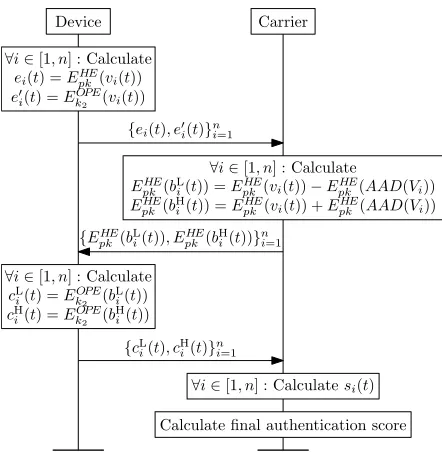
The HE ciphertext allows the carrier to perform necessary computations, namely addition and scalar multiplication, in the encrypted domain, while the OPE ciphertext helps the carrier find the order information necessary to the compu-tation. The carrier calculates EHE
pk (bli(t)) and EpkHE(bhi(t)) as follows:
EHE
pk (bli(t))←EpkHE(vi(t))−EpkHE(AAD(Vi)),
EHE
pk (bhi(t))←EpkHE(vi(t)) +EHEpk (AAD(Vi)). The carrier however does not know the order of the newly generated encrypted values with respect to the stored ci-phertexts in the user profile. To find the order, the car-rier interacts with the device as follows: the carcar-rier first sendsEHE
pk (bli(t)) and EpkHE(bhi(t)) back to the device for all features. The device decrypts the ciphertexts using the de-cryption functionDHE
sk and obtainsbli(t) andbhi(t), and then encrypts them to compute the following OPE ciphertexts:
cli(t) =E
OPE
k2 (b
l
i(t)) and chi(t) =E
OPE
k2 (b
h
i(t)). The device sends cl
i(t) and chi(t) back to the carrier. The carrier computes the individual score si(t) as the number of the OPE ciphertexts e0
i(tj) in the profile that satisfy
cl
i(t) ≤ e0i(tj) ≤ chi(t). Note that this condition is equiv-alent tobl
Device Carrier
ei(t) =EpkHE(vi(t))
∀i∈[1, n] : Calculate
{ei(t), e0i(t)}ni=1
∀i∈[1, n] : Calculate
EHE
pk (bLi(t)) =EpkHE(vi(t))−EpkHE(AAD(Vi)) EHE
pk(bHi(t)) =EHEpk(vi(t)) +EpkHE(AAD(Vi))
{EHE
pk(bLi(t)), EpkHE(bHi(t))}ni=1
cL
i(t) =EOPEk2 (b
L
i(t))
∀i∈[1, n] : Calculate
cH
i(t) =EOPEk2 (b
H
i(t))
{cL
i(t), cHi(t)}ni=1
∀i∈[1, n] : Calculatesi(t)
Calculate final authentication score
e0
i(t) =EOPEk2 (vi(t))
Figure 3: The authentication phase of our protocol Π
carrier based on its authentication policy, e.g. the weighted sum method described earlier in Section 3.1. If implicit au-thentication is not successful, the device is challenged on an explicit authentication method, e.g. the user is logged out of a service and prompted to log in anew by providing a password. If either implicit or explicit authentication is successful, the carrier enters the profile update phase. Fig-ure 3 shows the interaction diagram of the authentication phase of the protocol.
Phase 4. Profile Update: The carrier enters this phase after a successful implicit or explicit authentication. The carrier has the ciphertext for a new feature value ei(t) =
EHE
pk (vi(t)), and from the authentication phase it knows how vi(t) compares with the previously recorded features
{vi(tj)}`j=1i . The carrier updates the recorded features and the AAD as follows. Assume ei(t1) is the ciphertext cor-responding to the oldest feature and it is to be omitted from the feature list, and instead the new feature cipher-textei(t`i+1) =ei(t) added. LetT
old
i andBioldrespectively denote the set of top and bottom half indexes for the old features {vi(tj)}j=1`i , and Tinew and Binew denote sets de-fined similarly for the updated features {vi(tj)}`j=2i+1. Also let AADold(Vi) and AADnew(Vi) denote the old and updated AADs. We have
EHE
pk (AADold(Vi)) =`−i1·
X
j∈Told i
ei(tj)−
X
j∈Bold i
ei(tj)
,
EpkHE(AADnew(Vi)) =`−i1·
X
j∈Tnew i
ei(tj)−
X
j∈Bnew i
ei(tj)
.
Let us denote by ∆i the difference between the two AAD ciphertexts times`i, i.e.
∆i=`i·(EpkHE(AAD new
(Vi))−EpkHE(AAD old
(Vi)) ).
If ∆i is calculated, the updated AAD can be calculated as follows:
EHE
pk (AADnew(Vi)) =EpkHE(AADold(Vi)) +`−i1·∆i. Let\ denote the set difference operation. To calculate ∆i givenTold
i ,Boldi ,Tinew, andBinew, the carrier computes the following:
∆i =
X
j∈Tnew i \Tiold
ei(tj) −
X
j∈Told i \Tinew
ei(tj)
− X
j∈Bnew i \Tiold
ei(tj) +
X
j∈Bold i \Tinew
ei(tj).
Note that each of the above four set differences includes at most one element. This means the profile update phase can be carried out very efficiently. At the end of this phase, the carrier holds a set of updated feature ciphertexts and an updated AAD ciphertext. The carrier will enter the au-thentication phase afterwards and wait for a new feature reading to be reported from the device.
Complexity: We discuss the computation complexity of the profile initialisation, authentication, and profile update phases of our protocol Π in the following. We also imple-mented Paillier and OPE to confirm computation bench-marks in the literature, and calculate concrete running times for our protocol. In the following we analyse the computation complexity of the protocol for one feature. To calculate approximate execution times for multiple features, the figures may be multiplied by the number of features.
In the profile initialisation phase, the device calculates a total of`i HE encryptions and `i OPE encryptions, and the carrier calculates`i ciphertext-space homomorphic ad-ditions and 1 ciphertext-space homomorphic scalar multi-plication. Recall that this phase is only executed once.
The computation in the authentication phase is domi-nated by 1 homomorphic encryption, 2 homomorphic de-cryptions, and 3 order-preserving encryptions on the device side, and 2 ciphertext-space homomorphic additions (imple-mented in Paillier scheme by multiplications) on the carrier side, for each feature.
In the profile update phase, the carrier performs 4 space homomorphic additions and 1 ciphertext-space homomorphic scalar multiplication.
on the implementation of OPE. We confirm these bench-marks through implementations of our own. Hence, we can see that the authentication phase for one feature is almost real-time. For multiple features, this phase can take at the longest in the order of a second to complete, which is rea-sonable given that there is no requirement for implicit au-thentication to be real-time.
To confirm the efficiency of Paillier homomorphic encryp-tion and OPE implementaencryp-tions, we have benchmarked both schemes using Java-based implementations for both on an Intel 2.66 GHz core 2 duo processor (which is comparable to the processors of today’s smartphones) while running other processes (including web browser, word processor, terminal, music player etc.) in the background. Hyper threading was not activated and only one core was used by the implemen-tation.
For Paillier with 1024-bit keys (i.e. moduli) we have found that encryption takes 26 ms (milliseconds), decryption takes 35 ms, and both homomorphic addition and homomor-phic scalar multiplication take negligible time comparatively (both are more than 500 times faster). We did not apply any optimisation techniques. These benchmarks are comparable to the ones reported in the literature on PCs with compara-ble specifications. Basu, Kikuchi, and Vaidya report compa-rable results, namely encryption times of 17 and 125 ms, and decryption times of 17 and 124 ms, with 1024-bit and 2048-bit keys, respectively [3]. Jakobsen, Makkes, and Nielsen report encryption times of 8 and 17 ms for optimised Pail-lier with 1024-bit and 2048-bit keys, respectively [29]. We use our own 1024-bit Paillier benchmarks, i.e. HE encryp-tion: 26 ms, HE decrypencryp-tion: 35 ms, to demonstrate how efficient a simple implementation of our protocol can be in practice. Although, from the above examples it can be seen that optimised versions of the protocol can achieve higher efficiency even when 2048-bit keys are used. To provide some insight into how efficiency can be improved using op-timisation techniques, we also give concrete execution times for our protocol using the best benchmarks known to us (as discussed above), i.e. HE encryption: 8 ms, HE decryption: 17 ms.
We have also implemented the OPE scheme proposed in [5]. Our implementation was independent of the only two other implementations of such scheme in the literature known to us, which are parts of the encrypted database sys-tems CryptDB [46] and Monomi [57]. Using typical features for implicit authentication, a maximum plaintext length around 100 bits seems to be sufficient for our protocol Π. Execution times required for encryption and decryption in our implementation are at most 56 ms for plaintext lengths between 100 and 1000 bits5. CryptDB authors report initial encryption time of 25 ms for 32-bit plaintexts [46], and were
5OPE complexity depends on ciphertext length as well as plaintext
length. In our implementations, we have considered combinations of plaintext sizes of 100 and 1000 bits and ciphertext sizes of 10, 100, and 1000 kilobits.
able to optimise the encryption to bring the encryption time down to 4 ms [47]. We use the 56-ms benchmark to calcu-late concrete execution times for a simple implementation of our protocol. However, as the CryptDB implementation demonstrates, execution times can be as much as around 10 times lower. Hence, we also provide concrete execution times based on the optimised benchmarks above, i.e. OPE encryption / decryption: 4 ms. This optimised benchmark assumes that features may be expressed in 32 bits, which is a reasonable assumption for the majority of features pro-posed in the literature for implicit authentication. In fact all the candidate features listed in Section 3.2 can be ex-pressed in 32 bits. GPS coordinates are usually exex-pressed in the NMEA 0183 standard format [1] which for a one me-ter precision would consist of at most 9 digits: at most 3 for degrees, 2 for minutes, and at most 4 for decimal minutes. 9 digits may be expressed in 30 bits. An additional bit is needed to indicate either N/S or E/W. Hence latitude and longitude can each be expressed in 32 bits. Other discussed candidates such as power consumption in percentage, WiFi session duration in minutes, battery level in percentage, and interaction time in minutes can be immediately seen to be expressible in less than 32 bits.
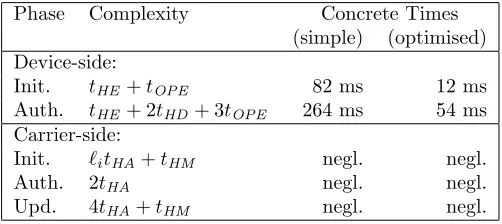
Using the above sets of benchmarks in two categories: simple and optimised benchmarks, we can estimate concrete times for our protocol on the device side. Table 1 sum-marises the computational complexity of the profile initiali-sation, authentication, and profile update phases of protocol Π for one feature. On the device side, initialisation phase complexity is reported for each period in which the device reports a pair of ciphertexts, whereas on the carrier-side, the computation of the initial AAD is assumed to take place at once at the end of the phase, hence the reported complexity is for the whole initialisation phase. On the carrier side, the computations are limited to ciphertext-space homomorphic additions and scalar multiplications which are in the order of hundreds of time faster than HE and OPE encryption. Besides, the carrier side naturally has much more compu-tational power than the device side. Hence, despite the multiplicative factor`i (typically in the order of 100) in the complexity of the profile initialisation phase on the carrier side, the concrete execution time for all phases on the car-rier side ends up being negligible compared to those on the device side.
Finally, note that the authentication phase for each fea-ture takes less than 300 ms on the device side and neg-ligible time on the carrier side, even with a non-optimised implementation. The concrete system example given in Sec-tion 3.2 involves at most five features and hence the total system authentication time will be at most five times the above figure. Considering the whole process is executed im-plicitly as a background process, the overhead of introducing privacy is not significant.
Phase Complexity Concrete Times (simple) (optimised) Device-side:
Init. tHE +tOPE 82 ms 12 ms
Auth. tHE + 2tHD+ 3tOPE 264 ms 54 ms
Carrier-side:
Init. `itHA+tHM negl. negl.
Auth. 2tHA negl. negl.
Upd. 4tHA+tHM negl. negl.
Table 1: Computation complexity of protocol Π based on one feature assuming `i = 100. Legend: Init: profile ini-tialisation phase, Auth: authentication phase, Upd: pro-file update phase, tHE, tHD: HE encryption and
decryp-tion times, tOPE: OPE encryption time, tHA, tHM: HE
ciphertext-space addition and scalar multiplication times, negl: negligible.
ciphertexts in each round of authentication, and the carrier needs to send 2 HE ciphertexts. Each HE ciphertext is 1 kb (kilobits) and each OPE ciphertext may be implemented as 10 kb for typical plaintext sizes in our scheme. This means that the device needs to send less than 4 kB (kilo Bytes) and receive around 0.25 kB in each round of communication.
Security: We discuss the security of our protocol con-sidering semi-honest devices and carriers in Appendix B. We provide a formal definition of privacy for our protocol against honest-but-curious devices and carriers. The def-inition intuitively guarantees that by participating in the protocol, the device only learns the AAD of the usage data stored at the carrier side, and the carrier only learns little beyond the order information of the current sample with re-spect to the stored data. We argue that the AAD and order information learned during the protocol reveal little about the actual content of the data in question, and hence our definition guarantees a high level of privacy. Eventually, in Appendix B.1, we prove the following theorem guaranteeing the privacy of our protocol:
Theorem 1 Our protocol Π is provably secure against semi-honest devices and semi-honest carriers.
4.2
Securing the Protocol against
Mali-cious Devices
In the above version of the protocol, secure against hon-est but curious adversaries, in the authentication phase the carrier interacts with the device as follows: the carrier sends homomorphic ciphertextsEHE
pk (bli(t)) andEHEpk (bhi(t)) to the device and the device is expected to reply back order-preserving ciphertexts of the same plaintexts, i.e.
EOPE
k2 (b
l
i(t)) and EkOPE2 (b
h
i(t)). These order-preserving ci-phertexts are subsequently used to compare the values of
bl
i(t) andbhi(t) in the order-preserving ciphertext space with
the feature values and find out how many feature values lie betweenbl
i(t) andbhi(t). However, a malicious device cannot be trusted to return correctly formatted order-preserving ci-phertexts.
First, we note that the device cannot be forced to use an honest feature value vi(t) to start with. In the absence of a trusted hardware such as tamper-proof hardware, the de-vice may enter the interaction with the carrier on any arbi-trary input. Even with the recent advances in smartphone technology, e.g. ARM’s TrustZone6, the device cannot be prevented to change the sensor readings unless the whole algorithm is run in the so called Trusted Execution Environ-ment (TEE). However, the device can be required to show that the ciphertext EHE
pk (vi(t)) is well-formed. To enforce this requirement, we require that the device sends a proof of knowledge of the corresponding plaintext vi(t) along with the ciphertextEHE
pk (vi(t)). Efficient proofs of knowledge of plaintext exist for most public key encryption schemes. For Paillier encryption, a concrete and efficient interactive proof protocol can be found in [4]. The protocol can be made non-interactive using the well-known Fiat-Shamir heuristic, by replacing the random challenge generated by the verifier with the hash of the protocol parameters concatenated with the message sent by the prover in the first round. We de-note the resulting proof of knowledge of the plaintextvi(t) byPoK{vi(t)}.
Apart from inclusion of the above proof of knowledge, further modification is required to make the protocol se-cure against malicious devices. The main idea here is as follows: instead of asking the device for order-preserving ciphertexts, the ability to interact with the device is used to directly compare bl
i(t) and bhi(t) with the feature val-ues, only using the homomorphic ciphertexts. Assume that the carrier wishes to comparebl
i(t) withvi(tj). The carrier has homomorphic encryptions of both, i.e.EHE
pk (bli(t)) with
EHE
pk (vi(tj)), and hence can calculate EHEpk (bli(t)−vi(tj)). The carrier is hence interested in knowing whether bl
i(t)−
vi(tj) is positive, negative, or zero. In the following, we show how the carrier is able to interact with the device and determine whether the above value is positive, negative, or zero, without the device being able to cheat or to have a no-ticeable chance of finding out some information about the value in question.
In the following, we propose a modified version of the pro-tocol secure against malicious devices. We call this modified version Π?. Let HE = (KeyGenHE, EHE, DHE) be a
ho-momorphic encryption scheme, such as Paillier cryptosys-tem. The protocol Π?consists of four phases: system setup, (user) profile initialisation, authentication, and profile up-date. The profile initialisation phase is exactly the same as that of the protocol Π described in Section 4.1, and thus is not repeated here. System setup is carried out once for each device, but afterwards the authentication and profile
update phases are carried out once per each authentication round. Authentication rounds are carried out periodically and continuously. The protocol works as follows:
Phase 1. System Setup: This phase is performed once for each device. KeyGenHE is run by the device to generate
the HE key pair (pk, sk). The public key pk is communi-cated to the carrier. The private key sk is kept by the device.
Phase 2. Profile Initialisation: This phase is per-formed only once for each device to record the initial`i fea-ture readings and compute an initial AAD for each feafea-ture. During this phase the device is assumed to be honest. This phase is similar to the user initialisation phase in protocol Π, but here there are no OPE ciphertexts involved. During this phase, the device periodically sends HE encrypted fea-ture readingsei(t) =EpkHE(vi(t)) to the carrier. The device also keeps a record of vi(t) values and along with each HE ciphertext, it sends the order information of the value with respect to the previous values to the carrier. The commu-nications end after `i feature readings. At the end of this phase, the carrier has `i ciphertexts for the i-th feature:
{ ei(tj)}`j=1i and the ordering information about the corre-sponding plaintexts. Since the carrier knows the ordering of plaintexts, it is able to find the encryption of the median of the feature readingsEHE
pk (Med(Vi)), where Med(Vi) denotes the median of { vi(tj) }`j=1i . The carrier finds the indexes of the top and bottom half of plaintexts with respect to the median. Let us denote the set of top half indexes byTi and the set of bottom half indexes byBi. The carrier uses the homomorphic property of HE to compute the encryption of AAD based on Equation 1 as follows:
EHE
pk (AAD(Vi)) =`−i 1·
X
j∈Ti
ei(tj)−
X
j∈Bi
ei(tj)
.
The device deletes the record of vi(t) values it has been keeping at the end of this phase. The setup and initialisation of the system are complete and from now on, the system will enter the mode in which the device is not trusted any more. In this mode, a continuous and periodic succession of authentication and profile update phases will be carried out.
Phase 3. Authentication: The device and the carrier enter the authentication phase with the carrier holding a profile of the device user including`iHE ciphertexts for the
i-th feature: { ei(tj) = EpkHE(vi(tj))}`j=1i and the HE en-cryption of the AAD of the features EHE
pk (AAD(Vi)). The device reports to the carrier the HE encryption of a new reading ei(t) =EpkHE(vi(t)). The device also sends a proof of knowledge of the plaintextPoK{vi(t)} to show that the ciphertext is well-formed. The carrier verifies the proof of
knowledge and if the verification fails, it deems authentica-tion failed. Otherwise, the carrier calculates the following using the homomorphic property:
EHE
pk (bli(t)) ← EpkHE(vi(t))−EpkHE(AAD(Vi))
EHE
pk (bhi(t)) ← EpkHE(vi(t)) +EpkHE(AAD(Vi)) Now the carrier needs to find out howbl
i(t) andbhi(t) com-pare to{vi(tj)}j=1`i to be able to count the number ofei(tj) values that fall between bl
i(t) and bhi(t) for the purpose of authentication. The carrier also needs to find out how the new reported reading vi(t) compares to the previous ones
{ vi(tj)}`j=1i , so that if the authentication succeeds, it has the ordering information necessary to update the profile ac-cordingly in the profile update phase. Let us define for alli
andj:
δijl = bli(t)−vi(tj),
δij = vi(t)−vi(tj), and
δh
ij = bhi(t)−vi(tj). To compare any of the above values, i.e., bl
i(t), vi(t) and
bh
i(t), withvi(tj), the carrier needs to find out if the corre-sponding differences, i.e.,δl
ij,δij, andδijh, as defined above, are each negative, zero, or positive. To achieve this, the carrier first calculates for all j ∈ [1, `i] the ciphertexts
EHE
pk (δlij), EpkHE(δij), and EpkHE(δhij) using the homomor-phic property of the encryption scheme from EHE
pk (vi(tj)),
EHE
pk (vi(t)),EpkHE(bil(t)), and EHEpk (bhi(t)). Then the carrier chooses`irandom bits, and for eachj∈[1, `i] based on the
j-th bit either leaves the calculated HE ciphertext triplets as is, or calculates the ciphertext triplets for−δl
ij,−δij, and
−δh
ij through ciphertext homomorphic scalar multiplication by −1. Let us denote these ciphertexts by EHE
pk (±δlij),
EHE
pk (±δij), andEpkHE(±δhij). This makes sure that the these differences are distributed independently of the value of the current reading in terms of being positive or negative. That is, on anyvi(t) a similar number of the differences will be positive or negative.
Assume the i-th feature values belong to the interval [mini,maxi] with a range di = maxi−mini. This means
δij ∈ [−di, di]. The carrier chooses σ`i random values
{{δijk0 } `i
j=1}σk=1from the interval [−di, di], whereσis a secu-rity parameter. The values{δ0ijk}σk=1serve as values among whichδijwill be hidden. Also note thatδijl =δij−AAD(Vi) and δh
ij = δij + AAD(Vi). Let us define analogously
δ0l
ijk = δijk0 −AAD(Vi) and δijk0h = δ0ijk+ AAD(Vi). The carrier now calculates the corresponding ciphertexts for the “fake” difference values as follows: for allj andk it calcu-latesEHE
pk (δijk0 ), and thenEpkHE(δijk0l ) andEpkHE(δ0ijkh ). The carrier then puts together the following set of values for all j ∈ [1, `i] and all k ∈ [1, σ]: EpkHE(δlij), EpkHE(δij),
EHE
device decrypts the ciphertexts and replies to the carrier in-dicating whether each ciphertext corresponds to a positive, zero, or negative plaintext. The device is able to compute AAD(Vi) and also distinguish the three sets of values: the differencesδij andδ0ijk, the differences minus AAD, and the differences plus AAD. However, among the differences δij and δ0
ijk the device cannot distinguish between “real” and “fake” values. The carrier on the other hand, knows what the response should be for all fake differences δ0
ijk. Also if
δij is positive, then the carrier knows thatδhijshould be also positive, and if δij is negative, then the carrier knows that
δl
ij should be also negative. Hence upon receiving the re-sponses the carrier checks if these rere-sponses are correct and if not the authentication is deemed failed. The idea here is that since all theσ+ 1 differences (real and fake altogether) look indistinguishable to the device, a malicious device has at most σ+11 chance of cheating and not getting caught. σis a security parameter of the protocol and controls a trade-off between complexity and security. The larger σ is, the less chance there is for a malicious device to cheat, but at the same time the higher the complexity of the protocol is.
If the responses pass all the checks, from the responses for the real differences, the carrier is able to find out how each ofbl
i(t),vi(t), andbhi(t) compare to{vi(tj)}`j=1i . The carrier computes the individual score si(t) as the number of vi(tj) that are between bil(t) and bhi(t). The final au-thentication decision is then made by the carrier based on its authentication policy, e.g. the weighted sum method de-scribed earlier in Section 3.1. If implicit authentication is not successful, the device is challenged on an explicit au-thentication method, e.g. the user is logged out of a service and prompted to log in anew by providing a password. If either implicit or explicit authentication is successful, the carrier enters the profile update phase. Figure 4 shows the interaction diagram of the authentication phase of the pro-tocol.
Phase 4. Profile Update: The carrier enters this phase after a successful implicit or explicit authentication. The carrier updates the recorded features and the AAD in this phase. The calculations in this phase are the same as those of the profile update phase in protocol Π. At the end of this phase, the carrier holds a set of updated feature ciphertexts and an updated AAD ciphertext. The carrier will enter the authentication phase afterwards and wait for a new feature reading to be reported from the device.
Complexity: We discuss the computation complexity of the profile initialisation, authentication, and profile update phases of our protocol Π? in the following. We also calcu-late concrete running times for the protocol. Like before, we analyse the computation complexity of the protocol for one feature. To calculate approximate execution times for mul-tiple features, the figures may be multiplied by the number of features.
Device Carrier
ei(t) =EHEpk(vi(t)),PoK{vi(t)}
∀i∈[1, n] : Calculate
{ei(t),PoK{vi(t)}}ni=1
∀i∈[1, n] : Calculate
EHE
pk(bLi(t)) =EHEpk(vi(t))−EpkHE(AAD(Vi)) EHE
pk (bHi(t)) =EpkHE(vi(t)) +EpkHE(AAD(Vi))
Calculate response∈ {−,0,+}
for each value received
all responses
∀i∈[1, n] : Calculatesi(t)
Calculate final authentication score
∀i∈[1, n]∀j∈[1, `i] : Calculate EHE
pk(±δijL), EHEpk(±δij), EHEpk(±δHij)
∀i∈[1, n]∀j∈[1, `i]∀k∈[1, σ] :
Choose randomδ0
ijk, Calculate EHE
pk(δijk0L), EHEpk(δijk0 ), EHEpk(δijk0H)
EHE
pk (±δLij),{EpkHE(δ0ijkL)}σk=1
EHE
pk (±δij),{EpkHE(δ0ijk)}σk=1
EHE
pk (±δHij),{EpkHE(δ0ijkH)}σk=1 ∀i∈[1, n]∀j∈[1, `i] :
Check responses for known values
Figure 4: The authentication phase of our protocol Π?
The profile initialisation and update phases are similar to those of protocol Π with the exception that OPE ciphertexts are no more involved.
The authentication phase on the other hand differs sub-stantially from that of protocol Π. In the authentication phase, the protocol requires 1 homomorphic encryption, 1 proof of knowledge generation, and (σ + 1)`i homomor-phic decryptions on the device side. Given that the proof of knowledge generation takes only a couple of multiplica-tions, the computation complexity here is dominated by (σ+ 1)`i homomorphic decryptions. On the carrier side, the following computations are required: 1 proof of knowl-edge verification (roughly as complex as 1 multiplication), 2 homomorphic ciphertext additions to calculateEHE
pk (bli(t)) and EHE
pk (bhi(t)) (roughly as expensive as a multiplication each), then 3`ihomomorphic ciphertext additions to calcu-late EHE
pk (δlij), EpkHE(δij), and EpkHE(δijh), then an expected 1
2`i homomorphic ciphertext scalar multiplications to cal-culate EHE
pk (±δlij), EpkHE(±δij), and EpkHE(±δijh), then σ`i homomorphic encryptions to calculate EHE
pk (δijk0 ), and fi-nally 2σ`i homomorphic ciphertext additions to calculate
EHE
homomor-phic encryption operations.
Choosing a small σ means that a malicious device is caught at the time of protocol execution with lower proba-bility, however, the device does not gain meaningful advan-tage by cheating and will not have a higher chance of suc-ceeding in authentication. Hence, even a small σ provides a reasonable level of protection against malicious devices. Consequently, we consider σ to be a small multiplicative factor and will be able to state that the complexity of the modified protocol is approximately proportional to `i. In other words, the complexity grows linearly with the size of the user profile.
Note that finding how each of the ciphertextsEHE
pk (bli(t)),
EHE
pk (vi(t)), andEpkHE(bhi(t)) compare with the recorded fea-tures can be carried out in log`irounds (instead of at once) through a binary search. That is, since the carrier knows the ordering of the recorded profile features, in each round the carrier can ask the device to help with comparing the above ciphertexts with one recorded feature value, and based on the answer to each round decide which recorded feature value to use for comparison in the next round. This is a trade-off between the round complexity and the communi-cation complexity. Carrying out the comparison in this way requires log`i rounds of communication (instead of one),
σlog`i homomorphic encryption operations on the server side, andσlog`ihomomorphic decryption operations on the client side. Thus this trade-off brings the communication complexity down to a logarithmic function of the size of the user profile. We consider this a reasonable price to be paid for protection against malicious devices.
To give concrete examples, consider σ= 9 (which means a cheating device is caught immediately with probability 101 each time it deviates from the protocol) and a typical profile size of `i= 100.
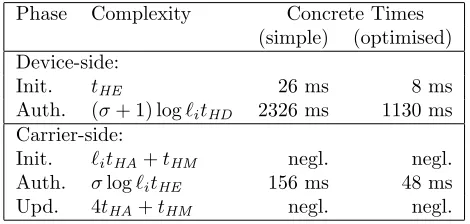
Table 2 summarises the computational complexity of the profile initialisation, authentication, and profile update phases of protocol Π?for one feature, using the same bench-marks as in the previous section. Similar to before, on the device side, initialisation phase complexity is reported for each period, whereas on the carrier-side, the reported com-plexity is for the whole initialisation phase. On the carrier side, the computations in the profile initialisation and up-date phases are limited to ciphertext-space homomorphic additions and scalar multiplications which end up being neg-ligible compared to the other computation times. The au-thentication phase however requires σlog`i homomorphic encryptions on the carrier side. To merely calculate a nom-inal concrete execution time for the carrier-side, we assume that the carrier has 10 times the processing power of the device. This assumption gives us the figures for concrete execution times for the authentication phase on the carrier side reported in Table 2. Of course, the concrete figures in this case are to be treated as merely an indication of the efficiency of the protocol.
Finally, considering the execution times on both sides,
Phase Complexity Concrete Times
(simple) (optimised) Device-side:
Init. tHE 26 ms 8 ms
Auth. (σ+ 1) log`itHD 2326 ms 1130 ms
Carrier-side:
Init. `itHA+tHM negl. negl.
Auth. σlog`itHE 156 ms 48 ms
Upd. 4tHA+tHM negl. negl.
Table 2: Computation complexity of protocol Π? based on one feature assumingσ= 9, `i= 100, and that the carrier side has 10 times the computation power of the device side. Legend: Init: profile initialisation phase, Auth: authen-tication phase, Upd: profile update phase, tHE, tHD: HE
encryption and decryption times,tHA, tHM: HE
ciphertext-space addition and scalar multiplication times, negl: negli-gible.
note that an authentication failure for one feature is dis-coveredin around 2.5 secondsafter the first feature reading is reported by the device, even with a non-optimised im-plementation. The concrete system example given in Sec-tion 3.2 involves at most five features and hence the total system authentication time will be at most five times the above figure. We stress again that implicit authentication is an ongoing background process and does not need to be real-time.
In terms of communication complexity, for each feature the device needs to send one HE ciphertext, one proof of knowledge, and 3(σ+ 1) log`ibits in each round of authen-tication, and the carrier needs to send 3(σ+ 1) log`i HE ciphertexts. Each HE ciphertext is 1 kb (kilobits) and each proof of knowledge is 2 kb for typical parameters in our scheme. This means that the device needs to send less than 0.5 kB (kilo Bytes) and receive around 25 kB in each round of communication.
Security: We discuss the security of our protocol consid-ering malicious devices in Appendix C. We provide a formal definition of privacy for our protocol against maliciously-controlled devices. The definition intuitively guarantees that even if the device is maliciously controlled, it will not be able to learn any information more than what it would learn during an honest execution of the protocol. Eventually, in Appendix C.1, we prove the following theorem guaranteeing the privacy of our protocol:
Theorem 2 Our protocol Π? is provably secure against
maliciously-controlled devices (with probability at least
σ
σ+1), and is provably secure against honest-but-curious