Location-Proof System based on
Secure Multi-Party Computations
Aur´elien Dupin1,3, Jean-Marc Robert2, and Christophe Bidan3
1
Thales Communications & Security, Gennevilliers, France 2 ´
Ecole de Technologie Sup´erieure, Montr´eal, Canada 3 Centrale-Sup´elec, Rennes, France
Abstract. Location-based services are now quite popular. The variety of applications and their numerous users show it clearly. However, these applications rely on the persons’ honesty to use their real location. If they are motivated to lie about their position, they can do so. Alocation-proof systemallows aproverto obtain proofs from nearbywitnesses, for being at a given location at a given time. Such a proof can be used to convince averifier later on. Yet, provers and witnesses may want to keep their location and their identity private. In this paper, a solution is presented in which amalicious adversary, acting as a prover, cannot cheat on his position and remain undetected. It relies on multi-party computations andgroup-signature schemes to protect the private information of both the prover and the witnesses against anysemi-honest participant.
1
Introduction
Location-based services are now ubiquitous, mostly through our vehicles and smartphones. These services generally rely on the persons’ honesty to transmit their real location. Thus, they are limited to situations in which the persons do not have any motivation to lie. However, for some services such as electronic voting, location-based access control, and law enforcement investigation, this is not the case. These services must be based on a location-proof system that allows a participant, called prover, to obtain proofs from nearby participants, calledwitnesses, asserting that he is at a given location at a given time. Such a proof can be presented later on to convince a service provider, calledverifier.
Any location-proof systems based on the interaction between a prover and his neighbors have some privacy issues. The prover may not want to broadcast his identity and his location every time he needs location-proofs. Similarly, witnesses may want to hide their identity and their location. Hence, private information must be kept secret from all the participants but not from an independent trusted third-party, calledjudge. Indeed, the judge must be allowed to retrieve the iden-tities of the participants, in order to detect collusions with the prover. An ideal location-proof system must then have the following properties [4].
2. Unforgeability: a prover cannot obtain/modify valid location proofs for a location he is not, or at a different time.
3. Non-transferability : location proofs are valid only for the prover who generated them. They cannot be exchanged.
4. Traceability: given a proof, the judge must be able to retrieve the identity of the witness who signed it.New property - not in [4].
5. Location and identity privacy : the location and the identity of the witnesses and the prover must be kept secret from other participants. 6. Unlinkability : given two distinct location proofs, a participant cannot
guess whether they have been generated by the same witness, nor whether they concern the same prover. This obviously does not stand for the judge. 7. Storage sovereignty: the prover is responsible for storing his own location
proofs. No one is able to access them without the prover’s agreement.
In this paper, we propose a privacy-aware location-proof system that fulfills these properties. It relies on two protocols: a location-proof gathering protocol (allowing a prover to obtain proofs from witnesses) and alocation-proof verifying
protocol (allowing a verifier to validate the correctness of a proof). The first one ensures that both the prover and the witnesses keep secret their identity and their location. Once the location proofs have been obtained from witnesses, a prover must keep them securely and may use them later on to convince verifiers. For efficiency reasons, no centralized server is used during the gathering protocol. Our scheme relies onmulti-party computations andgroup signature schemes
to protect the identity and the location of all participants. It assumes also that the participants have mobiles/vehicles with directional antenna to locate their neighbors. Such a solution can complement the classical distance-bounding pro-tocols [1].
The security of our solution is analyzed againstmalicious and semi-honest
adversaries. The former is a prover trying to obtain invalid location proofs, whereas the later is any participant (prover, witness or verifier) trying to obtain the private information on other participants.Static collusionsbetween a prover and some of the witnesses against other witnesses are also considered.
a solution to get rid of the central authority. Unfortunately, only identities are protected through a group-signature scheme.
2
Problem Statement
Let us suppose the participants have devices (phone or vehicle) equipped with directional antennas, allowing to locate a transmitting device in 90◦-quadrants
with respect to their position and orientation. Depending on his location and orientation, a witness would be able to locate a prover in only one of the four reference orthogonal half-planes (North,East,South,West), as shown in Fig. 1. Thus, our location problem can be stated as follows. Consider n witnesses having located a proverP in half-planes with respect to their position. Looking for a location proof, P wants to obtain an authenticated description of the in-tersection of these half-planes, as shown in Fig. 2, while the witnesses want to protect their identity and their private information. This can be reduced to find the maximum (or minimum) of the privatex−ory−coordinates of the witnesses.
(b) (a)
Wi
Wi
Fig. 1.Half-planes from 90-quadrants
W1
W2
W3
W5
W4
W7 P
Fig. 2.Intersecting half-planes
2.1 Location-Proof Generation Protocol Outline
Protocol 1 presents the outline of our approach. After sharing the ephemeral additive homomorphic public key and the direction of each witness (Step 1), the idea is to find the intersection of the witness-defined orthogonal half-planes approximating the prover’s position (Steps 2-3), and generate location proofs from it (Steps 4-5).
Our method relies on anadditive homomorphic encryption scheme, such as Paillier’s cryptosystem [9], and a unique group-signature scheme [3], that pos-sesses the following properties : correctness, unforgeability, anonymity, traceabil-ity, unlinkability and uniqueness. The last property assures that two signatures on the same message by a given group member share a lot of common bits, breaking the unlinkability property in this very particular case. The uniqueness property prevents that an accomplice of the proverP, orP himself, simulate the presence of multiple witnesses (Sybil attack).
In our scheme, groups can be dynamically managed and each participantU
Input:Each witnessWi knows his position (xi, yi) and his signature key
gskWi. The encryption function of the verifierEV(·) is public.
Output:Pobtains an authenticated location proof from his neighbor witnesses. Step 1:Initialization
Pbroadcasts a request: “I’d like location proofs at timeτ”. forallaccepting witnessWi do
Find the directiondiofP(N,S,W orE) and generate an ephemeral public keyNWi (used in the min/max computation protocol).
Send back (di, NWi) toP.
Pbroadcasts to all witnessesµ= (τ,(di, NWi)1≤i≤n) andGS(gskP, µ)
forallaccepting witnessWi do
Find the presence of his keyNWi – if not, abort.
Return the signatureGS(gskWi, µ).
Pbroadcasts{GS(gskWi, µ)|1≤i≤n}. forallaccepting witnessWi do
Find if all the signatures are valid and different. If not, abort. Step 2:forallaccepting witnessWido
Run a min/max computation protocol with other witnesses (Protocol3). Step 3:PgetsEV(ximin),EV(ximax),EV(yimin) andEV(yimax) (Protocol5).
Step 4:Ptransfers these encrypted results to all witnesses.
Step 5: AllWisign the proof, usinggskWi, and send it toP(Protocol2).
Protocol 1:Location proof generation
of the message mwith gskU and GV(gv, m, σ) the public verification function, that allows anyone to verify the signature σofmwith the public group keygv.
2.2 Adversary Models
The following definitions of adversary models are extracted from [6] :
Definition 1 (semi-honest adversary model).A semi-honest adversary fol-lows the protocol specification exactly, but it may try to learn more information than allowed by looking at the messages that it received and its internal state. This model is also known as the passive or honest-but-curious adversary model.
Definition 2 (malicious adversary model).A malicious adversary may use any efficient attack strategy and thus may arbitrarily deviate from the protocol specification. This model is also known as the active adversary model.
In this paper, we stress that there are two different motivations for the prover. First, the main motivation of a malicious prover is to obtain a valid proof that he is at a given location at a given time, when in fact he is somewhere else. In this case, the prover has to deviate from the protocol, while remaining undetected. Otherwise, legitimate witnesses would abort and alert the judge.
relies on the security of the group-signature scheme used, the potential risk is low. At best, the prover can expect to get the location of an unknown participant. The witnesses could be interested in discovering more information on their neighbors. However, since a witness has quite less possibilities than a prover, a malicious witness would be better to act as a prover with his neighbors.
Similarly, the verifier does not participate in the gathering location protocol and thus can only follow the semi-honest adversary model to try to get more information on the witnesses and the prover.
Finally, notice that a prover can always obtain a valid but faked location proof from accomplices. The verifier and the judge can always determine the number of witnesses, having participated in the protocol. If they determine that this number is too low, they may reject the valid proof anyway.
To sum up, our scheme is secure against the following adversaries :
– A malicious prover willing to obtain fake location proofs.
– A semi-honest prover, witness or verifier trying to violate other participants’ privacy.
In the rest of the paper,Section3 presents how to build encrypted location proofs against a malicious adversary, and how to verify them. InSection4, a new solution to the secure multi-party maximum computation problem is described. It relies on a modified version of a classical two-party comparison protocol pre-sented inSection5.
3
Location-proof Gathering and Verifying
Let us first assume that the proverP has obtained somehow the four encrypted optimum valuesEV(ximin),EV(ximax),EV(yimin) andEV(yimax) describing the
rectangle in which he lies from his neighbor witnesses (Section4 will show how to obtain them). Unfortunately, nothing proves that he has not chosen these values himself and encrypted them with the verifier public key. The goal of Steps 4-5
of Protocol1 is specifically to prevent that a prover can do so. In this section, we design a protocol allowing each group of witnesses to certify the value of their corresponding optimum value. In the remaining of this section, we will focus only onEV(ximax), defining the western side of the locating rectangle.
3.1 Location-Proof Gathering
We assume (w.l.o.g.) that the public keyNV of the verifier is 2048 bit-long and that the witnesses are at most at one kilometre from the prover. If the scale of the grid system is one meter, the differenceximax−xi≤2
10uses at mostl x= 10 bits. We define lk = |NV| −(lx+ 1). Our method for generating the location proofs is presented in Protocol 2. If a witness follows the protocol, the verifier would be able to retrieve the valueki(ximax−xi) +ri. This value is such that:
ki(ximax−xi) +ri> 2
lx iff x
i< ximax (1)
−2lx< k
i(ximax−xi) +ri< 2
lx iff x
i=ximax (2)
ki(ximax−xi) +ri<−2
lx iff x
Input: PknowsEV(ximax). Each witnessWihas his valuexiand his
signature keygskWi. Each witness knows the number of participantsn, GS(gskP, µ), and the keyNV of the verifier with functionEV(·).
Output:P obtains a location proof from each witness. Step 1:Pbroadcasts the randomized version ofEV(ximax).
Step 2:forallwitnessWido Choose randomlyki∈RJ2
lx+1; 2lk−1
Kandri∈R J−2
lx+ 1; 2lx−1
K. ComputeEV(ki(ximax−xi) +ri) = (EV(ximax)·EV(−xi))ki·EV(ri).
SendEV(ki(ximax−xi) +ri) toP.
Step 3:Pbroadcasts to all (EV(ki(ximax−xi) +ri))1≤i≤n.
Step 4:forallwitnessWido
Check the presence ofEV(ki(ximax−xi) +ri) – if not, abort.
Defineν= ((EV(ki(ximax−xi) +ri))1≤i≤n, EV(ximax), n,GS(gskP, µ)).
Signσi= GS(gskWi, ν) and send it toP.
Step 5:Pstoresν, GS(gskP, ν) and all witness signaturesσi.
Protocol 2:Location-proof gathering protocol
If all the participants follow the protocols, Case (2) must happen at least once and Case (3) never. This can be confirmed by the verifierV. Thus,V can detect if a malicious prover deviates inStep 1and uses an invalid value. On the other hand, if a malicious prover deviates inStep 3and drops (or alters) some values, at least one witness can abort the protocol and alert the judge, by sending it any value signed by the prover (such asGS(gskP, µ) of Protocol 1), which the
judge can trace thanks to the properties of the group-signature scheme. Finally, the prover cannot deviate inStep 5due to the unique group-signature scheme.
3.2 Security Properties of the Overall Process
We have now to argue that the overall process to obtain the location proofs respects all the security properties listed in the introduction.
Since the unique group signature scheme [3] is unforgeable, the prover P cannot forge new proofs, except with his own key. InStep 5of Protocol1, such an opportunity is impossible.P would have to generate two distinct signatures on the same message, contradicting the uniqueness property of the signature scheme. In fact, the judge would identify any transgressing participant in this step, due to the traceability property of the signature scheme. Thus, the unforge-ability and traceunforge-ability properties of our location-proof protocol are ensured.
InStep 1of Protocol1, the prover broadcasts a messageµand its signature GS(gskP, µ). This links the timestamp and thenephemeral keys of the witnesses.
Since this signature is included in the final proofs signed by the witnesses, the location proof is valid only for the participant able to produce the valid signature GS(gskP, µ), confirming the non-transferability property of the protocol.
Due to the unlinkability property of the group signature scheme, the location proof associated to GS(gskP, µ) would not be linkable with another location
Similarly, the signatures of the witnesses inProtocol2 would also not be linkable. Thus, the unlinkability property of our location-proof protocol is guaranteed.
The privacy of the identity follows from the property of group signature scheme. Similarly, the privacy of the positions (xi, yi) relies on the semantic property of the encryption scheme and the randomization process (see Sec-tion 5.2). Unfortunately, the last step of Protocol 2 leaks some information throughEV(ki(ximax−xi) +ri). The verifier can guess some bits ofxi. However,
we can show that the Shannon entropy H(X|Y = ki(ximax −xi) +ri) is still
close toH(X|X ≤ximax).
The prover obtains his location proofs duringStep 5. Then, he stores them until he needs to convince the verifier, ensuring the storage sovereignty property.
3.3 Location-Proof verifying
Finally, the correctness property has to be shown. The prover P wants to con-vince the verifierV thatEV(ximax) is indeed the maximum value. So, he sends:
– His positionx, the message µ and his signature GS(gskP, µ). The message
contains the timestampτ and the number of witnessesn(seeProtocol1).
– The randomized value of maximumEV(ximax) (seeProtocol5).
– Thenproofs EV(ki(ximax−xi) +ri) and the witness signatures σi ofν =
[(EV(ki(ximax−xi) +ri))1≤i≤n, EV(ximax),
n,GS(gskP, µ)] (seeProtocol2).
The verifier proceeds to several verifications. He first decrypts EV(ximax)
and checks ifximax < x. Then, he checks that thenproofs are generated by n
distinct participants, different fromP. This verification is based on the unique-ness property of the group signature scheme. All the signatures of the message
ν must be different. The verifier also asks the judge to check that GS(gskP, µ)
was generated using gskP, ensuring that P took place in the proof generation
protocol. The final step is to make sure that EV(ximax) is really the maximum
value of the witnesses. From the values ofEV(ki(xmax−xi)+ri) inν, the verifier can check that there is an indexjs.t.−2lx≤k
j(ximax−xj) +rj<2
lx, and that
there is no indexj s.t.kj(ximax−xj) +rj <−2
lx.
If all these verifications succeed, the verifier should be convinced that P was indeed at the east of ximax at the given time. If any of these steps fails,
it reveals a malicious action by either the prover or a witness. But unlike the prover, witnesses do not have any incentive to cheat. If some proofs are missing, the prover might have deleted them on purpose, or a witness may have aborted because of a deviation of the prover.
4
Secure Multi-party Maximum Protocol
Input:The witnessesS1={W1, W2,· · ·, Wn}. EachWihas a private valuexi. Output:P determinesimax= arg max{xi|1≤i≤n}.
fori= 1 todlog(n)edo forj= 2i−1 to2i−1do
Step 1:Pdoes the following steps :
S=∅
if |Sj|is odd then
SelectSingle∈RSj s.t.Singleis not marked.
Mark the witnessSingleand add it toS.
Pair the elements ofSj\ S −pair the marked witnesses. Step 2: Each pair of witnesses usesProtocol4, andPobtains the
index of the owner of the greater value.
Step 3:Pselectsk∈R{0,1}and computes the following sets: S2j+k=S ∪ {the set of the losing witnesses}
S2j+k=S ∪ {the set of the winning witnesses}
Step 4:Pdetermines the index Setimaxof this witness.
Protocol 3:Secure maximum computation based on binary tree
The basic idea of our protocol is to use iteratively a dedicated secure two-party comparison protocol, that (i) enables the proverPto know which one of the two witnesses owns the greater private value without having to know this value, and (ii) guarantees that if one of the witnesses has already lost a comparison against another witness, the prover would not get any further information. This protocol (Protocol4) is presented inSection5.
4.1 The Protocol Description
Protocol 3 presents our approach for maximum computations. The prover re-groups subsets of witnesses in a binary tree. In each node, the witnesses of the associated subset are paired and run the dedicated secure two-party comparison protocol (Protocol 4). At the end of each round, the prover gets the results of these comparisons and can eliminate half of the remaining witnesses. If a witness does not participate in any further comparison, he can deduce that he was far-ther away from the prover than his latest paired witness. Similarly, if one keeps participating in the protocol, he knows he has won every previous comparisons. Thus, the protocol should be adapted to ensure that witnesses keep participat-ing in the protocol even if they have been eliminated. However, the comparisons with eliminated witnesses must be randomized and meaningless for the prover.
First assume that the number of witnesses is a power of 2. In the initial round, the prover pairs the 2k witnesses all together. Each of these pairs runs the two-party comparison protocol. At the end of a round, the winners and the losers are regrouped independently. This process is then applied recursively on each subset. Hence, two witnesses would never be paired twice together. After
would be composed of only winners and all the other subsets would be composed of witnesses which have lost in a previous round.
Consider now the general case ofnwitnesses. The prover pairs the witnesses. If there is an odd number of witnesses in a subset, one of them (calledSinglein
Protocol3) would bedoubled, and considered as both a winner and a loser. Finally, notice that the witnesses do not communicate with each other di-rectly. Otherwise, it would be simple to find out which one is closer to the prover due to the directional antennas. Communications must go throughP.
4.2 The Protocol Security
The security of our maximum computation protocol relies on these objectives:
1. the prover cannot get any information from the two-party comparison pro-tocol if at least one of the witnesses has been already eliminated previously, 2. the prover cannot get any information on the value of any witness, and 3. the witnesses cannot get any information from the comparison protocol.
The prover does the pairing and acts as the intermediary for the two-party comparison protocol. He can then observe all the messages exchanged between the witnesses. Thus, the objectives (1) and (2) rely on the security of the two-party comparison protocol. This will be addressed inSection5.
Objective (3) relies on the indistinguishability of the subsetsSj in the round
i of Protocol 3, for 2i−1
≤j ≤ 2i
−1. If the two-party comparison protocol is secure, the only way for a semi-honest witness to get any information on the comparisons is to find if he is in the subset of the winners. All of the subsets in the round contain the same number of witnesses. Since the indices of the subset are chosen randomly, any of these subsets can be the subset of the winners.
4.3 The Protocol Analysis
The secure maximum computation problem have already been studied (e.g., [2, 5]). However, as far as we know, their computational and communication com-plexity are inO(n2). Such complexities are not suitable for portable or embedded devices. Our method only requires approximately n2dlog(n)etwo-party compar-isons, at the cost of leakingn−1 comparison results. This follows directly from the underlying binary tree orchestrating the comparisons.
In order to show the complexity ofProtocol3, a few facts have to be proven. Since some witnesses may have been doubled, they may have to be compared at least twice in any given round of comparisons. We consider that the comparisons of a marked witness are resolved consecutively. We may then wonder if a round has to be split into more than two consecutive stages (i.e. if a witness has to be doubled several times).
the beginning of the round. If|Sj|is even, the subsetsS2j andS2j+1may contain at most one marked element. Otherwise, if |Sj| is odd, one new witness would be marked and the subsets S2j and S2j+1 may contain at most two marked elements - the new one and one of the old ones. This implies that, for any subset of odd cardinality in a non-final round, there are at least one unmarked witness that can be marked and doubled if needed. Marking twice the same witness is unnecessary. As a corollary of this analysis, we have the following fact:
Fact 1 Sets having two marked witnesses at the end of a round would contain one previously marked witness and a newly doubled witness.
The second step is to show that any combination of comparisons can always be split into at most two stages in any given round. Consider the hypothetical cycle {Wi1, Wi2},{Wi2, Wi3},· · ·,{Wik, Wi1} of comparisons between marked
witnesses in a given round. Each of these pairs belongs to a different subset of witnesses. Ifkis even, these comparisons can be split easily into two independent stages. This is optimal since a marked witness may have to be compared with two other witnesses. Now, ifkis odd, consider the chainWi1−Wi2−Wi3− · · · −
Wik−Wi1. By Fact 1, alternate witnesses would have been just doubled in the round. This is impossible since the length of the cycle is odd. Therefore, no cycle of comparisons of odd length may exist. This implies that two stages per round are enough to order the comparisons. As a result, the total number of stages is greater thandlog(n)eand lower than 2dlog(n)e.
5
Secure Two-party Comparison Protocol
In this section, we propose a specific two-party comparison protocol (Protocol4) that enables a third party (the prover P) to know which one of the two partic-ipants (the witnesses A and B) owns the greater private value without having to know this value explicitly. This can be used iteratively, so that if one of the participants has already lost a comparison against another participant, he should not give any further information to the third party. Such a protocol can be obtained by adapting the protocol of Lin and Tzeng [7], chosen for efficiency. Given an integerx, let us define the following sets for our comparison proto-col: T0x={x1x2...xi−11|xi = 0} and T1x={x1x2...xi|xi = 1}. LetTjx[i] denote theithelement ofTx
j, if it exists. Lin and Tzeng’s protocol relies on this lemma:
Lemma 1. [7] Forx, y∈N,x > y if and only if T1x∩T y 0 6=∅.
Our comparison protocol has been developed to be used in our multi-party maximum protocol presented in the previous section. It relies heavily on a prob-abilistic additive encryption scheme such as Paillier’s cryptosystem [9]. As men-tioned earlier, there should be no direct communication between the participants.
5.1 The Protocol Correctness
Input:Thel-bit private valuesaandbofAandB. KeysNA,NB andNP with
functionsEA(·),EB(·) andEP(·). The private valuesEP(sA) and
EP(sB) ofAandB, respectively. The public hash functionh(·).
Output:P determines whethera > bora≤b. Step 1:Adoes the following steps :
ComputeT1a and thel-element vectorγ, so thatγi=h(T1a[i]) if it exists, otherwise,γiis simply a random value.
Pick a randomc∈RZNB.
Return (EA(γ1),· · ·, EA(γl)) andEB(c) toBthroughP. Step 2:B does the following steps after decryptingEB(c):
ComputeT0b and thel-element vectorδ, so that
EA(δi) =EA(ki(h(T1a[i])−h(T0b[i])) +rB) = (EA(γi)·EA(−h(Tb
0[i])))ki·EA(rB)
whereki, rB∈RZNA s.t. (ki, NA) = 1. Otherwise,δiis a random value.
Pick randomly a permutationπB(·) andα, β∈RZNP s.t. (α, NP) = 1. ReturnEP(sB−rB+c),EA(α),EA(β) and
(EA(δ1∗),· · ·, EA(δ
∗
l)) =πB(EA(δ1),· · ·, EA(δl)) toAthroughP. Step 3:Adoes the following steps :
Decrypt the elementsEA(δ∗i) and compute the vectorµhomomorphically,
so that
EP(µi) =EP((δ∗i −rB+sB+sA+rA,i)·rA,i
−1)
= (EP(δi∗+rA,i)·EP(sA)·EP(sB−rB+c)·EP(−c))rA,i
−1
whererA,i∈RZNP s.t. (rA,i, NP) = 1.
Return (EP(µ∗1),· · ·, EP(µ∗l)) =πA(EP(µ1),· · ·, EP(µl)),
whereπA(·) is a random permutation, toP. Step 4:Pdecrypts the cyphertextsEP(µ∗i).
If one of the elements ofµ∗is equal to 1, thena > bandP setss0A= 0.
Otherwise,a≤bandP setss0A= 1.PreturnsEP(s0A) toA.
Step 5:Adoes the following steps, onceαandβhave been retrieved : UpdateEP(sA)←EP(sA+kA·s0A) usingEP(sA)·EP(s0A)
kA, where
kA∈RZNP.
ReturnEP(αs0B+β) = (EP(1)·EP(s0A)−1)α·EP(β) toB throughP,
sinces0B= 1−s
0
A.
Step 6:B does the following steps :
RetrieveEP(s0B) = (EP(αs0B+β)·EP(−β))α
−1 .
UpdateEP(sB)←EP(sB+kB·s0B) usingEP(sB)·EP(s
0
B)kB, where kB ∈RZNP.
Protocol 4:Secure two-party comparison protocol determining which partic-ipant has the greater private value.
that the permutation functions are the identity function. At the end of Step 2, there is an index i∗ such thatδ
i∗ =rB, iffa > b. This follows from Lemma 1 and the fact that the hash function is collision-free. Consequently, at the end of Step 3, if sA and sB are both still equal to 0, there would be an element
µi∗ =rA
i∗·r −1
Ai∗ = 1, iffa > b. Thus,P would know the result of the comparison.
valueEP(s∗), due to a previous comparison, no element of the vector µwould
be equal to 1, except if δi−rB+sA+sB ≡0 modZP. In any case, the result
would be meaningless.
5.2 The Protocol Security
To prove the security of Protocol 4 w.r.t. semi-honest polynomially-bounded adversaries trying to get more information on other participants, we have to show that these objectives are achieved:(1)Acannot findb,(2)B cannot find
a,(3)P cannot find neitheranorb,(4)the result of the comparison is known only toP,(5)no one knows the first indexi∗ that differentiatesaandb,(6)P
eliminatesAorB,(7)there is no information leaking ifAorBhas been already discarded, and(8)P cannot simulate AorB and have a coherent result.
First, consider the information sent byAinStep 1.Ta
1 gives a bit-encoding of a. Due to the semantic security of Paillier’s cryptosystem, P and B cannot get any information ona(Objectives (2) and (3)). Notice that the exact sameγ
(including random values) must be produced by Aat any iteration. Otherwise, a collusion ofPandBcan setEA(δi) =EA(γi)·EA(γi0)−1and have an encoding ofa. Eitherδi would be equal to 0, ifai= 1, or be a random value, ifai= 0.
Now, let us demonstrate that the vectorδinStep 2does not leak any infor-mation onb toA. SincerB ∈RZNA, knowing δi does not give any information
onki(h(T1a[i])−h(T0b[i]). Besides, even ify=ki(h(T1a[i])−h(T0b[i])) could be in-ferred, for any valuexofh(Ta
1[i])−h(T0b[i]) s.t. (x, NA) = 1, there is a uniquek∗ s.t.y≡k∗·xmodN
A. In other words, the vectorδfollows a uniform distribution ofZlNA and independent ofb(Objectives (1) and (5)).
We now show that the vectorµ∗ in Step 3 does not leak any information, except whether a > b or not. If neither A norB has already been discarded,
µ∗
i = (kj·r−A,j10)(h(T1a[j])−h(T0b[j])) + 1, for somej and j0. The valuekj·r−A,j10 can be seen as a random value selected inZNP. If a > b, one of these values is 1, and the others are random values ofZNP. Ifa≤b,µ
∗ is a uniformly random
vector ofZlNP (Objective (3)). Due to the permutations, no information on the index differentiatingaandbcan be inferred (Objective (5)).
The semantic security of Paillier’s cryptosystem assures that A cannot re-trieve neither the values of rB nor µ∗i in Step 3 as well as A and B cannot retrieve the value of s0
Ain Step 4(Objective (4)).
In the last two steps,sAandsBare updated. SincePcannot infer the values of αandβ inStep 2, it cannot manipulate the value ofs0
B in Step 6in such a way that s0
B = 0. At least one of the participants would then have his value
s∗6= 0, achieving Objective (6). Finally, notice that oncesA or sB is a random number different than 0,µ∗follows an independent uniform distribution of
ZlNP. Hence, no conclusion follows from the value of µ∗in Step 4(Objective (7)).
Input:P knowsimax. Each witnessWi has his valuesxiandEP(sWi). Public
keysNP andNV with functionsEP(·)EV(·).
Output:P obtainsEV(ximax).
Step 1:forallwitnessWido
Generate a random numberαi∈RZNP.
ComputeEP(αi+sWi) =EP(αi)·EP(sWi) and return it toP.
Step 2:Pdoes the following steps:
Computeαimax fromEP(αimax+sWimax) received fromWimax.
Broadcast to all witnessesEV(αimax).
Step 3:forallwitnessWi receivingEV(αimax)do
ComputeEV(αimax−αi+xi) =EV(αimax)·EV(−αi)·EV(xi).
and return it toP, only if it is the first request for that proof generation. Step 4:Pdoes the final steps:
ReceiveEV(ximax) fromWimax.
Randomize itEV(ximax)←EV(ximax)·r
NV, forr∈ RZ∗NV.
Protocol 5:Maximum transfer protocol
Let us briefly consider the collusion betweenA andP againstB. In such a case,AandP accept to exchange all their private information. Due toπB(·),A andP cannot obtain the index of the bit that differentiatesaandb. Moreover, due to the multiplication of each element of µby a distinctki,AandP cannot compute h(Ta
1[i∗])−h(T0b[i∗]), except if the hashes are equal, which has been discarded anyhow. Thus, P does not discover more information with the help of A. Similarly,B and P do not gain more information neither. The index of the bit that differentiatesaandb is hidden by the permutationπA(·), and it is impossible to computeδ∗ without knowing the valuesr
A,i generated byA.
5.3 The Protocol Complexity
Following the fact that communications are made throughP, any message sent betweenAandBis counted twice. The size of a public keyN is denoted by|N|. Notice that ciphertexts are 2|N|-bit long in Paillier’s cryptosystem.
For any iteration, there are eight communications and (10l + 22)|N| bits transferred. A maximum of 4l+ 6 cryptographic operations are computed byA, 2l+8 byBand onlyl+1 byP. By cryptographic operations, we mean encryption, decryption and modular exponentiation. If eitherAorBwas eliminated,P does not have to decrypt the result inStep 4: only one encryption is needed.
5.4 The Maximum Transfer
Using Protocols 3 and 4, the prover P knows the index imax of the witness that has the maximum value. However, P needs to obtain EV(ximax), which
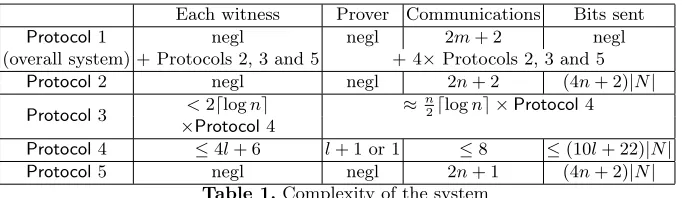
Each witness Prover Communications Bits sent Protocol1 negl negl 2m+ 2 negl (overall system) + Protocols 2, 3 and 5 + 4×Protocols 2, 3 and 5
Protocol2 negl negl 2n+ 2 (4n+ 2)|N|
Protocol3 <2dlogne ≈
n
2dlogne ×Protocol4
×Protocol4
Protocol4 ≤4l+ 6 l+ 1 or 1 ≤8 ≤(10l+ 22)|N|
Protocol5 negl negl 2n+ 1 (4n+ 2)|N|
Table 1.Complexity of the system
witnesses do not want to provide their location uselessly.Protocol5 manages to reach both objectives. It relies on the fact thatWimax ends up with the internal
valueEP(sWimax) =EP(0) at the end ofProtocol4 (which correspond tosA or
sB in Protocol4). The other witnesses have a randomsWi.
The security of Protocol 5 is easy to show. The security of all encrypted messages relies on the semantic security of the cryptosystem. In Step 1, P receives only random values from the witnesses. In Step 2, he picks one of them and broadcasts it back to all witnesses encrypted with the verifier’s public key. A witness would return a meaningful value in Step 3 only if his internal random value αi is the additive inverse of the value sent by P. In this case, the witness would return his encrypted position. Otherwise, he would return a random encrypted value. Finally, EV(ximax) is randomized to conceal it from
the witness Wimax. In term of complexity, if broadcasting generates only one
communication, 2n+1 messages of 2|N|bits are exchanged during the protocol.
6
Complexity of the overall system
We have detailed the computational and communication complexity in each sub-protocols, but we are now interested in the the complexity of the entire of location-proof system (Protocol1), depending on the number of witnesses. For simplicity, let us assume there arem= 4nwitnesses andnin each directions.
Table 1 presents the number of cryptographic operations processed by the prover and by each witness, the number of communications and the bits ex-changed during the different protocols. We only deal with the worst case : we consider a marked witness for the computational complexity inProtocol3 and we consider only witnessAinProtocol4. This can obviously be optimized by giving role B to marked witness as most as possible. The complexity of Protocol 3 is an approximation of the total number of comparisons. An exact formula is given in Section4.3. InProtocol4, it has been shown that P runsl+ 1 operations in
n−1 comparisons, and only 1 otherwise, then the number of operations run by the prover inProtocol 3 and 4 is approximately (n−1)l+n
2dlogne.
prover in O(n) and O(1) for a witness. This is due to the fact that witnesses do not need to interact with each other. However, location-privacy requires such interactions, and thus we do not reach the same objectives.
7
Conclusion
In this paper, we have presented a privacy-aware location-proof system, allowing a prover to generate location-proofs with the cooperation of nearby witnesses, without having to know explicitly any participant’s identity and position. Our scheme relies on a novel secure multi-party computation protocol, allowing a third-party to find which participant has the maximum value and approximating the region in which he is. The proofs are then signed with a group signature scheme, protecting the identity of the participants and allowing to detect any adversary trying to impersonate multiple witnesses. Finally, our scheme assumes that participants’ devices are equipped with directional antennas. Although this is not a technological challenge, it would be interesting to get rid of it.
References
1. X. Bultel, S. Gambs, D. G´erault, P. Lafourcade, C. Onete, and J.-M. Robert. A prover-anonymous and terrorist-fraud resistant distance-bounding protocol. In Proc. of WISec. ACM, 2016.
2. R. Cramer, S. Fehr, Y. Ishai, and E. Kushilevitz. Efficient multi-party computation over rings. InProc. of EUROCRYPT, pages 596–613. Springer, 2003.
3. M. Franklin and H. Zhang. Unique group signatures. InProc. of ESORICS, pages 643–660. Springer, 2012.
4. S. Gambs, M.-O. Killijian, M. Roy, and M. Traor´e. Props: A privacy-preserving location proof system. InProc. of SRDS, pages 1–10. IEEE, 2014.
5. O. Hasan, L. Brunie, and E. Bertino. Preserving privacy of feedback providers in decentralized reputation systems. Computers & Security, 31(7):816–826, 2012. 6. C. Hazay and Y. Lindell. Efficient Secure Two-party Protocols: Techniques and
Constructions. Springer Science & Business Media, 2010.
7. H.-Y. Lin and W.-G. Tzeng. An efficient solution to the millionaires’ problem based on homomorphic encryption. In Proc. of ACNS, pages 456–466. Springer, 2005.
8. W. Luo and U. Hengartner. Veriplace: a privacy-aware location proof architecture. InProc. of SIGSPATIAL, pages 23–32. ACM, 2010.
9. P. Paillier. Public-key cryptosystems based on composite degree residuosity classes. InProc. of EUROCRYPT, pages 223–238. Springer, 1999.
10. A. Pham, K. Huguenin, I. Bilogrevic, I. Dacosta, and J.-P. Hubaux. Securerun: Cheat-proof and private summaries for location-based activities. InProc. of TMC, pages 2109–2123. IEEE, 2015.
11. S. Saroiu and A. Wolman. Enabling new mobile applications with location proofs. InProc. of HotMobile, pages 1–6. ACM, 2009.
12. N. Sastry, U. Shankar, and D. Wagner. Secure verification of location claims. In Proc. of WISEC, pages 1–10. ACM, 2003.
13. D. Singelee and B. Preneel. Location verification using secure distance bounding protocols. InProc. of MASS, pages 7–14. IEEE, 2005.