Static and Dynamic Chain Structures in the Mean-Field Theory
T. Ichikawa1, N. Itagaki1, N. Loebl2, J. A. Maruhn2,1a, V. E. Oberacker3, S. Ohkubo4, B. Schuetrumpf2, and A. S. Umar3
1 Yukawa Institute for Theoretical Physics, Kyoto University, Kyoto 606-8502, Japan 2 Institut fuer Theoretische Physik, Goethe-Universitaet, Frankfurt am Main, Germany
3 Department of Physics and Astronomy, Vanderbilt University, Nashville, Tennessee 37235, USA 4 Department of Applied Science and Environment, University of Kochi, Kochi 780-8515, Japan
Abstract. We give a brief overview of recent work examining the presence ofα-clusters in light nuclei within
the Skyrme-force Hartree-Fock model. Of special signif cance are investigations intoα-chain structures in carbon
isotopes and16O. Their stability and possible role in fusion reactions are examined in static and time-dependent
Hartree-Fock calculations. We f nd a new type of shape transition in collisions and a centrifugal stabilization of
the 4αchain state in a limited range of angular momenta. No stabilization is found for the 3αchain.
1 Introduction
In light nuclei, cluster structures and large deformation may be present even in the mean-f eld model [1]. For ex-ample, 8Be has an α-αstructure of “superdeformed”
na-ture, and the degree of deformation is closely related to the orbits of valence neutrons in neutron-rich Be isotopes [2, 3]. Also there have been many discussions on the nature of the 0+
2 state of12C with well-developed 3αstructure,
possibly a linear chain [4–7]. Another example is the 4α linear chain band starting around the 4αthreshold energy region in16O suggested by Chevallieret al.[8] through the
data analysis of the12C+α→8Be+8Be reaction. This is
supported by theoretical work[9]; they analyzed the decay widths and discussed that the observed states are possibly characterized by well-developed 4αstructure.
Concerning the stability of the linear chain states, in conventional models, it has been usually studied through the analyses of small vibration around the equilibrium con-f guration [10]. However, the bending motion is the most important path for the transition to the low-lying states [11]. Therefore, it is necessary to calculate the stability in a wide wave function space, which covers not only the lin-ear chain conf gurations but also the lower excited states. Utilizing a rather large model space, we have analyzed in neutron-rich C isotopes that adding valence neutrons in-creases the stability of the linear chain states with respect to the bending motion [12,13]. The basic instability still remains, though.
Even if they are fundamentally unstable, the chain structures could still appear as intermediary conf gurations in a collision involving 8Be and/orα-particles, and one
of the aims of this paper is to explore this possibility us-ing time-dependent Hartree-Fock (TDHF) methods. It is generally acknowledged that the TDHF theory provides a
a Invited Speaker
useful foundation for a fully microscopic many-body the-ory of low-energy heavy-ion reactions [14]. Earlier TDHF calculations of collisions between light nuclei involving cluster-like conf gurations have been made for the study of nuclear molecular resonances [15]. However, due to the lack of computational resources these calculations suffered from numerical imprecision as well as unphysical symme-try assumptions, such as collisions being restricted to axial symmetry. Current TDHF calculations are performed with high numerical precision and with no symmetry assump-tions as well as using modern Skyrme forces. Recently, we have shown that when TDHF is combined with the density-constraint method [16] dynamical potentials and ion-ion interaction barriers can be accurately reproduced [17–19]. Thus an alternative approach would be to investigate the formation and stability of the linear chain conf guration us-ing the fully microscopic and dynamical TDHF theory.
An important mechanism to stabilize the linear chain state could be the rotation of the system; a large moment of inertia such as in the linear-chain conf guration is fa-vored if large angular momentum is given to the nucleus. If the angular momentum is too high, however, it leads to the f ssion of the nucleus, and there must exist a region of angular momentum where the linear chain conf guration is stabilized. We focus on this mechanism and discuss the angular momentum of the linear-chain conf guration based on cranked Hartree-Fock.
2 The
3
α
chain state in nuclear collisions
In this work we study TDHF collisions which reproduce the linear chain conf guration and subsequently decay to lower-energy conf gurations of the system. To our knowl-edge such mode changes have never been observed in TDHF calculations previously and appear to simulate the
suggested astrophysical mechanism for the formation of
12C nuclei.
T<2500 fm/c
2500<T<4000 fm/c
T=5000 fm/c
Fig. 1.Selected density prof les from TDHF time-evolution of the
4He+8Be head-on collision for initial Be orientation angleβ=0◦
using the SLy4 interaction. The initial energy isEc.m.=2 MeV.
In our numerical calculations we have chosen a Carte-sian box which is 40 fm along the collision axis and 24 fm in the other two directions. Calculations are done in 3-D geometry and using the full Skyrme force (SLy4) [20] as described in Ref. [21]. Using different mod-ern parametrizations of the Skyrme force all show the same phenomena. We have chosen to study two different col-lisions leading to the linear chain conf guration, f rst the
4He+8Be system and then the triple collision of three4He
nuclei, which may be astrophysically much less probable. The Hartree-Fock (HF) state for the8Be nucleus is
axi-ally symmetric. In Fig. 1 we show three snapshots from the long time evolution of the4He+8Be collision at zero
impact parameter andEc.m. = 2 MeV. The top panel of
Fig. 1 shows the linear chain conf guration about which the system oscillates for times less than 2,500 fm/c. In partic-ular, it is remarkable that the moving clusters do not equi-librate while moving inside the linear chain state but re-tain their 2p−2ncharacter, where one observes a complex quasiperiodic motion with little damping up to this time. Around 2500 fm/cthe system starts to bend and acquires a somewhat triangular shape as shown in the middle panel of Fig. 1. The system still retains its cluster character with the center cluster moving offthe reaction plane cut shown in the f gure, but can be clearly observed in volumetric three-dimensional movies of the collision process. The bending motion, where the center cluster oscillates somewhat per-pendicular to the left and right clusters continues for ap-proximately 1000 fm/c, with very little damping. Finally, at even longer times the system relaxes into a relatively more compact shape (bottom panel of Fig. 1.). Such mode changes, where the dynamical energy in the longitudinal direction is converted to a transverse mode, while the sys-tem retains its cluster structure have never been seen in pre-vious TDHF calculations albeit this would not have been possible in calculations imposing axial symmetry. Even in three-dimensional calculations, for an exactly central col-lision, the axial symmetry would be preserved under ideal theoretical and numerical conditions. Therefore the
mean-ing of head-on collision (b = 0) should be interpreted to have a small dispersion around this value, which facilitates the mode change even for exactly central collisions.
0 1000 2000 3000 4000 5000 6000
time (fm/c) -1.5
-1 -0.5 0 0.5 1 1.5
Single-Particle Parity (neutrons)
4He + 8Be Ec.m. = 2 MeV 1n
2n
3n
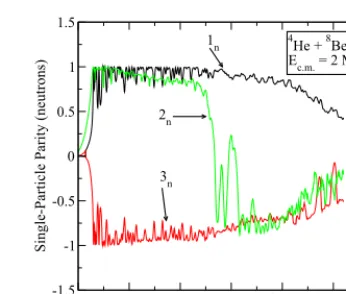
Fig. 2. Single-particle parities of the neutron states during the
collision of the4He+8Be system as a function of time atE
c.m. = 2 MeV.
We were also successful, for the f rst time, in creat-ing a static Hartree-Fock linear chain state orthogonal to the ground state in a fully three-dimensional geometry. This was achieved by initializing one of the single-particle states to be in the s−d shell with positive parity rather than in the p state with negative parity. This results in a linear chain state similar to the one shown in the top panel of Fig. 1. The fact that this state has two positive parity and one negative parity state proves that it is exactly orthogo-nal to the 12C ground state which has one positive parity
and two negative parity states. A similar dependence on parity was also studied in cluster model calculations [22]. In order to relate this observation to the dynamical mode changes discussed above we have used the density con-straint method to calculate the potential energy and the single-particle parities during the TDHF time-evolution. In Fig. 2 we show the neutron single-particle parities as a function of collision time. What is striking is that the combined system initially has the same parity signature as the static linear chain state but at the time of bending one of the positive parity states starts to decay towards nega-tive parity and this decay continues as the system becomes closer to the parity signatures of the ground state. Oscilla-tions in the numerically calculated parities stem from the fact that these are done during the dynamical evolution of the system. The proton single-particle parities are almost exactly the same as for the neutrons as anticipated.
0 2 4 6 8 10 12 14 16 R (fm)
-20 -15 -10 -5 0 5
V(R) (MeV)
4He + 8Be
β = 90o β = 45o β = 0o Ec.m. = 2 MeV
Fig. 3. Potential energy curves for the collision of the4He+8Be
system as a function ofRfor three initial alignments of the Be
nucleus and atEc.m.=2 MeV.
as angleβ, and for the entire duration of the collision pro-cess. Since for the real system the angular momentum of
8Be is projected all possible alignments of the8Be nucleus
needs to be considered. For all of the alignments the com-bined system climbs up a shallow potential barrier height of approximately 1.24−1.44 MeV, the lowest barrier be-ing that of theβ=0opotential, thus making this alignment most probable under threshold conditions. For the poten-tial energy curve showing the head-on collision (β = 0o, black curve) we observe that the system initially relaxes to a relatively shallow metastable minimum and oscillates about this minimum until approximatelyT = 2500 fm/c at which points it slips down the curve towards the second conf guration as indicated by three alphas in a triangular conf guration. After spending some time in this conf gura-tion the system further slips down to even lower energy and more compact conf guration. The potential energy curves corresponding to8Be initial alignment angles ofβ =45o andβ = 90o (red and blue curves, respectively) undergo a different behavior, bypassing the linear chain minimum but directly going to the triangular and subsequently to the compact conf guration, the perpendicular energy collision attaining the most compact and lowest energy conf gura-tion. It is interesting to note that all of the potential energy curves spend some time in the triangular conf guration.
As an alternate collision leading to the same conf gura-tion we have also studied the collision of three4He nuclei,
one at rest at the origin of the collision axis and the other two on each side boosted towards the center with 1 MeV energy. In Fig. 4 we contrast the time dependence of the potential energies for the two different collisions. We ob-serve that the three4He collision process spends
consider-ably longer time (about 6000 fm/c) undergoing quasiperi-odic oscillations with very little damping in the linear chain conf guration before switching to bending and compact modes.
In order to gauge the stability of the linear chain con-f guration we have made systematic studies as a con-function of impact parameter and center-of-mass energy, as well as a study using heavier Be isotopes to determine the dence on neutron number. In Fig. 5 we show the
depen-0 1000 2000 3000 4000 5000 6000 7000
t (fm/c) -15
-10 -5 0
V(t) (MeV)
4He + 8Be 4He + 4He + 4He
Ec.m. = 2 MeV
Fig. 4. Time development of the potential energy for the
head-on collisihead-on of the4He+8Be and the4He+4He+4He systems for
Ec.m.=2 MeV.
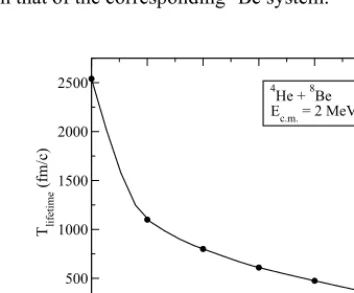
dence of the linear chain survival time on the impact pa-rameter for the 4He+8Be system at E
c.m. = 2 MeV and
β=0o. We observe that as the impact parameter increases the survival time rapidly decreases. This decrease naturally happens slower (faster) for lower (higher) energies. We have also done a similar study for the time spent in the lin-ear chain conf guration as a function of the center-of-mass energy for the4He+8Be system forβ=0o alignment. We decreased the energy in steps of 0.1 MeV to f nd the lowest energy for which we form the linear chain conf guration (at lower energies the nuclei rebound due to Coulomb repul-sion). At this energy of 1.3 MeV the lifetime of the linear chain conf guration increases to about 2875 fm/c. As the energy is increased the lifetime decreases gradually. In or-der to study the dependence of the linear chain state on the neutron number of the Be isotopes we have repeated all of the above calculations using a9Be nucleus instead. The
calculations were done by using all the time-odd terms in the Skyrme interaction appropriate for an odd-A nucleus. While we do f nd an analogous behavior in this study, the lifetime of the linear chain state is approximately 30% less than that of the corresponding8Be system.
0 0.1 0.2 0.3 0.4 0.5
b (fm)
0 500 1000 1500 2000 2500
Tlifetime
(fm/c)
4 He + 8Be Ec.m. = 2 MeV
Fig. 5. Time spent in the linear chain conf guration as a function
of the impact parameter bfor the 4He+8Be system at Ec.m. =
3 Cranked
4
α
chain states
To discuss the 4αlinear chain state in the rotational frame, we perform cranked HF calculations. We self-consistently calculate the cranked HF equation, given byδhH−ωJi= 0, whereHis the total Hamiltonian,ωis the rotational fre-quency, andJis the angular momentum around theyaxis. We also perform TDHF calculations in order to discuss the 4αlinear chain state in a collision situation.
We represent the single-particle wave functions on a Cartesian grid with a grid spacing of 0.8 fm. The grid size is typically 243for ground states and 32×242for
su-perdeformed states. This accuracy was seen to be sufficient to provide converged conf gurations. The numerical pro-cedure is the damped-gradient iteration method [23], and all derivatives are calculated using the Fourier transform method.
We take three different Skyrme forces: Sly6 as a recent f t which includes information on isotopic trends and neu-tron matter [24], and SkI3 as well as SkI4 as recent f ts which map the relativistic isovector structure of the spin-orbit force [25]. SkI3 contains a f xed isovector part anal-ogous to the relativistic mean-f eld model, whereas SkI4 is adjusted allowing free variation of the isovector spin-orbit term. Thus all forces differ somewhat in their actual shell structure. Besides the effective mass, the bulk parameters (equilibrium energy and density, incompressibility, sym-metry energy) are comparable.
0 0.1 0.2 0.3 0.4 0.5
0 5000 10000 15000
~
2/ 2
Θ
(MeV)
Iteration 16
O (α + α + α + α)
Cranking
(SkI3)
(b)
(c)
(d) 0.0 MeV 0.5 MeV 1.0 MeV 1.5 MeV 2.0 MeV 2.5 MeV
Fig. 7. Coefficient of the rotational energy, ~2/2Θ, calculated using the cranking method versus the HF iterations with various
rotational frequenciesω. The symbols (b), (c), and (d) correspond
to the density distribution given in Fig. 6.
0.06 0.07
1.8 2 2.2
~
2/ 2
Θ
(MeV)
Rotational Frequency ω (MeV/~)
16
O (α + α + α + α) Cranking
SkI3 SkI4 SLy6
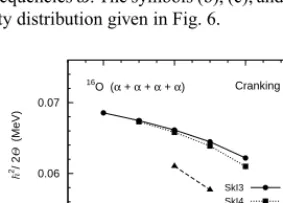
Fig. 8.Coefficient of the rotational energy,~2/2Θ, calculated
us-ing the crankus-ing method versus the rotational frequencyω. The
lines correspond to the different Skyrme forces as indicated.
15 20
1.8 2 2.2
Angular Momentum
J
(
~
)
Rotational Frequency ω (MeV/~)
16
O (α + α + α + α) Cranking
Jrid Jcra
SkI3 SkI4 SLy6
15 20
1.8 2 2.2
Angular Momentum
J
(
~
)
Rotational Frequency ω (MeV/~)
16
O (α + α + α + α) Cranking
Jrid Jcra
Fig. 9.Angular momentum calculated using the cranking method
versus the rotational frequency. The lines with solid symbols de-note the calculated results for the rigid-body moment of iner-tia, while the open symbols denote the results for the cranking method; both for the Skyrme forces as indicated.
We here discuss the stability of the 4αlinear chain con-f guration in the rotating con-frame con-for16O. To this end, we
per-form the cranked HF calculations with various rotational frequencies,ω. For the initial wave function, we use the twisted 4αconf guration, as shown in Fig. 6 (a). Note that this initial state violates axial symmetry, which facilitates the transition of the initial state to low-lying states includ-ing the ground state durinclud-ing the convergence process (this was demonstrated for the carbon chain states in [12,13]). We calculate the rigid-body moment of inertia,Θ, using the total nucleon density at each iteration step. We here only consider rotation around theyaxis.
We f rst investigate the convergence behavior of the HF iterations. To check this, we calculate the coefficient of the rotational energy, given by ~2/2Θ, at each
itera-tion step. Figure 7 shows the calculated results with var-ious rotational frequencies versus the iterations in the case of the SkI3 interaction. The initial state with the twisted linear chain conf guration is not the true ground state of the HF model space and the solution changes into the true ground state after some large number of iterations; how-ever the situation depends on the value of the rotational frequencyω. In the f gure, we see that the rotational fre-quenciesω=0.5, 1.0, and 1.5 MeV/~(the dashed, dotted,
and dot-dashed lines, respectively) lead to the true ground state. The corresponding density distribution at the itera-tion step of 15000 is plotted in Fig. 6 (b). The frequency ω=0.0 MeV/~(the solid line) leads to the quasi-stable one
(see Fig. 6 (c)). At aroundω =2.0 MeV/~, we obtain the
state (the thin solid line) with the 4αlinear chain conf gu-ration, as shown in Fig. 6 (d), whereas f ssion occurs above those rotational frequencies (the dot-dot-dashed line).
We next estimate the range of the rotational frequen-cies where the 4αlinear-chain conf guration can be stabi-lized. Figure 8 shows the coefficient of the rotational en-ergy,~2/2Θ, versus the rotational frequencyωwith
vari-ous Skyrme interactions. We f nd stable states for the 4α linear chain conf guration. For the SkI3 interaction, we ob-tain the lower and upper bounds of the rotational frequen-cies as 1.8 and 2.2 MeV/~, between these the 4α linear
chain conf guration is stabilized. The values are 1.9 and 2.2 MeV/~for the SkI4 interaction and 2.0 and 2.1 MeV/~
(a)
16O Cranking
(α + α + α + α)
–10 0 10
Z (fm)
–10 0 10
X
(fm)
(a)
16O Cranking
(α + α + α + α)
–10 0 10
Z (fm)
–10 0 10
X
(fm)
(b)
–10 0 10
Z (fm)
(b)
–10 0 10
Z (fm)
(c)
–10 0 10
Z (fm)
(c)
–10 0 10
Z (fm)
(d)
–10 0 10
Z (fm)
(d)
–10 0 10
Z (fm)
Fig. 6. Total nucleon density distribution calculated using the cranking method for (a) the initial wave function, (b) the ground state, (c)
the quasi-stable state, and (d) the 4αlinear chain state. The isolines correspond to multiples of 0.02 fm/c. We normalize the color to the
density distribution at the maximum of each plot.
regions where the linear chain conf guration is stabilized, we can def ne the rigid-body moments of inertia, which is calculated as 0.065 MeV for the SkI3 and SkI4 interactions and 0.06 MeV for the SLy6 interaction. There values are in very good agreement with the conventional cluster model calculations[26].
We also estimate the corresponding angular momen-tum where the 4αlinear chain conf guration is stabilized. We calculate the angular momentum using the obtained rigid-body moment of inertia and compare those with that calculated by the cranking method. The angular momen-tum with the rigid-body moment of inertia,Jrid, is calcu-lated asJrid =Θω. The angular moment calculated using the cranking method,Jcra, is given byJcra=<J>, where < J >is the expectation value of the angular momentum in the cranking equation. Figure 9 shows the angular mo-mentum thus obtained versus the rotational frequency. In the f gure, we see that the calculated angular momentum using the rigid-body moment of inertia agrees well with that of the cranking method, indicating that the rigid-body approximation is reasonable for the 4αlinear chain states. We f nd that the lower and upper bounds of the angular momentum where the 4αlinear chain conf guration is sta-bilized are about 13 and 18~for the SkI3 interaction, 14
and 18~for the SkI4 interaction, and 16 and 18~for the
SLy6 interaction, respectively. With such high angular mo-menta, very exotic conf guration of 4αlinear chain can be stabilized, however, f ssion occurs beyond this angular mo-mentum region.
We analyzed such stability of linear chain conf gura-tions ofαclusters for three-αin12C and three-αwith va-lence neutrons in20C. However it is rather difficult to
ob-tain stable regions of rotational frequency and angular mo-mentum in these cases, and stability shown in16O is
con-sidered to be a unique character of the 4αconf guration.
3.1 Four-αlinear chain in collisions of two8Be with
TDHF
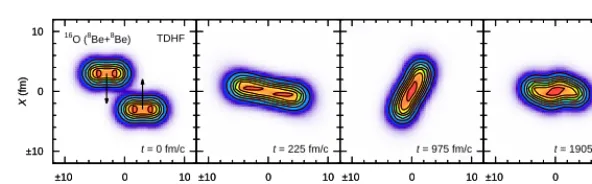
To check the importance of this chain conf guration as an intermediate state in a collision situation, we also per-formed time-dependent Hartree-Fock calculations for the
8Be+8Be reaction in a conf guration where the axes of the
collision partners are aligned. Fig. 10 shows a number of typical snapshots of the collision for an impact parameter of 6 fm and a relative energy of 2 MeV. The f rst picture
0,05 0,1 0,15
¯
h
2/
2Θ
[M
eV
]
0 1000 2000
t [fm/c]
J= 2.6¯h
J= 14¯h
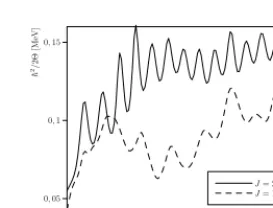
Fig. 11. Coefficient of the rotational energy,~2/2Θcalculated
using the TDHF method for two situations:E = 3.3 MeV with
b =8 fm, corresponding toJ =2.6~, andE =18 MeV for the
same impact parameter withJ=14~.
shows the starting conf guration; the initial velocities are in thex-direction. Upon contact the two nuclei are strongly attracted and form a compound system that rotates while also undergoing strong vibrations as indicated by the other snapshots.
To illustrate the behavior of the moment of inertia we show its time development for two typical cases in Fig. 11. The moment of inertia is calculated from the instantaneous density as the rigid-body value. They correspond to two different angular momenta at the same impact parameter of 8 fm, which is selected to get the system to coalesce into a strongly deformed rotating conf guration; the curves also show the quite large oscillations caused by the shape changes. Yet the tendency appears to follow that of the cranked calculations: for the small angular momentum it goes to much smaller moment of inertia, while forJ=14~
the system spends quite a long time oscillating around the moment of inertia found in the cranking calculations be-fore relaxing to a slightly smaller value.
4 Summary
In this work we have performed microscopic dynamical calculations of nuclear collisions to study the formation of a metastable linear chain state of12C. The time
t = 0 fm/c
16O (8Be+8Be) TDHF
–10 0 10
Z (fm)
–10 0 10
X
(fm)
t = 0 fm/c
16O (8Be+8Be) TDHF
–10 0 10
Z (fm)
–10 0 10
X
(fm)
t = 225 fm/c
–10 0 10
Z (fm) t = 225 fm/c
–10 0 10
Z (fm)
t = 975 fm/c
–10 0 10
Z (fm) t = 975 fm/c
–10 0 10
Z (fm)
t = 1905 fm/c
–10 0 10
Z (fm) t = 1905 fm/c
–10 0 10
Z (fm)
Fig. 10. Snapshots of the total nucleon density calculated using the TDHF method for the8Be+8Be collision. The impact parameter is 6 fm and the relative energy is 2 MeV. We normalize the color to the density distribution at the maximum of each plot.
which is studied using the density constraint procedure. We have shown that the calculations lead to the forma-tion of a metastable linear chain state of three alpha-like clusters which subsequently decays to a lower energy tri-angular alpha-like conf guration before acquiring a more compact shape. This is the f rst observation of such mode changes in TDHF calculations and the results seem to be analogous to the suggested astrophysical mechanism for the formation of12C nuclei.
For the 3α-chain conf guration of16O we found a stabi-lization due to centrifugal forces for a range of angular mo-menta not including zero. This is a new situation in cranked mean-f eld calculations. An investigation of the presence of a chain structure in collisions of8Be+8Be shows a
ro-tating compound system of roughly the right deformation, but with superimposed strong shape oscillations.
Acknowledgments
This work has been supported by the U.S. Department of Energy under grant No. DE-FG02-96ER40963 with Van-derbilt University, by the German BMBF under contract No. 06FY9086, and by the GCOE program “The Next Generation of Physics, Spun from Universality and Emer-gence” from MEXT of Japan. A.S.U. thanks for support by the Hessian LOEWE initiative through the Helmholtz International Center for FAIR; J.A.M thanks the Japan So-ciety for the Promotion of Science (JSPS) for an invitation fellowship for research in Japan (short-term).
References
1. J. A. Maruhn, M. Kimura, S. Schramm, P.-G. Rein-hard, H. Horiuchi and A. Tohsaki-Suzuki, Phys. Rev. C74, 044311 (2006).
2. N. Itagaki and S. Okabe, Phys. Rev. C 61, 044306
(2000).
3. M. Ito, N. Itagaki, H, Sakurai and K. Ikeda, Phys. Rev. Lett.100, 182502 (2008).
4. F. Hoyle, Astrophys. J. Suppl.1, 121 (1954).
5. H. Morinaga, Phys. Rev.101, 254 (1956).
6. K. Ikeda, N. Takigawa and H. Horiuchi, Prog. Theor. Phys. Suppl. Extra Number 464 (1968).
7. A. Tohsaki, H. Horiuchi, P. Schuck, and G. R¨opke, Phys. Rev. Lett.87, 192501 (2001).
8. P. Chevallieret al., Phys. Rev.160, 827 (1961).
9. Y. Suzuki, H. Horiuchi and K. Ikeda, Prog. Theor. Phys.471517 (1972).
10. H. Horiuchiet al., Prog. Theor. Phys. Suppl.52, 89
(1972).
11. A.S. Umar, J.A. Maruhn, N. Itagaki, and V.E. Ober-acker, Phys. Rev. Lett.104212503 (2010).
12. N. Itagakiet al., Phys. Rev. C64, 014301 (2001), N.
Itagaki, W. von Oertzen, and S. Okabe Phys. Rev. C
74067304 (2006).
13. J.A. Maruhn, N. Loebl, N. Itagaki, and M. Kimura, Nucl. Phys. A833(2010).
14. J. W. Negele, Rev. Mod. Phys.54, 913 (1982).
15. A. S. Umar, M. R. Strayer, R. Y. Cusson, P. -G. Rein-hard, and D. A. Bromley, Phys. Rev. C32, 172 (1985).
16. R. Y. Cusson, P. -G. Reinhard, M. R. Strayer, J. A. Maruhn, and W. Greiner, Z. Phys. A320, 475 (1985).
17. A. S. Umar and V. E. Oberacker, Phys. Rev. C 74,
021601(R) (2006).
18. A. S. Umar and V. E. Oberacker, Phys. Rev. C 77,
064605 (2008).
19. A.S. Umar and V. E. Oberacker, Eur. Phys. J. A39,
243 (2009).
20. E. Chabanat, P. Bonche, P. Haensel, J. Meyer and R. Schaeffer, Nucl. Phys. A635, 231 (1998); A643,
441(E) (1998).
21. A. S. Umar and V. E. Oberacker, Phys. Rev. C 73,
054607 (2006).
22. N. Itagaki, W. von Oertzen, and S. Okabe, Phys. Rev. C74, 067304 (2006).
23. P.-G. Reinhard, and R. Y. Cusson, Nucl. Phys. A378,
418 (1982).
24. E. Chabanat, P. Bonche, P. Haensel, J. Meyer, and R. Schaeffer, Nucl. Phys. A627, 710 (1997).
25. P.-G. Reinhard and H. Flocard, Nucl. Phys. A584, 467
(1995).