© 2014, IJCSMC All Rights Reserved
11
Available Online atwww.ijcsmc.com
International Journal of Computer Science and Mobile Computing
A Monthly Journal of Computer Science and Information Technology
ISSN 2320–088X
IJCSMC, Vol. 3, Issue. 6, June 2014, pg.11 – 18
RESEARCH ARTICLE
Network Security Analysis Based on
Authentication Techniques
Anupriya Shrivastava
1, M A Rizvi
2¹Department of computer engineering and application, NITTTR, Bhopal, India ²Department of computer engineering and application, NITTTR, Bhopal, India
1 [email protected]; 2 [email protected]
Abstract— Network Security issues are now becoming important as society is moving to digital
information age. Data security is the utmost critical component in ensuring safe transmission of
information through the internet. It comprises authorization of access to information in a network,
controlled by the network administrator. The task of Network security not only requires ensuring
the security of end systems but of the entire network. Authentication is one of the primary and most
commonly ways of ascertaining and ensuring security in the network. In this paper, an attempt has
been made to analyze the various authentication techniques such as Knowledge-based,
Token-based and Biometric-Token-based etc. Furthermore, we consider multi-factor authentications by choosing
a combination of above techniques and try to compare them.
Keywords— Authentication; Denial of service; Virtual Private Network; Passcode; Smart card;
RSA; SecureID; Biometric
I. INTRODUCTION
© 2014, IJCSMC All Rights Reserved
12
While developing a secure network, the following need to be considered -
1. Access – Only authorized users are allowed to communicate to and from a particular network.
2. Authentication – This ensures that the users in the network are who they say they are. Actual flow of information can start only after the user has been authenticated and allowed to communicate to other systems in the network.
3. Confidentiality – Data in the network remains private. This is done to ensure that the information can be viewed only by authenticated systems and it can be achieved using various encryption techniques. 4. Integrity – This ensures that the message has not been changed during transmission.
II.
D
ATA SECURITY AND AUTHENTICATIONData Security is a challenging issue in the field of data communications. For securing information from hackers and crackers, authentication is the major phase in network security. It is a concept to protect network and data transmission over wired as well as wireless networks. Authentication is one of the primary techniques of ensuring that the person who is transmitting the information is whom he says he is. It is thus the process of determining the actual identity of users, systems or any other entity in network. To verify someone's identity, password is mostly used. To authenticate user or machines, different techniques can be used to perform authentication between user and machine or machine and another machine too. Different types of attacks are possible during authentication is shown in Table I.
TABLE I
DIFFERENT TYPES OF ATTACKS ON NETWORK/DATA
Attacks types Description
Weak password recovery Websites permit hackers to find a way to illegally obtain, modify or recover another user's password.
Brute force attacks By trial and error, hackers can guess username, password, debit cards numbers, etc. This technique is highly popular.
Insufficient authentication Some websites don‟t authenticate much so hackers attack sensitive content Shoulder surfing attacks Hackers directly observe user while typing passwords or by some hidden
cameras.
III. AUTHENTICATION
TECHNIQUES
Following are the primary authentication techniques used in the public network these days:A. Password and pin based:
In this authentication technique, privacy and confidentiality can be maintained up to some extent. Users memorize there passwords and hence we can term these as Knowledge-based techniques. Passwords can be single words, numeric, phrases, any combination of these or personal identification number. But problem with this technique is that memorized passwords can be easily guessed or randomly searched by the hackers. Virtual Private Networks such as Point-to-Point Tunneling Protocol (PPTP) make use of both clear-text protocols such as Password Authentication Protocol (PAP) and MD5-based protocols like Challenge Handshake Protocol (CHAP). As it is clear, MD5 should be preferred due to sniffing attacks. Plain passwords must be avoided as far as possible. They should be used only with SSL certificates.
© 2014, IJCSMC All Rights Reserved
13
Fig. 1
Directory Server based authentication
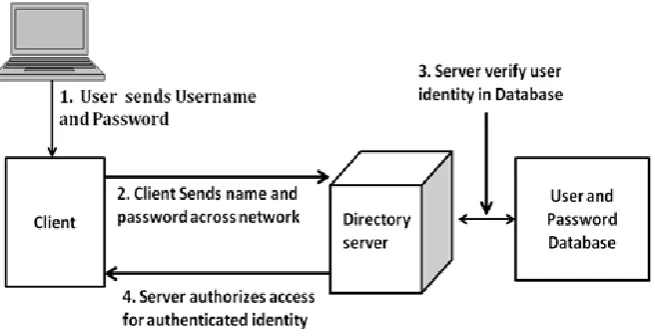
Fig.1 shows working of password based authentication technique. The user first enters a name and password. It is required that the Client application binds itself to the Directory Server with a distinguished Name. The client uses the name entered by user to retrieve domain name. Next the client sends these credentials to the Directory Server. The server then verifies the password sent by the client by comparing it against the password stored in database. If it matches, the server accepts the credentials for authenticating the user identity. Then the server allows client so authorized to access the resources.
In password-based authentication techniques, password policies are a set of rules that also have major roles in deciding how to administer password in the systems. There are multiple policies supported by directory servers. „Default‟ and „Specialized‟ are the two of them. The default password policy is part of the configuration for the instance, once modified, it cannot be replicated.
B. Token based:
This is a physical device that performs authentication and hence can be termed as object based. Tokens can be compared with physical keys to houses that are used as a token but in digital tokens many other factors are present to provide information safety. In digital world, security tokens are used. Tokens themselves have password so even if they are lost, the hackers cannot modify the vital information. Bank cards, smart cards are security token storage devices with passwords and pass codes. Pass codes are same as password except that the former are machine generated and stored. There exist one time security tokens and smartcards as shown in Fig. 2.
© 2014, IJCSMC All Rights Reserved
14
1. One time security tokens:Ron Rivest, Adi Shamir and Leonard Adleman (RSA) algorithm uses one time security token, that is, secureID which reduces the risk as compared to a simple password as we may change our passwords according to our mood in every 60 to 90 days or may be longer. But secureID works differently as it changes every 60 seconds, which is generated by some mathematical algorithms and only known to security server. As user logs on to the company network, he enters his ID and then the some random number displayed on the screen. By encryption this information is sent to the security server. So user gets authenticated only when the number that display on the screen matches the mathematical algorithm and the ID. Combination of user ID known to the user and OTP makes this authentication much stronger. Fig 3 shows the sequence of events that normally occur during the process of OTP.
Fig. 3 Mechanism for OTP method
C. Biometric Based:
Biometric authentication is the process of verifying if a user is whom he is claiming to be, using digitized biological signatures of the user. Biometric authentication can be classified into two groups: physiological and behavioural. In physiological authentication, faces, finger prints, hands, iris and retina follow. And in the case of behavioral, voice prints, signatures and keystrokes are used. This technique can term as ID based. This technique is safer as compared to password and token based techniques. Biometric authentication techniques are currently in operation in various enterprises. They are used for passports, visas, personal identification cards, accessing bank machines, doorway access control, and general computer desktop access.
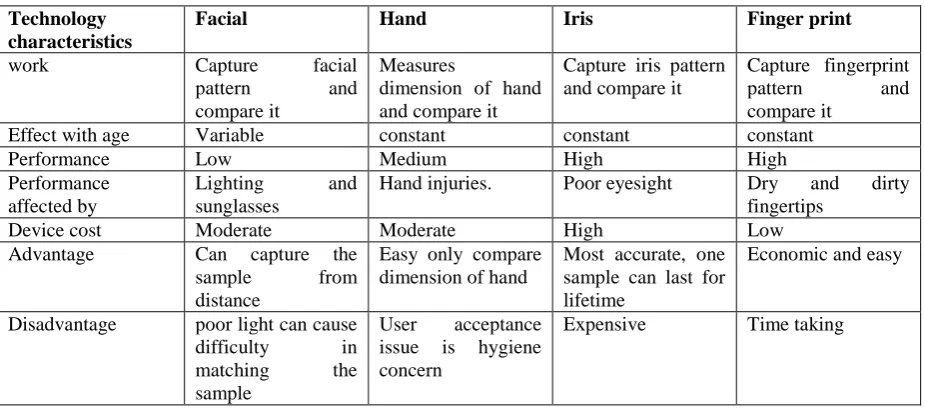
TABLE II
COMPARISON OF COMMONLY USED BIOMETRIC AUTHENTICATION TECHNIQUE
Technology characteristics
Facial Hand Iris Finger print
work Capture facial pattern and compare it
Measures
dimension of hand and compare it
Capture iris pattern and compare it
Capture fingerprint pattern and compare it
Effect with age Variable constant constant constant
Performance Low Medium High High
Performance affected by
Lighting and sunglasses
Hand injuries. Poor eyesight Dry and dirty fingertips
Device cost Moderate Moderate High Low Advantage Can capture the
sample from distance
Easy only compare dimension of hand
Most accurate, one sample can last for lifetime
Economic and easy
Disadvantage poor light can cause difficulty in matching the sample
User acceptance issue is hygiene concern
© 2014, IJCSMC All Rights Reserved
15
IV. COMPARSION OF STRENGTH OF PARAMETER OF AUTHENTICATION MECHANISM
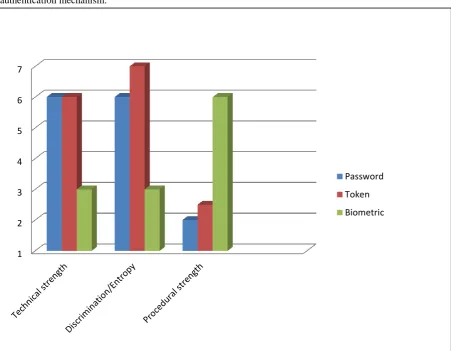
For comparing the above three authentications, we consider three important factors shown in the Graph 1 and finally calculate the composite of all those factors to determine the Binding strength which becomes the single point of comparison.
But, the model that we use to find out this value makes use of individual weaknesses rather than individual strengths where weakness = 1/strength. As a result, we get the following equation:
Binding Weakness = Discriminatory Weakness + Procedural Weakness + Technical Weakness
Having setup the above equation, we determine the individual strengths as per the following parameters:
1. Discrimination Strength: For passwords, number of attempts in a defined time period. In case of tokens, we consider their distinct number. Whereas, for Biometrics, we need to find out the number of different attempts feasible.
2. Technical Strength: For all the three authentication mechanisms, security evaluation process is carried out.
3. Procedural Strength: This is hard to determine as it may depend on many environmental factors such as site security and staff discipline. But, still we use a specific set of parameters to gauge the value such as length, randomness and frequency of change in the case of Passwords; physical security and user discipline in the case of Tokens and for Biometrics, inherent strength is sufficient.
Next, we substitute these values into the above equation and determine the Binding Strength for each authentication mechanism.
1 2 3 4 5 6 7
Password
Token
Biometric
Fig 4.Comparison of strengths of different parameters of authentication techniques
© 2014, IJCSMC All Rights Reserved
16
TABLE III
SUMMARIZATION OF DIFFERENT AUTHENTICATION TECHNIQUES
Technology characteristics
Password based Token based Biometric based
Ease of operation Simple Simple Simple Hardware used No need of extra
hardware
Require smart card for each services
No need of extra hardware
Initial cost Moderate as it requires simple computer system, laptop and mobile
Moderate because only smart cards are required.
High as it requires specialized hardware, which is also difficult to install in normal systems
Running cost Expense on system maintenance
Expense of card maintenance
Expense of maintaining and managing special hardware
Changes Changed as per user convenience
Can be changed Never changed
Client attacks Guessing the password by trial and error
Exhaustive search False match
Host attacks Plaintext theft Pass code can be stolen
Template can be stolen
Denial of service Lockout by multiple failed authentication
Lockout Lockout
After analyzing the Fig.4 and Table III, it can be summarized that technology characteristics of the three different authentication mechanisms including their ease of operation, hardware requirement, initial setup cost, running cost and vulnerability to attacks such as Denial-of-Service (DOS),technical strength and procedural strength. Password based authentication provides high key space and hashing which protects from host attacks. It is convenient and inexpensive technique. Token based authentications are significantly more robust against attacks because of twin password combination. In comparison to above two techniques, biometric cannot be easily stolen so it provides stronger protection but it is too expensive for personal use. So according to use people can choose the authentication technique as per their need and sensitivity of data and cost available, because no one method can be suggested as per the analysis done.
V.
MULTI FACTOR AUTHENTICATION
Tomake network more secure, a combination of above techniques need to be used as shown in Table 4. This is referred to as multi-factor authentication. For network security, each authenticator result must be satisfied. As a Boolean AND operation is performed for each factor‟s authentication results, so all must be affirmative. Two factor authentications in ATM cards are the card itself and its password. So even if the card was lost or stolen, we can ensure that the safety is maintained until hackers don‟t know cards password. This example of token plus password are mostly implemented today. Other combinations of token and biometric ID are also considered as secure techniques if it‟s difficult for user to remember passwords, but they require costly machines. But the combinations of biometric and passwords implementation are not so common because biometric usually includes sake for convenience. Combination of all three factors is required where there is a high need of security. Till now such a combination is not highly applied. Combinations of different technique are shown in Table IV.
TABLE IV
COMBINATION OF DIFFERENT AUTHENTICATORS FOR BETTER SECURITY
Authenticator combination Password-token based Password-biometric base Token-biometric based Password-token-and biometric based
Security Good Better Better Best
© 2014, IJCSMC All Rights Reserved
17
Advantage Lost token is secure, as protected by password
Biometric provide security if password is forgotten also.
Lost token is secure as protected by biometric ID
Three factors provide add on security.
Drawback Memorize password and always carry token
Memorize password and have biometric ID
Always have to carry id, but not if it is a Biometric
Have to memorize password, carry Token and have Biometric ID
Real life example ATM cards Password-Biometric for any machine access
Photo ID proof as driving license
Where high security require like
MILITARY,PARLIAMENT etc.
VI. CONCLUSION
Network security can be maintained by making use of various authentication techniques. User has to use authentication technique depending on requirement. Password based technique is best if you have to remember a single password. But problems occur when we have to remember many passwords so we use those passwords that are easy to remember. Token based techniques provide added security against denial of service (DoS) attacks. In comparison to above two, techniques biometric cannot be easily stolen so it provides stronger protection. As signals, biometric can be easily copied by attackers so it should not be deployed in single factor mode. Furthermore we can choose a combination of above technique as discussed above. All the techniques have their pros and cons. We have to be smart to choose as per our requirement of safety of networks and information by considering cost factor also.
R
EFERENCES[1] Lawrence O‟Gorman, “Comparing Passwords, Tokens, and Biometrics for User Authentication”, Vol. 91,
No. 12, Dec. 2003, pp. 2019-2040 ã 2003 IEEE.
[2] Hafiz Zahid Ullah Khan, “Comparative Study of Authentication Techniques”, IJVIPNS-IJENS Vol: 10 No: 04.
[3] [Online]Available: http://www.authenticationworld.com/Token-Authentication. [4] [Online]Available: http://www.authenticationworld.com/Authentication-Biometrics.
[5] Jae-Jung Kim and Seng-Phil Hong, “A Method of Risk Assessment for Multi-Factor Authentication”,
Journal of Information Processing Systems, Vol.7, No.1, March 2011.
[6] Qinghua Li, Student Member, IEEE, and Guohong Cao, Fellow, IEEE "Multicast Authentication in the Smart Grid with One Time Signature", IEEE TRANSACTIONS ON SMART GRID, VOL. 2, NO. 4, DECEMBER 2011.
[7] [Online]Available: http://www.duosecurity.com.
[8] [Online]Available:http://ids.nic.in/technical_letter/TNL_JCES_JUL_2013/Advance%20Authentication%2 0Technique.pdf.
[9] Stamati Gkarafli, Anastasios A. Economides, “Comparing the Proof by Knowledge Authentication Techniques”, international Journal of Computer Science and Security (IJCSS), Volume (4): Issue (2).
[10] Roger Meyer, “Secure authentication on the internet”As the part of security reading room, SANS institute
2007.
[11] R. Dhamija, and A. Perrig,“Déjà Vu: “A User Study Using Images for Authentication”, 9th USENIX
Security Symposium, 2000.
[12] R. Morris, K. Thompson, “Password security: A case history,” Comm. ACM, Vol.22, no. 11, Nov. 1979,
pp. 594-597.
[13] B. L. Riddle, M. S. Miron, J. A. Semo, “Passwords in use in a university timesharing environment,”
Computers and Security, Vol. 8, no. 7, 1989, pp. 569-579.
[14] S. M. Bellovin, M. Merritt, “Encrypted key exchange: Password-based protocols secure against dictionary attacks,” Proc. 1992 IEEE Computer Society Conference on Research in Security and Privacy, 1992, pp.
72-84.
[15] R. Pond, J. Podd, J. Bunnell, R. Henderson, “Word association computer passwords: The effect of formulation techniques on recall and guessing rates”, Computers and Security, Vol. 19, no. 7, 2000, pp. 645-656.
© 2014, IJCSMC All Rights Reserved
18
[17] Harbitttr, A. and Menasce, D.A., “A Methodology for Analyzing the Performance of Authentication Protocols”, November 2002.
[18] Haq, I. U. and Yahya, K. M. “Heterogeneous Networks: Challenges and Future Requirements”.
[19] TSENG, Y.M., YANG, C.C. AND HAUR SU, J. “Authentication and Billing Protocols for the Integration
of WLAN and 3G Networks”, 2004.
[20] Li, S., Zhou, J., Li, X. and Chen, K. “An Authentication Protocol for Pervasive Computing”.