in Profiling Side-channel Analysis
L´eo Weissbart1,2 1
Delft University of Technology, The Netherlands
2 Digital Security Group, Radboud University, The Netherlands
Abstract. In profiling side-channel analysis, machine learning-based analysis nowadays offers the most powerful performance. This holds espe-cially for techniques stemming from the neural network family: multilayer perceptron and convolutional neural networks. Convolutional neural net-works are often favored as results suggest better performance, especially in scenarios where targets are protected with countermeasures. Mul-tilayer perceptron receives significantly less attention, and researchers seem less interested in this method, narrowing the results in the literature to comparisons with convolutional neural networks. On the other hand, a multilayer perceptron has a much simpler structure, enabling easier hyperparameter tuning and, hopefully, contributing to the explainability of this neural network inner working.
We investigate the behavior of a multilayer perceptron in the context of the side-channel analysis of AES. By exploring the sensitivity of mul-tilayer perceptron hyperparameters over the attack’s performance, we aim to provide a better understanding of successful hyperparameters tuning and, ultimately, this algorithm’s performance. Our results show that MLP (with a proper hyperparameter tuning) can easily break im-plementations with a random delay or masking countermeasures. This work aims to reiterate the power of simpler neural network techniques in the profiled SCA.
1
Introduction
machine learning techniques are successful even on implementations protected with countermeasures [12,2]. There, in the spotlight are techniques from the neural network family, most notably, multilayer perceptron (MLP) and convo-lutional neural networks (CNNs).
When considering the attack success, we commonly take into account only the performance as measured by the number of traces needed to obtain the key. While this is an important criterion, it should not be the only one. For instance, attack complexity (complexity of tuning and training a model) and in-terpretability of the attack are also very important but much less researched. For instance, CNNs are often said to perform better than MLPs in SCA’s context, as they make the training of a model more versatile and alleviate the feature engineering process. On the other hand, MLP has a more straightforward struc-ture and is probably easier to understand than CNNs, but still, less attention is raised around its performance in SCA. Consequently, this raises an interest-ing dilemma: do we consider profilinterest-ing SCA as a sinterest-ingle-objective problem where the attack performance is the only criterion or should it be a multi-objective problem where one considers several aspects of “success”? We believe the proper approach is the second one as, without a better understanding of attacks, we cannot make better countermeasures, which is an integral part of the profiling SCA research.
In this paper, we experimentally investigate the performance of MLP when applied to real-world implementations protected with countermeasures and ex-plore the sensitivity of the hyperparameter tuning of a successful MLP architec-ture. We emphasize that this work does not aim to compare the performance of different techniques, but rather to explore the multilayer perceptron’s capa-bilities. To achieve this, we use two datasets containing different AES imple-mentations protected with random delay countermeasure and masking counter-measure. Our results show that we require larger architectures only if we have enough high-quality data. Hence, one can (to a certain degree) overcome the limitation in the number of hidden layers by providing more perceptrons per layer or vice versa. Finally, while our experiments clearly show the difference in the performance concerning the choice of hyperparameters, we do not notice that MLP is overly sensitive to that choice. This MLP “stability” means it is possible to conduct a relatively short tuning phase and still expect not to miss a hyperparameter combination yielding high performance.
2
Background
2.1 Profiling Side-channel Analysis
compute these probabilities, such as template attack [3], stochastic attack [26], multivariate regression model [28], and machine learning models [15,12]. When profiling the leakage, one must choose the appropriate leakage model, which will result in a certain number of classes (i.e., possible outputs). The first common model is the intermediate value leakage model, which results in 256 classes if we consider the AES cipher with an 8-bit S-box:
Y(k) =Sbox[Pi⊕k].
The second common leakage model is the Hamming weight (HW) leakage model:
Y(k) =HW(Sbox[Pi⊕k]).
The Hamming weight leakage model results in nine classes for AES. Note that the distribution of classes is imbalanced, which can lead to problems in the classification process [22].
2.2 Multilayer Perceptron
The multilayer perceptron (MLP) is a feed-forward neural network that maps sets of inputs onto sets of appropriate outputs. MLP has multiple layers of nodes in a directed graph, where each layer is fully connected to the next layer. The output of a neuron is a weighted sum of m inputsxi evaluated through a (nonlinear) activation functionA:
Output=A( m X
i=0
wi·xi). (1)
An MLP consists of three types of layers: an input layer, an output layer, and one or more hidden layers [5]. If there is more than one hidden layer, the archi-tecture can be already considered as deep. A common approach when training a neural network is to use the backpropagation algorithm, which is a generalization of the least mean squares algorithm in the linear perceptron [9].
The multilayer perceptron has many hyperparameters one can tune, but we concentrate on the following ones:
1. The number of hidden layers. The number of hidden layers will define the depth of the algorithm and, consequently, how complex relations can the MLP model process.
3. Activation functions. Activation functions are used to convert an input signal to an output signal. If complex functional mappings are needed, one needs to use nonlinear activation functions.
When discussing machine learning algorithms, it is common to differentiate between parameters and hyperparameters. Hyperparameters are all those con-figuration variables that are external to the model, e.g., the number of hidden layers in a neural network. The parameters are the configuration variables inter-nal to the model and whose values can be estimated from data. One example of parameters is the weights in a neural network. Consequently, when we talk about tuning a machine learning algorithm, we mean tuning its hyperparameters.
2.3 Datasets
We consider two datasets presented in previous researches and that we denote as ASCAD and AES RD. Both datasets are protected with countermeasures: the first one with masking and the second one with the random delay interrupts.
The ASCAD dataset, introduced in the work of Prouff et al. [24], consists of electromagnetic emanations (EM) measurements from a software implemen-tation of AES-128 protected with first-order Boolean masking running on an 8-bit AVR microcontroller (ATMega8515). This dataset counts 60 000 traces of 700 samples each and targets the third byte of the key. The SNR for this dataset is around 0.8 if the mask is known and 0 if it is unknown. The trace set is publicly available at https://github.com/ANSSI-FR/ASCAD/tree/master/ ATMEGA_AES_v1/ATM_AES_v1_fixed_key.
The AES RD dataset, introduced in the work of Coron and Kizhvatov [6], consists of power traces from a software implementation of AES-128 protected with random delayed interruptions running on an 8-bit AVR microcontroller (ATmega16). This dataset has 50 000 traces with 3 500 samples each, and targets the first byte of the key. The SNR has a maximum value of 0.0556. The trace set is publicly available athttps://github.com/ikizhvatov/randomdelays-traces.
3
Related Work
Still, the hyperparameter tuning was often not sufficiently explored. Despite our attempts, we could not confirm the first paper using MLP in a deep learning paradigm, i.e., with more than a single hidden layer. Interestingly, first papers with MLP were often not clear on the number of layers, as the tuning phase played an even smaller role than today.
In 2016, Maghrebi et al. conducted the first experiments with convolutional neural networks for SCA, and they compared their performance with several other techniques (including MLP) [15]. Their results indicated that, while MLP is powerful, CNNs can perform significantly better. From that moment on, we observe a number of papers where various deep learning techniques are being considered, see, e.g., [23,22,20,10].
Pfeifer and Haddad considered how to make additional types of layers for MLP to improve the performance of profiling SCA [19]. B. Timon investigated the “non-profiled” deep learning paradigm, where he first obtained the mea-surements in a non-profiled way, which are then fed into MLP or CNN [30]. Interestingly, the author reported better results with MLP than CNNs. Finally, Picek et al. connected the Universal Approximation Theorem and performance of the side-channel attack, where they stated that if the attacker has unlimited power (as it is usually considered), most of the MLP-based attacks could (in theory) succeed in breaking implementation with only a single measurement in the attack phase [21].
4
Experimental Setup
In this section, we present our strategy to evaluate and compare the perfor-mance of the different MLP attacks on different datasets. We want to observe the influence of the choice of leakage model, information reduction, and major hyperparameters defining an MLP (i.e., number of layers, number of perceptrons per layers, and activation function).
We provide results with power leakage models of both the S-box output (di-rect model) and the Hamming Weight (HW) representation of the S-box output. Besides considering the raw traces (i.e., no pre-processing and feature en-gineering), we apply the Difference-of-Means (DoM) feature selection method. DoM method selects the samples of a dataset that have the highest variance for a given leakage model. As the variance for theses samples is maximum, the in-formation about the leakage is preserved while samples with a smaller variance, that contain but noise, are ignored.
To compare the hyperparameters’ influence, we conduct a grid search for hyperparameter optimization and consider each resulting model as a profiling model for an attack. Considering the MLP hyperparameters, we fix some pa-rameters (i.e., number of training epochs and learning rate) and explore the influence of the three following hyperparameters:
– The number of perceptrons, with a fixed number of layers. – The number of layers, with a fixed number of perceptrons.
In Table 1, we list all explored hyperparameter. The total number of models trained per experiment is of nact ∗nl ∗np = 2∗6 ∗10 = 120. We run our experiments with Keras [4], and we use 200 epochs for the training phase with a learning rate of 0.001.
To assess the performance of a profiling model for an attack, we use the guessing entropy (GE) metric [27]. GE defines the average rank position of the correct key candidate in the guessing vector. In other words, when consideringN attack traces, each of which results in a guessing vectorg= [g0, g1, . . . , g|K−1|]
containing the probabilities of each key candidates in the keyspaceK, ordered by decreasing probability.GE equal to 0 means that the first key guess is correct, while GE of 128 indicates a random behavior.
The metric used during a neural network training phase is training accuracy. Note, this metric can be deceiving for assessing the quality of a side-channel attack because it evaluates the attack one trace at a time, while SCA metrics take several traces into account, giving a more accurate estimation for a real attack scenario [22].
5
Experimental Results
Table 1: List of evaluated hyperparameters.
Hyperparameter Range
Activation function ReLU, T anh
Number of layers 1,2,3,4,5,6
Number of perceptrons per layer 10,20,30,40,50,100,150,200,250,300
5.1 ASCAD Results
The authors of the ASCAD dataset report the best performance using an MLP with six layers containing 200 units and ReLU activation function trained over 200 epochs. The same hyperparameters are also evaluated, and we refer to the pre-trained MLP provided along with the database asM LPbest. Note, “best” in this context is to be understood as the best hyperparameter combination from the original ASCAD paper.
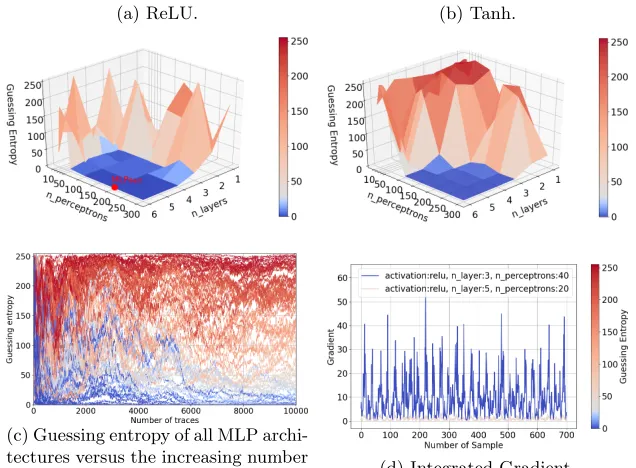
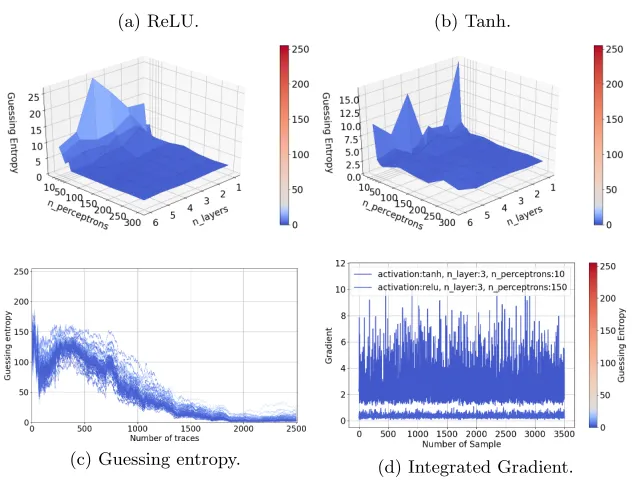
In Figure 1, we depict the influence of all combinations of hyperparameter choices for the ReLU and T anh activation functions when considering the in-termediate value leakage model. For both choices of activation functions, some models reach guessing entropy of 0 within 1 000 attack traces. More models achieve a low guessing entropy with the ReLU activation function than with T anh. On the other hand, T anh seems to behave more stable as the result is more uniform across a number of explored hyperparameters settings. Several models withReLU activation function and a low number of perceptrons (down to 50) can reach GE near zero. As it can be observed in Figure 1a, for settings with 200 perceptrons per layer, all MLPs with more than two hidden layers con-verge approximately equally fast to GE of 0. Further, we notice that increasing the number of perceptrons above 200 increases GE (i.e., decrease the perfor-mance of the attack), and that very similar results can be obtained in the close range of this hyperparameters setting. In Figure 1c, we see that many settings reach GE of 0 but also have bad performance even with 10 000 attack traces. We interpret this as expected sensitivity to the hyperparameter tuning. Finally, Figure 1d shows that the best model is more sensitive to the various samples of the input than other models that fail to learn the leakage. The leakage seems entirely spread over all samples, which indicates reducing the number of features will reduce the attack performance.
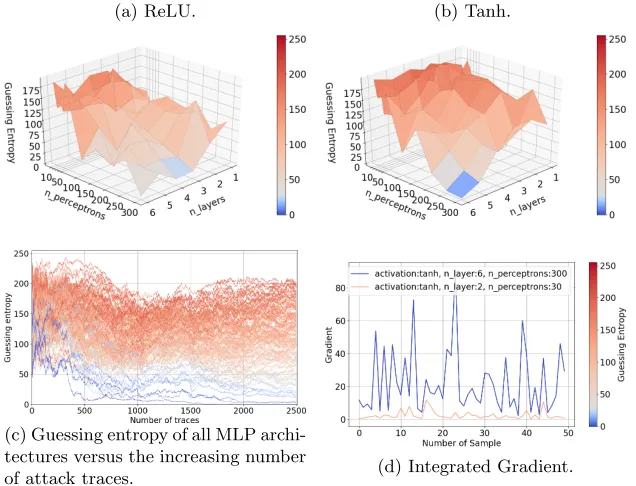
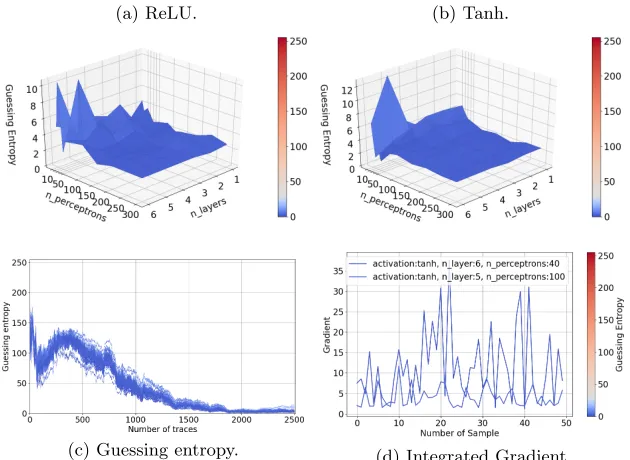
We now reduce the number of features to 50 with the Difference-of-Mean method. We train different MLPs with the traces that have a reduced number of features. We apply the same reduction for the attack dataset and compute guessing entropy, and we show the results in Figure 2.
Fig. 1: ASCAD guessing entropy for the intermediate leakage model.
(a) ReLU. (b) Tanh.
(c) Guessing entropy of all MLP archi-tectures versus the increasing number
of attack traces. (d) Integrated Gradient.
to combine available features in any way that would indicate influence in the classification process.
Fig. 2: ASCAD guessing entropy with a reduced number of features and the intermediate leakage model.
(a) ReLU. (b) Tanh.
(c) Guessing entropy of all MLP archi-tectures versus the increasing number
of attack traces. (d) Integrated Gradient.
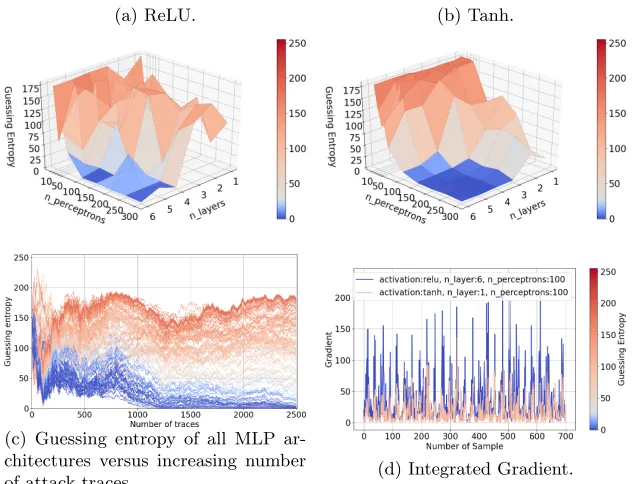
Fig. 3: ASCAD guessing entropy in the Hamming weight leakage model.
(a) ReLU. (b) Tanh.
(c) Guessing entropy of all MLP ar-chitectures versus increasing number
of attack traces. (d) Integrated Gradient.
5.2 AES RD Results
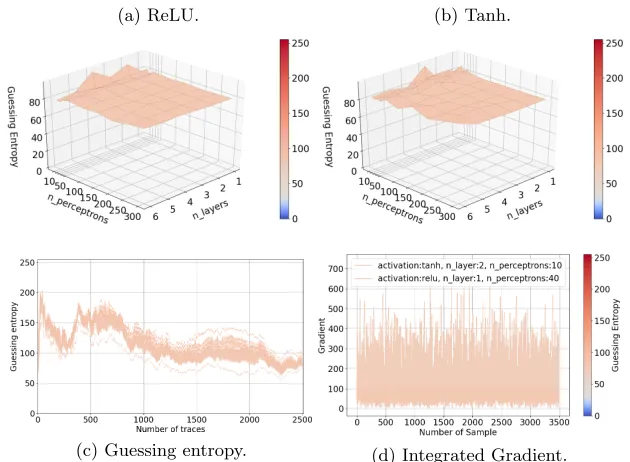
Given the intermediate value leakage model (Figure 5), all MLP architectures, including the smallest ones (one hidden layer with ten perceptrons), are capable of reaching GE below 30 within 2 500 attack traces. Increasing the number of layers does not have an impact on theReLuactivation function. For the T anh activation function, it even seems to increase GE (thus, decreasing the attack performance). For both activation functions, increasing the number of percep-trons per layer decreases GE. Still, from Figure 5c, regardless of the architecture chosen, all MLP settings converge within the same amount of attack traces. This indicates that there is not enough useful information that larger networks can use, and as such, using them brings no performance gain (consequently, there is not much benefit from detailed hyperparameter tuning). The best-fitting model and the median model are both models that fit the dataset correctly. However, from Figure 5d, the integrated gradient method reveals that the two models have very different sensitivity on the input. Such a result could have been expected as the AES RD dataset deals with randomly delayed traces, meaning that the leakage is not located in a precise area of the input.
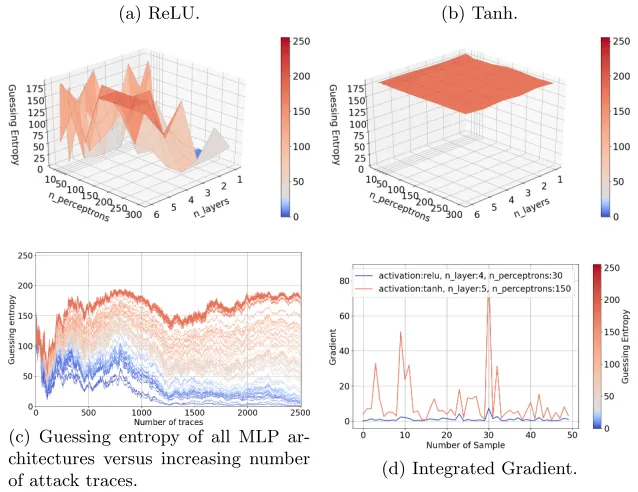
Fig. 4: ASCAD guessing entropy with a reduced number of features and the Hamming weight leakage model.
(a) ReLU. (b) Tanh.
(c) Guessing entropy of all MLP ar-chitectures versus increasing number
of attack traces. (d) Integrated Gradient.
is no useful information in additional features, and that is why MLP cannot perform better even if we use larger/deeper architectures. This is following the expected behavior for the random delay countermeasure as the features are not aligned. Finally, the landscape is smoother for T anh than for ReLU (similar to ASCAD but differing from AES RD with all features). The outcome from Figure 6d is quite similar to the integrated gradient obtained on the raw traces. The gradient values for the two models are more similar, but no maximum or minimum values are the same, meaning that no samples contribute significantly more to the network prediction.
Fig. 5: AES RD guessing entropy for the intermediate leakage model.
(a) ReLU. (b) Tanh.
(c) Guessing entropy. (d) Integrated Gradient.
difficult to talk about features that contribute more to the classification result. No trace samples show a higher sensitivity for the network prediction because of the random delay nature of the dataset.
As no MLP architecture can succeed in the HW leakage model’s attack on the AES RD dataset, we cannot conclude whether more layers or percep-trons would result in improved attack performance. The phenomenon prevent-ing MLPs from obtainprevent-ing good attack performance might be linked to the class imbalance, pointed out by Picek et al. [22], where they obtain similar results for different architectures of MLP using the HW leakage model. Additionally, they observe increasing performance when balancing the training data among the classes.
6
Discussion
Fig. 6: AES RD guessing entropy with a reduced number of features and the intermediate leakage model.
(a) ReLU. (b) Tanh.
(c) Guessing entropy. (d) Integrated Gradient.
start of the encryption execution, a strong leakage of the operation handling the secret information is still present. Consequently, using an MLP is enough to overcome this countermeasure. This result indicates that the current consen-sus in the SCA community on MLP performance should change. Indeed, CNNs are considered especially good for random delay countermeasure and MLP for masking countermeasure. Our results indicate there is no reason not to con-sider MLP successful against the random delay countermeasure. When selecting 50 POIs with a Difference-of-Mean method, the selected points represent only 50/3 500'1% of the original traces in the dataset, and the information about the leakage is reduced. Still, the attack succeeds in the same way, which can be explained because the leakage only comes from the selected POIs. Finally, the integrated gradient is more difficult to interpret as the dataset has randomness in the time domain, which means it becomes difficult to pinpoint a few features with a significant contribution toward the classification result.
Fig. 7: AES RD guessing entropy for the Hamming weight leakage model.
(a) ReLU. (b) Tanh.
(c) Guessing entropy. (d) Integrated Gradient.
not able to recover the full secret key. Still, some MLPs can obtain the secret key in the given number of traces, and we observe that both the number of layers and the number of perceptrons influence their performance. Finally, the performance of MLPs with the Hamming weight leakage model gives better performance than for the intermediate value. The range of hyperparameters that can achieve the best results is smaller than for the intermediate value leakage model. From the integrated gradient perspective, we see that many features contribute to a successful attack, but MLP makes slightly different feature selection than DoM. This is obvious as not all 50 selected features contribute significantly. For the HW leakage model, the integrated gradient is somewhat more aligned, which means that more features in this leakage model contribute similarly. Such a behavior is again expected as the HW leakage model forms larger clusters with S-box output values, where the importance of features is more spread within clusters.
To answer the question of how challenging is the tuning of MLP hyperpa-rameters, we observe that there is nearly no influence using a (relatively) big or small MLP for the AES RD dataset. When considering the ASCAD dataset with the masking countermeasure, depending on the leakage model considered, the size of the MLP can play a significant role. There, either by increasing the number of perceptrons per layer or the number of layers with a fixed number of perceptrons, we can decrease the guessing entropy.
top performance with a smaller number of layers/perceptrons. For the Hamming weight leakage model,T anhseems to work better on average, butReLU reaches top performance with smaller architectures thanT anh. Finally,T anhgives more stable behavior when averaged over all settings, i.e., with the T anh activation function, the hyperparameter tuning seems to be less sensitive. To conclude, ReLU appears to be the preferred option if going for top performance or using smaller architectures. In contrast, T anh should be preferred if stability over a number of scenarios is required.
MLP is (or, at least, can be) a deep learning algorithm that has a simple architecture and a few hyperparameters but can show good performance in the side-channel analysis. What is more, our results show it can break implemen-tations protected with both masking or hiding countermeasures. If there is no sufficient useful input information (as one would expect when dealing with the random delay countermeasure), a reasonable choice is to go with a relatively small architecture. For masked datasets, the number of perceptrons or the num-ber of layers must be large, but the activation function’s choice also plays an important role. Finally, we observe that in all considered scenarios, the MLP architectures are not overly sensitive to the hyperparameter choice, i.e., there does not seem to be a strong motivation to run very fine-grained hyperparameter tuning.
Based on those observations, we list general recommendations for MLP in the profiled SCA context3:
1. Many hyperparameter settings can lead to good performance, which makes the benefit of an exhaustive search very limited.
2. ReLUis better for top performance, whileT anhis more stable over different hyperparameter combinations.
3. Smaller depth of an MLP can be compensated with wider layers.
4. Feature selection such as DoM will, on average, reduce the MLP performance significantly.
5. Integrated gradient is an efficient method for evaluating the influence of features if MLP manages to reach good performance.
6. Simpler leakage models require fewer layers.
7
Conclusions and Future Work
In this paper, we considered the behavior of a multilayer perceptron for profiling side-channel analysis. We investigated two datasets protected with countermea-sures and a number of different MLP architectures concerning three hyperpa-rameters. Our results clearly show that the input information to the MLP plays a crucial role, and if such information is limited, larger/deeper architectures are 3 The recommendations are based on the tested configurations. There is no
not needed. On the other hand, if we can provide high-quality input informa-tion to the MLP, we should also use larger architectures. At the same time, our experiments revealed no need for very fine-grained hyperparameter tuning. While the results for MLP maybe cannot compare with state-of-the-art results for CNNs, we note that they are not far in many cases. If we additionally factor in that MLP is simpler and faster to train, the choice between those two tech-niques becomes even more difficult to make and should depend on additional goals and constraints. For example, reaching the top performance is the argu-ment for the usage of CNNs, but if one requires small yet powerful architecture, a more natural choice seems to be MLP.
In this work, we concentrated on scenarios where each hidden layer has the same number of perceptrons. It would be interesting to investigate the perfor-mance of MLP when each layer could have a different number of perceptrons. Naturally, this opens a question of what combinations of neurons/layers to con-sider as one could quickly come to thousands of possible settings to explore. Similarly, for activation functions, we consider only the two most popular ones where all hidden layers use the same function. It would be interesting to allow different layers to have different activation functions. Recent experiments showed that MLP could outperform CNNs when considering different devices for train-ing and testtrain-ing (i.e., the portability case) [1]. We plan to explore the influence of the hyperparameter choice in those scenarios. Finally, as we already mentioned, MLP architectures are usually simpler than CNNs, which should mean there are easier to understand. We aim to explore whether we can design stronger countermeasures against machine learning based-attacks based on MLP inner working.
References
1. Bhasin, S., Chattopadhyay, A., Heuser, A., Jap, D., Picek, S., Shrivastwa, R.R.: Mind the portability: A warriors guide through realistic profiled side-channel anal-ysis. Cryptology ePrint Archive, Report 2019/661 (2019),https://eprint.iacr. org/2019/661
2. Cagli, E., Dumas, C., Prouff, E.: Convolutional Neural Networks with Data Aug-mentation Against Jitter-Based Countermeasures - Profiling Attacks Without Preprocessing. In: Cryptographic Hardware and Embedded Systems CHES 2017 -19th International Conference, Taipei, Taiwan, September 25-28, 2017, Proceed-ings. pp. 45–68 (2017)
3. Chari, S., Rao, J.R., Rohatgi, P.: Template attacks. In: International Workshop on Cryptographic Hardware and Embedded Systems. pp. 13–28. Springer (2002) 4. Chollet, F., et al.: Keras.https://github.com/fchollet/keras(2015)
5. Collobert, R., Bengio, S.: Links Between Perceptrons, MLPs and SVMs. In: Proceedings of the Twenty-first International Conference on Ma-chine Learning. pp. 23–. ICML ’04, ACM, New York, NY, USA (2004). https://doi.org/10.1145/1015330.1015415, http://doi.acm.org/10.1145/ 1015330.1015415
7. Cybenko, G.: Approximation by superpositions of a sigmoidal function. Mathematics of Control, Signals and Systems 2(4), 303–314 (Dec 1989). https://doi.org/10.1007/BF02551274,https://doi.org/10.1007/BF02551274
8. Gilmore, R., Hanley, N., O’Neill, M.: Neural network based attack on a masked implementation of AES. In: 2015 IEEE International Symposium on Hardware Oriented Security and Trust (HOST). pp. 106–111 (May 2015). https://doi.org/10.1109/HST.2015.7140247
9. Goodfellow, I., Bengio, Y., Courville, A.: Deep Learning. MIT Press (2016),http: //www.deeplearningbook.org
10. Hettwer, B., Gehrer, S., G¨uneysu, T.: Profiled power analysis attacks us-ing convolutional neural networks with domain knowledge. In: Cid, C., Jr., M.J.J. (eds.) Selected Areas in Cryptography - SAC 2018 - 25th Interna-tional Conference, Calgary, AB, Canada, August 15-17, 2018, Revised Se-lected Papers. Lecture Notes in Computer Science, vol. 11349, pp. 479– 498. Springer (2018). https://doi.org/10.1007/978-3-030-10970-7 22, https:// doi.org/10.1007/978-3-030-10970-7_22
11. Heuser, A., Picek, S., Guilley, S., Mentens, N.: Side-channel analysis of lightweight ciphers: Does lightweight equal easy? In: Radio Frequency Identification and IoT Security - 12th International Workshop, RFIDSec 2016, Hong Kong, China, November 30 - December 2, 2016, Revised Selected Papers. pp. 91–104 (2016) 12. Kim, J., Picek, S., Heuser, A., Bhasin, S., Hanjalic, A.: Make some noise.
un-leashing the power of convolutional neural networks for profiled side-channel anal-ysis. IACR Transactions on Cryptographic Hardware and Embedded Systems
2019(3), 148–179 (May 2019). https://doi.org/10.13154/tches.v2019.i3.148-179,
https://tches.iacr.org/index.php/TCHES/article/view/8292
13. Kocher, P.C.: Timing Attacks on Implementations of Diffie-Hellman, RSA, DSS, and Other Systems. In: Proceedings of CRYPTO’96. LNCS, vol. 1109, pp. 104–113. Springer-Verlag (1996)
14. Kocher, P.C., Jaffe, J., Jun, B.: Differential power analysis. In: Proceedings of the 19th Annual International Cryptology Conference on Advances in Cryptology. pp. 388–397. CRYPTO ’99, Springer-Verlag, London, UK, UK (1999),http://dl. acm.org/citation.cfm?id=646764.703989
15. Maghrebi, H., Portigliatti, T., Prouff, E.: Breaking cryptographic implementations using deep learning techniques. In: Security, Privacy, and Applied Cryptography Engineering - 6th International Conference, SPACE 2016, Hyderabad, India, De-cember 14-18, 2016, Proceedings. pp. 3–26 (2016)
16. Mangard, S., Oswald, E., Popp, T.: Power Analysis Attacks: Revealing the Se-crets of Smart Cards. Springer (December 2006), ISBN 0-387-30857-1, http: //www.dpabook.org/
17. Martinasek, Z., Zeman, V.: Innovative method of the power analysis. Radioengi-neering22(2) (2013)
18. Martinasek, Z., Hajny, J., Malina, L.: Optimization of power analysis using neural network. In: Francillon, A., Rohatgi, P. (eds.) Smart Card Research and Advanced Applications. pp. 94–107. Springer International Publishing, Cham (2014) 19. Pfeifer, C., Haddad, P.: Spread: a new layer for profiled deep-learning side-channel
attacks. Cryptology ePrint Archive, Report 2018/880 (2018), https://eprint. iacr.org/2018/880
21. Picek, S., Heuser, A., Guilley, S.: Profiling side-channel analysis in the restricted attacker framework. Cryptology ePrint Archive, Report 2019/168 (2019), https: //eprint.iacr.org/2019/168
22. Picek, S., Heuser, A., Jovic, A., Bhasin, S., Regazzoni, F.: The curse of class imbalance and conflicting metrics with machine learning for side-channel evaluations. IACR Trans. Cryptogr. Hardw. Embed. Syst. 2019(1), 209– 237 (2019). https://doi.org/10.13154/tches.v2019.i1.209-237, https://doi.org/ 10.13154/tches.v2019.i1.209-237
23. Picek, S., Samiotis, I.P., Kim, J., Heuser, A., Bhasin, S., Legay, A.: On the perfor-mance of convolutional neural networks for side-channel analysis. In: Chattopad-hyay, A., Rebeiro, C., Yarom, Y. (eds.) Security, Privacy, and Applied Cryptogra-phy Engineering. pp. 157–176. Springer International Publishing, Cham (2018) 24. Prouff, E., Strullu, R., Benadjila, R., Cagli, E., Dumas, C.: Study of deep learning
techniques for side-channel analysis and introduction to ascad database. Cryptol-ogy ePrint Archive, Report 2018/053 (2018),https://eprint.iacr.org/2018/053
25. Quisquater, J.J., Samyde, D.: Electromagnetic analysis (ema): Measures and counter-measures for smart cards. In: Attali, I., Jensen, T. (eds.) Smart Card Programming and Security. pp. 200–210. Springer Berlin Heidelberg, Berlin, Hei-delberg (2001)
26. Schindler, W., Lemke, K., Paar, C.: A stochastic model for differential side chan-nel cryptanalysis. In: International Workshop on Cryptographic Hardware and Embedded Systems. pp. 30–46. Springer (2005)
27. Standaert, F.X., Malkin, T., Yung, M.: A Unified Framework for the Analysis of Side-Channel Key Recovery Attacks. In: EUROCRYPT. LNCS, vol. 5479, pp. 443–461. Springer (April 26-30 2009), Cologne, Germany
28. Sugawara, T., Homma, N., Aoki, T., Satoh, A.: Profiling attack using multivariate regression analysis. IEICE Electronics Express7(15), 1139–1144 (2010)
29. Sundararajan, M., Taly, A., Yan, Q.: Axiomatic attribution for deep networks. arXiv preprint arXiv:1703.01365 (2017)
30. Timon, B.: Non-profiled deep learning-based side-channel attacks with sensitiv-ity analysis. IACR Transactions on Cryptographic Hardware and Embedded Sys-tems 2019(2), 107–131 (Feb 2019). https://doi.org/10.13154/tches.v2019.i2.107-131,https://tches.iacr.org/index.php/TCHES/article/view/7387