© 2014, IJCSMC All Rights Reserved 415 Available Online atwww.ijcsmc.com
International Journal of Computer Science and Mobile Computing
A Monthly Journal of Computer Science and Information Technology
ISSN 2320–088X
IJCSMC, Vol. 3, Issue. 2, February 2014, pg.415 – 422
RESEARCH ARTICLE
Smart Remote Health Care Data
Collection Server
Kalyani Bangale1, Karishma Nadhe2, Nivedita Gupta3, Swati Singh Parihar4, Gunjan Mankar5
¹CSE & RTMNU, India
2
CSE & RTMNU, India
3
CSE & RTMNU, India
4
CSE & RTMNU, India
5
CSE & RTMNU, India
1
[email protected]; 2 karishmas.nadhe @gmail.com; 3 [email protected];
4
[email protected]; 5 [email protected]
Abstract—This paper presents a method to secure data collection server by protecting and developing backups used for Health Care Cloud. The Objective of Smart Remote Health Care Data Collection Server (SRHDCS) is to provide Auto Response Server, Better Solutions for Data Backup and Restore using Cloud, Availability of data remotely using safer protected data transmission and Confidentiality of data remain intake.
The Smart Remote Health Care Data Collection Server can collect data and send to a centralized repository in a platform independent format without any network consideration. The central repository is also a source for other vendors/depts. to use the information for their specific requirement. The purpose of Smart Remote Health Care Data Collection Server is to help users (basically admin) to collect information from any remote location even if network connectivity is not available at that point of time.
Keywords— Central repository; Remote repository; Cloud Server; Data Backup; Data Restore
I. INTRODUCTION
© 2014, IJCSMC All Rights Reserved 416 feasible solution that collects data and sends it to a centralized storage location smartly and in a platform independent format without any network consideration.
The client application can be ported to any other machine and stored data should be platform independent to be sent to a central repository. The data stored can be encrypted locally to protect from any local copy or theft of device (laptop/handheld device).
Smart remote health care data collection server includes E-Health Care Service which delivers services to doctors and users. This application is powerful, flexible, and easy to use and is designed and developed to deliver benefits to doctors and users. More importantly it is backed by reliable and dependable Health Care Server support. The data backup and restore is done through cloud server.
Today, Cloud Computing is itself a gigantic technology which is surpassing all the previous technology of computing (like cluster, grid, distributed etc.) of this competitive and challenging IT world. The need of cloud computing is increasing day by day as its advantages overcome the disadvantage of various early computing techniques.
Cloud storage provides online storage where data stored in form of virtualized pool that is usually hosted by third parties. The hosting company operates large data on large data centre and according to the requirements of the customer these data centre virtualized the resources and expose them as the storage pools that help user to store files or data objects.
The remaining of this paper is organized as follows, section II provides Literature review, section III provides proposed plan on Smart remote health care data collection server and section IV provides conclusion.
II. LITERATURE REVIEW
In literature, different algorithms are already define for recent back-up and recovery techniques that have been developed in cloud computing domain such as HSDRT[2], PCS[3], ERGOT[4],Linux Box [5], Cold/Hot backup strategy [6] . The following review shows that none of these techniques are able to provide best performances under all circumstances such as cost, security, low implementation complexity, redundancy and recovery in short spanof time.A survey and comparison of these techniques are given as follows.
PCS is comparatively reliable, simple, easy to use and more convenient for data recovery totally based on parity recovery service but it is unable to control the implementation complexities [3]. On the contrary, HSDRT has come out an efficient technique for the movable clients such as laptop but it fails to manage the low cost for the implementation of the recovery and also unable to control the data duplication [2].
Rather, ERGOT provides efficient way of retrieval of that is based on the semantic analysis but is unable to focus on time and implementation complexity [4]. Similarly, we also found that one technique in addition, Linux Box model is having very simple concept of data back-up and recovery with very low cost. However, in this model protection level is very low [5].
All these techniques tried to cover different issues maintaining the cost of implementation data increases i.e. cold and hot back-up strategy [6] that performs backup and recovery on trigger basis of failure detection.
© 2014, IJCSMC All Rights Reserved 417
TABLE I
Comparison between various techniques of Back-up and recovery [7]
Srno. Approach Advantage Disadvantage
1 HSDRT[2] Used for Movable clients like laptop, smart phone
Costly
Increase redundancy 2 Parity Cloud
service[3]
Reliable
Privacy
Low cost
Implementation
Complexity is high
3 ERGOT[4] Perform exact match retrieval
Privacy
Time complexity
Implementation complexity 4 Linux box[5] Simple
Low cost for implementation
Required higher bandwidth
Privacy
Complete server backup at a time 5 Cold/Hot back-up
strategy[6]
Triggered only when failure detected
Cost increases as data increases gradually
III.PROPOSED PLAN
In proposed system, the data which will be lost due to certain conditions like if the system gets physically crash can be recovered using cloud server. These days, it seems like every new IT headline has something to do with this new technology called “Cloud Sever”. Cloud computing systems fundamentally provide access to large amounts of data and computational resources through a variety of interfaces.
Whenever an internal process or system is taken out of the internal datacenter and hosted in a datacenter which is owned by another company, these systems are said to be “moved to the cloud”. Cloud Server consists mainly of two components: clients, and the service providers. Most of the organization including government as well as private can use this software to prevent from data loss permanently. It provides much more security than other system. This software is very flexible and any user can use easily. Its cost is very reliable for any user.
A.Remote Data Backup Server
When we talk about Backup server of main cloud, we only think about the copy of main cloud. When this Backup server is at remote location (i.e. far away from the main server) and having the complete state of the main cloud, then this remote location server is termed as Remote Data Backup Server. The main cloud is termed as the central repository and remote backup cloud is termed as remote repository.
1) Architecture
© 2014, IJCSMC All Rights Reserved 418 And if the central repository lost its data under any circumstances either of any natural calamity (for ex - earthquake, flood, fire etc.) or by human attack or deletion that has been done mistakenly and then it uses the information from the remote repository. The main objective of the remote backup facility is to help user to collect information from any remote location even if network connectivity is not available or if data not found on main cloud. As shown in Fig-1 clients are allowed to access the files from remote repository if the data is not found on central repository (i.e. indirectly).
2) Characteristics of Remote Data Backup Server
The remote data backup server should cover the following characteristics:-
1) Data Integrity:
Data Integrity is concerned with complete state and the whole structure of the server. It verifies that data such that it remains unaltered during transmission and reception. It is the measure of the validity and fidelity of the data present in the server.
2) Data security:
Giving full protection to the client’s data is also the utmost priority for the remote server. And either intentionally or unintentionally, it should be not able to access by third party or any other users/client’s.
3) Data Confidentiality:
Sometimes client’s data files should be kept confidential such that if number of users simultaneously accessing the cloud, then data files that are personal to only particular client must be able to hide from other clients on the cloud during accessing of file.
4) Trustworthiness:
The remote cloud must possess the Trustworthiness characteristic. Because the user/client stores their private data; therefore the cloud and remote backup cloud must play a trustworthy role.
5) Cost efficiency:
The cost of process of data recovery should be efficient so that maximum number of company/clients can take advantage of back-up and recovery service.
B. Smart Remote Health Care Data Collection Server
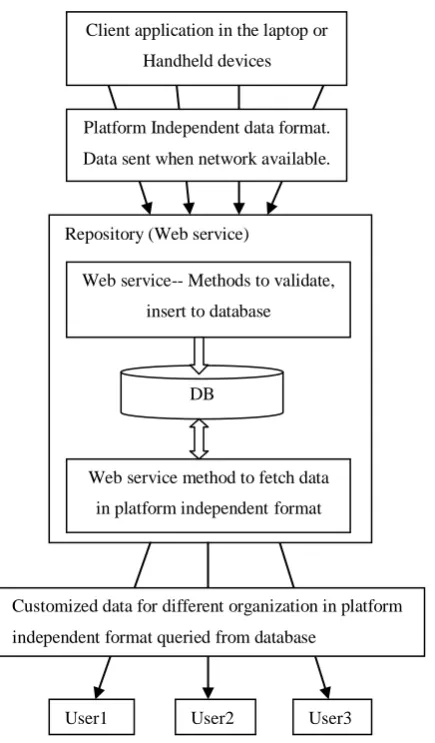
Smart Remote Health Care Data Collection Sever is an E-Health Care Service which delivers services to doctors and users (patients).It is powerful, flexible, and easy to use and is designed and developed to deliver benefits to doctors and users. More importantly it is backed by reliable and dependable Health Care Server support.Following shows the work flow of the proposed system.
© 2014, IJCSMC All Rights Reserved 419
Fig2. Work flow of Smart Remote Health Care Data Collection Server
The Architecture of the Smart Remote Data Collection Server is shown in Figure 1. This figure shows the essential components of the architecture: Client application, Repository (web service), main database, users.
The client application can be ported to any other machine like laptop or handheld devices. The stored data is platform independent that are sent to a central repository. When connected to network, the client application is authenticate into a central repository using a web service and submit all collected information.
The web service will expose the methods to do the following things:-
The central repository will verify the user and the information before uploading the data to the database.
The central repository is independent and thus it is able to collect application data from various application similarly as in a platform independent way.
The information of each data uploads like the user information, the time of upload etc are captured.
The central repository will handle multiple requests from different users at a time. Since, the central repository is independent of any type application; ie it will only
collect information in a platform independent format and stores it in the appropriate location in the database.
Platform Independent data format.
Data sent when network available. Client application in the laptop or
Handheld devices
Repository (Web service)
Web service-- Methods to validate,
insert to database
DB
Web service method to fetch data
in platform independentformat
Customized data for different organization in platform
independent format queried from database
© 2014, IJCSMC All Rights Reserved 420
The data stored in the database later can be shared to different other sources in a platform independent way. The information shared can also be customized according to the receiver.
The data stored are encrypted locally to protect from any local copy or theft of devices (eg.laptop/handheld device).Also all the validations are applied on the platform independent format before inserting it into the centralized repository (database).
Therefore this architecture provides a solution that collects data and sends it to a centralized storage location smartly and in a platform independent format. It help user to collect information from any remote location even if network connectivity is not available or if data not found on main cloud.
C. Algorithm Technique
The algorithm technique in Smart Remote Health Care Data Collection Server is Seed Block Algorithm (SBA) which focuses on simplicity of the back-up and recovery process. It basically uses the concept of Exclusive-OR (XOR) operation of the computing world. Suppose there are two data files: A and B. When we XOR A and B it produced X i.e. X = A XOR B. If suppose A data file get destroyed and we want A data file back then it is very easy to get back it with the help of B and X data file .i.e. A = X XOR B.
a) Original file b) EXORed file c) Recovered file Fig3. Sample output image of SBA Algorithm
As fig-4 (a) shows the original file which is uploaded by the client on main cloud. Fig-4
(b) shows the EXORed file which is stored on the remote server. This file contains the secured EXORed content of original file and seed block content of the corresponding client. Fig-4 (c) shows the recovered file; which indirectly sent to client in the absence of network connectivity and in case of the file deletion or if the cloud gets destroyed due to any reason.
D.Role of Internal & External Users
Users of Smart Remote Health Care Data Collection server are as follows 1) Internal user (local user): Administrator and Doctors (Local & Specialist) 2) External user (global user): Patient
© 2014, IJCSMC All Rights Reserved 421
Fig4. Users and Roles
Fig.4 shows two main users of the system that is internal user and external user. Internal user consists of administrator and doctors. The second main user is external user that consist of patients or general user. Data related to both internal user and external user is stored in the database. Then backup from this database is taken into the cloud server and if required data can be restored from the cloud server.
Modules of Smart Remote Health Care Data Collection Server
This paper basically focuses on providing facilities to the administrator to backup and restore data from cloud server. Following modules have been incorporated within this utility:
1) Users:
In the first module of our project we have designed the main window in which user can login and register them. After getting authenticated user can access and process their data. The user can also store their data onto web server in their account.
2) Admin :
In the second module, Admin will maintain records, make settings as per requirement Admin will handle web server and cloud server. Data backup and restore can be done automatically and manually by Admin .
3) Data Processing Web Server:
In the third module, Data Processing web server can handle multiple requests from different users at a time. It is independent and thus able to collect application data from various application in a platform independent way. It will verify user before uploading the data & data which is stored in the database later can be shared to different other and information shared is customized according to the receiver.
4) Data Backup/Restore Cloud Server:
© 2014, IJCSMC All Rights Reserved 422 E. Advantages of Smart Remote Health Care Data Collection Server :
Flexibility: Any new facility or the new work can be added easily. It is extremely adaptable, with the ability to be used in a variety of environments.
Portability: It can work in any environment thus it is able to collect application data from various application similarly as in a platform independent way.
Fastness: Faster than the manual system, this system is less time consuming and more efficient than other system.
User friendly: Specific flow of the information so, user friendly, this system is more user friendly than other system enables sharing of resources and costs across a large pool of users.
Proper Backup Facility: Database is centralized, recover same size data.
Reliability: It possesses the reliability characteristic. Because the user/client stores their private data; therefore the cloud and remote backup cloud must play a reliable role. Reliability is improved if multiple redundant sites are used, which makes well-designed cloud computing suitable for business continuity and disaster recovery.
Maintenance: It is easy to maintain because of cloud computing application, they do not need to be installed on each user's computer and can be accessed from different places.
IV.CONCLUSIONS
Due to computerization and availability of data from remote location , vast amount of data is going to be collected on the web servers. It helps in reducing allocation of geographical area required for storing records and also promotes paperless work. Time consumed for searching required documents is less. Every organization prefers computerization as well as remotely accessible web services. Hence data security and protection comes in highest priority so recent developments will be on securing and protecting data collection on web server. Thus, Smart Remote Health Care Data Collection aims the same.
REFERENCES
[1] Harsha Girish Chandra, 2008, “Remote Data Collection and Analysis using Mobile Agents and Service- Oriented Architectures” North Carolina State University.
[2] Yoichiro Ueno, Noriharu Miyaho, Shuichi Suzuki,Muzai Gakuendai,Inzai-shi, Chiba,Kazuo Ichihara, Oriented Architectures” North Carolina State University “Performance Evaluation of a Disaster Recovery System and Practical Network SystemApplications ”, Fifth International Conference on Systems Networks Communications.
[3] Chi-won Song, Sungmin Park, Dong-wook Kim, Sooyong Kang, 2011, “Parity Cloud Service: A Privacy- Protected Personal Data Recovery Service,” International Joint Conference of IEEETrustCom-11/IEEE. ICESS-11/FCST-11
[4] Giuseppe Pirr´o, Paolo Trunfio , Domenico Talia, Paolo Missier andCarole Goble, 2010, “ERGOT: A Semantic-based System for ServiceDiscovery in Distributed Infrastructures,” 10th IEEE/ACMInternational Conference on Cluster, Cloud and GridComputing.
[5] Vijaykumar Javaraiah Brocade Advanced Networks andTelecommunication Systems (ANTS), 2011, “ Backup for Cloud and Disaster Recovery for Consumers and SMBs,” IEEE 5th InternationalConference, 2011.
[6] Lili Sun, Jianwei An, Yang Yang, Ming Zeng, 2011, “RecoveryStrategies for Service Composition in
Dynamic Network,”International Conference on Cloud and Service Computing.
![TABLE I Comparison between various techniques of Back-up and recovery [7]](https://thumb-us.123doks.com/thumbv2/123dok_us/1994281.1263960/3.595.180.424.596.749/table-i-comparison-various-techniques-recovery.webp)