Non-adiabatic pulsations in ESTER models
Daniel RoyReese1,,Marc-AntoineDupret2, andMichelRieutord3,4
1LESIA, Observatoire de Paris, PSL Research University, CNRS, Sorbonne Universités, UPMC Univ. Paris 06, Univ. Paris Diderot, Sorbonne Paris Cité, 92195 Meudon, France
2Institut d’Astrophysique et Géophysique de l’Université de Liège, Allée du 6 août 17, 4000 Liège, Belgium 3Université de Toulouse, UPS-OMP, IRAP, 31028 Toulouse, France
4CNRS, IRAP, 14 avenue Edouard Belin, 31400 Toulouse, France
Abstract.One of the greatest challenges in interpreting the pulsations of rapidly rotating stars is mode identifi-cation, i.e. correctly matching theoretical modes to observed pulsation frequencies. Indeed, the latest observa-tions as well as current theoretical results show the complexity of pulsation spectra in such stars, and the lack of easily recognisable patterns. In the present contribution, the latest results on non-adiabatic effects in such pulsations are described, and we show how these come into play when identifying modes. These calculations fully take into account the effects of rapid rotation, including centrifugal distortion, and are based on models from the ESTER project, currently the only rapidly rotating models in which the energy conservation equation is satisfied, a prerequisite for calculating non-adiabatic effects. Non-adiabatic effects determine which modes are excited and play a key role in the near-surface pulsation-induced temperature variations which intervene in multi-colour amplitude ratios and phase differences, as well as line profile variations.
1 Introduction
The interpretation of pulsation spectra in rapidly rotating stars has proven to be a considerable challenge. Indeed, due to the lack of simple and easily identifiable pattern in the pulsation spectra, it has been very difficult to estab-lish the correspondence between observed pulsation fre-quencies and theoretically calculated modes, i.e. to carry out mode identification [1]. This is extremely problem-atic since it means we do not know what regions of the star are being probed by individual modes, and cannot, ac-cordingly, carry out meaningful inversions of the stellar structure. Nonetheless, [2] and [3] have recently shown the presence of patterns in the period spacings of rapidly rotatingγDor stars, which agree with the most recent the-oretical expectations [4–6] and allow us, in some cases, to determine the dominant harmonic degree and azimuthal order of these modes. ForδScuti stars, progress remains more limited. In a recent paper, [7] derived an observa-tional scaling relation between the large frequency separa-tion and the mean density of severalδScuti stars in eclips-ing binary systems, in agreement with previous theoreti-cal predictions [8]. Such large separations have also been used to create echelle diagrams [9,10]. However, no firm identification has been obtained for individual modes.
As such, it is necessary to develop ways to obser-vationally constrain mode identification, in addition to searching for patterns in the observed frequency spectra. In slowly rotating stars, amplitude ratios and phases
e-mail: [email protected]
ferences based on multi-colour photometry, as well as line profile variations observed via spectroscopy, have proven to be popular methods for constraining mode identification [11,12]. Various efforts have been made to extend these methods to rapid rotators, but it is only recently that all of the necessary ingredients are starting to come together. These include:
1. rapidly rotating models in which the energy conser-vation equation is satisfied. Indeed, this is important for carrying out self-consistent non-adiabatic pulsa-tion calculapulsa-tions as will be described in the follow-ing point. Currently the only code able to produce such models is the ESTER1project2[13–15].
2. non-adiabatic pulsation calculations which fully take into account the effects of rapid rotation. In-deed, these can be used to predict which modes are excited by the κ-mechanism, the predominant mode-excitation mechanism in rapid rotators. Fur-thermore, only such calculations provide realis-tic pulsation-induced surface effective temperature variations, a key ingredient in photometric and spec-troscopic mode signatures [11, 16]. Up until re-cently, the only non-adiabatic code which fully takes into account the effects of rotation was that of [17]. However, this code was generally applied with a limited number of spherical harmonics to models
1“Evolution STEllaire en Rotation”
based on a Chandrasekhar expansion, or even spher-ical models. This has, however, changed with the advent of the non-adiabatic version of the TOP code [18,19], currently the only code which is set up to calculate pulsation modes in ESTER models.
3. detailed calculations of photometric mode visibili-ties and spectroscopic line profile variations (LPVs). Recently, [20] carried out detailed mode visibility calculations in rapidly rotating SCF models [21]. However these calculations, now need to be ex-tended to the non-adiabatic case as described above. Probably the most realistic LPV calculations in rapidly rotating stars are those of [22], but were nonetheless carried out using the traditional approx-imation. Other calculations [23] fully include the effects of rotation on pulsations but use a simplified modelling of spectroscopic effects.
In the following, we describe the latest non-adiabatic pulsation calculations in ESTER models using the TOP code (Section 2), and some of the results for mode-excitation, mode visibilities, and line profile variations (Section3).
2 Theory
2.1 ESTER models
The results presented in the following sections are based on 9 MESTER models with rotation rates ranging from 0.0 to 0.8ΩK, whereΩKis the Keplerian break-up rotation rate. These models have a metallicity ofZ = 0.025 and use OPAL opacities. They harbourβCep type pulsations, in the p and g-mode range, which are excited by the iron opacity bump at log(T)=5.3.
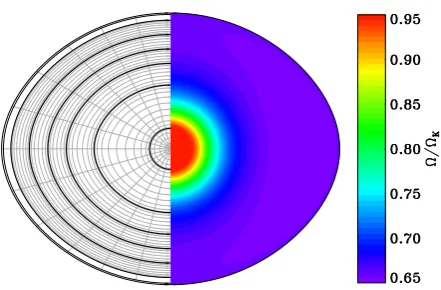
Models from the ESTER project fully take into ac-count the effects of rotation. These include: centrifu-gal deformation, gravity darkening, and baroclinic ef-fects which result from the mismatch between isobars and isotherms (given that the temperature profile is determined via the energy conservation equation). These effects lead to meridional circulation as well as differential rotation which depends both on rand θ, as illustrated in Fig. 1. From a numerical point of view, the ESTER code uses a multi-domain spectral approach with Chebyshev polyno-mials in the radial direction, and spherical harmonics in the horizontal directions. The multi-domain approach is illustrated in Fig.1.
2.2 Non-adiabatic pulsations
The set of non-adiabatic pulsation equations implemented in the TOP code are the perturbed continuity Equation, Euler’s equation, Poisson’s equation, the perturbed energy conservation equation, and the perturbed energy flux
equa-Figure 1:Multi-domain coordinate system and 2D rotation pro-file in an ESTER model.
tion:
0 = δρ ρ0 +
∇ ·ξ (1)
0 = [ω+mΩ]2ξ−2iΩ ×[ω+mΩ]ξ
−Ω ×Ω ×ξ−ξ·∇Ω2e
−P0ρ
0 ∇ δP P0
+∇P0 ρ0
δρ ρ0 −
δP P0 −∇Ψ +∇ ξ· ∇P0
ρ0 +
ξ·∇P0∇ρ0−ξ·∇ρ0∇P0
ρ20 (2)
0 = ∆Ψ−4πG
ρ0δρρ
0 −ξ·
∇ρ0
(3)
0 = −i[ω+mΩ]ρ0T0δS +0ρ0 δ 0 + δρ ρ0
−∇ · δ F+ξ·∇∇ ·F0 −∇ ·ξ·∇F0 (4)
δ FR =
(1+χT)δT
T0 +χρ δρ ρ0
FR
0 −χ0
T0∇
δT
T0
+ξ·∇∇T0−∇ξ·∇T0 (5)
whereρis the density,ξthe Lagrangian displacement,ω the pulsation frequency,mthe azimuthal order,Ωthe ro-tation profile (which depends onrandθ),Ω the rotation vector (i.e.Ωez),the distance from the rotation axis,P the pressure,Ψthe gravitational potential,T the tempera-ture,S the entropy,the nuclear energy generation rate,F the energy flux,FRthe radiative energy flux,χthe
opac-ity,χT the logarithmic derivative ofχwith respect toT, i.e. ∂χ
based on a Chandrasekhar expansion, or even spher-ical models. This has, however, changed with the advent of the non-adiabatic version of the TOP code [18,19], currently the only code which is set up to calculate pulsation modes in ESTER models.
3. detailed calculations of photometric mode visibili-ties and spectroscopic line profile variations (LPVs). Recently, [20] carried out detailed mode visibility calculations in rapidly rotating SCF models [21]. However these calculations, now need to be ex-tended to the non-adiabatic case as described above. Probably the most realistic LPV calculations in rapidly rotating stars are those of [22], but were nonetheless carried out using the traditional approx-imation. Other calculations [23] fully include the effects of rotation on pulsations but use a simplified modelling of spectroscopic effects.
In the following, we describe the latest non-adiabatic pulsation calculations in ESTER models using the TOP code (Section 2), and some of the results for mode-excitation, mode visibilities, and line profile variations (Section3).
2 Theory
2.1 ESTER models
The results presented in the following sections are based on 9 MESTER models with rotation rates ranging from 0.0 to 0.8ΩK, whereΩKis the Keplerian break-up rotation rate. These models have a metallicity ofZ = 0.025 and use OPAL opacities. They harbourβCep type pulsations, in the p and g-mode range, which are excited by the iron opacity bump at log(T)=5.3.
Models from the ESTER project fully take into ac-count the effects of rotation. These include: centrifu-gal deformation, gravity darkening, and baroclinic ef-fects which result from the mismatch between isobars and isotherms (given that the temperature profile is determined via the energy conservation equation). These effects lead to meridional circulation as well as differential rotation which depends both on r andθ, as illustrated in Fig. 1. From a numerical point of view, the ESTER code uses a multi-domain spectral approach with Chebyshev polyno-mials in the radial direction, and spherical harmonics in the horizontal directions. The multi-domain approach is illustrated in Fig.1.
2.2 Non-adiabatic pulsations
The set of non-adiabatic pulsation equations implemented in the TOP code are the perturbed continuity Equation, Euler’s equation, Poisson’s equation, the perturbed energy conservation equation, and the perturbed energy flux
equa-Figure 1:Multi-domain coordinate system and 2D rotation pro-file in an ESTER model.
tion:
0 = δρ ρ0 +
∇ ·ξ (1)
0 = [ω+mΩ]2ξ−2iΩ ×[ω+mΩ]ξ
−Ω ×Ω ×ξ−ξ·∇Ω2e
−P0ρ
0 ∇ δP P0
+∇P0 ρ0
δρ ρ0 −
δP P0 −∇Ψ +∇ ξ· ∇P0
ρ0 +
ξ·∇P0∇ρ0−ξ·∇ρ0∇P0
ρ20 (2)
0 = ∆Ψ−4πG
ρ0δρρ
0 −ξ·
∇ρ0
(3)
0 = −i[ω+mΩ]ρ0T0δS +0ρ0 δ 0 + δρ ρ0
−∇ · δ F+ξ·∇∇ · F0 −∇ ·ξ·∇F0 (4)
δ FR =
(1+χT)δT
T0 +χρ δρ ρ0
FR
0 −χ0
T0∇
δT
T0
+ξ·∇∇T0−∇ξ·∇T0 (5)
whereρis the density,ξthe Lagrangian displacement,ω the pulsation frequency,mthe azimuthal order,Ωthe ro-tation profile (which depends onrandθ),Ω the rotation vector (i.e.Ωez),the distance from the rotation axis,P the pressure,Ψthe gravitational potential,T the tempera-ture,S the entropy,the nuclear energy generation rate,F the energy flux,FRthe radiative energy flux,χthe
opac-ity,χT the logarithmic derivative ofχwith respect toT, i.e. ∂χ
though we do note that [31] proposed an alternate mode identification strategy in such stars.
Figure 8:Amplitude ratios for an=3 multiplet at an inclina-tion ofi=30◦(upper panel) and for an (,m)=(2,0) mode at 4 different inclinations (lower panel).
3.3 Line profile variations (LPVs)
Another way of constraining mode identification is through LPVs. In the present case, we reuse some of the formulas from [20] with an additional Doppler term from both the stellar rotation and the oscillatory movements. The ray profile is modelled in crude way using a black-body spectrum (thereby accounting for gravity darkening) as a background and a Gaussian profile as an intrinsic ab-sorption ray. Furthermore, the contributions ofδTeff and
δgeff are neglected as are any dependence of the
absorp-tion ray on Teff andgeff. A rudimentary description of
limb-darkening is also included.
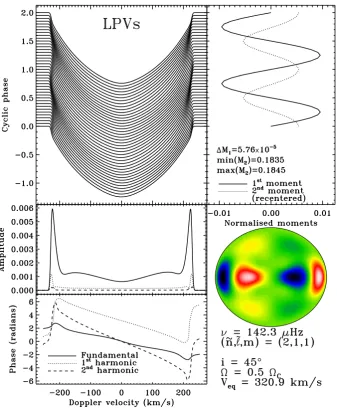
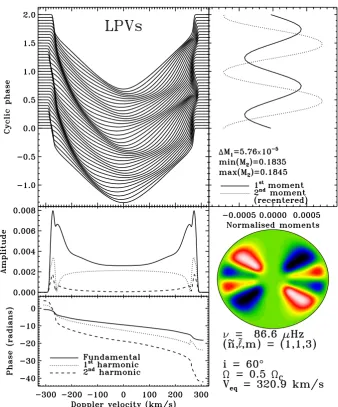
Figures 9 and 10 show two examples of LPVs cal-culated in a model rotating at 0.5ΩK. These plots also contain the first and second moments, the amplitudes and phases of the first three harmonics of the variations for a particular Doppler position, and a meridional cross-section of the modes. A note worthy feature is that most of the variations take place in the wings of the absorption ray, which is different than what takes place in the non-rotating
case. This feature is fairly frequent at rapid rotations and has been suggested as a possible explanation for macro-turbulence in massive stars (Aerts, private communica-tion).
4 Conclusions
The ability to carry out non-adiabatic pulsation calcula-tions in rapidly rotating stars is an important step forward in being able to understand and interpret seismic data for such stars. Indeed, it is now possible to predict which modes are excited, and it will lead to more realistic pre-dictions for amplitude ratios, phase differences, and line profile variations. The next steps forward include: gain-ing a better understandgain-ing of how rotation interacts with non-adiabatic effects, understanding what causes the dif-ferences between prograde and retrograde modes, includ-ing a realistic atmosphere in the stellar model when cal-culating amplitude ratios and line profile variations, and identifying modes in observed spectra using multi-colour photometry and spectroscopy.
Acknowledgements
DRR acknowledges financial support from the "Programme Na-tional de Physique Stellaire" (PNPS) of CNRS/INSU, France.
References
[1] M.J. Goupil, M.A. Dupret, R. Samadi, T. Boehm, E. Alecian, J.C. Suarez, Y. Lebreton, C. Catala, JA&A26, 249 (2005)
[2] T.R. Bedding, S.J. Murphy, I.L. Colman, D.W. Kurtz,
Échelle diagrams and period spacings of g modes in
γDoradus stars from four years of Kepler
observa-tions, inEuropean Physical Journal Web of Confer-ences(2015), Vol. 101 ofEuropean Physical Journal Web of Conferences, p. 01005
[3] T. Van Reeth, A. Tkachenko, C. Aerts, A&A 593, A120 (2016)
[4] J. Ballot, F. Lignières, V. Prat, D.R. Reese, M. Rieu-tord, 2D Computations of g-modes in Fast Rotat-ing Stars, inProgress in Solar/Stellar Physics with
Helio- and Asteroseismology, edited by H. Shiba-hashi, M. Takata, A.E. Lynas-Gray (2012), Vol. 462 ofAstronomical Society of the Pacific Conference Se-ries, p. 389
[5] M.P. Bouabid, M.A. Dupret, S. Salmon, J. Montal-bán, A. Miglio, A. Noels, MNRAS429, 2500 (2013) [6] R.M. Ouazzani, S.J.A.J. Salmon, V.L. Antoci, T.R. Bedding, S.J. Murphy, I.W. Roxburgh, MNRAS (2016), in press, astro-ph.SR:1610.06184
[7] A. García Hernández, S. Martín-Ruiz, M.J.P.F.G. Monteiro, J.C. Suárez, D.R. Reese, J. Pascual-Granado, R. Garrido,811, L29 (2015)
though we do note that [31] proposed an alternate mode identification strategy in such stars.
Figure 8:Amplitude ratios for an=3 multiplet at an inclina-tion ofi=30◦(upper panel) and for an (,m)=(2,0) mode at 4 different inclinations (lower panel).
3.3 Line profile variations (LPVs)
Another way of constraining mode identification is through LPVs. In the present case, we reuse some of the formulas from [20] with an additional Doppler term from both the stellar rotation and the oscillatory movements. The ray profile is modelled in crude way using a black-body spectrum (thereby accounting for gravity darkening) as a background and a Gaussian profile as an intrinsic ab-sorption ray. Furthermore, the contributions ofδTeff and
δgeff are neglected as are any dependence of the
absorp-tion ray on Teff andgeff. A rudimentary description of
limb-darkening is also included.
Figures 9 and 10 show two examples of LPVs cal-culated in a model rotating at 0.5ΩK. These plots also contain the first and second moments, the amplitudes and phases of the first three harmonics of the variations for a particular Doppler position, and a meridional cross-section of the modes. A note worthy feature is that most of the variations take place in the wings of the absorption ray, which is different than what takes place in the non-rotating
case. This feature is fairly frequent at rapid rotations and has been suggested as a possible explanation for macro-turbulence in massive stars (Aerts, private communica-tion).
4 Conclusions
The ability to carry out non-adiabatic pulsation calcula-tions in rapidly rotating stars is an important step forward in being able to understand and interpret seismic data for such stars. Indeed, it is now possible to predict which modes are excited, and it will lead to more realistic pre-dictions for amplitude ratios, phase differences, and line profile variations. The next steps forward include: gain-ing a better understandgain-ing of how rotation interacts with non-adiabatic effects, understanding what causes the dif-ferences between prograde and retrograde modes, includ-ing a realistic atmosphere in the stellar model when cal-culating amplitude ratios and line profile variations, and identifying modes in observed spectra using multi-colour photometry and spectroscopy.
Acknowledgements
DRR acknowledges financial support from the "Programme Na-tional de Physique Stellaire" (PNPS) of CNRS/INSU, France.
References
[1] M.J. Goupil, M.A. Dupret, R. Samadi, T. Boehm, E. Alecian, J.C. Suarez, Y. Lebreton, C. Catala, JA&A26, 249 (2005)
[2] T.R. Bedding, S.J. Murphy, I.L. Colman, D.W. Kurtz,
Échelle diagrams and period spacings of g modes in
γDoradus stars from four years of Kepler
observa-tions, inEuropean Physical Journal Web of Confer-ences(2015), Vol. 101 ofEuropean Physical Journal Web of Conferences, p. 01005
[3] T. Van Reeth, A. Tkachenko, C. Aerts, A&A 593, A120 (2016)
[4] J. Ballot, F. Lignières, V. Prat, D.R. Reese, M. Rieu-tord, 2D Computations of g-modes in Fast Rotat-ing Stars, in Progress in Solar/Stellar Physics with
Helio- and Asteroseismology, edited by H. Shiba-hashi, M. Takata, A.E. Lynas-Gray (2012), Vol. 462 ofAstronomical Society of the Pacific Conference Se-ries, p. 389
[5] M.P. Bouabid, M.A. Dupret, S. Salmon, J. Montal-bán, A. Miglio, A. Noels, MNRAS429, 2500 (2013) [6] R.M. Ouazzani, S.J.A.J. Salmon, V.L. Antoci, T.R. Bedding, S.J. Murphy, I.W. Roxburgh, MNRAS (2016), in press, astro-ph.SR:1610.06184
[7] A. García Hernández, S. Martín-Ruiz, M.J.P.F.G. Monteiro, J.C. Suárez, D.R. Reese, J. Pascual-Granado, R. Garrido,811, L29 (2015)
Figure 9:Line profile variations for an (n, ,m)=(1,3,1) mode (top left panel), first and second moments (top right panel), amplitudes and phases of the first three harmonics of the variations across the line profile (lower left panels), and meridional cross-section of the mode (lower right panel).
[9] A. García Hernández, A. Moya, E. Michel, J.C. Suárez, E. Poretti, S. Martín-Ruíz, P.J. Amado, R. Garrido, E. Rodríguez, M. Rainer et al., A&A559, A63 (2013)
[10] M. Paparó, J.M. Benk˝o, M. Hareter, J.A. Guzik, ApJS224, 41 (2016)
[11] M.A. Dupret, J. De Ridder, P. De Cat, C. Aerts, R. Scuflaire, A. Noels, A. Thoul, A&A 398, 677 (2003)
[12] W. Zima, D. Wright, J. Bentley, P.L. Cottrell, U. Heiter, P. Mathias, E. Poretti, H. Lehmann, T.J. Montemayor, M. Breger, A&A455, 235 (2006) [13] M. Rieutord, F. Espinosa Lara,Ab Initio Modelling
of Steady Rotating Stars, inLecture Notes in Physics, Berlin Springer Verlag, edited by M. Goupil, K. Belkacem, C. Neiner, F. Lignières, J.J. Green (2013), Vol. 865 ofLecture Notes in Physics, Berlin
Springer Verlag, p. 49
[14] F. Espinosa Lara, M. Rieutord, A&A 552, A35 (2013)
[15] M. Rieutord, F. Espinosa Lara, B. Putigny, Journal of Computational Physics318, 277 (2016)
[16] M. Dupret, J. De Ridder, C. Neuforge, C. Aerts, R. Scuflaire, A&A385, 563 (2002)
[17] U. Lee, I. Baraffe, A&A301, 419 (1995)
[18] D. Reese, F. Lignières, M. Rieutord, A&A455, 621 (2006)
[19] D.R. Reese, K.B. MacGregor, S. Jackson, A. Sku-manich, T.S. Metcalfe, A&A506, 189 (2009) [20] D.R. Reese, V. Prat, C. Barban, C. van ’t
Veer-Menneret, K.B. MacGregor, A&A550, A77 (2013) [21] K.B. MacGregor, S. Jackson, A. Skumanich, T.S.
Metcalfe, ApJ663, 560 (2007)
[22] R.H.D. Townsend, MNRAS284, 839 (1997)
Figure 10:Same as Fig.9but for the (n, ,m)=(0,6,3) mode.
[23] M.J. Clement,Pulsation in Rapidly Rotating Stars, inIAU Symp. 162: Pulsation; Rotation; and Mass Loss in Early-Type Stars, edited by L.A. Balona, H.F. Henrichs, J.M. Le Contel (1994), p. 117
[24] U. Lee, Pulsational Stability of Rotating Stars, in
American Institute of Physics Conference Series, edited by V. Mioc, C. Dumitrche, N.A. Popescu (2008), Vol. 1043 of American Institute of Physics Conference Series, pp. 344–350
[25] D.R. Reese,Internal rapid rotation and its implica-tions for stellar structure and pulsaimplica-tions, in Euro-pean Physical Journal Web of Conferences (2015), Vol. 101 ofEuropean Physical Journal Web of Con-ferences, p. 05007
[26] F. Lignières, B. Georgeot, A&A500, 1173 (2009)
[27] R.M. Ouazzani, I.W. Roxburgh, M.A. Dupret, A&A
579, A116 (2015)
[28] A. Claret, A&A363, 1081 (2000)
[29] J. Daszy´nska-Daszkiewicz, W.A. Dziembowski, A.A. Pamyatnykh, M.J. Goupil, A&A 392, 151 (2002)
[30] R.H.D. Townsend, MNRAS343, 125 (2003) [31] D.R. Reese, F. Lignières, J. Ballot, V. Prat, C.
Bar-ban, C. van’t Veer-Menneret, K.B. MacGregor,Mode Visibilities and Frequency Patterns in Rapidly Rotat-ing Stars, inProgress in Physics of the Sun and Stars: A New Era in Helio- and Asteroseismology, edited by H. Shibahashi, A.E. Lynas-Gray (2013), Vol. 479 of
Figure 9:Line profile variations for an (n, ,m)=(1,3,1) mode (top left panel), first and second moments (top right panel), amplitudes and phases of the first three harmonics of the variations across the line profile (lower left panels), and meridional cross-section of the mode (lower right panel).
[9] A. García Hernández, A. Moya, E. Michel, J.C. Suárez, E. Poretti, S. Martín-Ruíz, P.J. Amado, R. Garrido, E. Rodríguez, M. Rainer et al., A&A559, A63 (2013)
[10] M. Paparó, J.M. Benk˝o, M. Hareter, J.A. Guzik, ApJS224, 41 (2016)
[11] M.A. Dupret, J. De Ridder, P. De Cat, C. Aerts, R. Scuflaire, A. Noels, A. Thoul, A&A 398, 677 (2003)
[12] W. Zima, D. Wright, J. Bentley, P.L. Cottrell, U. Heiter, P. Mathias, E. Poretti, H. Lehmann, T.J. Montemayor, M. Breger, A&A455, 235 (2006) [13] M. Rieutord, F. Espinosa Lara,Ab Initio Modelling
of Steady Rotating Stars, inLecture Notes in Physics, Berlin Springer Verlag, edited by M. Goupil, K. Belkacem, C. Neiner, F. Lignières, J.J. Green (2013), Vol. 865 ofLecture Notes in Physics, Berlin
Springer Verlag, p. 49
[14] F. Espinosa Lara, M. Rieutord, A&A 552, A35 (2013)
[15] M. Rieutord, F. Espinosa Lara, B. Putigny, Journal of Computational Physics318, 277 (2016)
[16] M. Dupret, J. De Ridder, C. Neuforge, C. Aerts, R. Scuflaire, A&A385, 563 (2002)
[17] U. Lee, I. Baraffe, A&A301, 419 (1995)
[18] D. Reese, F. Lignières, M. Rieutord, A&A455, 621 (2006)
[19] D.R. Reese, K.B. MacGregor, S. Jackson, A. Sku-manich, T.S. Metcalfe, A&A506, 189 (2009) [20] D.R. Reese, V. Prat, C. Barban, C. van ’t
Veer-Menneret, K.B. MacGregor, A&A550, A77 (2013) [21] K.B. MacGregor, S. Jackson, A. Skumanich, T.S.
Metcalfe, ApJ663, 560 (2007)
[22] R.H.D. Townsend, MNRAS284, 839 (1997)
Figure 10:Same as Fig.9but for the (n, ,m)=(0,6,3) mode.
[23] M.J. Clement,Pulsation in Rapidly Rotating Stars, inIAU Symp. 162: Pulsation; Rotation; and Mass Loss in Early-Type Stars, edited by L.A. Balona, H.F. Henrichs, J.M. Le Contel (1994), p. 117
[24] U. Lee, Pulsational Stability of Rotating Stars, in
American Institute of Physics Conference Series, edited by V. Mioc, C. Dumitrche, N.A. Popescu (2008), Vol. 1043 of American Institute of Physics Conference Series, pp. 344–350
[25] D.R. Reese,Internal rapid rotation and its implica-tions for stellar structure and pulsaimplica-tions, in Euro-pean Physical Journal Web of Conferences (2015), Vol. 101 ofEuropean Physical Journal Web of Con-ferences, p. 05007
[26] F. Lignières, B. Georgeot, A&A500, 1173 (2009)
[27] R.M. Ouazzani, I.W. Roxburgh, M.A. Dupret, A&A
579, A116 (2015)
[28] A. Claret, A&A363, 1081 (2000)
[29] J. Daszy´nska-Daszkiewicz, W.A. Dziembowski, A.A. Pamyatnykh, M.J. Goupil, A&A 392, 151 (2002)
[30] R.H.D. Townsend, MNRAS343, 125 (2003) [31] D.R. Reese, F. Lignières, J. Ballot, V. Prat, C.
Bar-ban, C. van’t Veer-Menneret, K.B. MacGregor,Mode Visibilities and Frequency Patterns in Rapidly Rotat-ing Stars, inProgress in Physics of the Sun and Stars: A New Era in Helio- and Asteroseismology, edited by H. Shibahashi, A.E. Lynas-Gray (2013), Vol. 479 of