Development of Statistics-based Estimation Model (SEM) for Landslide-triggering Factors Using the Soil Physical Properties of the Landslide in Gneiss and Granite Areas of South Korea
Kyeong-Su Kim1, Man-Il Kim2,*, Moon-Se Lee3 and Eui-Soon Hwang4
1 Geologic Environment Division, Korea Institute of Geoscience and Mineral Resources, 124, Gwahak-ro, Yuseong-gu, Daejeon, Republic of Korea; [email protected]
2 Forest Engineering Research Institute, National Forestry Cooperative Federation, 1800 Dongseo-daero Daedeok-gu, Daejeon, Republic of Korea; [email protected]
3 Institute of Slope Disaster Prevention, Association of Slope Disaster Prevention, 58 Namhyeon-gil, Gwanak-gu, Seoul, Republic of Korea; [email protected]
4 Korea Specialty Contractors Association, 15 Boramae-ro 5-gil, Dongjak-gu, Seoul, Republic of Korea; [email protected]
* Correspondence: [email protected]; Tel.:+82-42-341-1026
Abstract
In South Korea, landslides are caused by localized heavy rainfall and typhoons, which often occur in the summer season at natural slopes in mountainous areas and artificial slopes in urban surroundings. Flow-type landslides frequently occur in mountainous areas. To evaluate flow-type landslides, it is essential to identify the physical characteristics of soil, giving focus to the soil on the top layers of various types of slope. This study conducts a survey and an analysis of the characteristics of landslides that occurred in the study area with different geological conditions of granite and gneiss. The characteristics of soil in the area and its surroundings that have or have not undergone landslides for every geological condition is also evaluated. Based on these characteristics and a statistics method, it extracts the triggering factors, permeability coefficients (k), and shearing strength with cohesion (c) and internal friction angel (φ) of soils that are highly related to landslides around weathered soil layers. As a result, the permeability coefficients show significant relevance with void ratio (e), the effective size of grains (D10), and uniformity coefficient (cu), while the shearing strength with the proportion of
fine-grained soil (Fines), uniformity coefficient (cu), degree of saturation (S), dry weight density (rd), and
void ratio (e). By obtaining this result, the study uses the regression analysis to suggest models to estimate the permeability coefficients and shearing strength.
For the gneiss area, the statistics-based estimation model (SEM) is proposed as kgn = (1.488 × 10-02 × e) + (1.076 × D10) + (-1.629 × 10-04 × cu) - (1.893 × 10-02) for permeability coefficients; cgn = (-0.712 × Fines) + (-0.131 × cu) + 15.335 for cohesion; and φgn = (27.01 × rd) + (-12.594 × e) + 6.018 for internal
frictional angle of soils. For the granite area, the statistics-based estimation model (SEM) is proposed as kgr = (8.281 × 10-03 × e) + (0.639 × D10) + (-2.766 × 10-05 × cu) - (9.907 × 10-03) for permeability
coefficients; cgr = (-0.689 × Fines) + (-0.0744 × S) + 18.59 for cohesion; and φgr = (33.640 × rd) + (-0.875
× e) - 9.685 for internal frictional angle of soils.
The use of statistics-based estimation models (SEMs) for landslide-triggering factors that trigger landslides will support the simple calculation of permeability coefficient and shearing strength (cohesion and internal frictional angle), only requiring information about the physical properties of soil at the natural slopes that have different geological features such as gneiss and granite areas.
Keywords: statistics-based estimation model (SEM), different geological condition, permeability coefficient, shearing strength, landslide-triggering factor
1. Introduction
The increasing human activities have brought changes in the topography, with mountainous areas being developed into living spaces with facilities and residences. This caused more natural disasters in the developed mountains and their surroundings, such as slope failure, landslide, and debris flow. Areas that experience landslides sharply increased from 289 ha in 1970 to 713 ha in 2000, exponentially raising the costs for restoration [1].
In particular, the large landslides that occurred during the summer season (July to August) of 2011 in the mountainous areas in a city center of Seoul and the nonurban area of Chuncheon, Gangwon-do, caused a range of damages on human life and asset. Umyeon Mountain in Seoul, the capital of South Korea, experienced landslides brought by localized heavy rainfall that buried roads and apartment buildings in the mountain’s surrounding and caused 13 losses of life [2, 3]. In August of the same year, a heavy rainfall in Chuncheon that led to landslides on the upper part of natural slides at the road used for entrance to the Soyang River Multipurpose Dam resulted to destroying houses and caused 40 casualties. As shown in these cases, landslides in Korea are concentrated from July to September, when the summer season’s typhoons and localized heavy rainfall frequently occur, costing numerous lives and assets [4].
Landslides on natural slopes occur mainly because of localized heavy rainfall that leads to the increasing weight per unit of the components and the decreasing resistance on failure surfaces. Therefore, rainfall is the most major factor with an influence on the occurrence of landslides. Aside from rainfall, other factors include topography, geology, soil characteristics, earthquakes, and vegetation [3, 5-8].
rainfall [9-13]. Soil layers of natural slides collectively refer to the unconsolidated substances that include weathered rocks, coarse fragments, and earth and sand. The pore water pressure increasing with rainfall reduces the effective stress of soil layers and the shearing strength, ultimately leading to collapse [14-18].
Out of the different factors of topography, the inclination of natural slopes determines the geometrical shapes of the slope, which causes slope failure. Therefore, inclination is an important factor that causes landslides. Meanwhile, earthquakes bring about a temporal change of intensity in the bedrock and weaker cohesiveness in soil layers to result in landslides. Moreover, other important factors that cause landslides could be observed depending on geological materials that constitute a slope, including weak slope materials, weathered rocks, shearing and jointing actions, and unfavorable discontinuous faces (foliation, fault, facing surfaces such as unconformity planes) [19-21].
In the case of natural slopes, topsoil layers, which are located on the rock formation, is mostly formed with the bedrock being weathered. The physical and engineering properties of the layers vary with the weathering degree and geological conditions [22, 23]. Furthermore, they show relevance with the geology of areas where landslides occur. Residual soil and soil sediments have different properties depending on the mineral constituents of rocks in landslide areas, as they are formed by the weathering of rocks.
Materials that compose slides are one of the most significant factors in understanding the failure mechanism as they are the material of the collapse of the landslide itself. In most cases, landslides on natural slopes occur from the topsoil layers of the upper level that cover the bedrock. Therefore, it is particularly important to understand the physical and engineering properties of the constituents of the topsoil layers, which are residual soil and colluvium [24, 25].
Furthermore, the permeability and the shearing strength characteristics of the ground that forms the natural slide must be considered. It is also crucial to reflect physical and chemical properties and permeability as well as the shearing strength of the ground. As there is a wide range of factors that cause landslides, and the ground characteristics vary with such factors, its permeability has a close relation to slopes’ stability that continues before an episode of landslide and the transformation that occur before and after the collapse. In particular, stress variation on saturated and unsaturated grounds is an important factor in estimating the safety level of slopes.
Shear characteristics are considered an influencing factor necessary to evaluate the stability of slopes and the diffusion of debris flows. They have different stress-transformation properties depending on control conditions such as drainage, consolidation, and shear speed. Meanwhile, strength characteristics depend on stress history, interaction between particles, bonding force, structure, anisotropy, and porosity [26, 27].
precipitation patterns, topographical conditions, and geometrical features that are highly linked to landslides. In addition, soil samples were extracted from soil layers at the upper part of the bedrock, where landslides occurred, to conduct a soil test and analysis to evaluate physical characteristics that make a difference between outbreak and non-outbreak of landslides. In particular, this study aimed to identify soil factors that have close relations to landslides by geological features using statistical analysis. Finally, based on the physical data of soil factors, the study proposed a model to estimate permeability coefficient and shearing strength, which are known as the influence factors of landslides.
2. Methodology
2.1. Soil physical properties of landslide areas by geological feature
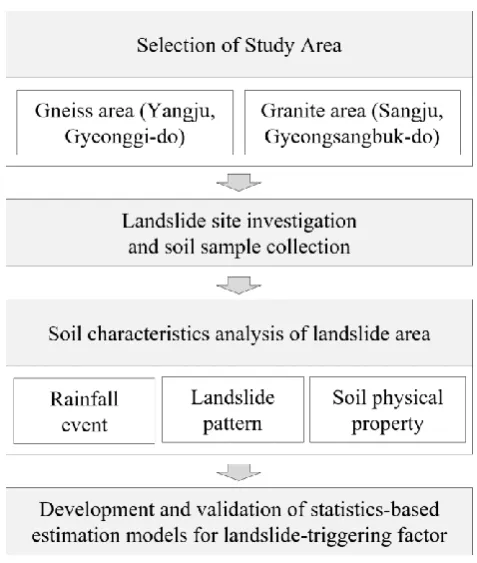
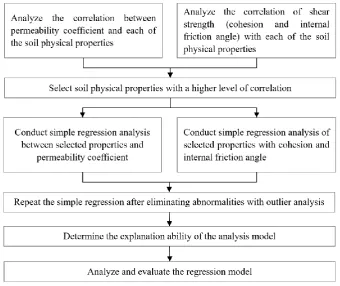
To evaluate flow-type landslides caused by localized heavy rains in Korea, it is important to understand the topography and nature of soil materials composing the surface of slope based on rainfall data. Therefore, data of landslides that occurred in the study areas were collected and various geological features related to landslides statistically analyzed. A correlation analysis was also conducted on gneiss and granite areas to discover whether there are differences or distinctions of soil characteristics in landslide areas according to geological conditions. In addition to analyzing soil correlations, estimation models of permeability coefficient and shearing strength, which are the main soil constants related to landslides using only the soil characteristics, were developed. As such, a series of research methods and contents performed in this study are shown in Figure 1.
The selected sites for this study are the areas with different geological features that experienced multiple landslides because of localized heavy rainfall during the same period. As such, the gneiss area of Yangju, Gyeonggi-do and the granite area of Sangju, Gyeongsangbuk-do were selected in South Korea. Within these sites, 76 landslides occurred in the gneiss area and 99 in the granite area. Soil samples were collected from landslides and non-landslides, and soil physical characteristics were analyzed for each geological features.
2.2. Statistical analysis on landslide-triggering factors by geological feature
The permeability test in landslide studies is conducted to find the coefficient of permeability through constant and variable head permeability test on saturated sample and unsaturated permeability test on the unsaturated sample. The shear test determines the permeability and shear characteristics of the slope by obtaining the cohesive force and the internal friction angle by triaxial test, ring shear test, and direct shear test. In particular, the stability of a slope is decreased sharply when the soil layer is almost saturated with water content and reaches the maximum shear stress, which leads to collapse.
characteristics obtained at extremely limited shear rates. In particular, the greatest advantage of the direct shear test is that the shear strength properties of the soil can be identified relatively, accurately, quickly, and easily compared to other test methods.
As such, the test methods for measuring the permeability coefficient and shear strength, which are the main soil constants in the soil characteristics of landslide areas, are more complicated than the basic physical properties tests and require an expert’s skill. To understand the soil characteristics and identify the destruction mechanism in the landslide area, permeability coefficients and shear strength constants of various points are required. Thus, a considerable amount of time and cost are required to obtain these test results.
Therefore, if the permeability coefficient and the shear strength can be roughly estimated using the results of basic soil physical test, which are relatively easy, simple, and inexpensive, the soil characteristics in the landslide area can be identified more quickly and easily. It is possible to predict the change of dependent variables (permeability coefficient and shear strength) from the change of independent variables (basic soil physical values) by analyzing the correlation between soil properties, permeability coefficient, and shear strength constant in natural slopes where landslides took place. In addition, it is possible to understand soil characteristics in landslide areas more easily and quickly by roughly calculating the permeability coefficient and shear strength using the basic soil physical properties of soil [28].
For this, correlation and regression analysis were used as statistical methods in this study. Correlation analysis is widely used as a traditional statistical method to analyze the correlations between independent and dependent variables. It evaluates the presence or absence of a linear relationship between two variables. Therefore, the main purpose of correlation analysis is to verify if a relationship exists, not to find out what functional relations there are between the variables. However, there are often cases where one wants to predict the value of a variable from other variables. In this case, regression analysis can be used, which is a statistical analysis method that estimates a mathematical model from the data or makes a correlation through statistical inference.
In correlation analysis, correlation refers to the variation, degree, and direction of the relationship between two or more variables. Correlation analysis predicts the change of scale and direction of other variables as one variable increase or decrease. As such, the correlation is determined by how much of the variance (variate) of one variable changes as other variables’ variance change, which is the covariance (covariate). Another important factor in correlation analysis is the correlation coefficient, which is an index that summarizes the degree and direction of a relationship between variables with a single numerical value, an absolute value between 0 and 1. The closer the correlation coefficient is to 0, the lower the correlation, and the closer to the absolute value 1, the higher the correlation.
other hand, regression analysis is a method used to predict values, which is often a way to understand the extent and direction of one or more variables affecting another variable and analyze how the dependent variable changes as the independent variables change. It is also used to analyze the effect on the change of the dependent variable (Y) caused by the independent variable (X) and find the values of the slope B and the Y-intercept A. Once the values of B and A are determined, and the regression equation is obtained, it can predict the value of Y with the value of X.
In this study, statistics-based estimation models (SEMs) were developed by applying correlation analysis and regression analysis, which are statistical methods to analyze the correlation between independent and dependent variables. RMSE is the square root of the mean of the squared error between the value predicted from an estimate or model equation and the value observed in a real environment. It is a method to check the difference between the predicted value and the actual experiment and observation results. Furthermore, the correlation and suitability of the statistics-based estimation model (SEM) results and direct test results were evaluated.
3. Results
3.1. Landslide pattern
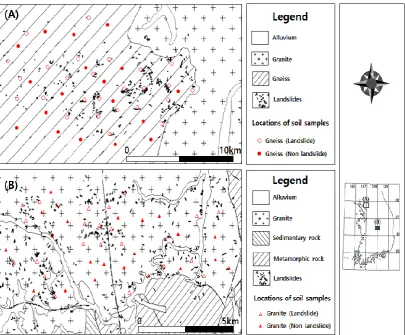
The study areas are composed of two different major geological types: one is the Yangju area of Gyeonggi-do, which is a gneiss area, and the other is the Sangju area, Gyeongsangbuk-do, which is a granite area in Korea. Most of the landslides in these areas occurred during the heavy rains in early August, with 175 sites including 76 sites in gneiss and 99 sites in granite area.
Figure 2 shows the location of landslides in the study areas as well as the geological distribution of these areas. In Yangju area, Gyeonggi-do, the destruction patterns of landslides in gneiss areas started with transitional slides and changed into flows as the landslide materials move to the lower slope. Thus, it was found that the transition type plane destruction occurred on a relatively flat slope, and the destroyed materials moved downward, mixed with the surrounding materials, and transformed into the shape of debris flow, flowing down the V-shaped valley. Moreover, a shallow solum was found to consist of residual soil and colluvial soil collapsed along with the interface with the bedrock.
In Sangju area, Gyeongsangbuk-do, the granite area, granite is widely distributed, and sedimentary rocks are partly distributed. Landslides occurred over a wide area but had a higher frequency in granite areas. Moreover, landslides in this area were found to be mostly transitional, most of which were relatively shallow at depths of less than 1 m, with the upper soil layers consisting of residual and colluvial soils that collapsed along the boundary with the bedrock. It was also shown that the landslide material moved to the bottom of the slope and changed into a flow. Overall, landslide patterns were found to be similar to gneiss areas.
Landslide patterns in the study area mostly changed from transitional-type landslides to flow-type landslides. Transitional-type landslides were largest in the granite area, which was about 98%, while it was about 75% in the gneiss area. In particular, most of the transitional-type landslides in the granite area showed a shallow collapse formed along with the interface with the bedrock. Subsequently, the collapsed soil material developed into a flow slide down the slope.
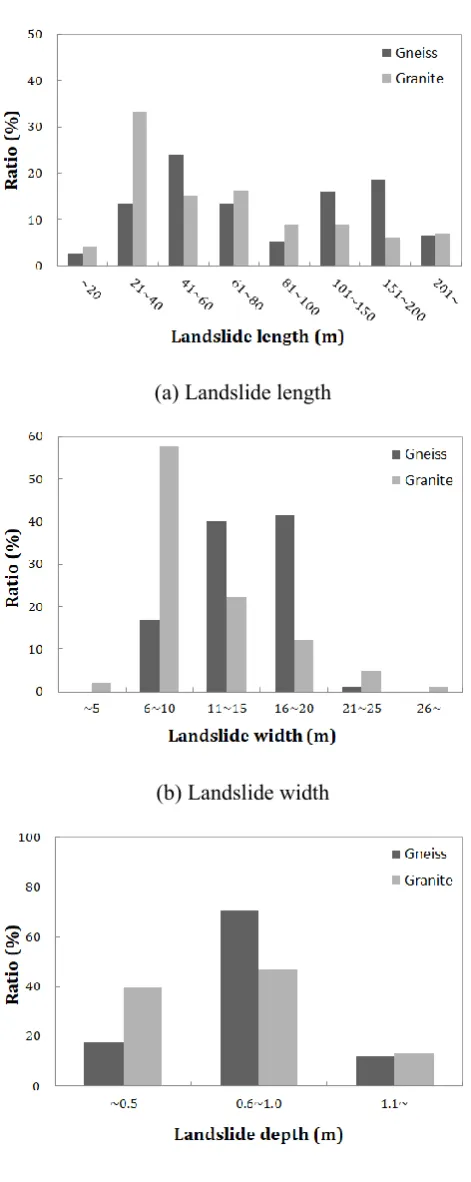
Figure 3 shows the length, width, and depth of landslides by geology in the study area. The scale of landslides in the gneiss area ranged from 20 to 290 m based on the length of occurrence. On a 20 m– length criteria, 41–60 m accounted for the highest occupancy rate of about 24%, 18 sites among the 77 outbreaks, followed by 61–80 m and 21–40 m, which occupied about 13%, 10 sites each. On the other hand, landslides over 100 m in length accounted for 31 sites among the 77, which is about 42%, showing several long length landslides occurred (Figure 3 (a)).
The length of landslides in the gneiss region ranged from 8 to 22 m, with 16–20 m and 11–15 m accounting for about 42% and about 40%, respectively, taking up the most (Figure 3 (b)). In contrast, about 58% of landslides in the granite region came within the 6–10 m length interval, on account of the gentle V-shaped water sump type topography where the landslides occurred.
More than about 88% of landslides in the study area were found to have occurred within a meter of depth because landslides usually occur in areas with low slopes, and outcrops are well developed on slopes at higher elevations, resulting in relatively low rates of landslides. In addition, the depth of landslides is considered to be shallow because the destruction occurs at the boundary between the shallow top layer consisting of residual and colluvial soil and the bedrock.
3.3. Soil characteristics of landslide and non-landslide
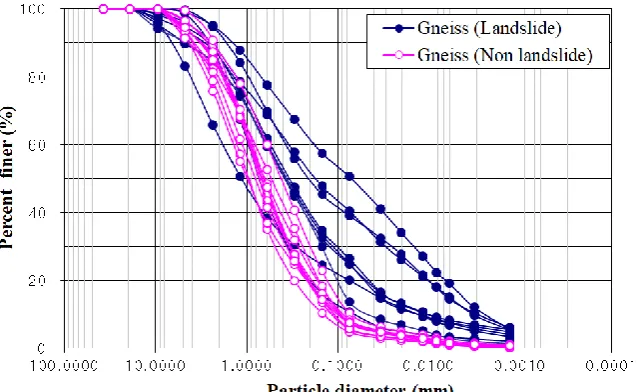
Comparing the soil particle size characteristics between landslide and non-landslide areas, the soil layer in the landslide area is known to have a finer soil particle and a smaller liquid limit than the non-landslide area [29, 30]. Soil particle size distribution is an important factor in non-landslides. In the case of flow-type landslides, soil particle size analysis is performed, and if it contains 20%–80% of particles of 2 mm or more in diameter, it is classified as rock flow. On the other hand, if it contains 80% or more of particles less than 2 mm in diameter, it is classified as soil flow [14].
Figure 4 shows the particle size test results for soil samples in different geological feature of the study area, categorized into landslide and non-landslide areas in the soil particle size distribution curve. In the gneiss area, the soil particle size distribution curve is moderately inclined in general, and coarse and fine-grained soil are moderately mixed. The uniformity coefficient is in the range of 5 to 40, and the curvature coefficient is in the range of 1 to 3, satisfying the qualifications for well-graded soil gradations. In addition, it was found that the soil particle size of landslide areas is distributed more evenly, and the non-landslide area has similar distribution aspects of soil particle size.
ratio by particle size is good. Moreover, the uniformity coefficient is in the range of 2 to 33, and the curvature coefficient is in the range of 1 to 3, showing that the soil can be deemed as well graded. In particular, the granite area showed the same particle size distribution pattern regardless of landslide or non-landslide areas.
Table 1 shows the soil constants for the soil layers of landslides in gneiss and granite areas. The liquid limit showed a similar tendency, whereas the plastic limit of soil surface was found to be higher in the gneiss area than the other. The plastic limit is a property that is directly related to the content of clay particles in the particle size distribution of the soil layer, which is consistent with the result that the gneiss area shows a higher content of fine-grained soil than the granite area.
Soils in the granite region had the highest permeability coefficient, followed by gneiss regions with the smallest permeability coefficient. On the other hand, this phenomenon can be seen to be affected by the soil characteristics such as soil particle size distribution, roughness, and structure of the soil particles, and geological properties such as weathering or sedimentation environment.
3.4. Developing an statistics-based estimation model (SEM) for landslide-triggering factors by geological feature
To develop a statistics-based estimation model (SEM) estimating the permeability coefficient and shear strength (cohesion and internal friction angle), which are considered to be the major landslide-triggering factors, correlation analysis was conducted using various soil physical property tests and analysis data on soil samples collected in the study area. Then, soil physical parameters related to permeability coefficient were selected, and using the selected soil physical parameters and the permeability coefficients determined through permeability tests, the study developed a statistics-based estimation model (SEM) for estimating permeability coefficient through a series of regression analysis. Likewise, a statistics-based estimation model (SEM) for estimating shear strength was developed by a series of regression analysis on cohesion and internal friction angle data obtained from direct shear test and soil physical parameters selected from the correlation analysis. Figure 5 shows the flowchart of the development of statistics-based estimation models (SEMs) for each geological feature (gneiss and granite) in study area.
3.4.1. Statistics-based estimation model (SEM) of permeability coefficient
while positive means a directly proportional relation.
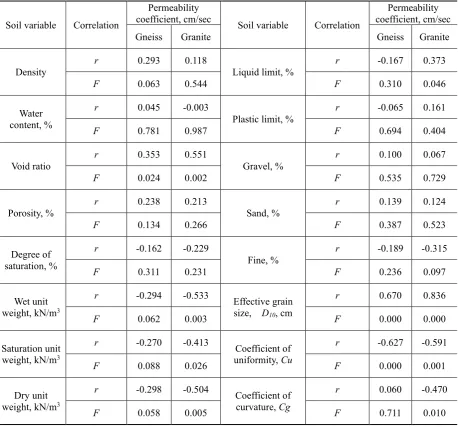
As shown in Table 3, the soil physical properties with high significance for the permeability coefficient showed a high correlation in order of effective diameter, uniformity coefficient, and void ratio, which are the three soil properties with the highest level of correlation to permeability coefficient. Therefore, these soil physical properties were selected as independent variables for the regression analysis.
Using a two-step process selecting the soil physical properties related to the permeability coefficient from the correlation coefficients determined through the correlation analysis, subsequently performing a regression analysis, more accurate correlations were able to be found, and the contribution of each soil physical property related to the permeability coefficient is represented numerically as a regression model.
From the correlation analysis, simple regression analysis with permeability coefficients calculated in the permeability test using effective diameter, uniformity coefficient, and the void ratio was performed to develop statistics-based estimation model (SEM) of soil.
According to the regression analysis results for gneiss and granite areas of the study area, variance analysis, which is a measure of the accuracy of the model, has a significant probability of P = 0.000, and the R-square representing explanatory power is about 83% in gneiss soil, about 93% in granite soil, which can be considered that the regression model is suitable. Based on this, the statistics-based estimation model (SEM) for estimating permeability coefficient by different geological conditions can be summarized as follows using the non-standardized coefficient of model coefficient results.
kgn = (1.488 × 10-02 × e) + (1.076 × D10) + (-1.629 × 10-04 × cu) - (1.893 × 10-02) (4.1)
kgr = (8.281 × 10-03 × e) + (0.639 × D10) + (-2.766 × 10-05 × cu) - (9.907 × 10-03) (4.2)
Where, kgn is permeability coefficient of a gneiss soil, kgr is permeability coefficient of a granite soil, D10is effective diameter, e is void ratio, and cu is uniformity coefficient, individually.
3.4.2. Statistics-based estimation models (SEMs) of shear strength
As a model to estimate the shear strength of soil by different geological feature, correlation analysis was performed using various soil physical property tests and analytical data on soil samples collected in the study area in the same way as the estimation of permeability coefficient. Similar to the correlation analysis of permeability coefficient, Pearson correlation analysis was conducted on the soil physical properties of 16 items to select soil properties that are significant for shear strength with cohesion and internal friction angle. Pearson‘s correlation coefficient and significance were obtained for cohesion and internal friction angle of soil, as shown in Table 4.
fine grain content and uniformity factor. Therefore, the fine-grained soil content and uniformity coefficient, which have the highest level of significance to cohesion, were selected as the independent variables for the regression analysis. Soil properties with high significance for internal friction angle in the gneiss soil layer were analyzed as void ratio, saturation unit weight, and dry unit weight. However, as the saturation unit weight and the dry unit weight are proportional to each other, only the void ratio and the dry unit weight were selected as independent variables to be applied to the regression analysis to simplify the model.
The properties of high significance level to cohesion in granite soils were found to be in the order of fine-grain soil content, saturation, effective diameter, and uniformity coefficient. Among these soil properties, the significance of equality coefficient was 0.086, which is greater than 0.05, a significant level from a statistical point of view, that led to exclude equality coefficient from the model, and added the degree of saturation and effective diameter.
Finally, to simplify the statistics-based estimation model (SEM), only fine-grained soil content and saturation degree were selected as independent variables for the regression analysis. Soil physical properties with equally high significance level for internal friction angle in granite soil were void ratio, dry unit weight, wet unit weight, and saturated unit weight. Therefore, to simplify the model and be consistent with the gneiss model, void ratio and dry unit weight were finally selected as independent variables for regression analysis.
As shown in Table 5, a simple regression analysis of the soils by geological feature was used to derive the ground variables with high correlations between the soil physical properties to make a statistics-based estimation model (SEM) for estimating the cohesion and internal friction angles of the gneiss and granite soils.
According to the regression analysis, variance analysis, which is a measure of the accuracy of the cohesion model for the gneiss soil, showed a very good probability of P = 0.000, and the R-square representing the explanatory power is about 88%. Moreover, the regression model for internal friction angles is suitable with the probability of P = 0.000, and the R-square about 96%. Therefore, the final statistics-based estimation models (SEMs) for the cohesion and internal friction angle of the gneiss soil are shown as Equations (4.3) and (4.4).
cgn = (-0.712 × Fines) + (-0.131 × cu) + 15.335 (4.3)
φgn = (27.01 × rd) + (-12.594 × e) + 6.018 (4.4)
Where, cgn is cohesion of gneiss soil, φgn is internal friction angle of gneiss soil, Fines is fine-grained soil content, cu is uniformity coefficient, rd is dry unit weight, and e is void ratio, respectively.
In the case of the internal friction angle, the probability of variance analysis showed P = 0.000, and the R-square about 70%. Finally, the statistics-based estimation models (SEMs) for estimating the cohesion of granite soils is as shown in Equation (4.5). On the other hand, the internal friction angle estimation model of the granite soil is as shown in Equation (4.6).
cgr = (-0.689 × Fines) + (-0.0744 × S) + 18.590 (4.5) φgr = (33.640 × rd) + (-0.875 × e) - 9.685 (4.6)
Where, cgr is cohesion of granite soil, φgr is internal friction angle of granite soil, Fines is fine-grained soil content, S is degree of saturation, rd is dry unit weight, and e is void ratio, respectively.
4. Discussion
4.1. Validation of permeability coefficient estimation model
To validate the statistics-based estimation model (SEM) for estimating permeability coefficient for the gneiss area, this study analyzed the results of the estimation model and the permeability test on 26 sample soils from landslide areas and 18 samples from non-landslide areas. In addition, for the estimation model for the granite soil, 27 sample soils from landslide areas and 18 sample soils from non-landslide areas were verified using the same method.
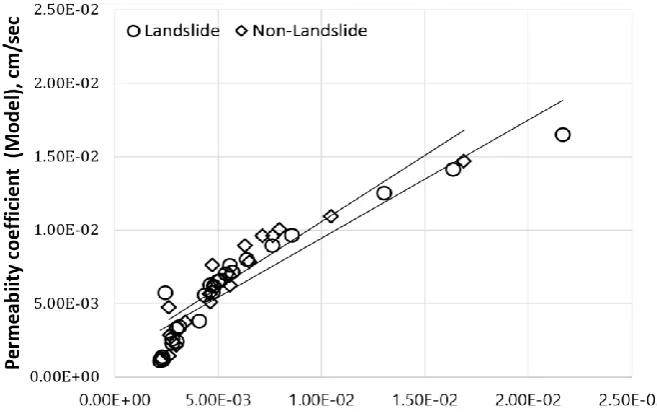
Figure 6 shows the results of the permeability test and estimation model analysis by landslide occurrence. The relations between two permeability coefficients on the gneiss area were verified to have a significant R square of about 87.1% in landslide soil layers and about 84.5% in non-landslide soil layers. In the granite area, landslide area soil showed a highly significant R square of about 96.6%, and in the case of non-landslide area, about 94.0%.
As a result of verifying the significance of the estimation model developed with RMSE as shown in Table 6, the root of mean square error of the permeability coefficient test result and the estimation model analysis value is considered to be significant because it is within the tolerance.
4.2. Validation of shear strength estimation model
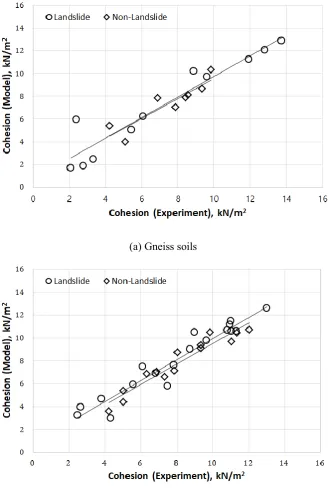
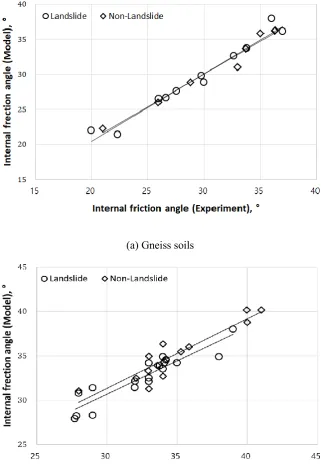
To validate the statistics-based estimation models (SEMs) for estimating shear strength with cohesion and internal friction angle for the gneiss soil, this study analyzed the results of the estimation model and the soil physical test on 11 sample soils from landslide areas and 8 samples from non-landslide areas. Furthermore, for the estimation model for the granite soil, 18 sample soils from landslide areas and 14 sample soils from non-landslide areas were verified using the same method.
and about 97.3% for internal friction angle. In the case of granite areas, in landslide area samples, correlations of about 92.7% for cohesion and about 85.8% for internal friction angle was verified. Results on non-landslide areas were about 91.9% for cohesion and about 85% for internal friction angle. As a result of verifying the significance of the estimation model developed with RMSE as shown in Table 7, the root of mean square error of the soil test result and the estimation model analysis value is considered to be significant because it is within the tolerance.
5. Conclusion
In this study, the characteristics of landslide occurrences by different geological features were investigated, focusing on gneiss and granite areas that have undergone landslides. In addition, a statistics-based estimation models (SEMs) for landslide-triggering factor using soil physical properties were developed to estimate the permeability coefficient and shear strength with cohesion and internal friction angle of different geological weathered soils that affect landslides.
The occurrence of landslides is directly affected by the large porosity and small density characteristics of the soil material because soils in landslide areas have the poor soil particle size distributions and the loosed ground conditions. Therefore, soils with large porosity and small density are relatively more vulnerable to landslides under the same geological conditions.
As a result of analyzing the correlations between the soil parameters of gneiss and granite areas, the permeability coefficient has a significant correlation with the void ratio, the effective diameter, and the uniformity coefficient, and shear strength has a significant correlation with fine-grain content, uniformity coefficient, saturation, dry density, and void ratio.
Based on this, the statistics-based estimation models (SEMs) that can easily calculate the permeability coefficient and shear strength (cohesion and internal friction angle), which are considered important in landslide risk areas, were developed, using only the soil physical property data that have a significant correlation with the soils. These estimation results were analyzed to have a correlation to the actual test results of at least about 85%. Therefore, the statistics-based estimation models (SEMs) can be used to calculate the permeability coefficient and shear strength with cohesion and internal friction angle in soils of natural slopes with geological conditions using simple soil properties.
Acknowledgments: This research was supported by Korea Institute of Geoscience and Mineral Resources (KIGAM) Research Project (19-3413). Also reanalysis of the research data and paper work were supported by the Korea Agency for Infrastructure Technology Advancement under the Ministry of Land, Infrastructure and Transport of the Korean government (Project Number: 19SCIP-C151408-01).
Writing – original draft, M-I Kim; Writing – review & editing, M-I Kim. All authors significantly contributed to the research.
Conflicts of Interest: The authors declare no conflict of interest.
References
1. Oh, S.; Lee, G.; Bae, W. Estimation of landslide risk based on infinity flow direction, Journal of the Korean Geo-Environmental Society, 2019, 20(2), 5-18. (in Korean with English Abstract) 2. Seoul Metropolitan Government (SMG). The 1st final inspection report on causes and restoration
works of the 2011 Umyeonsan landslides. In: Korean Geotechnical Society, Republic of Korea, 2011, 262p.
3. Lee, S.-G.; Winter, M.G. The effects of debris flow in the Republic of Korea and some issues for successful risk reduction, Engineering Geology, 2019, 251, 172-189.
4. Nam, D.H.; Kim, M.-I.; Kang, D.-H.; Kim, B.S. Debris flow damage assessment by considering debris flow direction and direction angle of structure in South Korea, Water, 2019, 11, 328; doi:10.3390/w11020328
5. Olivier, M.; Bell, F.G.; Jemy, C.A. The effect of rainfall on slope failure, with examples from the Greater Durban area, Proceedings 7th international Congress IAEG, 1994, vol. 3, 1629-1636. 6. Oh, K.D.; Hong, I.P.; Jun, B.H.; Ahn, W.S.; Lee, M.Y. Evaluation of gis-based landslide hazard
mapping, Journal of Korea Water Resources Association, 2006, 39(1), 23-33. (in Korean with English Abstract)
7. Cha, A. A comparison on the identification of landslide hazard using geomorphological characteristics, Journal of the Korean Geo-Environmental Society, 2014, 15(6), 67-73. (in Korean with English Abstract)
8. Chae, B.-G.; Choi, J.; Heong, H.K. A feasibility study of a rainfall triggering index model to warn landslides in Korea, The Journal of Engineering Geology, 2016, 26(2), 235-250. (in Korean with English Abstract)
9. Mathewson, C.C.; Keaton, J.R.; Santi, P.M. Role of bedrock ground water in the initiation of debris flows and sustained post flow stream discharge, Bulletin of Association of Engineering Geologists, 1990, 27(1), 73-83.
10. Sitar, N.; Anderson, S.A.; Johnson, K.A. Conditions leading to the initiation of rainfall-induced debris flows, Geotechnical Engineering Division Specialty Conference: Stability and Performance of Slopes and Embankments-Ⅱ, ASCE, New York, 1992, 834-839.
11. Montgomery, D.R.; Schmidt, K.M.; Greenberg, H.M.; Dietrich, W.E. Forest clearing and regional landsliding, Geology, 2000, 28, 311-314.
slopes, Sustainability, 2017, 9(7), 1280. https://doi.org/10.3390/su9071280
13. Ran, Q.; Hong, Y.; Li, W.; Gao, J. A modelling study of rainfall-induced shallow landslide mechanisms under different rainfall characteristics, Journal of Hydrology, 2018, 563, 790-801. 14. Varnes, D.J. Slope movement types and process, National Academy of Science, Washington, D
C., Special Report, 1978, Vol. 2, 11-33.
15. Brand, E.W. Some thoughts on rain-induced slope failures, Proceedings of the 10th International Conference on Soil Mechanics Foundation Engineering, Stockholm, The Netherlands, 1981, 373-376.
16. Cho, S.E. Probabilistic stability analysis of rainfall-induced landslides considering spatial variability of permeability, Engineering Geology, 2014, 171, 11-20.
17. Hong, H.; Chen, W.; Xu, C.; Youssef, A.M.; Pradha, B.; Bui, D.T. Rainfall-induced landslide susceptibility assessment at the Chongren area (China) using frequency ratio, certainty factor, and index of entropy, Geocarto International, 2017, 32(2), 139-154.
18. Tang, G.; Huang, J.; Sheng, D.; Sloan, S.W. Stability analysis of unsaturated soil slopes under random rainfall patterns, Engineering Geology, 2018, 245, 322-332.
19. Highland L.; Johnson, M. Landslide types and processes, Fact Sheet 2004-3072, USGS, 2004, 40 p.
20. Lee, S.; Jeong, G.; Park, S.J. Evaluating geomorphological classification systems to predict the occurrence of landslides in mountainous region, Journal of the Korean Geographical Society, 2015, 50(5), 485-503. (in Korean with English Abstract)
21. Kim, M.-I.; Kwak, J.-H.; Kim, B.-S. Assessment of dynamic impact force of debris flow in mountain torrent based on characteristics of debris flow, Environmental Earth Sciences, 2018, 77:538, 1-15. https://doi.org/10.1007/s12665-018-7707-9
22. Hutchinson, J. N. Morphological and geotechnical parameters of landslides in relation to geology and hydrology, In Landslides Proc. Fifth International Symposium on Landslides, 1988, Vol. 1, 3-35.
23. Li, W.; Liu, C.; Hong, Y.; Saharia, M.; Sun, W.; Yao, D.; Chen, W. Rainstorm-induced shallow landslides process and evaluation – a case study from three hot spots, China, Geomatics, Natural Hazards and Risk, 2016, 7:6, 1908-1918.
24. Sewell R.J.; Fletcher C.J.N. Pilot study on regolith mapping in Hong Kong. Geological Report GR 1/2000, GEO, 2000, 45 p.
25. Lepore, C.; Kamal, S.A.; Shanahan, P.; Bras, R.L. Rainfall-induced landslide susceptibility zonation of Puerto Rico, Environmental Earth Sciences, 2012, 66(6), 1667-1681.
27. Ering, P.; Sivakumar Babu, G.L. Probabilistic back analysis of rainfall induced landslide - A case study of Malin landslide, India, 2016, 208, 154-164.
28. Hwang, E.-S. Analysis of soil characteristics in landslide sites by statistical techniques, Ph.D. thesis, Joongbu University, 2014, 156 p. (in Korean with English Abstract)
29. Giannecchini, R.; Pochini, A. Geotechnical influence on soil slips in the Apuan Alps (Tuscany): First results in the Cardoso area. Proceeding of International Conference on Fast Movements-Prediction and Prevention for Risk Mitigation (IC-FSM 2003), 2003, 241-245.
List of Figures
(a) Landslide length
(b) Landslide width
(C) Landslide depth
(a) Gniess soils
(b) Granite soils
Figure 4. Soil particle size distribution curves for soil samples collected from landslides and non-landslide areas in gneiss and granite areas.
(a) Gneiss soils
(b) Granite soils
(a) Gneiss soils
(b) Granite soils
(a) Gneiss soils
(b) Granite soils
List of Tables
Table 1. Soil physical property of soil in landslide occurrence areas.
Geology Density, g/cm
3 Water content, % Liquid limit, % Plastic limit, %
Range Average Range Average Range Average Range Average
Gneiss 2.6~2.76 2.69 8.72~33.47 17.38 20.15~37.55 29.66 14.74~26.32 19.84
Granite 2.52~2.72 2.62 9.49~31.84 16.23 23.97~37.15 30.10 13.77~27.00 18.97
Geology Void ratio Porosity, % Dry unit weight, kN/m
3
Range Average Range Average Range Average
Gneiss 0.75~1.57 1.13 42.86~61.09 52.57 10.3~15.3 12.8
Granite 0.76~1.29 1.03 43.18~56.33 50.49 11.5~14.7 13.0
Geology Permeability coefficient, cm/sec Cohesion, kN/m2 Internal friction angle, °
Range Average Range Average Range Average
Gneiss 1.33×10⁻⁵~2.17×10⁻⁴ 5.43×10⁻⁵ 1.6~29.6 8.8 18~38 33
Granite 1.66×10⁻⁶~5.16×10⁻⁴ 6.00×10⁻⁵ 0.8~13.3 5.3 30~39 34
Table 2. Correlation coefficient and significance results between soil permeability coefficient and soil physical properties through correlation analysis.
Remarks: r is Pearson correlation coefficient, and F is significance
Soil variable Correlation
Permeability
coefficient, cm/sec Soil variable Correlation coefficient, cm/sec Permeability
Gneiss Granite Gneiss Granite
Density
r 0.293 0.118
Liquid limit, %
r -0.167 0.373
F 0.063 0.544 F 0.310 0.046
Water content, %
r 0.045 -0.003
Plastic limit, % r -0.065 0.161
F 0.781 0.987 F 0.694 0.404
Void ratio
r 0.353 0.551
Gravel, %
r 0.100 0.067
F 0.024 0.002 F 0.535 0.729
Porosity, % r 0.238 0.213 Sand, % r 0.139 0.124
F 0.134 0.266 F 0.387 0.523
Degree of saturation, %
r -0.162 -0.229
Fine, %
r -0.189 -0.315
F 0.311 0.231 F 0.236 0.097
Wet unit weight, kN/m3
r -0.294 -0.533 Effective grain
size, D10, cm
r 0.670 0.836
F 0.062 0.003 F 0.000 0.000
Saturation unit weight, kN/m3
r -0.270 -0.413 Coefficient of
uniformity, Cu
r -0.627 -0.591
F 0.088 0.026 F 0.000 0.001
Dry unit weight, kN/m3
r -0.298 -0.504 Coefficient of
curvature, Cg
r 0.060 -0.470
Table 3. Statistics-based Estimation Model (SEM) of permeability coefficient by the regression analysis of soils by different geological feature.
Geology Soil variable
Non-standardized coefficient Standardized coefficient
t probability, P Significance
B Standard error B
Gneiss
(constant) -1.893E-02 0.004 -5.004 0.000
Effective grain
size, D10 1.076 0.161 0.774 6.683 0.000
Coefficient of
uniformity, Cu -1.629E-04 0.000 -0.151 -1.350 0.185
Void ration, e 1.488E-02 0.002 0.655 9.415 0.000
Granite
(Constant) -9.907E-03 0.001 -7.831 0.000
Effective grain
size, D10 8.281E-03 0.001 0.474 9.177 0.000
Coefficient of
uniformity, Cu 0.639 0.047 0.772 13.702 0.000
Void ration, e -2.766E-05 0.000 -0.058 -.973 0.340
Table 4. Correlation coefficient and significance between cohesion and internal friction angle and soil physical properties.
Remarks: r is Pearson correlation coefficient, and F is significance
Soil variable Correlation Cohesion, kN/m2 Internal friction angle, °
Gneiss Granite Gneiss Granite
Density r 0.634 0.297 0.635 0.219
F 0.036 0.231 0.036 0.254
Water content, % r -0.409 -0.642 -0.403 -0.351
F 0.211 0.004 0.219 0.062
Void ratio r -0.272 -0.093 -0.935 -0.808
F 0.418 0.713 0.000 0.000
Porosity, % r 0.146 0.546 -0.337 -0.287
F 0.667 0.019 0.311 0.132
Degree of saturation, % r -0.234 -0.687 0.112 -0.113
F 0.489 0.002 0.743 0.559
Wet unit weight, kN/m3 r 0.097 -0.294 0.826 0.679
F 0.777 0.234 0.002 0.000
Saturation unit weight, kN/m3 r 0.318 0.178 0.960 0.816
F 0.341 0.481 0.000 0.000
Dry unit weight, kN/m3 r 0.071 0.136 0.925 0.844
F 0.837 0.590 0.000 0.000
Liquid limit r -0.270 0.073 -0.502 -0.258
F 0.423 0.775 0.115 0.177
Plastic limit r -0.151 0.309 -0.475 0.247
F 0.658 0.213 0.139 0.196
Gravel, % r 0.215 0.419 0.032 -0.040
F 0.525 0.084 0.927 0.835
Sand, % r 0.534 0.125 0.198 0.252
F 0.091 0.621 0.559 0.188
Fine, % r -0.947 -0.928 -0.219 -0.345
F 0.000 0.000 0.518 0.067
Effective grain size, D10, cm r 0.480 0.606 0.599 -0.043
F 0.135 0.008 0.052 0.826
Coefficient of uniformity, Cu r -0.746 -0.417 -0.374 -0.008
F 0.008 0.086 0.257 0.966
Coefficient of curvature, Cg r 0.551 -0.403 0.147 0.197
Table 5. Statistics-based Estimation Models (SEMs) of shear strength with cohesion and internal friction angle by the regression analysis of soils by different geological feature.
Geology Soil variable Non-standardized coefficient
Standardized
coefficient t Significance
probability, P
B Standard error B
Gneiss
Cohesion, kN/m2
(Constant) 15.335 1.479 10.369 0.000
Fine grain content,
Fines -0.712 0.130 -0.851 -5.457 0.001
Coefficient of
uniformity, Cu -0.131 0.151 -0.135 -0.863 0.413
Internal friction angle, °
(Constant) 6.018 10.509 0.573 0.583
Void ratio, e -12.594 2.566 -0.543 -4.909 0.001
Dry unit weight, rd 27.010 6.047 0.494 4.466 0.002
Granite
Cohesion, kN/m2
(Constant) 18.590 0.871 21.347 0.000
Fine grain content,
Fines -0.698 0.072 -0.779 -9.701 0.000
Degree of
saturation, S -7.441E-02 0.020 -0.298 -3.709 0.002
Internal friction angle, °
(Constant) -9.685 27.740 -0.349 0.730
Void ratio, e -0.875 9.138 -0.033 -0.096 0.924
Dry unit weight, rd 33.640 14.381 0.813 2.339 0.027
Table 6. RMSE analysis results of permeability coefficients in soils by different geological feature.
Soil variable Type Gneiss soil Granite soil
MSE RMSE MSE RMSE
Permeability coefficient,
cm/sec
Landslide 2.864E-06 1.692E-03 1.536E-07 3.919E-04
Non-landslide 2.738E-06 1.654E-03 1.769E-07 4.206E-04
Remarks: MSE is mean squared error, and RMSE is root mean squared error
Table 7. RMSE analysis results of cohesion and internal friction angle in soils by different geological feature.
Soil variable Type Gneiss soil Granite soil
MSE RMSE MSE RMSE
Cohesion, kN/m2
Landslide 1.643 1.282 0.722 0.850
Non-landslide 0.692 0.831 0.559 0.748
Internal friction angle, °
Landslide 0.987 0.993 1.633 1.278
Non-landslide 0.761 0.872 1.854 1.361