TASK REPETITION ON ACCURACY AND FLUENCY: EFL LEARNERS’ SPEAKING SKILL
Hossein Bozorgian1+ Seyyedeh Maryam Kanani2
1University of Mazandaran,Iran
2Rodaki Institute of Higher Education,Iran
(+ Corresponding author)
ABSTRACT
Article History Received: 30 January 2017 Revised: 23 May 2017 Accepted: 21 June 2017 Published: 28 July 2017
Keywords Task repetition Fluency Accuracy EFL. Speaking skill Speaking development
Developing speaking skill has become a priority for many second and foreign language learners in English as a Second Language/ English as Foreign Language (ESL/EFL) contexts and they need to be provided with opportunities to speak accurately and fluently. To reach to this goal, task repetition is performance tool to ameliorate learners‟ speaking performance. Thus, this paper used intermediate Iranian female learners (N = 21) with an age range of 12-15 to investigate the effect of task repetition on their accuracy and fluency of speaking skill. Learners were divided into two experimental (n = 12) and control (n = 9) groups. The experimental group received intervention focusing on repeating the tasks for 6 sessions, whereas the control group received conventional input without receiving the intervention. The results showed that learners in the experimental group completed task repetition outperformed better than the other learners in the control group. Also, the findings of pre-test and post-test showed that task repetition led to improvement in the intermediate learners‟ accuracy and fluency in speaking skill.
1. INTRODUCTION
Speaking is one of the most important skills required particular attentions to be paid in ESL/EFL classrooms. Utilizing verbal and non-verbal symbols in various contexts contributes to the process of sharing meaning with others through speaking. It functions as a vehicle of social solidarity, social ranking, and business, and also the medium through which much language is learnt (Febriyanti, 2012). The requirement of teaching speaking skill process should be met in second and foreign language classrooms (Shumin, 1997).
Many second and foreign language learners lean speaking skill as a priority. Learners and teachers often assess their achievement of English language learning based on how well their improvement on speaking the language. In genuine communication, speaking is purpose-driven or achieving communication is a particular end, expressing a wish or desire to do something; negotiating or solving a particular problem; or maintaining social relationships and friends. Therefore, speaking skill is one of the language skills supportive for oral communication but is the most difficult skill to develop in a classroom (Febriyanti, 2012).
International Journal of English Language and Literature Studies
ISSN(e): 2306-0646 ISSN(p): 2306-9910
DOI: 10.18488/journal.23.2017.62.42.53 Vol. 6, No. 2, 42-53
From a pedagogical perspective, it is important to have a better understanding of how much improvement learners make in their communicative language skills. Generally, task repetition facilitates a quicker retrieval of information. Repetition of a task is potentially important because it helps them change the internal factors in L2 learning. Task repetition is helpful as learners‟ performance from general to specific depends more on linguistic capacity, speed of access, and learners‟ attention (Bygate, 2007).
As experience suggests that we facilitate our communication skills with similar requirements through familiar encounters (e.g. service encounters, small talk, telephone conversations, and professional encounters). Typically we first focus on the message content, scanning our memory for appropriate language to cope with the task. Thus, familiarity with useful message content and language knowledge supports to manage the task. Subsequently, this task familiarity provide us with an opportunity to select appropriate language and monitor the content or message of the language (Bygate, 1999). The shift of attention helps learners to meet the close requirements of fluency, accuracy and complexity (Bygate, 1999). However, the focus of this study is to examine whether task repetition has any effect on EFL learners‟ speaking skill.
2. THE IMPORTANCE OF SPEAKING SKILL IN ENGLISH
Second and Foreign language learners are required to go through stages of learning to improve their speaking skill. A study conducted by Ahmadian and Tavakoli (2011) focused on speech production model which is one of the strongest models of language production suggested by Levelt (1989). It is initially proposed to explain L1 production, but researchers (Bygate, 1996; Ahmadian and Tavakoli, 2011) have used it to account for L2 production and considered the variation of two processes. This model has enlightened many aspects of language production, and has inspired researchers in pedagogy and language teaching to include some practical steps into classroom activities. Based on this model, speakers went through three stages of conceptualization, formulation, and articulation, which in reality overlap each other.
The first stage, conceptualization, concerns about selection of the related information to be expressed, ordering the selected information for expression, and keeping track of what has just been said (Levelt, 1989). The product of this stage is what (Levelt, 1989) calls „preverbal message‟, which is the overall meaning to be communicated. EFL learners can also facilitate their speaking skill through the way language is represented. Skehan (1998) proposed that different components of aptitude might be relevant to information processing. The ability to code phonemics is relevant to input processing; language analytic ability (grammatical sensitivity, inductive language learning) can be related to central processing; and memory-as-retrieval can be related to output and fluency.
The second stage, the formulation stage, learners rely on the memory-based system to produce lexicalized language, which enable them to improve their fluency. The memory-based system is fast and requires little processing. Skehan (1998) maintain that producing L2 speech depends on evidence from Instance-based theories of fluency and an instance is Logan (1988) research, proposing that fluency of speech requires the retrieval of ready-made chunks, which does not require much analysis. Learners in the conceptualization stage of messages produce language which is more accurate or complex, as they consider the rule-based system to process the information.
Finally, during the third stage, the articulation phase, the phonetic plan is converted into speech and all these stages proceed in an incremental fashion (Levelt, 1989).
3. TASK BASED LANGUAGE TEACHING
Task-based approach is a revolution in ELT in the late 20th century which has been developed based on the concept of tasks. According to Leaver and Willis (2004) “task-based language teaching (TBLT) helps language learners make real efforts to communicate as best as they can in the foreign language which they are learning”. In fact, task-based instruction (TBI) is an approach focusing on real world language use to serve the purpose of
goal-oriented communication.
Ellis (2003) defines “a task is a work plan that requires learners to process language pragmatically in order to achieve an outcome that can be evaluated in terms of whether the correct or appropriate propositional content has been conveyed.” To this end, meaning should be paid close attention and tasks require to be integrated with their own linguistic resources despite the need of choosing particular forms. The purpose of a task should result in language use leading to the way language is used in a real life situation. Like other language activities, a task involves productive or receptive, and oral or written skills in multifarious cognitive activities.
Using tasks in language pedagogy has a long history, and the communicative approach in language teaching, in particular. In fact, Crookes (1986) maintained that tasks were sometimes referred to „communicative activities‟ in the late 1970s and 1980s. The term „communicative activities‟ step-by-step has given its place to „tasks‟ (Bygate et al., 2001). The interest in tasks comes from the belief that they are essential spots for learning and teaching; syllabus designers in TBLT have preferred activities and tasks to grammar or vocabulary; the early research efforts focused on investigating the potential of the task as a unit of organization in syllabus design or language instruction
(Breen, 1987; Candlin and Murphy, 1987; Prabhu, 1987; Long and Crookes, 1993; Willis, 1996).
Tasks were used to decrease the cognitive load processing placed on L2/FL learners in language teaching classrooms (Ellis, 2003). Using a task as the main plan for teaching approach in language teaching focuses on task-based language teaching; therefore, the principles of communicative language teaching made sense from 1980 and some of the examples are as follows: a) Activities that involve real communication are essential for language learning, b) activities in which language is used for caring out meaningful task promote learning, and c) language that is meaningful to the learner supports the learning process (Richard and Theodore, 2014).
McDonough and Mackey (2006) state that interaction, which is derived from using communicative tasks, would be of a help to second language learners. Creating tasks provide learners with opportunities to engage in meaningful interaction and to direct their attention to linguistic form. Therefore, learning takes place when learners are engaged in meaningful interaction and their attention is directed to specific linguistic form.
From a pedagogical perspective, it is important to have a better understanding of how much improvement happens for learners through their communicative language skills. Generally, task repetition improve learners‟ recall of information, and is potentially important as it supports them to modify the internal factors in L2 learning
(Nishikawa, 2014).
4. TASK REPETITION
Task repetition involves rotating the steps from which learners should take and language learners are asked to repeat the same or slightly altered task for a week or two (Bygate and Samuda, 2005). In task repetition, preparation is considered as the first performance of the task (or a pre task activity) before further performance
(Ellis, 2005). At first glance, it might seem reminiscent of behaviorist drills that are based on assumptions that language learning occurs via a process of habit formation through repetition. Paulston and Bruder (1976) identified different types of repetition drills and defined them as „plain repetition of the cue‟. However, in new conceptualization, “verbatim” repetition of the cues in the L2 classroom does not fall into task repetition; rather, familiar form and content are repeated (Bygate, 2006).
communication is instinctively limited to a large extent (Ahmadian and Tavakoli, 2011). Repeating the similar tasks, therefore, helps learners to think over what they do mentally in that they can choose words, and reformulate them more efficiently, effectively, and accurately.
In fact, learners consider the planning content i.e. processing the preverbal message (Bygate, 1996) during the initial task performance. They seek for the appropriate language which best suits for the task, which is aligned with familiarity with the message content. However, the second opportunity to perform the task is when learners are already familiar with the message content; they have enough time (and attentional resources) to monitor the language which is appropriate in that their use of language results in more fluency, complexity and/or accuracy
(Bygate, 1999).
The theoretical logic behind the hypothesis that task repetition may assist language performance comes from the fact that „part of the work of conceptualization, formulation and articulation carried out on the first occasion is kept in the learners” memory store and can be reused on the second occasion” (2001, p. 29). All in all, to Bygate and Samuda (2005) task repetition is essentially theorized as having two phases:
A first enactment of a task, in which learners are likely to organize the cognitive content, scope out the likely useful lexico-grammar, and process it in real time,generating a experientially derived multi-level schema to support subsequent linguistic work; followed by a second enactment during which the speaker can build on the previous one.
As Ellis (2003) states that one of the procedural factors that has been found to influence task performance is a rehearsal-giving learner the opportunity to repeat a task. Typically, we first focus on the message content, scanning our memory for appropriate language to cope with the task. This establishes familiarity with useful message content and language knowledge, and provides a basis for handling the task.
Providing L2 learners with task repetition opportunities for dealing with important part of the language learning process enables them to improve the structure and appropriateness of target vocabulary use (Cook, 1994).
Bygate and Samuda (2005) maintain that task repetition is a kind of planning and they argue that repetition has “the potential to lead to integration of knowledge and performance” and it could be viewed as “facilitating changes particularly in the conceptualization and formulation phases of the production process” (Bygate and Samuda, 2005).
5. PREVIOUS STIDIES USING TASK REPETITION ON FLUENCY AND ACCURACY
Potential benefits for learners made through presenting the task repetition are increasing linguistic capacity, the speed of access, and learners‟ attention to their performance from the general to the specific (Bygate, 2007). One of the earliest studies documented attempts to study task repetition is Bygate (1996) study, which investigated the effects of exact repetition of a task on language production. In this study, a participant was asked to watch a video cartoon and then to retell it - a simple unscripted communication task. Task was not repeated and nor was it considered rewarded and it want not part of a class activity either, so there was no discussion between learner and staff, and no-one else performed the task; thus, it could not be discussed with informed peers. The result of the study showed a striking change in accuracy at time 2 (T2), in terms of vocabulary, idiomaticity, grammatical markers and structure. Some evidence showed that the speaker became more fluent: at Time 1 (T1), she used a lot of repetition before producing words and phrases; at T2, she repeated rather to self-correct after producing words and phrases. That is, at T1, hesitation occurred generally to find formulations; at T2, it occurred more to check formulations. This all suggests a greater capacity for form on the second occasion.
Bygate (2001) stated that task repetition is particularly beneficial to enhance task performer‟s fluency. This is probably because when they already knew what they would say in their task performance, they have more processing space available to be used in the formulating stage of the language required to express their thoughts, with the result that the amount of the output are enhanced (Ellis, 2003).
In another study, Ahmadian and Tavakoli (2011) also investigated the effect of task repetition on accuracy and fluency. In this study, 60 learners in four groups were required to watch a 15-minute episode of a silent classical film (Robbins, 1921) and were then asked to explain about that film under the conditions specified for each group. The reason behind using a silent film was to preclude learners from taking advantage of the immediate exposure to authentic language. It showed that students produced more error- free clauses and verb forms which relates to accuracy and more meaningful syllables which refers to fluency the study indicated that students‟ fluency and accuracy improved.
6. RESEARCH QUESTIONS
1. Does task repetition lead to more accuracy of EFL learners‟ speaking skill? 2. Does task repetition lead to more fluency of EFL learners‟ speaking skill?
7. METHODOLOGY 7.1. Participants
The sample consisted of 21 Iranian female institute students between the ages of 12 and 15 enrolled in intermediate level based on the English language proficiency in the institute, which is equivalent to IELTS 3.5. The teacher was a female, 38 years old with a master‟s degree and 15 years of English language teaching experience. The second researcher herself was the teacher and provided the intervention noted below and all the female students approved the consent forms to participate in this study. The pseudonyms were used for analyzing the data in this study.
7.2. Control Group
The tasks that were used in this thesis were narrative.In this group, there were nine students, which were not provided the intervention for task repetition. They just performed the same tasks without any repetitions. In this group, both speaking tests also included retelling stories (Hill, 1985).
7.3. Instrument
To assess the learners' knowledge of the target forms before and after the instruction, a speaking test which included retelling a story taken from the intermediate part of a book (Hill, 1985) was required to measure the research questions. The students listened to stories and retold them. The teacher recorded their voice by two F70 digital camcorders placed one in front of the classroom and the other at the back of the classroom. The SMX-F70 digital camcorder with HD video recording quality allowed us to capture a dynamic video (180 minutes) in intense sharp detail during 6 sessions. The camcorders were frequently monitored to serve the purpose of this study. Data was collected through the students‟ recorded performance, which was done by the teacher.
7.4. Preparation for Task Repetition
The purpose of the present study was to examine whether the task repetition boosts accuracy and fluency of the learners‟ speaking ability. Before the intervention was provided, the second researcher as a teacher explained to the 12 students what to do about the tasks. The researcher was familiar with the students and encouraged them to work together in class.
7.4.1. Task
Ellis (2003) asserts that a task in language teaching is a form that treats language primarily as a tool for communicating rather than as an object for studying manipulation. The purpose of Task-based language teaching (TBLT) is to consider the use of tasks as a main element in language classroom and the reason is that they assist learners in better acquiring the process and improving L2 learning (Shehadeh, 2005). However, there are different kinds of tasks like closed and open-ended task, which is like narrative tasks used in this study. A narrative task is the one in which learners produce a story within the framework set up by the task. In practice, this usually means retelling a story provided by the researcher, teacher, or textbook. Storytelling tasks function effectively, as learners make the most of a narrative task requiring them to produce long speech (Skehan, 2001).
7.4.2. Intervention
In order to apply interaction strategies in the experimental group, the following phases were used in the intervention. Before the teacher provided the detailed explanation of the phases, she had presented the content of the lesson plan for the students. In contrast to Bygate (1996) and Ahmadian and Tavakoli (2011) study, this study used intervention for the effect of task repetition on speaking ability. In Byagte‟s study the participants were asked to watch a video cartoon and then retell it. The reason is that task repetition improves both fluency and accuracy.
The lesson plan included three stages for the effects of task repetition and was administered during three weeks, twice a week (See Table1). Each stage was taken in a session. In stage one, learners listen to some funny stories, which are played and after that the teacher reads and explains about new words. In second and third stages, students listen again and start retelling the short stories. The tasks were the narrative ones in which the learners retell the stories. After retelling the story, the teacher corrects the students‟ mistakes. The participants were provided with teacher‟s feedback.
Table-1. Lesson Plan for Task Repetition
Sessions Stages Teacher Work Learner Work
1
One: Listen and explain new words and retell
Reading the first story
Explaining new words Listening to the first story
2 Reading the second story
Explaining new words Listening to the second story
3
Two: Retell Reading the first story for the second time
Giving support to the learners Giving
feedback Listening to the first story again Retelling the story
4
Reading the second story for the second time
Giving support to the learners Giving feedback
Listening to the second story again
Retelling the story
5
Three: Retell
Reading the first story for the third time
Giving support to the learners
Listening to the first story for the third time
Taking a short look at the story Retelling the story for the second time
6 Reading the second story for the third time Giving support to the learners
Listening to the second story for the third time
Taking a short look at the story Retelling the story for the second time
wanted to see a doctor and he heard doctor would get cheaper if he went there for the second time. So, he went to the doctor and said that he comes again. The doctor examined him and said to him to continue with medicine I gave you before. Then the teacher read the story and explained about the meaning of the new words such as charge, feel
well, medicine and nod. She explained them by giving the synonyms or doing gestures. She said „nod‟ means „move
your head up and down‟ and she did through gesture, too. After that she asked the students some questions like „why did the man go to the doctor‟. Asking questions about the story helped them to understand more. Finally she asked one of the students to retell the story.
In session 2, the students listened to the second funny short story. That was about Peter who wanted to have a party but he did not have his friends‟ phone number. His mom called the first Poe and said, „Excuse me. Is that Mrs. Poe who has a daughter who takes painting lessons? The woman answered. „This is the Mrs. Poe who had to get out of her bath to answer the telephone!‟ Then the teacher read the story and explained about the meaning of the new words such as invite, and holiday. She brought an example to make them to understand the meaning of the new words. The teacher said „the school holiday starts after your final exams.‟ Then she asked them to repeat the new words. Also, she asked some questions about the story such as „What did the woman say?‟ Asking helped them to understand more. The students read it one by one to practice reading and check the pronunciation of the new words.
In session 3, retelling the first story for the second time was focused. After listening to the story, the students were given some time to take a short look at the story and retell it. During retelling the story, some students had long pauses and mispronunciation of some words like medicine and decide. Some students forgot the whole story and did not finish retelling, so the teacher helped them to continue retelling and it took a long time to finish it. When every student finished retelling, the teacher corrected them and gave some feedbacks like, do not say he wanted go.
In session 4, the learners listened to the second story again. After listening, they could take a short look, read the story, think more, and then retell the story one by one. During retelling, when one could not pronounce the new words other students tried to help her and at last when nobody could pronounce correctly, the teacher herself pronounced it. Also it happened to the students that they lost the word, at this stage the teacher helped them to remember the words in order to continue it. When one student finished, the teacher gave her comments and feedbacks whenever necessary, the students paid attention carefully in order not to repeat those mistakes again. Most of the teacher‟s comments were about the tense of the verbs and pronunciation.
In session 5, the learners, listened to the first story for the third time, had a short look at it and they tried to retell it for the last time. At this stage when the students have problems while speaking or when they had long pauses in doing the task, they could ask their teacher or their classmates for help. Now the teacher noticed that the students were quicker and they had fewer mistakes through repetition. Most of the learners agreed that repetition increased their self-confidence, they learned the lesson well, and they had a complete awareness of it.
In Session 6, the students listened to the second story for the third time. After taking a short look, they started retelling it for the third time. Repeating the story made them become faster, make fewer mistakes, and have more confidence. And if they had trouble in retelling, remembering the words, and pronouncing, the teacher, and classmates helped them. When all of them finished retelling, the teacher corrected their mistakes like the verb agreement, the use of the pronouns, infinitive and gave comments when necessary. She asked students idea about repetition and most of them agreed that it helped them to improve their speaking. They loved to do it again.
8. RESULTS
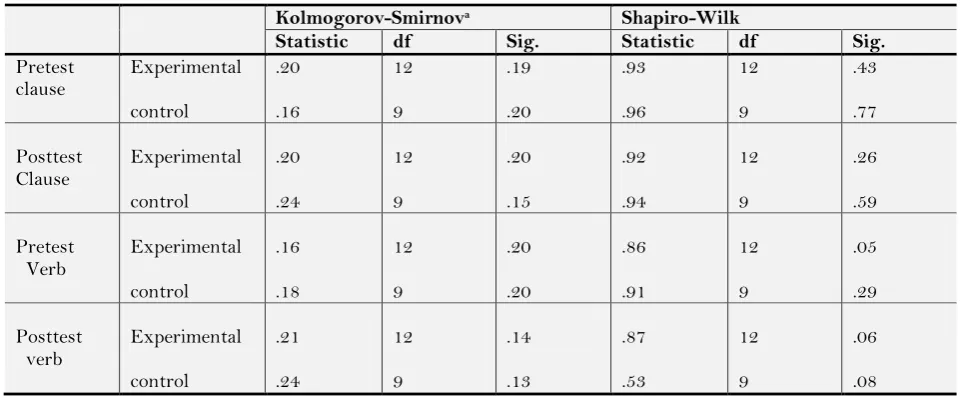
scores in the experimental and control groups. The observed levels of significance for the experimental group for pretest clause p = .19 and p = .43 and verb section p = .20 and p = .05 were nonsignificant. The ones for the control group for pretest clause p = .20 and p = .77 and verb section p = .20 and p = .29 were nonsignificant. Therefore, both the experimental and control groups were normally distributed in the pretest clause and verb test before we provided the intervention.
Table-1. Tests of Normality with Pretest /Post Test Scores to Check Accuracy
Analysis of second research question: Does task repetition lead to more accuracy of EFL learners‟ speaking? Table 2 presents learners‟ performance in the pre-test and test. 0verall, the learners who did better in the post-test speaking accurately, is suggesting that task repetition had a significant effect on intermediate learners‟ speaking ability, p-value (p <.00). To respond to the first research question focusing on the effect of task repetition on accuracy of EFL learners‟ speaking, the EFL learners were divided into two groups: experimental and control groups. The result of the analysis in pre-test clause and verb sections showed no significant difference on the knowledge of the target forms between the experimental group, respectively clause/verb parts (M = 67.77, SD = 8.30) (M= 70.68, SD = 11.47) and Control group (M = 63.71, SD = 11.09) (M = 66.69, SD = 6.99). Therefore, any difference between experimental group and control group from pre-test to posttest should be related to the effect of the task repetition.
Table-2. Descriptive Information of Accuracy Data in the Pretest and Posttest (N = 21) and Statistics for Pre-Post Comparison
pretest Post test
M SD M SD P- value
Experimental group clause 67.77 8.30 82.64 8.51
Control group clause 63.71 11.09 65.29 8.60 < . 05 Experimental group verb 70.68 11.47 82.22 11.30
Control group verb 66.69 6.99 61.64 10.59 < . 05
The first research question on whether task repetition leads to more accuracy of EFL learners‟ speaking. As can be seen in Table 3, the results of the independent t-test found a significant difference between pre- and post-test clause scores (M = 4.06, SD = 4.22; and M = 17.35, SD = 3.77, respectively) t (21) = 4.60, (p < .00), and pre-posttest verb scores (M = 3.99, SD = 4.34; and M = 20.59, SD = 4.85, respectively) t (21) = 4.24, (p < .00), suggesting that task repetition enhances accuracy of EFL learners‟ oral production.
Kolmogorov-Smirnova Shapiro-Wilk
Statistic df Sig. Statistic df Sig.
Pretest
clause Experimental control .20 .16 12 9 .19 .20 .93 .96 12 9 .43 .77 Posttest
Clause Experimental control .20 .24 12 9 .20 .15 .92 .94 12 9 .26 .59 Pretest
Verb Experimental control .16 .18 12 9 .20 .20 .86 .91 12 9 .05 .29 Posttest
Table-3. The Pre and Posttest Independent Sample t-Test (N = 21)
The second research questions focuses on whether task repetition leads to more fluency of EF learners‟ speaking? Table 4 presents learners‟ performance in the pre-test and post-test. The result of the analysis in pre-test fluency A & B showed no significant difference on the knowledge of the target forms between the experimental group, respectively A & B (M = 76.05, SD = 13.46) (M= 67.08, SD = 14.31) and Control group (M = 69.43, SD = 9.56) (M = 61.08, SD = 11.10). This implies that the difference between the two groups was not significant in the pretest (see Table 7.4).
Table-4. Descriptive Information of fluency Data in the Pretest and Posttest (N = 21) and Statistics for Pre-Post Comparison
Pretest Post test
M SD M SD P- value
Experimental group fluency A 76.05 13.46 112.42 17.93
Control group fluency A 69.43 9.56 86.93 22.09 < . 05 Experimental group fluency B 67.08 14.31 67.08 14.31
Control group fluency B 61.08 11.10 61.08 11.10 < . 05
As can be seen in Table 5, the results of the independent t-test found a significant difference between pre- and posttest fluency A scores (M = .22, SD = 6.62; and M = 25.49, SD = 8.72, respectively) t (21) = 2.92, (p = .05), and pre-posttest fluency B scores (M = 6.00, SD = 5.76; and M = 30.04, SD = 9.44, respectively) t (21) = 3.18, (p = .00), suggesting that task repetition enhances EFL learners‟ fluency in the oral production.
Table-5. The Pre and Post test Fluency Independent Sample t-Test (N = 21)
Pretest Post test
M SD
t-value Sig. (2- tailed) M SD t-value tailed)Sig. (2-
Clause
Equal variances
assumed 4.06 4.22 .96 .35 17.35 3.77 4.60 .00
Equal variances
not assumed 4.06 4.40 .92 .37 17.35 3.77 4.60 .00
Verb
Equal variances
assumed 3.99 4.34 .92 .37 20.59 4.85 4.24 .00 Equal variances
not assumed 3.99 4.05 .99 .34 20.59 4.80 4.28 .00
Pretest Post test
M SD
t-value
Sig. (2- tailed)
M SD
t-value
Sig. (2- tailed)
Fluency A
Equal variances
assumed .22 6.62 1.25 .22 25.49 8.72 2.92 .00
Equal variances not
assumed .20 6.62 1.32 .20 25.49 8.99 2.83 .01
Fluency B
Equal variances
assumed 6.00 5.76 1.04 .31 30.04 9.44 3.18 .00
Equal variances not
9. DISCUSSION
The findings of this study indicated that providing learners with task repetition such as storytelling had a positive effect on learners‟ accuracy and fluency in their speaking skill. Results of this study suggested that repeating the stories helped learners to improve their speaking and task repetition helped them to boost their pronunciation, fluency and remember the story. Therefore, the finding of this study is aligned with Gass et al.
(1999) emphasized that task repetition leads to amelioration of learners‟ fluency, and accuracy in speaking skill. Also, producing language promotes their language learning processes and consolidates their existing knowledge. Learners in EFL context lack opportunity to produce language out of classroom context, and output tasks provide learners with opportunity to use their language and make a connection between form, meaning, and function in the classroom. When learners are engaged in producing language through task repetition, their mind is involved in process of learning more actively, and output pushes learners to move from input processing to syntactic processing
(Swain, 1995).
In this study, in response to the research question focusing on the effect of task repetition on accuracy and fluency, it was also found that in the first trial when the teacher asked learners to retell the story, most of them had problems in remembering most of the story, they frequently hesitated, and they could not recall adequately to retell it; however, in the second trial, task repetition helped them to remember the stories better than the first time. Aligned with our findings, Bygate (1996) stated repetition of exactly the same task made learners shift their attention from message content to more accurate and appropriate formulations (i.e., form). If learners had problems in retelling the story, they were asked to take a quick look at the story to remember the main point. For the third trial they remembered the whole story and they could talk faster. The effect of task repetition is that learners initially keep the picture of an item temporarily in its abstract form in memory and the repetition would reactivate that form stored in memory easier its logogen when repeated (Morton, 1979; Clarke and Morton, 1983).
The results in the current study also showed some evidence that task repetition resulted in improvement in language learners‟ speaking consistent with some previous studies (Lynch and Maclean, 2001; Ahmadian and Tavakoli, 2011) that found support for the beneficial effect of repetition on accuracy. The result of this study also supports the previous studies (Bygate, 2001; Lynch and Maclean, 2001; Ahmadian and Tavakoli, 2011) that found repetition to be beneficial with the fluency of speaking skill.
The learners in this study were slow and had many pauses in telling the stories because of the unfamiliarity with the content of the stories, but by repeating it and being familiar with the text, they became fast enough and could express themselves better. The findings is in consistent with Gass et al. (1999) who assumed that increased familiarity of the content from the repeated speaking task would provide learners with a better opportunity to attend more to linguistic resources.
10. CONCLUSION
Despite being a small-scale examination, this study has highlighted the importance of task repetition and the potential use to improve learners‟ accuracy and fluency in speaking skill. The results showed that task repetition through storytelling affects speaking skill and improves the learners‟ accuracy and fluency in this regard. Further investigations are still needed to shed more light on the issues contributing to this area of study. For instance, for the sake of generalizability, it would been better if we required more participants, and more than one class in each proficiency level to conduct the study. Furthermore, it would be fruitful to collect the data for a longer period in another longitudinal study to increase its generalizability. However, future study can be conducted on each gender separately to see whether the results would change according to each particular gender or not and it can be conducted in advance level, too. Noted that more research should be performed to examine different types of tasks, compare them, and investigate their effect on speaking skill. More studies are required to discover how tasks should be designed to be more effective.
Funding: This study received no specific financial support.
Competing Interests: The authors declare that they have no competing interests.
Contributors/Acknowledgement: Both authors contributed equally to the conception and design of the study.
REFRENCES
Ahmadian, M. and M. Tavakoli, 2011. The effects of simultaneous use of careful planning and task repetition on accuracy, complexity, and fluency in EFL learners‟ oral production. Language Teaching Research, 15(1): 35-59. View at Google
Scholar
Breen, M., 1987. Learner contributions to task design. In C. Candlin and D. Murphy (eds.), Language Learning Tasks. Englewood Cliffs NJ: Prentice-Hall.
Bygate, M., 1996. Effects of task repetition: Appraising the developing language of learners. In J. Willis, & D. Willis (Eds), Challenge and change in language teaching. Oxford: Heinemann. pp: 136-46.
Bygate, M., 1999. Task as the context for the framing, re-framing and unframing of language. System, 27(1): 33–48. View at Google
Scholar | View at Publisher
Bygate, M., 2001. Effects of task repetition on the structure and control of oral language in M. Bygate, P.Skehan, and M. Swain (eds.). Researching Pedagogic Tasks: Second Language Learning, Teaching and Testing. Harlow: Longman.
Bygate, M., 2006. Areas of research that influence L2 speaking instruction. In E. Usó-Juan & A. Martínez-Flor (Eds.), Current trends in the development and teaching of the four language skills. Berlin: Mouton de Gruyter. pp: 159-186.
Bygate, M., 2007. Linking empirical research to the development of language pedagogy: Case of task repetition. Paper Presented at the Language Learning Pedagogy Research Group, Lancaster University, UK.
Bygate, M. and V. Samuda, 2005. Integrative planning through the use of task repetition. In R. Ellis, (Ed.), planning and task performance in second language. Amsterdam: John Benjamins Publishing. pp: 37-74.
Bygate, M., P. Skehan and M. Swain, 2001. Researching pedagogic tasks: Second language learning, teaching and testing. Harlow: Longman.
Candlin, C.N. and D. Murphy, 1987. Language learning tasks. Englewood Cliffs, NJ: Prentice Hall.
Clarke, R. and J. Morton, 1983. Cross modality facilitation in tachistoscopic word recognition. Quarterly Journal of Experimental Psychology, 35(1): 79-96. View at Google Scholar | View at Publisher
Cook, G., 1994. Repetition and learning by heart: An aspect of intimate discourse, and its implications. ELT Journal, 48(2): 133-141. View at Google Scholar | View at Publisher
Crookes, G., 1986. Task classification: A cross-disciplinary review (Technical Report No. 4). Honolulu: University of Hawaii at Manoa, Social Science Research Institute, Center for Second Language Classroom Research.
Ellis, R., 2005. Planning and task performance in a second language. Amesterdam/Philadelphia: John Benjamin Publishing Campony.
Febriyanti, E.R., 2012. Teaching speaking of english as a foreign language: Problems and solutions. Available from download.portalgaruda.org/article.php?article=96563&val=4806.
Gass, S.M., A. Mackey, M. Fernandez and M. Alvarez-Torres, 1999. The effects of task repetition on linguistic output. Language Learning, 49(4): 549–580. View at Google Scholar | View at Publisher
Hill, L.A., 1985. Intermediate steps to understanding. UK: Oxford University Press.
Leaver, B. and J.R. Willis, 2004. Task-based instruction in foreign language education: Practices and programs. USA: Georgetown University Press.
Levelt, W.J.M., 1989. Speaking: From intention to articulation. Cambridge, Mass: MIT Press.
Logan, G.D., 1988. Toward an instance theory of automatization. Psychological Review, 95(4): 492-527. View at Google Scholar | View
at Publisher
Long, M. and G. Crookes, 1993. Units of analysis in syllabus design: The case for task. In Crookes and Gass (eds.). Tasks in Pedagogical context: Integrating theory and practice. Clevedon, UK: Multilingual Matters.
Lynch, T. and J. Maclean, 2001. A case of exercising: Effects of immediate task repetition on learners' performance. In M. Bygate, P. Skehan and M. Swain (Eds.). Researching Pedagogic Tasks: Second Language Learning, Teaching and Testing. Harlow: Longman. pp: 141-162.
McDonough, K. and A. Mackey, 2006. Responses to recasts: Repetitions, primed production, and linguistic development. Language Learning, 56(4): 693–720. View at Google Scholar | View at Publisher
Morton, J., 1979. Facilitation in word recognition: Experiments causing change in the logogen modeL In P. A. Kolers, M. Wrolstal, & H. Bouma (Eds.), Processing of visible language. New York: Plenum. pp: 259-268.
Nishikawa, S., 2014. Learners‟ awareness of the role of input and task repetition on L2 speech production. Innovación Educativa, 14(64): 157-178. View at Google Scholar
Nunan, D., 1989. Designing tasks for the communicative classroom. New York: Cambridge University Press.
Paulston, C. and M. Bruder, 1976. Teaching english as a second language: Techniques and procedures. Cambridge, MA: Winthrop Publishers.
Prabhu, N., 1987. Second language pedagogy. Oxford: Oxford University Press.
Richard, J.C. and S.R. Theodore, 2014. Approaches and methods in language teaching. UK: Cambridge University Press. Robbins, J., 1921. The lucky dog [motion picture]. USA: Sun-Lite Pictures.
Shehadeh, A., 2005. Task-based language learning and teaching: Theories and applications. In C. Edwards & J. Willis (Eds.), Teachers exploring tasks in English language teaching. New York: Palgrave Mcmillan. pp: 13-30.
Shumin, K., 1997. Factors to consider developing adult EFL students‟ speaking ability Bureau of Educational and Cultural Affairs, 35(3): 8.
Skehan, P., 1998. A cognitive approach to language learning. Oxford: Oxford University Press.
Skehan, P., 2001. Cognition and tasks. In P. Robinson, (Ed.), Cognition and second language instruction. Cambridge: Cambridge University Press. pp: 183-20.
Swain, M., 1995. Three functions of output in second language learning. In Guy Cook and Barbara Seidlhofer, eds. Principle and practice in applied linguistics. Oxford: Oxford University Press. pp: 125–144.
Willis, J., 1996. A framework for task based learning. Harlow: Longman.