Analysis of flow observables in small systems using an
inte-grated dynamical model
Koji Kawaguchi1,, Koichi Murase2,1,, and Tetsufumi Hirano1,
1Department of Physics, Sophia University, Tokyo 102-8554, Japan 2Department of Physics, The University of Tokyo, Tokyo 113-0033, Japan
Abstract.We investigate collectivity in small colliding systems by using an integrated dynamical model in which Monte-Carlo initialisation of hydrodynamic fields, the ideal hydrodynamic description of the quark-gluon plasma and the kinetic description of the hadron gas are incorporated. We implement fluctuations of the multiplicity and of the longitudinal matter profile in the initial conditions which are of particular importance in small colliding systems. We also discuss the effects of hadronic rescatterings on flow observables.
1 Introduction
The perfect fluidity of the quark-gluon plasma (QGP) created in high energy nuclear collisions was discovered at Relativistic Heavy Ion Collider (RHIC) [1]. The perfect-fluid-like collective behaviour of the QGP is well described by relativistic hydrodynamics. One of the main observables to gain information of the bulk and the transport properties of the QGP is the second harmonics of azimuthal angle distributions, the so-called elliptic flow [2].
Since the system size dependence of the observables is one of the keys to get information about the property of the matter, small colliding systems attract a great deal of attention. Collective flow in small colliding systems had not been studied since the system is not supposed to reach thermal equilibrium in these systems. However, recent measurements reveal that the system exhibits collective-flow-like behaviour even inp/d/3He-Au collisions at RHIC [3, 4]. All the lowp
Tdata in small colliding systems
are consistent with a hydrodynamic flow picture [5]. Thus it would be interesting to see whether flow observables really result from the presence of the QGP. Therefore we analyse flow observables in small colliding systems at the RHIC energy by employing an integrated dynamical model based on an assumption of QGP fluid formation.
2 Model
In order to describe the dynamics of high energy nuclear collisions at the RHIC energy, we employ an integrated dynamical model [6] which is combination of Monte-Carlo Glauber model (MC-Glauber)
for the initial entropy production, ideal hydrodynamics for QGP fluids in the intermediate stage and a hadronic cascade model for hadron gases in the late stage. In the initial stage, we use MC-Glauber to calculate initial entropy density distributions just after collisions of two nuclei. Space-time evolution of the QGP is described by fully (3+1) dimensional ideal hydrodynamic simulations. After that we switch from fluids to hadron gases with the Cooper-Frye formula [7] in the isothermal hypersurface at the temperature of 155 MeV. For the evolution of the hadronic gas, we use a hadron cascade code, JAM [8].
In small colliding systems, one needs to extend a model of initial conditions in hydrodynamic simulations by taking account of event-by-event fluctuations of geometry and initial entropy densities. Since an initial entropy density profile is parametrised as a smooth function in p+p collisions in the original integrated dynamical model, final multiplicity fluctuations cannot be reproduced inp+p collisions. To resolve this problem, we employ an event generator, PYTHIA [9], which naturally describes multiplicity distributions in elementaryp+pcollisions. For each pair of binary collisions, we run PYTHIA for one inelasticp+pcollisions. For the soft particle production, it is well known that multiplicities scale with the number of participants, rather than the number of binary collisions. To account for this, we perform a rejection sampling from final particle lists in PYTHIA for pairs of all binary collisions so that the multiplicities scale with the number of participants for a given rapidity. By taking into account an idea of “rapidity triangle/trapezoid” [10–12], we parametrise the rapidity-dependent acceptance probability of the rejection sampling as
w(Y)=Yb+Y 2Yb
1
NA
+Yb−Y
2Yb
1
NB
, (1)
whereYis rapidity andYbis beam rapidity.NAandNBare the number of nucleons in a nucleus A and
B, respectively. We assume that the initial entropy density distribution is proportional to the number distribution of produced particles and that each produced particle is associated with a Gaussian func-tion in the configurafunc-tion space. Thus the entropy density distribufunc-tion at initial proper timeτ0 in full
three-dimensional space is
s(τ0,x, y, ηs)= τK 0
i
1
2πσ2 η
1 2πσ2
⊥
exp
⎡
⎢⎢⎢⎢⎣−(x−xi)2+(y−yi)2
2σ2 ⊥
−(ηs−ηis)2
2σ2 η
⎤
⎥⎥⎥⎥⎦. (2)
Herexandyare transverse coordinates andηs is space-time rapidity. Each particleiis supposed to
be produced at (xi,yi) in the transverse plane andηi
s(=Y) in the longitudinal direction.σ⊥andσηare
smearing parameters in the Gaussian function andKis an overall normalization. We setσ⊥=0.3 fm,
ση=0.3,τ0=0.6 fm/candK=5.6 and use this parameter set throughout this study.
Figure 1 shows an example of transverse (ηs=0) and longitudinal (x=0 fm) profiles of the initial
entropy density in p+Au,d+Au and3He+Au collisions. The impact parameter is chosen to beb=
0 fm. One sees differences of the numbers of separated hot spots which correspond to transverse positions of nucleons in colliding p, d and 3He. In the longitudinal plane, the entropy density is
distributed mainly in the negative rapidity region,i.e., Au-going direction. In all cases, initial entropy density has a bumpy structure in both a transverse and longitudinal plane.
3 Results
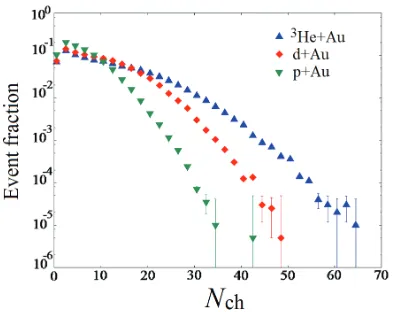
Figure 2 shows multiplicity distributions in negative rapidity region (−3.9 < η < −3.0) in p+Au,
d+Au and3He+Au collisions at √s
NN = 200 GeV. Since we employed, for the initial conditions,
DOI: 10.1051/
,0 (2017) 714101009
141 1009 epjconf/201
EPJ Web of Conferences
Figure 1.Examples of initial entropy density profile in the transverse plane (upper) and in the longitudinal plane (lower) inp+Au (left),d+Au (middle) and3He+Au (right) collisions at √s
NN=200 GeV.
Figure 2. Multiplicity distributions of charged hadrons in−3.9< η <−3.0 inp+Au (green),d+Au (red) and
3He+Au (blue) collisions at √
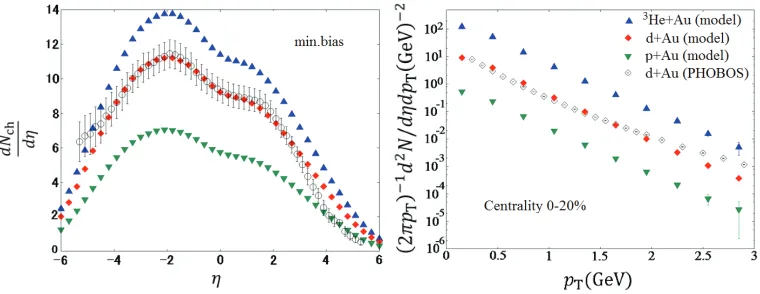
Figure 3. Pseudorapidity distributions in minimum bias (left) and transverse momentum distributions in 0.2<
η <1.4 in central 0-20% events (right). Results inp+Au (green),d+Au (red) and3He+Au (blue) collisions at
√
sNN =200 GeV are compared with the PHOBOS data (black) [13, 14]. To see the plots clearly, the result in 3He+Au (p+Au) collisions is multiplied (divided) by ten in the right figure.
PYTHIA in which multiplicities fluctuate inp+pcollisions, multiplicity distributions in small collid-ing systems take over these fluctuations. These multiplicity distributions are used for a later centrality cut.
Figure 3 shows the pseudorapidity distributions (left) and transverse momentum (pT) distributions
(right) of charged hadrons in p+Au, d+Au and 3He+Au collisions at √s
NN = 200 GeV.
Pseudo-rapidity distributions are averaged over minimum bias events, while pT distributions are in 0-20%
centrality. The PHOBOS data [13, 14] ind+Au collisions are also shown for comparison. We
re-produce the shape and yield of the pseudorapidity distribution ind+Au collisions and find the idea of initial “rapidity triangle/trapezoid” works well. The pTslope in Fig. 3 (left) is consistent with the
PHOBOS data in the lowpTregion. However, our result deviates from the PHOBOS data in highpT
region since we do not have any jet components in our model.
We analyse the transverse momentum dependence of the elliptic flow parameterv2 of charged
hadrons in 0-5% central3He+Au collisions at √s
NN = 200 GeV in Fig. 4. The PHENIX data are
also shown for comparison. In both analyses, an event plane method is used to obtain the elliptic flow parameterv2. We reasonably reproduce the PHENIXv2data [3] from the integrated dynamical model.
This indicates the QGP fluid+hadronic gas picture works well also in this small colliding system.
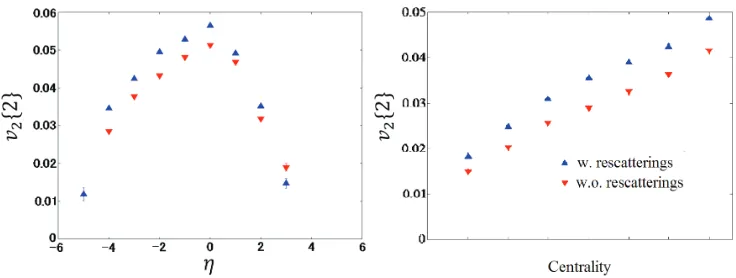
Pseudorapidity and centrality dependences of elliptic flow parameters are shown in Fig. 5. To see how much elliptic flow is generated in the QGP fluid stage, the results with hadronic rescatterings switched offare shown [15, 16]. These elliptic flow parameters are obtained by using the two particle cumulant method. In Fig. 5 (left), the shape of elliptic flow is asymmetric with respect to pseudorapid-ity. Elliptic flow in the Au-going side (in the left-hand side) is larger than that in the3He-going side (in the right-hand side) due to a difference of multiplicities as shown in Fig. 3 (left). In Fig. 5 (right), top 10% results, 10-20% results and so on are shown from right to left. Our results show elliptic flow parameters increase with the multiplicity. In both figures, roughly 90% of finalv2is generated in the
QGP fluid stage. The situation is quite similar to that in Au+Au collisions at the RHIC energy. This indicates that a large fraction ofv2is generated in the QGP fluid state even in small colliding systems.
DOI: 10.1051/
,0 (2017) 714101009
141 1009 epjconf/201
EPJ Web of Conferences
Figure 4.Preliminary result ofv2(pT) of charged hadrons at midrapidity (|η|<0.35) in 0-5% central3He+Au
collisions at√sNN=200 GeV. Our results (blue) are compared with the PHENIX data (red) [3].
Figure 5. Pseudorapidity dependence of elliptic flow (left) and centrality dependence of elliptic flow (right) in
3He+Au collisions at √
sNN=200 GeV. In the right figure, from right to left, results in 0-10%, 10-20%, 20-30%,
30-40%, 40-50%, 50-60% and 60-70% centrality are shown. Blue (Red) plots are results with (without) hadronic rescatterings.
4 Summary
We studied flow observables in small colliding systems by employing an integrated dynamical model. We extended a model of initial conditions to describe dynamics in small colliding systems by taking account of event-by-event fluctuations of geometry and entropy densities. Using the newly developed version of the model, we analysed multiplicity, pseudorapidity distributions andpT spectra as well
aspT-/pseudorapidity-/centrality-dependence of elliptic flow in small colliding systems. From these
rescatterings, but a large fraction ofv2 is generated in the QGP fluid stage even in small colliding
systems.
References
[1] “RHIC Scientists Serve Up Perfect Liquid”, http://www.bnl.gov/newsroom/news.php?a=1303 [2] J.-Y. Ollitrault, Phys. Rev.D46, 229 (1992)
[3] A. Adareet al.(PHENIX), Phys. Rev. Lett.444, 212301 (2013) [4] A. Adareet al.(PHENIX), Phys. Rev. Lett.115, 142301 (2015) [5] A. Adareet al.(PHENIX), Phys. Rev. Lett.114, 192301 (2015)
[6] T. Hirano, P. Huovinen, K. Murase and Y. Nara, Prog. Part. Nucl. Phys.70, 108 (2013) [7] F. Cooper and G. Frye, Phys. Rev.D10, 186 (1974)
[8] Y. Nara, N. Otuka, A. Ohnishi, K. Niita and S. Chiba, Phys. Rev.C61, 024901 (2000) [9] T. Sj¨ostrandet al., Comput. Phys. Commun.191, 159(2015)
[10] A. Adil and M. Gyulassy, Phys. Rev.C72, 034907 (2005)
[11] S.J. Brodsky, J.F. Gunion and J.H. Kuhn, Phys. Rev. Lett.39, 1120 (1977)
[12] T. Hirano, U.W. Heinz, D. Kharzeev, R. Lacey and Y. Nara, Phys. Lett.B636, 299 (2006) [13] B.B. Backet al.(PHOBOS), Phys. Rev.C72, 031901 (2005)
[14] B.B. Backet al.(PHOBOS), Phys. Rev. Lett.91, 072302 (2003)
[15] S. Takeuchi, K. Murase, T. Hirano, P. Huovinen and Y. Nara, Phys. Rev.C92, 044907 (2015) [16] T. Hirano, U.W. Heinz, D. Kharzeev, R. Lacey and Y. Nara, Phys. Rev.C77, 044909 (2008)
DOI: 10.1051/
,0 (2017) 714101009
141 1009 epjconf/201
EPJ Web of Conferences