Research Article
The effect of using multimedia education in Women’s Breast Cancer Screening Health Education Program
Sheng-Der Hsu 1, 2, 3*M.D., Ph.D., Cheng‑Jueng Chen 1, 2 M.D., Ph.D. Jyh-Cherng Yu 1 M.D., Zhi-Jie Hong 1, 2 M.D.,
1 General Surgery, Department of Surgery, Tri-Service General Hospital, National Defense Medical Center, Taipei 11486, Taiwan
2 Trauma Surgery, Department of Surgery, Tri-Service General Hospital, National Defense Medical Center, Taipei 11486, Taiwan
3 Department of Health Promotion and Health Education, National Taiwan Normal University, Taipei 10610, Taiwan
*Author for Correspondence: Sheng-Der Hsu,
General Surgery, Department of Surgery, Tri-Service General Hospital, National Defense Medical Center, Taipei 11486, Taiwan
Tel: +886-2-6600-9576 ; Fax: +886-2-66009576 [email protected]
Sheng-Der Hsu, [email protected]
Cheng‑Jueng Chen, [email protected] Zhi-Jie Hong, [email protected] Jyh-Cherng Yu, [email protected]
Abstract:
Breast cancer is an important disease that threatens the lives of women. The majority of breast screening health
education is printed promotional material, which is ineffective in enhancing women’s knowledge on breast screening
in Taiwan, and showed low breast cancer screening rate in women. This provided the impetus for us to carry out this
study to understand the major barrier of women on breast cancer and screening procedures. This study used
quasi-experimental design and purposive sampling. The study participants were 45–69 year-old women. Data
collection was carried out before and after intervention. The health belief model was used as a research framework to
examine changes in the study participants after multimedia health education intervention for detecting which factors
most affect women's breast cancer screening behavior. Then we could make the policy for enhancing women's
breast cancer screening in the future. Our study showed that after multimedia health education intervention, the
scores of perceived susceptibility, perceived seriousness, perceived benefits, perceived barriers, cues to action, and
self-efficacy in the experimental group were all significantly higher than the control group. We believe that the
effectiveness of multimedia health education is better than traditional health education methods, and can enhance
women to receive breast cancer screening.
Introduction
Breast cancer is an important disease that threatens the lives of modern women. According to the World Health
Organization (WHO) [1], breast cancer is the number one cancer in European women. In the US, breast cancer is
also ranked first in incidence of cancers in women and its mortality rate is only below that of lung and bronchial
cancer. Breast cancer is the most common cancer in Taiwanese women. In Taiwan, the age-standardized incidence
rates have risen from 11.69/100,000 population in 1979 to 69.1/100,000 in 2013, and the number of newly diagnosed
cases has increased from 701 people in 1979 to 11,281 in 2013. Breast cancer most commonly affects women aged
between 45–54 years in Taiwan, which indicates an earlier age of onset than in Western countries[2]. The number of
deaths due to breast cancer is also second only to lung cancer, liver cancer, and colorectal cancer [3-4].
Taiwanese women age 45-69 can get free mammograms; nevertheless, earlier data indicated that still fewer
women had ever undergone a mammogram. Official statistics released revealed that only 18% of women aged 45–69
years received a mammogram during the past 2 years, and only 30% of breast cancer patients were diagnosed at the
early Stages 0 and I. So the Health Promotion Administration in Taiwan wanted to improve mammography‑screening
rates by providing a mammogram test every 2 years for women aged 45–69 years. In 2013, official statistics released
revealed that 36% of women aged 45–69 years received a mammogram during the past 2 years. Despite of
intervention, a study showed 50% women never received any type of breast cancer screening during the past 5 years
[5]. The mortality rate of breast cancer in Taiwan is also relatively high and this is attributed to insufficient screening.
The top three reasons of no regularly breast cancer screening is: 1.no receiving relevant information on breast cancer
prevention, 2. breast cancer will not be harmful, 3. they does not have the family history of breast cancer[2]. Hence,
a better health education intervention for women’s breast cancer screening should be promoted. In medicine, early
detection and treatment is the key to decreasing the incidence of breast cancer. Foreign medical care emphasizes
disease prevention and indicates that early-diagnosed breast cancer accounts for 70% of all breast cancer. Since the
1990s, when the UK started implementing screening strategies in women aged 50 years and above, the prevalence
of breast cancer has declined rapidly[6]. In the US, screening tools are used for early detection of breast cancer and
for carrying out early treatment and this has resulted in decreased mortality rates. According to reports from the
Health Promotion Administration, Ministry of Health and Welfare, Taiwanese women have a serious lack of
awareness of breast cancer prevention and this affects the overall execution of preventive work[3-4].
The majority of existing breast screening health education in Taiwan are printed promotional materials, which
are ineffective in enhancing women’s knowledge on breast screening, as women remain fearful and anxious about
the content of the screening. Multimedia education has been widely used in various fields and has overtaken the
classroom education model, resulting in having no spatial and temporal limitations for learning. Text, pictures,
been widespread adoption of multimedia health education for clinical education and the promotion of healthcare
policies. This provided the impetus for us to carry out this study to understand the women’s knowledge on breast
cancer and screening procedures. Women were given multimedia health education films to watch followed by
one-on-one health education guidance and assessed to understand whether there are changes in knowledge on
breast cancer and breast cancer screening after intervention and whether health education intervention can
effectively increase breast-screening awareness.
Materials and Methods:
This study used a quasi-experimental design of pre-test and post-test of experimental and control groups (Table
1). The participants were recruited from 1 January 2017 to 31 March 2017. This study was reviewed and approved by
the human experimentation committee by the Institutional Review Board II (approval no.: 2-105-05-112).
Table 1. Study design
Group Pre-test Intervention Post-test
Experimental group O1 X O2
Control group O3 O4
O1, O3:Pre-test of experimental and control groups
O2, O4:Post-test of experimental and control groups
X: Breast cancer screening health education intervention based on health belief model (HBM)
1. Drafting of preliminary questionnaire
The health belief model (HBM) is a psychological health behavior change model developed to explain and
predict health-related behaviors, particularly in regard to the uptake of health services. The health belief model was
developed in the 1950s by social psychologists at the U.S. Perceived susceptibility refers to subjective assessment of
risk of developing a health problem. Perceived severity refers to the subjective assessment of the severity of a health
problem and its potential consequences. Perceived benefits refer to an individual's assessment of the value or
efficacy of engaging in a health-promoting behavior to decrease risk of disease. Perceived barriers refer to an
individual's assessment of the obstacles to behavior change. Cues to action can be internal or external. The health
belief model posits that a cue, or trigger, is necessary for prompting engagement in health-promoting behaviors. The
intensity of cues needed to prompt action varies between individuals by perceived susceptibility, seriousness,
benefits, and barriers. Self-efficacy refers to an individual's perception of his or her competence to successfully
perform a behavior. Self-efficacy was added to the health belief model in an attempt to better explain individual
differences in health behaviors.
The health belief model (HBM) has been used widely as a theoretical framework in many studies related to
health belief model (HBM), that is, based on the perceived susceptibility, perceived seriousness, perceived benefits
from action, and perceived barriers to action, to evaluate the basic profiles and risk factors of women breast cancer
screen. The preliminary scale and questionnaire were based on the scales in the article by Wang et al. [7]. The
contents of the questionnaire included 7 sections, including sociodemographic and relevant variables, breast cancer,
perceived susceptibility (4 items), perceived seriousness (12 items), perceived benefits (12 items), perceived barriers
(19 items), cues to action (3 items), and self-efficacy (4 items), with a total of 54 questions. Participants were asked to
indicate their answers on a 5-point Likert scale, ranging from strongly disagree (1 point), disagree (2 points), neither
agree nor disagree (3 points), agree (4 points), to strongly agree (5 points).
2. Content validity
After the questionnaire was compiled, content validity assessment was carried out by asking a panel of 8 experts
to read and determine the appropriateness and comprehensibility of the content. These experts include academic
experts, doctors, pharmacists, breast cancer patient case managers, and nurses. These experts reviewed the
questionnaire content for relevance, accuracy, appropriateness, necessity, and completeness, and provided
suggestions for revision. Various questions were also evaluated and scored. Following that, the researchers
consolidated the suggestions and scores by the experts and modified the questionnaire content and selected
questions to for the pre-trial questionnaire. The content validity was 0.924, which fulfilled the requirement of the
content validity index (CVI) of 0.8 and above [8].
3. Reliability analysis
In order to ensure the reliability of the questionnaire, a pilot study was conducted from 1 December to 31
December 2016 with women aged 45–69 years from the general surgery department. A total of 37 valid
questionnaires were collected after the pilot was completed. Data coding of the completed answers was carried out,
and SPSS 22.0 for Windows was used for statistical analysis of the completed answers. Reliability analysis of the
scale was carried out. The Cronbach's α value for the overall scale was 0.903, showing that the internal consistency
of the entire scale was good.
4. Formal samples
Due to manpower and time constraints in this study, we decided to carry out purposive sampling of women aged
45–69 years from the general surgery department from 1 January to 31 March 2017. According to Cohen’s [9]
estimation of sample size, with α = 0.05, power = 0.95, and effect size = 0.50 as an example, a valid sample size of 46
people were needed. According to a sample dropout rate of 10%, it is estimated that 100 participants would have
and 50 in the control group. Study participants were selected for the experimental group (n = 50; odd last digit
national ID card number) and the control group (n = 50; even last digit national ID card number) based on the
inclusion criteria. The aims and methods of the study were explained to participants individually. Participants signed
an informed consent form. Pre-test data collection was carried out using structured questionnaires to gain
understanding of Taiwanese women’s awareness of breast cancer and the current status of breast cancer screening.
After the pre-test questionnaire was completed, the experimental group underwent multimedia health education
intervention with HBM as a basis. The participants first viewed health education films and were given breast cancer
prevention brochures that were similar to those given to the control group. They were also given a one-on-one special
guidance session relating to breast cancer and breast cancer screening measures. The total time taken was 15–20
minutes (contains 6 minutes of film viewing and oral health education). This allowed patients to obtain awareness on
breast cancer and breast cancer screening, read through the brochures, and address questions and concerns with
their physician. Through this interview method, the likelihood of patients engaging in health behavior is increased.
After the session, the patients were reminded of the procedures for making a breast cancer screening appointment
and medical treatment. The control group was only given breast cancer prevention brochures. After intervention was
carried out in both groups, post-test data collection was carried out for effectiveness analysis of health education
HBM was widely used in the last 40 years to predict and explain health-related behaviors. The health beliefs of
breast cancer screening include 6 concepts, namely perceived susceptibility, perceived seriousness, perceived
benefits, perceived barriers, cues to action, and self-efficacy [10-13]. The health beliefs of participants and other
variables were used to predict whether the participant would develop health-promoting behaviors. Even though the
participant may have some awareness on perceived susceptibility and perceived seriousness, and the evaluated
perceived benefits is greater than perceived barriers, the cues to action is an indispensable factor, just like a match
that can start a raging fire. Therefore, a health education intervention was created using the HBM as a theoretical
framework to increase women’s awareness of breast cancer and increase their self-efficacy in engaging in breast
cancer screening and decrease the barriers toward breast cancer screening to increase breast cancer screening
Results
With regard to general information, we carried out an analysis of demographic variables in the experimental and
control groups including the variables age, career, educational level, marriage status, place of residence, family
income, family history, personal medical history, reproductive history, and breast cancer screening experience.
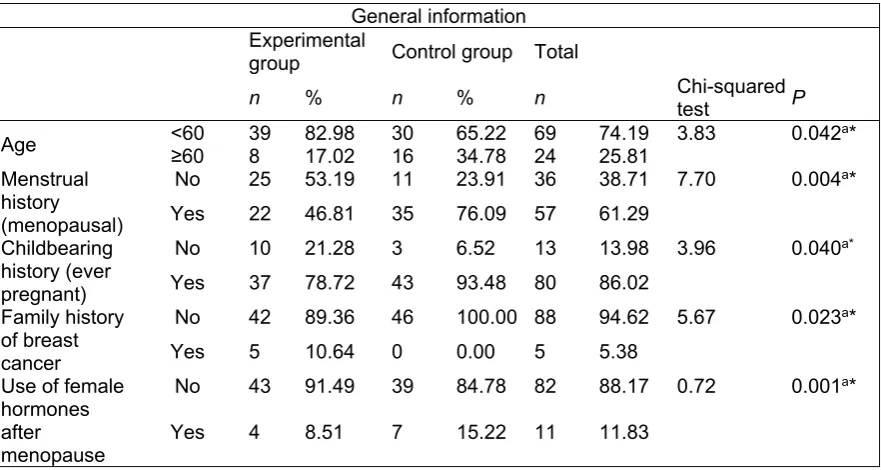
Chi-squared tests showed that there were differences in age, menstrual history, childbearing history, family history of
breast cancer, and whether or not female hormones were used after menopause between the experimental and
control groups, and these were statistically significant (P < 0.05) (Table 2).
Table 2. Significant differences in demographic information between the experimental and control groups
General information Experimental
group Control group Total
n % n % n Chi-squared test P
Age <60 ≥60 39 82.98 8 17.02 30 16 65.22 69 34.78 24 74.19 3.83 25.81 0.042a* Menstrual
history (menopausal)
No 25 53.19 11 23.91 36 38.71 7.70 0.004a* Yes 22 46.81 35 76.09 57 61.29
Childbearing history (ever pregnant)
No 10 21.28 3 6.52 13 13.98 3.96 0.040a* Yes 37 78.72 43 93.48 80 86.02
Family history of breast cancer
No 42 89.36 46 100.00 88 94.62 5.67 0.023a* Yes 5 10.64 0 0.00 5 5.38
Use of female hormones after menopause
No 43 91.49 39 84.78 82 88.17 0.72 0.001a*
Yes 4 8.51 7 15.22 11 11.83
Note a: Fisher’s exact test
Note: * P < 0.05
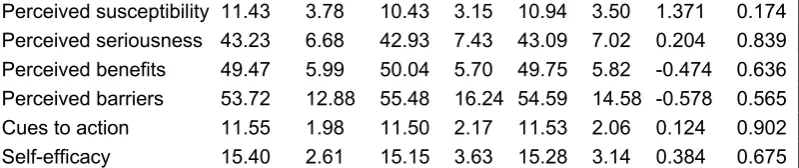
When the pre-test health belief indicators of both groups were compared using an independent sample t-test, it
was found that there were no differences in perceived susceptibility, perceived seriousness, perceived benefits,
perceived barriers, cues to action, and self-efficacy (Table 3-1).
Table 3-1. Comparison of various effectiveness indicators in the experimental and control groups before breast cancer screening health education intervention
Pre-test Experimental
group (n = 47) Control group (n = 46) Total (n = 93)
Perceived susceptibility 11.43 3.78 10.43 3.15 10.94 3.50 1.371 0.174 Perceived seriousness 43.23 6.68 42.93 7.43 43.09 7.02 0.204 0.839 Perceived benefits 49.47 5.99 50.04 5.70 49.75 5.82 -0.474 0.636 Perceived barriers 53.72 12.88 55.48 16.24 54.59 14.58 -0.578 0.565 Cues to action 11.55 1.98 11.50 2.17 11.53 2.06 0.124 0.902 Self-efficacy 15.40 2.61 15.15 3.63 15.28 3.14 0.384 0.675
For post-test, it was found that the experimental group had higher scores for four effectiveness markers, namely
perceived susceptibility, perceived seriousness, perceived benefits, and self-efficacy, compared with the control
group and this was statistically significant. The differences in perceived barriers and cues to action did not reach
statistical significance (Table 3-2).
Table 3-2. Comparison of various effectiveness indicators in the experimental and control groups after breast cancer screening health education intervention
Post-test Experimental
group (n = 47) Control group (n = 46) Total (n = 93)
mean SD mean SD mean SD t P
Perceived
susceptibility 12.89 4.95 10.15 3.54 11.54 4.50 3.076 0.003* Perceived
seriousness 45.81 10.65 41.61 7.31 43.73 9.34 2.222 0.029* Perceived benefits 55.94 6.22 51.61 5.93 53.80 6.42 3.435 0.001* Perceived barriers 50.68 13.75 53.17 17.16 51.91 15.50 -0.774 0.441 Cues to action 13.47 1.82 12.85 1.67 13.16 1.76 1.712 0.090 Self-efficacy 17.79 2.20 16.37 2.92 17.09 2.66 2.652 0.009* Note: * P < 0.05
Following that, paired t-tests were used for analysis. It was found that participants in the experimental group
showed differences before and after health education intervention in various health belief indicators, namely
perceived susceptibility, perceived seriousness, perceived benefits, perceived barriers, cues to action, and
Table 4-1. Differences in various effectiveness indicators in the experimental group before and after health education intervention
Note: * P < 0.05
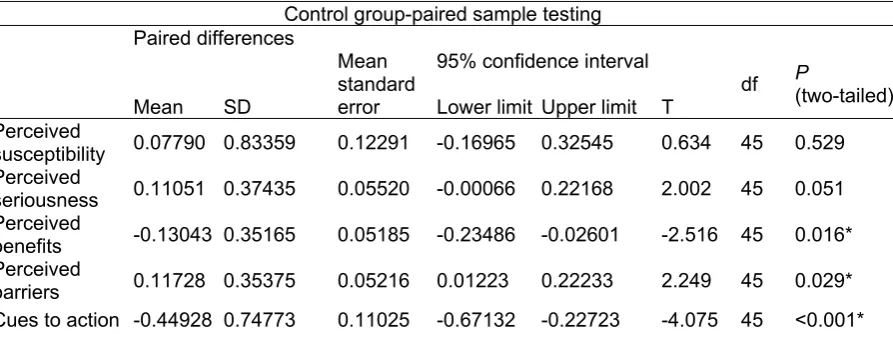
Besides perceived susceptibility and perceived seriousness, the participants in the control group showed
differences before and after health education intervention in perceived benefits, perceived barriers, cues to action,
and self-efficacy and these differences were all statistically significant (P < 0.05) (Table 4-2).
Table 4-2. Differences in various effectiveness indicators in the control group before and after health education intervention
Experiment group-paired sample testing Paired differences
df p(two-tailed)
Mean SD
Mean standard error
95% confidence interval
Lower limit Upper limit T Perceived
susceptibility -0.36702 0.88135 0.12856 -0.62579 -0.10825 -2.855 46 0.006* Perceived
seriousness -0.21454 0.63101 0.09204 -0.39981 -0.02927 -2.331 46 0.024* Perceived
benefits -0.53901 0.50536 0.07371 -0.68739 -0.39063 -7.312 46 < 0.001* Perceived
barriers 0.13998 0.30890 0.04506 0.04928 0.23067 3.107 46 0.003* Cues to
action -0.63768 0.76603 0.11294 -0.86516 -0.41020 -5.646 45 < 0.001* Self-efficacy -0.57609 0.62776 0.09256 -0.76251 -0.38967 -6.224 45 < .001*
Control group-paired sample testing
Paired differences
Mean SD
Mean standard error
95% confidence interval
df P (two-tailed) Lower limit Upper limit T
Perceived
susceptibility 0.07790 0.83359 0.12291 -0.16965 0.32545 0.634 45 0.529 Perceived
seriousness 0.11051 0.37435 0.05520 -0.00066 0.22168 2.002 45 0.051 Perceived
benefits -0.13043 0.35165 0.05185 -0.23486 -0.02601 -2.516 45 0.016* Perceived
Note: *P < 0.05
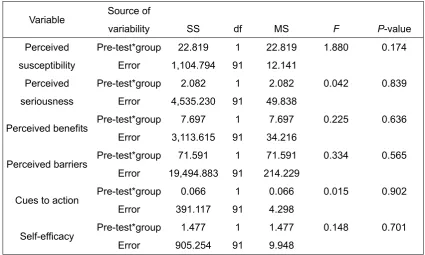
Before carrying out covariate analysis, homogeneity testing of intragroup regression coefficients was carried out.
Perceived susceptibility ([F] = 1.88, P >0.05), perceived seriousness ([F] = 0.042, P > 0.05), perceived benefits ([F]=
0.225, P > 0.05), perceived barriers ([F] = 0.334, P > 0.05), cues to action ([F] = 0.015, P > 0.05), and self-efficacy
([F] = 0.148, P >0.05) and the covariates of both groups all showed homogeneity with the regression coefficients of
the post-test data, and covariate analysis could therefore be carried out (Table 5).
Table 5. Homogeneity testing of post-test intragroup regression coefficients of various effectiveness covariates
Variable Source of
variability SS df MS F P-value
Perceived susceptibility
Pre-test*group 22.819 1 22.819 1.880 0.174 Error 1,104.794 91 12.141
Perceived seriousness
Pre-test*group 2.082 1 2.082 0.042 0.839 Error 4,535.230 91 49.838
Perceived benefits Pre-test*group 7.697 1 7.697 0.225 0.636 Error 3,113.615 91 34.216
Perceived barriers Pre-test*group 71.591 1 71.591 0.334 0.565 Error 19,494.883 91 214.229
Cues to action Pre-test*group 0.066 1 0.066 0.015 0.902 Error 391.117 91 4.298
Self-efficacy Pre-test*group 1.477 1 1.477 0.148 0.701 Error 905.254 91 9.948
Covariate variables: Age, menstrual history, childbearing history, family history of breast cancer, whether or not
there was use of female hormones after menopause
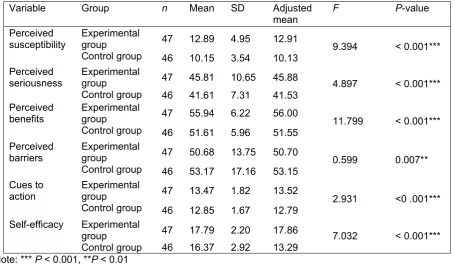
Table 6 shows the results and description of ANCOVA of various effectiveness markers after breast cancer
screening health education intervention.
Table 6. ANCOVA of various effectiveness markers after multimedia breast cancer screening health education intervention
Variable Group n Mean SD Adjusted
mean F P-value
Perceived
susceptibility Experimental group 47 12.89 4.95 12.91 9.394 < 0.001*** Control group 46 10.15 3.54 10.13
Perceived seriousness
Experimental
group 47 45.81 10.65 45.88 4.897 < 0.001*** Control group 46 41.61 7.31 41.53
Perceived
benefits Experimental group 47 55.94 6.22 56.00 11.799 < 0.001*** Control group 46 51.61 5.96 51.55
Perceived barriers
Experimental
group 47 50.68 13.75 50.70 0.599 0.007**
Control group 46 53.17 17.16 53.15 Cues to
action
Experimental
group 47 13.47 1.82 13.52 2.931 <0 .001***
Control group 46 12.85 1.67 12.79 Self-efficacy Experimental
group 47 17.79 2.20 17.86 7.032 < 0.001***
Control group 46 16.37 2.92 13.29 Note: *** P < 0.001, **P < 0.01
1. Perceived susceptibility
Covariate analysis showed that the post-test scores between the experimental and control groups on perceived
susceptibility were significantly different ([F] = 9.394, P < 0.001). Therefore, the study hypothesis of significantly
better post-test scores on perceived susceptibility in the experimental group, compared with the control group, after
multimedia breast cancer screening health education intervention was supported.
2. Perceived seriousness
Covariate analysis showed that the post-test scores between the experimental and control groups on perceived
seriousness were significantly different ([F] = 4.897, P < 0.001). Therefore, the study hypothesis of significantly better
post-test scores on perceived seriousness in the experimental group, compared with control group, after multimedia
3. Perceived benefits
Covariate analysis showed that the post-test scores between the experimental and control groups on perceived
benefits were significantly different ([F]=11.799, P < 0.001). Therefore, the study hypothesis of significantly better
post-test scores on perceived benefits in the experimental group compared with the control group after multimedia
breast cancer screening health education intervention was supported. This means that after multimedia breast
cancer screening health education intervention, there were statistical differences in post-test perceived benefits
scores between the experimental and control groups, i.e. multimedia breast cancer screening health education
intervention has effects on perceived benefits.
4. Perceived barriers
Covariate analysis showed that the post-test scores between the experimental and control groups on perceived
barriers were significantly different ([F] = 0.599, P < 0.01). Therefore, the study hypothesis of significantly better
post-test scores on perceived barriers in the experimental group, compared with control group, after multimedia
breast cancer screening health education intervention was supported.
5. Cues to action
Covariate analysis showed that the post-test scores between the experimental and control groups on cues to
action were significantly different ([F] = 2.931, P < 0.001). Therefore, the study hypothesis of significantly better
post-test scores on cues to action in the experimental group compared with control group after multimedia breast
cancer screening health education intervention was supported.
6. Self-efficacy
Covariate analysis showed that the post-test scores between the experimental and control groups on
self-efficacy were significantly different ([F] = 7.032, P < 0.001). Therefore, the study hypothesis of significantly better
post-test scores on self-efficacy in the experimental group compared with control group, after multimedia breast
cancer screening health education intervention, was supported.
In summary, a multimedia breast cancer health education intervention can improve women’s awareness and
attitudes, increase their risk awareness of breast cancer, deepen the awareness of the seriousness of cancer in
women, improve the benefits of participating in screening, overcome the behavioral barriers of participation in breast
cancer screening, and strengthen the individual’s self-efficacy. If face-to-face health education can be used
appropriately, this can promote the self-efficacy of the study participants toward breast cancer screening.
Only approximately 30% of breast cancer patients were diagnosed in stage I during 2004-2009 in Taiwan. Since
the cure rate for stage I breast cancer with contemporary treatment is as high as 95%, overall survival could be
improved markedly if the percentage detection of early breast cancer cases could be increased to more than
50%[14]. Because of low breast cancer screening rate is low in Taiwan; we designed the study to understand the
effectiveness of intervention and awareness of breast cancer screening. Our study also used HBM as a foundation to
consider the characteristics of the study participants, and to plan and design a multimedia breast cancer screening
health education course. This health education intervention strategy was used to establish knowledge of breast
cancer preventive screening, health beliefs, and strengthen activity benefits and relevant cues to action in women
aged 45–69 years. One-on-one interviews were used to counter anxiety and fear by using explanations to decrease
perceived barriers due to a lack of understanding and improve the person’s self-efficacy in terms of breast cancer
screening. After the health education intervention, it was found that perceived susceptibility, perceived seriousness,
perceived benefits, perceived barriers, cues to action, and self-efficacy all showed significant improvements.
With regard to health education intervention, the correlation between various health belief indicators before and
after intervention will be examined according in sequence.
Perceived susceptibility
Before the multimedia health education intervention, the experimental group had higher scores for the third
question (“I feel that with the status of women in my family, my probability of contracting breast cancer in the future is
high”) compared with the control group and this was statistically significant. At the same time, we observed that the
proportion of women with a family history of breast cancer in the experimental group was higher than in the control
group. Therefore, we found that women with a family history of breast cancer had greater awareness of perceived
susceptibility, perceived benefits, cues to action, and self-efficacy. This result was consistent with that of other
studies [15-18]. In addition, studies by Abbaszadeh [19] and Avci and Kurt [20] also found that if the study
participants have a greater perceived susceptibility of breast cancer or if they believe that breast cancer screening
can decrease the mortality rate due to breast cancer, they will carry out screening behavior. A study by Hosseini and
Hosseini[21] found that in the HBM, the stronger the perceived susceptibility, the more likely the person will be to take
action. Therefore, all health education interventions mainly awaken the susceptibility feelings of the person toward
certain diseases and the greater the susceptibility, the more likely the person will be to carry out behaviors to prevent
the disease.
Perceived seriousness
It was found that the intervention could strengthen the awareness of breast cancer seriousness in participants.
on family members. This section can be used as an area of focus for improving future health education on breast
cancer screening. The results of this study were also consistent with the results of other researchers [22].
Rosenstock [23] showed that perceived susceptibility and perceived seriousness are strong awareness variables
and will be affected by the level of awareness of the women themselves.
Perceived benefits
Differences in perceived benefits in both experimental and control groups reached statistical significance. There
was also significant improvement in the perceived benefits of breast cancer screening in study participants of the
control group and we deduced that this might be a result of sampling. This is because the participants were patients
who came to the hospital for consultation and these patients themselves have a higher acceptance of
health-promoting behaviors. The scores on all questions were significantly higher in study participants from the
experimental group after the multimedia health education intervention and this was significantly better than in the
control group. We hypothesized that this difference is due to the professional explanations by doctors, which
decreased participants’ anxiety and their lack of understanding on breast cancer awareness. This cannot be
achieved purely by reading printed health education materials. At the same time, our study found that women have a
high acceptance of breast cancer screening health education provided by the hospital. Many patients provided good
feedback after watching the film. Some patients started to worry whether they might have breast cancer and started
showing concern for the health of their relatives and hoped that they could also watch these films. Some women
mentioned that their awareness of breast cancer and breast cancer screening became clearer after watching the
films and that it also removed their long-standing fear, anxiety, and lack of understanding and they thanked us for our
efforts. Some patients even immediately enquired about the examination method and arranged for examination
appointments. In addition to graphics and text, the simultaneous use of film, brochures, and educational guidance in
this study to repeatedly explain the importance of breast cancer screening, the seriousness of developing breast
cancer, and the benefits of screening can be combined with timely education to different participants. For example,
explanation through film had greater benefits for participants who have lower educational levels. A study by Miller
[24] pointed out that for health education to patients, the education materials are extremely important and the reading
level of the participants should be considered. The health education content can be matched with various forms of
health education so that patients have the opportunity for repeated learning, which will strengthen their memory and
promote the development of healthy behaviors. Visual experiences account for around 90% of sensory acceptance
during health education, while the remainder is hearing, touch, smell, and taste. The combined used of graphics,
audiovisual materials, and printed information can stimulate the use of patients’ eyes and ears [25]. In addition,
found that health education videos can significantly improve the knowledge and attitudes of patients compared to
verbal health education.
Perceived barriers
With regard to perceived barriers, although study participants showed a decrease in scores for perceived
barriers after multimedia health education intervention, this did not reach statistical significance when compared with
the control group. We hypothesize two possible reasons: 1) Poor design of the set of questions as some questions
are negative questions and the participants may have misunderstood the intent of the questions and answer
incorrectly. During reliability analysis of questions, the Cronbach's α value of perceived barriers was 0.801, which
was the lowest among all coefficients for effectiveness indicators and is far below the overall reliability value of 0.903.
2) Over-emphasis on perceived benefits of breast cancer screening during course design and simplified content on
perceived barriers of breast cancer screening. The questionnaire also cannot change certain behaviors of perceived
barriers such as lack of time, inconvenience of consultation, requirement for another appointment, long consultation
times, and the fact that breast examination cannot be carried out by males, and so on. These factors require
cooperation with the system and the environment, such as social health policies and hospital environment. In
addition, the health education interviews with patients also verified this hypothesis as the reason for study
participants for not accepting breast cancer were similar to the top 10 reasons for not agreeing to breast cancer
screening that were obtained from a large database on the Internet. This shows that these reasons are the greatest
perceived barriers affecting whether patients will undergo breast cancer screening.
Cues to action
There were significant differences in breast cancer screening cues to action indicators during pre-test and
post-test between both groups. An intergroup comparison showed that the experimental group had better scores than
the control group and, even though this difference did not reach statistical significance, it was close to statistical
significance. We hypothesize that the effectiveness is mainly due to the multimedia breast cancer health education
intervention and that our study uses brochures and multimedia breast cancer screening videos together. Regardless
of breast cancer prevention brochures or multimedia breast cancer screening, the presentation methods have more
graphics than text and the information was clear and concise. The education materials used in our study used six
minutes of animation and subsequent verbal health education. The results showed that, although the video education
times were short, when this was combined with oral health education it can repeatedly strengthen the impression of
the study participants and increase the intention of the study participants to participate in breast cancer screening. A
study by Adelson et al., [29] also found that using posters, pamphlets, and interactive computer programs for various
Self-efficacy
There were significant differences in breast cancer screening self-efficacy indicators during the pre-test and
post-test between both groups. An intergroup comparison showed that the experimental group had better scores than
the control group and this reached statistical significance. We deduced that the effectiveness is mainly due to the
multimedia breast cancer screening health education intervention. According to Bandura’s social-cognitive theory
[30], the concept of self-efficacy is produced from an understanding of the self and is composed of four determining
factors. These four factors are enactive mastery experiences, vicarious experiences, verbal persuasion, and
physiological and affective states. These four aspects were used for health education intervention to strengthen the
individual’s mastery in carrying out health-promoting behaviors. A European study on the effectiveness of breast
cancer screening health education activities found that the majority of active invitation methods for breast cancer
screening activities performed better than not carrying out any intervention at all [31]. In addition, face-to-face
communication on the content between the doctor and the woman can strengthen the level of sensibility and
psychological contact, so that the woman can have deeper communication.
Conclusions
In conclusion, the rate of breast cancer screening is low in Taiwanese aged 45-69 women. Our study is the first
to adopt multimedia for health education courses on breast cancer screening and uses the HBM to verify that
multimedia health education courses show effectiveness for breast cancer screening in women. Despite of
one-to-one interview is unlikely to be cost-effective for a population-based education programme but we still
recommend that the government should strengthen health education throughout the community and use multimedia
to highlight the importance of mammography. Future more studies can further examine the impact of demographics
and the reinforcing and inhibiting factors which may impact women's awareness of breast cancer and their screening
uptake.
Practice implications
This study shows that by employing multimedia health education intervention enhances the effects in the
participants in the experimental group, increase the women’s awareness on breast cancer screening and achieve the
aim of breast cancer prevention.
A limitation of this study was the scope of the intervention. Expanding the intervention to other modules or other
courses, where appropriate, may provide additional evidence. Another limitation of the study was the modest
although significant improvements in patient performance.
Informed consent: All authors confirm all participants identifiers have been removed or disguised so the participants described are not identifiable and cannot be identified through the details of the story.
References
1. World Health Organization. (2014). Breast cancer: prevention and control. Retrieved from
http://www.who.int/cancer/detection/breastcancer/en/
2. Health Promotion Administration, Ministry of Health Welfare of Taiwan (2017). Retrieved from
http://www.hpa.gov.tw/Pages/Detail.aspx?nodeid=269&pid=5191
3. Health Promotion Administration, Ministry of Health Welfare of Taiwan(2014 ). Retrieved from
http://www.hpa.gov.tw/BHPNet/Portal/File/PressFile/201404151012192334/2011%e7%99%8c%e7%99%bb%
e8%a8%98%e8%80%85%e6%9c%83%e7%b0%a1%e5%a0%b1.pdf
4. Health Promotion Administration, Ministry of Health Welfare of Taiwan(2014 ). Retrieved from
http://health99.hpa.gov.tw/Article/ArticleDetail.aspx?TopIcNo=846&DS=1-life
5. Wu, T. Y, Chung, S, Yeh, M. C, Chang, S. C, Hsieh, H. F, Ha, S.J (2012). Understanding breast cancer
screening practices in Taiwan: a country with universal health care. Asian Pac J Cancer Prev, 13, 4289‑4294.
6. Health Promotion Administration, Ministry of Health Welfare of Taiwan (2010) 。 Retrieved from
http://www.doh.gov.tw/CHT2006/DM/DM2_2.aspx?now_fod_list_no=12336&class_no=440&level_no=4.
7. Wang, W. L., Hsu, S. D., Wan, J. H., Huang, L. C., & Hsu, W. L. (2014). Survey of breast cancer mammography
screening behaviors in Eastern Taiwan based on a health belief model. The Kaohsiung Journal of Medical
Science, 30(8), 422-427.
8. Waltz, C. F., O. L. Strickland, & E. R. Lenz. (1991). “Measurement in nursing research (2nd ed.),” Philadelphia:
A. Davi.
9. Cohen, J. (Ed). (1988) .Statistical Power Analysis for the Behavioral Sciences (2nd ed.). New Jersey:
Lawrence Erlbaum Associates, Publishers Hillsdale.
10. Rosenstock, I. M. (1974). The Health Belief Model and Preventive Health behavior. Health Education
Monography, 2(4), 354-386.
11. Lewin K: The nature of field theory. In Marx MH. (Ed). (1951)Psychological Theory. New York, Macmillan.
12. Kirscht JP. (1974): Research related to the modification of health beliefs. Health Educ Monogr, 2, 455–469.
13. Becker MH. (Ed). (1974): The Health Belief Model and personal health behavior. Health Educ Monogr, 2,
14. Chang, L. Y, Yang, Y. L, Shyu, M. K, Hwa, S. L, Hsieh, F. J. (2012). Strategy for Breast Cancer Screening in
Taiwan: Obstetriciane Gynecologists Should Actively Participate in Breast Cancer Screening. Journal of Medical
Ultrasound, 20, 1-7.
15. Kash, K. M., Holland, J. C., Halper, M. S., & Miller, D. G. (1992). Psychological distress and surveillance
behaviors of women with a family history of breast cancer. Journal National Cancer Institute, 84, 24-30.
16. Epstein, S. A., Lin, T. H., Audrain, J., Stefanek, M., Rimer, B., & Lerman, C. (1997). Excessive breast
self-examination among first-degree relatives of newly diagnosed breast cancer patients. High-Risk Breast
Cancer Consortium. Psychosomatics, 38(3), 253-261.
17. Jackson, S. L., Hislop, T. G., Teh, C., Yasui, Y., Tu, S. P., Kuniyuki, A., & Taylor, V. M. (2003)Screening
mammography among Chinese Canadian women. Canadian Journal of Public Health, 94 (4), 275-280.
18. Sorensen, J., Hertz, A., & Gudex, C. (2004.)Evaluation of a Danish teaching program in breast
self-examination. Cancer Nursing, 28(2), 141-147.
19. Abbaszadeh, Haghdoost, Taebi, & Kohan. (2007). The Relationship Between Women’s Health Beliefs and
Their Participation in Screening Mammography. Asian Pacific Journal of Cancer Prevention, 8, 471-475.
20. Avci, I. A., & Kurt, H. (2008). Health Beliefs and Mammography Rates of Turkish Women Living in Rural Areas.
Journal of Nursing Scholarship, 40(2), 170-175.
21. Hosseini, H., & Hosseini, N. (2008). Epidemiology and prevention of fall injuries among the elderly. Journal of
Hospital Topics, 86(3), 15-20.
22. Champion, V. L. (1991). The relationship of selected variables to breast cancer detection behaviors in women
35 and older. Oncology Nursing Forum, 18(4), 733-739.
23. Rosenstock, I. M., Strecher, V., & Becker, J. (1988). Social learning theory and the health belief model. Health
Education Quarterly, 15, 175-183.
24. Miller, A. (1985). When is the time ripe for teaching? American Journal of Nursing, 85(7), 801-804.
25. Cunnigham, M. A., & Baker, D. (1986). How to teach patients better and faster. RN, 49(9), 50-52.
26. Garrett, B. M., & Callear, D. (2001).The value of intelligent multimedia simulation for teaching clinical
decision-making skills. Nursing Education Today, 21(5), 382-390.
27. Reis, J., Riley, W., Lokman, L., & Bear, J. (2000). Interactive multimedia prevention alcohol education : A
technology application in high education. Journal of Drug Education, 30(4), 399-421.
28. Gaskey, N. J. (1987). Evaluation of the effect of a pre-operation-anesthesia videotape. Journal of the American
29. Adelson, Irwig, & Turnbull. (1992). Evaluating the impact of a promotional campaign for screening
mammography: women's knowledge and sources of awareness. Australian Journal of Public Health, 16(1),
72-78.
30. Bandura, A. (1977). Self-efficacy: toward a unifying theory of behavioral change. Psychological Review, 84,
191-215.
31. Atkins, Burgess, Forbes, Linsell, Omar, Ramirez, & Tucker. (2011). A promoting early presentation intervention
increases breast cancer awareness in older women after 2 years: a randomised controlled trial. British Journal of