1
Change and Continuity in Vaping and Smoking by Young People: A qualitative case
study of a Friendship Group
Neil McKeganey Ph.D. FRSA Marina Barnard Ph.D.
Centre for Substance Use Research
Block 3/2 West of Scotland Science Park
Kelvin Campus
Maryhill Road
Glasgow
Abstract
Introduction
The introduction, proliferation and diversification of e-cigarettes into the tobacco, nicotine and smoking marketplace has generated two prominent public health concerns. Firstly, that the multiplicity of new electronic nicotine delivery devices (ENDS) for inhaling nicotine and flavoured liquids in aerosolized form (vaping), may serve to re-normalise smoking (1,2) and, secondly, that they may be a gateway means to introduce young people to tobacco smoking (3,4,). Those concerns have been fuelled by research indicating a marked increase in the prevalence of ENDS used by young people, and by the findings from a range of surveys reporting that young people who have used e-cigarettes/vapes are more likely than non-using peers to have started smoking when followed-up over a twelve month period (5, 6, 7). In the UK, Eastwood and colleagues (8) reported ‘ever’ use of ENDS rose from 4.6% in 2013 to 8.2% in 2014. The US National Youth Tobacco Survey (5) reported an exponential 900% increase in e-cigarette/vape use among high school students between 2011-15 with 27.1% reporting use of ENDS at some point in the past, and 2,390,000 having done so at least once, in the past 30 days.
the relative novelty of these devices combined with the speed with which the e-cigarette market is developing and diversifying.
The available data on the prevalence of vaping provide only a partial picture on the place of e-cigarettes/vapes amongst youth populations. Even if large numbers of young people have tried them, use by the great majority is neither frequent nor regular. Assertions that e-cigarettes/vapes are becoming normalised amongst youth populations, and may be acting as a bridgehead to the re-normalisation of smoking, deserve greater investigation than the iteration of prevalence measures alone (4). Normalisation, as conceptualised originally by drugs researchers Parker, Aldridge and Measham (13), related to what was seen as the increasing acceptance of some forms of drug use to the point that such use had effectively become a normalised part of individuals’ social worlds. The concept of normalisation was seen to involve a great deal more however than increasing prevalence in actual drug use and comprised such additional elements as drug availability and accessibility, increased drug trying, increased drug offers, increased public knowledge, increasing future intentions to use drugs, and a level of cultural acceptance of the fact of some forms of drug use. Most recently the notion of normalisation has been extended to examine the use of e-cigarettes by young people. In their application of the concept of normalisation to the phenomenon of increasing e-cigarette use by young people Measham and colleagues (14) have drawn attention to two further components of normalisation namely legal status and risk perception. To understand whether or to what extent e-cigarette use is itself becoming increasingly normalised amongst young people it is important to move beyond data reporting solely on overall level of e-cigarette use and to enquire in a much more detailed way about individuals perceptions and attitudes towards e-cigarettes, their reactions others use of these devices, their knowledge about e-cigarettes and their intentions to use these devices.
acceptance of e-cigarettes/vapes seen through the lens of the normalisation thesis to focus analytic attention on the processes by which a substance becomes embedded within youth cultures.
The attractions of e-cigarettes/vapes have often been framed as a means of nicotine delivery and/or cigarette substitution (15). Qualitative research on e-cigarette use by young people, however, suggests that different factors are at play in their choices to use them. Their reasons for use have often centred on pleasurable consumption and involve a degree of social playfulness. Qualitative research by Pokhrel and colleagues (16) reported that the e-cigarette preferences of the 62 young adult current vapers (aged 18-35) interviewed were not easily defined in terms of nicotine consumption or tobacco substitution. Rather, interviewees reported that they liked vaping because it was novel and fashionable and a ‘cool’ and ‘intriguing’ part of their socialising with friends. Some enjoyed making and seeing big clouds and vapour shapes and saw it as an interesting and customisable hobby. The vape device was represented by some as a means of self-expression and personalised consumption . Measham and colleagues (14) similarly found that whilst not ignorant of scientific and media representations of e-cigarettes and harm, young people’s motivations for using e-cigarettes/vapes were more likely to be focussed on ‘complex personal social and cultural factors’ (233:2016). The authors describe vaping as a ‘new pleasure’ particularly in relation to the wide variety of available flavours, which, along with the tricks, vape systems and novelty factor of e-cigarettes/vapes were more salient to their sample than the effects of the nicotine or their smoking cessation function. These qualitative findings suggest that e-cigarettes/vapes have found a place in the social worlds of some young people. Whether these devices have found a permanent place within those social worlds or whether they represent more of a transitory pleasure remains a question for research to answer (12).
Methods
this study whilst reporting high perceived visibility of vaping, even amongst their peer groups, expressed little personal interest in the initiation of regular vaping. The 8 young people described in this paper were notable for being quite atypical to the main sample in their positive attitudes and styles of use of vaping which is why they merited closer research attention as a case study.
Research participants for the full study were recruited from a range of educational/work/social settings, were aged between 16 and 30 and lived in Glasgow, Scotland and in the North of England (Leeds and Newcastle). The average age of the 150 respondents in the study was 21 years, (71 females, 79 males). Semi- structured interviews were carried out by 6 peer interviewers (3 males, 3 females, aged 17-30) who were trained and supervised by one of the authors (MB). Peer interviewers were recruited by means of social media advertisement and contacts local to the study leads. Participants were predominantly recruited by means of snowballing although one student peer interviewer used his University social media network to generate recruits. The study intention was to consider young people’s perceptions, experiences and understandings of e-cigarettes and to this end we recruited across the spectrum of non-smoking and/or non-vaping, non-smoking and/or vaping. Non-use of e-cigarettes was defined as no use of an e-cigarette or experimental one-off use. Mixed recruitment was either face to face and proceeded through snowballing or in response to Facebook and institutional media sharing (student networks for example).
might lead, to smoking and if they knew of non-smoking friends or associates moving from vaping to smoking tobacco. They were asked to consider whether they considered e-cigarettes and vaping were acceptable behaviours and whether vaping made smoking more attractive or socially acceptable.
The unusual character of the data derived from interviews with the peer group of schoolchildren led to the decision to re-interview them after 6 months had elapsed to see if their reported patterns of use and attitudes had continued or altered at all. At T2 we were able to re-interview seven of this same group. They preferred being interviewed in groups of two or three, although at T1 we did interview one young man alone. In light of their relatively young age these interviews were carried out by the authors both of whom are professionally trained interviewers with extensive qualitative research experience.
Recorded interview data were all transcribed and analysed within the Centre for Substance Use. Analysis of the interview transcripts followed content analysis by ordering data into key themes covered in the topic guide and assessing dominant patterns or themes. Using a deviant case analysis approach the authors considered the data for its consistency in explaining the data but, importantly, closely examined those data that did not fit the data’s overall emergent patterning. Contradictory data were analysed specifically in terms of their capacity to either refine or overturn the emergent explanation until it could account for the majority of cases (19). The small sample of eight at T1 and seven at T2 meant that these data were most logically assessed by comparing individual interviews within and across the two-time points. Our analytic approach to the case study was inductive (20) and used to generate substantive theory as a description and abstraction of this particular social setting (21), we were not testing a theory (22). The analysis indicated a ‘fit’ with conceptualisations of normalisation by Measham and colleagues (13,14) that were further explored. Given that the behaviours of this friendship group were atypical within the main study this case study analysis is best described as ‘intrinsic’; the focus of interest was on understanding the case itself in its own right (23).
The funder had no role whatsoever to play in the research design, in the collection and analysis of any of the data, or in the preparation and submission of this manuscript.
Describing the Case Study Sample
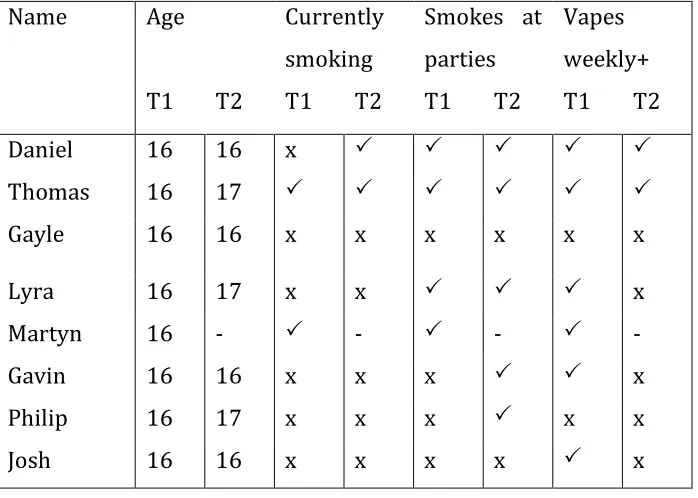
The peer group who form the focus of this paper were all friends attending the same school who socialised with each other both in and out of school hours. The age of all 8 participants at Time 1 (T1) was 16, by Time 2 (T2), three had turned 17 years of age. Most of the original peer group were male (6/8), at T2 one male, who was a smoker, did not want to be re-interviewed reducing the sample to seven. At T1, two males reported that they were current smokers additionally one male and one female reported that they smoked tobacco at parties. By T2, one other male had become a smoker and another four said that they smoked at parties. Vaping at least once a week was reported by 6/8 at T1, by T2 this had reduced to two people, both of whom reported that they were current smokers and that they vaped daily.
Table One Here
All the Fun of the Vape
At the time of the first set of interviews, the subject of e-cigarettes/vapes appeared to elicit a good deal of interest and excitement, even by the two participants who reported that they had not vaped beyond trying it out once. As has been reported elsewhere, e-cigarettes can generate a lively interest among young people (16,24). Amongst the friends interviewed here, vaping was commonplace, all of them had tried it and six of them had bought at least one vape device (not e-cigarettes) in the recent past. The sight of young people vaping was regarded as something of an “event”, a “performance” or “show” that rapidly drew the attention of others in their wider social group and afforded them a certain social status:
Some people thought they could become like in our little group of vapers by buying one and trying to be like cool with us.
(Gavin: smoker T1)
(Daniel: smoker, T1)
During the first set of interviews there was a palpable sense of “play” and sociality associated with vaping, which appeared to have influenced the decision to purchase a device for some:
It was my birthday and I just decided to buy one. I had leftover cash and everyone was doing it. Maybe that’s not the way I should be doing things because everyone else is but I thought that kind of looks like an enjoyable pastime so I thought I’ll go for it and bought a cheap one.
(Josh: non-smoker, T1)
Regularity of Use
It was difficult to definitively characterize the quantity of smoking and vaping these young people engaged in because it appeared to be highly context dependent. Although 2/8 described themselves as regular, daily smokers who also regularly vaped, there were varying degrees to which the others vaped or smoked. In total four young people said they vaped at least once a week and used a nicotine infusion of .3mg, Two young people who owned vape devices said they vaped ‘sometimes’, mostly when in company with their friends and if they were ‘bored’. The remaining 2 said they had only ever tried it out of curiosity and were not intending on doing it more than this. Of the six who had purchased at least one vape device two said that they used 0mg nicotine and vaped only intermittently:
I have one but I don’t use it that much, it just sits in the cupboard in my room, I don’t use it a lot.
(Josh T1)
The two young people who did not own vape devices said that whilst they often enjoyed watching their friends’ vaping and the tricks they could perform, they were not personally interested in vaping:
I’ve never done it properly. I just don’t have an interest in it. I didn’t really like it that much. It was kind of just really weird. I didn’t really like it. I like seeing the way it moves but I don’t really do it.
Regular use of the vape was described by four young men, with three saying they used it multiple times every day:
Daniel: Probably all the time, quite a lot Thomas: Like every 20 minutes
(Daniel and Thomas, T1)
The fourth young man said he used it about every two nights because he was ‘bored and it’s there’. The situational character of much of this vaping can be heard in the following interview excerpt:
If it’s people I don’t really know who are doing it and they’re like ‘do you want a draw?’ then no. But if it’s like my best friend then I can just pick it up and do it when I’m bored. I’ve never had a desire to do it, it’s just if it’s there and I can do cool things with it. Just something to play with. It’s not like I need to try it, like I feel I need to vape...I just like blowing circles with the smoke and trying like tricks and stuff just like that, it’s kind of interesting seeing how smoke works.
(Lyra: non-smoker, T1)
Even in this small group there were very different styles of use and it was clear that shifting social circumstances influenced the likelihood of use:
I have phases where I’ll go through a lot of the e-juice at the one time and then I’ll just go off it for a wee bit and then just have the occasional one at night … When I was studying over the prelims I went through so many bottles because I hate studying and it was just something to do.
(Daniel T1)
Social gatherings, particularly parties, were occasions where vaping was likely to be seen, experimented with and sometimes resulted in initiation of use (Hilton et al., 2017):
I saw one at a party and thought it was cool so I decided to get one to take to a party.
These narratives gave the clear impression of a group of young people for whom vaping was a pleasurable, social activity, whether in their use of the device, the flavours and the plumes of smoke they could generate or in the kudos of their skilled display of tricks to their peers. Their motivations for using e-cigarettes or vapes were not however framed in terms of the infusion of nicotine in the liquids and they did not appear to see these devices as cigarette substitutes.
Smoking and Vaping Hierarchies
There was a definite agreement amongst these young people at this time that vaping was cool and that this was the prime motivation for doing it in a social setting:
Just to look cool, that’s pretty much how everything is done, like you’ll drink at a party, because everyone else is drinking at a party and you’ll smoke because everyone else is smoking.
(Gavin T1)
However, as Gavin points out, the motivation to share in similar behaviours was not confined to vaping. It was also true of smoking, especially at parties and social gatherings. Their patterns of tobacco smoking were similarly resistant to categorisation in terms of frequency and quantity because they too were often confined to particular social circumstances, most especially to parties.
These young people described a clear hierarchy of smoking relative to vaping; even if at this time vaping was perceived as cool, it was not as cool as smoking:
People still say smoking is cooler than vaping because see, like at a party you’ll see people smoking still, they’ll go outside to have a smoke, a social smoke, nobody would go outside to have a social vape.
(Gavin T1)
We’re the only people that have kind of kept it on, a lot of our friends will maybe toke it once every two, three weeks…. We’ve got about 10, 15 friends who do it but they don’t do it on a regular basis like us, they’ll keep it in a drawer.
(Thomas T1)
They themselves could envisage a time when their interest in vaping would taper off. The widely-held perception of cigarettes as the ‘real thing’ relative to e-cigarettes might possibly have influenced their view of vaping as a phase to be grown out of:
Sometimes smokers look down on vapers, they’re like ‘are you not cool enough for that’? Clive’s brother he made fun of me because he was like ‘Och are you not hard enough to do the real thing’, he went on ‘you’re too scared to do the real thing.’ …Sometimes at parties’ people will say ‘that’s so gay, what are you doing with that why don’t you have a real cigarette’? (Martyn T1)
These more negative reactions sound like a virtual egging-on of the young person to initiate tobacco smoking.
The two young people who regularly smoked felt that their vaping was healthier than smoking tobacco and helped reduce their dependence on cigarettes:
A lot of people say they don’t know if it’s healthier or not (vaping), but when I smoke because I play rugby a lot I can feel it in my lungs, whereas when I go for a vape my lungs feel fine. Vaping has changed the way I see smoking. I feel bad when I have a cigarette now…I feel unhealthy. I feel I’m putting chemicals and cancer and stuff in my body, whereas like before I didn’t really care.
(Thomas T1)
There was some uncertainty over whether vaping was as harmful as cigarette smoking. For one young woman, the similarity of smoking and vaping was sufficient to put her off vaping as an activity:
It could harm me and it looks like it has something to do with smoking so it’s going to be like it’s bad for you so I don’t do it.
The six vapers personally experienced vaping as better for them than smoking (‘my chest is not tight’) and thought that as vaping had been invented to help people stop smoking it must be less harmful, particularly when they were vaping zero nicotine. None of the young people however, thought vaping was without harm:
I know they were created to stop people from smoking…I would say there is still some harm in them because it is still chemicals going into your body and people do smoke the nicotine ones …but it’s not as bad as smoking.
(Lyra T1)
Only one young man described his vaping as addictive. Whilst viewing it as a safer alternative to smoking, the issue of nicotine dependence had surfaced such that if he could not vape he said he would almost certainly smoke more. The other 3 regular vapers did not consider this to be their situation. They discounted addiction for two main reasons, firstly, they did not consider they ‘needed’ to vape and instanced having spent weeks away from vaping without adverse consequence or even particularly noticing. Secondly, they used either very low concentrations of nicotine or none at all. This same pattern of low or, in most cases, zero nicotine was replicated across all six of the young people who had been sufficiently interested in vaping to invest in a device at T1.
Vaping Normalisation at Time One
Interestingly the majority view was that continued future vaping was unlikely, most of the group considered that they were likely to grow out of it. Even whilst vaping held their attention they were aware that it had a somewhat stigmatised status as ‘kid on smoking’ particularly articulated by smokers outside the group.
Change and Continuity: 6 months later
At T2, six months later, we successfully re-interviewed seven of the eight young people. Even in this relatively short time period there had been some quite notable shifts in attitude and use of e-cigarettes.
Attitudes towards vaping were now much less positive, the excitement and novelty of e-cigarettes was no longer mentioned, and they were now no longer apparently a part of their socialising. At T1 most (6/8) owned a vape device and said they vaped more than once a week. Six months later only two (2/7) had functioning devices that they used at least once a week. The two young people who continued to vape were also regular smokers, one of who had moved from intermittent to regular smoking in the time between the interviews.
The young people who said they no longer vaped were also those who did not consider themselves to be smokers. Problems with devices breaking and the expense of buying liquids and maintaining vaping equipment had often precipitated the decision to stop a behaviour that they no longer felt invested in:
It kept breaking and I couldn’t be arsed with it. I didn’t need to get off smoking or anything so it was just like pointless, there wasn’t any need to do it and I didn’t like it much, it makes me feel lightheaded, made me feel sick.
(Lyra T2)
I did have a vape but I didn’t use that much. It was just a thing that was there, that I would just sort of pick up whenever I felt like it and now I’m much the same but I don’t use the vape at all and I’m actually trying to sell it…the vape has just become a drag. It’s like one of those things you need to do and it’s a lot of money and I don’t really care about it all that much to keep it up like a hobby so I’m just going to sell it. …. I quite enjoyed it in the first few weeks I had it but I kind of got bored. (Josh T2)
The price of e-liquids, the effort and cost of vape device maintenance were factors that were cited as inhibiting regular or continued vaping:
I vaped quite a lot in July and I still vape but I can’t really afford the liquid so I don’t buy it that often because they’re constantly putting the prices up so I don’t buy it…. I stopped when I couldn’t afford it anymore, midway through my exams I just wasn’t getting any more so there was no point, I was just wasting it all on that. (Gavin T2)
The 2 dual vaper/smokers noted that the relatively high, upfront, costs of vaping sometimes resulted in their buying cigarettes as a cheaper alternative:
Daniel: Because I always end up like breaking it or something. I’d say with a vape you’ve got to buy juice, it’s like you buy it in bulk so you need lots of money to buy it…so say if I don’t have a tenner on me…
Thomas: It’s cheaper to go buy tobacco (Daniel and Thomas T2)
Further, these 2 young people considered that cigarettes were ‘more reliable’ than vape devices because nothing went wrong with them. They were more convenient to use and also less likely to be stolen, especially at parties. Such rationales led to a preference to smoke tobacco over vaping in those situations.
Vaping as a Discredited Activity
Josh: Nobody ever does that now, it doesn’t really happen anymore. I don’t see it happening at a party.
Philip: It used to happen quite a lot actually Gavin: Yeah it used to be quite a thing Philip: I think everybody has grown out of it Josh: The hype of it runs out
Gavin: And it’s now overpriced as well (Josh, Philip and Gavin T2)
To avoid drawing negative comments from other people around them the two regular vapers reported vaping in private and cigarette smoking in public, particularly at parties. An awareness of a public aversion to vaping had surfaced in the interviews six months earlier but was more prominent at T2:
I think a lot of people have been scared off because see when you’re walking down the street like blowing a cloud of whatever people of every age, they’re just like…the looks you’ll get from people. So, I think that’s why you don’t see many on the street nowadays.
(Thomas T2)
Perhaps more pertinently, the negative comment attached to vaping at parties was allied with an explicit ranking of smoking cigarettes over vaping:
…people just kind of mess with you a bit when you’ve got it, people can undermine you a bit and say, “Ha, what a gimp he’s vaping, you know”.
(Daniel T2)
Smoking at parties was reported by 5/7 young people at T2. Social smoking appeared to mean sharing puffs of others’ cigarettes, or, having 1 or 2 cigarettes with friends. It was seen by these young people as a limited, situational activity.
Dual Patterns of Smoking and Vaping
I started getting nicotine in the juice because my friends were and I thought you know it’s quite cool getting some nicotine in, see what it’s like. At first, it’s quite harsh on your throat, but then you get used to it, and then, you kind of stop thinking about it. Like it’s kind of subconscious- 3mg a weak bit of nicotine in it and also you vape it more when you’ve got nicotine.
(Daniel T2)
The higher nicotine content was allied to the particular vape device he now used but for the other teenager it was clearly associated with wanting the nicotine:
…over the summer, I smoked a lot so I found I couldn’t go back to the 3 mgs, but then I can have 3 but sometimes say like 5 is good because you don’t have as much time, 3 is ok if you’re constantly doing it whereas at school you don’t have time to do that, v so doing it at lunchtime or break time 6 is better, a couple of tokes. (Thomas T2)
Daniel described how over the last few months a pattern of dual use of both smoking and vaping had occurred:
I go through a phase like I’ll vape for a month and then like smoke for a week and then by the end of the week I’m done with smoking so I’ll go vape for another while…
(Thomas T2)
Daniel described his own combined vaping and smoking although he stated that he preferred vaping over smoking because he enjoyed the flavours, the actual experience of vaping and wanted to limit his exposure to the dangers of smoking:
My friend is always giving me cigarettes he’s like ‘c’mon I’ll give you one’ because he wants to smoke with someone, and then I’ll do it and I’ll be like ‘no’ and I’ll throw it away. Then I’ll pick my vape up again but if I’ve not been vaping for a while, like a whole day, I’ll have a cigarette at the end of the day. It’ll be quite nice because I’ve not had any nicotine in my system for the whole day.
(Daniel T2)
vaping and smoking. These two young people saw vaping as a brake on smoking and also as a relaxing, but now private pleasure in its own right. In the six months between interviews their attitudes towards vaping and indeed smoking had changed quite significantly. Their reported engagement in vaping and smoking suggested patterns of behaviour that were fluid and variable rather than entrenched and fixed.
Discussion and Conclusions
The young people we interviewed presented vaping as a context driven social activity. At T1 it was associated with spectacle, a means of consumption and a hobby. By T2 most no longer vaped at all and described the activity in rather pejorative terms. For the two regular smokers vaping had become an activity no longer associated with parties and display, but with private relaxation and more functionally as a means to ameliorate the harms of tobacco. The interviews at T1 suggested that vaping could be seen as a normalised activity in that it was an accepted and integrated part of their socialising with each other. By T2 however, the case study group had substantially changed their use of and attitudes towards vaping. What appeared to be a normalised activity at T1 no longer looked to be the case by T2. Pennay and Measham (25) describe the advantages of the normalisation thesis in terms of its ‘fluidity, flexibility and conceptual mutability’. The longitudinal component of this research has underscored the mutability of behaviour over time (a relatively short time at that) and is a cautionary note where the case for normalisation in young peoples’ substance use is based upon measurements occurring at a single point in time.
widely characterised as ‘not the real thing’, seen as a bit of a joke or, the ‘baby way of smoking’. One effect of this jibing was that by T2 there was reluctance to vape in public and also at parties where they would smoke tobacco instead. These references to tobacco smoking as preferential perhaps suggest that in young people’s worlds at least, smoking is unfortunately a more normalised behaviour than vaping. In light of Public Health England’s assessment (26) that e-cigarettes are 95% less harmful than cigarettes this is a regrettable development. However, that finding shows very clearly that the response to visible vaping may well impact upon young people’s own vaping and smoking in positive or negative ways.
Declaration of Interest
The research reported in this paper was funded by Fontem Ventures, a manufacturer of e-cigarettes. Fontem Ventures played no role whatsoever in the design of this study, the collection of data, analysis and write up of the data nor in the decision to seek publication of these research findings. In all of these areas the research was entirely independent of Fontem Ventures.
References
1) U.S. Department of Health and Human Services (2016) E-Cigarette Use Among Youth and Young Adults: A Report of the Surgeon General.
2) National Academy of Sciences and Engineering and Medicine (2018) Public Health Consequences of E-Cigarettes Committee on the Review of the Health Effects of Electronic Nicotine Delivery Systems National Academies Press Washington DC
3) Doran, N Brikmanis, K., Petersen, A., Delucchi, K., Al-Delaimy, W., Luczak, S., Myers, M., Strong, D. (2017) Does e-cigarette use predict cigarette escalation? A longitudinal study of young adult non-daily smokers Preventive Medicine 100:279-284
4) Bell, K., Keane, H (2014) All gates lead to smoking: the ‘gateway theory’, e-cigarettes and the remaking of nicotine Social Science and Medicine 119: 45-52
5) Barrington-Trimis JL, Urman R, Berhane K, Unger JB, Cruz TB, Pentz MA, Samet JM, Leventhal AM, McConnell R. E-cigarettes and future cigarette use. Pediatrics 2016;138(1): e20160379
7) Wills TA, Knight R, Sargent JD, Gibbons FX, Pagano I, Williams RJ. (2017) Longitudinal study of E-cigarette use and onset of cigarette smoking among high school students in Hawaii. Tobacco Control 26: 34-39 DOI 10.1136/tobacco control-2015-052705
8) Eastwood, B., Dockrell, M.J., Arnott, D., Britton, J., Cheeseman, H. Jarvis, M.J., McNeill, A. 2015 Electronic cigarette use in young people in Great Britain 2013-2014 Public Health 129; 1150-1156
9) Miech, R., Patrick, M., O’Malley, P., Johnston, L. (2017) E-cigarette use as a predictor of cigarette smoking: Results form a 1-year follow up of a national sample of 12th grade students. Tobacco Control 1-6 – 053291
10) Miech, R., Patrick, M., O’Malley, P., Johnston, L. (2017) What are kids vaping? Results from a national survey of US adolescents Tobacco Control 26: 386-391
11) Villanti, A. C.; Pearson, J. L.; Glasser, A. M.; Johnson, A. L.; Collins, L. K.; Niaura, R. S.; Abrams, D. B. (2016) Frequency of youth e-cigarette and tobacco use patterns in the U.S.: Measurement precision is critical to inform public health. Nicotine Tob. Res ntw388.
12) Warner, K (2016) Frequency of E-cigarette use and cigarette smoking by American students American Journal of Preventive Medicine 51 (2) 179-184
13) Parker, H.., Aldridge, J., Measham, F. (1998) Drugs futures: Changing patterns of drug use among English youth London Institute for the Study of Drug Dependence
Drugs: Education, Prevention and Policy, 23:3, 224-237 DOI:10.1080/09687637.2016.1178708
15) Bunnell, R.E., Agaku, I., Arrazola, R., Carabello, R., Corey, C., Coleman, B., Dube, S., King, B. (2015) Intentions to smoke cigarettes among never smoking US middle and high school electronic cigarette users. National Youth Survey 2011-13 Nicotine Tobacco Research 17: 228-35
16) Pokhrel, P., Herzog, T.A., Muranka, N., Fagan, P. (2015) Young adult e-cigarette users’ reasons for liking and not liking e-cigarettes: A qualitative study Psychology & Health 30:12, 1450-1469 DOI: 10.1080/08870446.2015.1061129
17) McKeganey, N., Barnard, M., Russell, C. (2017) Vapers and Vaping: E-cigarettes users view of vaping and smoking Drugs Education Prevention and Policy DOI:10.1080/09687637.2017.1296933
18) McKeganey, N., Barnard, M., Russell, C. (2016) Visible Vaping: E-cigarettes and the Further De-normalization of Smoking. International Archives of Addiction Research and Medicine vol 2 no 3 pp1-6
19) Deviant Case Analysis In: The SAGE Encyclopedia of Social Science Research Methods Michael S. Lewis-Beck, Alan Bryman & Tim Futing Liao (eds) Published: 2004
20) Rule, P., John, V.J., (2015) A necessary dialogue: theory in case study research International Journal of Qualitative Methods 1-11 DOI 10.1 177/1609406915611575
21) Fouche, C.B., (2002) Research Strategies In A.S. De Vos (Ed.) Research in grass roots: For the social sciences and human service professions. (2nd ed., pp270-290)
22) Yin, R.K. (2018) Case Study Research and Applications: design and methods Sage Publications Thousand Oaks CA
23) Stake, R.E. (2006) Multiple case study analysis New York NY: Guilford Press
24) Hilton, S., Weishaar, H., Sweeting, H., Trevisan, F., Vittal Katikireddi, S. 2017 E-cigarettes, a safer alternative for teenagers? A UK focus group study of teenagers’ views BMJ Open 6:e013271. DOI:1136/bmjopen-2016-013271
25) Pennay, A.E., Measham, F.C. (2016) The normalisation thesis – 20 years later Drugs Education, Prevention and Policy 23:3, 187-189 DOI: 10.3109/09687637.1173649
26) Public Health England (2015) E-cigarettes: an evidence update. Public Health England London
27) Polosa, R., Russell, C., Farsalinos, K., Nitzkin, J. (2017) A critique of the U.S. Surgeon General’s conclusions regarding E-cigarette use among youth and young adults in the United States. International Journal of Environmental and Public Health.
28) Kaufmann, N., Currie, D. (2017) The Scottish adolescent e-cigarette user: profiling from the Scottish Adolescent Lifestyle and Substance Use Survey (SALSUS) Public Health 147:69-71
30) Arrazola, R., Singh, T., Corey, C., Husten, C., Neff, L., Apelberg, B., Bunnell, R, Choinier, C., King, B., Cox, S., McAfee, T., Carballo, R. (2015) Tobacco Use among Middle and High School; Students MMWR 64 381-385
31) Singh, T., Arrazola, R., Corey, C., Husten, Cl, Neff, L., Homa, D. King, B., (2016) Tobacco use among middle and high school students United States 2011-2015 MMWR 65: 361-367
32) Hoek, J., Thrul, J., Ling, P. (2017) Qualitative analysis of young adult ENDS users’ expectations and experiences BMJ Open;7:e014990. DOI: 10.1136/bmjopen-2016-014990
Figure 1: Reported Change in Vaping and Smoking at Six Months (Time= T1/T2)
Name Age Currently
smoking
Smokes at parties
Vapes weekly+
T1 T2 T1 T2 T1 T2 T1 T2
Daniel 16 16 x
Thomas 16 17
Gayle 16 16 x x x x x x
Lyra 16 17 x x x
Martyn 16 - - - -
Gavin 16 16 x x x x
Philip 16 17 x x x x x
Josh 16 16 x x x x x