458 | P a g e
BALL BEARING DESIGN THROUGH JAYA
ALGORITHM
Anit Kumar
Mech. Engg. Dept, P. G. Moze College of Engineering, Wagholi, Pune 412107, (India)
ABSTRACT
Bearings are the basic components of any machines whose function is to enable rotation or linear movements.
The design of rolling element bearings has been a challenging task in the field of mechanical engineering. For
proper utilization of the recourses and technologies in a better way, Optimization of bearing is also necessary.
Maximization of dynamic capacity is the main objective during designing and optimization of bearing, with
considering all necessary constraints. In the present paper, design optimization of rolling element bearing is
carried out by taking maximization of dynamic capacity as objective. Jaya algorithm is a new, population based
optimization algorithm is used to solved this problem and their results have been compared with the results of
the other algorithm proposed by previous researchers. The results obtained using Jaya algorithm is better than
the other algorithm. The convergence study is also carried out in all problems.
Keywords: Design optimization, Jaya algorithm, Ball bearing, Genetic algorithm, Dynamic
capacity.
I INTRODUCTION
Design of any product involves several parameters and stages depending upon the design strategy, procedure,
depth of design and requirements. In machine element the design is focused on strength, load bearing capacity,
wear and deflection, etc. Design optimization of a mechanical system is more complicated and involves a
number of design variables and constraints. So it is a good practice to apply optimization approach to individual
subassembly level. Rolling elements Bearing is a mechanical component, which is use to support a rotating
machine element and confines its motion. It has variety of applications in automobiles, rotating machinery,
machine tools, aircraft, household appliances, etc. The basic purpose of optimize designing of bearing is to
increase the performance of bearing, better efficiency and to getting more reliable operation under adverse
operating condition. Consequently, it also affects the operating quality and economy of machines on which the
bearings are used. Bearing designer have the responsibility of selecting an optimum scheme from all possible
alternative designs. In all such applications of bearings, the demand of high reliability and dynamic capacity
gives a boost to the advancement in design technology of bearings. Design engineers come with various
technologies that will optimize the fatigue life of the bearings. There are many numerical techniques available
for solving linear constrained optimization to optimize objective function. Jaya algorithm is the
non-conventional method, is easy and suitable for non-linear constrained problems. We are here discussing the
459 | P a g e
II LITERATURE REVIEW
Research literature available on bearings is mainly concentrated on development of new bearing design, the
analysis of load distributions, design of profiles of bearings, and the effect of roller screw; and very few
literature is available on optimum design of rolling element bearings. Krzeminski-Freda and Ward [1] presented
their study on optimization of the correction of roller generators in the spherical roller bearing. Choi and Yoon
[3] used genetic algorithm for design optimization of automobile wheel bearing unit with discrete design
variables by considering the maximization of fatigue life as the objective. Chakraborty et al. [4] described the
design optimization of radial ball bearings with five design variables by using genetic algorithm for longest
fatigue life. The authors presented the optimum design variables and dynamic load capacity of different size of
bearings. However, the constraints considered in that model appear unrealistic. Rao and Tiwari [6] described a
constraint non- linear optimization problem for designing roller bearings using genetic algorithms. The
optimization was performed in two stages. Gupta et al. [7] proposed multi objective optimization procedure for
rolling element bearing, with maximization of dynamic load capacity, static load capacity and
elestohyderodynamic minimum thickness as the three objectives using NSGA-II (non-dominated sorting based
genetic algorithm).
Kumar et al. [8] developed an optimum design methodology of cylindrical roller bearing using genetic
algorithm. Waghole and Tiwari [9] proposed optimization of needle roller bearing using various methods. They
had solved non-liner optimization problem using the artificial bee colony algorithm (ABCA), differential search
algorithm (DSA), grid search method (GSM) and hybrid method (HM, a approach of combination of the
ABCA/DSA and GSM. On examination of the available literature, it is notice that various optimization methods
are used to optimize fatigue life of different types and sizes of bearings. Results obtained using those advanced
optimization methods are better than previously known standard values. However, some degree of constraint
violation is always there and that‟s why possibilities of getting better results still exist. It can be done by
applying other improved optimization algorithm, which able to reduce constraint violence. Rao [10] proposed a
new advanced algorithm known as Jaya algorithm. It is a simple and powerful optimization algorithm for
solving both constraint and unconstraint problems. This algorithm secures first rank for the best and mean
solutions in the Friedman‟s rank test for all 24 constrained benchmark problems.
In this paper, Jaya algorithm is applied to optimize design of ball bearings. The results of the present
investigation are compared with the results obtained by previous researchers. Dynamic load capacity is taken as
main objective and other variables are going to optimized accordingly. The next section describes the newly
proposed Jaya algorithm.
III JAYA ALGORITHM
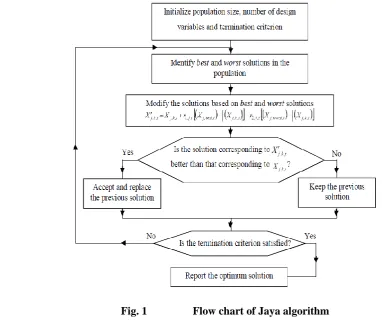
Jaya algorithm is a newly developed advanced optimization algorithm. It consists a single phase process and
460 | P a g e
solution of a problem closer to the best solution and moving away from the worst solution. The algorithm can be
applied in both constrained and unconstrained type optimization problem. This algorithm requires only some
common control parameters and does not require any algorithm specific controls parameter. The description of
Jaya algorithm is given below.
Consider a problem where f(x) is the objective function which is to be maximized (or minimized). At any
number of iteration „i‟, consider „d‟ is the number of design variables (i.e. j=1,2,…,d) and „p‟ be the number of
candidate solution (i.e. population size, k=1,2,…p). Let the best candidate best obtained the best value of f(x)
(i.e. f(x)best) in the entire candidate solutions and the worst candidate worst obtained the worst value of f(x) (i.e.
f(x)worst) in the entire candidate solutions. If Xj,k,i is the value of the jth variable for the kth candidate during the ith
iteration, then this value is modified as per the following equation.
X’j,k,i = Xj,k,i + r1,j,i (X1,best,i - | Xj,k,i | ) - r2,j,i (X1,worst,i - | Xj,k,i | ) (1)
where, Xj,best,i is the value of the jth design variable for the best candidate and Xj,worst,i is the value of the jth
design variable for the worst candidate. X‟j,k,i is the new improved value of Xj,k,i and r1,j,i and r2,j,i are the two
random numbers for jth variable during the ith iteration in the range [ 0, 1 ]. The term“r1,j,i (X1,best,i - | Xj,k,i | )”
indicates the tendency of the solution to move towards the best solution and the other term “ - r2,j,i (X1,worst,i - |
Xj,k,i | )” indicates the tendency of the solution to move away from worst solution. The value of X‟j,k,i is only
accepted if it give better function value. All the accepted function values at the end of iteration are taken as the
input to the next iteration.
461 | P a g e
IV DESIGN OPTIMIZATION OF BALL BEARING
On the basis of operating requirements, different objective functions for rolling element bearings may be
proposed, the most important of these being the requirement of the longest fatigue. Thus, the basic requirement
for a ball bearing is the long fatigue life. In normal operating conditions of ball bearings, the main reason of
failure is contact stress. The most frequent failure of bearing is due to surface fatigue or flaking phenomenon.
Flaking is a phenomenon of removable of scaly surface particles from the bearing material which is due to
surface fatigue that occurs between the rolling elements and the inner and outer rings. Fatigue life of bearing is
defined as the number of revolutions after which flanking or any cracks initiates due to repeated stresses.
Fatigue life of bearing is the most important factor in bearing design. Therefore, the bearings are designed for
maximum fatigue life as an objective. The fatigue life of bearing under a radial load can be expressed as
.
(2)where, L10 is the fatigue life in revolutions with 90% reliability, Cd is the dynamic load capacity of bearing, Fe is
the dynamic equivalent load, and n is the load life exponent, which is taken as 3 for point contact or ball
bearing. It can be seen from eq. (2) that the fatigue life of bearing is directly proportional to the dynamic load
capacity of bearing. Hence, the dynamic load capacity is taken as objective function for maximization in this
case study. Micro- geometry of ball bearing and formation of optimization problems are described below.
4.1. Micro- geometry of radial bearings
Ball bearing is a type of rolling contact bearing, in which rollers are in the form of small spherical balls. It can
take both radial and axial loads. Fig. 2 shows micro-geometry of a ball bearing in which various geometrical
parameters are indicated.
4.2. Objective function
In this present case study, the basic dynamic capacity is taken as objective for maximization and expression of
basic dynamic capacity for ball bearing is given as:
(3)
with
(4)
and
462 | P a g e
where, γ is a dependent parameter, α is the free contact angle of bearing and it depends on type of bearings. In
present of deep groove ball bearing α is equal to zero.
Fig.
2. Micro-geometries of a typical ball bearing.
The present optimization problem is a single objective multi constraint optimization problem and the
maximization of dynamic load capacity of radial ball bearing is the main objective.
max[ f(X) ] = max[ Cd] (6)
where f(X) represent the objective function, which is to be maximized and X is the design variable vector.
4.3. Design variable vector
Referring to eq. (3) and eq. (4), the ball bearing design parameter vector has been chosen as
{X} = [ Db , Dm , Z, fo, fi, ]T
where, Db, Dm,Z, fo, fi, are the parameters defining the internal geometry of ball bearing (see Fig. 2), Db is the
diameter of the ball in mm, Dm is the bearing pitch diameter in mm, Z is the numbers of balls, fo (= ro/Db ) is the
curvature radius coefficient of the outer raceway groove, fi (= ri/Db ) is the curvature radius coefficient of the
inner raceway groove; ro and riare the outer and the inner raceway groove curvature radius, respectively. There
are three more parameters are used in constraints to give bearing a feasible design space. The value of these
parameters has taken constant in this problem. KDminis the minimum roller diameter limiter = 0.5, KDmax is the
maximum roller diameter limiter = 0.8, ε is the Parameter for outer ring strength consideration = 0.1, and e is
463 | P a g e
4.4. Constraints
Designing of radial ball bearing involved various constraints proposed by researchers (Indraneel Chakraborty ,
Vinay Kumar , Shivashankar B. Nair & Rajiv Tiwari). These constraints are obtained based on the bearing
internal geometries, manufacturing consideration, running consideration and contact stresses. Various
constraints have been complied in Table 1 and small description about them given below.
TABLE 1
Constraint defining the range of geometric design variables of spherical
roller bearings
S.N. Constraint no. Constraint parameter ranges and constraint conditions for design variables.
1. Constraint 1
2. Constraint 2
3. Constraint 3
4. Constraint 4 ; where
5. Constraint 5
6. Constraint 6 ; where
7. Constraint 7 ; and
8. Constraint 8
Constraint 1 is used to find out the number and diameter of balls, for convenience of bearing assembly, first
constraint must be satisfied. (= 4.7124 radians) is the maximum tolerable assembly angle which depends
upon the bearing geometry. Constraints 2 and 3 are used to choose the bounds of diameter of ball. Constraints 4
and 5 are defined for running mobility of bearings. Bearing pitch diameter of bearing should fall in a certain
range. Constraint 6 is defined to take care of thickness of bearing ring at the outer raceway, so that bearing ring
not distorted under process of manufacturing and mounting. Constraint 7 and 8 defined to take care of groove
curvature radii of raceways to provide relief in contact stress. The coefficient of groove curvature radii of the
inner and outer raceways of ball bearing should not be less than 0.515Db.
4.5. Results
Jaya algorithm is used for obtaining optimum values of design variables of various sizes of ball bearings. These
bearings are selected from bearing standards belonging to various dimensional series, which is available
464 | P a g e
ranges of various design parameters are obtained using various constraints. Computations were conducted using
MATLAB09 and it is executed in dual core – 2.00GHz (3 Gb RAM) computer.
TABLE 2
Bounds of design variables for ball bearing (D = 30; d = 10 )
Design variables Lower bound Upper bound
Db 3 9
Dm 18 24
Z 4 50
0.515 0.52
0.515 0.53
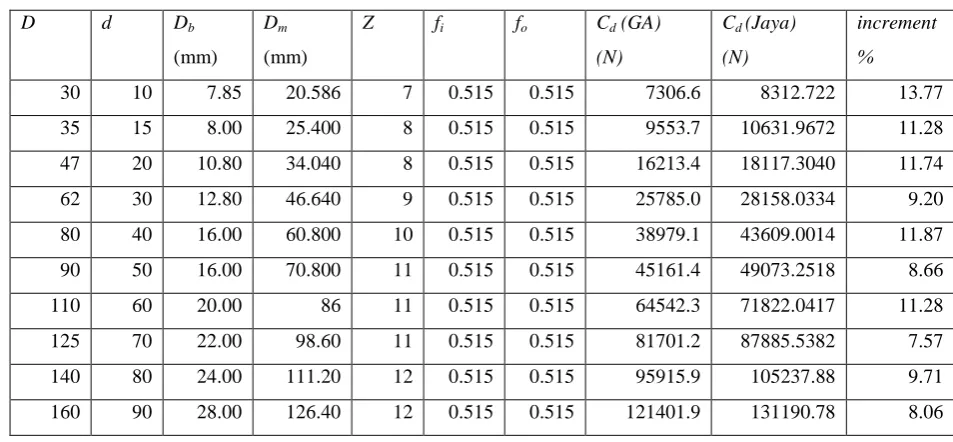
Optimization of ball bearing was carried out through Jaya algorithm using the bounds of variables with a
population size of 300 and number of generation of 10000. In order to verify effectiveness of newly proposed
Jaya algorithm, it is applied to various ball bearings, listed in Table 3. And the results obtained are compared
with previously proposed algorithms. The algorithm is run several times and the results obtained are found
consistently better than the results of previously proposed. Table 3 shows the various optimized design variables
of ball bearing obtained through Jaya algorithm and comparison of dynamic capacity obtained using Jaya
algorithm with Genetic algorithm obtained by past researchers. The results obtained using Jaya algorithm is
found better than other algorithm.
TABLE 3
Optimum design of radial ball bearing using Jaya algorithm and
comparison with other algorithms.
D d Db
(mm)
Dm
(mm)
Z fi fo Cd (GA)
(N)
Cd (Jaya)
(N)
increment
%
30 10 7.85 20.586 7 0.515 0.515 7306.6 8312.722 13.77
35 15 8.00 25.400 8 0.515 0.515 9553.7 10631.9672 11.28
47 20 10.80 34.040 8 0.515 0.515 16213.4 18117.3040 11.74
62 30 12.80 46.640 9 0.515 0.515 25785.0 28158.0334 9.20
80 40 16.00 60.800 10 0.515 0.515 38979.1 43609.0014 11.87
90 50 16.00 70.800 11 0.515 0.515 45161.4 49073.2518 8.66
110 60 20.00 86 11 0.515 0.515 64542.3 71822.0417 11.28
125 70 22.00 98.60 11 0.515 0.515 81701.2 87885.5382 7.57
140 80 24.00 111.20 12 0.515 0.515 95915.9 105237.88 9.71
160 90 28.00 126.40 12 0.515 0.515 121401.9 131190.78 8.06
Convergence study is carried out by plotting graphs between design variables and number of generations.
465 | P a g e
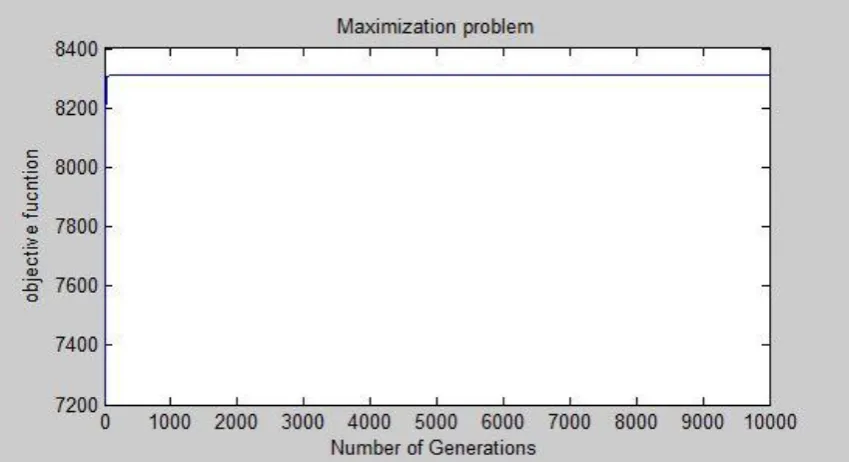
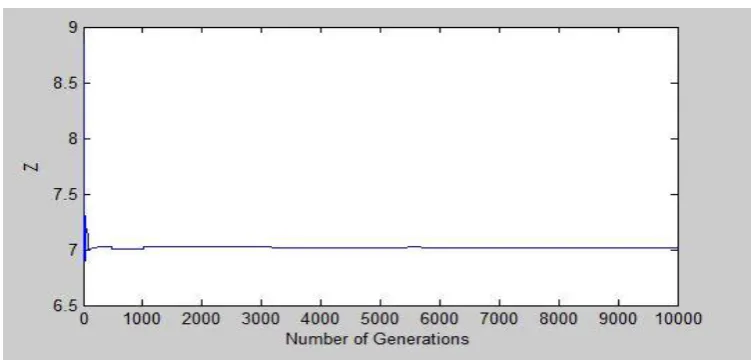
attends convergence at 44th generation with a value of 8312.722 N and become constant for rest of generations. Fig. 4 to Fig.6 shows variation of basic design variable with number of population. The value of ball diameter
initially increases to 7.699mm at 12th generation, after that its value once decrease and again increases to 7.862mm at 993th generation and remain constant for rest generation. The pitch diameter of ball bearing attends convergence value of 20.59mm at 1014th generation and remains constant. Similarly, the number of balls also attends fast convergence value of 7 at 241th generation and remains constant for rest generations.
Fig. 3
shows the variation of dynamic capacity with no. of generation for radial
ball bearing 6200 series.
466 | P a g e
Fig. 5 Variation of the pitch diameter versus number of generations
Fig. 6 Variation of no. of balls versus no. of generations for a radial ball bearing.
V CONCLUSION
Selection of the optimal values of different design variables is of chief importance for designing of any kind of
bearings. Design optimization has to yield maximize dynamic capacity while considering various design
parameter and constraints. In the present paper, Jaya algorithm has used successfully for obtaining optimized
design of ball bearing, which is taken from literature. This case study is a single objective problem and
subjected to various non-linear constraints. The main aim is to increase fatigue life of the bearing. The design of
ball bearings of various sizes was optimized using Jaya algorithm and their results compared with genetic
algorithm, which obtained by previous researchers. The results obtained using Jaya algorithm is better than
genetic algorithm and also fulfilling all necessary constraints. Convergence studies are also carried out and it
shows very fast convergence towards than other algorithm. The analysis of the optimized design parameters and
467 | P a g e
other types of bearings. Some more realistic constraints can be introduced for getting more precious result. Heat
generation could be taken as objective along with dynamic capacity incorporated for multi objective bearing
design problems.
REFERENCES
[1] Krzeminski-Freda H., Warda B., Correction of roller generation in spherical roller bearings, Wear, vol. 192,
pp. 29-39, 1996.
[2] Choi D.H., Yoan K, A design method of an automobile wheel-bearing unit with discrete design variables
using genetic algorithm, J. Tribol, vol. 123, pp. 180-7, 2001.
[3] Chakraborthy I., Vinay K., Nair S.B., Tiwari R., Rolling element bearings design through genetic
algorithms, Eng. optim., vol. 35(6), pp. 649-59, 2003.
[4] SKF, general catalogue, Germany, 2005.
[5] Rao B.R., Tiwari R., Optimum design of rolling element bearings using genetic algorithms, Mech. Mach.
Theory, vol. 42(2), pp. 233-50, 2007.
[6] Gupta S., Tiwari R., Nair S.B., Multi-objective design optimization of rolling bearings using genetic
algorithms, Mech. Mach. Theory, vol. 42(2), pp. 1418-43, 2007.
[7] Harris T.A., Kotzalas M.N., Rolling bearing analysis, 5th ed., Taylor and Francis, Boca Raton, FL, 2007.
[8] Kumar S.K., Tiwari R., Reddy R.S., Development of an optimum design methodology of cylindrical roller
bearings using genetic algorithm, Int. J. Comput. Methods Eng. Sci. Mech, vol. 9(6), pp. 321-41, 2008.
[9] Waghole V., Tiwari R., Optimization of needle roller bearing design using novel hybrid methods,
Mechanism and Machine Theory, vol. 72, pp. 71-85, 2014.
[10] Rao R.V., Jaya: a simple and new optimization algorithm for solving constrained and unconstrained