190 | P a g e
THERMAL ANALYSIS OF FUNCTIONALLY GRADED
RECTANGULAR PLATE
Mukesh Kumar Saini
1, VikasBansal
2, Amit Gahlaut
31,2,3
Department of Mechanical Engineering, Rajasthan Technical University, Kota, (India)
ABSTRACT
In today’s life, the use of FGM became very wide due to its high strength, stiffness and low density. Aerospace, aircraft and marine are most applicant area of FGM. In most of applications, FGM are subjected to severe temperature and therefore, thermal analysis of FGM is very important. This paper presents 2-D thermal analysis of functionally graded rectangular plate using COMSOL Multiphysics 4.2, in which material properties are varying according to exponential law. In this paper, COMSOL Multiphysics 4.2 used to find out temperature, displacement, stress distribution for rectangular plate and results are compared radial integration boundary element method (RIBEM) and Finite Element Method (ANSYS software) [6].
Keywords
:
Functionally Graded Material, COMSOL Multiphysics 4.2, Rectangular Plate, thermal
stress analysis
.
I. INTRODUCTION
Functionally graded materials are those in which the value fraction of the two or more constituents’ materials is
varied continuously as a function of position along certain dimension (s) structure [1]. A number of advantages
possess by FGMs including an improved residual stress distribution , high temperature withstanding ability ,
higher fracture toughness , reduced stress intensity factors and improved strength , which make them attractive
in many field of engineering such as electronic industries, biomedical, aircraft, biomedical, aerospace and
defense.
Radial Integration boundary element method (RIBEM) used to obtain displacement, temperature and stress
distribution for FGM structures such as rectangular plate and hexahedral by Kai Yang, Wei-Zhe Feng, Hai-Feng
Peng and Jun Lv [6]. COMSOL Multiphysics has been used to simulate temperature distribution, displacement
and stress distribution for five layered FGM of Al2O3/Ti by Dheya N. Abdulameer [3]. M. Jabbari, A. Bahuti
and M. R. Eslami[4] used Bessel function to study the axisymmetric mechanical and thermal stresses in thick
short length FGM cylinders. The influence of mixing ratio variation index and graded layer thickness on the
resulting thermal induced stresses investigated by Dr. AlaaAbdukhasanAtiyah and Ahmed Taifor Aziz [5].
Element – free Kp-Ritz method used for thermo elastic response and free vibration of FGM shells by Zhao [10].
In this paper, COMSOL multiphysics 4.2 is used to present displacement, temperature and stress distribution for
2D functionally graded rectangular plate. Thermal conductivity is assumed to be expressed by exponential law
191 | P a g e
1.1 Effective Properties Of Fgm
Three laws namely power law (P-FGM), exponential law (E-FGM), and sigmoid law (S-FGM) [2] are used to
obtain properties of functionally graded materials.
1.1.1 POWER LAW (P-FGM)
Fig. 1 volume fraction across the functionally graded layers.
The value of function Vc(z) is assumed to obey the following power law function:
(1)
Where n is the material grading index and h is the plate thickness. The material properties of a P-FGM can be
determined by the rule of mixture:
(2)
Where Ec and Emare young’s modulus of the lowest (z= -h/2) and top surfaces (z=h/2) of the FGM plate. The
subscripts m and c represents the metallic and constituents, respectively.
192 | P a g e
1.1.2 Exponential Law (E-Fgm)
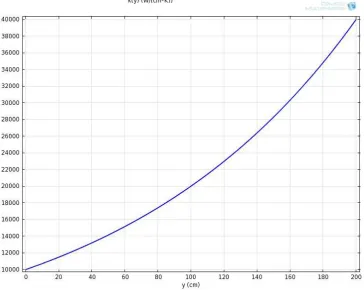
In this paper, exponential law is used to vary the thermal conductivity of the FGM rectangular plate
(3)
Where H is the width of the plate, and k1 and k2 are the conductivities of the top and bottom sides of the plate
respectively.
Fig. 3 variation of thermal conductivity along y-axis.
1.1.3 Sigmoid Law (S-FGM)
Sigmoid law is defined as:
(4)
(5)
The young’s modulus of S-FGM can be calculated using rule of mixture:
(6)
193 | P a g e
Fig. 4variation of volume fraction representing sigmoid law [2].
II. THEORETICAL FORMULATION
2.1 Displacement Integral Equation
In thermoelasticity, the relationship among the stress, displacement and temperature can be expressed as [7]
(8)
Where,
(9)
In equations A and B, σijis the stress tensor; represents the partial derivative of displacement with respect
to the coordinate xl ; is the value of temperature change; Poisson’s ratio; and k are the shear modulus and
thermal expansion coefficient, respectively, which are the functions of spatial coordinates; and is the
elastic tensor with the form:
(10)
For the convenience, body forces are not considered in this study. The equilibrium of stress can be expressed as:
(11)
194 | P a g e
(12)
Using the weight function Uij,we can write da weighted residual formulation for Eq. (11) as follows:
(13)
On substituting Eq. (11) into Eq. (13), integrating by parts twice and using Gauss’s divergence theorem, it
follows that:
(14)
The weight function Uij is taken as the solution of the following equation:
(15)
Where is the Dirac function with the singular point at xp. Substituting Eq. (15) into Eq. (14) and after
using the property of the Dirac function, the following displacement boundary domain integral equation can be
obtained:
(16)
Where tj is determined by Eq. (12) and
(17)
In which ũj, and are the normalized displacement, temperature, and shear modulus, respectively, defined as:
(18)
The fundamental solution Uij satisfying Eq. (13) turns out to be the Kelvin displacement solution with μ=1, the
expression of which can be found in any elasticity BEM book, e.g. Ref. [7]. Tijis the corresponding Kelvin
traction fundamental solution [8] and the kernel function Vij can be obtained by substituting the expression of
Uijinto Eq. (18), resulting in:
195 | P a g e
The function Uij,j is as follows:(20)
In which, β=2 for 2D problems with α=β-1.
Eq. (16) is the displacement integral equation formulated in terms of the normalized physical quantities for
thermal stress analysis. The main feature of the equation is that the representative form is very simple and no
displacements gradient are included in the integral equation.
2.2 Stress Integration Equation
From the first expression from the Eq. (18):
(21)
On taking the partial derivative of Eq. (16) with respect to the point xp, regularizing the strongly singular
domain integral related to the temperature by subtracting and adding a singular term [8] and then substituting the
result into Eq. (21), we can obtain following stress integral equation:
(22)
Vijk and the free term coefficient Fijk are same as described in [9]; and the remaining quantities ψij and h are
defined as follows:
(23)
(24)
III. PROBLEM DEFINITION
Fig. 5 dimension of the plate
A rectangular FGM plate is considered of dimension 200*100, in which bottom part is made of metal and top
196 | P a g e
(25)
With H= 100 being width of the plate and k1 = 100 W/(cm*K) and k2 = 200 W/(cm*K) being the conductivities
on the bottom and top sides of the plate respectively. The boundary condition for heat conduction computation
are as shown in fig 5: the temperatures 0K and 100K are applied to the left and right sides respectively; the
adiabatic condition (q=0) is applied on the top and bottom sides. The boundary conditions for thermal stress
analysis are defined as follows: the left side is fixed and other sides are traction free.
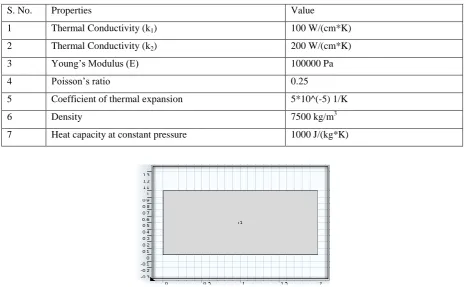
Table 1 Material Properties
S. No. Properties Value
1 Thermal Conductivity (k1) 100 W/(cm*K)
2 Thermal Conductivity (k2) 200 W/(cm*K)
3 Young’s Modulus (E) 100000 Pa
4 Poisson’s ratio 0.25
5 Coefficient of thermal expansion 5*10^(-5) 1/K
6 Density 7500 kg/m3
7 Heat capacity at constant pressure 1000 J/(kg*K)
Fig. 6 Geometry of 2D rectangular functionally graded plate on COMSOL Multiphysics.
IV. RESULTS AND COMPARISION
A powerful computer code named COMSOL Multiphysics has been developed to find out the thermal stresses
in a functionally graded materials. For example, a 2D rectangular plate has taken in this paper and two physics
(Heat Transfer + Thermal Stresses) are applied according to described boundary conditions, in Problem
definition, to find out the displacement, temperature and stress distribution. Results are compared with RIBEM
and FEM analysis [6]. Fig.7 and fig. 8show the distribution of displacement (ux) along the central line y=50,
197 | P a g e
Fig. 7 displacement distribution along central line of the plate using COMSOL Multiphysics.
Fig. 8 displacement distribution along central line of the plate using RIBEM and FEM [6]
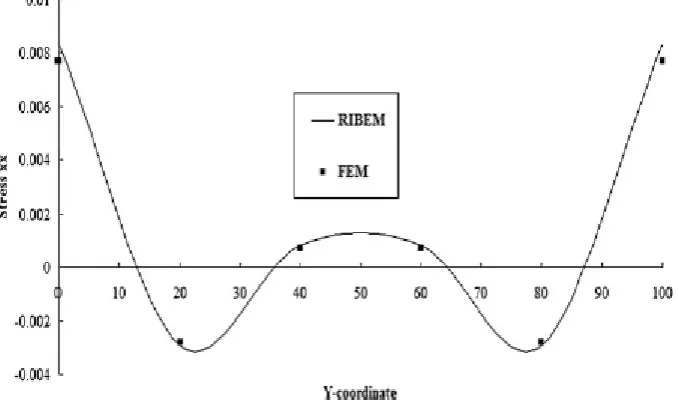
Fig. 9 shows the computed stress (σx) along the middle line x=100 of the plate using COMSOL Multiphysics,
198 | P a g e
Fig. 9 stress distribution along x=100 (in cm) of the plate using COMSOL Multiphysics.
199 | P a g e
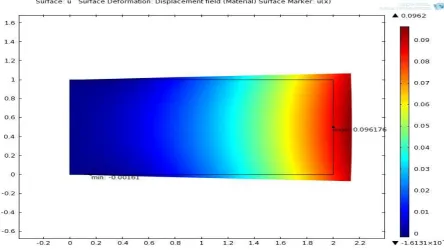
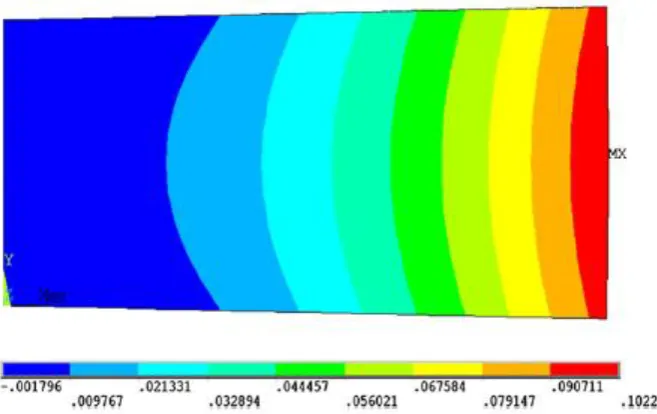
Displacement and temperature contours after deformation are shown in fig. 11 and fig. 12 using COMSOLMultiphysics while fig. 14 and fig. 15 using RIBEM and FEM.
Fig. 11 X-direction displacement contour after deformation using COMSOL Multiphysics
200 | P a g e
Fig. 13 X-direction displacement contour after defoermation using RIBEM.
Fig. 14 X-direction temperature contour after deformation using RIBEM.
Table 2 maximum and minimum values of various Displacement, stress and temperature.
S. No. Parameters X- Coordinate Y- Coordinate Maximum value Minimum value
1 Displacement(cm) 0.16 0 - -0.0016
2 0.5 0.0962 -
2 Stress (σx) at X=100
(N/cm2)
100 0.79 - -0.0034
100 1 0.0095 -
3. Temperature(K) 0 0.02 - 0K
201 | P a g e
From fig 7-14, it can be seen that the COMSOL Multiphysics results are very close to RIBEM and FEM results.This shows that computer coding in COMSOL mutliphysics is correct. The numerical integration takes 7s,
analytical integration RIBEM takes 4s, while COMSOL Multiphysics takes 3s to compute the results. So,
COMSOL Multiphysics saved above 57% and 25% of the computaion time in compare with numerical
integration and RIBEM, respectively.
V. CONCLUSION
Static analysis of 2D FGM rectangular plate is analysed under thermal and heat transfer loading. The effective
material property (thermal conductivity) of FGM plate is assumed to vary continuously through the Y-direction
and is graded according to exponential law distribution. The accuracy of the method was validated by
comparing the results with the previous results.
It is found from the present study that minimum displacement and maximum displacement are obtained at X =
0.16, Y = 0 and X = 2, Y= 0.5, respectively. For the case of temperature minimum temperature is found at X =
0, Y = 0.02 and maximum temperature is obtained at X = 2, Y=0. From the thermal stress analysis, we can see
that stresses become zero at four points along X = 100. The value of maximum and minimum displacement is
-0.000161 and 0.096176, reapectively, which are very close to displacement obtained from the RIBEM and FEM
analysis.
The present paper provides a thermal and heat transfer analysis of 2D FGM plate which shall be useful in the
designof the components utilizing the same. Moreover, this paper tells the use of COMSOL Multiphysics 4.2 as
an useful tool in the analysis of FGM structures.
REFERENCES
[1] S. Suresh, A. Mortensen, Fundamentals of Functionally Graded Materials, IOM Communications Ltd.,
London, 1998.
[2] RohitSaha and Maiti. P. R., Buckling of Simply supported FGM plates under uniaxial loads, Hindu
University, Varanasi 221005, India, May 2012.
[3] Dheya N. Abdulameer, Fabrication and modeling of high order functionally graded materials for space
application, M. S. Thesis, Material Engineering Department, Technology University, MS, 2012.
[4] M. Jabbari, A. Bahuti, M. R. Eslami, Axisymmetric mechanical and thermal stresses in thick short length
FGM cylinders, International Journal of Pressure Vessels and Piping,86,2009,296-306.
[5] AlaaAbdulhasanAtiyah and Ahmed Taifor Aziz, Design and Modelling (Fe/ZrO2) of Functionally Graded
Materials, Engineering and technology Journal, 32(7), 2014, 1843-1858.
[6] Kai Yang, Wei-Zhe Feng, Hai-Feng Peng, Jun Lv, A new analytical approach of functionally graded
material structures for thermal stress BEM analysis, International Communications in Heat and Mass Transfer,
62, 2015, 26-32.
[7] X. W. Gao, Boundary element analysis in thermoelasticity with and without internal cells, International
202 | P a g e
[8] X. W. Gao, T. G. Davis, Boundary Element Programming in Mechanics, Cambridge University Press, 2002.[9] K. Yang, X. W. Gao, Y. F. Liu, Using analytical expressions in radial integration BEM for variable
coefficient heat conduction problem, Eng. Anal. Boundary elem., 32, 2008, 692-696.
[10] Zhao X, Lee YY and Liew KM, Thermo elastic and vibration analysis of functionally graded cylindrical
![Fig. 2 effect of power law index (n) on the volume fraction [2].](https://thumb-us.123doks.com/thumbv2/123dok_us/7763522.1275424/2.595.162.427.183.290/fig-effect-power-law-index-n-volume-fraction.webp)
![Fig. 4variation of volume fraction representing sigmoid law [2].](https://thumb-us.123doks.com/thumbv2/123dok_us/7763522.1275424/4.595.130.462.106.320/fig-variation-volume-fraction-representing-sigmoid-law.webp)
![Fig. 8 displacement distribution along central line of the plate using RIBEM and FEM [6]](https://thumb-us.123doks.com/thumbv2/123dok_us/7763522.1275424/8.595.81.518.112.345/fig-displacement-distribution-central-line-plate-using-ribem.webp)