PERFORMANCE ANALYSIS OF OLSR USING CPWF
TECHNIQUE IN MOBILE AD-HOC NETWORK
(MANET)
1
Usha Dagar,
2Prashant Hemrajani
1
Student, Computer Science & Engineering ,
School of Engineering & Technology, Poornima University, Jaipur, Rajasthan (India)
2
Assistant Professor , Computer Science & Engineering
Poornima College of Engineering, Jaipur, Rajasthan (India)
ABSTRACT
A wireless network is any type of computer network that uses wireless data connections for connecting networks nodes. A mobile ad hoc network is a network that consists of mobile nodes that communicate with each other node over wireless links. These networks contain several nodes in groups as the network size increases ,it generally happens for nodes to be dispersed in a wide area than the range of individual nodes. In these conditions there is need to employ routing techniques such that the out of range nodes may communicate with each other via intermediate nodes. In Optimized Link Routing (OLSR) protocol Greedy Algorithm will choose the nodes with stronger cover ability using Multipoint Relay Selection but this technique creates multiple nodes repetition in MPR Selection which decrease the performance of Network. Multipoint Relaying is a technique to reduce the number of duplicate retransmissions while forwarding a broadcast message. In this paper a new technique CPWF Technique is proposed for selection of Multipoint Relays (MPR) in optimized link state routing protocol to improve the performance. CPWF technique calculate the power of each node and select the node as MPR node which takes less power consumption. The comparison analysis will be carrying out about this routing using MATLAB.
Key words:
MANET, Link State Protocol, NFA, BEST, Greedy Algorithm, MPR, CPWF,
MATLAB
I. INTRODUCTION
mobile users that communicate over reasonably slow wireless links. The network topology may vary rapidly and unpredictably over time, because the nodes are mobile. This kind of network is prone to link failure or node failure due to restricted energy or mobility.
OLSR Protocol in link state routing protocol, all links with neighbor nodes are flooded in the entire network. OLSR protocol is an optimization of a pure link state protocol for mobile ad hoc networks. OLSR protocol reduces the size of control packets. By only declaring only the subset of links with its neighbours i.e.) their multipoint rely selectors. It uses only selected nodes to flood its control packets by using selected nodes called as multipoint relays. Only the MPRs of a node retransmit the broadcast messages. This reduces the number of retransmissions in a flooding or broadcast procedure. A set of nodes is selected for the retransmission of packets. These selected nodes are called as Multipoint Relays (MPRs). The nodes which are not in its MPR set, read and process the packet but do not retransmit them. For this purpose, each node maintains a set of its neighbours which are called the MPR Selectors of the node. This MPR set can change over time, which is indicated by the selector nodes in their HELLO messages.
In the previous approach the Multi Point Relays (MPRs) selected by greedy algorithm [38] and BEST Algorithm [27] are not optimal in terms of performance analysis parameters like redundant retransmission messages (TC messages), packet delivery ratio and throughput.
In this paper CPWF Technique is used to select MPRs .By selecting MPRs using CPWF Technique , in some scenarios this technique improves greedy algorithm and BEST Algorithm in a certain extent. The final results of simulation show that: in different scenarios, packet delivery ratio and throughput calculated by CPWF are increased compared with existing algorithms and the numbers of TC packets are reduced considerably.
II. METHODOLOGY USED BY RESEARCHERS:
Greedy Algorithm:
Inthe Greedy Algorithm MPR node is a set node which is the union of the MPR setsconstructed for each interface. In every Hello message, the nodes advertise their willingness to forward traffic on behalf other nodes. A node must advertise the same willingness on all interfaces. The possible values are: • WILL_NEVER: the node must not be selected as MPR
• WILL_ALWAYS: the node should be selected as MPR. • WILL_DEFAULT: is the default value.
MPR set for a given node n is as follows:
reach ability, i.e., the number of two hop neighbor nodes which are not yet covered by at least one node in the MPR set, and which are reachable through this one-hop neighbor. (b) Select as a MPR the node with highest willingness among the one-hop neighbor nodes with non-zero reach ability. If there are multiple node, select the node with maximum reachability.5. The MPR set is constructed from the union of the MPR sets for each interface [11].
Necessity First Algorithm (NFA):
Necessity First Algorithm (NFA) is used to select the optimal Multi Point Relays with the goal of solving performance problem of greedy algorithm. The idea behind NFA is that when there is 1 hop neighbors with Necessity of selecting, deleting the neighbor with poorest cover ability purposely to create necessity of selecting, then choosing the neighbors with necessity of selecting as MPRs. By selecting MPRs from the “necessity of selecting”, in some scenarios NFA improves greedy algorithm in acertain extent. The number of MPRs selected by NFA could be reduced by 2%~11% compared with greedy algorithm, and the number of TC packets could be reduced by more than 7% and this is important for the reduction of overhead in the network. The extent of improvement made by NFA in different scenarios shows that, NFA is an algorithm more suitable for the networks with higher density [38].
III. PROPOSED CPWF TECHNIQUE
MANET requires the routing protocols to reduce overhead as much as possible for saving resource of network. In OLSR, there are some lacks with greedy algorithm and NFA, the Multi Point Relays (MPRs) selected by both algorithm are not optimal in terms of performance analysis parameters like redundant retransmission messages (TC messages), packet delivery ratio and throughput.
The idea behind CPWF is to select the MPRs in a way such that all the 2 hop neighbors have the maximum lifetime of a path through the MPRs to the current node like - A network topology extended with the arcs which constitute the transmission powers. The number along the lines indicates the power needed for a successful transmission from a node to a neighbor node. The optimal power path means that the maximum energy consumption on that path is the smaller among the maximum energy consumption of all the possible paths between the source and destination in the partial network topology (the path contains only the MPR nodes). Each node maintains a routing table and calculates its routing table using CPWF technique so as to find an optimal power path.
In this approach the initial power allocation vector always satisfies the power constraints. At every iteration, it is try to increase the number of bits on the subcarriers or equivalently, to setup a new bit-loading vector that is greater (component wise) when compared to the current bit-loading vector. This leads to the increase of power allocation vector.
In the Standard Greedy initializes is Set of Channels A=0, Set of Sub Channels B=0, Allocated power for each node P=0. Let CCPWFand PCPWFbe the continuous bit-loading and power allocation vectors obtained by the CPWF algorithm; B0 and P0 be the discrete bit-loading vector.
Algorithm:-
Step 1: Start with an Empty MPR Set=0
Step 3: Select Nodes from 1 Hop Nodes that are only ones able to reach in 2-hop nodes and add these Nodes in MPR Set.
Step 4: Exclude the covered nodes by the last from 2-hop away Nodes from X Step 5:- While 2 Hop- Nodes is not empty do.
Step 6:-For each node, calculate the transmission power using CPWF Technique
Step 6:- Select the 1 -Hop node that has the highest willingness and minimum power using CPWF Technique. Step 7: Add to these node in MPR Set.
MPR set U {Highest willingness nodes from 1 Hop Node with CPWF Technique}. Step 8: Repeat step 4.
IV.SIMULATION MODEL
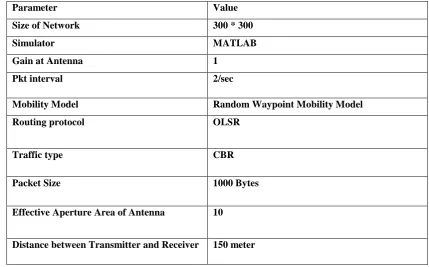
In this simulation a MANET with 100 nodes in a dense 300 x 300 meter square area. There are CBR/UDP source generated packets are used which are 1000 bytes with different data rates. The Random Waypoint Mobility Model is used as the nodes mobility Model. The pause time is set to 0. To evaluate the performance of modified routing scheme compared to standard OLSR. The common simulation parameters of the variations are summarized in table below.
Table 1.1 Simulation Parameters
Parameter Value
Size of Network 300 * 300
Simulator MATLAB
Gain at Antenna 1
Pkt interval 2/sec
Mobility Model Random Waypoint Mobility Model
Routing protocol OLSR
Traffic type CBR
Packet Size 1000 Bytes
Effective Aperture Area of Antenna 10
V RESULT
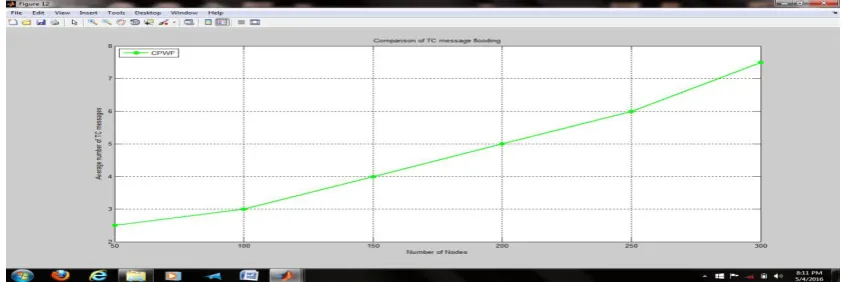
An experiment is performed using MATLAB in the network with the size of 300 x 300 m. All the nodes in experiment use the OLSR protocol with greedy algorithm and BEST algorithm and CPWF Technique respectively. After the execution time, the results are recorded for all sets of mobile nodes. Below Fig. shows the simulation graph for percentage of TC messages flooding in the network. This provides the flow of TC Message which aim is to provide the integrity of routing messages, especially Topology Control messages and prevent intermediate nodes from altering routing messages while forwarding them. The comparison is made for 50, 100, 150, 200, 250 and 300 nodes in these three techniques.
Fig. 1.1.Comparison of TC Message with respect to Different No. of nodes in Greedy Algorithm
Fig. 1.2.Comparison of TC Message with respect to Different No. of nodes in BEST Algorithm
Fig.1.4 Traffic Analysis of TC Message with respect to Greedy, BEST and CPWF Technique in OLSR
VI
.
CONCLUSION
Major problems in mobile ad hoc networks are (a) limited bandwidth and (b) high rate of topological changes. The goal for a routing protocol is to minimize its control traffic overhead while at the same time, it should be capable of rapidly adapting to link failures and additions caused by node movements. In the OLSR there are some drawbacks with the greedy algorithm and BEST Algorithm such as Multi Point Relays selected by these techniques are not optimal in terms of performance analysis parameters like TC Messages, Throughput, Packet Delivery Ratio. In this paper CPWF Technique is used which improves the performance of the network. In the simulation shows that Numbers of TC packets are reduced in CPWF Technique. The improvement shows that CPWF Technique is more suitable for the networks.
VII. ACKNOWLEGDEMENT
I would like to express my deep gratitude and thanks to Prof. Mahesh Bundele (Coordinator, Research),Poornima University for giving me an opportunity to work under his guidance for review of research papersand his consistent motivation & direction in this regard. I would also express my sincere thanks to Mr. Pershant Hemrajani (Asst.Professor, Poornima group of College), Poornima University for their guidance and support.`
REFERENCES
[1] Alam, M.R.; Chan, K.S., "RTT-TC: A topological comparison based method to detect wormhole attacks in MANET," Communication Technology (ICCT), 2010 12th IEEE International Conference on , vol., no.,
[2] Ahyoung Lee; Lavina, C.G.; Caballero, J.; Ilkyeun Ra, "Performance Analysis of Ad Hoc Routing Protocols Based on Selective Forwarding Node Algorithms," Information Science and Applications (ICISA), 2013
International Conference on , vol., no., pp.1,4, 24-26 June 2013
[3] Baccelli, E.; Cordero, J.A.; Jacquet, P., "Multi-point Relaying Techniques with OSPF on Ad Hoc Networks," Systems and Networks Communications, 2009. ICSNC '09. Fourth International Conference
on , vol., no., pp.53,62, 20-25 Sept. 2009
[4] Bouassida, M.S.; Chrisment, I.; Festor, O., "Efficient Group Key Management Protocol in MANETs using the Multipoint Relaying Technique," Networking, International Conference on Systems and International
Conference on Mobile Communications and Learning Technologies, 2006. ICN/ICONS/MCL 2006. InternationalConferenceon ,vol.,no.,pp.64,64,23-29April2006.
[5] Christian Haas ,Shi-Zong, Shyarn V. Nath, 2012 “A Clustering Approach based to Wireless network intrusion detection system”, Issue on security on wireless networks, IEEE, vol. 35, pp.99-101, 2012.
[6] Dashbyamba, Narangerel; Wu, Celimuge; Ohzahata, Satoshi; Kato, Toshihiko, "An improvement of OLSR using fuzzy logic based MPR selection," Network Operations and Management Symposium (APNOMS),
2013 15th Asia-Pacific , vol., no., pp.1,6, 25-27 Sept. 2013
[7] De Rango, F.; Fotino, M.; Marano, S., "EE-OLSR: Energy Efficient OLSR routing protocol for Mobile ad-hoc Networks," Military Communications Conference, 2008. MILCOM2008.IEEE
,vol.,no.,pp.1,7,16-19,Nov.2008.
[8] Fu Cai; Cui Yongquan; Han Lansheng; Fang Zhicun, "Projection Pursuit Based Wormhole Detection in Ad Hoc Network," High Performance Computing and Communications & 2013 IEEE International Conference
on Embedded and Ubiquitous Computing (HPCC_EUC), 2013 IEEE 10th International Conference on , vol., no., pp.1315,1322, 13-15 Nov. 2013
[9] Guangwu Hu; Chaoqin Zhang, "MR-OLSR: A link state routing algorithm in multi-radio/multi-channel Wireless Mesh Networks," Communications (APCC), 2012 18th Asia-Pacific Conference on , vol., no.,
pp.883,888, 15-17 Oct. 2012
[10] Jin Guo; Zhi-yong Lei, "A kind of wormhole attack defense strategy of WSN based on neighbor nodes verification," Communication Software and Networks (ICCSN), 2011 IEEE 3rd International Conference
on , vol., no., pp.564,568, 27-29 May 2011
[11] Jacquet, P.; Muhlethaler, P.; Clausen, T.; Laouiti, A.; Qayyum, A.; Viennot, L., "Optimized link state routing protocol for ad hoc networks," Multi Topic Conference, 2001. IEEE INMIC 2001. Technology for the 21st Century. Proceedings. IEEE International ,vol.,no.,pp.62,68,2001.
[12] Keer, S.; Suryavanshi, A., "To prevent wormhole attacks using wireless protocol in MANET," Computer and Communication Technology (ICCCT), 2010 International Conference on , vol., no., pp.159,163, 17-19
Sept. 2010.
[14] Karuppanan, K.; Mahalaksmi, S., "Enhanced Optimized Link State Routing protocol for VANET using Fuzzy Rough Set," Advances in Computing, Communications and Informatics (ICACCI), 2013
International Conference on , vol., no., pp.1942,1947, 22-25 Aug. 2013.
[15] Kasiran, Z.; Mohamad, J., "Throughput performance analysis of the wormhole and sybil attack in AODV," Digital Information and Communication Technology and it's Applications (DICTAP), 2014 Fourth International Conference on , vol., no., pp.81,84, 6-8 May 2014.
[16].Larry Korba ,1998," Security System for Wireless Local Area Networks ", In IEEE, National Research Council of Canada, Issue on security of WLAN ,pp1550-1554,1998.
[17] Mehto, A.; Gupta, H., "A dynamic hybrid approach for wormhole detection and prevention," Computing, Communications and Networking Technologies (ICCCNT),2013 Fourth International Conference on , vol.,
no., pp.1,4, 4-6 July 2013
[18] Mingxi Li; Yan Xiong; Xuangou Wu; Xiancun Zhou; Yuhui Sun; Shenpei Chen; Xiaoya Zhu, "A Regional Statistics Detection Scheme against Sybil Attacks in WSNs," Trust, Security and Privacy in Computing and
Communications (TrustCom), 2013 12th IEEE International Conference on , vol., no., pp.285,291, 16-18 July 2013
[19] Ouacha, A.; Lakki, N.; El abbadi, J.; Habbani, A.; Bouamoud, B.; Elkoutbi, M., "Reliable MPR selection based on link lifetime-prediction method," Networking, Sensing and Control (ICNSC), 2013 10th IEEE International Conference on , vol., no., pp.11,16,10-12April2013.
[20] Paraskevas, E.; Manousakis, K.; Das, S.; Baras, J.S., "Multi-metric Energy Efficient Routing in Mobile Ad-Hoc Networks," Military Communications Conference (MILCOM), 2014 IEEE , vol., no., pp.1146,1151, 6-8 Oct. 2014.
[21] Ren Xiu-li; Yang Wei, "Method of Detecting the Sybil Attack Based on Ranging in Wireless Sensor Network," Wireless Communications, Networking and Mobile Computing, 2009. WiCom '09. 5th International Conference on , vol., no., pp.1,4, 24-26 Sept. 2009
[22] Shaohe Lv; Xiaodong Wang; Xin Zhao; Xingming Zhou, "Detecting the Sybil Attack Cooperatively in Wireless Sensor Networks," Computational Intelligence and Security, 2008. CIS '08. International Conference on , vol.1, no., pp.442,446, 13-17 Dec.2008
[23] Safi, S.M.; Movaghar, A.; Mohammadizadeh, M., "A Novel Approach for Avoiding Wormhole Attacks in VANET," Computer Science and Engineering, 2009. WCSE '09. Second International Workshop on , vol.2, no., pp.160,165, 28-30 Oct. 2009
[24] Shakkeera, "Optimal path selection technique for flooding in link state routing protocol using forwarding mechanisms in MANET," Communication and Computational Intelligence (INCOCCI), 2010 International Conference on , vol., no., pp.318,323, 27-29 Dec. 2010
[25] Stephan, T.; Karuppanan, K., "Cognitive inspired optimal routing of OLSR in VANET," Recent Trends in Information Technology (ICRTIT), 2013 International Conference on , vol., no., pp.283,289, 25-27 July
[26] Shelja, S.; Suresh, K., "Performance improvement of OLSR protocol by modifying the Routing Table construction mechanism," Optimization, Reliabilty, and Information Technology (ICROIT), 2014
International Conference on , vol., no., pp.182,187, 6-8 Feb. 2014
[27] Selvi, K.T., "The secured OLSR protocol for MANET," Information Communication and Embedded
Systems (ICICES), 2014 International Conference on , vol., no., pp.1,6, 27-28 Feb. 2014
[28] Singh, K.; Verma, A.K., "Applying OLSR routing in FANETs," Advanced Communication Control and
Computing Technologies (ICACCCT), 2014 International Conference on , vol., no., pp.1212,1215, 8-10 May 2014
[29] Soo-Young Shin; Halim, E.H., "Wormhole attacks detection in MANETs using routes redundancy and time-based hop calculation," ICT Convergence (ICTC), 2012 International Conference on , vol., no.,
pp.781,786, 15-17 Oct. 2012
[30] Song Yanwei; Zeng Guangzhou; Lian Jian; MingQu Fan, "A more efficient link-state routing algorithm for telecommunication networks," IT in Medicine and Education (ITME), 2011 International Symposium on ,
vol.2, no., pp.383,386, 9-11 Dec. 2011
[31] Shanshan Chen; Geng Yang; Shengshou Chen, "A Security Routing Mechanism Against Sybil Attack for Wireless Sensor Networks," Communications and Mobile Computing (CMC), 2010 International
Conference on , vol.1, no., pp.142,146, 12-14 April 2010
[32] T. Kunz, "Energy-Efficient Variations of OLSR,"2008 International Wireless Communications and Mobile Computing Conference, Crete Island, 2008, pp.517-522.doi: 10.1109/IWCMC90. 2008.
[33] Umesh Kumar Chaurasia, U.K.; Singh, V., "MAODV: Modified wormhole detection AODV protocol," Contemporary Computing (IC3), 2013 Sixth International Conference on , vol., no., pp.239,243,
8-10 Aug. 2013
[34] Xun Li; Guangjie Han; Aihua Qian; Lei Shu; Rodrigues, J., "Detecting Sybil attack based on state information in Underwater Wireless Sensor Networks," Software, Telecommunications and Computer Networks (SoftCOM), 2013 21st International Conference on , vol., no., pp.1,5, 18-20 Sept. 2013
[35] Ying Ge; Lamont, L.; Villasenor, L., "Hierarchical OLSR - a scalable proactive routing protocol for heterogeneous ad hoc networks," Wireless And Mobile Computing, Networking And Communications,
2005. (WiMob'2005), IEEE International Conference on , vol.3, no., pp.17,23 Vol. 3, 22-24 Aug. 2005
[36] Y. Bai, Y. Liu and D. Yuan, "An Optimized Method for Minimum MPRs Selection Based on Node Density,"2010 6th International Conference on Wireless Communications Networking and Mobile Computing (WiCOM), Chengdu, pp. 1-4. 2010.
[37] Woungang, I.; Obaidat, M.S.; Dhurandher, S.K.; Traore, I., "A timed and secured monitoring implementation against wormhole attacks in AODV-based Mobile Ad Hoc Networks," Computer,
Information and Telecommunication Systems (CITS), 2013 International Conference on , vol., no., pp.1,5,
7-8 May 2013
[38] Z. Li, N. Yu and Z. Deng, "NFA: A New Algorithm to Select MPRs in OLSR," 2008 4th International