110 |
P a g e
A STUDY ON SEGMENTATION TECHNIQUES FOR
WEB MINING
R. Amuthavalli
1and P. Balamurugan
2,MPhil Research Scholar
1, Assistant Professor
2Department of Computer Science,Government Arts College, Coimbatore, (India)
ABSTRACT
Web mining is the process of mining information from the large set of data. Today the web has become the
largestinformation source for people. Web pages are smallest and undividable units, but a web page as a whole may
not be appropriate to represent a single topic. This contains various contents such as navigation, decoration,
interaction and contact information, which are not related to the topic of the web-page called noise.The
segmentation of informative and non-informative segments such as noises is important pre-processing steps in data
mining. The main purpose of this paper is to review and discuss the major research work that has been done in this
area and identifying the challenges and issues.
Keywords: Web Mining, Web Page Segmentation And Noises
I. INTRODUCTION
The Internet is an extraordinary resource that full of the information, which is strongly needed by many users and
applications for different purposes. However this resource is composed of web pages that contain different types of
information and extra data which affect the process of extract the intended information from the web. The
difficulties of extracting the relevance content from the web come from unstructured formatting of the files where
the intended data resides.
Most of the web documents contain extra information which is not relevant to the main article, but used for visual
layout concerns among the desired contents. The redundant information in web document, like advertisement
banner, copyright information and navigation menus assumed as noisy data for many applications. These noisy data
considered harmful to many applications that related to the web, since it affects and reduces the performance of their
process.There are many applications work to collect and manipulate the relevant data on web pages, for example
web mining applications, which include classification and clustering of web pages, detecting of replicated web pages
and information retrieval applications.The process of detecting and removing noisy data out of the web page in most
111 |
P a g e
II. WEB PAGE SEGMENTATION - A SHORT REVIEW
Web page segmentation and data cleaning are essential step in structure web data extraction. Identifying the web
page main content not important region can greatly improve the performance of the extraction process.
Roberto
Penerai et. al [8
] proposed aTPS (Tag Path Sequence
) algorithm searches for position in the TPS where it ispossible to split in two regions. This algorithm is very effective in identifying the main content block of several
major websites. The TPS consist of a sequence of symbol, each one representing a different tag path.
To address the problem of resource limitation of small screen devices, a unique methodology of web page
segmentation with tag path clustering is proposed by
Aruljothi et.al[3],
that reduces the memory space demand ofthe small hand-held devices. For segmenting web pages, both reappearance key patterns detection technique and
page layout information are used to provide better segmentation accuracy.
Sandeep Kauret.al. [10]
proposed DOM based page segmentation technique. Initially a XML web page isconverted into DOM tree. DOM based page segmentation which converts the pages into blocks and regions.
Performance of Web content extraction is analyzed based on complexity and efficiency on proposed algorithm.
S. Debnath [5]
proposed two new algorithms, ContentExtractor, and Feature Extractor. The algorithms identifyprimary content blocks by i) looking for blocks that do not occur a large number of times across webpages and ii)
looking for blocks with desired features respectively. The identify the primary content blocks with high precision
and recall, reduce the storage requirement for search engines, result in smaller indexes and thereby faster search
times, and better user satisfaction.
Ruihua Song et.al. [9]
proposed how to find a model to automatically assign importance values to blocks in webpage. That defines the block importance estimation as a learning problem. VIPS algorithm used to partition a web
page into Semantic blocks with a hierarchy structure. Two types of features extracted for each block namely spatial
feature (such as position and size), content feature (such as no of images and links). A Learning algorithm SVM and
Neural Network is applied to train various block importance models based on the features.
X. Liu .et.al. [8]
proposed a novel web page segmentation algorithm based on finding the Gomory-Hu tree in aplanar graph. The algorithm firstly distills vision and structure information from a web page to construct a weighted
undirected graph, whose vertices are the leaf nodes of the DOM tree and the edges represent the visible position
relationship between vertices. Then it partitions the graph with the Gomory-Hu tree based clustering algorithm.
III. WEB PAGE SEGMENTATION TECHNIQUES
In this sectiondiscuss the recent developments in web page segmentation and search optimization techniques. Some
112 |
P a g e
-
DOM Tree Based Approach
-
Vision Based Approach
-
Text Based Approach
-
Hybrid Approach
-
Graph Theoretic Based approach
DOM Tree Based Approach:
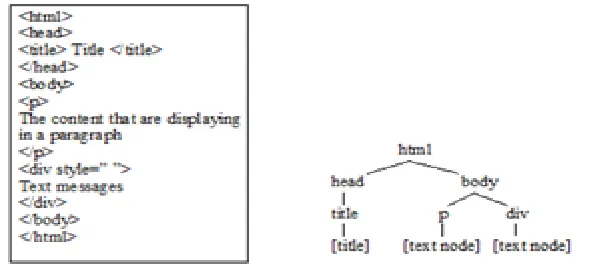
The Document Object Model(DOM) is an application programminginterface(API) for valid HTML and well-formed XML documents. It defines the logical structure of documents and
the way a document is accessed and manipulated. In the DOM-based segmentation approach, an HTML document is
represented as DOM tree, which provides a useful structure for a web page, but often not accurate enough to identify
different semantic blocks in a web page.
Fig 1: DOM Tree Segmentation from HTML source code.
Vision Based Approach:
Visual approaches segment the web page from the browser-side perspective as it isrendered. They used to partition the page into separators, such as lines, whitespaces and images, content and build a
content structure out of this information. Also it requires external resourcessuch as CSS files and images in order to
work correctly.
Text Based Approaches:
Text content based segmentation method[12] to extract content text from diverse webpages byusing the HTML document’s tag ratios. Which describe how to compute tag ratios on a line-by-linebasis and then cluster the resulting histogram into content and non-content area.These work is not on structured
extraction, but instead, on indexing and clustering of web sites.
Example: Snippet of a webpage news article.
1. <div id="topnav">
113 |
P a g e
3. <div id="author">James Smith</div>
4. OKLAHOMA CITY - Police were told that. . .
5. . . . The Oklahoman reported Sunday. <br><br> Jones had. . .
6. </div></div>
The Tag Ratios for these six lines are computed as follows.
1. Text=0, Tags=1, TR=0
2. Text=0, Tags=1, TR=0
3. Text=11, Tags=2, TR=5.5
4. Text=37, Tags=0, TR=37
5. Text=41, Tags=2, TR=20.5
6. Text=0, Tags=2, TR=0
Hybrid Approach[7]:
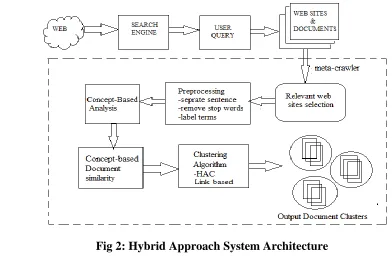
It uses Concept-Based Mining Model and Hierarchical Agglomerative Clustering (HAC)as a document clustering algorithm along with link based algorithm to cluster the web documents considering both
the content of web page as well as and the links of a web page in order to use as much information as possible for
the clustering. Fig. 2 shows the architecture that uses the Hybrid Approach (HAC algorithm and Link based
algorithm) in order to cluster the documents focusing on both the contents of the web page as well as hyperlinks in
the pages.
114 |
P a g e
Graph Theoretic Approach[4
]
:
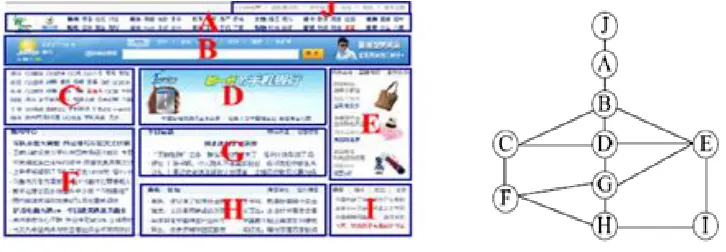
Segmenting a webpage into visuallyand semantically cohesive pieces.
These approaches isbased on formulating an appropriate optimization problem on weighted graphs, where
the weights capture if two nodes in the DOM tree should be placed together or apart inthe segmentation.
Fig 3. Example web page for segment a weighted graph
IV. CONCLUSION AND FUTURE WORK
In this study work discussed the various approaches that concern with the problem of web page segmentation. The
review explores various approaches and explained the difference between them, also it presents the different
algorithm’s approach and the application area related to each algorithm. The results of this review showed the
importance of web page segmentation as an essential step to various applications that related to it.
REFERENCES
[1] Ananthi J.et.al. , A Survey on Web Content Mining Methods and Applications for Information Extraction from
Online Shopping Sites, International Journal of Computer Science and information Technologies. Vol. 5(3),
2014, pp. 4091-4094.
[2] AndresSanoja and S. Gancarski, Block-o-Matic: Web Page Segmentation Tool and its Evaluation, 2009.
[3] S. Aruljothi and S. Sivaranjani, et.al, Web page segmentation for small screen Devices Using Tag Path
Clustering Approach, IJCSE, Vol 5, 2013.
[4] Chakrabarthi D.et al., A graph-theoretic approach to webpage Segmentation, In Proceeding of the International
conference on World Wide Web, 2008.
[5] Debnath S, Mitra P., and C.L. Giles,Automatic Extraction of Information Blocks from Web pages, In ACM
Symposium on Applied Computing, 2005, pp.1722-1726.
[6] H. F. Eldirdiery and A. H. Ahmed, Detecting and removing noisy data using Text Density Approach,
115 |
P a g e
[7] S. Pralhad, G. Gamare1, and A. Patil, Web Document Clustering using Hybrid Approach in data mining,International Journal of Research in Advent Technology,Vol.3, 2015.
[8] R. Panerai, F. Carina andDorneles,Automatic Web Page Segmentation and Noise Removal for Structure
Extraction using Tag Path sequences, Vol.4, JIDM, 2013, pp. 173-187.
[9] Ruihua Songand H. Liu. et.al, Learning Block Importance Model for Web pages, ACM, 2004.
[10]S. Kaur,and A. Tyagi et.al, Noise Reduction and Content Extraction from Web Pages Using DOM based page
segmentation,Vol. 5(6), IJCTA. Dec 2014.
[11] R. Sharma and M. Bhatia,Eliminating the Noise from webpages using Page Replacement
algorithm,International Journal of Computer Science and Information Technologies, Vol. 5(3), pp. 2014,
3066-3068.
[12] T. Weninger, and HsuW.H., et al., Content extraction via tag rations, In Proceedings of the International
Conference on World Wide Web, 2010.
[13] Y. K. Patel and N. Limbad, Noise Removal from Web Pages for Web Content
Mining,IJARIIE-ISSN(O)-2395-4396. Vol-2, 2016.
[14] Liu X et. al., Segmenting Webpage with Gomory-Hu TreeBased Clustering,JournalofSoftware, Vol. 6, No. 12,