1044 | P a g e
Data Concentrator for Connected Devices using BeagleBone
Board
R. Prashanth Goud
1
, Mirza Nemath Ali Baig
2
,
Mohammad Jabirullah
3
, K. Subramanyam Chari
4
1
Final Year, B.Tech. Student, Department of ECE, CMR Engineering College, Hyderabad, (India)
2, 3, 4Assistant Professor, Department of ECE, CMR Engineering College, Hyderabad, (India)
ABSTRACT
The main task of Data Concentrators is to collect data which is originated from any devices in the network that is connected via wired or wireless interfaces and protocols such as RS232C/RS485 with Modbus, USB, Ethernet, Wi-Fi, GSM/GPRS, Zigbee etc. Then they process the obtained data and, in a subsequent communication, transmit the acquired data to the Head-End Server System. This paper presents our work of employing the BeagleBone Black (BBB) board as a data concentrator for connected sensor devices. In the last few years, there has been a rapid increase towards single-board microcontrollers. These days, trend has shifted towards development of full-fledged credit-card sized computer’s like Arduino Mega2560, Raspberry Pi, Orange Pi, Chip and even Beaglebone Boards. These boards are low cost, low power, easy deployable and has user-friendly configurable options. The BeagleBone Black (BBB) board is a low cost, open hardware and expandable computer launched by a community of developers sponsored by Texas Instruments. This board is showing tremendous increase in adaptability and implementation in diverse areas like Robotics, Drones, Smart Homes, IoT devices, Linux and Cloud Computing Servers and even more.
Keywords: BeagleBone board, DCCD, Data Concentrators, IoT, Open Source Hardware, etc.
I INTRODUCTION
In the evolution of modern telecommunications systems there was a requirement to connect large numbers of
low-speed access devices with large telephone company 'central office' switches over common paths. During the first
generations of digital networks, analog signals were digitized on line cards attached to the telephone exchange
switches. In an effort to reduce local loop costs, it was decided to push this conversion closer to the customer premises
by deploying small conversion devices in customer neighborhoods. These devices would combine multiple digital
signals on a single link to a larger telephone switch, which would provide service to the customer. These devices were
initially called Data Concentrator.
A step in this direction would be to make the grid itself more intelligent so that power utilities, governmental
regulators, power distribution companies and consumers could better monitor, analyse and control energy generation,
distribution and usage. Along with smart meters deployed worldwide in the last ten years, data concentrators play a key
role in enabling intelligent power consumption with more robust end-to-end communications. The ever growing
capabilities of modern micro-controllers, together with the cost reduction induced by the competition between
1045 | P a g e
cost. Available with a wide range of clock frequencies and I/O capabilities, SOBs can be effectively used in a particle
accelerator control systems as a customizable embedded platform. With these considerations in mind, a survey has been
carried out to find the most suitable SOB to be used as the core for a general purpose embedded platform, or “smart
node”; the BeagleBone Black has been eventually selected.
The data may originated from any devices in the network that is connected via wired or wireless interfaces and
protocols such as RS232C/RS485 with Modbus, USB, Ethernet, Wi-fi, GSM/GPRS, Zigbee among others. The data is
stored in servers in the network where the data is processed to generate information. Network clients such as desktop
computers, laptops, Smartphone, tablets can access this information for smart business decisions. The information may
be displayed on annunciators and shared across locations through the gateway.
The paper is structured as follows: Section 2 describes the data concentrator, Section 3 overview of Beaglebone board,
Section 4 describes methodology, Section 5 presents the block diagram of the system, Section 6 presents the working
of the system, Section 7 describes research areas/future scope for project development’s and finally conclusions is
depicted in Section 8.
II DATA CONCENTRATORS
Data concentrators in substations provide a vital interface with intelligent electronic devices (IEDs). Retrieving
operational and non-operational IED data and communicating it to the corporate network, they provide users with the
data required for faster, more informed business decisions. A data concentrator is the core of data and energy
management in an advanced metering infrastructure (AMI). It provides the technology to measure and collect energy
usage data. The concentrator can also be programmed to analyze and communicate this information to the central utility
database. Not only can the utility providers could use this information for billing services, but can improve customer
relationships through enhanced consumer services such as real-time energy analysis and communication of usage
information. Additional benefits of fault detection and initial diagnosis can also be achieved, further optimizing the
operational cost. Data concentrators also called data aggregators provide the core functionality required to measure,
analyze and collect the data. They then communicate that data to a central database for troubleshooting and analyzing.
2.1.
Main Functions of a Data Concentrator
Data concentrators push intelligence to the edge of the grid by integrating, organizing and aggregating information
from e-meters or other end equipment on the grid. Typically located at the transformer or a secondary substation level,
data concentrators need to have the following basic functions:
Provide reliable communication with meters and head ends
Secure consumers’ data and information
Monitor regional grid status
1046 | P a g e
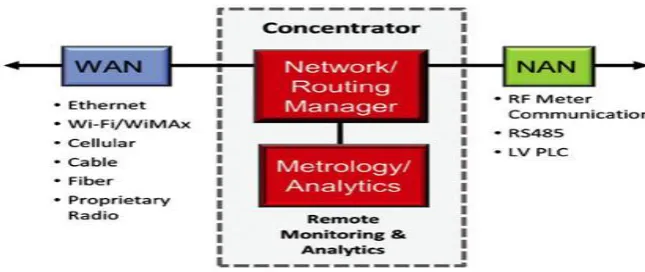
Fig 1: Data concentrator functional block diagram
2.2.
Types of Networks connected to Data Concentrators for Communication
Basically there are two types of networks connecting to data concentrators:
a. NAN: Neighbourhood Area Network and
b. WAN: Wide Area Network
2.2.1 NAN Communication
Power line communication (PLC) has been used for many decades and gained worldwide interest with its ability to
modulate communication signals over existing power lines and enabling devices to be networked without introducing
any new wires or cables. This capability is extremely attractive across a diverse range of applications; including utility
metering, home area networks, lighting and solar, which can leverage greater intelligence and efficiency through
networking. A variety of new services and applications now require greater reliability and data rates than PLC
techniques from the past. Several factors impact PLC performance, including impulsive and narrowband noise,
time-varying line impedance and frequency-selective channels.
2.2.2 WAN Communication
10/100/1000M Ethernet and optical cable have been widely used in grid infrastructure as WAN options, but those may
be not accessible everywhere, nor the best options from a CAPEX/OPEX perspective. Wireless access technology is
another choice. Currently, GSM/GPRS technology has been adopted (up to 52kbps throughput); future alternatives are
WCDMA/CDMA2000 (up to 2Mbps) and LTE (up to 1Gbps). The appropriate choice for WAN technology will likely
be made on the following criteria: availability, price, throughput, latency and indoor coverage, with a mix of different
technologies possible in the future.
III OVERVIEW OF BEAGLEBONE BOARD
Beaglebone board was originally developed and introduced by Texas instruments in year 2008 by using OMAP3530
System-on-a-chip technology with basic objective done by a small team of engineers to come out with some sort of
educational board that can provide good platform to various educational and research centres/institutions across the
world to teach/research/develop open source hardware based projects. Beaglebone is regarded as Giant step from
Microcontrollers such as AVR, PIC, ARM Cortex M3, 8051etc. to full-fledged microcomputer. Beaglebone is regarded as fully functional computer like desktop or laptop. OMAP3530 is integrated with ARM Cortex-A8 CPU, a
TMS320C64x+ DSP for video acceleration and encoding and decoding audio and also supporting 2D and 3D rendering
1047 | P a g e
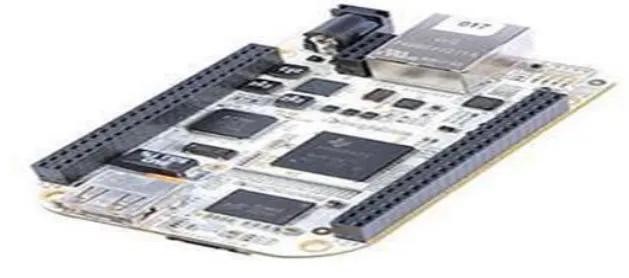
Fig. 2: Beaglebone board
3.1
Technical Specifications & Features of Beaglebone
The following are the Technical Specifications of Beaglebone:
Processor- OMAP3530 SoC- 720 MHz ARM Cortex-A8 core
TMS320C64+- 520 MHz HD Capable Processor supporting Video Playback of 720p@30fps
256 MB LPDDR RAM
256 MB NAND Flash Memory
Slots- 1 USB Port, 1 USB OTG, SD/MMC Port, 3.5mm Jack, JTAG Connector, Power Socket 5V, S-Video,
DVI-D, RS-232, Ethernet Interface.
Operating Systems Supported- Android, Linux (Fedora, Angstrom, Ubuntu, Gentoo, Arch, Maemo),
VxWorks, FreeBSD, Windows CE, Symbian QNX & RISC OS 5.
The following are the Features of Beaglebone:
Low-Power Credit Card Small Size compact ergonomics.
Large number of GPIO I/O Pins. High Performance Computing experience.
Supports deterministic execution hardware via dedicated processing unit.
Robust and Wide options for connectivity.
Open Source Hardware technology- Giving Options to manufactures to integrate ARM Technology for
developing cloned Beaglebone development boards.
Open Source Software Technology- Giving Options to install wide range of Android and Linux flavoured
operating systems.
Support via large and continuous expanding community of developers, users and researchers.
Supports interfacing with wide range of Analog cum Digital Sensors in turn opening doors for various IoT and
Cloud based projects.
3.2.
Why Beaglebone?
Beaglebone, a powerful ARM Technology based development board is widely adopted by researchers and embedded
1048 | P a g e
Networking Capabilities: Beaglebone has on-board 10/100 Ethernet port. Apart from peer to peer networkconnectivity, it is capable for providing all sorts of networking services like FTP, TELNET, SSH and even has
capability to act as web server to publish website using lighttpd web server package.
Remote Control: As, Beaglebone has efficient networking capabilities, it also facilitates Remote Control
access. In some situations, it is necessary to control Beaglebone remotely. With use of VNC/MobaXterm based
software, entire graphical desktop can be viewed and edited remotely without any hiccup.
File System: As compared to Windows, Embedded Linux file systems have much enhanced security,
organization and retrieval capabilities. Linux file system is known on ext3/ext4 which is pure file based system
providing much better capabilities towards managing and organizing system functions/system calls as compared to
FAT32/NTFS file systems.
Time Management: Beaglebone board is equipped with NTP (Network Time Protocol) which enables
accurate time synchronization via Internet time servers.
Wide range of Programming Languages: Beaglebone has capability to support various compilers, tools and
editors to facilitate users to write programming code of various programming languages like C, C++, Java, Python,
Perl, Ruby, Shell Scripting, Ruby on Rails and even latest programming languages like R, Hack from Facebook is also
supported.
Supports Multitasking: As Beaglebone runs Linux operating system which has capability to run
multiple-processes in terms of programs and tasks at single point of time. Beaglebone provides users with Multi-tasking
capability in terms of multi-processes without hindering its performance.
Growing Support Worldwide: As now Beaglebone has plenty of users, research groups cum institutions and
Hobbyists working on several multi-platform projects, any person using Beaglebone can take help from online forums,
developer communities and even manufactures are providing customer support 24x7 which in-turns makes it widely
adoptable platform across other development platforms.
3.3.
BEAGLEBONE BLACK
BBB is the newest product in the Beagle family. This board features a powerful TI Sitara™ ARM Cortex™-A8
processor which runs at 1 GHz. And a 2 GB on-board flash memory acts as the “hard drive” for the board to host a
Linux operating system and other software development tools. With a user-friendly, browser-based Bonescript
programming environment called Cloud9, a learner can easily program the BBB board to rapidly prototype electronic
systems that interface with real-world applications. As the knowledge of users develops, the board provides more
complicated interfaces including C/C++ functions to access digital and analog pins aboard the ARM Cortex A8
microprocessor. The full power and capability of the BBB board can be programmed in the underlying onboard Linux
operating system, such as Angstrom or Ubuntu. Beaglebone Black is currently most widely sold board worldwide
because of its low-cost. Beaglebone black is regarded as most utilized Beaglebone board amongst all boards available
till date for various applications and hardware based projects and has support of developers and hobbyists communities
worldwide. It is powered by AM335x 1GHz ARM Cortex A8 processor and supports 3D graphics acceleration.
Because of its configuration this board can boot Linux in less than 10 seconds.
1049 | P a g e
Fig. 3: Beaglebone Black Board-Components [ImgSrc: www.beagleboard.org]
Table -1 Technical Specification of Beaglebone Black
SoC CPU GPU DSP RAM Connectivity Options
(Audio/ Video)
Storage/N etwor
k
Option
Internal Modules Software Price
AM335 8/9
ARM-Cortex
A8
Power VRSGX 530
N/A 512 1 USB,
Micro-HDMI,cape add-ons Ethernet
UART,PWM, GPMC,MMC,SPI,
I2C,ADC, CANBUS,Timers,
JTAG
Ubuntu, Android, Debian, Cloud 9
,
IDEonNode.js
w/Bone
scriptLibrary
$55
IV METHODOLOGY
The data may originated from any devices in the network that is connected via wired or wireless interfaces and
protocols such as RS232C/RS485 with Modbus, USB, Ethernet, Wi-Fi, GSM/GPRS, Zigbee. The data is stored in
servers in the network where the data is processed to generate information. Network clients such as desktop computers,
laptops, Smartphone, and tablets can access this information for smart business decisions. The information may be
displayed on annunciators and shared across locations through the gateway.
The BeagleBone is quite a powerful tool when it comes to data acquisition, because it provides easy access to the web
and lots of GPIOs. To controlling an output, reading a button/sensor, controlling a motor is quite easy with BoneScript.
Most functions of begalbone script is very similar to Arduino.
4.1
Specification of DCCD System
Multi-protocol interface to Sensor Nodes
Wired and Wireless TCP/IP connectivity to Server on Intranet or Internet
Sensor Data fusion, Data Concentration and Data Publish
Optional use of various software protocols such as Modbus, MQTT and other IoT protocols, TCP/IP protocols
1050 | P a g e
V BLOCK DIAGRAM OF THE SYSTEM
In our system Begalbone balck Board is used as data concentrator for connected devices. The BBB has some Desirable
characteristics of an embedded platform for DCCD are:
wide set of low level analog and digital I/O subsystem (e.g. GPIO, SPI, ADC, …);
remote communication interfaces; · multiple communication protocol support;
high level operating system support; · software and documentation availability;
long term commercial availability and support;
flexibility and modularity; · competitive purchasing and maintenance costs;
Deterministic (real-time) capabilities.
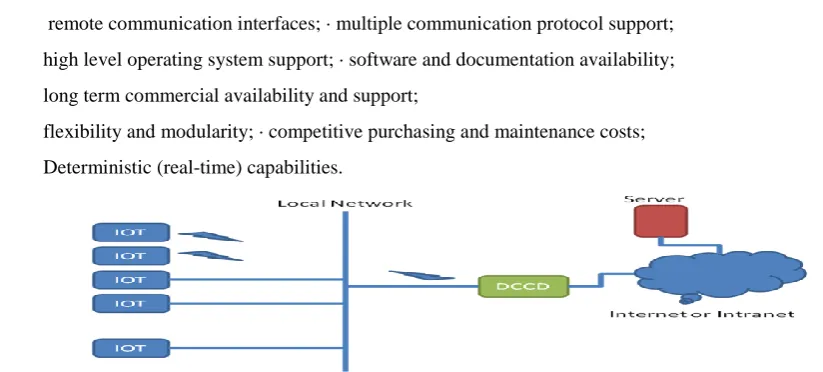
Fig. 4: Block Diagram of Beaglebone Board based Data concentrators for connected Devices
The Data Concentrator for the Connected Devices is an embedded appliance that collects data from various embedded
devices in a network, fuses the data as appropriate and transmits the same upstream to a server where the data is logged
into a database for further analytics. The main work of DCCT is to collect data which is originated from any devices in
the network that is connected via wired or wireless interfaces and protocols such as RS232C/RS485 with Modbus,
USB, Ethernet, Wi-Fi, GSM/GPRS, Zigbee etc. . The data is stored in servers in the network where the data is
processed to generate information. Network clients such as desktop computers, laptops, Smartphone, tablets can access
this information for smart business decisions. The information may be displayed on annunciators and shared across
locations through the gateway. The BeagleBone Black (BBB) board works as a data concentrator for connected sensor
devices.
Fig. 5: Block Diagram of the architecture of DCCD
VI WORKING OF THE SYSTEM
The BeagleBone is quite a powerful tool when it comes to data acquisition, because it provides easy access to the web
and lots of GPIOs. To controlling an output, reading a button/sensor, controlling a motor are quite easy with Bone
Script. However, with thousands on devices generating data from sensors and transducers, it is not sufficient to collect
the data and display in graph or numerical form. The sensor data needs to be combined to generated information as well
1051 | P a g e
storage/processing servers. These devices are called data concentrators. Examples of data concentrators can be found in
metering networks where data is periodically collected from the meters and transmitted to the central servers for billing
and other activities. The data concentrators can also act as control devices to enable/disable meters and other actions.
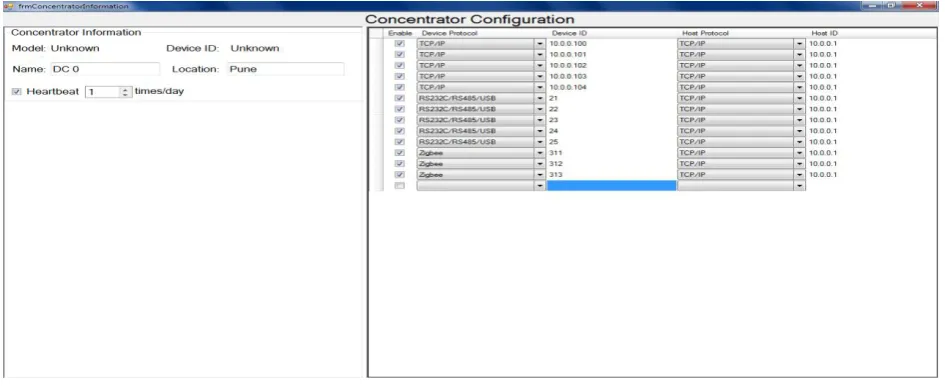
The data concentrator developed in this project is an embedded system that collects data from the sensor nodes and
pushes to servers to storage and analysis. The data concentrator can be configured by host software with a user
interface similar to the one shown in fig. below.
Fig. 6: Data Concentrator result after configuration
The concentrator configurator initialises the concentrator device by setting the name and location of the device. The
device can also be configured to send status messages called “Hearbeat” that indicate the health of the device as well as
the current status of data movement. The device can also be programmed to collect data from a device and send the
same to a host. The protocol and ID of the device as well as the host can be programmed. Thus devices connected using
TCP/IP (wired Ethernet or wireless Wi-Fi) can be identified by their hostname or TCP/IP address or devices connected
using RS232C/RS485/USB/Zigbee can be identified by their using device address.
The host is typically, but not restricted to, a LAN or Internet based server with its own TCP/IP address or hostname.
There may be multiple hosts in the network that can collect data from multiple devices or one device may send data to
multiple servers. The matrix of data source and destination is downloaded to the concentrator device as a table which is
used by the concentrator to route the data. The concentrator pulls the data from the devices at a preset time, optionally
pre-processes the same and forwards the pre-processed data to the host. This is repeated for all devices.
Processing Steps
a. Plug the USB cable of BBB into your computer having Linux OS.
b. Wait for the board to initialize.
c. The leds should have gone all solid and be blinking
d. Load BBB flash Linux image
e. Open terminal window.
f. type ssh [email protected]
1052 | P a g e
h. You should now be logged into the board home directory.
i. Connect BBB with Ethernet LAN.
j. Login BBB using putty software
k. Run the server program
l. Connect client using IP address or communication port number
m. Then there will be duplex communication established between server and clients.
Fig. 8: Connection of Power and LAN to BBB
VII RESEARCH AREAS/FUTURE SCOPE FOR PROJECT DEVELOPMENT’S
Using different types of sensor devices we can collect different types of data, those data can further processed by data
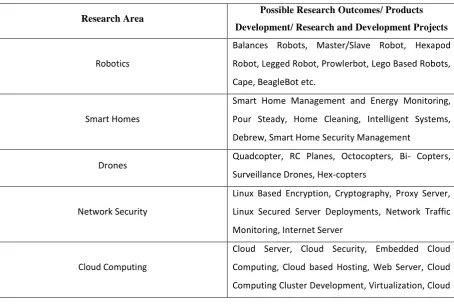
concentrator for various applications. Hence, research areas would be enlisted in tabular form which will provide
wide scope for researchers to research and develop wide range of products on various areas of technology.
Table -2 Research Areas & Project Outcomes/Products of Beaglebone Black Board’s based DCCD
Research Area Possible Research Outcomes/ Products Development/ Research and Development Projects
Robotics
Balances Robots, Master/Slave Robot, Hexapod
Robot, Legged Robot, Prowlerbot, Lego Based Robots,
Cape, BeagleBot etc.
Smart Homes
Smart Home Management and Energy Monitoring,
Pour Steady, Home Cleaning, Intelligent Systems,
Debrew, Smart Home Security Management
Drones Quadcopter, RC Planes, Octocopters, Bi- Copters,
Surveillance Drones, Hex-copters
Network Security
Linux Based Encryption, Cryptography, Proxy Server,
Linux Secured Server Deployments, Network Traffic
Monitoring, Internet Server
Cloud Computing
Cloud Server, Cloud Security, Embedded Cloud
Computing, Cloud based Hosting, Web Server, Cloud
1053 | P a g e
Load Balancing, Cloud Based Fault Tolerant Research
IoT
IoT Devices, Smart Gizmos, Kitchen Automation,
Sensor Based communication technology, NFC, Smart
Money Transfer Technology, IoT Development Kits
Sensors Integration
All types of Analog and Digital Sensors for wide
applications in Homes, Military, Irrigation,
Automation, Medical, Automobiles, Nuclear Power
Plants, Smart Grids, and Intelligent Production
Machines.
Solar Technology Smart Solar Tracking System, Solar Generators etc.
Open Source Platforms/Applications Linux Development, Programming (All Languages) etc.
VIII CONCLUSION
Data concentrators play an important role in a modern system design. To design cost-efficient and future-proof
concentrators, developers need to carefully consider WAN and NAN options, hardware platform scalability, software
availability, and networking/data security design. Beaglebone being ARM based board provides efficient, smart,
reliable and flexible platform to various professionals, researchers and embedded systems enthusiasts to take up this
board for developing various live and ready to use market implementation projects. Beaglebone community is
contributing a lot in research and is growing day by day. Beaglebone boards with improved configurations and
connectivity options are launching at regular intervals in this area providing more project development options, high
performance and making portable boards full-fledged Linux and cloud computing servers. In this paper, various
research areas which can be taken up by researchers is also being mentioned for providing them with varied options of
research applications by using Beaglebone Black (BBB) powered DCCD.
REFERENCES
[1] Texas Instruments, Smart Data Concentrator EVM (TMDSDC3359) Hardware Manual, TMDSDC3359 Wiki (http://processors.wiki.ti.com/index.php/Smart_Data_Concentrator_EVM_(TMDSDC3359)_Hardware_Manual)
[2] AnandNayyar and VikramPuri, “A Comprehensive Review of BeagleBone Technology: Smart Board Powered by
ARM”, International Journal of Smart Home,Vol. 10, No. 4 (2016), pp. 95-108
[3] S.Cleva, A. I. Boganiand and L. Pivetta, “A low-cost high-performance embedded platform for accelerator
controls”, proc. PCaPAC2012, Kolkata, India, (2012).
[4] Global Smart Grid Cyber Security Market 2012-2016: Worldwide Industry Share, Investment Trends, Growth,
Size, Strategy And Forecast Research Report 2016 – BWWGeeksWorld by www.broadwayworld.com
[5] M. Nassar, J. Lin, Y. Mortazavi, A. Dabak, I. H. Kim, and B. L. Evans, “Local utility powerline communications
in the 3-500kHz band: channel impairments, noise, and standards,” IEEE Signal Proc. Mag., to appear
[6] PRIME Alliance – Technical Working Group, “PRIME Specification”, version 1.3.6, Nov 2011, available:
1054 | P a g e
[7] G3-PLC Alliance, available: www.g3-plc.com
[8] http://eecatalog.com/smart-energy/2014/04/09/data-concentrators-are-key-to-engineering-a-smarter-grid/
[9] Publitek marketing communications, “BeagleBone Black Brings Arduino-Style Connectivity Simplicity to
Embedded Linux”, Digi-key Article Library.
[10]Beagle class ECE497 in Rose-Hulman: http://elinux.org/Embedded_Beagle_Class
[11]Course website: http://mavweb.mnsu.edu/hen/EET310_fall13.html
[12]H Yau, “Learning BeagleBone”, Packt Publishing Ltd, (2014).
[13]http://www.digikey.com,Accessed on(2015) October 27.
[14]http://www.ti.com ,Accessed on (2015) October 27.
[15]http://www.beagleboard.org ,Accessed on (2015) October 27.
[16]Richardson, M. Getting Started with BeagleBone: Linux-powered Electronic Projects with Python and JavaScript.
Maker Media, Inc., (2013).
[17]M. A. Yoder and J. Kridner, “BeagleBone Cookbook: Software and Hardware Problems and Solutions”,(2015).
[18]G. Coley,” BeagleBone Black System Reference Manual-Revision B”, (2014).
[19]http://beagleboard.org/beagleboard-xm , Accessed on (2015) October 31.
[20]http://beagleboard.org/green,Accessed on(2015)November 1.
[21]http://www.seeed.cc/beaglebone_green/ ,Accessed on ( 2015) November 1.
![Fig. 3: Beaglebone Black Board-Components [ImgSrc: www.beagleboard.org]](https://thumb-us.123doks.com/thumbv2/123dok_us/7782075.1285867/6.595.67.479.99.308/fig-beaglebone-black-board-components-imgsrc-www-beagleboard.webp)