15 | P a g e
EVALUATION OF STRENGTH PERAMETERS IN
BASE LAYER OF PAVEMENT WITH RBI 81
Pulapaka Usha Rani
1, Bharthavarapu Srikanth
2.
1* M.Tech Student, MVR College of Engineering & Technology, Kanchikacherla, India.
2* Assistant Professor,
MVR College of Engineering & Technology,
Kanchikacherla
, India.ABSTRACT
The overall performance of a flexible pavement structure underneath loading circumstance is ruled by the properties of materials used in base and sub base layer. Base course is the layer of the fabric immediately below the floor of binder route and it presents the additional load distribution and contributes to the subsurface drainage and frost resistance. The highway construction industry has made rapid studies in the field of new technology up gradation and adoption with increase in traffic volume and increase in demand for innovative design, Rehabilitation and repair of the getting older transportation infrastructure. New materials and strategies have been attempted with lot of emphasis on optimizing existence cycle cost and minimizing layout price.
RBI Grade 81 is an odorless beige powder this is composed of a number of naturally going on compounds. It improves the structural residences of soil. It works by means of hydration reaction. Through the addition of low dosages of RBI Grade 81 the quantity balance of the soil is increased notably. The response of RBI Grade 81 with soil particles produces an inter particle blend that binds soil debris together right into a inflexible mass. This binding of the soil particle, thru both chemical bonds and fractional forces, serves to restrict the pore quantity of the created inflexible stabilized soil machine.
In this study, an strive is made to have a look at the effect of overall performance enhancers utilized in base layer. In addition to the laboratory experimental work, evaluation of results when the material is applied in field has also been studied. The California Bearing Ratio, Maximum dry density, Degree of compaction were determined for the samples collected from the live project site at different chainages and these results are compared with the design data. Economic analysis was done for bare soil and soil with RBI Grade 81 and the results were compared.
Keywords: RBI Grade 81, CBR, Standard Proctor, Degree of compaction, fatigue, rutting
I.INTRODUCTION
A pavement shape can be designed either as a flexible pavement or a rigid pavement based totally on its structural
behaviour, with flexible pavements being broadly desired in India due to its advantages over rigid pavements and
in reasonably-priced point of view also. Flexible pavements have low or negligible flexural power and are as a
substitute bendy of their structural action below the loads. These pavements are layered systems with the following
factor layers
soil sub-grade
Sub-base course
Base course
16 | P a g e
SIGNIFICANCE OF RBI GRADE 81
It is an inorganic soil stabilizer and pavement material
It is a cementitious powder stabilizer and non-toxic in nature
It can be used to increase the CBR for subgrade, sub base, base course and hard shoulders
Advantages of RBI Grade 81
Construction time and cost reduction
Drastically increases the strength
Treated layers are water resistant
Reduces thickness, use of transport, and earth moving machinery substantially
Longer durability which reduces maintenance
Environmental benefits of using RBI Grade 81
Reduces, leaching and use of bitumen
Reduces energy consumption
Saves materials like Aggregates, Soil, Bitumen
Reduces carbon emission enabling, carbon credits
Fig 1.2 RBI Grade 81 Material
EXPERIMENTAL INVESTIGATIONS
SOIL AND RBI Grade 81
The preliminary studies were conducted on the soil samples collected from the live project site at
17 | P a g e
II.EXPERIMENTAL STUDIES
Standard Proctor Test
To assess the quantity of compaction and the water content required within the discipline, compaction
exams are important at the equal soil in laboratory. The water content at which the most density is attained is
received from the relationships supplied by way of the assessments. According to IS:2720(Part-7)the mould
recommended is of 100mm diameter, 127.3mm height and 1000ml potential. The rammer endorsed is of 2.6kg
with unfastened drop of 310mm.
California Bearing Ratio Test (CBR)
CBR take a look at changed into advanced by the California division of toll road in 1929. This test is used
for comparing the suitability of sub-base materials. The check can be conducted on a organized specimen in a
mould or on soil in-situ situations. The laboratory CBR apparatus consists of a mold 150mm diameter and 175mm
high, having separate base plate and collar. The load is carried out by way of a loading body through a plunger of
50mm diameter. Dial gauges are used for measurement of the expansion of the specimen on a soaking and for
dimension of penetration.
DETERMINATION OF FIELD DENSITY BY CORE CUTTER METHOD
Test Procedure:
Measure the inner dimensions of the middle cutter and calculate its extent. Find the mass of the core
cutter. Expose the small area, about 30cm square, to be examined and level it. Put the dolly at the pinnacle of the
middle-cutter and pressure the meeting in to the soil with the assist of the rammer. Dig out the container from the
surrounding soil, and trim flat the stop of the middle-cutter. Find the mass of the cutter complete of soil. Keep a
few consultant soil specimen for water content dedication
SUMMARY
This chapter explained all the experiments which need to be done for analyzing the behavior of soil before
and after mixing with RBI Grade 81. All the experiments viz., Proctor compaction, California Bearing Ratio tests
were done according to Indian Standards.
RESULTS AND DISCUSSIONS
GENERAL
This chapter deals with the results and discussions of the experiments viz., Standard proctor, California
Bearing Ratio conducted on soil before mixing with RBI Grade 81 and soil after mixing with RBI Grade 81. The
results had been compared with the design data
COMPACTION CHARACTERISTICS
18 | P a g e vital on the same soils in laboratory. The water content at which the maximum density is attained is obtained from
the relationship provided by the checks.
The fashionable Proctor check was conducted for soil earlier than blending with RBI Grade eighty one
and soil after mixing with RBI Grade eighty one. Optimum cost of RBI Grade eighty one used inside the base layer
of that assignment is three%. Moisture content material and dry density values had been plotted inside the graphs.
From the graphs, the maximum dry density and top-quality moisture content material values were derived and
proven in table four.1. It may be seen that there may be a increase in most dry density and reduce in ultimate
moisture content material of soil after including RBI Grade 81 to it.
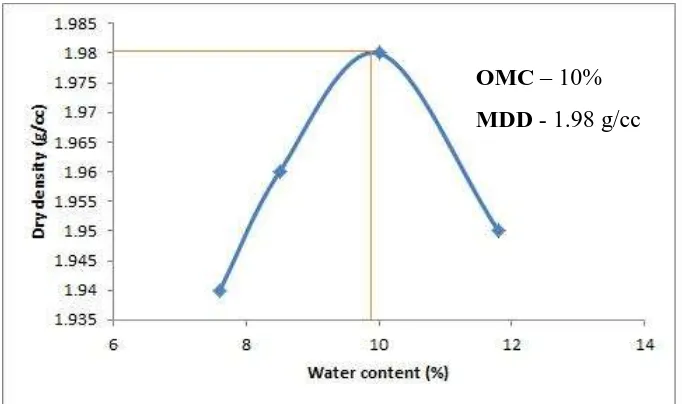
The foremost moisture content and most dry density values of soil sample accumulated from the
undertaking website online at chainage zero/0 are 10% and 1.Ninety eight g/cc as proven in Fig. 5.1. After mixing
with RBI at equal chainage highest quality moisture content price is reduced to 9.5 % and Maximum dry density is
multiplied to 2g/cc as shown in Fig. 5.2.
OMC
–
10%
MDD
- 1.98 g/cc
Fig. 5.1 at Chainage 0/0 before mixing with RBI
OMC
–
9.5%
MDD
- 2 g/cc
Fig. 5.2 at Chainage 0/0 after mixing with RBI
19 | P a g e Chainage
OMC (%) MDD (g/cc)
Before mixing
with RBI
After mixing
with RBI
Before mixing with
RBI
After mixing with
RBI
0/0 10 9.5 1.98 2
0/350 10.5 9.8 1.95 1.97
0/700 10.5 10.3 2.06 2.11
1/050 10.2 9.8 1.99 2.05
1/350 10.7 9.8 1.95 1.98
Average value of OMC before mixing with RBI = 10.3% Average
value of OMC after mixing with RBI = 9.8%
Average value of MDD before mixing with RBI= 1.98 g/cc Average
value of MDD after mixing with RBI=2.02 g/cc
Design data Value of OMC before mixing with RBI =10.5%
Value of OMC after mixing with RBI =10%
Value of MDD before adding RBI =2 g/cc
Value of MDD after adding RBI =2.06 g/cc
OMC, MDD values of samples collected from site are almost matching with the design data.
CALIFORNIA BEARING RATIO
The CBR was conducted for soil before mixing with RBI Grade 81 and soil after mixing with RBI Grade
81.These samples were collected at every chainage of 350 meters from the live project site. Optimum value of RBI
Grade 81 used in the base layer of that project is 3%.CBR value of soil increased after adding RBI Grade 81 to it.
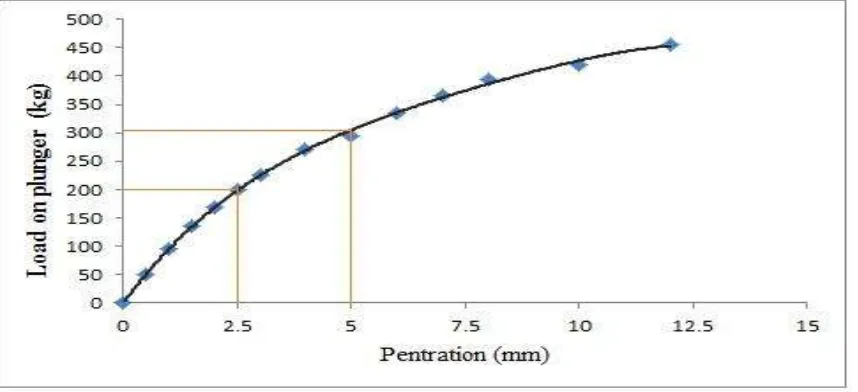
CBR value of soil sample collected from the project site at change 0/0 is 14.6% as shown in Fig. 5.11.
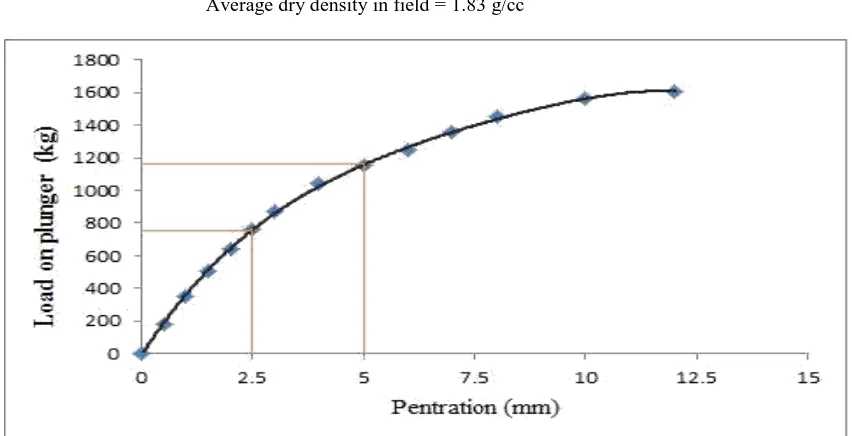
After mixing with RBI at same change CBR value is increased to 55.8% as shown in Fig. 5.12
.
20 | P a g e
Fig. 5.12 at chainage 0/0 after mixing with RBI
Table 5.2 CBR test results
Chainage
CBR (%)
Before mixing RBI After mixing RBI
0/0 14.6 55.8
0/350 15 64.9
0/700 15.3 54.8
1/050 16.1 58.4
1/350 14.2 62
Average value of CBR before adding RBI =15%
Average value of CBR after adding RBI = 59%
Design data: CBR value before adding RBI = 16%
CBR value after adding RBI = 70%
CBR values of samples collected from site are almost matching with the design data
.
Relative compaction
Number of core samples collected from the site = 3
Table 5.3 Dry density results
Sample no Dry density in field (g/cc)
1 1.82
2 1.86
3 1.83
21 | P a g e Maximum dry density obtained in the lab = 2.11 g/cc
Relative compaction =Dry density in field/ Max dry density obtained in the lab = 88%
ECONOMIC ANALYSIS
GENERAL
This chapter deals with the economic benefits of usage of RBI Grade 81 in base layer. In this both conventional
PMGSY road and RBI Grade 81 stabilized road compared and economic analysis was done.
COST ANALYSIS
The difference between conventional PMGSY road and RBI Grade 81 stabilized road is in thickness of GSB layer
and base layer. Reduction in the thickness of GSB layer is 50 mm and in the base layer is 75mm. Unit rates for
material, machinery and labour were obtained from the live project data and calculations were made accordingly.
A stretch of 1 km single lane (3.75 m) has taken for the analysis as in the live project.
For conventional road:
a) Labour: 41/-per cubic meter
b) Machinery: 87/- per cubic meter
c) Materials: Soil 129/- per cubic meter Aggregates 1122/- per cubic meter
d) Overheads @ 12.5% on a+b+c = 178/- per cubic meter Per meter cube total cost is 1600/-
Table 6.1 Cost comparison between conventional and RBI Grade 81 stabilized road
S.No Layer type Cost in conventional road Cost in RBI Grade 81 stabilized road
1 Base layer 9,02,400/- 11,81,250/-
2 Granular sub base (GSB) 9,00,800/- 6,00,000/-
GST 18% 324576/- 320625/-
Total cost 21,27,776/- 21,01,875/-
Total savings as compared to conventional road by using RBI Grade 81 per km is 26000/-
III.SUMMARY
This chapter dealt with the advantages of RBI Grade 81 in base layer, in terms of economy. Detailed cost analysis
was done for both conventional PMGSY road and RBI Grade 81 stabilized road and the results have been
compared. A total cost savings of
Rs 26000/- was achieved per kilometer by using RBI Grade 81 as compared to the conventional section.
IV.CONCLUSIONS
Based on the comparison of the test results of soil before mixing with RBI and the stabilized soil
with RBI the following conclusions are drawn.
1. Optimum Moisture Content of soil has been decreased from 10.3% to 9.8% after the addition of
22 | P a g e 2. Maximum Dry Density of soil has been increased from 1.98g/cc to 2.02g/cc after the addition of
3% RBI Grade 81 to it.
3. The CBR value of soil has been increased from 15% to 59% after the addition of 3% RBI Grade
81 to it.
4. OMC, MDD, CBR values of samples collected from the project site are almost matching with
the design data.
5. Relative compaction of 88% was observed in the base layer.
6. From economic analysis, a total cost savings of 64,130/- was achieved per kilometer by using
RBI Grade 81 as compared to conventional section.
FUTURE SCOPE OF PROJECT
Fatigue behavior of the soil with RBI Grade 81 has to be studied. Comparision of strain values for the Control
section and RBI Grade 81 stabilized road has to be carried out. Similarly like RBI Grade 81, usage of Cement in
the base layer has to be studied.
REFERENCES
1. Pandey B.B (2008), ‘Use of RBI Grade 81 for soil stabilization and pavement
Rehabilitation’, Transportation Engineering Division, IIT Kharagpur.
2. Yohannes Argu (2008), ‘Stabilization of light grey and red clay subgrade soil usingcement’, Addis Ababa
University.
3. Koloane. Paige-green. (2004), ‘Standardized testing of RBI Grade81 as a roadmaterial stabilizer’, CSRI report.
4. A.K.Sinha , Vasant G Havangi and Sudhir Mathur (2010), ‘Powder basedinorganic stabilizer for
construction of subgrade and sub-base layers of road pavement’, Journal of Indian Highways.
5. Abu siddique and Bipradas Rajbongshi (2005), ‘An analytical study on design andanalysis of stabilized rural roads’ Proceedings of the Easter Asia society forTransportation studies, Vol.5, pp.813-828.
6. K.V. Madurwar, P.P. Dahale, A.N.Burile (2013), ‘Comparative Study of BlackCotton Soil Stabilization with RBI Grade 81 and Sodium Silicate’. InternationalJournal of Innovative Research in Science, Engineering and Technology, 21,493-499.
7. Manisha Gunturi, P.T.Ravichandran, R.Annadurai (2014),‘Study on strengthcharacteristics of soil
using soil stabilizer RBI – 81’.International Journal ofResearch in Engineering and Technology, 98,201-206.
8. K.Rama Devi (2011), ‘Fatigue behavior study of subgrade soil with performanceenhancers’, M.Tech thesis, NIT, Tiruchirappalli.
9. Testing manual of RBI Grade 81, Road building International.
10. Indian standard methods of tests for soils, IS: 2720-1983, Indian Standard Institution New Delhi.