Fuzzy PID Controller Design for Heating
Control System
Sneha S Patole1, Shailendra K Mittal
PG Student, Department of Electrical Engineering, GH Raisoni Institute of Engineering &Technology, Pune, India1
Professor, Department of Electrical Engineering, GH Raisoni Institute of Engineering & Technology, Pune, India2
ABSTRACT:This paper proposed an artificial intelligent control method for temperature control system and is suitable for low temperature applications such as laboratory equipments (e.g. ovens and incubators).The proposed design uses fuzzy PID as a control method that maintains the temperature of simulated heater to the desired point.The Fuzzy PID controller of heating system adds a conventional PID controller to the common fuzzy control and forms a mix fuzzy
PID controller and it can realize the self adaptive of , and of PID.So fuzzy PID not only has the advantage of
easy to application,strong robust,but also can be more widely used and have higher performance than normal PID. PID Microcontroller based circuit is built to acquire data from sensor, actuate heat element and communicate with computer workstation.As compared to normal PID the Fuzzy-PID algorithm has better performance of reducing temperature overshoot and improves systems performance.
KEYWORDS:Fuzzy-PID, PID, Heating,Control system
I.INTRODUCTION
space is adjusted to achieve a desired average temperature. Temperature is an essential physical quantity which is found in most application of home appliances, scientific laboratories equipments and industrial processes [9]. Therefore the main issue in every temperature control strategy is to monitor and maintain temperature status of these facilities. In some industrial application the goal is not only precise temperature control, but also a fast heat-up and quick response to disturbances with minimal overshoot and undershoot when the set point changes. Also the chemical laboratories incubator which may contain Living creatures or Parts of organisms, so it’s crucial to tightly keep the temperature inside it at required set point. In addition it’s too important in rice cooker to make fine adjustments to temperature and heating time to cook perfect rice every time.
The control elements of system include:
1) Sensor measures the actual value of controlled variable such as temperature, humidity or flow and provides information to the controller.
2) Controller receives input from sensors, processes the input and then produces an intelligent output signal for the controlled device.
3) Controlled device acts to modify controlled variable as directed by the controller.
4) Source of energy is needed to power the control system. Control systems use either a pneumatic or electric power supply.
II. SYSTEM OVERVIEW
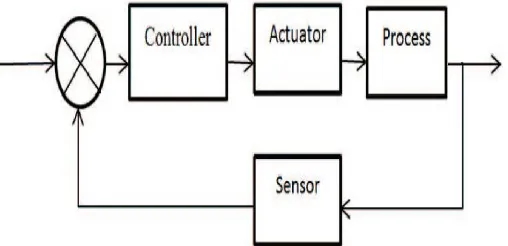
To present an intelligent controller approach providing best control of temperature process using fuzzy rule-based techniques and to show how Fuzzy PID can overcome the undesirable features of traditional PID controller, a simulated temperature control system consisting of a sensor; actuator and shown in fig. 1 should be realized as follows. The Hardware design is include the temperature sensor to read an actual temperature of the heater to the
microcontroller (μC) ADC, in voltage form which is linearly proportional to the Celsius (Centigrade) temperature. Low
power Ceramic resister is used to simulate the heater, because it can be simply driven by Microcontroller μC output
port using common power transistor. Arduino ATMEGA 328 is used to acquire temperature reading from sensor by its internal ADC and to provide actuating signal to the heater through its programmed PWM by varying on/off duration time and provide interface to computer workstation.
Fig. 1: The control loop diagram of heating system
III. PID CONTROLLER
schematic model of a control system with a PID controller. Control signal U (t) is a linear combination of error E (t), its integral and derivative.
Fig2. PID control system
Where:
Kp = proportional gain Ki = integral gain Kd = derivative gain Ti = integral time Td = derivative time
( ) = . ( ) + ∫ ( ) + e(t) (1)
( ) = .e(t)+ ∫ e(t)dt + e(t) (2)
e(t)=r(t)-y(t) (3)
If the controller is digital, then the derivative term may be replaced with a backward difference and the integral term may be replaced with a sum. For a small constant sampling time (Ts), Can be approximated as:
( ) = [ e(n) + ∑ ( ) + . ( ) ( )] (4)
Table1: The effect of PID parameter on system response[1]
Rise time Overshoot Settling time Steady state error
Decrease Increase Small change Decrease
Small change Decrease Decrease Small change
Decrease Increase Increase Eliminate
IV. SELF-TUNING PID BASE ON FUZZY LOGIC
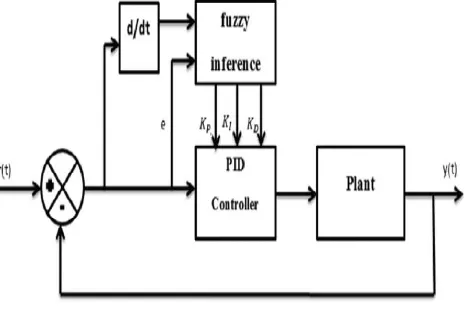
purpose here. A fuzzy logic system consists of four main parts, namely:fuzzifier, rules, inference engine and defuzzifier. These components and the general architecture of a fuzzy logic system are shown in Fig. 3 and Table 2.
Fig. 3: Structure of fuzzy control design
In this system, the difference between the set point and the output as the error and its changes are considered asthe
inputs. Also, three coefficients of PID controller i.e, and obtained from the fuzzy inference are theoutputs. The
membership functions are selected as the triangular form.. Themembership function for the inputs and outputs are illustrated in Fig. 6.
Fig.4 Fuzzy logic-PID
Table 2: Fuzzy Logic Algorithm
Fuzzy Logic Algorithm
1 Define linguistic variables and terms
2 Construct the membership function
3 Construct rule base
4 Convert crisp data to fuzzy values using the membership function
5 Evaluate rule in the rule base
6 Combine the result of each rule
7 Convert output data to non-fuzzy values
V.RESULTS AND DISCUSSION
Fig.5. Mamdani Inference System
Fuzzy inference system used is Mamdani system. Here there are two inputs error and change in error and three outputs proportional gain kp integral gain ki and derivative gain kd
Fig.6. Membership function for e, ec, kp, ki and kd
Fig.7.Fuzzy PID at reference temperature 50
Figure.7. shows temperature response of Fuzzy based PID for reference temperature of50 Celsieus and corresponding
control signal.Fuzzy based PID controller achieves desired temperature.
Fig.8.The comparison between pure PID(red) and Fuzzy PID(blue) at reference temperature50
To compare the traditional PID control with fuzzy PID control results, we can see that the overshoot of PID control response curve was larger, the fuzzy PID control strategy of the parameter self-adjusting can be adjusted to achieve very good performance included short settling time, small overshoot, and the system runs into the stable state quickly, non-oscillatory, high control precision, non-steady-state error, and so on.
VI.CONCLUSION
PIDcontroller and Fuzzy PID shows that the Fuzzy PID is able to perform better than the conventional PID controller. The control system has robustness and high precision control.
ACKNOWLEDGMENT
The authors would like to thanks the support provided by the Department of Electrical Engineering,GHRaisoni Institute of Engineering and Technology,Pune and also Avatron Industries Pvt.Ltd.Pune.
REFERENCES
[1]HamedKhodadadiand Ali Dehghani”Fuzzy Logic Self-tuning PID Controller Design Based on Smith Predictor for Heating System”2016 16th International Conference on Control, Automation and Systems (ICCAS 2016)
Oct. 16-19, 2016 in HICO, Gyeongju, Korea
[2] Mirinejad, Hossein, SeyedHosseinSadati, Maryam Ghasemian, and Hamid Torab. "Control Techniques in Heating, Ventilating and Air Conditioning (HVAC) Systems" Journal of Computer Science vol. 4, no. 9, pp.
777-783, 2008.
[3] Harrold, M.V. and D.M. Lush. “Automatic controls in building services”. Proceedings Electric Power Applications, vol. 135, no. 3, pp.105-133, 1988.
[4]John Yen RezaLangari “Fuzzy Logic intelligence,control,and information” Pearson Education. [5] Dehghani A, Khodadadi H, “Fuzzy Logic Self-Tuning PID control for a single-link flexible joint robot manipulator in the presence of uncertainty”. In: Control, Automation and Systems (ICCAS), 2015 15th International Conference. IEEE, pp 186-191, 2015.
[6]Jan Jantzen, “Tutorial on Fuzzy Logic,” Technical University of Denmark, Department of Automation, Tech. report no 98-E 868, 19 Aug 1998. [7]Lewis, “Introduction to Modern Control Theory, in: F.L, Applied Optimal Control and Estimation,” Prentice-Hall, 1992.
[8]L.A.Zadeh, Fuzzy Sets[J], Information and control, 2000,8
[9] Lakhmi C. Jain; N.M. Martin, “Fusion of neural networks, fuzzy systems and genetic algorithms: Industrial Applications,” CRC Press LLC ISBN: 0849398045, 1998.
[10] Shu-chingDong,Feng-XinJiang,Jiechen,HongFeiZang,senior member IEEE Fuzzy Based Heating System. [11]Mohammed Elnour A/Alla Electrical Eng. And Computer Department Elmergib University Elkhoms, Libya
PID and Fuzzy Logic in Temperature Control System 2013 international conference on computing,electrical and electronics engineering.
[12]Tieqiang Sun College of Information Engineering HeBei United University Tangshan, ChinaZhaohuiNie,RongLiuCollege of Electrical Engineering HeBei United University Tangshan, ChinaApplication on Fuzzy PID Technology for Central Heating20 II International Conference on Computer Science and Network Technology
[13] ZhuangM.and Atherton D.P,Automatic tuning of optimum PIDcontrollers[J],Proceedings of IEE, Pt.D, 1993 [14] E.H.Mandani, Application of Fuzzy Algorithms for the Control of a Dynamic Plant[J], 2006,12