Behaviour and Refinement of
Port-Based Components with
Synchronous and Asynchronous
Communication
Stephan Janisch
Dissertation
an der Fakultät für Mathematik, Informatik und Statistik der
Ludwig-Maximilians-Universität München
Erster Gutachter: Prof. Dr. Rolf Hennicker, LMU München, IFI, PST Auswärtiger Gutachter: Prof. Dr. Stephan Merz, INRIA Lorraine, LORIA Dritter Gutachter: Prof. Dr. Martin Wirsing, LMU München, IFI, PST
Abgabedatum: 18. Juni 2010
Abstract
Component-based development is an established discipline of Software Engineering. It focuses on the development of strongly encapsulated components to support reuse within the construction of hierarchical systems by assemblies of components and their connectors. Software component models define concepts for the construction of component-based sys-tems. Formal software component models additionally define a model of dynamic com-ponent behaviour and support formal analysis which is of paramount importance for the verification of behavioural properties and component correctness. This holds in particular for the development of concurrent component-based systems.
Existing formal component models usually use a synchronous rendezvous mechanism to define the global behaviour of communicating concurrent components. However, in order to support the specification and analysis of concurrent systems an asynchronous communication timing, as prominent for example in FIFO buffered communications of message-passing systems, must also be taken into account. Moreover, in order to support component-based development of hierarchical systems with top-down or bottom-up design approaches, it is crucial to distinguish between behaviour specifications and behaviour im-plementations. Still, an integrated view of specification and implementation of component behaviour must be provided.
In this thesis, we develop a formal software component model with hierarchical port-based components, providing an integrated approach for the static and dynamic modelling of concurrent message-passing systems with synchronous and asynchronous message ex-change. We consider components that execute in parallel to each other and communicate solely by message exchange via ports. Binary connectors between ports are utilised for synchronous (rendezvous) or asynchronous (FIFO buffered) message exchange. Compo-nents and connectors are used for a compositional construction of assemblies. Assemblies in turn can be used for the implementation of composite components by delegating mes-sages between the ports of the composite component and the open ports of the assembly.
The proposed model distinguishes abstract models for component implementations and component specifications. We call the former “component behaviours” and the lat-ter “component frames”. Behaviours and frames are formally related by a definition of implementation correctness. We show that our model supports top-down and bottom-up design approaches, and component-wise evolution [dAH01b] in hierarchical systems. As a formal model of behaviours we use I/O-transition systems (IOTSs) and for frames we use input-persistent I/O-transition systems (PIOs). IOTSs are in fact a special case of PIOs that in turn are a specialisation of modal I/O automata of Larsen and Nyman [LNW07].
We develop a theory for refinement and compatibility of PIOs with synchronous and asynchronous communication and show that our refinement relation, called blackbox re-finement, satisfies fundamental properties such as transitivity and compositionality. Mo-tivated by the aim to detect communication errors we take into account the asymmetry of sending (output) and receiving (input) messages and develop different notions of output compatibility with varying degrees of freedom for the interleaving of local, non-shared component actions. Based on an encoding of FIFO buffers we show that blackbox refine-ment is transferable to asynchronously communicating components. Moreover, we develop a notion of asynchronous output compatibility that is a natural extension of synchronous
output compatibility and show its preservation by blackbox refinement. The resulting the-ory is an interface thethe-ory in the sense of [BMSH10]. Concerning more general properties we define a greybox variant of blackbox refinement. Greybox refinement allows to distin-guish internal labels and we show that greybox refinement preserves safety properties with regard to the communication traces of a composed system.
As a concrete syntax we use UML components with ports for the specification of static structures, state machines for the specification of behaviours, and protocol state machines for frames. By combining an industry-strength modelling language with a formal theory we obtain both a precise and well-understandable specification as well as an unambiguous meaning of dynamic system aspects.
With regard to verification we must take into account that systems of buffered PIOs are potentially infinite-state systems which makes most verification problems undecidable. We consider foremost the verification of asynchronous compatibility and discuss a criterion for closed systems based on synchronous compatibility. For the general verification support of buffered PIO systems we discuss a translation to Communicating Finite State Machines (CFSM) [vB78]. We develop a CFSM correspondence of asynchronous compatibility and sketch the application of a symbolic CFSM-based approach to its verification.
Finally, we illustrate the model developed within this thesis, using the Common Com-ponent Modelling Example (CoCoME). The CoCoME, initiated as a GI-Dagstuhl research seminar, aimed at a comparison of existing component models using a common require-ment specification and reference implerequire-mentation of a point-of-sale system. We consider UML specifications of static and dynamic system aspects, illustrate their translations to transition systems, and discuss proof obligations arising from behaviour, correctness, and frame analysis.
Acknowledgements
I would like to thank my supervisor Rolf Hennicker for his guidance and support dur-ing all the years. The countless discussions about both, concepts and theory, often resulted in new ideas to extend and improve the results of this thesis. Rolf continously insisted on a conceptional sustainable and formally precise development and, by this means, contributed to a component model which is hopefully precise about concepts and, at the same time, in touch with practical applicability.
I am also deeply indebted to Alexander Knapp for many fruitful discussions and the joint work on our publications. Alexander’s help in technical, but also in conceptional questions was invaluable. His intuition in formal reasoning repeatedly helped me to move on with the theoretical parts of my research. Moreover, I would like to thank Stephan Merz and Martin Wirsing for their reviews and critical reading of this thesis and the whole PST team for providing a perfect working atmosphere with lots of discussions, especially during the days we spent at our yearly “hut seminar”.
Finally, I thank my wife Clarissa da Costa and my whole family for their encourage-ment and support. I am especially grateful to Gudrun da Costa for her language corrections of the informal parts of this thesis.
Contents
Chapter 1. Introduction 1
1. Component-Based Software Engineering 1
2. Component Models and Distributed Systems 4
3. Contribution and Overview 9
Chapter 2. A Formal Model for Components with Behaviours 15
1. Port-Based Components and Behaviours 15
2. I/O-Transition Systems (IOTS) with Queues 22
3. Components with (A)Synchronous Communication 26
4. Implementation using Message-Oriented Middleware 31
Chapter 3. Behavioural Neutrality in Synchronous Assemblies 35 1. Syntactical Reduction of Synchronous Assemblies 35
2. Port-Based Views of Component Behaviour 39
3. Application to the Compressing Proxy System 43
4. Discussion and Related Work 44
Chapter 4. A Theory for Refinement and Compatibility 47
1. Input-Persistent I/O-Transition Systems (PIO) 48
2. Asynchronous Communication 58
3. Compatibility and N-ary Composition 64
4. Greybox Refinement and General Properties 66
5. Discussion and Related Work 73
Chapter 5. On the Verification of PIO Systems 75
1. Verification Based on Finite-State PIOs 76
2. Correspondence with Communicating Finite State Machines (CFSM) 81
Chapter 6. Frames for the Specification of Component Behaviours 99 1. Frame Specifications for Port-Based Components 99
2. Compressing Proxy Revisited 103
3. Supporting Component-Based Development 107
4. Port-Based Frame Verification of Communication-Safety 110
5. Related Work 112
Chapter 7. UML2 – Applied Features and Extensions 113
1. Static Structure of Components and Assemblies 113
2. Component Behaviour and UML State Machines 117
3. Frame Specifications and UML Protocol State Machines 119
4. From State Machines to Transition Systems 120
Chapter 8. The Common Component Modelling Example (CoCoME) 125
1. Modelling of the CoCoME 125
2. Static Structures 126
3. Component Behaviours and their Translation 129
viii CONTENTS
4. Hierarchical Component Behaviours 131
5. Frame Specifications of Simple and Composite Components 136
6. Analysis and Proof Obligations 137
Chapter 9. Conclusion 143
1. Related Work 143
2. Evaluation and Prospects 152
CHAPTER 1
Introduction
1. Component-Based Software Engineering 1
2. Component Models and Distributed Systems 4
3. Contribution and Overview 9
The thesis starts with an introduction into component-based software engineering as a sub-discipline with distinct characteristics which allows us to separate it from other paradigms such as, for instance, object-oriented software engineering. In particular, we identify the specifics of component-based development to which the provision of an ap-propriate software component model is fundamental. A software component model de-fines what exactly components are and how they have to be composed in order to support the construction of larger systems. Software component models differ in variable classes of systems. Within this thesis we examine concurrent message-passing systems with syn-chronous and asynsyn-chronous message exchange and develop a formal software component model with a focus on modelling and behavioural analysis. After a discussion of what we believe constitutes a formal software component model, we summarise the contributions of this thesis and provide an overview of the single chapters.
1. Component-Based Software Engineering
Component-based software engineering (CBSE) has emerged as a sub-discipline of software engineering aiming at the development of reusable components and component-based systems. Reusability might be achieved by composing systems out of prefabricated components which can be considered as key aspect of the paradigm underlying CBSE. In this context it is an important goal to be able to composewithout reference to a certain implementation [Som06, Chap. 19]. Components are supposed to be delivered by third-parties, or at least by independent project teams, as binary units so that there is no necessity to compile a component before it is composed with other components to be integrated into a larger system. Therefore, it is important to develop components as encapsulated entities that are equipped with a precise specification of their static structure as well as their dynamic behaviour.
CBSE is rooted in a promise of software engineering with off-the-shelf components, developed by third-parties and composable for system construction without too much knowledge of component implementation details but with enough knowledge to judge ap-propriateness with regard to given requirements [NR68]. It turned out that it is extremely difficult to find the appropriate abstraction level for the unambiguous description of com-ponents. We believe that there is still no consensus of what constitutes acomplete com-ponent description including an integration of control- and data-related specifications as well as an integration of non-functional properties. However, focused research on each of these issues is promising and it seems that an integrated description is not out-of-reach. In contrast, agreement seems to exist concerning the description of functional component properties that relate to the control behaviour of components. Control behaviour of compo-nents is usually specified by protocols describing temporal orderings of message exchange
2 1. INTRODUCTION
or method calls. Then the relation to an implementation is either by a formal implementa-tion relaimplementa-tion or by code generaimplementa-tion. Since implementaimplementa-tions are equipped with data, these relations usually include an abstraction step.
Regardless of the concrete relation between specification and implementation, the specification of control behaviour is used for two complementary development concerns in CBSE. On the one hand, specifications are composed to compute the behaviour of an assembly of components. Moreover, they are abstracted, hiding internal details, to effec-tively construct behavioural specifications for hierarchical component-based systems. On the other hand, these descriptions are also used as a design specification for the indepen-dentdevelopment of components as mentioned above. Therefore, it is crucial to obtain a precise understanding of the interplay between composition and independent refinement respectively implementation. Formal software component models examined hereafter (cf. Sect. 3) aim at providing exactly such an understanding.
Besides system construction, also maintenance and evolution focus on components and their specification. Components are either replaced by new versions or existing com-ponents are modified. In both cases it is important to know about the effects of the mod-ification before any part of the original system is indeed touched. Unambiguous specifi-cations again may serve as a helpful tool. Altogether, CBSE is characterised as follows:
(1) Independent development of reusable components
(2) System development by assembly and hierarchical composition
(3) Maintenance and evolution by substitution (and adaption) of components Component development should be independent to support reuse, be it internal reuse within some given project or external in the sense that commercial prefabricated components are used. Moreover, independent development also leads to looser coupling of an inte-grated system and therefore helps in understanding the structure and behaviour of large component-based systems. The key to CBSE is composition. Systems are developed by composition of components and connectors, resulting in what is called an assembly. As-semblies in turn can be encapsulated within a composite component that can again be used for composition with other components and connectors. In this way, CBSE features a form of hierarchical composition. Finally, maintenance and evolution of a component-based system proceeds mainly by component substitution. Of course, also adaption of existing components, or more precisely, of existing component implementations plays an important role. However, such an adaption might also be understood as a substitution using a new component with an equivalent specification, but modified implementation.
Component-Based Development. We refer to the development process embedded within CBSE by component-based development (CBD).1 In general, system construction often follows either a top-down approach where initial system requirements are decomposed into parts that are refined stepwise until an executable system is finally obtained, or bottom up where first the parts of a system are designed in detail and then the parts altogether are composed to achieve an implementation with respect to given requirements. CBD often follows a mixture of top-down and bottom-up steps during system development. While one starts with general system requirements and proceeds top-down to construct a component architecture appropriate for the given requirements, one also searches for existing components that might be reusable for the construction of the given system. If such a component indeed exists, it is integrated into the existing architecture in a bottom-up way. The following (simplified) steps might be considered to be characteristic for component-based system development; cf. [Crn03, p.155] or [Som06, Sect. 19.2]:
1CBD is sometimes also denoted as component-based system development (CBSD). The notion of CBSE is
1. COMPONENT-BASED SOFTWARE ENGINEERING 3
(1) Identify usable components (e.g. repository) (2) Select components; refine or modify requirements (3) Adapt or implement missing components
(4) Compose and deploy components (after validation) (5) Maintain system by replacing or modifying components
The identification of usable components is guided by the initial requirements for the system under construction. Since CBSE aims at reuse of existing components, this activity appears quite early in the development process. The components are selected, and according to component availability, requirements might be modified (if a system is constructed faster due to reused components, clients might be willing to accept modifications of their initial requirements). It is unlikely that all required components are already available, hence it is necessary to adapt existing or implement new components in order to fill gaps due to missing components. After that, the final set of components is validated, composed, and deployed. Note that the previous step of component implementation may already involve component composition for the realisation of composite components. Finally, and as mentioned in the more general context of CBSE above, maintenance is characterised by substitution of existing components. Either we replace a complete component, or we may modify its implementation.
Fundamental to the CBD process is the general component model chosen as an appro-priate means to model the given system under construction. More precisely and following Lau and Wang [LW07], it is thesoftware component modelwhich plays a key role dur-ing component-based development. A software component model defines the syntax, the semantics, and the composition of components relating to the following questions: How are components represented? What exactly are components? How are components com-posed? Software component models (SCM) are supposed to answer these questions for the complete life cycle of a component: design, deployment, and runtime.2
Concerning the design of components, there is a long-standing research direction in the context of architectural description languages (ADL). Research within this area usu-ally focused on the design and analysis of systems composed of “architectural units”. Two prominent ADLs, Darwin [MDEK95] and Wright [AG97], using components and con-nectors as their architectural units are considered more detailed in our comparison with related work in Chap. 9. Opposed to the design focus of ADLs, there exist industrial component-based frameworks with an implementation focus such as CORBA [OMG] or Microsoft .NET [Mic, TGG+05]. Since the component models of these frameworks do usually not fully support the component concepts underlying the models of ADL ap-proaches, a number of frameworks, e.g. Fractal [BCL+06] or SOFA [BHP06], and archi-tectural programming languages, e.g. Java/A [Hac04], ComponentJ [SC00] or ArchJava [ACN02], emerged that try to close the conceptual gap between design and implementation of component-based systems.
All of the component models mentioned above have in common that a particular soft-ware component model is defined and used. However, since the concepts of the models differ sometimes considerably, one may ask to what extend the main CBSE characteristics stated above are indeed supported within the respective approach. Lau and Wang discuss this issue with a focus on the life cycle of components and use a slightly extended list of characteristics that is already biased by their notion ofsoftwarecomponent model and therefore provides a useful reification of the more general characteristics for CBSE: “[..] components should be preexisting reusable software units”, “[..] components should be produced and used by independent parties”, “[..] components should be composable into composite components”, “[..] it should be possible to copy and instantiate components”
4 1. INTRODUCTION
and “Composition means [..] also a systematic approach to system construction” [LW07, p. 709].
The first three requirements directly translate the general characteristics of reusability, independent implementation, and hierarchical composition as discussed in CBSE context above. The remaining aspects, however, provide more detailed requirements. First, instan-tiation of components calls for a notion of declarations to be used for system construction. For this reason, component type descriptions are needed that may be (re)used within a dec-laration similar to attribute decdec-larations within a class of some object-oriented language. Second, the aim of a “systematic approach to system construction” based on composition obviously entails their requirement on hierarchical composition with composite compo-nents, but may additionally be considered to be a call for the general support of top-down and bottom-up approaches to system development. Due to their explicit distinction be-tween design-time, deployment and runtime entities, a systematic approach should provide a link between deployed and running entities (at the bottom of a system development) and their design specifications (at the top of a system development). Therefore, if an entity on either level is touched (e.g. replaced or modified), the consequences for the other level should be clear. Such a notion of software component models gives rise to characteristics of component-based development along a certain SCM as shown in Fig. 1.1.
(1) Independent development of reusable component types (2) Reusability of component types along declarations
(3) System development by assembly and hierarchical composition
(4) Maintenance/Evolution by substitution (and adaption) of component types (5) Support for top-down and bottom-up system development
FIGURE1.1. Characteristics of component-based development
Lau and Wang point to the necessity to have a composition theory available that allows a formal reasoning about composition [LW07, p. 711]. One of the aims is to be able to predict the effect of component composition. We think that this remark directly leads to the notion offormalsoftware component models as discussed in Sect. 3 below. A formal software component model is a SCM that supports formal reasoning about the behaviours of components and their composition.
2. Component Models and Distributed Systems
Any software component model must be precise about the mechanisms of component composition within the particular model. Depending on what a component exactly con-sists of, such a composition means that components are somehow connected allowing to interact respectively to communicate with each other. Note that here and in the following text we will useinteractionandcommunicationsynonymously. There is no hidden means of interaction in component-based systems. Components must provide a public interface3
that describes the possibilities to interact with that component. Due to this strict encap-sulation, it does not seem to make much difference if we talk either of interacting or of communicating components.
One particular class of systems whose development might take the most advantage out of a component-based approach are distributed systems. Andrew S. Tanenbaum provides the following loose characterisation of this class of systems: “A distributed system is a collection of independent computers that appears to its users as a single coherent system” and gives a schematic view as depicted in Fig. 1.2 [TM07].
One of the important characteristics of distributed systems is the possibility of uniform interaction between different applications despite possibly different operating systems or particular network services. Middleware aims, amongst others, at providing this means
2. COMPONENT MODELS AND DISTRIBUTED SYSTEMS 5
Local OS 2 Local OS 3
Application B
Computer 4
Computer 1 Computer 2 Computer 3
Network
Local OS 4 Local OS 1
Distributed system layer (middleware)
Appl. C Appl. A
FIGURE1.2. Distributed systems and middleware (from [TM07, Fig. 1-1])
and is realized by a software layer that spans over all machines which should be integrated into a distributed system. The software then provides communication facilities for the particular applications hiding away heterogeneous operating systems or network services. The given figure shows that systems of this kind fit well with the characteristics of component-based systems. The different applications correspond to components and the middleware providing the communication facilities implements connectors that are used by the particular applications to communicate with each other. The distributed applica-tion B could be modelled by a composite component that consists of two subcomponents executing on computer 2 and 3 respectively.
Communication in distributed systems is always based on message passing [TM07, p. 115] which is mainly due to the fact that there is no shared memory in a distributed system. Applications send and receive messages using the given middleware. Even though the availability of concrete communication facilities depends on the implementation of the middleware, there are important general properties of communication that can be discussed independently from concrete implementations. Amongst others one may distinguish syn-chronousandasynchronouscommunication. With synchronous communication a “sender is blocked until its request is known to be accepted” whereas with asynchronous commu-nication the “sender continues immediately after it has submitted its message for trans-mission” [TM07, p. 125].4Two important corresponding communication mechanisms are
remote procedure call(RPC) andmessage-oriented middleware(MOM). The former aims at providing a more convenient way of interprocess communication than the latter. In fact, message-oriented communication is considered as a low-level mechanism that might be used as a mechanism to realize remote procedure calls. The basic idea of RPC is simple: instead of calling a procedure on the same machine, it is possible to call a procedure on a different machine. There are a number of technical difficulties, but the basic concept remains. Concerning synchronisation, as in local calls, the sender is blocked until the result returns. There is also a notion of asynchronous RPC that we do not further elab-orate here and refer to [TM07] instead. The notion ofremote method invocation(RMI) is principally equivalent to RPC. The main difference is that RMI applies to object-based distributed systems. Thus, methods are invoked on remote objects using global object references. While RPC is usually used to enable synchronous communication between distributed applications, message-oriented middleware allows for asynchronous communi-cation that completely decouples the sender and receiver of messages. The receiver of a message must not even exist at the time some application sends out a message. In case
4Note that this notion of synchronicity could be interpreted in the sense of process algebraic rendezvous
6 1. INTRODUCTION
of so-called persistent communications, the middleware will store the particular message until some receiver comes back to live again.
Message-oriented systems usually allow for message exchange following a point-to-point or a publish/subscribe pattern. For instance, Java Message Service (JMS) [Mic02], a specification for message-oriented middleware implementations in Java, exactly considers these two models of message exchange. With point-to-point communication the sender and receiver of messages use queues for buffered communication. With the publish/subscribe model so-called topics are used to which a receiver subscribes. In case a sender publishes a message related to this topic the receiver is notified accordingly. A more detailed de-scription of these modes of communication is given in [Mic02], and more concretely in the context of the reference implementation of JMS in [Mic07].
The publish/subscribe model is directly related to the support ofgroup communication in distributed systems. Following the terminology used by [Kaa92], group communication denotes sending of messages from 1 tondestinations; withbroadcast, a group communi-cation is implemented that requires all destinations to receive the message, whilemulticast requires reception only by those that indeed had announced interest before.
As apparent from a further study of the goals of distributed systems [TM07, pp. 3– 15], the communication mechanisms mentioned find their counterpart in the behavioural descriptions of components and their composition. Formal software component models provide a perfect match with the goal of “openness”. Anopen distributed systemis a sys-tem that provides services through interface definitions. These specifications must not only cover syntactical issues, such as available operation signatures, but they are also expected to provide semantical information such as the effect of a particular service. In [TM07, p. 8] the importance of proper interface specifications in order to support “interoperability” and “portability” is stressed. The former relates to interaction between different applications that relies solely on the interface specifications, and the latter refers to the possibility to reuse an application in distributed systems that implement the same interfaces. We would claim that these characteristics are covered by independently developed component types that are reused and composed based on their behavioural specifications only. Portability may additionally require support for bottom-up system development which allows to first develop a single component in great detail and then to put this component into a larger context again by composition that relies on the specification of the particular component.
2. COMPONENT MODELS AND DISTRIBUTED SYSTEMS 7
is defined independently from the communication direction. If a sender may choose non-deterministically among a set of alternative output transitions, all of these outputs are con-sidered for synchronisation with corresponding input transitions of a potential receiver. In this vein only the successful synchronisations show up in the composed transition system. Since these transitions correspond to the potential communications between components, the synchronous mechanism yields a correct but incomplete representation. In particular, when it comes to analysing communication errors like messages sent that are not received, this issue of incompleteness is of major importance.
The combination of the characteristics of concurrent message-passing systems such as distributed systems and a formalisation of communication based on transition systems yields aformal component modelwith a precise definition of static entities and their means of interaction. Components represent possibly hierarchically structured applications that communicate with each other via synchronous and asynchronous connectors. Communi-cation consists of sending and receiving messages, and is described by behavioural spec-ifications based on transition systems. The composition of components and connectors is called an assembly whose behaviour is a derived transition system. Composite components use assemblies for their implementation again showing a derived behaviour that is based on the behaviour of the encapsulated assembly.
The following example illustrates a specification of a simple component-based system, exemplifying the concepts introduced so far. In particular, we would like to illustrate the relation to distributed systems as an example for an implementation within the general class of concurrent message-passing systems.
Bank/ATM System. In the following we specify a simple Bank/ATM system using the UML2 for static structure specification and UML state machines for the behavioural de-scriptions. We do not aim at illustrating or explaining available modelling features in detail. We rather would like to give a small example to clarify some of the main concepts of component-based systems introduced so far.
Figure 1.3 shows the specification of the system. A composite component with type
BankAtmcontains an assembly of two simple components with typesBankandAtmused
for the component declarations bank:Bankandatm:Atm. Ports specify typed interaction
points of a component. The simple component types Bank andAtmhave port
declara-tions a:AtmCom,m:Mgt ands:Srvrespectively that are connected with an asynchronous
assembly connector calledaband typeBatand an anonymous delegate connector. The two
simple component declarations and the assembly connector form an assembly with open portm:Mgt. The provided and required interfaces of the port typesAtmComandSrvwith
their operations are depicted using the UML ball-and-socket notation on the right-hand side of Fig. 1.3. The port typeMgtis specified analogously and not further described. If
two ports are connected by an assembly connector, the provided interface of one port has to match the required interface of the other and vice versa. The open port of the assembly is connected to the port declarationr:Mgtof the composite componentBankAtm. Here, we
reused the same port type, but in general one may also use a different type as long as the particular interfaces match.
Our behavioural descriptions are based on transition systems with distinguished input, output, and internal actions focusing on the temporal order of messages sent and received interspersed with local internal computations. For the concrete specification we use a sim-ple subclass of UML state machines. Hence, any existing UML modelling tool can be used for the design of port-based components. Behaviours for the component typesBank
andAtmare given in Fig. 1.3. Input and output messages are indicated byp.m/and/p.m,
respectively, wherepis the port name on which the messagemis sent or received
8 1. INTRODUCTION
(a) Static structure
bank:Bank [1]
<<async>> ab:Bat BankAtm
atm:Atm [1]
s:Srv [1] r:Mgt [1] m:Mgt [1]
a:AtmCom [1]
(b) Ports and Interfaces
<<port>>
verifyPin() withdraw()
pinOk() pinNotOk() giveMoney() AtmRequest BankAck BankAck
AtmRequest AtmRequest
BankAck AtmCom
<<port>>
Srv
(c) BehaviourBank (d) BehaviourAtm
FIGURE1.3. Specification of a simple Bank/ATM system
the composite component is derived from a combination of the behaviours for the compo-nentsBankandAtm. The behaviour at the portsm:Mgtandr:Mgt, however, is trivial due to
the simplified presentation of the bank behaviour sending and receiving messages via port
a:AtmComonly.
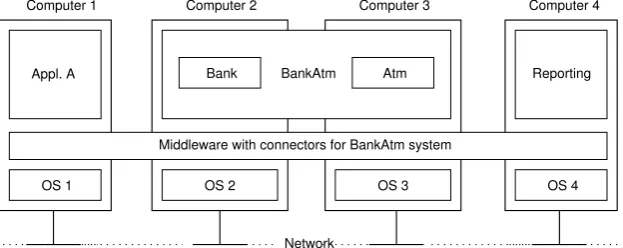
Figure 1.4 illustrates a possible realisation as a distributed system. Note that the figure is not supposed to specify a formal deployment view to the given system, but merely takes up the schematic view of Fig. 1.2 neglecting any questions related to types, instances, or concrete connections. The composite componentBankAtmis realised as a distributed
application. The applicationReportis assumed to be realised by a component that connects
to the open portr:MgtofBankAtm.
Appl. A Bank Atm
OS 2 OS 3
Computer 4
Computer 1 Computer 2 Computer 3
Network
BankAtm Reporting
Middleware with connectors for BankAtm system
OS 4 OS 1
FIGURE1.4. Bank/ATM distributed system
3. CONTRIBUTION AND OVERVIEW 9
012345678459
! "#$ %&'()*!'& +((,&---. %&&---
/01421324564506764818 +!(.
+!!!#( +!!!.(9(9 :#'$(() ;(!&$ <$!(--- +..--- 484866=503088
+!&
>&!#(. <$
&& +$' ? "#
@355030884818 <$!(--- + +..---
A((. B!&&
.
A(.(<
CDEFGHIJDKLMGEN ODFPDQNQLIRDSNH
FIGURE1.5. Aspects of formal software component models
3. Contribution and Overview
Within this thesis we develop a formal software component model with a focus on modelling and general behavioural analysis. Figure 1.5 provides an overview of what we think are fundamental categories and aspects in this context (values given in parentheses are used for a comparison with related work in Chap. 9). The given categories can be aligned to the notion of software component model as discussed above (cf. Sect. 1). The static elements definehow components are represented, and together with behaviour and implementation it is also definedwhat is represented. Moreover, the execution model un-derlying the behavioural aspects additionally defineshow components are composedand hence the categories indeed cover all information that constitute a software component model in the sense of Lau and Wang. However, we draw a sharper line between com-ponent andsoftwarecomponent models, since we require an explicit distinction between specification and implementation of component behaviour to qualify as a software compo-nent model. In contrast, our requirements on support for formal analysis again may be put into line along the notion ofcomposition theory[CSSW04] mentioned by Lau and Wang; cf. [LW07, p. 711]. A composition theory formally describes the result of applying com-ponent composition. We understandcompositionhere in a broader sense, including a form of hierarchical composition using blackbox views of component behaviour.
10 1. INTRODUCTION
programming language we discuss the implementation of port-based components based on the Java Message Service specification JMS [Mic02].
We define equivalence relations similar to process algebraic approaches such as Wright, Darwin, and more recently PADL [BCD02]. Most importantly, we define refinement re-lations for specifications related to [dAH01a, LNW07] as well as a correctness relation between specifications and abstract models of implementations methodologically related to [PV02]. Finally, we aim at providingformalsupport for component-based design which in particular means to allow hierarchical abstraction, to support top-down and bottom-up approaches to system design, and to support “component-wise evolution” as discussed in [dAH01b] and similar also in [PV02]. As a concrete property being preserved during top-down or bottom-up development steps we consider communication-safety. This property implies the absence of architectural incompatibilities in the sense of [BOR04] or [AP05]. Concerning general properties we discuss the preservation of safety properties based on finite and infinite execution traces of a system, showing similarities with Tracta [Gia99].
Even though each of the mentioned aspects is covered by a number of related works, a formal software component model addressing an integrated view on the different aspects together with support for asynchronous message exchange as prevalent, for instance, in dis-tributed systems is still missing. Especially, the formal relation between abstract models of behaviour specifications and models of implementations is often neglected. However, a precise theory for specification refinement and implementation correctness is crucial for a proper support of hierarchical system construction in the context of component-based system development. Moreover, a statement on specific and general properties that are pre-served by correct hierarchical system construction is important to indicate the applicability of the developed theory. Here, the integration of asynchronous communication imposes particular difficulties. The contributions of this thesis in these aspects are as follows: (1) An integrated formal software component model is developed that covers both, static
and dynamic aspects of hierarchical system development. Ports play an important role for the structural definition of components’ interaction points.
(2) Models for the specification and implementation of component behaviours are dis-tinguished and a theory for refinement and implementation correctness is developed. The models take asynchronous communication into account by an integration of FIFO queues for buffered message exchange. It is shown that hierarchical component-based system development is properly supported by the formal part of our component model. (3) Notions of synchronous and asynchronous compatibility are developed, exemplifying specific properties that are of interest in the context of formal behavioural analysis. The preservation of safety properties is examined as an example for more general proper-ties. The verification of asynchronous compatibility in closed systems is addressed by a criterion based on synchronous compatibility. General verification of systems with asynchronous communication is addressed by a translation to Communication Finite State Machines (CFSM).
3. CONTRIBUTION AND OVERVIEW 11
we give a more detailed overview of the mentioned and the remaining chapters of this thesis.
Component Abstract Syntax Formal Model Concrete Syntax Static Metamodel (2) Algebraic model (2) UML Components (7)
Dynamic Behaviour (2)Frame (6) IOTSs (2)PIOs (4) UML STMs (7)UML PSMs (7)
TABLE1.1. Syntax and formal models
InChapter 2we develop a formal model for port-based component behaviours with synchronous and asynchronous communication. The general concepts are defined by a metamodel and illustrated using the example of a compressing proxy system. The meta-model is complemented by an algebraic meta-model, making precise the core structural elements and behavioural features of port-based component systems. Component behaviours are for-mally represented by I/O-transition systems which are equipped with basic operators and equivalence relations as known from process algebraic languages such as CCS [Mil89] or FSP [KM06]. Message queues are encoded by I/O-transition systems and composed with component behaviour, resulting in systems with FIFO buffered message exchange. On this basis we define a formal model for components with behaviours that communicate by synchronous and asynchronous message exchange. We include guidelines for implementa-tions based on message-oriented middleware using JMS and its reference implementation Open Message Queue [Mic07].
Support for the construction and behavioural analysis of large scale component-based systems that communicate solely by synchronous communication is developed in Chap-ter 3. In this way, also an application of the formal model of Chap. 2 is illustrated. The crucial concept is a notion of neutral component behaviour. Component behaviour can be considered to beneutralwithin a given assembly if its composition does not show an ef-fect on the assembly behaviour apart from the synchronisation of shared transitions without loosing any transition of the original assembly behaviour. A major result of this chapter is an algorithm that shows how to remove neutral components for the computation of a syn-tactically reduced but behaviourally equivalent assembly. A reduced assembly may then be used to implement a given composite component in a more efficient way. Moreover, we show that it is sufficient to perform neutrality checks using the projection of a com-ponent behaviour to one of its ports, provided that the projected behaviour is a weakly deterministic I/O-transition system. The port projection is usually a simpler and smaller transition system, at least after minimisation with respect to greybox respectively blackbox equivalence. The approach is illustrated with the compressing proxy system introduced in Chap. 2.
12 1. INTRODUCTION
relation is denoted “blackbox” because it ignores differences of internal labels. PIOs can be considered as a special case of modal I/O automata (MIO) and then, blackbox refinement corresponds to weak modal refinement.
Our theory is required to cope with FIFO buffered message exchange. Based on an encoding of FIFO buffers we show that blackbox refinement is indeed transferable to asyn-chronously communicating components. Moreover, we develop a notion of asynchronous output compatibility that is a natural extension of synchronous output compatibility to an asynchronous setting and show its preservation by blackbox refinement. The resulting the-ory is an interface thethe-ory in the sense of [BMSH10], which is briefly discussed in Sect. 5 of Chap. 4.
Additionally, we define communication-safety as a notion of output compatibility for n-ary compositions of PIOs. We show that blackbox refinement of single transition sys-tems preserves communication-safety of their composition and, moreover, investigate to what extend pairwise analysis of output compatibility implies communication-safety. Fi-nally, we consider more general properties and a greybox variant of our refinement relation. Greybox refinement distinguishes internal labels. We show that greybox refinement pre-serves safety properties with regard to the communication traces of a composed system and briefly discuss counter-examples for the preservation of liveness properties.
InChapter 5we consider foremost the verification of asynchronous communication-safety. Due to the modelling with unbounded FIFO queues, we must take into account that systems of buffered PIOs are potentially infinite-state systems which makes most verifica-tion problems undecidable. We investigate a criterion for asynchronous communicaverifica-tion- communication-safety in closed systems based on synchronous compatibility. An important additional as-sumption, input-separation of the underlying transition systems, is conceptionally related to single-threaded components. For the general verification support of buffered PIO sys-tems we discuss a translation to Communicating Finite State Machines (CFSM) [vB78]. CFSM systems consist of finite state machines communicating with each other via un-bounded, full-duplex, and error-free FIFO channels. Thus, there is a close relationship of systems of buffered PIOs and CFSM systems. We describe a translation of IOTSs to CF-SMs and develop a CFSM correspondence of asynchronous communication-safety. After that we sketch the application of a symbolic CFSM-based approach to the verification of asynchronous communication-safety. Finally, necessary extensions to verify PIOs instead of IOTSs are briefly discussed.
With the basic formal model in Chap. 2 components are equipped with behaviours (formalised by I/O-transition systems) that are supposed to represent the implementation of a component. Chapter 6 extends this model by a specification layer with so-called component frames using the theory developed in Chap. 4. Frames are formally related to behaviours by a correctness relation: the semantics of a frame is the class of all be-haviours which are a blackbox refinement of the frame. We illustrate the completed com-ponent model using the compressing proxy system from Chap. 2. After that, we show that the model supports important characteristics of component-based development. We examine support for top-down and bottom-up design approaches and, moreover, show that component-wise evolution [dAH01b] is supported in hierarchical systems. Top-down de-sign starts with a frameFthat is refined to a composition of several frames. Then, support for top-down design allows to conclude that the composition of component-wise correct blackbox refinements yields a correct implementation of the original frameF. By this kind of support it is shown that the definitions of refinement and implementation relations work smoothly together.
3. CONTRIBUTION AND OVERVIEW 13
is shown that the implementation relation preserves “greybox properties” of compositions and thus supports, for instance, analysis of communication traces in composed systems.
Finally, we discuss a port-based approach for the verification of compatibility and communication-safety based on frames and port protocols illustrating the fundamental dif-ficulty of making effective use of port protocols that hide too much of the component behaviour.
InChapter 7we define a concrete syntax for our component model using UML2 com-ponents with ports, state machines and protocol state machines. We summarise applied UML2 features and explain the meaning of additional notations and stereotypes. We re-late static structure elements with our formal model and discuss an informal pattern-based translation from state machines to transition systems. Based on this translation we define the relation between UML state machines and protocol state machines, and component behaviours and frames as considered in Chap. 6. In this way, we may apply our theory as a formal underpinning for the definition of a UML-based theory of refinement (protocol conformance) and compatibility.
Availability of a concrete specification language was of particular importance for the modelling of the Common Component Modelling Example5(CoCoME) in [KJH+08a] . CoCoME was initiated as a modelling contest aiming at a comparison of existing compo-nent models based on a common requirement specification and reference implementation of a point-of-sale system. Chapter 8revises our initial submission and illustrates features of our component model that were not available at the time of writing [KJH+08a]. The formal model sketched in [KJH+08a] considered only synchronous communication along a rendezvous mechanism. It did not distinguish between behavioural specification (frames) and implementation (behaviours) of components and it did not feature a theoretical model for refinement and compatibility. We provide a brief introduction to the CoCoME require-ments and elaborate on our static structure specifications using UML class and component diagrams, and on our modelling of component behaviours using UML state machines. We illustrate the modelling of more complex component behaviours using hierarchical UML submachine states and translate selected behaviours to IOTSs based on Chap. 7. We spec-ify component frames for simple and composite components using UML protocol state machines and discuss the analysis of compatibility, implementation correctness and refine-ment on the level of the corresponding transition systems.
The main part of the conclusion inChapter 9discusses related work with respect to the aspects of formal software component models given by Fig. 1.5. We consider as relevant for a more detailed comparison only those component models from the literature that have similar objectives like Sofa 2.0 [BHP06], GCM/Fractal [HKR08, BABC+09], STSLib [FR08], FSP/Tracta [KM06, GKC99], and Wright [AG97]. We conclude with remarks on prospects, limitations and future work.
Publications. The thesis is based on publications as listed below. In (P1) we modelled and analysed the CoCoME using the Java/A component model. The study in (P2) focused on the detailed development of a behavioural theory using I/O-transition systems. Finally, in (P3) we extended the model to take into account asynchronous communication. In the following we briefly relate the publications to the chapters of this thesis.
(P1) Alexander Knapp, Stephan Janisch, Rolf Hennicker, Allan Clark, Stephen Gilmore, Florian Hacklinger, Hubert Baumeister, and Martin Wirsing. Modelling the CoCoME with the Java/A Component Model. In Andreas Rausch, Ralf Reussner, Raffaela Mi-randola, and Frantisek Plasil, (Eds.): The Common Component Modeling Example: Comparing Software Component Models, LNCS 5153, pp. 207–237. Springer, Hei-delberg (2008).
14 1. INTRODUCTION
(P2) Rolf Hennicker, Stephan Janisch, and Alexander Knapp. On the Observable Be-haviour of Composite Components. Electronic Notes in Theoretical Computer Sci-ence (5th FACS’08), Vol 260 (1) Jan 2010, pp. 125–153.
(P3) Rolf Hennicker, Stephan Janisch and Alexander Knapp. Refinement of Components in Connection-Safe Assemblies with Synchronous and Asynchronous Communica-tion. Christine Choppy and Oleg Sokolsky (Eds.): Monterey Workshop 2008, LNCS 6028, pp. 154–180. Springer, Heidelberg (2010).
The Java/A component model described in (P1) provided the basis for a metamodel in (P2) for components with (observable) behaviours and synchronous communication. Parts of the modelling of the CoCoME in (P1) appear in Chap. 8. The formal approach to dead-lock analysis of (P1) evolved into the formal behavioural model based on I/O-transition systems in (P2), yet without asynchronous communication. The analysis techniques devel-oped in (P2) appear in revised and aligned form in Chap. 3
CHAPTER 2
A Formal Model for Components with Behaviours
1. Port-Based Components and Behaviours 15
1.1. Concepts of Port-Based Components 16
1.2. Example: Compressing Proxy System 17
1.3. Composition and Behavioural Incompatibilities 20
2. I/O-Transition Systems (IOTS) with Queues 22
2.1. Transition Systems with Partitioned I/O-Labellings 22
2.2. Operators on I/O-Transition Systems 23
2.3. Greybox and Blackbox Equivalence 24
2.4. Encoding of FIFO Queues 26
3. Components with (A)Synchronous Communication 26
3.1. Ports, Components, and Connectors 26
3.2. Assemblies and Composite Components 28
4. Implementation using Message-Oriented Middleware 31
4.1. Java Message Service and Open MQ 31
4.2. Implementation of Port-Based Components 32
This chapter develops a formal model for systems of port-based components with syn-chronous and asynsyn-chronous communication. The general concepts are defined by a meta-model and illustrated using the example of a compressing proxy system. The metameta-model is complemented by set-theoretical definitions stating precisely the core structural elements and behavioural features of port-based component systems. Component behaviours are formally represented by I/O-transition systems that are equipped with basic operators and notions of equivalence as known from process algebraic languages such as CCS or FSP. Message queues are encoded by I/O-transition systems and composed with component be-haviour, resulting in systems with FIFO buffered message exchange. On this basis we define a formal model for components with behaviours that communicate by synchronous and asynchronous message exchange. We close the chapter with guidelines for implemen-tations based on message-oriented middleware using the Java Message Service specifica-tion and its reference implementaspecifica-tion Open Message Queue. Related formal component models are discussed in Chap. 9.
1. Port-Based Components and Behaviours
We consider components to be strongly encapsulated behaviours. Encapsulation is achieved by ports that regulate any interaction of components with their environment. Components can be hierarchically structured containing an assembly of components and connectors that link components using their ports. Interaction consists of synchronous or asynchronous message exchange and we therefore distinguish synchronous and asynchro-nous connectors. By synchroasynchro-nous communication we understand a rendezvous mechanism where sender and receiver synchronise on message exchange. In contrast, asynchronous communication works with FIFO-buffering where the messages issued by a sender are buffered and can be taken (and processed) later on by the receiver. Sending and receiving
16 2. A FORMAL MODEL FOR COMPONENTS WITH BEHAVIOURS
messages with synchronous and asynchronous communication timing are basic primitives of general message-passing systems [Tuc04, Sect. 96.3.4].
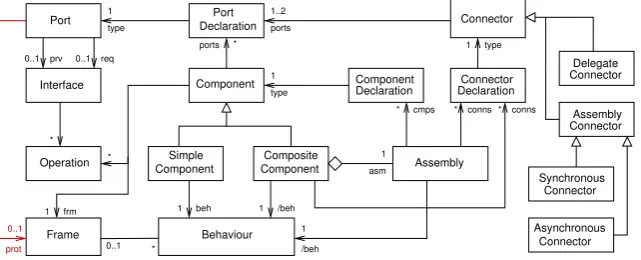
1.1. Concepts of Port-Based Components. Figure 2.1 shows the metamodel of our component model. A port describes a (partial) view on a component. The operations offered by a port are summarised in its provided interface; the operations needed in its required interface. An operation declares the signature to be used for message exchange along this port. Ports as well as components and connectors are in fact considered as types that can be used in local declarations of components and assemblies respectively. A declarationconsists of a name and a type.
type 1
*
prv 0..1 req
0..1
Declaration ports
ports
cmps * conns * conns
Component Component Composite Behaviour Component Simple * 1 /beh Assembly Connector type 1 Delegate Connector Assembly Connector Connector Declaration Component Asynchronous Synchronous Connector Port Interface Operation Port asm type * /beh 1 1 beh 1..2 1 1 Connector Declaration *
FIGURE2.1. Component metamodel
There are two kinds of components,simple componentsandcomposite componentswhich are abstracted in the metaclasscomponent. Any kind of component has a set ofport dec-larationsthat introduce locally unique port names with corresponding port types. Compo-nents can be used in component declarations for the construction of assemblies.
Anassemblydefines the internal structure of a composite component in terms of a set of localcomponent declarationsand localconnector declarationsusing binaryassembly connectors that link local components using their port declarations. Assembly connec-tors can be synchronous or asynchronous indicating which kind of communication timing is used for the message exchange along this connector. In a composite component, non-connected (open) ports of local components may be non-connected to so-calledrelay portsof the composite component, using declarations ofdelegate connectors. Unary connectors can be used to close ports of a component that should not be available, neither for connec-tion nor for delegaconnec-tion. This feature is used in Chap. 3 to reduce assemblies with so-called neutral leaf components.
1. PORT-BASED COMPONENTS AND BEHAVIOURS 17
(multiplicity1) and leave an extension of our formal component model supporting arbitrary
multiplicities, especially an extension of the semantics on the level of global behaviours in hierarchically structured component-based systems, to future work. Moreover, we restrict the components of our models to binary communication. UML2 would allow for arbitrary n-ary connectors. However, these kinds of connectors would complicate our formal treat-ment of behaviours based on I/O-transition systems while being not strictly necessary from the semantical point of view: An n-ary connector is perfectly described by a component whose behaviour reflects the desired connector behaviour. Such a “connector-component” is then linked in between thencomponents alongnbinary connectors. Finally, note that
we usually do not consider messages with different parameter values for the specification of a component behaviour while operations in interfaces in general may show formal pa-rameters.
The behaviours will be described directly on a semantic level using (finite) I/O-tran-sition systems (IOTSs, see Sect. 2) and represented by graphs with labelled tranI/O-tran-sitions and states. We do not intend to propose a particular, e.g., process algebraic or state machine, syntax for specifying behaviours. In fact, any concrete syntax could be used as long as an interpretation using IOTSs is provided. This interpretation may also provide the construc-tion of messages with different values according to the parameter types of the respective operation. In the graphical representation we indicate that a messagemis received (input label, provided) by the visual representation m/and, symmetrically, that a messagemis
sent (output label, required) by /m. Internal, local actions are represented by transitions
labelled without slash. An initial state is indicated by an incoming arrow without source state.
1.2. Example: Compressing Proxy System. We illustrate our component model by a compressing proxy system.1 An HTTP proxy server mediates connections between a
web server and its clients. In order to increase network bandwidth, the proxy server may apply different compression techniques depending on the kind of information transferred. The proxy server distinguishes between textual (txt) and graphical (gif) data and applies
different compression tools before sending the data further downstream.
We describe the static structure of the compressing proxy system by a composite com-ponent type CompressingProxythat consists of an assembly of three simple components
with typesAdaptor,GZip, andGifToJpg introduced by the respective component
declara-tions adapt:Adaptor, gzip:GZip, and gifToJpg:GifToJpgas shown in Fig. 2.2. The adaptor
receives uncompressed data upstream, delegates the textual data for compression togzip,
which employs the gzip utility, and the graphical data togifToJpg, a tool to convert GIF- to
JPG-images. The compression result will then be sent downstream.
The simple components as well as the composite component show port declarations such as t:TxtComprorl:UpStream. The port declarations of composite components are called
relay ports. Port declarations inside the assembly are connected by synchronous and asyn-chronous assembly connectors while delegate connectors link port declarations of inner components and relay ports of the composite component. Communication timing is speci-fied by stereotypes «sync» and «async». The connectortzbetweent:TxtComprandz:Zipis
an asynchronous assembly connector, the connectorgjis synchronous, and the anonymous
connector betweenu:UpStreamandl:UpStreamis a delegate connector.
The provided and required interfaces of the port types of the compressing proxy sys-tem are depicted with the UML ball-and-socket notation on the right-hand side of Fig. 2.2.
1This example is to some extend identical with an example originally used by [IU01] (and also by [BCD02]) to
18 2. A FORMAL MODEL FOR COMPONENTS WITH BEHAVIOURS
adapt : Adaptor [1]
u : UpStream [1] d : DownStream [1]
t : TxtCompr [1] g : GifCompr [1]
gif : GifToJpg [1]
j : ToJpg [1] gzip : GZip [1]
z : Zip [1]
«component» CompressingProxy
l : UpStream [1] r : DownStream [1]
«async» tz:TZ
«sync» gj:GJ
«port» DownStream
«port» ToJpg «port» GifCompr «port»
TxtCompr «port» UpStream
«port» Zip
GCR GCP DSR
GCR
GCP TCR
TCP USP
TCP TCR
FIGURE2.2. Static structure of a compressing proxy server
If two ports are connected by an assembly connector, it is required that the provided in-terface of one port is equal to the required inin-terface of the other, and vice versa.2 The
operations of these interfaces are assumed to be given as follows:
USP={openTxt,openGif}, TCR={txt,endTxt}, GCR={gif},
DSR={comprData}, TCP={stop,zip,endZip}, GCP={jpg}.
We do not consider operations with parameters here, thus the operation names coincide with the messages used for communication.
Based on the static structure of the compressing proxy system, the informal descrip-tion of its intended behaviour reads as follows: A proxy of typeCompressingProxyreceives
stream-based data on its portlthat is delegated to the portuof the contained component adapt. The adaptor distinguishes textual and graphical data received at portuand forwards
data for textual compression via porttand graphical compression via portg. After
receiv-ing the compression result, the component sends the data further downstream usreceiv-ing portd
which is relayed to portrof the composite component.
The behaviour of simple components, which are basic building blocks of port-based component systems, are assumed to be given by IOTSs provided by the component im-plementor respectively designer. Figure 2.3 shows behaviours of the simple components
Adaptor,GZipandGifToJpg. Since components communicate only via ports, any label
rep-resenting a message received or sent has the formp.mwherepis a port name andmis a message according to the provided or required interface of the port. Behaviours also show internal actions represented by internal transition labels without prefix. Additionally we al-low an anonymous internal actionτto reflect a possible internal choice of the component
that can or should not be further detailed.
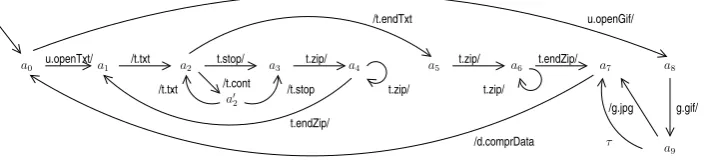
For instance, the behaviour of the componentAdaptorshows label for receiving
mes-sages u.openTxt, u.openGif, t.zip, t.stop, t.endZip, and g.jpg, and for sending messages d.comprData,t.txt,t.endTxt, andg.gif. The only internal action istimeout. The adaptor
com-ponent receives requests for either text or gif compressionu.openTxtoru.openGifresp. at
the upstream portu. After having sent an initial part of textual datat.txtvia portt, there
is a choice between sending further text until the end of the text is reached (signalled by
t.endTxt), or the messaget.stop is received, for example indicating a buffer overflow of
the component attached for text compression. In the first case, the component waits to receive zip data (t.zip) until transmission end is signalled byt.endZip. In the second case,
2In general, one could use a more flexible condition so that the required interface of one port is included in
the provided interface of the other one. However, it is technically more convenient to use the more restrictive condition from above.
1. PORT-BASED COMPONENTS AND BEHAVIOURS 19
(a) Behaviour ofAdaptor3
/d.comprData /t.txt
t.endZip/
/t.endTxt
timeout u.openTxt/ t.zip/ t.zip/ t.endZip/
t.zip/ u.openGif/
t.stop/ /g.gif
g.jpg/ t.zip/
/t.txt
a2 a3
a1
a0 a4 a5 a6 a7 a8 a9
(b) Behaviour ofGZip
z.endTxt/
/z.endZip /z.zip /z.stop
z.txt/
z.txt/
/z.zip
z0 z1 z2 z3
(c) Behaviour ofGifToJpg
/j.jpg j.gif/ cancel
j.gif/ process
j1 j2
j0
FIGURE2.3. Behaviour of simple components
the component retrieves compressed data viat.zipand the communication proceeds until
eventually the end of the text will be reached. In both cases a new communication can be started by sending again an initial piece of textual data to be compressed viat.txt. After
the text compression is finished, the component sends the compression result comprData
further downstream at portd.
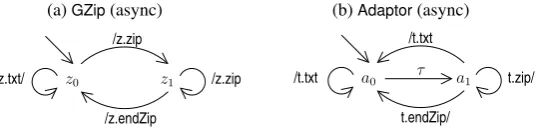
Note that the communication betweenAdaptorandGZip is asynchronous, therefore
the behaviours are not blocked until a message sent is received. Instead, the sender may continue immediately, analogously to the execution of local actions. An asynchronous connector is equipped with two FIFO queues, one for each communication direction. For the given protocol this means, e.g., that the adaptor may continue to send text even though the GZipcomponent has sent astoprequest in the meantime. This is not an immediate
defect, since it is the FIFO buffer which is flooded bytxtmessages, not the
communica-tion partner. If we assume that the adaptor eventually receives the messagestopthen the
communication may proceed indeed as required.
Graphical compression consists only of sending the GIF input further on viag.gifat
port gand then to receive the JPG result back again. In case the compression takes too
long, an internaltimeouttransition is triggered and the adaptor sends instead of a JPG the
uncompressed data further downstream viad.comprData. The behaviour of theGZip
com-ponent mirrors the corresponding part of the adaptor. In fact the design process following a bottom-up approach would probably start with the behaviour of the tool componentGZip
and then mirror this behaviour in the design of the adaptor component. The component
GifToJpg shows an internal choice within its behaviour. After having receivedgifat port j, the component either processes the given GIF or returns without processing to its initial
state. In the former case either the JPG result is sent back viaj.jpgor another GIF is
re-ceived at portgwhich transits back to the given internal choice. In this case a previous
result is dismissed and JPGs are delivered only for the latest given GIF.
The behaviours of assemblies and composite components are derived behaviours. As-semblies use component declarations showing a name and a component type. In order to distinguish the different components inside an assembly, the labels of their behaviours are prefixed by the name of the component declaration, thus turning, e.g., u.openGifof the
20 2. A FORMAL MODEL FOR COMPONENTS WITH BEHAVIOURS
behaviour of an assembly shows both, the interaction behaviour of the composed comnents that are connected within the assembly via their ports, and the communication po-tential at the open ports of components that are not connected within the assembly. Hence, an assembly behaviour is a derived behaviour, given by the composition of the component behaviours of all declared components and connectors of the assembly.
The synchronisation within an assembly maps the labels of the ports connected by an assembly connector to the name of the connector, thus making them shared between the respective components. Transitions with shared labels synchronise and represent commu-nication of the components via their connected ports. Open ports do not appear in assem-bly connectors, therefore those parts of component behaviours related to open ports remain unsynchronised. In general, we also consider the case where a port is neither open nor con-nected to another port. Technically, these ports are closed by applying unary connectors so that, altogether, the internal actions of an assembly behaviour comprise the synchronised transitions along the shared actions of its components and the unused actions of closed ports. The behaviour according to the remaining open ports is described by the unsynchro-nised input and output transitions of the component behaviours that are the only external actions of an assembly.
For instance the behaviour of the assembly underlying theCompressingProxy
compo-nent is computed by the synchronisation of the compocompo-nent behaviours ofadapt: Adaptor, gzip:Gzip, andgifToJpg:GifToJpgaccording to the connectors of their ports. The
synchroni-sation label for the output labeladapt.g.gifofadapt:Adaptorand the input labelgifToJpg.j.gif
ofgifToJpg:GifToJpgis given in accordance with the connectorgjby the labelgj.gif. Now,
both component behaviours may synchronise on transitions with the shared label gj.gif.
If the assembly contains asynchronous connectors, the derived behaviour is a potentially infinite-state system, due to the unboundedness of the FIFO queues used to model buffered communication. For strictly synchronous assemblies, the composition can be computed and represented by finite-state techniques. Assuming that the assembly connector tzis
synchronous, the mentioned assembly behaviour has30states and65transitions (includ-ing internal and τ-transitions). If we hide internal actions of components and use the minimisation procedure of observational equivalence, we obtain the simpler IOTS given by Fig. 2.4a. The minimised IOTS shows only synchronised and open transitions as well as thoseτ-transitions that could not be removed without invalidating observational equiv-alence.4
Finally, the behaviour of composite components is derived in such a way that the input and output actions of a composite component are delegated between its relay ports and the open ports of the assembly. The synchronised transitions of the assembly are considered to be internal labels of the composite component analogous to internal actions of simple components. When a component is put into the context of a new assembly, its internals are hidden, i.e. relabelled to the anonymous action τ. Figure 2.4b shows the resulting
component behaviour ofCompressingProxy, after hiding and minimisation with respect to
blackbox equivalence under the assumption oftzbeing a synchronous connector.
1.3. Composition and Behavioural Incompatibilities. Fundamental to component-based design is a composition operator that allows to construct new components from an assembly of existing components (and connectors). Arbitrary composition might lead to a vast number of component interoperability errors concerning different aspects and proper-ties of the underlying components. Becker et al. [BOR04] provide a classification of these errors in the context of general component characteristics comprising functional as well as non-functional aspects. In the centre of our interest arearchitectural incompatibilities