Optimistic Mixing, Revisited
Antonio Faonio and Dario Fiore
IMDEA Software Institute, Madrid, Spain
Table of Contents
Optimistic Mixing, Revisited. . . 1
Antonio Faonio and Dario Fiore 1 Introdution. . . 2
1.1 Our Contribution . . . 3
1.2 Other related work. . . 5
2 Preliminaries . . . 6
2.1 Basic Notation. . . 6
2.2 Non-Interactive Zero-Knowledge 7 2.3 UC Security Model. . . 8
2.4 Algebraic Notation and Assumptions . . . 9
3 Verifiable and Optimistic Mixing Definitions . . . 10
3.1 Auditable Protocols with Bulletin Board. . . 11
3.2 Verifiable Mixing Schemes and Optimistic Mixing Schemes. 11 4 RCCA PKE with Authenticated Re-randomizability . . . 13
4.1 Re-randomizable RCCA PKE . . 13
4.2 Authenticated Re-randomizability. . . 15
4.3 A Scheme Secure under DDH in the Random Oracle Model . . . 16
4.4 Proof of Theorem 2 (RCCA Security). . . 19
4.5 Proof of Theorem 3 (re-randomizability). . . 27
4.6 Proof of Theorem 5 (unforgeability) . . . 32
5 Our Optimistic Mixing Construction. 35 5.1 A high-level description of the protocol . . . 36
5.2 Description of the Algorithms . . 38
6 Verifiable Mixing from Optimistic Mixing. . . 55
6.1 Structured Verifiable Mixing Scheme . . . 55
6.2 Construction . . . 56
6.3 Concrete Instantiation for the Structured Mix . . . 62
7 Efficiency Evaluations . . . 63
8 Conclusions and Open Problems . . . . 63
9 Acknowledgements . . . 64
A NIZK Proof Systems. . . 66
A.1 Instatiations in the CRS+NPRO Model . . . 66
A.2 How to obtain N IZKmx and N IZKsd. . . 67
A.3 A Sigma protocol for Rmx . . . 70
A.4 Non-interactive zero-knowledge proof system for Rsd . . . 70
1 Introdution
Bakground.Mixing Networks (aka mix-nets), originally proposed by Chaum [16], are protocols that allow a set of senders to send messages anonymously. Typically, a mix-net is realized by a chain of mix-servers (aka mixers) that work as follows. Senders encrypt their messages and send the ciphertexts to the first mix-server in the chain; each mix-server applies a transformation to every ciphertext (e.g., partial decryption, or re-encryption), re-orders the ciphertexts according to a secret random permutation, and passes the new list to the next mix-server. The idea is that, if at least one of the permutations applied by the mixers remains secret, the list returned by the last mixer contains (either in clear or encrypted form, depending on the mixing approach) the messages sent by the senders in a randomly permuted order.
where a dishonest mixer could replace all the ciphertexts with encrypted votes for a desired candidate!
Realizing Mix-Nets. A popular design paradigm of mixing networks are re-encryption mix-nets[41] in which each server decrypts and freshly encrypts every ciphertext. Interestingly, such a transformation can be computed even publicly using re-randomizable encryption schemes (e.g., El Gamal). The process of re-randomizing and randomly permuting ciphertexts is typically called ashuffle. Although shuffle-based mix-nets achieve privacy when all the mix-servers behave honestly, they become insecure if one or more mixers do not follow the protocol. An elegant approach proposed to solve this problem is to let each mixer prove the correctness of its shuffle with a knowledge proof (or argument). This idea inspired a long series of works on zero-knowledge shuffle arguments, e.g., [24,40,31,51,53,34,48,9]. Notably, some recent works [53,48,9] improved significantly over the early solutions, and they have been implemented and tested in real-world applications (elections) [54]. In spite of the last results, zero-knowledge shuffle arguments are still a major source of inefficiency in mix-nets. This is especially a concern in applications like electronic voting where it is realistic for mix-nets to be able to scale up to millions of senders (i.e., voters).
Optimistic Mixing.Most of the research effort for improving efficiency of mix-nets has been so far devoted to improving the efficiency of shuffle arguments. A notable exception is the work of Golleet al.[30]. They proposed a new mixing network optimized to quickly produce a correct output when all the mix-servers execute the protocol correctly. If, on the other hand, one or more mix-servers cheat, then no privacy is guaranteed, but the attack is noticed, and one can decide to “back up” to a different, slow, mix-net execution. Their efficiency improvement came from an “optimistic” or “fast-track” [25] approach, from which the name optimistic mixing. Essentially, the idea is that optimistic mixing is not sufficient to realize a mix-net by itself, yet one can (optimistically) attempt an execution of the optimistic mix-net and, in the rare case of failure, “backup” to a slow mix-net. This way, one gets protocols that, in most realistic scenarios, run fast.
Unfortunately, one year after its proposal, Abe and Imai [5] and independently Wikstr¨om [49] showed major flaws in the optimistic protocol of Golleet al. The attacks leveraged malleability issues in the encryption scheme used in the protocol as well as a lack of a formal security definition for optimistic mixing.
1.1 Our Contribution
In this work we rescue the optimistic mixing approach. As main contributions, (1) we introduce formal definitions for optimistic mixing in the UC model, (2) we propose a compiler in the UC model for obtaining a secure mix-net through the composition of optimistic mixing with a traditional mixing protocol as backup mixing, and (3) we propose a UC-secure realization of optimistic mixing based on a new public key encryption (PKE) scheme that is re-randomizable and replayable-CCA (RCCA) secure (as defined by Canettiet al. [14]).
When instantiating our compiler with our new optimistic net and the UC-secure mix-net of Wikstr¨om [51], we obtain a new UC-secure mixing network whose optimistic execution is faster than in existing UC-secure mix-nets [50,51]. In what follows we discuss our contributions in more detail.
addition to providing a way to clearly specify the security requirements of a protocol, offers the strong property that security is preserved even if the protocol is arbitrarily composed with itself or other protocols. We find the compositional property of UC particularly relevant to protocols like mix-nets that are naturally used in composition with larger cryptographic protocols.
For our definition, we start from the mix-net UC definition of Wikstr¨om [50] who models a mixing (Mix) protocol as one that realizes the functionality that collects inputs from the senders and outputs their lexicographic ordering, i.e., FMix(x
1, . . . , xn) = Sort(x1, . . . , xn). Inspired by this, we model an OMix network as a protocol that UC-securely realizes the functionality that either shuffles the input messages or does not, but in this case notifies all the parties that an attack was performed. More precisely,
FOMix(b, x
1, . . . , xn) =
(b,Sort(x1, . . . , xn))b=valid (b, x1, . . . , xn) b=invalid
Above, b is a flag provided by the adversary. This means that the ideal adversary can decide whether the functionality provides a layer of anonymization of the inputs or not. While this functionality may seem useless if one wishes security against dishonest mixers, the original idea of Golleet al. [30] is that an OMix protocol needs to be backed up by another mixing protocol (let us call it the backup mixing) which would be run in case the ideal adversary decided to set b to invalid. In a sense, one aims to obtain FMix by composing FOMix ◦ FMix where the composition consists in executing FOMix first, and then, if the output contains b = invalid, executing FMix on the outptut of FOMix. The promising aspect of this composition approach is that valid executions only run the OMix protocol, and since this must realize a weaker functionality it might allow for faster realizations.
In our definitions we also consider the notion of public verifiability (aka auditability) for (optimistic) mixing. In a nutshell, auditability means that any third party can publicly verify that the output generated by running the mix-net on the private inputs is correct. To formalize this notion, we introduce a definitional framework for (UC composition of) auditable protocols with a bulletin board (BB). The idea is that the protocol’s transcript is registered in the BB, and that an auditor can, in a non-interactive fashion, read this transcript and decide its correctness. This can be seen as an extension to the UC model of the auditable MPC notion of Baum et al.[8].
A ‘Mix+OMix⇒Mix’ Compiler. The above idea of composing an optimistic mixing with a traditional mixing requires care, though. For example, one challenge of the composition is that when the invalid branch is taken by the OMix protocol, the inputs cannot appear in clear before being sent to the backup mixing. The idea of Golle et al. to solve this problem, called double-enveloping, is that OMix runs on ciphertexts of the Mix protocol.
Realizing Optimistic Mixing.We construct the first secure OMix network and prove it UC-secure in the non-programmable random-oracle (NPRO) model based on the DDH assumption. The first two main ingredients of our OMix protocol are: (1) a re-randomizable RCCA-secure public key encryption scheme, and (2) a non-interactive zero-knowledge (NIZK) proof of “loose shuffling” of ciphertexts of this PKE. We recall that RCCA security, introduced by Canetti, Krawczyk and Nielsen [14], is a relaxation of CCA2 security where one is allowed to maul a ciphertext if the underlying plaintext stays the same, as in the case of re-randomizations, whereas all other kinds of malleability would be detected.
In our OMix protocol, the senders use the RCCA PKE to encrypt their messages, and then each mixer re-randomizes the ciphertexts and creates a “loose shuffling” proof. For security, the key idea is that, despite this proof alone does not guarantee that the output ciphertexts are a shuffle, its combination with the RCCA property yields a shuffle proof. More in detail, if the “loose shuffling” is verified, the only other way to create a list that is not a shuffle would be to invalidate at least one ciphertext. So, if an invalid decryption occurs when decrypting the list returned by the last mixer, the OMix protocol raises an error.
This idea, however, does not work yet to produce a secure OMix protocol. The problem is that, to ensure that every mixer did a shuffle, one should decrypt the lists of ciphertexts returned by every mixer, but this would reveal their permutations. We solve this issue with our third key ingredient, which is (3) a novel technique called authenticated re-randomization. Informally, this offers the following guarantee: if an invalid ciphertext appears in a middle list, then it must propagate until the last list, or in other words it is infeasible for the adversary to repair invalid ciphertexts after they are re-randomized in an authenticated way. Authenticated re-randomization works by letting a mixer re-randomize using a secret-key (one for all the ciphertexts); this key performs a sort of homomorphic authentication on the ciphertexts and can be revealed after all mixers are done. Our proof shows that as long as there is one honest mixer performing this authentication we obtain the property that invalid ciphertexts cannot disappear.
Putting ideas (1), (2), and (3) together gives us a secure OMix protocol. To implement these ideas, our technical contributions are: a new PKE scheme that is re-randomizable, RCCA-secure, and has authenticated re-randomization; a NIZK proof of “loose shuffling” for the ciphertexts of this PKE. This NIZK is based on a simple sigma protocol for proving that a tuple of group elements lies in the span of a public vector. For nciphertexts, this NIZK proof can be created and verified by doing 6ngroup multiplications and 5 exponentiations, which is extremely fast considering that exponentiations are way more expensive than multiplications. So, the work to be performed by every mixer is dominated by the authenticated re-randomization of ciphertexts, which depends on the efficiency of the PKE. Considering the overhead of double-enveloping, and using standard precomputation techniques, this requires 9.2 exponentiations per ciphertext (plus other 1.8 that can be precomputed offline prior to receiving the ciphertexts). Moreover, since re-randomization happens independently for every ciphertext, this operation can be highly parallelizable. These costs are comparable with those of state-of-the-art mixing protocols and are about 3 times faster than existing UC-secure mix-nets [50,51] (some details are in Sec.7).
PKE Enc Dec Rand |C| |pk| RCCA rnd-RCCA Ass. Model [32] Gro1 3k+ 2 4k 3k+ 1 3k+ 1 3k+ 3 weak perfect DDH std [32] Gro2 3k+ 3 4k+ 3 3k+ 3 3k+ 2 3k+ 3 full perfect – GGM [43] PR07 22 32 24 20 11 full perfect DDH∗ std
This paper 16 18 15 11 11 full weak DDH NPRO
Table 1.Comparison among a selection of re-randomizable and RCCA-secure PKE schemes. Encryption, de-cryption and randomization are measured in number of exponentiations; ciphertexts and public key in number of group elements. For the schemes of [32],k is the message bit-length, in the second scheme the group isZ∗N2
for an RSA modulusN, GGM refers to the generic group model, and DDH∗refers to the use of special groups. rnd-RCCA stands for re-randomizability in the presence of an RCCA decryption oracle. By “weak” RCCA (resp. rnd-RCCA) we mean the scheme satisfies the RCCA (resp. rnd-RCCA) notion in the presence of a weak-RCCA decryption oracle, whereas “full” means that the notion is satisfied with the standard RCCA decryption oracle (see Def. 10and Fig. 4 for more details). Perfect re-randomizability, where the unbounded adversary gets the secret key, implies full rnd-RCCA.
A new re-randomizable RCCA-secure PKE.As we mentioned in the previous paragraph, a key ingredient of our OMix protocol realization is a new public key encryption that is RCCA-secure and re-randomizable. Our scheme is proven RCCA-secure in the NPRO model under the DDH assumption and, to the best of our knowledge, outperforms all previous re-randomizable RCCA-secure schemes in all fronts. For fairness, we should mention that we achieve a weaker notion of re-randomizability that holds computationally and in which the adversary has access to a weaker RCCA oracle (as defined by Groth [32]) that outputs “invalid” (instead of “same”) even when the decrypted message is the challenge one. We stress that this weaker oracle is used only for re-randomizability, whereas we achieve full-fledged RCCA security.
In Table 1 we present a comparison with other schemes.1 We note that the scheme of Prabhakaran and Rosulek [43] works over two specific groups that are the quadratic residues subgroups of Z∗2q+1 and Z∗4q+3 respectively, where (q,2q+ 1,4q+ 3) is a Cunningham chain of the first kind of length 3. In contrast, our scheme can be instantiated overany groupwhere the DDH assumption holds, notably including elliptic-curve groups, which offer better performance.
1.2 Other related work
The notion of mix-net was introduced by Chaum [16]. The use of zero-knowledge arguments to prove the correctness of a shuffle was first suggested by Sako and Kilian [45]. The first proposals used expensive cut-and-choose based zero-knowledge techniques [45,2]. Abe et al.removed the need of cut-and-choose by proposing a shuffle based on permutation networks [3,4]. Furukawa and Sako [24] and independently Neff [40] proposed the first zero-knowledge shuffle arguments for ElGamal ciphertexts that achieve a complexity linear in the number of ciphertexts. These results have been improved by Wikstr¨om [53], and later Terelius and Wikstr¨om [48], who pro-posed arguments where the proof generation can be split into an offline and online phase (based on an idea of Adida and Wikstr¨om [6]). These protocols have been implemented in the Ver-ificatum library [54]. Groth and Ishai [35] proposed the first zero-knowledge shuffle argument with sublinear communication. Bayer and Groth gave a faster argument with sublinear commu-nication in [9]. A definition of mix-nets in the UC-framework was given by Wikstr¨om in [50], and another UC-secure realization appears in [51]. The concept of optimistic security is closely related to the concept of covert security [7]. On one hand, optimistic security specializes covert security, in the sense that the attacker is always caught when cheating; on the other hand, in our formulation optimistic secure protocols do not identify which party cheated.
2 Preliminaries
2.1 Basic Notation
For a binary string x, we denote respectively its length by|x| and itsi-th bit by xi; if X is a set, |X| represents the number of elements in X. When x is chosen randomly in X, we write
x ←$ X. When A is an algorithm, we write y ← A(x) to denote a run of A on input x and
outputy; ifAis randomized, thenyis a random variable andA(x;r) denotes a run ofAon input
xand randomness r. An algorithmAisprobabilistic polynomial-time (PPT) if Ais randomized and for any inputx, r∈ {0,1}∗ the computation ofA(x;r) terminates in a polynomial number
of steps (in the size of the input). We let [n] be the set {1, . . . , n} and denote with Sn the group of permutations over [n]. In this paper we differentiate between ordered list of elements hx1, . . . , xni, namely, list of elements where the positions of the elements x1, . . . , xn in the list is leaked, and not-ordered lists of elements (i.e., sets) {x1, . . . , xn} where the order does not matter.
Negligible functions.We denote withλ∈Nthe security parameter. A functionν :N→[0,1] is negligible in the security parameter (or simply negligible) if it vanishes faster than the inverse of any polynomial in λ, i.e. for any positive polynomial p(λ) there exists a constant λ0 such that for all λ ≥ λ0 we have ν(λ) ≤ 1/p(λ). Equivalently, ν(λ) ∈ O(1/p(λ)) for all positive polynomialsp(λ). We often write ν(λ)∈negl(λ) to denote thatν(λ) is negligible.
Random variables and indistinguishability.For a random variableX, we write Pr [X =x] for the probability thatX takes on a particular valuex∈ {X}(with{X}being the set where
Xis defined). The statistical distance between two random variablesX andX0defined over the same set X is defined as SD(X;X0) = 12Px∈{X}|Pr [X=x]−Pr [X0 =x]|.
Given two ensembles X = {Xλ}λ∈N and Y ={Yλ}λ∈N, we write: X ≈s Y to denote that the two ensembles are statistically indistinguishable, i.e., there exists a negligible function ν : N→[0,1] such that SD(X;Y)≤ν(λ);X ≡Y to denote that the two ensembles areidentically distributed, i.e., that SD(X;Y) = 0; and X ≈c Y to denote that they are computationally indistinguishable, i.e., for all PPT algorithms Dthere exists a negligible functionν :N→[0,1] such that|Pr [D(Xλ) = 1]−Pr [D(Yλ) = 1]| ≤ν(λ).
Lemma 1 (Shoup’s difference lemma [47]). Let A, B, F be events defined in some proba-bility distribution, and suppose that A∧ ¬F ⇔B∧ ¬F. Then |Pr [A]−Pr [B]| ≤Pr [F].
2.2 Non-Interactive Zero-Knowledge
A non-interactive zero-knowledge (NIZK) proof system for a relation R is a tuple N IZK = (Init,P,V) of PPT algorithms such that:Initon input the security parameter outputs a common reference stringcrs;P(crs, x, w), given (x, w)∈ R, outputs a proofΠ;V(crs, x, Π), given instance
xand proofΠ outputs 0 (reject) or 1 (accept). In the protocols of this paper we use the notion of NIZK with labels, that are NIZKs whereP and V additionally take as input a label L(e.g., a binary string). A NIZK (with labels) iscorrect if for every crs←$ Init(1λ), any label L, and
any (xw)∈ R, we have V(crs, L, x,P(crs, L, x, w)) = 1. We define three properties of a NIZK argument system.
Definition 1 (Adaptive soundness).A NIZK with labelsN IZKfor relationRis adaptively sound if for every PPT adversary A, the following probability is negligible:
Pr
(x, Π)←A(crs), x6∈ R V(crs, x, Π) = 1
crs←Init(1λ)
If soundness holds against unbounded adversaries we call N IZK a proof system, else it is an argument.
Definition 2 (Adaptive multi-theorem zero-knowledge, [22]).A NIZK with labelsN IZK for relation R satisfies adaptive multi-theorem zero-knowledge if the following holds:
(i) There exists an algorithm Init that outputs crs, and a simulation trapdoor tds.
(ii) There exists a PPT simulatorSim such that, for all PPT adversaries A, we have that
Pr
h
AP(crs,·,·,·)(crs) = 1|crs←Init(1λ)
i
−Pr
h
ASIM(·,·)(crs) = 1| (crs,tds)←Init(1λ)
i
is negligible in λ. The simulation oracle SIM(·,·,·) answers queries of the form (L, x, w) by checking if (x, w)∈ R, if so returning Sim(tds, L, x) otherwise returning ⊥.
Groth [33] introduced the concept of simulation-extractable (SE) NIZK, which informally states that extractability holds even in presence of a simulator that simulates NIZK proofs for (possibly false) statements. In our paper we use a relaxed notion of simulation extractability where the extractor only returns a (possibly not invertible) function f of the witness. Specifically, in our case we use an f that outputs only a portion of the witness.
Definition 3 (simulation f-extractability). A NIZK with labels N IZK for relation R is
f-simulation extractable (f-SE) if the following holds:
(i) There exists an algorithmInitthat outputs crs, a simulation trapdoor tds, and an extraction trapdoor tde.
(ii) There exists a PPT algorithmExt(tde,(L, x), Π) such that every PPT adversaryA has neg-ligible probability of winning in the following game:
– The challenger runs (crs,tds,tde)←Init(1λ), and gives crs to A.
– Ais given access to the simulation oracleSIM∗(·,·), which it can be queried on pairs of the form(L, x)of its choice, andSIM∗returnsSim(tds, L, x), whereSimis the simulator given by the zero-knowledge property.
– A outputs a tuple (L∗, x∗, Π∗).
– The challenger runs y←Ext(tde,(L∗, x∗), Π∗).
We say thatAwins if: (a)(L∗, x∗)was not queried to the simulation oracle; (b)V(crs,(L∗, x∗), Π∗) = 1; (c) for any w such thatf(w) =y, (x∗, w)6∈ R.
2.3 UC Security Model
We use the Universal Composability model of Canetti [12]. Specifically, our notation for multi-party protocols comes from the book of Cramer, Damg˚ard, and Nielsen [17]. In this formulation of the UC model, the basic computational components are calledinteractive agents. Briefly, an interactive agentAis a computational device that receives and sends messages on named ports, and holds an internal state. More in particular, an interactive agentAhas a collection of named inports where it receives messages and a collection of namedoutports where it sends messages. Given two agentsAand Bthe union of them, denoted asA ◦ B is theinteractive system where every outport ofA(resp.B) with nameNis connected to an inport ofB(resp.A) with the same nameN(if it exists). An interactive system where all the inports and outports are connected is saidclosed. The collection of all the ports that are not connected is called the open ports of the interactive system.
All the agents in the framework have one or more inports with name ending in infl or
with named N.infl then it must have a matching port with name N.lk. We call these special ports the leakage ports of the agent. Leakage and influence ports are very important: agents are activated by a special message on the influence port and they return their activation on the leakage port; parties of a protocol are corrupted by a special message on the influence port and from that point on they return their full state on their leakage port and proxy all the messages from the influence port (resp. to the leakage port) to (resp. from) their other ports (in this paper we consider only active corruption of the parties); the leakage and influence port of an ideal functionality model which information is allowed to leak and how an adversary can influence the functionality2 (for more details see chapter 4 of [17]).
The agent of an ideal functionality with nameFadditionally hasninports namedF.in1, . . . ,
F.inn, andnoutports namedF.out1, . . . ,F.outn. These 2nports are called theprotocol ports. A protocolΠconsists ofnpartiesP1, . . . ,Pn where each party is an interactive agent. A protocol
Π has aprotocol name F. We let a protocolΠ and the ideal functionalityF thatΠ is supposed to implement have the same name. We name the port N of the protocol Π asF.N. A protocol also has ports connecting it to the resourceRwithresource name R. Theresource Rtakes care of moving messages between parties of the protocol. In addition to moving messages, it also models the leakage of the communication network and the possible influence that an attacker might have on the network.
A simulator S for a protocol Π with name F is defined as a polytime interactive system with an open inport named F.infl and an open outport named F.lk; these two ports allow S to connect to an ideal functionalityF with nameF. In addition to these two ports, a simulator has a collection of ports corresponding to all the open ports of the protocolΠwith resource R. As a consequence, the interactive systems (F ◦S) and (Π◦ R) have the same open ports.
An environment Z for a protocol Π with resource R is an interactive system that has the dual open ports of Π◦ R(namely,Z ◦Π◦ Rforms a closed interactive system). In this paper we consider protocols that are secure against environments which performs static corruption of the parties. This means that corruption takes place before the protocol starts its execution and, as already mentioned above, the adversary can deviate from the protocol specification in any arbitrary way. Let Envstatic be the set of all polytime interactive agents Z of this flavor. Specifically, Z ∈ Encstatic if, at the first activation, and only in this activation, it sends a list
of messages corrupt to the influence ports of the protocol. Two systems are indistinguishable to an environmentZ if it cannot tell them apart, expect with negligible advantage, by sending and receiving messages on the open ports of the systems. More formally, the environment plays with a system and then, at the end of the execution outputs a bit b. Two systems A and B are indistinguishable to a class of environments Env if for any Z ∈Env the bit output by Z interacting with Aand the bit output by Z interacting withB are indistinguishable.
Definition 4. Let F and R denote arbitrary protocol names. Let F be any ideal functionality with name F, Π be any protocol with protocol name F and resource name R, and let R be an ideal functionality with name R. We say thatΠ◦ R securely implements F in the environments from Env if there exist a simulator S such that Π◦ R and S◦ F are indistinguishable to the class Env.
We are ready to state the UC Theorem (see Thm 4.20 of [17]).
Theorem 1 (The UC Theorem). Let Env be a class of environments. Let ΠF a protocol with protocol name Fand resource name G. LetΠG a protocol with protocol nameGand resource name H. Let F,G,H be ideal functionalities with name F,G,H.
2
If ΠF ◦ G securely implements F and ΠG ◦ H securely implements G, then (ΠF ◦ΠG)◦ H securely implements F.
2.4 Algebraic Notation and Assumptions
In this section we present notation and useful definitions related to the algebraic tools used in our constructions. Let Setup(1λ) be an algorithm that upon input λ produces parameters
prm= (G, q, G) describing a groupGof prime order q >2λ, with generatorG. We use additive notation for the group operation, and we denote group elements using the bracket notation introduced by Escala et al. in [20]. Namely, for a y ∈ Zq we let [y] be the element y·G. We write elements inGwith capital letters and elements inZq with lower case. We indicate vectors with boldface (e.g. a,b, . . .) and matrices with capital bold face (e.g. A,B,· · ·). We indicate vectors of elements inGwith overlined capital letters (e.g. ¯A,B, . . .¯ ).
We briefly recall the DDH assumption that we use in Sec. 5.
Definition 5 (DDH).The Decisional Diffie-Hellman Assumption assumption holds forSetup, if for anyprm= (G, q, G)←$ Setup(1λ), any a, b, c←$ Zq and any PPT A
|Pr [A(prm,[a, b, a·b]) = 1]−Pr [A(prm,[a, b, c]) = 1]| ≤negl(λ).
Useful facts.To analyze the security of our construction we rely on the following lemma, and a simple corollary of it.
Lemma 2 (Adaptive smoothness). For all prm ←$ Setup(1λ), any g ∈ Z2q, a ∈ Zmq , and
any (unbounded) adversaryA:
Pr
A←$ Zm×2q ,A
[w,z]←A(a),
w6∈Span(g) z=A·w
A·g=a,
≤1/q
m.
Proof. We show that for any a ∈Zm
q , any Aand any assignment of the randomness of A that leads to [w,z] such that the event in the probability above holds there is 1 possible assignments of A∈Zm×2
q . In fact, notice that A is such that:
(
A·g=a A·w=z
This is a system of 2mlinear and independent equations over 2mvariables inZq, which therefore admits only 1 solution. Notice that, conditioned on a, the matrix A is sampled uniformly at random from a set of sizeqm, therefore the probability thatAis a solution for the system above is 1/qm.
Corollary 1 (Non-Adaptive Smoothness).For all prm←$Setup(1λ), anyg∈Z2q, we have
(prm,A·g,w,A·w])≡(prm,A·g,w,u]) where A←$ Zmq ×2,w←$ Z2q,u←$ Zmq.
The corollary follows from Lemma 2 by observing that here w is chosen randomly and inde-pendently of a=A·g.
Although for simplicity we do not use the SPHF abstraction in our PKE scheme, we briefly recall the corresponding construction below. Let [g]←$G2be a vector that defines the language L=Span([g])⊂G2. For a positive integer m ∈N, A←$ Zmq ×2 is the secret hashing key, and
[a] = [A·g] the public projective key. Then, on input the projection key [a], word [w] and witnesswsuch thatw=w·g, the public hashing outputsw·[a]. Instead, on input the hashing key Aand any wordw, the (private) hashing outputs [A·w].
3 Verifiable and Optimistic Mixing Definitions
In this section we give definitions for Verifiable and Optimistic Mixing protocols in the UC model. In our work we are interested in protocols that areauditable(or, in other words, publicly verifiable). Informally speaking, auditability means that a third party (the auditor) can publicly verify that the output generated by executing the protocol on private inputs is correct.
To formalize this notion, we introduce a definitional framework for auditable protocols with a bulletin board (BB, for short). The basic idea is that the protocol’s transcript, including the output, is written in the BB, and that an auditor can, in a non-interactive fashion, read such transcript from the BB and decide its correctness. Auditability was considered by Baum, Damg˚ard and Orlandi [8]. Our definition follows in spirit their definition as we consider an external auditor party that cannot be corrupted, acts after the execution of the protocol and interacts only with the bulletin board. The main difference is that our definition is in the UC model and, loosely speaking, achieves what they call auditable correctness by comparing two experiments (in an ideal-versus-real-world fashion), whereas their definition asks explicitly that the probability of an auditor to accept (resp. reject) an output y is overwhelming when the functionality would output (resp. would not output) y over the input provided.
3.1 Auditable Protocols with Bulletin Board
In our model all the protocols have, as resource, a bulletin boardBB with nameBB. The func-tionality bulletin board is the same as defined in [50], and can be realized using an authenticated broadcast channel (c.f. [28,38]). This resource is shared by all the protocols. To formalize this, we slightly tweak the notion of composition of interactive agents. Specifically, given two proto-colsΠ1 andΠ2both with resourceBB, we denote the composition of (Π1◦BB) and (Π2◦BB) as (Π1◦Π2◦BB), where the protocol ports of the resourceBBin the composed system are the union of the protocol ports ofBB inΠ1◦BB and Π2◦BB.
An auditable protocol is a tuple (Π,Audit), whereAuditis a non-interactive PPT algorithm andΠ is a multi-party protocol. To define auditability we consider an auditor partyPAdefined as an agent with nameAand parametrized by an algorithmAudit(see Fig.1). More in detail, the partyPAcannot be corrupted, (i.e., it would reject all corruption messages sent to its influence port), and whenever activated it reads the full content of the BB, it selects a relevant portion
τ (e.g., the messages of the specific protocol execution to audit), runs the audit algorithm
b←Audit(τ), and returns b on its leakage port.
To make auditable protocols composable, and in particular to enable the composability of Audit algorithms, we define an ideal audit procedure for the output of an ideal functionality. Notice that the output of an ideal functionality is, by definition, correct as it is produced as the correct computation on the private inputs. Therefore, given an ideal functionality/resource F with name F we define the ideal audit Audit∗F that trivially accepts if it finds in the BB a specific output authenticated byF.
proxies all the messages ofF and also forwards all the messages in the protocol’s output ports to the bulletin board using a special port name. This way, the bulletin board can syntactically distinguish what event to register in the “ideal board” DI and what to register in the “real board”DR. The auditor partyP
A is the only agent that can get access to the ideal boardDI. Formally, letDR,DI, Xas in the description of the auditor agent in Fig.1, we letAudit∗
F(DI, X) return true iff∃c: (c,F, X)∈ DI.
Definition 6. Given an ideal functionality F with name F, a resource R with name R, and a class of environments Env, we say that an auditable protocol (Π,Audit), where Audit is a non-interactive PPT algorithm, andΠ is a protocol with protocol nameFand resource nameR, is secure for F with resource R for environments in Env if:
1. The protocolΠwith resourcesW[R]andBBsecurely implementsF ◦BBfor all environments Z ∈Env.
2. LetS be the simulator ofΠ, the agent systems (W[S]◦ W[F]◦BB◦ PA[Audit])and (W[S]◦ W[F]◦BB◦ PA[Audit∗F]) are indistinguishable for all environments Z ∈Env.
3.2 Verifiable Mixing Schemes and Optimistic Mixing Schemes
A Verifiable Mixing scheme and a (Verifiable) Optimistic Mixing scheme are auditable protocols that involve two groups of parties: (i) the senders{PSj}j∈[n], (ii) and the mixers{PMi}i∈[m]. To
define the security of VMix and OMix schemes we describe corresponding ideal functionalities FMix in Fig.2 and FOMix in Fig.3.
In brief, the mixing functionality FMix waits for an input M
j from every sender PSj, and
after all senders have submitted their inputs it returns these inputs in sorted order (essentially hiding who sent which message). The optimistic mixing functionalityFOMix is almost the same asFMixexcept that the adversary can send a special messageinvalidate. Then, ifinvalidate was sent,FOMix returns the senders’ inputs in the same order as they were submitted, otherwise it returns the inputs in sorted order as FMix does. In addition to the list of messages, FOMix outputsb∈ {valid,invalid}to indicate if invalidatewas sent or not.
We stress that for both FMix and FOMix the mixers do not need to provide any input to the functionalities. This feature is particularly useful in the UC model. For example, in our Mix-Net protocol, there is no need to UC-extract the permutations used by the mixers.
Definition 7. A VMix VM= (Π,Audit) isR-secure iff VMis a secure auditable protocol for FMix with resource R for environments in Envstatic.
Definition 8. An OMixOM= (Π,Audit) is R-optimistic-secure iff OM is a secure auditable protocol for FOMix with resource R for environments in Envstatic.
4 RCCA PKE with Authenticated Re-randomizability
4.1 Re-randomizable RCCA PKE
A re-randomizable PKE schemePKE is a tuple of five algorithms specified as follows.
Setup(1λ) takes as input the security parameter λ(in unary) and produces public parameters
prm, which include a description of the message spaceM.
WrapperW[F] (resp.W[S]):
The wrapper has the same open ports of the functionalityF with nameF(resp. the simulatorSwith nameS). Moreover the wrapper has an outport with nameinF that connects it to the bulletin board. (Resp. the wrapper for any ideal functionality simulated by S with name F as an outport with nameinF that connects it to the bulletin board.)
1. On activation proxy all the messages on its inports to the inports ofF and activateF (resp.Sand activate S);
2. OnceF (resp.S) returns its activation proxy all the messages on the outports ofF (resp.S) to its outports, moreover ifF has sent a messageXon an protocol portoutithen send the message (write,F,(i, X)) to the portinF(resp. ifShas sent a messageX on a protocol portF,outithen send the message (write,F,(i, X)) to the portinF).
Ideal functionalityBB:
The ideal functionality has enough protocol ports to connect with all the protocols’ agents of the agent system, for each ideal functionality in the agent system, it has special protocol ports named withinFwhereFis the name of the functionality, it has a special protocol inportinAand special protocol outport namedoutA (connected to the auditor party).
1. The functionality holds three databases D,DI
andDT
. We callDI
the database of the ideal functionalies’ messages andDTthe database of the messageson transit. At first activation initialize the databases as empty, and the countersc←1, cI←1.
2. Upon message (write,pid, x) on the inportBB.ini, with x ∈ {0,1}∗, write (pid, i, x) on the database DT. Send the message (write,pid, i, x) to the outportBB.lk.
3. Upon message (write, X) on the inportBB.infl, ifX appears inDT then write (c, X) on the databaseD, delete the entry fromDT
, and increase the counterc.
4. Upon message (read, c) on the inportBB.inisend the message (read, i, c) to the outportBB.lk.
5. Upon message (read, i, c) on the inportBB.infl, read from the databaseDthe tuple (p, i, x) and if it exists write (read,(p, i, x)) to the outportBB.outi and toBB.lk.
Special commands:
6. Upon message (write,F, X) on the inportBB.inFwrite (c, X) on the databaseDI and increase the counter cI.
7. Upon messagereadon the inportBB.inA, send the message (read,D,DI
) to the outportBB.outA. AgentPA[Audit]:
The agent has two portBB.inAandBB.outAconnected to theBB. Moreover, a protocol identifierpidis assigned to the agent.
1. Upon activation, if the messagecorruptappears in the influence port then ignore it;
2. Read the message (input, X) from the influence port, send the messagereadto the outportBB.inAand at next activation read the message (read,D,DI) fromBB.outA. LetDR be the set{(c, i, x) :p=pid,(c, p, i, x)∈ D} and letτ ←(DR
,DI ).
3. If for alli∈[n] there exists (∗, i,endProtocol) then computeb←Audit(τ, X) else return the messageerror
to the port portA.lkand return;
4. Return the message (audit, b) to the portA.lk.
FunctionalityFMix :
The functionality is implicitly parametrized by the security parameter 1λ and hasn =poly(λ) protocol ports with indices{Sj}j∈[n]andm=poly(λ) protocol ports with indices{Mi}i∈[m].
Init: At first activation read fromMix.inflthe sets of corrupted playersCS,CM, and setIS← ∅,
flginpDone← false, andflgmixDone←false;
Input: On message (input, i,Mi) on the inportMix.inSi (or on the inportMix.inflifi∈C
S
), if the entry (i,∗) does not exist in the database of the inputs then setIS← IS∪ {i}, register the entry (i,
Mi) in the database of the inputs, and send (input, i) on outportMix.lk.
If|IS|=nthen setflg
inpDone←trueand return.
Mix: On messagemixDoneon the inportMix.infl, ifflginpDone=true, computeO ←Sort(hMjij∈[n]), send message (mixDone,O) on the outportMix.lk, and setflgmixDone=true.
Delivery: On message (mixDone, i), if flgmixDone = true, then send the message (mixDone,O) on the outport
Mix.outMi.
Fig. 2: Ideal Functionality for Mixing.
FunctionalityFOMix :
The functionality is implicitly parametrized by the security parameter 1λ, has name
OMix, and hasn=poly(λ) protocol ports with indices{Sj}j∈[n]andm=poly(λ) protocol ports with indices{Mi}i∈[m].
Init: At first activation read fromOMix.inflthe sets of corrupted playersCS,CM, and setIS← ∅,flg
inpDone← falseandflgmixDone←false,b←valid;
Input: On message (input, i,Mi) on the inport OMix.inSi (or on the inportOMix.infl ifi∈C
S), if the entry (i,∗) does not exist in the database of the inputs, then setIS ← IS∪ {i}, register the entry (i,
Mi) in the database of the inputs, and send (input, i) on outportOMix.lk.
If|IS|=nthen setflg
inpDone←trueand return.
Mix: On messagemixDoneon the inportOMix.infl, ifflginpDone=true: – Ifb=validthen computeO ←Sort(hMjij∈[n]);
– Ifb=invalidthen computeO ← hMjij∈[n].
send (mixDone, b,O) on the outportOMix.lkand setflgmixDone←true.
Delivery: On message (mixDone, i), if flgmixDone =true, then send the message (mixDone, b,O) on the outport
OMix.outMi.
Invalidate: On messageinvalidateon the inportOMix.inflthen setb←invalid(resp. ignore the message).
Fig. 3: Ideal Functionality for Optimistic Mixing.
Enc(pk,M) is the encryption algorithm that, on input a public key pk and a message M ∈ M, outputs a ciphertext C;
Dec(sk,C) is the decryption algorithm that, on input the secret key sk and a ciphertext C, outputs a message M∈ M or an error symbol ⊥.
Rand(pk,C) is the randomization algorithm that, on input a public key pk and a ciphertext C, outputs another ciphertext C0;
We require the natural correctness property that for any pair (pk,sk)∈KGenany randomization of a valid ciphertext underpk decrypts to the intended plaintext undersk.
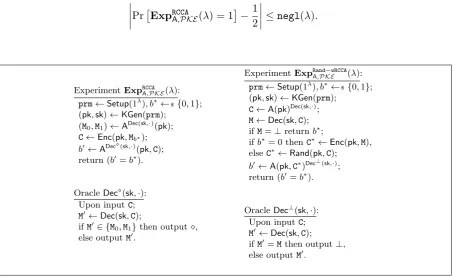
We recall the notion of RCCA-PKE Security [14]. Very intuitively this can be thought of as a relaxation of the standard CCA security notion that allows for re-randomization of ciphertexts. A bit more technically, this is formalized with a security experiment that proceeds the same as the CCA security one except that in RCCA the decryption oracle can be queried on any ciphertext and, when decryption leads to one of the challenge messages M0,M1, it answers with a special symbol (meaning “same”).
PKE is indistinguishable secure under replayable chosen-ciphertext attacks(RCCA-secure, for short) if there exists a negligible function negl such that for any PPT adversaryA
PrExpRCCAA,PKE(λ) = 1 −1 2
≤negl(λ).
ExperimentExpRCCA
A,PKE(λ):
prm←Setup(1λ), b∗←${0,1};
(pk,sk)←KGen(prm); (M0,M1)←ADec(sk,·)(pk);
C←Enc(pk,Mb∗);
b0←ADec(sk,·)(pk,C); return (b0=b∗).
OracleDec(sk,·): Upon inputC;
M0←Dec(sk,C);
ifM0∈ {M0,M1}then output, else outputM0.
ExperimentExpRand−wRCCAA,PKE (λ):
prm←Setup(1λ), b∗
←${0,1};
(pk,sk)←KGen(prm);
C←A(pk)Dec(sk,·) ;
M←Dec(sk,C); ifM=⊥returnb∗;
ifb∗= 0 thenC∗←Enc(pk,M), elseC∗←Rand(pk,C);
b0←A(pk,C∗)Dec⊥(sk,·); return (b0=b∗).
OracleDec⊥(sk,·): Upon inputC;
M0←Dec(sk,C); ifM0=Mthen output⊥, else outputM0.
Fig. 4: The Re-Randomizable RCCA Security Experiments.
Second, we recall the notion of re-reradomizability for PKE. Intuitively, this notion asks that an adversary cannot tell apart a randomized ciphertext from a fresh new ciphertext for the same message. The strongest notion of re-randomizability (as considered in Groth [32] and Prabhajaran and Rosulek [43]), indeed, asks that the two distributions are identical, even condi-tioned on the knowledge of the secret material. In our work, we settle down for a weaker notion that considers indistinguishability for computationally bounded adversaries, which can still do a form of chosen-ciphertext attacks.3 Specifically, we consider a decryption oracle that outputs the error message (⊥) either when the ciphertext does not decrypt or when it properly decrypts to the challenge message. This weaker oracle was considered by Groth [32] as a weakening of the RCCA one.
Definition 10 (Weak-RCCA Re-randomizability.).Consider the experimentExpRand−wRCCA in Fig. 4. Let PKE be a re-randomizable PKE scheme.PKE is rerandomizable under weak re-playable chosen-chipertexts attacks(Rand-wRCCA secure) if there is a negligible function negl
such that for any PPT adversaryA
Pr h
ExpRandA,PKE−wRCCA(λ) = 1
i −1 2
≤negl(λ).
4.2 Authenticated Re-randomizability
We introduce the notion of(key-homomorphic) authenticated re-randomizabilityfor PKE schemes. Informally speaking, this notion ensures that after honest re-randomization, an adversarially
3
generated ciphertext (which may be invalid), cannot be “repaired” to become valid. This prop-erty is crucial to counter “invalidate-and-repair” ciphertext tagging attacks that work as follows. Assume a mixing service consisting of three mixers such that each of them outputs a permuted re-randomization of the list of ciphertexts taken as input; also, assume that mixing is consid-ered valid if all ciphertexts decrypt correctly (otherwise, an error is raised). Now, consider an adversary that controls the first and last mixer and, despite the honest behavior of the second mixer, wants to track a given input ciphertext, i.e., it wants to learn if the i-th ciphertext Ci given to the first mixer corresponds to the j-th ciphertext C0j returned by the second mixer, thus de-anonymizing the i-th sender. The attack is the following: the first mixer invalidatesCi (replacing it with ˜Ci); the third mixer makes a corresponding reverse operation onC0j (replacing it with ˜C0j). Such operation has the property that, if C0j is a re-randomization of ˜Ci, then ˜C0j is a valid re-randomization of Ci. This way, if an error is not raised while decrypting ˜C0j, the adversary learns that, with high probability, i was mapped into j. Notably, such an attack is not prevented by the RCCA property, and in fact it is possible to show RCCA schemes (e.g., the one in [43]) susceptible to it.
To solve this problem and make such repair infeasible, we introduce our new notion of authen-ticated re-randomizability. In terms of functionality, we require the randomization algorithm to use a authentication secret key κ, which must then be known by the decryption algorithm. Additionally, to let different independent parties re-randomize a ciphertext in a cascade fashion, we allow each party to use a different secret key, and decryption to work with the product of all these keys. Namely, Rand(κ2,Rand(κ1,C)) can be decrypted using (κ1·κ2) (this property is useful for efficiency, but not necessary for correctness). For security, we formalize a notion of unforgeability, which at a very high level says that an adversary who receives a ciphertextC re-randomized under secret keyκcan only produce a ciphertextC0 that is either invalid or decrypts (under κ) to the same value as C, i.e., Dec(sk, κ,C) =Dec(sk, κ,C0), orDec(sk, κ,C) =⊥.
Formally, a re-randomizable PKE scheme PKE = (Setup,KGen,Enc,Dec,Rand) has authen-ticated re-randomizability if it admits two PPT algorithms (ADec,ARand) and a groupKacting as key space, that work as follows:
ARand(pk, κ,C) is the authenticated re-randomization algorithm that takes as input a public key pk, a secret randomization key κ∈ K and a ciphertextC, and outputs a ciphertextC0. ADec(sk, κ,C) is the authenticated decryption algorithm that takes as input the secret key sk,
a randomization keyκ∈ Kand a ciphertextC, and outputs a messageMor a special symbol ⊥ (indicating an error).
For correctness, the following two properties must be satisfied.4For any (sk,pk)∈KGen(prm) and for any message M: (1) For any κ ∈ K we have ADec(sk,1,Enc(pk,M)) = M; (2) For any
κ, κ0 ∈ Kand for anyCsuch thatDec(sk, κ,C) =M, we haveADec(sk, κ·κ0,ARand(pk, κ0,C)) =M.
We introduce the following security property.
Definition 11 (Unforgeability under Chosen-Chipertext Attacks). Consider the ex-periment ExpUF−CCA in Fig. 5. Let APKE = (Setup,KGen,Enc,ADec,ARand) be a PKE with authenticated re-randomizability. We say that APKE is unforgeable under chosen-ciphertext attacks (UF-CCA-secure, for short) if there exists a negligible function negl such that for any
PPT A
PrhExpUFA,APKE−CCA (λ) = 1i≤negl(λ). 4
ExperimentExpUF−CCAA,APKE(λ):
prm←Setup(1λ),
(pk,sk)←KGen(prm), κ←$K;
({Ci}i∈[n],κ)˜ ←A(pk);
C={C0i←ARand(pk, κ,Ci)}i∈[n];Q={ADec(sk,˜κ,Ci)}i∈[n];
C∗←A(C);M∗←ADec(sk,κ˜·κ,C∗)); return 1 iff (m∗∈ Q ∪ {⊥})./
Fig. 5:UF-CCA security experiment.
Finally, for a PKE scheme with authenticated re-randomizability, the properties of RCCA security and weak-RCCA re-randomizability are required to hold with respect to the decryption oracleADec(sk,·,·) that takes inputs (κ,C).
4.3 A Scheme Secure under DDH in the Random Oracle Model
We present our PKE scheme with authenticated re-randomizability. In order, we first present a re-randomizable PKE and prove that it is RCCA-secure and re-randomizable under the DDH assumption in the non-programmable random oracle model. Next, we show that the scheme can be extended to satisfy authenticated re-randomizability.
Our re-randomizable RCCA PKE.We are ready to describe the main construction of this section. The scheme works over a groupGwhere the DDH problem is assumed intractable, and it supports the encryption of messages that are tuples of `∈N group elements. By abusing of the notation we let the key generation algorithm takes, as additional input, the length parameter
`=poly(λ). The schemePKE = (Setup,KGen,Enc,Dec,Rand) is defined by the following tuple of algorithms.
– Setup(1λ): Choose a groupGof prime orderq such thatq >2λ, and letGbe a generator of G. Output the group description prm= (G, q, G).
– KGen(prm,1`): Sample g ←$ Z2q, a,c,d ←$ Zq2, B ←$ Zq`×2 and F←$ Z(`+3)
×2
q . Compute
a ← aT ·g, b ← B ·g, c ← cT ·g, d ← dT ·g and f ← F·g. Choose hash functions H:G→ {0,1}λ and G:G`× {0,1}λ→Zq that will be modeled as random oracles.
Return pk= (H,G,[g, a,b, c, d,f]),sk= (a,B,c,d,F).
– Enc(pk,¯M): Samplew, x, y←$ Zq and R←$ Guniformly at random, and compute:
ak← H(R), p← G(¯Mkak),
[w]←w·[g], [cw]←w·[a] +R, Z¯←w·[f]
[x]←x·[g], [cx]←x·[b] + ¯M, [px]←x·(p[c] + [d]), [y]←y·[g], [cy]←y·[b], [py]←y·(p[c] + [d]),
Define ¯W := [w, cw]∈G3, ¯X := [x,c
x, px] + ¯Z ∈G`+3, ¯Y := [y,cy, py]∈G`+3, and output the ciphertext C:= ( ¯W ,X,¯ Y¯).
– Rand(pk,C;w0, s, t): ParseC= ( ¯W ,X,¯ Y¯) as defined above. Samplew0, t←$Zqands←$Z2λ
and output C0 := ( ¯W0,X¯0,Y¯0) computed as follows: ¯
W0 ←W¯ +w0·[g, a], X¯0 ←X¯ +s·Y¯ +w0·[f], Y¯0 ←t·Y¯
Samplet←$Zq, compute ¯X0 ←X¯−F·[w]+t·Y¯, and parse ¯X0 := [x,cx, px]. Next, compute
ak← H([cw]−aT ·[w]), ¯M←[cx]−B·[x], p← G(¯Mkak) If [cw]−aT ·[w]6= [0] and [px] = (p·c+d)T ·[x], output ¯M, else output ⊥.
The correctness of the scheme can be checked by inspection. If we do not consider re-randomization, then it simply reduces to the correctness property of the underlying SPHF, e.g., on thataT ·[w] =w·[a] when w=w·[g].
We remark that the decryption procedure is randomized (namely, it sample the value t). In this way we can simultaneously check, by verifying only one equation, that both the ¯X
component and the ¯Y component lie in the suitable subspaces. Alternatively, one could de-randomize the procedure by additionally check the validity of thepy component of ¯Y and that the cy component decrypts to 0. Notice this extra checks on the ¯Y component are necessary only to comply with our notion of correctness which asks that for any valid ciphertext a re-randomization of it decrypts to its intended value. However, one could redefine the decryption procedure by fixingt= 0 and still obtain a RCCA-secure scheme with a slightly relaxed notion of correctness.
In the following theorems we state the RCCA security (see Def. 9) and re-randomizability (see Def. 10) of the PKE scheme described above.
Theorem 2. If the DDH assumption holds, the schemePKE described above is RCCA secure in the NPRO Model.
Theorem 3. If the DDH assumption holds, the scheme PKE described above satisfies weak-RCCA re-randomizability in the NPRO Model.
The proofs appear slightly later in Section4.3.
Remark 1 (On Variations of the Scheme.). The proof of Theorem 2 does not use neither the component ¯Y nor the secret keyFto argue security. In fact, a PKE scheme like the above one but where ciphertexts consist only ( ¯W ,X¯), and y = 0 in encryption is RCCA secure (but not re-randomizable). Golle et al. [29] define the notion of universal re-randomizability that says that the re-randomization algorithm can work without the public key. For efficiency reason, our PKE scheme is not universally re-randomizable (as, for example, the scheme of [43]). However, using thedouble-strand technique of Golleet al.for the component ¯W (as we do with ¯X,Y¯) we can make our scheme universally re-randomizable.
Our PKE with authenticated re-randomizability. Here we show that the scheme PKE described earlier can be extended to have authenticated re-randomizability. To this end, we describe the two additional algorithms (ARand,ADec), let K = Z∗2λ, and then show that the
schemeAPKE = (Setup,KGen,Enc,ARand,ADec) has correctness, UF-CCA security, as well as RCCA security and re-randomizability.
– ARand(pk, κ,C): Output C0 ←Rand(pk, κ·C). – ADec(sk, κ,C): OutputDec(sk,C/κ).
First, we show in the following lemma the correctness of the scheme.
Lemma 3. The schemeAPKE is a correct PKE scheme with authenticated re-randomizability. Namely, for any `, any sk,pk ∈ KGen(prm,1`) and for any message M: (1) for any κ ∈ Z∗q we haveADec(sk,1,Enc(pk,M)) =M; (2) for anyκ, κ0∈Z∗
Proof. Property (1) follows immediately by the correctness of PKE. To see that the second correctness property holds, we proceed as follows.
Let ˜C← ARand(pk,κ,˜ C), parse ˜C= ( ˜W ,X,˜ Y˜) with ˜W = [ ˜w,c˜w], ¯Y = [˜y,˜cy,p˜y], and parse analogously C= ( ¯W ,X,¯ Y¯). Let decryption ofC withκ compute the following values:
R←([cw]−aT ·[w])/κ
¯
X0 ←( ¯X−F·[w])/κ and parse ¯X0 = [x0,c0x, p0x] ¯
M←[c0x]−B·[x0]
and let the check [px] = (p·c+d)T ·[x] be satisfied, forp=G(¯MkH(R)).
Decryption of the re-randomized ciphertext ˜Cwith tagκ·κ˜ instead computes the following: ˜
R←([˜cw]−aT ·[ ˜w])/(κ·˜κ) ˜
X0 ←( ˜X−F·[ ˜w])/(κ·κ0) and parse ˜X0 = [˜x0,c˜0x,p˜0x] ˜
M←[˜c0x]−B·[˜x0]
Letw, s, t be the randomizers used in ARand. First, we argue that R0 =R: ˜
R= ([˜cw]−aT ·[ ˜w])/(κ·κ˜) =
=(˜κ·[cw] +w·[a]−aT ·(˜κ·[w] +w·[g]))/(κ·κ˜) =(˜κ·[cw]−κ˜·aT ·[w])/(κ·˜κ) = ([cw]−aT ·[w])/κ=R
Second, we argue that ˜X0 = ¯X0+s·Y¯: ˜
X0 = ( ˜X−F·[ ˜w])/(κ·κ˜) =
= (˜κ( ¯X+s·Y¯ +s·Y¯ +w·[f])−F·˜κ([w] +w·[g]))/(κ·˜κ) = = ( ¯X+s·Y¯ −F·[y])/κ= ¯X+s·Y .¯
Third, we argue that ˜M= ¯M:
[˜c0x]−B·[˜x0] = [˜c0x]−B·[˜x0] +s·([c0y]−B·[y0]) = [c0x]−B·[x0] +s·0
Finally, by the same derivation in the equation above, the decryption checks [˜p0x] = (p·c+d)T·[˜x0] and [˜p0y] = (p·c+d)T ·[˜y0] (withp=G(¯MkH(R)) ) are also satisfied.
In the following theorems we state the security properties of theAPKE scheme described above.
Theorem 4. If the DDH assumption holds, the scheme PKE described above satisfies RCCA security and weak-RCCA re-randomizability in the NPRO Model.
The proof of this theorem can be obtained in a straightforward way by adapting the proofs of theorems 2 and 3 for the schemePKE. The idea is very simple. Since the only difference is that for APKE the decryption oracle takes inputs (κ,C), by following the construction of the ADec algorithm we observe that every oracle query toADec can be simulated by using theDec simulation on inputC/κ.
The proof of this theorem appears in Appendix4.6. Here we give an intuition, which relies on two main ideas. The first one is that the re-randomization secret keyκ is hidden to the adversary: via a series of hybrid steps based on the DDH assumption we can get to an experiment where each ciphertext is authenticated with a random and independent keyκi. Once the previous step is done, the keyκused in the decryption of the ciphertextC∗ is random and independent of the adversary’s view. Hence, the second idea is that in such a case there is a negligible probability (over the choice of κ) that the adversary can create a valid ciphertext (unless it is a honest re-randomization of one it received).
4.4 Proof of Theorem 2 (RCCA Security)
Proof. We prove the theorem by defining the following sequence of hybrid experiments and arguing that each consecutive pair of experiments is indistinguishable. Eventually, in the last experiment the adversary can guess the challenge bit only with probability 1/2.
To simplify the exposition, we consider a slightly different decryption algorithm where the randomizertis always set to 0. Notice that for any adversaryAfor the RCCA experiment with oracle access to the original decryption procedure there exists an adversary A0 for the RCCA experiment with oracle access to this new decryption procedure.
The reason is that the randomized part of the decryption algorithm can be publicly per-formed. More in details, the adversary A0 emulates the adversary A and whenever it gets a decryption queryC= ( ¯W ,X,¯ Y¯) it samples randomnesst←$Zq and setsC0 = ( ¯W ,X¯+t·Y ,¯ Y¯)
and forwards C0 to its decryption oracle. It is to see that the adversary A0 simulates perfectly the original decryption oracle for the adversary A.
We are ready to start with the hybrids argument. In what follows we denote underlined the changes introduced in each experiment.
Hybrid H1.In this experimentH1 the challenge ciphertextC∗= ( ¯W∗,X¯∗,Y¯∗) is encrypted as inExpRCCA except that [x∗],[w∗]←$G2\Span([g]) and the computation ofC∗ uses the private
hashing procedure with knowledge of the secret material. Specifically: Sample: [w∗],[x∗]←$ G2\Span([g]), y∗ ←$ Zq
let [µw]←aT ·[w∗],[µx]←B·[x∗],
¯
W∗ ←([w∗], µw+R∗), Z¯∗←F·[w∗] ¯
X∗←([x∗],[µx] + ¯Mb∗,(p·c+d)T ·[x∗]) + ¯Z
¯
Y∗ ←y∗·([g],b,(p·[c] + [d])
Lemma 4. If the DDH Assumption holds over Gas generated by Setup thenExpRCCAPKE ≈cH1.
The proof is rather straightforward and thus we only give a sketch. The reduction, given in input a DDH challenge, which is either inSpan([g]) or random inG2, can sample all the secret material of the experiment (i.e., secret key values and challenge bitb∗) and runs an experiment that simulates eitherExpRCCAPKE orH1according to whether [x∗],[w∗] are inSpan([g]) or random
in G2. With a little more detail, this argument also relies on the fact that elements sampled from G2 and G2\Span([g]) are statistically indistinguishable.
Hybrid H2. Let experimentH2 be the same as H1 but where all the randomness used for the challenge ciphertext, including ak∗ ←$ {0,1}λ, is sampled at the beginning of H2, and where
Dec2(sk,C): ParseC= ( ¯W ,X,¯ Y¯), and ¯W = [w, cw]. Proceed asDecexcept that compute
R as follow.
Let αw, βw be such thatw=αw·w∗+βw·g. Notice that every w∈Z2q can be written in this way as (w∗,g) is a basis forZ2q. Compute R←[cw]−αw·[µw]−βw·[a] . Lemma 5. HybridsH1 andH2 are identically distributed: H1 ≡H2.
Proof. The only difference betweenDecandDec2is that the former computesRas [cw]−aT·[w] while the latter computes as described above. However notice that:
aT ·[x] =aT ·(αw[w∗] +β[g]) =αw(aT[w∗]) +βw·[a] =αw·[µw] +β·[a],
in the last equation, we use that [µw] is set asaT ·[w∗], as introduced in the experimentH1.
Hybrid H3. Let experiment H3 be the same as H2 but the element µw←$ G is sampled
uniformly at random.
Lemma 6. The hybrids H3 and H3 are identically distributed:H3 ≡H4.
Proof. We use the non-adaptive smoothness of Corollary 1. In particular, notice that, given in input (prm, a,x∗, µw) we can perfectly simulate the experiment without the knowledge of the secret key componet a. In fact, because of the changes introduced inH3, the decryption oracle does not usea to compute its answer.
Hybrid H4. Let experimentH4 be the same as H3 but where all the randomness used for the challenge ciphertext, including ak∗ ←$ {0,1}λ, is sampled at the beginning of H4, and where
the decryption oracle executes the following decryption procedure:
Dec4(sk,C): ParseC= ( ¯W ,X,¯ Y¯), and ¯W = [w, cw]. Proceed asDec except that, instead of computing R, it definesakas follows.
Let αw, βw be such thatw=αw·w∗+βw·g.
1. Ifαw= 1 and cw =αw·cw∗ +βw·a, then set ak←ak∗; 2. Ifαw= 0 then compute ak← H([cw]−βw·[a]);
3. Ifαw6∈ {0,1}or (αw = 1 and cw6=αw·c∗w+βw·a) then sample ak←$ {0,1}λ.
Lemma 7. HybridsH4 andH3 are statistically indistinguishable: H4≈sH3.
Proof. Let us call a ciphertext C = ( ¯W ,X,¯ Y¯) ¯W-invalid if it falls in case (3) of Dec2, i.e., if
αw 6∈ {0,1} or (αw = 1 andcw6=αw·c∗w+βw·a).
Let QH be the set of queries made by A to the random oracle H together with the corre-sponding answers, and let ˆQH be the projection of QH to only the queries of H. Let QDec be
the queries made by Ato the decryption oracle.
We define the following two events in the experimentsH3,H4:
– InvQuery(a): there exists a ¯W-invalid ciphertext ( ¯W = [w, cw],X,¯ Y¯) ∈ QDec such that
([cw]−aT ·[w])∈QˆH – InvQuery(b):R∗∈QˆH,
In the following claim we argue that H4 ≡ H3 unless either one of the above events occurs. Then we will conclude the proof by showing that each event occurs with negligible probability. Claim 1 |Pr [H4]−Pr [H3]| ≤Pr
h
InvQuery(a) i
+ PrhInvQuery(b)∧ ¬InvQuery(a) i
Proof. Let E be the event (InvQuery(a)∨(InvQuery(b)∧ ¬InvQuery(a))). To prove the claim we rely on Shoup’s difference lemma (see lemma1) and a standard union bound. To apply this lemma, we have to show that Pr [H4∧ ¬E] = Pr [H3∧ ¬E]. Namely, since¬E=¬InvQuery(a)∧ ¬InvQuery(b), we show that conditioned on the event that both InvQuery(a) and InvQuery(b)
do not occur, the two hybrids are identically distributed.
Since the two games differ only in the answers to decryption queries, let us partition these queries in three classes: fori= 1,2,3, queries of typeiare those that fall in thei-th case of the Dec4 decryption algorithm. For queries of type 2, it is easy to see that they are answered in the same way in both games. For queries of type 1, the adversary has basically sent a component
¯
W that is a re-randomization of [w∗, c∗w], which thus must decrypt to R∗. Therefore, in H4 continuing decryption with ak=ak∗ generates the same distribution as in H3 if we condition on the fact thatR∗ ∈/ QˆH. For queries of type 3,Dec4 answers by samplingak at random that, similarly to the previous case, generates the same distribution as in H3 if we condition on the fact that ([cw]−aT ·[w])∈/ QˆH.
We continue the proof by bounding PrhInvQuery(a) i
.
Claim 2 For every PPT adversary PrhInvQuery(a) i
∈negl(λ).
Proof. We show that the claim holds over the random choice of a∈Z2q. Consider the following algorithm:
Adversary B(a):
1. SampleB←$ Z`q×2,c,d←$ Z2q and F←$ Z(q`+3)×2 and setsk= (⊥,B,c,d,F) and
pk= [g, a,b, c, d,f] where [b] = [B·g], [c] = [cT ·g], [d] = [dT ·g] and [f] = [F·g]. 2. Run the hybrid experiment H4 with the adversary A where the decryption oracle
Dec4 takes as secret keysk, and where the random oracleHis simulated in the non-programmable way (recall, this means that the reduction can only see the queries made by A but it cannot program their outputs). LetQDec be the set of all queries
made by A to the decryption oracle. Notice that the challenge ciphertext can be sampled without the knowledge ofaT ·[w∗] because of the change introduced inH3. 3. Pick a random C from QDec and pick a random element (R,ak) from QH. Parse
C= ( ¯W ,X,¯ Y¯) where ¯W = [w, cw] and output ([w],[cw]−R). We show that
Pr
a←$ Z2q,B "
aT ·[w] = [cw]−R
w6∈Span(g)
aT ·g =a
#
≥
PrhInvQuery(a) i
|QDec| · |QH|
In fact, conditioning on InvQuery(a), with probability 1/|QDec| the ciphertext C= ( ¯W ,X,¯ Y¯)
chosen by B is such that ([cw]−aT[w]) ∈ QH. Conditioning on the latter, with probability 1/|QH|the element (R,
ak) is such thatR = [cw]−aT ·[w]. Therefore, by applying Lemma 2, we obtain PrhInvQuery(a)
i
≤ |QDec| · |QH|/q, and since
both |QH|and |QDec|are polynomially bounded in λ, we obtain our claim.
We show that PrhInvQuery(b)∧ ¬InvQuery(a) i
is negligible in λover the randomness ofa.
Claim 3 For every PPT adversary PrhInvQuery(b)∧ ¬InvQuery(a) i
Proof. This proof is similar to the one of the previous claim. Consider the following algorithm: Adversary B(a):
1. SampleB←$ Z`q×2,c,d←$ Z2q and F←$ Z(q`+3)×2 and setsk= (⊥,B,c,d,F) and
pk= [g, a,b, c, d,f] where [b] = [B·g], [c] = [cT ·g], [d] = [dT ·g] and [f] = [F·g]. 2. Run the hybrid experimentH4with the adversaryAwhere the decryption oracleDec4
takes as secret key sk, the random oracle H is simulated in the non-programmable way, and with the only difference that the challenge ciphertext component [c∗w] is sampled uniformly at random fromG.
3. Pick a random element (R,ak) fromQH and output ([w],[c∗w]−R). We show that
Pr
a←$ Z2q,B "
aT ·[w] = [c∗w]−R
w6∈Span(g)
aT ·g =a
#
≥
PrhInvQuery(b)∧ ¬InvQuery(a) i
|QH|
In fact, first notice, conditioning on ¬InvQuery(a) then by Corollary1 the distribution of [c∗w] in H4 is equivalent to the uniform distribution over G. Further conditioning on InvQuery(b), with probability 1/|QH|the element (R,ak) is such thatR = ([c∗
w]−aT ·[w∗]) =R∗.
By Lemma 2 the left hand side of the above equation is upper bounded by 1/q. Therefore we obtain that Pr
h
InvQuery(b)∧ ¬InvQuery(a) i
≤ |QH|/q, and since |QH| is polynomially bounded in λ, we obtain our claim.
By combining the three Claims above we obtain the proof of Lemma7.
Hybrid H5.Let experimentH5be the same asH4 but with the decryption algorithm modified as follow:
Dec5(sk,C): Parse C= ( ¯W ,X,¯ Y¯) and ¯Y = [y,cy, py]. Computeak from ¯W as in Dec4, and let [x,cx, px]←X¯ −Z¯.
Let α, β∈Zq be such that x=α·x∗+β·g. Notice that, as in H2, every x can be written in this way.
Compute ¯M←[cx]−(α·µx+β·[b]);
If [px] = (p·c+d)T ·[x] , output ¯M, else output⊥.
Lemma 8. The hybrids H5 and H4 are identically distributed:H5 ≡H4.
Proof. The only difference betweenDec4 andDec5 is that the former computes ¯Mas [cx]−B·[x] while the latter computes it as described above. However notice that:
B·[x] =B·(α·[x∗] +β·[g]) =α·(B·[x∗]) +β·[b] =α·µx+β·[b],
in the last equation, we use thatµx is setB·[x∗], as introduced in the experiment H1.
Hybrid H6. Let experiment H6 be the same as H5 but the element µx←$ G` is sampled
uniformly at random.
Lemma 9. The hybrids H6 and H5 are identically distributed:H6 ≡H5.