International Journal of Research (IJR)
e-ISSN: 2348-6848, p- ISSN: 2348-795X Volume 2, Issue 4, April 2015Available at http://internationaljournalofresearch.org
A Cross Layer Based Modern Handover Algorithm for
Vehicle Ad-Hoc Networks Using AODV Protocol
D.Lakshmi
PG Scholar, Prist University of Pondicherry, India
EMAIL:
[email protected]
Abstract
The advancement and easy
implementation of the Vanet has made it as an important technology. The mobile WiMAX standard provides a good communication framework for a Vanet due to the support of mobility. The handover process in mobile WiMAX has two phases, namely NTAP and actual handover phase. But this process produces increased handover delay and the user will be temporarily disconnected from the mobile network station. The standard suffers from long handover delay due to unnecessary base-station scanning, which results in severe network degradation in system performance. It can be solved by using modern cross-layer based handover algorithm, which solves the prolonged handover processing incurred when using mobile WiMAX by eliminating the base station scanning phase. The relay vehicle is used to forward the message from the base station to the user, by accumulating the information they will get synchronized immediately on reaching the coverage area which in turn reduces the base station
scanning phase and enhances the network
parameters. It is implemented using the NS2,
through which the parameters like reduced handover delay, increased network
throughput and reduced packet loss can be attained.
Key words:
cross layer, modern handover algorithm, NS2 simulator, VANET, WiMAX.
I.
INTRODUCTION
An automobile plays in efficient role in people life standard. By improving the technology of the calling process in the moment of the user the potential and it results in high mobile application. Thus by embedding intelligence into automobile the higher potential can be attained. It can be attained by the use of networks which provide high mobile applications, with a broad range of large scale connectivity. By
use of VANETS (vehicular ad-hoc
International Journal of Research (IJR)
e-ISSN: 2348-6848, p- ISSN: 2348-795X Volume 2, Issue 4, April 2015Available at http://internationaljournalofresearch.org
Vanets provide several different applications like, to avoid critical situations such as road side accidents, traffic jams and free passage of emergency vehicles. Besides, Vanets provide high access applications like internet access, which makes the e commerce in the effective way.
By implementing Vanets, the
coverage area of the base stations can be extended through which the hand over duration can be reduced in the effective manner. To facilitate access of the Vanets, to provide different range of application it adopts short range technologies such as Wireless Fidelity (Wi-Fi) and wireless access in vehicular environment (WAVE) to enable and transfer information among different vehicles. The base station provides micro mobility management, hand of triggering,
tunnel establishment, radio resource
management, QoS space policy enforcement, traffic classification, dynamic host control protocol, key and session management. On the other hand, automobile connect to the through the Wi-Fi hotspots or through wireless technologies like worldwide inter operability for microwave access (Wi-MAX). The mobile Wi-MAX (IEEE 802.16e) the architecture consists of units’ namely remote or mobile stations, access service network and connectivity service network. Remote or mobile station or fixed in the user premises. Access service network forms the radio access network at the edge. ASN contains one or more base stations and capital ASN gateways. The domain name server present in CSN allows internet protocol to be assigned automatically to the networking base station. It is expected to deliver high quality
broadband services Wi-Max offers high speed date rate. Wi-Max can provide broadband wireless access up to 50 km for fixed station and 5 to 15 km for mobile station. Wi-Max is a standardized wireless version Ethernet intended primarily as an alternative wireless technologies (such as cable modem, digital subscriber loop and links) to provide broadband access to customer premises.
The modulation technique used in Wi-Max is SOFDM (Scalable Orthogonal Frequency Division Multiple Access) which means that the carrier is divided across the band with, results in higher efficiency. Scalable denotes automatic change of band width relating to the number of uses entering into the network. Career spacing is 10.94 kilo
Hz. By introducing downlink sub
International Journal of Research (IJR)
e-ISSN: 2348-6848, p- ISSN: 2348-795X Volume 2, Issue 4, April 2015Available at http://internationaljournalofresearch.org
II.HANDOVER PROCESS IN
MOBILE WiMAX
Handover occurs when the user switches from serving base station to the neighboring base station. It depends on the signal strength of the base station. When the user moves away from the serving base station the level of the signal strength decreases, once it reaches the threshold value the handover process comes into the role. At this point the user analysis the signal strength of all the neighboring base stations and then select the target base station for handover.
This process can be explained briefly through two phases, such as
1. Network topology acquisition phase
2. Actual handover phase.
The entire handover process in IEEE 802.16e is broadly divided into the above two sections. Detailed explanation of the entire process can be found below.
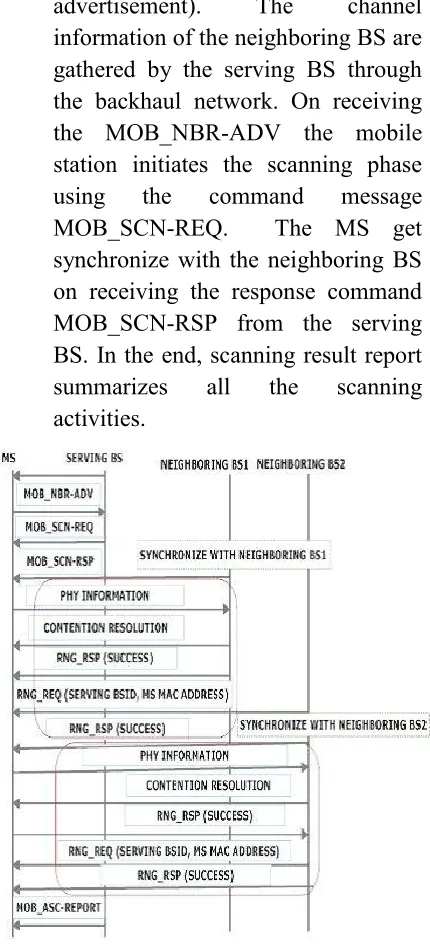
A. Network Topology Acquisition Phase: This phase deals with the mobile subscriber station (MS) and serving base station. The main function of NTAP is to gather the information of all neighboring base station from the backhaul network with the help MS and serving BS. Figure 1 shows the message sequence chart for the procedure. The major tasks involved in the phase are briefly explained as follows:
Synchronize With Neighboring BS:
The serving BS periodically broadcast the state of neighboring BS, using the
command message
MOB_NBR-ADV. (mobile neighboring
advertisement). The channel
information of the neighboring BS are gathered by the serving BS through the backhaul network. On receiving the MOB_NBR-ADV the mobile station initiates the scanning phase
using the command message
MOB_SCN-REQ. The MS get synchronize with the neighboring BS on receiving the response command MOB_SCN-RSP from the serving BS. In the end, scanning result report
summarizes all the scanning
activities.
Fig 1 NTAP
Fig 1 Network topology acquisition phase
Transfer of information in network topology: The physical information about the nearby base station are sent to the mobile station. contention/noncontention resolution ranging
International Journal of Research (IJR)
e-ISSN: 2348-6848, p- ISSN: 2348-795X Volume 2, Issue 4, April 2015Available at http://internationaljournalofresearch.org
RNG_REQ) in which MS gathers further information. The ranging is followed by association result reports MOB_ASC-REPORT, through which MS get associated with the potential target BS candidates.
B. Actual Handover Acquisition Phase:
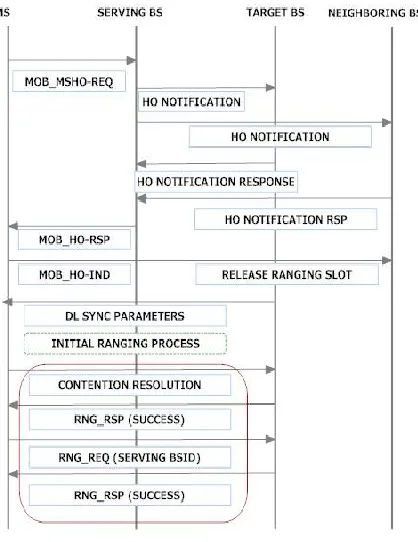
During this phase the MS switches the location from serving base station to the target base station. The target is selected inthis phase, the process of selection of target is explained as below and represented in figure 2:
Decision on Target Base Station: The
MS when attains the threshold value it sends the handover request message MOB_MSHO-REQ, which contains the list of selected target BS to the serving BS and the serving BS forwards the handover request to the target BS as handover notification message. Serving BS replies back to the MS through the command MOB_HO-RSP.
Proactive handover: In the initiative process MOB_HO-IND is generated by the MS. Different ranging slot at various frequencies are released along with the initiating message.
The downlink parameter of the target BS get synchronized with the MS(DL
SYNC PARAMETERS). The
connection establishment is verified by using contention ranging activity which collects the PHY information related to the target BS. The ranging
request and ranging response
command messages are used for this handover phase.
Fig 2 actual handover phase
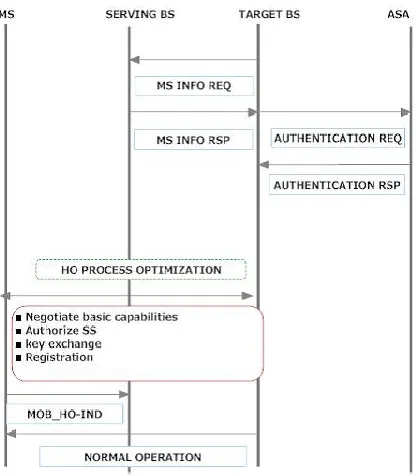
Network re-entry phase: The important
International Journal of Research (IJR)
e-ISSN: 2348-6848, p- ISSN: 2348-795X Volume 2, Issue 4, April 2015Available at http://internationaljournalofresearch.org
Fig 3 network re-entry phase
III RELATED WORK
The handover delay occurred in the mobile WiMAX is reduced by Enhanced Handover Algorithm(EH) which has been proposed by Nkoko S. Sehlabaka And Okuthe P. Kogeda[1]. The main goal of this algorithm is to decrease the handover latency in the vehicular environment. This method considers the ordinary traffic scenario on the highway in a four lane road where some users accumulate within the transmission range and some are moving out of transmission range, which are outside the coverage area and they are temporarily disconnected. These vehicles utilizes the signals from the relay vehicle(RV) moving in opposite direction to the area of coverage. Hence the relay vehicle generates the network topology message and broadcast to the disconnected vehicles .This information enables the disconnected vehicle to select the
target base station or target relay vehicle without scanning process. By using these details, the WiMAX adapters tunes according to their available channel frequency.
The handover delay is also reduced by implementing vehicular fast handover scheme (VFHS) which has proposed by Kuan-Lin Chiu, Ren-Huang and Yuh-Shayan Chen [2]. This scheme utilizes the oncoming vehicles to avail the PHY and MAC layer information provided by the relay vehicles (RVs) to the temporarily disconnected vehicles. This information contains the location and channel frequency of the neighboring RV. After receiving this network topology message(NTM), the disconnected vehicle alters the channel frequency of its WiMAX adapter. The scanning process is ultimately reduces and obviously the packet loss and handover delay is reduced and the bandwidth is efficiently utilized.
The nearby base station is identified by adaptive channel scanning algorithm (ACS) which has proposed by Rouil R. and GolmieN[3]. With the least scanning period, the serving base station identifies the target base station by the immediate response from target BS and MSC. Hence the configuration parameters of neighboring base station is received and total scanning time is reported to the MS.
IV MODERN HANDOVER (MH)
ALGORITHM
International Journal of Research (IJR)
e-ISSN: 2348-6848, p- ISSN: 2348-795X Volume 2, Issue 4, April 2015Available at http://internationaljournalofresearch.org
mobile in Highway vehicular environment. This algorithm consists of the normal traffic scenario in the four road lane along with relay vehicle (RV). In this case, some vehicles are within the coverage area of transmission and some are out of coverage. This MH algorithm helps the disconnected vehicles to be in connected throughout the handover process. Hence the hard handover in this mobile WiMAX is improved by using the relay vehicle.
.. .
Fig 4 Flow Chart
On the other hand, the neighboring base station is also provided with the relay vehicle, which contains the details of its corresponding base station. The relay vehicle contains GPS (Global Positioning System) and OAU (Onboard and Application Unit). GPS identifies the position of the disconnected vehicle from the serving base station. The Onboard and Application Unit used to store the PHY and MAC layer information and also communicate within the vehicles under transmission coverage. This algorithm also promotes the extension of
coverage area of WiMAX BS of up to 100 to
300 m by implementing the VANET concept.
V .ENHANCED HANDOVER (EH) ALGORITHM:
The goal of EH algorithm is to reduce
the handover latency in vehicular
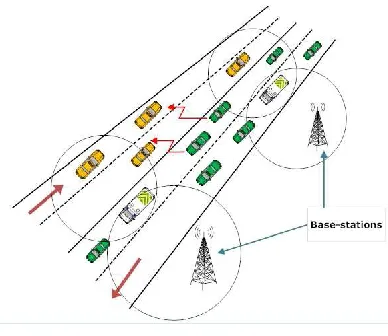
environment. The scheme considers a normal traffic scenario on highway in a four lane road, whereby some vehicles are within the transmission range of a relay vehicle (RV) and moving in opposite directions.
Fig. 5. System Architecture
Table 1 System Parameter
VI COMPARITIVE STUDY A. Simulation scenario:
International Journal of Research (IJR)
e-ISSN: 2348-6848, p- ISSN: 2348-795X Volume 2, Issue 4, April 2015Available at http://internationaljournalofresearch.org
considered a 20 vehicle in the network
moving in a multilane highway.
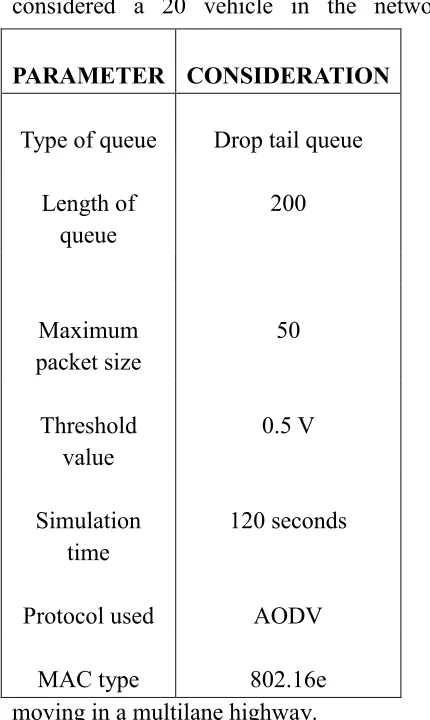
The RV is kept constant i.e. each base station has its own RV which moves within the coverage area of the respective base station. The simulation run time is 120 seconds. It shows the comparison between the enhanced handover algorithm (EH algorithm), and the modern handover .algorithm (MH algorithm). The table gives the simulation parameter for the MH algorithm.
The topology used is a flat grid type, which has a dimension of 600x600 meter. The RV are placed under their base station and the nodes are considered to be moving in opposite directions at different velocities.
Number of paths available is then determined.
Fig 6 System Architecture
In particular, single-flow multipath routing to/from separate gateways can improve the performance by up to the factor of two over single path routing, as is used in AODV. In grid networks of 10*10 nodes, with sources and destinations selected randomly.
A.Graphical Analysis
Handover Delay Vs Vehicle Speed
As the speed increases the time period to pass through the distance between the RV’s is reduced. Another important factor to reduce the handover delay is elimination of scanning phase at network re-entry. It is achieved by the The effect of vehicle speed on the handover delay for both EH and MH algorithm is shown in the fig 6. as the vehicle speed varies the handoff delay is also varied in the EH algorithm, but in MH algorithm which is independent of speed so that delay is maintained in minimum always. sharing of base station information or forwarding of base station information by the RV, where the cross layer (CR) function is performed.
PARAMETER CONSIDERATION
Type of queue Drop tail queue
Length of queue
200
Maximum packet size
50
Threshold value
0.5 V
Simulation time
120 seconds
Protocol used AODV
International Journal of Research (IJR)
e-ISSN: 2348-6848, p- ISSN: 2348-795X Volume 2, Issue 4, April 2015Available at http://internationaljournalofresearch.org
Fig 6 handover delay vs speed
Throughput Vs Time
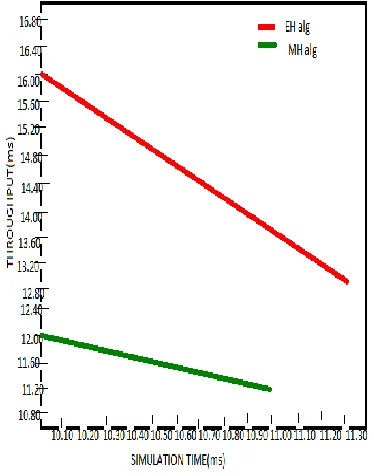
The throughput is calculated by using the AWK program. It is an interrupted programming language designed for text processing. The throughput comparison of EH and MH algorithm is shown in fig. 7The throughputs under various packet sizes are considered as CBR are: 15000, 20000, and 25000. From the graph we can conclude that the throughput and the size of CBR packets are related exponentially. Fig 4.5 describes throughput under various vehicle speed. As the speed increases there is decrease in the throughput, but by using the MH algorithm the throughput is maintained constant.
Fig 7 throughput under various time
Fig 8 throughput vs speed
Handover Delay Vs Packet Loss
International Journal of Research (IJR)
e-ISSN: 2348-6848, p- ISSN: 2348-795X Volume 2, Issue 4, April 2015Available at http://internationaljournalofresearch.org
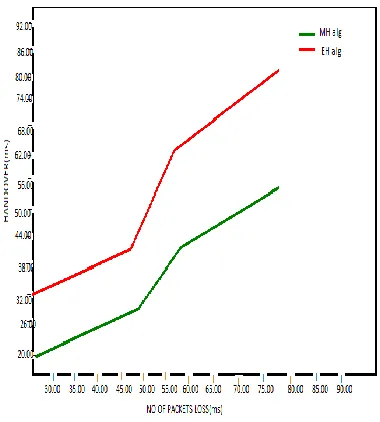
packets lost. Another factor which influences the packet loss is, the length of disconnected period. We notice from the graph that the number of lost packet increases as the number of vehicle increases because actually the more there are vehicles doing handover the more packets are sent and increased
probability of dropped packets. As
throughput is made independent of the vehicle speed packet loss is reduced.
Fig 9 number of packet lost during handover
VII. CONCLUSION
From the performance results, the vanet network implemented has many important applications such as collision control etc. But the actual handover in a mobile WiMAX has large handover delay which produces several network degradation. It can be overcome by the implementation of the Relay vehicle, which is based on the architectural design of cross layer based modern handover algorithm (MH). First the
relay vehicle receives the message from the base station and access the data after the authentication process. Then the temporarily disconnected vehicle gets the data from the RV and stores it in the on-board unit (OBU), before that the authentication process will be completed. Then when the disconnected vehicle reaches the target coverage area, it will get synchronized immediately by accessing the data stored in the OBU unit. The handover occurs between the relay vehicles. Thus the network parameters are enhanced and the network will be very effective for usages.
REFERENCE
[1.]L. Doo Hwan, K. Kyamakya, and J. P. Umondi, “Fast handover algorithm for IEEE 802.16e broadband wireless access system”, In wireless pervasive computing, 2006 1st International Symposium,pages 1-6, January 2006.
[2.]Algau S. and Meyyappan T.,
“Analysis of Handoff Schemes in Wireless Mobile Network”, IJCES International Journal of Computer Engineering Science, vol. 1, Issue 2, November 2011.
[3.]IEEE 802.16e – 2005: IEEE Standard for Local and Metropolitan Area Networks – Part 16: Air Interface for fixed and mobile broadband wireless access.
[4.]M. Grine, A. Najid and R. Messoussi
“Performance Optimization of
WiMAX Mobile Networks with a
predictive Handover process”,
International Journal of Research (IJR)
e-ISSN: 2348-6848, p- ISSN: 2348-795X Volume 2, Issue 4, April 2015Available at http://internationaljournalofresearch.org
and Parallel Systems (IJDPS), vol. 3, issue no. 3. May 2012.
[5.]P. P. Edwin Winston and K. S. Shaji,
“Optimizing Channel Scanning
during IEEE 802.16e Handover”, 2012 4th International Conference on Computer Research and Development (IPCSIT), vol. 39, 2012.
[6.]SayanKumar, Ray, Krzyszt of
Pawlikowski and HarshaSirisena, “Handover in Mobile WiMAX Networks: The state of art and research issues”, Communications Surveys and Tutorials, IEEE, vol. 12, issue no. 3, pp. 376 – 399, 2010.
[7.]Kuan-Lin chiu, Ren-Hung Hwang and
Yuh-Shyan Chen, “Cross-Layer
Design Vehicle-Aided Handover
Scheme in Vanets”, Wireless
Communications and Mobile
Computing, 1-13(2009).