Commit-Chains: Secure, Scalable Off-Chain
Payments
Rami Khalil
Imperial College London Liquidity Network [email protected]
Pedro Moreno-Sanchez
TU Wien
Alexei Zamyatin
Imperial College London [email protected]
Arthur Gervais
Imperial College London Liquidity Network
Guillaume Felley
Liquidity Network [email protected]
Abstract—Current permissionless blockchains suffer from scal-ability limitations. To scale without changing the underlying blockchain, one avenue is to lock funds into blockchain smart-contracts (collateral) and enact transactions outside, or off-the blockchain, via accountable peer-to-peer messages. Disputes among peers are resolved with appropriate collateral redistri-bution on the blockchain. In this work we lay the foundations forcommit-chains, a novel off-chain scaling solution for existing blockchains where an untrusted and non-custodial operator commits the state of its user account balances viaconstant-sized, periodic checkpoints. Users dispute operator misbehavior via a smart contract. The commit-chain paradigm enables for the first time that off-chain users can receive payments while being offline. Moreover, locked funds can be managed efficiently at constant communication costs, alleviating collateral fragmentation.
We instantiate twoaccount-basedcommit-chain constructions: NOCUST, based on a cost-effective challenge-response dispute mechanism; and NOCUST-ZKP, which provides provably correct operation via zkSNARKs. These constructions offer a trade-off between correctness, verification, and efficiency while both are practical and ensure key properties such as balance safety; that is, no honest user loses coins. We implemented both constructions on a smart contract enabled blockchain. Our evaluation demon-strates that NOCUST’s operational costs in terms of computation and communication scale logarithmically in the number of users and transactions, and allow very efficient lightweight clients (a user involved in e.g.100daily transactions only needs to store a constant46kb of data, allowing secure payments even on mobile devices). NOCUST is operational in production since March 2019.
I. INTRODUCTION
Since the beginning of centralized banking in Mesopotamia [1], financial intermediaries evolved as middlemen between parties that have surplus capital and others that desire access to liquid funds. Such financial intermediaries traditionally operate as custodians, as they (temporarily) hold the transmitted funds, and therefore are entrusted with enacting secure transaction policies.
While the emergence of decentralized Proof-of-Work (PoW) ledgers have portrayed a mechanism of performing finan-cial transactions without a centralized intermediary, low-throughput and volatility of transaction fees constraints are fundamentally hindering the practical use of such ledgers. To
improve transaction throughput, different classes of blockchain scaling solutions are being pursued. One such class of scaling solutions focuses on alternative consensus mechanisms [2, 3] or sharding [4, 5]. They, however, typically introduce different trust assumptions and are therefore not backwards compatible with current widely deployed blockchains.
Off-chain scaling (state-of-the-art). In this paper we focus on 2nd-layer (or off-chain) scaling solutions such as payment channels and payment channel networks (PCN) [6], which reduce the load on the blockchain ledger by performing oper-ations securely off-chain. Numerous contributions address the performance characteristics of payment channel networks [7– 13]. While PCN improve transaction throughput and enable decentralized channel topologies, they still leave room for future work: (i) bootstrapping cost: each channel establishment requires at least one (expensive and slow) blockchain trans-action, (ii) user churn: a user must be continuously online to receive incoming transfers - a drawback over traditional on-chain payments and (iii) collateral management: funds are typically bound to channels between two parties, leading to rigid collateral fragmentation, while transfers that form a path across multiple channels require fee-contingent routing. PCN’s decentralisation requires complex routing topologies which induce setup and maintenance costs.
To alleviate routing challenges, payment channels can be organized in a star-like topology, with one entity maintaining many channels, forming a so-called payment channel hub
(PCH) [14]. Given a network of a few PCHs, with long-lived peering and routing agreements, channel routing complexities can be reduced. However, PCH inherit the aforementioned challenges of PCN, namely, bootstrapping cost, user churn and collateral management. For instance, user churn leads to costly recovery and refilling of fragmented collateral:O(n)on-chain transactions fornchannels.
Commit-chains (this work). We introduce commit-chains, a novel 2nd-layer scheme that combines a permissionless
con-trol over their funds at all times) who processes cryptocurrency payments between the system’s users off-chain, and (ii) an
on-chainsmart contract which enforces the operator’s correct behavior. The operator commits the latest state of the user’s account balances to the smart contract in regular intervalsvia constant-sized checkpoints. These checkpoints (i) allow users to challenge the operator in case of disputes or (ii) enable the smart contract to verify and enforce correct operation.
While pursuing the same overall goals, commit-chains and PCNs provide a tradeoff in terms of bootstrapping, user churn, collateral management and decentralization. First, a user can join the commit-chain by only exchanging authenticated off-chain messages with the operator. Second, commit-off-chain users can receive payments while being offline and are only re-quired to surface online once within a checkpoint interval. Similarly to PCN, commit-chains can provideinstant payment finalization to users at full operator transaction volume col-lateralization1. Unlike PCNs, commit-chains can additionally provide delayed payment finalization at no operator trans-action volume collateralization. Finally, the collateral in a commit-chain allocated at a checkpoint can be fully reused in the following checkpoints, and redistributed with a single on-chain transaction,independent of the number of registered users. Commit-chains provide these advantages at the cost of centralization (rely on a single, untrusted operator) and lack of interoperability (rely on blockchains with support for Turing-complete smart contracts).
Our contributions. Summarizing, this paper makes the fol-lowing contributions:
• We introduce commit-chains, a novel scheme for off-chain payments. We show that commit-off-chains can be combined with any smart-contract capable blockchain to construct fully-fledged account-based payment systems. • We present two practical commit-chain constructions,
building upon a novel multi-layered Merkelized in-terval tree: (i) NOCUST, which relies on a low-cost challenge-response dispute mechanism, and (ii) NOCUST-ZKP, which achieves provably correct opera-tion via Zero Knowledge Proofs (recursively composed zkSNARKs [15–18]). We provide a security analysis for both constructions.
• We implement and evaluate NOCUST and NOCUST-ZKP. We show that a commit-chain can scale towards hundreds of thousands of users, while it costs less than 1.5 USD per month to operate NOCUST, irrespective of the number of users and transfers enacted. We make our smart contract code available as open-source on Github2. We went the last mile and deployed NOCUST in
production, where it serves reliably zero fee transactions for users since March 24, 2019.
1Collateral is defined as a volume of assets locked by an off-chain participant (e.g., user or operator) as a security lockup. Users need to lock up the transaction volume they transmit off-chain. If the operator also fully collateralizes payments, then 2X collateral is locked up to facilitate payments worth 1X.
2https://github.com/liquidity-network/nocust-contracts-solidity
Outline. Section II provides the background and reviews re-lated work, while Section IV provides an overview of commit-chains. Section V presents the details of NOCUST and Sec-tion VI of NOCUST-ZKP. SecSec-tion VII provides the security analysis, Section VIII evaluates NOCUST and NOCUST-ZKP in practice, Section IX discusses open challenges and future work. We conclude the paper in Section X.
II. BACKGROUND ANDRELATEDWORK
Blockchains allow to build an append-only immutable ledger that is maintained by a distributed network of nodes [19]. Permissionless blockchains in particular allow any party to join/leave the network, write to the underlying ledger, and participate in consensus. The majority of such systems [19, 20] rely on a random leader election process as part of their consensus mechanism. An elected participant decides on the current state transition: a set of transactions
altering the ledger state, arranged in a so called block. For example, in Proof-of-Work blockchains, the leader is the first participant to solve a computationally expensive puzzle [21].
Permissionless blockchains, however, face a significant per-formance bottleneck: to take effect, a transaction must be included in a block, which is broadcast to the majority of participants, who must then agree on its validity. Transactions are then considered final after a stabilization phase [22– 24] of k blocks, where k is the security parameter of the underlying system [25, 26]. Adjusting the number of trans-actions per block or the block generation interval thereby warrants caution, as bullish parameterization may severely impact security [25, 27, 28]. As a result, the most widely used permissionless blockchains, such as Bitcoin [19] and Ethereum [29], process only up to 10 transactions per second. Payment channel networks (PCN) enable rapid one-way [30, 31] or bi-directional [6] payments without publishing each transfer on-chain. Each channel is established between two parties and follows three phases: (i) an on-chain channel establishment, (ii) off-chain channel state transition(s) and
(e.g., offline/energy saving mobile recipients). Second, boot-strapping in this paradigm mandates an on-chain transaction for each channel, which is reasonable for senders (i.e., users that introduce coins into the off-chain system), but not for exclusively recipient users. For instance, assume a PCH with n users, where Alice has n−1 coins and wants to send 1 coin to every other user. In this scenario, the PCH operator needs to anticipate and allocate collateral among the other n−1 user channels, at a cost ofn−1 on-chain transactions. We conjecture that it is feasible to have an off-chain system where this scenario can occur with only a single on-chain transaction. Finally, current off-chain channel systems handle the collateral (i.e., coins locked on-chain) sub-optimally. In our PCH example, assume that the PCH allocates one coin in each n−1 receiver channel. In this case, Alice cannot pay more than one coin to any single receiver, even though her balance isn−1coins. The PCH would have to allocaten−1 coins in the channel of each receiver to permit this, requiring that the PCH locksn·(n−1)coins to allow onlyn−1coins to be transacted.
Plasma [43] is an effort by the Ethereum community for central operators to maintain UTXO based ledgers atop of an account-based blockchain to enable transfers. The downsides of this UTXO approach compared to ours include a lack of na-tive fungible payment support, a lack of instant finality mech-anisms, and linearly growing data storage and computation costs with each ledger update. Several informal variants of this approach, none of which have lead to practical solutions to the best of our knowledge, surfaced across multiple community websites3 to attempt to remedy these downsides.
In this state of affairs, the current landscape of off-chain scalability solutions has room for alternative execution paradigms that fill the aforementioned gaps.
III. COMMIT-CHAINS: PROBLEMDEFINITION
In this section, we introduce the notion of commit-chains, where we overview the system model and main functionality, describe the communication and threat models, and finally present the security goals.
A. Commit-chain
Actors.A commit-chain is composed of the following actors:
• User.A user owns at least one private key/account in the blockchain and acts as a participant in the blockchain and in the commit-chain.
• Operator. The commit-chain operator, who is also uniquely identifiable with a private/public key pair ac-count, handles user transactions and commits data to the blockchain that updates the commit-chain ledger. • Smart Contract. The smart contract(s) on the blockchain
defines and enforces mechanisms in the commit-chain protocol. This component, since it lives on the blockchain, enforces correct execution of operations it
3Compiled at https://www.learnplasma.org/en/
receives. Depending on the blockchain, this component may provide also privacy guarantees.
Functionality. Commit-chains process transactions off-chain following a model similar to that of payment channel hubs: a central entity maintains a service for multiple users. To execute transactions in a cost-efficient manner, users submit most of the transactions they would otherwise do in the blockchain to the operator to amortize their blockchain transaction costs. The users then only interact with the parent-chain to carry out tasks that cannot be carried out securely solely through the operator depending on the use-case, such as potentially moderating the operator behavior, or making transfers into or out of the commit-chain. Commit-chains are deployed alongside a blockchain, referred to as the parent-chain, that can already establish consensus in the network. The parent-chain exhibits ledger functionality, containing a global view of user accounts and transactions. Each account is controlled by a private key.
B. Communication Model
A commit-chain operates under the bounded synchronous communication setting [44], where the execution of the pro-tocol happens in discrete rounds (that we refer to as eons
in the rest of this paper). The parties are always aware of the current round and if a message is sent at round i, then it is delivered to the recipient at the beginning of round i+ 1. We further assume an upper bound δ on the delay between transaction broadcast an inclusion in the underlying blockchain. We remark that these are standard assumptions in blockchain literature [6, 7, 10, 12].
The operator and users participating in the commit-chain each have a verification/signing key pair (e.g., key pair from the parent-chain). Moreover, each user knows the verification key of the operator. Finally, all users are aware of the smart contract for the commit-chain. In practice, the operator can announce its public key and the commit-chain contract on its website and users can verify it by checking the publicly available blockchain.
C. Threat Model
We assume that the cryptographic primitives of the blockchain hosting the smart contract are secure, and that the adversary cannot corrupt any trusted setup component in the cryptographic primitives used4. We further assume that adver-saries are computationally bounded and can corrupt at most 1/3 of the consensus participants of the blockchain (or 33% of the computational power for blockchains with Nakamoto consensus [25, 27, 48]). As such, users can always read and write to the blockchain and an adversary cannot tamper with the correct execution of the smart contract. However, we allow an adversary to corrupt the commit chain operator and an arbitrary number of commit-chain users, as well as to execute Sybil [49] and Denial-of-Service attacks. Under these assumptions, commit-chain users must be online at least once within an eon(unless this requirement is outsourced to
a monitoring service (e.g., a watchtower [50]), or the operator broadcasts an offline user’s state to the blockchain as in NOCUST-ZKP).
D. Security Goals
• Safety. Generally, safety means that the system should not be exploited to mint nonexistent coins or steal from honest users. Specifically, the system must provide the following guarantes: (i) the total funds locked into a commit-chain must correspond 1-1 with the balances of the registered users; (ii) The adversary cannot debit a user without the user’s authorization, and must correctly credit the intended recipient; (iii) User balances must be correctly updated by the system operations even in the presence of the adversary.
• Liveness. Essentially, we formulate liveness as the guar-antee that an honest user will always be able to access its funds within a bounded amount of time, regardless of adversary behavior. More explicitly, users must always be able to: (i) learn the latest confirmed states of their commit-chain accounts; (ii) withdraw their balances to their blockchain accounts.
We make several remarks here. First, the above two guar-antees are only provided as securely as the underlying parent-chain can also provide them in their own sense. For example, a parent-chain with a consensus protocol that does not provide liveness would also affect the guarantees of our commit-chain. As mentioned in subsection III-C, in this work we assume the underlying parent-chain is operated by an honest majority.
Second, the safety property largely resembles that of bal-ance security defined for payment-channel hubs [14, 35] and payment-channel networks [12, 13]. However, balance security in payment-channels does not cover offline transfer delivery, which is crucial for commit-chains and thus covered by our safety definition.
Third, since a commit-chain operator manages the balance of many users on their behalf (even when some of them might be offline), achieving liveness is crucial to commit-chains. A similar property has not been defined for payment-channel hubs/networks since users actively participate in each operation that updates their account.
Finally, it is important to note that safety and liveness only disqualify the operator from being a trusted custodian of its users’ funds. These guarantees need to be provided by the system to an honest participant regardless of the behavior of the operator or any other participant (cf. proofs in Section VII). However, the operator can still selectively censor users from performing transfers in the commit-chain, and leave them no option but to withdraw their funds back into their blockchain accounts.
IV. SOLUTIONOVERVIEW
Our objective is to increase the transaction throughput by safely offloading payments from the parent-chain to a commit-chain. Users register with an operator without publishing messages in the parent-chain. Transfers are sent through the
operator, who periodically commits to the latest state of user balances on the smart contract. Transfers are considered final once the corresponding commitments stabilize in the parent-chain, i.e., received k confirmations5. Users come online to
retain custody of their account balances once per checkpoint interval.
A. High-Level Operation
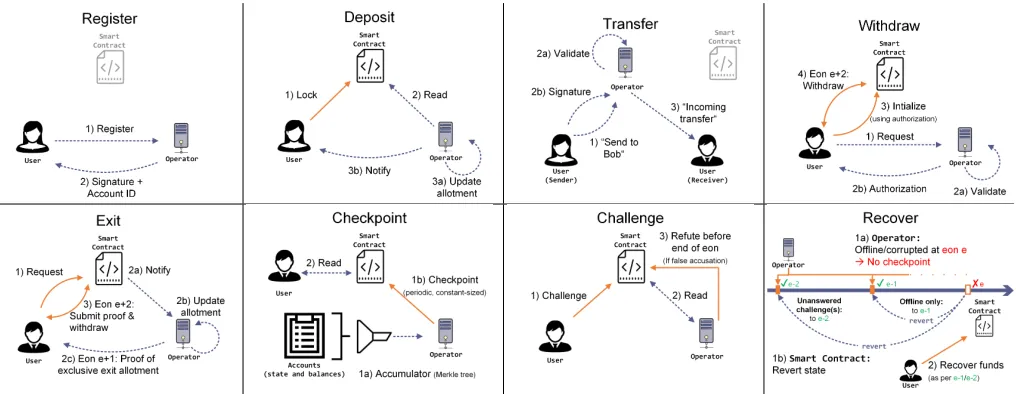
Figure 1 presents an overview of our systems’ lifecycles.
Register. A user registers with the operator via an off-chain message, receiving a new account identifier in the commit-chain. Afterwards, the user can solicit payments from other users in the commit-chain.
Deposit. Users lock the desired amount of coins in the smart contract. Then they cansend them off-chain to any other user registered in the commit-chain or always claim them back. Recipients do not need to perform any deposits.
Transfer. Users authorize the operator to debit their accounts, and credit the recipients. The recipient can then immediately transfer these funds to other commit-chain usersorwithdraw them after finalization.
Withdraw/Exit. Users submit off-chain requests to the op-erator, who queues withdrawals in the smart contract within the following checkpoint. Alternatively, users can initiate full forced exits via the smart contract, closing their commit-chain accounts and refunding all their balances.
Checkpoint. At the end of eacheon, the operator commits the latest state of all user accounts to the smart contract.6 User operations are then only finalized once the corresponding state changes are reflected in an on-chain checkpoint and passed a dispute period.
Challenge. If an operator misbehaves in any way, users pub-lish challenges on the smart contract, which secures user funds and penalizes the operator in case of fraud. 7
Recover. If the operator is penalized, the smart contract forces the commit-chain into recovery mode. The smart contract no longer accepts checkpoints, halting the commit-chains. Users can then recover their funds, at their earliest convenience, from the last valid checkpoint via on-chain transactions. 8
B. Design Roadmap: NOCUST and NOCUST-ZKP
NOCUST:In Section V our first construction follows a simple but cost-effective approach. Checkpoints represent the root (hash) of our novel multi-layered Merkelized interval tree
5Note: in challenge-based schemes e.g. NOCUST, an additional dispute period is introduced.
6Each checkpoint requires an on-chain transaction and thus clearly imposes a burden on the blockchain that does not exist with payment channels. The periodicity of checkpoints must be thus carefully adjusted as a system parameter and the size of each checkpoint must be minimized. This is a tradeoff of commit-chains in lieu of improving bootstrapping costs, user churn and collateral fragmentation.
7The operator is given time to reply to a challenge by publishing on-chain a proof of correct operation.
Fig. 1: Overview of the main NOCUST commit-chain sub-protocols:Register,Deposit,Transfer,Withdraw,Exit,Checkpoint,
ChallengeandRecover. Solid orange lines representon-chaintransactions. Blue dotted lines denoteoff-chainmessages/actions. The operator handles transfers between users and commits the state of all accounts to the smart contract once per eon. Users come online once per eonand, in case of disputes, challenge the operator via the smart contract, recovering funds in case of failure. Protocol steps correspond to descriptions in Section V-E.
introduced in this paper (Section V-B), which aggregates the state of all user accounts and their balances. In case a checkpoint containing invalid account changes is published at the end of an eon, or none at all, users must challenge the operator via the smart contract. The operator in turn must produce a proof of adherence to the protocol. Thereby, users can only challenge themost recentcheckpoint, and mustcome online once per eon toensure the safety and liveness of their funds. Our novel commitment data-structure facilitates this process securely and efficiently.
NOCUST-ZKP:In Section VI our second construction miti-gates safety and liveness risks by requiring the operator to con-struct a non-interactive Zero Knowledge Proof (NIZKP) [16, 51], proving to the smart contract that all updates to user accounts are correct and have been signed by users. We present constraint systems that can be utilized through recursive composition of zkSNARKS [17, 18], allowing incremental computation of proofs, while maintaining constant verification time and cost (Section VIII). As a result, the operator can no longer submit an inconsistent checkpoint or withhold user state data. Users still come online once per eon tocheck the freshness of their account and balance, i.e., verify that the operator has included all relevant transactions and not gone offline. This approach improves security guarantees at the cost of zero-knowledge proof generation and potential additional data submission to the smart contract, but still offers zero-gas fees on commit-chain transfers to honest parties.
V. NOCUST: A PRACTICALCOMMIT-CHAIN
A. The Commit-Chain Data Scheme
The commit-chain ledger is divided into: (i) local, in-formation stored locally at the operator about balances or
transfers performed through the operator; and (ii) global, information stored at the blockchain and globally available to all participants that covers balances or operations done through the smart contract. We note that naturally, different parties may have different views of local information whereas they must have the same view of global information, as we trust the blockchain for availability and integrity.
Local Information. The operator stores the following in the local ledger for every useri at everyeone:
allotmenti(e): The allotted balance.
receivedi(e): The total received.
senti(e): The total sent.
positioni(e): The offset of the last outgoing transfer.
txOuti(e): Outgoing commit-chain transfers.
txIni(e): Incoming commit-chain transfers.
collaterali(e): The instant finality collateral.
Global Information.The contract stores the following in the global ledger for every useriat everyeone:
depositedi(e): The total deposited ine.
withdrawni(e): The total requested for withdrawal ine.
exiti(e): A flag for whether an exit was requested.
extrai(e): The extra insurance collateral for eone. troot(e): The state commitment ofeone.
Additionally the smart contract can store the challenges posted by users until the operator responds.
The initially allotted balance of a user in the current eon
amount sent in the commit-chain.
B. Merkleized Interval Tree-Structure
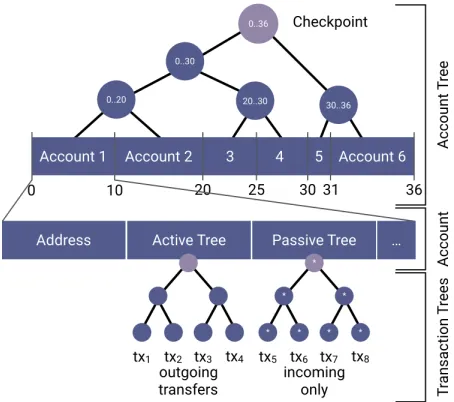
To provably account for the balances and additional collat-eral of each user at each eon, we design a novelMerklelized interval tree. The nodes in this Merkle tree [52] are aug-mented with continuous intervals so that the smart contract can efficiently verify the correct and exclusive allotment of funds by the operator. A nodetn(e)whose contents represent information ateoneis structured as defined in Equation 1.
tn(e) :=hoffsetn(e),informationn(e),allotmentn(e)i (1)
allotment is defined as the amount exclusively allotted to the node, while offset is defined per Equation 2.information is a cryptographic commitment to the information within this node.
Leaves. A leaf ti(e) is used to represent the commit-chain account of user i at eone, whereby allotmenti(e) is equal to their starting balance in eone, and offseti(e)corresponds to the sum of the starting balances of all users ordered before user i.
offseti(e) =
X
j<i
allotmentj(e) (2)
Using these two numeric values, a balance can then be rep-resented as the length of the interval
offset, offset+allotment. We utilize the condition that different intervals do not intersect each other to secure users’ accounts and transfers in NOCUST.
informationi(e) is the cryptographic hash of the blockchain address of the user and the commitment of the last state update the user signed in the previouseon, as defined in Equation 3:
{addressi,update p
i(e−1),update a
i(e−1)} (3)
where updatepi(e−1) and updateai(e−1) represent the last passive and authorized state updates, respectively, of the commit-chain account of the ithuser ateone−1, as explained
further in Section V.
Internal Nodes.An internal nodetu(e), with a left childtp(e) and a right child tq(e), is constructed per Eq. 4 and Eq. 5:
allotmentu(e) =allotmentp(e) +allotmentq(e) (4)
offsetu(e) = offsetp(e) (5)
informationu(e) is a cryptographic commitment to tp(e) and tq(e), with offsetq(e)as a middle border value.
informationu(e) :={tp(e),offsetq(e), tq(e)} (6)
With these definitions, an internal nodetuthen takes the offset of its left childtpas its own, and the offset of its right childtq as a border between the two children. It is important to note that the middle value of offsetq(e)is interchangeable with that of offsetp(e)+allotmentp(e)as they must be equal in correct intersection-free instances of this interval structure.
Fig. 2: Visualization of a Merkleized interval tree repre-senting the commit-chain accounts. There are six accounts with their respective balances (36 total commit-chain coins) visualized. An account consists of an address, the roots of the active/authorized and passive trees (and additional data relevant for implementation). Intermediate nodes are annotated with balance intervals (cf. Section V-B). Note: only the passive tree of incoming transactions is annotated with intervals.
C. Monotonic User-State Structure
The information in updatei(e) is divided into an au-thorized/active portion updateai(e), and a passive portion
updatepi(e). The authorized portion must be accompanied by a signature from the user, while the passive portion can be set by the operator. The authorized portion updateai(e) is structured as follows:
updateai(e) =htxOuti(e),senti(e)i (7)
txOuti(e) is committed to using an unannotated Merkle tree where the leaves are the individual commit-chain transfers authorized by the user duringeone. A commit-chain transfer is a tuple of the following information:
heon, sender, recipient, nonce, amount, offseti
The passive portionupdatepi(e)is structured as follows:
updatepi(e) =htxIni(e),positioni(e),receivedi(e)i (8)
positioni(e)is a numeric offset value specified by the operator to secure delivered transfers. Like offset values, the position
D. Proofs Of Exclusive Allotment
We now describe the proofs that are derived from this annotated merkle-tree structure to efficiently secure NOCUST balances and transfers. These proofs are extensively utilized throughout Section V-E. We prove in Appendix B-A that no valid instance of our annotated merkle trees may contain two overlapping allotments, and therefore that a fraudulent proof of exclusive allotment cannot be constructed or be accepted by an honest verifier such as the smart-contract.
User Balances. For each user, a proof of exclusive balance allotment is constructed. The main goal of this construct is to prove that the user exclusively owns an allotment of size
allotmenti(e)within the pool of user funds at the beginning of an eon. This proof is constructed similar to a regular Merkle tree membership proof: the proof consists of the hashes of the siblings of the nodes in the path from the root to the leaf. However, in addition to the hash, a boundary valueΩis required for each sibling tn(e)along the path to the root:
Ω(tn(e)) =
(
offsetn(e) tn(e)is L. child
offsetn(e) +allotmentn(e) tn(e)is R. child (9) Verification is similar to validating set membership in a Merkle tree, but node reconstruction is done per the definitions in Section V-B using the Ω values. The size of this proof then grows logarithmicallyin thenumber of users.9
Transfer Delivery. We utilize our exclusive allotment data-structure to ensure that the operator properly credits the amounts to offline recipients through making any misbehav-ior efficiently provable. A proof of transfer membership in
txIni(e)includes the respectiveΩvalues, similar to a balance proof. The root node allotment is the value of receivedi(e), which is the total amount received by a participant, while each leaf’s allotmentis the transferred amount.
Account Exits.The operator is required to post a commitment to an annotated-merkle tree that enables users to exit from the commit-chain instance with all of their funds. In this structure,
informationi(e)is only comprised ofaddressiandallotmenti(e). The latter represents the finalized balance the user can claim.
Insurance Collateral.To guarantee instant transaction finality, the operator stakes additional collateral that recipients claim in case of failure to finalize transactions within two eons. To efficiently manage the allocations of the staked collateral, the operator commits each eoneto an annotated merkle-tree that exclusively divides the insurance collateral pool among the users. All funds in this pool are separated from those in the user account balance pool. In the collateral structure,
informationi(e) in leaf nodes is only comprised of addressi, while allotmenti(e)is equal to the allocated collateral.
E. Subprotocols
In this section we describe the sub-protocols in NOCUST. We utilize the following symbols to refer to participants in the
9For comparison: a classic Merkle membership proof grows also logarith-mically in the size of the number of elements in the set.
protocols. U: User, O: Operator, S: Sender, R: Recipient, and C: Contract.
Register:
1) The User submits a signed update of an empty account {|updateaU(e)|}U to the Operator;
2) The Operator verifies the User’s signature, countersigns and returns the empty account update{|updateaU(e)|}Oto the user.
After verifying the Operator’s signature, the User can safely make deposits and solicit payments.
Deposit:
1) The User sends a transaction to the Contract, which adds the amount todepositedU(e)in its memory.
2) The Operator reads this deposit from the Contract. 3) The Operator updates the user allotment in local and
notifies the User of its commit-chain balance increase.
The User can then transfer these funds or withdraw them. The user may also later exit with them or challenge that they were not credited.
Transfer:
1) The Sender creates a new active state update to authorize the transfer. If the Sender’s positionS(e) is not empty before enacting a new transfer, then the new active state update must also move this value into the offset field of the previous outgoing transfer. The new transfer is inserted into txOutS(e), and the authorized state update is sent to the Operator.
2) The Operator validates if the received update is correct and the Sender has sufficient balance to carry out the transfer. The Operator then decides on the offset of the transfer, and copies the offset value into the Sender’s
positionS(e) value. This marks exactly where the trans-ferred amount was allotted intxInR(e), without this value being known beforehand by the Sender to safely avoid race conditions. The Operator responds to the Sender with its countersignature onupdateaS(e)kpositionS(e).
3) The Operator simply notifies the Recipient that a transfer was received whenever the Recipient comes online.10 The funds can then be transferred or withdrawn by the Recipient, or its delivery can be disputed.
Withdraw:
1) The User submits its withdrawal request to the Operator. 2) The Operator validates that the user possesses sufficient
balance, and responds with the authorization.
3) The User (or any party) submits the authorization to the smart contract to initiatethe withdrawal.
4) After the current eon e and the next eon e+1 suc-cessfully pass without challenges, the User finalizes this withdrawal request, and the Contract credits the User with the funds in a parent-chain transaction.
Instant Withdrawal.Additionally, an Operator can immediately pay out the withdrawal from its own personal funds and
Register.
1.U→O: {|updatea U(e)|}U
2.U←O: {|updatea U(e)|}O Deposit.
1.U→C: Transaction(U, C, amount) 2.O←C: Deposit(e, U, amount) 3.O→U: Balance update
Transfer.
1.S→O: {|updatea S(e)|}S
2.S←O: {|updatea S(e)|}O,
positionS(e)
3.R←O: Balance update
Withdraw.
1.U→O: {|C, O, U, Expiry, Amount|}U
2.U←O: {|C, O, U, Expiry, Amount|}O
3.U→C: {|C, O, U, Expiry, Amount|}O
4.U←C: WithdrawalInitialization(e, U, Amount) 5.U→C: confirmWithdrawal(e+2)
6.U←C: Transaction(C, U, Amount)
Exit.
1.U→C: requestExit() 2.O←C: ExitInitialization(e, U)
3.U→C: Exclusive allotment proof ine+2
4.U←C: Transaction(C, U, Amount)
Checkpoint.
1.O→C: troot(e)
2.U←C: CheckpointSubmission(e,troot(e)) Challenge (State Update).
1.U→C: Accounting data for U ineone−1,
•Exclusive allotment proof
•updatea U(e−1)
2.O←C: Challenge(e, U)
3.O→C: Accounting data for U ineone,
•Exclusive allotment proof
•updatea U(e−1)
Challenge (Transfer Delivery).
1.U→C: Accounting data for S ineone,
•Exclusive allotment proof
•updatea S(e−1) •Transfer debit proof 2.O←C: Challenge(e, S, R, Transfer) 3.O→C: Accounting data for R ineone,
•Exclusive allotment proof
•updateR(e−1) •Transfer credit proof
Recover.
1.U→C: Last confirmed accounting data for U,
•Exclusive allotment proof
•Insurance collateral proof 2.U←C: Transaction(C, User, Amount)
Audit.
1.U→O: {|e|}U
2.U←O: Exclusive allotment proof Transfer delivery proofs
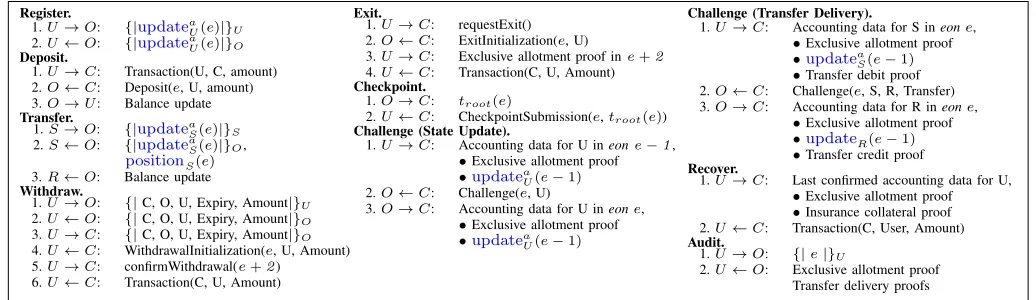
Fig. 3: Communication flow of the NOCUST sub-protocols. Communication with the Contract (C) is visible to all observers of the blockchain. Users interact only with the Operator in Registration, Transfer and Audit.
replace the intended recipient of the withdrawal finalization ine+2 with itself.
Exit:
1) The User submits an exit request to the Contract. 2) The Operator is notified that this User must exit in the
next eon e+1. The Operator then moves this User’s funds from the balance allotment tree to the exit allotment tree, and provides the User with a proof of exclusive exit allotment in eone+1.
3) If eone+1 passes successfully without challenge. The User, in possession of its exclusive exit allotment proof, finalizes its exit in eon e+2. In this process the Con-tract credits the User with the funds in a parent-chain transaction.
The Exit protocol is a fallback for Users to recover their funds from the commit-chain if the Operator blocks with-drawals. If the Operator fails to comply with the request then it gets punished by a state update challenge from the user.
Checkpoint:
1) The Operator submits the merkleized interval tree-structure checkpoint to the Contract, which will reject the checkpoint if the Operator is suspended, or if a checkpoint has already been submitted for the currenteon
e, or if the sizes of the root allotments are inconsistent. 2) Users can then read on the parent-chain that a new
checkpoint had been submitted and audit their proofs from the Operator.
The Operator needs to respond to User audits with proofs to avoid being challenged and allow efficient validation of its operations. The Operator can increase individual collateral allotments on the blockchain of individual participants during the current eon e, and submit a complete re-assignment of all collateral that takes effect starting from e+2 using a
single constant-sized commitment. The Operator is required to commit to valid instances of the collateral, account balance and exit tree commitments within the first epoch of every
eon. Commitments are rejected by the Contract in case of any outstanding challenges from eone−1.
Challenge (State Update):
1) The User sends to the Contract its accounting data for theeone−1.
2) The Operator reads that a challenge has been initiated. 3) The Operator responds with the accounting data foreone
before an epoch passes, and this data has to be consistent with what the Contract expects. Such that the authorized update in the response, which is used to construct the proof of exclusive allotment, is at least as fresh as the one in the challenge, and the allotment size of the proof corresponds to the expected amount.
Reading the challenge response allows the User to retain custody of its account. If the User had requested an exit in e−1, then the response will be the proof of exit allotment for finalizing its exit.
Challenge (Transfer Delivery):
1) The accounting data used to initiate this challenge is that of the currenteone, where the exclusive allotment proof, authorized state update, and outgoing transfer inclusion proof are validated.
2) The Operator reads that a challenge has been initiated. 3) The Operator responds within an epoch with the
corre-sponding transfer credit proof to avoid being punished by the Contract.
Senders directly communicate with Recipients to verify the delivery of transfers before issuing this challenge to avoid parent-chain costs and only issue challenges that they know the Operator won’t be able to respond to.
Recover:
1) In case the commit-chain is halted ateone, the exclusive allotment trees are reverted to those of eon e−1. The User submits its exclusive allotment proofs from e−1, and the Contract accepts the request only once if the commit-chain is indeed suspended.
2) The Contract credits the User with the funds in a parent-chain transaction.
All unfinalized transactions that were to be committed to in the revertedeonare then also cancelled, and only a User’s insurance collateral may be collected instead.
1) The User simply requests its proofs related to the check-point of eonefrom the Operator.
2) The Operator responds with the requested proofs.
If valid proofs are not provided, such that the updated balances are inconsistent, an outdated authorized state was used, or a transfer was not properly delivered, then Users resort to the challenge operations to retain custody of their accounts and potentially punish the Operator.
VI. NOCUST-ZKP: PROVABLESECURITY
NOCUST-ZKP is our second commit-chain construction which augments NOCUST with provably secure checkpoints. The crux of this design is requiring the operator to generate a non-interactive Zero-Knowledge Proof (NIZKP) at every checkpoint, proving that all user account updates aresafe, i.e., authorized by the users and executed according to the commit-chain safety criteria, andlive, i.e., the users have received their proofs of exclusive allotment or can infer them from some additional data posted in the parent-chain by the operator. The smart contract then only accepts a checkpoint as valid if the provided proof is correct. This proof needs to be provided for the last submitted checkpoint (within one eon) before a new checkpoint can be submitted.
Proving Methodology. We refer to the publicly available statement of the NIZKP as the verifier input, and to the private witness as prover input (i.e., input only known to the prover). Naively, including all proofs individually with each checkpoint explicitly, or constructing a constraint system with very large verifier inputs, would require a significant amount of addi-tional on-chain storage and computation that would completely defeat our scalability efforts. In NOCUST-ZKP, instead, we combine all zero-knowledge proofs into a single one using recursive composition [15–18], and employ several methods to minimize the verifier overhead. In a hierarchical recursive manner, we combine the results from every two related NIZKP into one parent NIZKP as in [18]. For different procedures, proof combination requires different validations and steps to ensure the consistency of the protocol. For example, in some contexts we validate the merger of two adjacent continuous intervals, while in other contexts we open the commitments provided in the verifier inputs of the nested verifiers (cf. Appendix C). This generic concept enables NOCUST-ZKP’s flexibility, security and efficiency.The sizes of the verifier input and prover output from the final combiner remain constant while encapsulating several sub-proofs.11
Safety Constraints. We designed our constraint systems to non-interactively prove thesafetyof the checkpoint posted by the operator in zero knowledge. First, we validate that for each user, the transfers included in txOut are correctly delivered, such that they have a verifiable exclusive allotment proof in the intended recipient’s txIn annotated merkle tree. Second,
11Although we’re not aware of a formal security proof in related work that attests that recursively composed proofs enjoy the same security as standard proofs, related work has argued that no evidence suggests their security is weaker [18]. For all intents and purposes, our constraint systems can be simply combined and flattened to a single monolithic constraint system if necessary.
the complete state update transition applied by the operator is validated to have correctly calculated each user’sallotmentin the neweon, from allglobalandlocalinformation. Finally, the user’s signature on the authorized state update that was used to construct the new checkpoint is validated. This entire proof is akin to successfully simulating state update and transfer delivery challenges on the new checkpoint for every single account and transfer without any inconsistency.
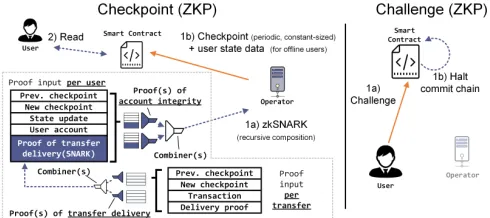
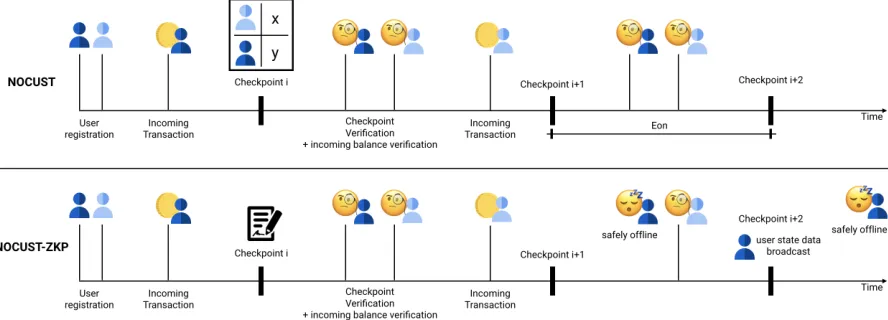
Fig. 4: High-level overview of theCheckpointandChallenge
sub-protocols in NOCUST-ZKP. The checkpoint is validated in the zkSNARK. In addition to the constant-sized checkpoint, the operator broadcasts thestate data for offline users.
Liveness Constraints.Livenessis achieved when a user learns its exclusive allotment proof to access its account balance. To prove this, the NIZKP must attest that all users achieved liveness. This then warrants an extension of the audit sub-protocol to end with the user providing this receipt to the operator after successful validation. Honest users online within an eon send the operator a signed proof-receipt, and the operator includes these receipts in the NIZKP. For users that don’t provide receipts, the operator broadcasts theirstate data
h address12, state13, allotment14 i to guarantee these users’ liveness via the parent-chain, and proves broadcasting this data in the NIZKP instead of obtaining a receipt (cf. Appendix C-C and Figure 8). The operator moreover disables the offline users from further transfers, until they surface back online and provide receipts. If a user remains offline for more subsequent
eons, the user state data does not need to be broadcast again. Because broadcasting this data would incur additional parent-chain transaction costs for the operator, the user and the operator pre-agree to an amount that will be deducted from the user account balance to make up for the broadcast cost. If the user account balance cannot cover this amount, the data is never broadcast and instead the account is simply closed with the fee burned in the parent-chain. Moreover, if the operator broadcasts the user state data at a cost less than what was agreed upon (e.g. the operator used a small gas price in Ethereum), the difference is kept by the user. This broadcast debit is also verified in our constraint systems. The operator must maintain the freshness of the authorized state
12Replaceable by numeric id if user was registered prior to previouseon. 13Omittable in case user does not care about proving debits.
updates it applies, and periodically commit checkpoints. The challenges that users can now issue in the smart-contract are non-interactive simplified versions. The first proves that the operator had countersigned an authorized state update that is more fresh than the one applied in the checkpoint. The second proves that the operator had countersigned a transfer to be delivered, but never included it in the checkpoint15.
Specification. We present an extended specification detailing the NIZK constraint systems required to enforce this system in Appendix C, along with the additional cryptographic accumu-lators and datastructures required to enable this construction. Admittedly, even though we design NOCUST-ZKP to min-imize running costs, this approach still comes at the added burdens of proof generation, verification and non-constant sized checkpoints, which are now comprised of merkle roots, and offline user state data. NOCUST-ZKP raises the bar for the adversary to carry out withholding attacks or grief the operator while lowering the dependence on the security of the parent-chain.
VII. SECURITYANALYSIS
In this section we analyze the security and prove the provi-sion of our required guarantees by NOCUST and NOCUST-ZKP under our stated system, communication and threat models. As a proof strategy, we argue that an honest participant or honest operator following the prescribed protocol may not end in a state where they cannot utilize the smart contract to enforce the safety or liveness of the commit-chain.
A. Safety
By breaking down our protocol into smaller sub-properties and proving their security, our analysis demonstrates that an adversary who attempts to violate the safety guarantees of our protocols would have to violate the security of at least one of these sub-properties.
Off-Chain Registration.As fully off-chain channel establish-ment is not common in2nd-layer solutions, we start our
discus-sion with why our commit-chains securely provide this feature. The registration procedure allows a user to learn the operator’s signature on an initially empty account. This signature and the account information allow the user to instantiate challenges in the smart contract, even in case no other operations involving the user were performed. This guarantees that a participant would be able to initiate a state update challenge in case it has not received a proof of its expected allotment in the next
eon e+1, and allows the operator to securely federate user entry. An adversary that attempts to misbehave with a newly registered account would then be left vulnerable to a state update challenge by its owner.
Balance Update. The exclusive allotment guarantees of the proofs from Section V-D prevent an adversary from minting new funds and creating an exclusive allotment tree with a root allotment not greater than the total funds locked in the smart contract. Such an allotment would trigger an immediate
15because another transfer’s exclusive allotment interval intersects with its interval, or the recipient’s total incoming value does not cover it.
rejection by the smart-contract. Moreover, an adversary who attempts to seize user funds or break the 1-1 correspondence between user balances and the funds locked in the smart-contract would be left vulnerable to a state update challenge by the affected users. The exclusive allotment(e) of a user at a given eon e is directly derived from its operations in the previous eon e−1, which are verified by a state update challenge to protect from any inconsistency in this information. A correct response to a state update challenge proves that the user balance was updated correctly according to the operations in the parent-chain and the commit-chain.
Due to the implicit validation in zero-knowledge by the smart-contract of all user account data in NOCUST-ZKP, an adversarial operator is left unable to mint or seize funds.
Transfer Delivery. A participant in possession of its proofs of exclusive allotment can decide if it needs to challenge the correct delivery of a transfer. Our communication model assumes that participants are able to communicate directly. Without this assumption, and assuming that the operator is withholding data, the ability of a participant to reason in advance whether a transfer delivery challenge is justifiable, before incurring the costs of issuing that challenge in the blockchain, is hindered.
A recipient of a transfer(t1)can immediately check whether
it knows of a different incoming transfer (t2) in the same
eon where the intervals [offsett1,offsett1 +t1.amount) and
[offsett2,offsett2 + t2.amount) intersect, or if offsett1 +
t1.amount > receivedi(e −1). All it requires is a proof that the transfer was debited from the sender, along with the corresponding offsett1 value, either in the form of position(e)
or t1.of f set. If there is an inconsistency, then the receiving
participant can infer that a transfer delivery challenge should be executed as it will not be refutable by the operator. This is becausetxIni(e−1)is constructed with its transfers reserving exclusive allotments for their amounts. An adversarial operator is then vulnerable to a transfer delivery challenge by an honest user in two cases. 1) It debits the sender but does not credit the recipient, or 2) It colludes with the sender to exclude the transfer from the next checkpoint after notifying the recipient. NOCUST-ZKP improves the safety of this guarantee, as all committed transfers are correctly verified to have been delivered in the zero knowledge proof to the smart-contract, eliminating the possibility to debit the sender without crediting the recipient.
Instant Transaction Finality. The halt of the commit-chain can cause financial damage to a recipient that accepted a non-finalized transaction. The instant finality mechanism guaran-tees that a recipient can always claim owed amounts, up to the coverage of the finality collateral, in case of failure. The smart contract maintains the insurance collateral pool balance so that a valid proof of exclusive collateral allotment can always be used at most once in case the commit-chain instance enters recovery to claim the amount allotted. A user waiting for its incoming transfers to be committed and finalized can then either withdraw its funds from the smart contract starting from
can withdraw the insurance collateral from the smart contract if the instance enters recovery during eons eor e+1. For a participant to guarantee itself instant finality on its incoming amounts, it must only solicit incoming transfers if they do not lead to a state update that violates either of the following two constraints16:
receivedi(e−1,e)≤ collaterali(e) +extrai(e−1, e) (10)
receivedi(e)≤ collaterali(e+ 1) +extrai(e) (11)
We refer the reader to Appendix B-E for our proof of sound-ness of this methodology, which prevents an adversary from breaking the safety of instant finalization.
Double-Spending. In the following we define double-spending as an attempt by the adversary to perform one of the following two actions while in control of a participant, and possibly while colluding with the operator:
1) Spend the same balance more than once in the commit-chain.
2) Spend its balance in the commit-chain and then withdraw it onto the blockchain.
An adversary without control of the operator cannot double-spend in the commit-chain as an honest operator would not countersign invalid transfers. Similarly, attempted withdrawals in eon e of funds spent in e−1 are denied by an hon-est operator through withholding the signatures required for initiation. Even with control of the operator, an adversary may not double-spend in the current eon e and be able to construct valid exclusive allotment trees in the nexteone+1. Since instances that contain no interval intersections guarantee exclusive allotments, the allotment sizes must correspond to the confirmed balances expected by each honest participant (cf. Appendix B-C for our proof). In case an honest user receives an invalid (intersecting) proof of exclusive allotment, then it can initiate an irrefutable state update challenge using the smart-contract. In NOCUST-ZKP, the smart contract will reject a checkpoint violating any of the balance conditions.
Thus far, each safety goal presented in Section III-D was covered by at least one of the above sub-properties, which are all simultaneously enforceable by an honest user.
B. Liveness
We assume that the underlying parent-chain is secure (e.g., there are no blockchain forks) and provides enough band-width to handle challenges and dispute resolutions (cf. Sec-tion III-D), as largely assumed in related literature [10, 12]. We follow the strategy of proving the security of sub-properties of our protocol to demonstrate the liveness of the overall system.
Data Availability.Honest users must maintain ongoing knowl-edge about their states to be able to utilize the smart contract for dispute and account access. This requirement holds regard-less of how other users or the operator behave. By keeping track of every authorized updateai(e) and every exclusive
16This implies that a new participant who joins during the currenteondoes not have any stake allocated to it upon registration, and thus has no instant finality guarantees until insurance-collateral is allocated to it.
allotment proof from the operator for previous eons, a user can open a balance update challenge in case the operator fails to provide a proof of exclusive allotment for the currenteon. This guarantees that users are always able to learn correct exclusive allotment proofs, or halt the commit-chain.
In NOCUST, an adversarial operator can take note of which users went offline and did not acquire their proofs of exclusive balance allotment in the previouseon. The operator can then submit a new checkpoint that seizes the balance of the offline users, knowing that they no longer possess sufficient data to initiate any challenges. On the other hand, an adversary only in control of a sizeable portion of users can flood the smart-contract with unwarranted challenges. To mitigate this Denial-Of-Service vulnerability, the operator should be selective about user registrations (e.g. requiring human verification) and the smart-contract should require that the transaction fees incurred by the operator to answer a challenge are subsidized by the users.
NOCUST-ZKP resolves this issue and neither leaves the operator open to the same griefing vector by adversarial users, nor allows the operator to withholding user state data, as users who do not provide receipts may always resort to reading data from the parent-chain.
Checkpoint Freshness.Honest users should be able to ensure that the operator does not commit outdated states of their accounts. Learning the operator’s countersignature on an au-thorized state update in the currenteonallows a user to enforce that the commit-chain is reverted if a state update is dropped. In NOCUST, we recall what the smart contract accepts as a valid response from the operator to a state update challenge. The updateai(e−1) in the commitment must be as recent as that submitted in the challenge by the user, and must bear the user’s signature. This prevents the operator from attempting to commit an outdated or forged authorized state, and provides users with sufficient knowledge to enact any future delivery challenges. Therefore, if the operator constructs the checkpoint without the most fresh version ofupdateai(e−1), then it would
not be able to answer the user’s state update challenge, and the user can effectively halt the commit-chain.
In NOCUST-ZKP, the state update challenge is reduced to only handle the freshness of accounts. As both the data availability and consistency of the update are already guaran-teed, the state update challenge only becomes a non-interactive challenge, where the user submits a countersignedupdateai(e−
1) that is fresher than the one the operator committed to in the user’s exclusive allotment proof, immediately halting the commit-chain. The transfer delivery challenge is further simplified to allow an honest sender or recipient who learns of the operator’s countersignature on an authorized state update to be able to non-interactively prove that the state update was not committed. Moreover, these two challenges may now be submitted at any point in time, and not just during theeonat which they are relevant.
censored by the operator, but Exit and Recovery mechanisms are guaranteed to progress by the smart-contract.
Analysing the exit protocol, we see that the operator cannot stop the user from initiating the exit request. If the operator does not move the user data from the balance allotment tree to the exit allotment tree, and provide the relevant proof to the user, it can be halted by a state update challenge, or have its next checkpoint rejected in NOCUST-ZKP.
In case of halt, the user can then simply utilize the recov-ery protocol, using the proofs of exclusive allotment that it already knows to retrieve its confirmed commit-chain balance, unclaimed deposits, unfinalized withdrawals, and any pending insurance collateral.
VIII. IMPLEMENTATION ANDEVALUATION
We implement NOCUST (1 894 LOC) and NOCUST-ZKP (2 782 LOC) in Solidity 0.4.24 and release the smart-contract code as open source17. We implement the operator code in Python 3.6 (6 937 LOC) and the NIZK proof generation (18 864LOC) in C++11 (gcc 7.4 compiler). We also develop a JavaScript wallet (9 281LOC) for users.
In the following, we evaluate NOCUST and NOCUST-ZKP in terms of real-world practicality and light-client usability. For our measurements, we deploy the smart contracts on a local Ethereum blockchain using the Parity 2.5.1 client18. We assume a gas price of5Gwei and an Ether price of150USD (as per 13 September 2019). We also deploy NOCUST on the Ethereum mainnet and process real-world payments.
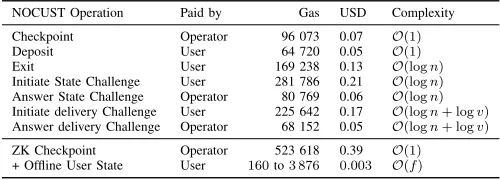
Operation costs. We registered a large number of addresses in exponential steps to measure gas costs (cf. Figure 5). We repeatedly chose 10 random users to make 20 random transactions, and then commit a checkpoint. Table I shows the base gas costs and complexity of all blockchain operations.
Contract Storage:A deposit adds160bytes, a withdrawal192 bytes. A checkpoint to 68 bytes and hash of all blockchain operations amounts to 32bytes. User Storage: Users store at least the data for the current and previouseons, including the account state (529bytes) and all signed commit-chain transfers (312bytes/transfer). The exclusive allotment proof sizes grow logarithmically, 1280 bytes for 1M users,1920 bytes for 1B users,allowing efficient lightweight clients.Operator Storage:
User accounts (529bytes/tx) and signed transfers in the current and previous eons (312 bytes/tx). Transaction Throughput:
We benchmark a single-threaded prototype implementation. Remote clients initiate transactions with a network latency of 19ms to the operator (16GB RAM, 4 virtual cores, SSD). We measured a throughput of 28 transactions per second, with a countersignature latency (avg. over 100 transactions) of 435ms±257.8ms.
zkSNARK Evaluation. Table II shows the complexities and experimental computing times of our libsnark implementation, built to verify commitments containing up to 4 billion users.
17https://github.com/liquidity-network/nocust-contracts-solidity 18https://github.com/paritytech/parity-ethereum
101 102 103 104 105 Number of users
100000 150000 200000 250000 300000 350000
G
as
co
st
Withdrawal Initiate state challenge Answer state challenge
0.10 0.15 0.20 0.25
G
as
co
st
in
U
S
D
Fig. 5: Costs in Ethereum gas and USD for challenges and exits depending on the number of users in the commit-chain. Costs increase with eachadditional heightof the Merkle trees, remaining below0.3USD with100000addresses.
NOCUST Operation Paid by Gas USD Complexity Checkpoint Operator 96 073 0.07 O(1)
Deposit User 64 720 0.05 O(1)
Exit User 169 238 0.13 O(logn)
Initiate State Challenge User 281 786 0.21 O(logn)
Answer State Challenge Operator 80 769 0.06 O(logn)
Initiate delivery Challenge User 225 642 0.17 O(logn+ logv)
Answer delivery Challenge Operator 68 152 0.05 O(logn+ logv)
ZK Checkpoint Operator 523 618 0.39 O(1)
+ Offline User State User 160to3 876 0.003 O(f)
TABLE I: Blockchain costs for a NOCUST commit-chain with 10 users. The cost complexity depends on: n, the number of commit-chain users. v, the number of transfers in the eon of the challenged user.f the number of offline users.
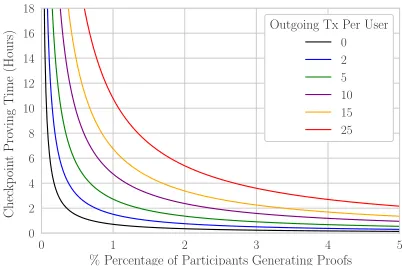
Verification times are all ≤ 0.01s, practical for smart con-tracts. The operator can parallelize checkpoint proof(constant-size 2690 bits) generation. Figure 6 shows proving times depending on the fraction of users collaborating (ignoring network latencies) with the operator. Given e.g. one billion users, 25 transfers per eon per user, generating a checkpoint proof requires about 6 hours with only 3% of all users’ computational power.
Our measured zkSNARK[53] verification cost on the Ethereum mainnet at the time of writing is523 618gas (0.39 USD). Moreover, depending on the state of users, between 0 and 58 bytes of data is broadcast, costing680to3 876gas, for each offline user within the last eon. At the time of writing, the planned upgrade to the Ethereum network19should reduce
the verification costs to around100 000gas20 and the cost per
offline user to be between160 and912gas21.
In Table II (cf. Appendix), we observe that the NIZK proof sizes range from 128 to 187 bytes. With the task of generating the checkpoint proof designed as a hierarchical tree of subtasks, where each node represents a proof, and edges represent dependencies, the storage required for storing the
19Istanbul: https://eth.wiki/en/roadmap/istanbul
0 1 2 3 4 5
% Percentage of Participants Generating Proofs
0 2 4 6 8 10 12 14 16 18
Ch
ec
kp
oi
nt
P
ro
vi
n
g
Ti
m
e
(H
ou
rs
) Outgoing Tx Per User
0 2 5 10 15 25
Fig. 6: Estimated time required to create a checkpoint con-sistency proof with a fraction of users generating proofs in parallel. We assume one user runs one CPU.
output (proof) of a task is then≤187 bytes per task22. The proof generation time must be taken into consideration when deciding the length of an eon, such that the operator is granted a sufficient amount of time to prove the consistency of a checkpoint. From Figure 6, we can observe that with a 5% proving power it would take about 2 hours to generate a consistency proof. While this is a considerable amount of time, it is shorter than our 36 hour eon. To accommodate a shorter eon, more computational power should be invested.
Instant Finality Collateral Costs. No stake is required to provide transaction finality within two eons. For instant
finality, only the incoming transactions of a user within two
eons need collateralization.
With a 24-houreon, the operator can stake e.g.2M USD to provide instant transaction finality towards its users, at e.g. n = 100k users, each receiving at most 10 USD. If the operator halves theeonduration to 12 hours, it can still provide the same instant transaction finality volume within 24 hours while halving the required stake to 1M USD. Shortening the
eon, however, also reduces the maximum transaction amount that a user can instantlyreceive within aneon. Following the previous example, in a 12-houreon, a user can accept instantly at most 5USD in a 12-hour period.
Live Deployment.We deployed an instance of NOCUST on the Ethereum mainnet23 on 24 March 2019. The deployment
costs amounted to 3.9M gas (11.14 USD). Since then, we count over 37 244 registered user accounts and observed 15 577 off-chain payments. At the time of writing, the total amount of deposited funds into the smart contract accounts for 7.312 ETH (about 1300 USD). We set a 36houreoninterval to allow for sufficient time to manually intervene if necessary.
IX. DISCUSSION
Centralization. A shortcoming of our commit-chains, and PCH designs, is that the operator becomes a central point of failure. Some possible countermeasures to this issue could be
22The operator can drop the results of tasks whose dependents completed
23NOCUST smart contract address on Ethereum mainnet:
0x83aFD697144408C344ce2271Ce16F33A74b3d98b
as follows. Watchtowers [50, 54, 55] can act as mirrors of all the data in a checkpoint, and the operator could possibly be required to provide the signatures of multiple watch towers on the checkpoint before the smart contract can accept it. One other possible strategy to explore would be to require that users retrieve the data of several other users and not just their own. Users could be offered an incentive to recover other users’ accounts, such as a fee paid per recovery from the balance of that account. We leave an extensive analysis of how to build incentive compatible redundancy mechanisms as an open avenue for future work.
Multiple Commit-Chains. We have presented a protocol for users only within the same commit-chain to transfer funds among each other. A protocol to perform cross-commit-chain payments without users having to migrate funds could reduce the disincentive for users to join small hubs, promoting more decentralization in the network, and amortizing costs even further. To this end, well known cross-chain communication protocols [56–58] can be adopted, but an extensive specifica-tion is outside the scope of our work.
Privacy. The commit-chain operator learns all data in the commit-chain, while users learn some information about other users through commit-chain and parent-chain operations. A possible direction for future work would be to design a scheme to minimize information leakage, possibly hiding transaction details from the operator, and possibly minimizing the infor-mation leakage that occurs in the smart-contract.
Eon Duration. In NOCUST the fixed eon length sets the lower and upper bounds on when a checkpoint can be sub-mitted. While this permits disputes and reduces user online presence, it would be useful to make it dynamic. An interesting mechanism to design would be a securely adaptive upper-bound for submission based on blockchain congestion, or how much activity occurred in the commit-chain. More concrete strategies for how to determine the best eontime for certain use cases would be an interesting future work.
NIZK Costs. Proving costs must be taken into consider-ation by the operator when deciding the fees to place on the transactions, which would raise the minimum value that is cost effective to transfer using NOCUST-ZKP compared to NOCUST. We have chosen to evaluate NOCUST-ZKP using zkSNARKS in this work. An interesting avenue of future work would be to explore the efficacy of utilizing other non-interactive proving systems such as Bulletproofs or zkSTARKS. While the proof sizes for these other systems are, to the best of our knowledge as of today, not as small as those of zkSNARKS, we leave exploring whether other advantages may offset the difference in the cost of verification in the blockchain for future work.
X. CONCLUSION
Off the chain transactions have emerged as a promising scalability solution for blockchains. In this work, we lay the foundations for a novel paradigm for off-chain transactions: